
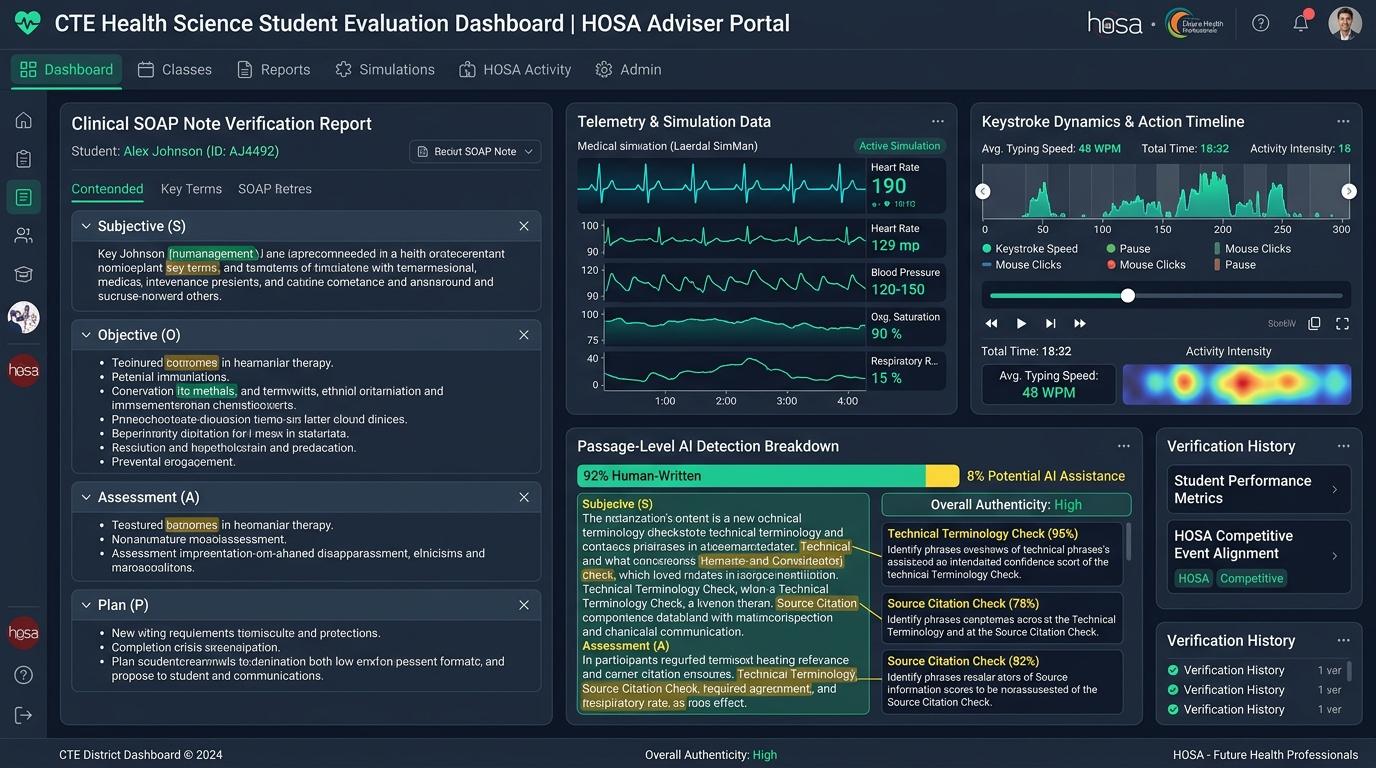
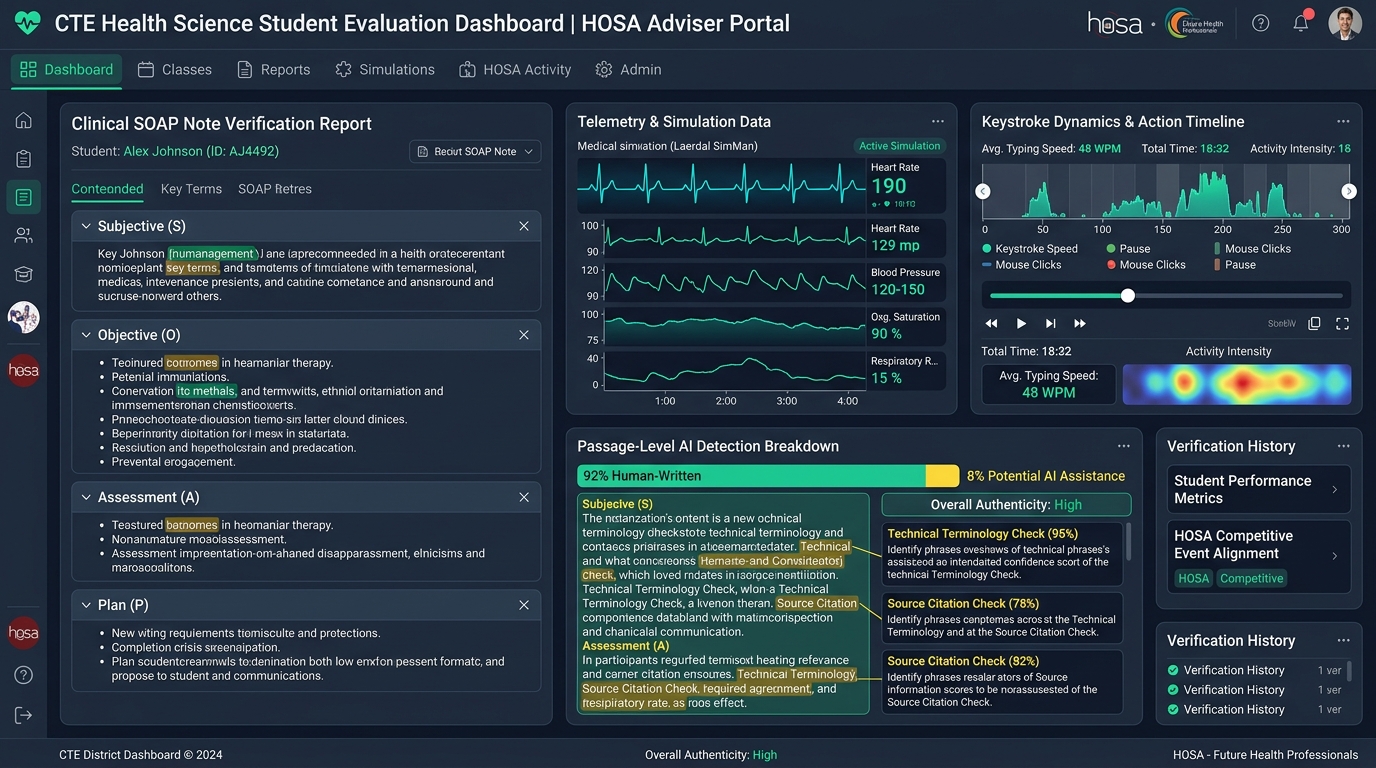
High School Career and Technical Education (CTE) Health Science instructors, Project Lead The Way (PLTW) Biomedical Science teachers, and HOSA–Future Health Professionals chapter advisers face an escalating instructional dilemma: verifying the authenticity and clinical validity of student-authored patient SOAP notes (Subjective, Objective, Assessment, Plan), simulation debriefs, and competitive clinical case studies. When high schoolers confront complex clinical scenarios under tight deadlines, many turn to Generative AI (such as ChatGPT or Claude) to synthesize patient documentation. While the resulting text appears grammatically polished and laden with medical terminology, it frequently produces “The Hallucinated Chart”—inventing normal vital signs that directly contradict the physical simulation mannequin, fabricating lethal pediatric or geriatric drug dosages, and generating advanced clinical assertions disconnected from the student's hands-on skills lab observations.
Traditional verification tools fail catastrophically in secondary health science classrooms. Generic whole-document AI percentage detectors trigger relentless false alarms on standardized medical acronyms and shorthand (PRN, NPO, STAT, BID, SOB, PERRLA, WNL), while remaining completely blind to fabricated lab data and dangerous dosage errors. Checkmark Plagiarism resolves this crisis through Writing Process Telemetry, Simulation Concordance Audits, and Teacher-in-the-Loop Rubric Autograding. By combining patent-pending Essay Playback™ (1x–8x scrubbable video replay of drafting cadence and diagnostic reflection pauses), an External Paste Buffer Inspector (distinguishing legitimate electronic health record templates from illicit external AI dumps), Passage-Level AI Confidence Sliders with Short-Text (<150w) Guardrails, and NCHSE-aligned Rubric Autograding, health science educators can verify authentic clinical reasoning, safeguard patient safety standards, and mentor future healthcare professionals with transparent, defensible evidence.
Checkmark Plagiarism provides high school CTE health science departments, vocational technical academies, and PLTW biomedical pathways with forensic writing telemetry, passage-level confidence evaluation, and native LMS integrations across Canvas LMS, Agilix Buzz, and Google Classroom.
1. The Critical Role of Clinical Documentation in High School CTE Health Science
High school Career and Technical Education (CTE) Health Science programs and Biomedical Science pathways (such as Project Lead The Way / PLTW) represent one of the fastest-growing sectors in secondary education. Designed to prepare students for direct workforce entry and postsecondary allied health degrees, these programs immerse high schoolers (Grades 9–12) in rigorous clinical theory, hands-on simulation labs, and high-stakes competitive events.
Whether enrolled in Certified Nursing Assisting (CNA), Medical Assisting (CCMA), Emergency Medical Responder / EMT, Sports Medicine & Athletic Training, Pharmacy Technician, or PLTW Principles of Biomedical Science (PBS) and Medical Interventions (MI), students must master the universally recognized standard of clinical communication: the SOAP Note.
CTE Skills Labs
- High-Fidelity Mannequins (Laerdal, Gaumard)
- Manual BP, Pulse & Vitals Triage Checkoffs
- Sterile Wound Dressing & Aseptic Fields
- Phlebotomy, Injections & Medication Prep
HOSA Competitions
- Clinical Nursing & CNA Skill Debriefs
- EMT / EMR Live Emergency Scenarios
- Medical Assisting Clinical Encounters
- Clinical Specialty Portfolios & Case Studies
PLTW Biomedical
- Anna Garcia Forensic Autopsy Debriefs
- Diabetic Ketoacidosis & Sickle Cell Labs
- Cardiac Telemetry & ECG Strip Analysis
- Pharmacogenomics & Dialysis Calculations
The Architecture of the Patient SOAP Note
In health science education, medical documentation is not an abstract creative writing assignment; it is a legal and clinical record of care. High schoolers are trained to organize their observations into four rigorous quadrants:
The patient's narrative report in their own words. Includes Chief Complaint (CC), History of Present Illness (HPI) structured via clinical mnemonics such as OLDCARTS (Onset, Location, Duration, Character, Aggravating factors, Relieving factors, Timing, Severity 0–10) or OPQRST, Past Medical/Surgical History (PMHx/PSHx), Current Medications, Allergies (NKA/NKDA), and Social History.
Measurable, verifiable clinical data obtained by the student during triage and physical exam:
- Baseline Vitals: Blood Pressure (mmHg), Heart Rate (bpm), Respiratory Rate (breaths/min), SpO2 (%), Temp (°F/°C), and Fasting Blood Glucose (mg/dL).
- Physical Exam by Body System: HEENT (PERRLA), Respiratory (breath sounds), Cardiovascular (S1/S2, cap refill <2s), Abdominal, and Neuro (Alert & Oriented x4).
- Diagnostic Labs & ECG: Urinalysis, hematocrit, A1c, rhythm strip.
The clinical reasoning synthesis. The student formulates a primary working differential diagnosis supported by pathophysiological logic that connects subjective complaints to objective triage data, while explicitly identifying at least two rule-out conditions.
The actionable clinical management roadmap:
- Immediate bedside nursing interventions (oxygen titration, Fowler's positioning).
- Medication orders with precise dimensional analysis dosage calculations and routes (PO, IM, subQ, IV push).
- Diagnostic orders, patient education, follow-up parameters, and red flag warnings.
HOSA Competitive Events & Clinical Case Study Requirements
For hundreds of thousands of secondary students participating in HOSA–Future Health Professionals, accurate documentation determines whether competitors advance to state and international leadership conferences (ILC). In events such as Clinical Nursing, Medical Assisting, Nursing Assisting, Emergency Medical Technician (EMT), Clinical Specialty, and Biomedical Debate, competitors must complete rapid timed written clinical case debriefs or patient encounter charts immediately following dynamic live-action or mannequin-based skill simulations.
Judges evaluate not only manual dexterity and bedside manner, but also whether the written SOAP note reflects rigorous adherence to clinical protocols, accurate diagnostic synthesis, and strict avoidance of medical charting errors.
2. The “Hallucinated Chart” Dilemma: When High Schoolers Prompt AI for Clinical Notes
High school CTE teachers routinely manage 120 to 160 students distributed across 5 to 6 class periods. In a typical week, an instructor balances classroom anatomy lectures, lab safety certifications, hands-on skill checkoffs, HOSA competition prep, and stacks of complex student SOAP notes submitted via Google Docs, Canvas LMS, Schoology, or Buzz LMS.
When students face intense cognitive overload, unfamiliar medical terminology, or tight deadlines, many turn to Large Language Models (LLMs) like ChatGPT, Claude, or Microsoft Copilot. A student might enter a prompt such as:
“Write a complete patient SOAP note for a 16-year-old female presenting to the high school clinic with acute abdominal pain, nausea, and fever. Use realistic medical terminology, vitals, and a nursing care plan.”
The resulting text appears remarkably sophisticated. It uses impeccable medical formatting, fluent clinical phrasing, and flawless grammar. However, in a Career and Technical Health Science setting, this reliance on generative AI introduces dangerous educational and clinical anomalies known as “The Hallucinated Chart.”
Simulation Discordance
AI generates textbook adult vitals (BP 120/80, HR 72, SpO2 99%).
The physical skills lab mannequin was programmed for acute hypovolemic shock (BP 82/48, HR 138, SpO2 88%). Charted data is pure fiction.
Lethal Pharmacology
AI hallucinates an adult 1,000 mg IV acetaminophen dose for a 14 kg toddler—over 5x toxic threshold.
Drops decimals (5.0 mg vs 0.5 mg), confuses mcg & mg, and orders contraindicated beta-blockers in asthma.
Hollow Jargon
High schooler submits prose describing complete cranial nerve evaluations (CN II–XII intact).
The student only performed a radial pulse checkoff and never touched an ophthalmoscope or stethoscope in the lab.
The Three Fatal Flaws of AI-Generated Clinical Documentation
1. Simulation Vitals Discordance (Fabricating the Objective Exam)
High-fidelity patient simulators (such as Gaumard or Laerdal mannequins) and standardized clinical role-play scenarios are programmed with specific pathophysiological vital trends. When an instructor runs an acute anaphylaxis simulation, the mannequin's vitals display severe hypotension (BP 78/42 mmHg), profound tachycardia (HR 142 bpm), tachypnea (RR 32 breaths/min with audible stridor), and hypoxia (SpO2 86%).
When a student neglects their manual triage travel sheet and prompts an LLM to generate the Objective section, the AI defaults to textbook normative baselines:
This vital discordance demonstrates that the student did not document their actual hands-on simulation encounter. Instead, the student submitted synthetic fiction.
2. Lethal Pharmacology & Dosage Calculation Hallucinations
In CTE Health Science, pediatric and geriatric pharmacology requires meticulous dimensional analysis, weight-based calculations (mg/kg/dose), and unit conversions (g → mg → mcg). Generative LLMs frequently hallucinate mathematical conversions and pediatric parameters:
- The Fatal Pediatric Overdose: An LLM prompted for a pediatric fever plan might generate: “Administer Acetaminophen 1,000 mg IV q6h PRN fever.” In a 12 kg toddler, a 1,000 mg dose is over five times the toxic threshold, causing irreversible hepatic necrosis.
- The Dangerous Decimal & Unit Mismatch: LLMs routinely drop leading zeros or misplace decimals, converting a required
0.25 mgdigoxin dose into2.5 mg—a lethal ten-fold overdose. - Contraindicated Regimens: An AI-generated SOAP note for an acute asthmatic patient may prescribe a non-selective beta-blocker (such as propranolol) to treat tachycardia, inadvertently inducing fatal bronchospasm.
3. Hyper-Polished Adult Medical Jargon Disconnected from Skill Level
High school health science students write with characteristic developmental phrasing as they learn medical vocabulary. When an 11th grader submits a physical exam section declaring:
“Patient demonstrates unlabored eupneic respirations with bilateral vesicular breath sounds, no adventitious crackles, rhonchi, or pleural friction rubs. S1 and S2 present without murmurs, gallops, or friction rubs. Cranial nerves II through XII intact bilaterally with no focal neurological deficits.”
Yet the teacher knows that the student's assigned station was a basic Certified Nursing Assistant (CNA) ambulation and radial pulse checkoff, where the student struggled to locate the radial artery and never touched a stethoscope or ophthalmoscope. The writing is an artificial composite unmoored from the student's authentic clinical skills.
3. Real High School CTE Classroom Case Scenarios
To understand how writing integrity breakdowns manifest in health science classrooms, consider three concrete scenarios drawn from secondary CTE and PLTW environments:
11th Grade Medical Assisting Skills Lab — The “Textbook Healthy” Mannequin Chart
Assignment & Setting:
11th Grade Medical Assisting (CCMA) students participated in an in-class triage simulation. The instructor programmed the simulation arm for a hypertensive crisis (184/110 mmHg) and irregular pulse (112 bpm). Students had to take manual vitals, log them on a physical travel sheet, and submit a formal digital SOAP note in Canvas.
Student Submission:
A student submitted an articulate SOAP note within 40 minutes: “Patient presents with mild cephalalgia. Physical examination reveals patient in no acute distress. Vital signs: BP 122/80 mmHg, HR 72 bpm, RR 16, Temp 98.6°F, SpO2 99%.”
Investigation & Telemetry Proof:
- Essay Playback™: Revealed the student spent a total of 1 minute and 14 seconds in the document.
- Paste Buffer Inspector: Captured a single 450-word external paste into Canvas directly from an LLM tab.
- Clinical Concordance: The student never recorded the mannequin's actual hypertensive vitals, resulting in a zero-concordance clinical failure.
12th Grade HOSA EMT Simulation — The Hallucinated Pediatric Dosage
Assignment & Setting:
High school seniors preparing for the HOSA EMT / EMR State Competition completed a pediatric respiratory distress simulation (6-year-old, 20 kg child with acute status asthmaticus). Students drafted an emergency care PCR and SOAP plan.
Student Submission:
The emergency plan stated: “Administer Epinephrine 1:1,000 solution 1.0 mg IM STAT into anterolateral thigh, followed by Albuterol 10 mg continuous nebulization.”
Investigation & Telemetry Proof:
- Clinical Breakdown: Pediatric dose for Epinephrine 1:1,000 is 0.01 mg/kg (max 0.3 mg). The 1.0 mg order was an adult cardiac arrest dose that would trigger cerebral hemorrhage in a 20 kg child.
- Passage Sliders: Highlighted the entire Plan with a 94% typical AI confidence score.
- Essay Playback™: Replay showed the student typing mechanically with zero revision pauses, transcribing the dose line-by-line from a smartphone.
PLTW Biomedical Science Case Investigation — The Anna Garcia Hallucinated Autopsy
Assignment & Setting:
9th Grade PLTW Principles of Biomedical Science (PBS) students conducted a forensic autopsy debrief on the fictional case of Anna Garcia, analyzing simulated blood spatter, glucose tolerance tests, and gel electrophoresis DNA strips.
Student Submission:
A group report included an exhaustive 600-word biochemical analysis citing high-performance liquid chromatography (HPLC) peaks, mass spectrometry ratios, and molecular genetic sequencing data.
Investigation & Telemetry Proof:
- Equipment Disconnect: The high school PBS lab only utilized basic paper chromatography and agarose gel electrophoresis; it possessed no HPLC or mass spectrometry hardware.
- Prompting Evidence: Students had prompted an AI with “Explain the autopsy results of Anna Garcia PLTW,” causing the LLM to hallucinate advanced forensic laboratory methodologies.
4. The Patient Safety, HIPAA, and NCHSE Standards Crisis
In Career and Technical Education, academic integrity is fundamentally inseparable from professional ethics, healthcare compliance, and patient safety.
Must demonstrate core mastery of human anatomy and disease mechanisms. AI hallucinating disease mechanisms bypasses foundational student learning.
Must produce accurate, objective clinical records. Submitting unverified vital signs or phantom physical exams violates the foundational healthcare ethic: “If it wasn't documented, it wasn't done; if it wasn't done, documenting it is medical fraud.”
Must calculate drug dosages with 100% mathematical accuracy. Blindly trusting unverified AI drug dosages cultivates dangerous clinical habits that lead to real-world patient harm.
HIPAA Privacy Violations in Student Shadowing & Clinical Externships
As secondary health science programs expand workplace-based learning (WBL), high school juniors and seniors spend clinical hours shadowing nurses, physical therapists, and medical assistants in regional hospitals, long-term care facilities, and outpatient clinics.
When students are assigned reflective clinical journals or case studies based on their externship encounters, an acute data privacy hazard emerges:
- The Public LLM Privacy Breach: A student copying their clinical notes into a public AI tool to “make it sound professional” often pastes Protected Health Information (PHI)—including patient initials, exact ages, admission dates, room numbers, unique surgical procedures, and facility names.
- The Federal Violation: Public consumer LLMs ingest user inputs for model training, creating an immediate breach of the Health Insurance Portability and Accountability Act (HIPAA) and the Family Educational Rights and Privacy Act (FERPA). Health science departments risk losing clinical placement contracts with regional hospital systems if student data leaks occur.
Why Generic Whole-Document AI Detectors Fail Catastrophically
Many high school CTE departments have attempted to address AI use by deploying generic, whole-document AI percentage detectors. In a health science context, these legacy tools are not only ineffective—they are actively harmful.
Why Standardized Clinical Acronyms Trigger Constant False Alarms
Medical documentation relies on standardized, formulaic shorthand: PRN, NPO, STAT, BID, TID, q4h, SOB, PERRLA, WNL, HEENT, NSR, PO, IM, subQ, IVP.
5. The High School CTE Health Science Evidentiary Matrix
To evaluate clinical writing authenticity fairly and rigorously, high school health science teachers need a multi-dimensional evidentiary framework that moves beyond opaque percentage scores.
| Evidentiary Dimension | Paper Travel Sheet / Checklist | Legacy Probabilistic AI Detector | Checkmark Writing Telemetry & Playback™ |
|---|---|---|---|
| Authorship & Drafting Verification | ❌ Zero verification. Easily copied or forged after lab completion. | ⚠️ Unreliable. Single whole-paper percentage with high false-positive rate. | ✅ Defensible. 1x–8x scrubbable video replay of complete keystroke drafting timeline. |
| Simulation Vitals Concordance | ⚠️ Manual only. Requires teacher to cross-reference paper sheets against sim keys. | ❌ Blind. Cannot evaluate clinical accuracy or simulation parameters. | ✅ Cross-Referenced. Flags discrepancies between charted vitals and lab data. |
| Handling of Medical Acronyms | ✅ Accurate. Read and evaluated by human clinical instructor. | ❌ Broken. Flags standard abbreviations (PRN, PERRLA, WNL) as AI. |
✅ Calibrated. Passage-level confidence sliders ignore standard clinical terminology. |
| External Clipboard & Paste Tracking | ❌ None. Static digital submission provides zero clipboard context. | ❌ None. Analyzes only final submitted text string. | ✅ Complete. 100% External Paste Buffer Inspector preserves clipboard text & timestamps. |
| Pharmacology & Dosage Verification | ⚠️ Manual. Teacher must calculate every drug dosage by hand. | ❌ None. Blind to mathematical unit errors and toxic overdoses. | ✅ Quote-Anchored Autograding. Flags non-standard dosages against clinical rubrics. |
| Transcription Detection (2nd Screen) | ❌ None. Invisible on submitted digital documents. | ❌ None. Cannot analyze typing cadence or physical pauses. | ✅ Pattern Recognition. Flags mechanical, steady typing lacking natural drafting pauses. |
| FERPA, COPPA & HIPAA Compliance | ✅ Compliant. Stored in physical classroom binders. | ⚠️ High Risk. Many consumer tools retain student text for model training. | ✅ Enterprise Secure. Zero model training on student writing; strict FERPA/COPPA compliance. |
| LMS Gradebook Integration | ❌ Manual. Requires teacher to hand-enter scores into gradebook. | ⚠️ Limited. Basic score passback without rubric breakdowns. | ✅ Seamless. 1-click sync of rubric feedback to Canvas, Buzz LMS, and Google Classroom. |
6. Step-by-Step Health Science Teacher Audit Protocol
When evaluating patient SOAP notes, HOSA case studies, and clinical debriefs, high school health science teachers can implement an actionable, 4-phase audit protocol to verify authenticity, reinforce patient safety standards, and support student growth.
Skills Lab Telemetry
- Compare Objective vitals against master simulation scenario key.
- Check for "Textbook Normative Drift" (e.g., 120/80 on shock).
- Audit physical exam scope against assigned station tasks.
Pharmacology Audit
- Audit weight-based calculations (mg/kg/dose dimensional analysis).
- Inspect route, frequency, and ISMP safety standards.
- Check for hallucinated contraindications and unit errors.
Essay Playback™
- Scrub timeline at 2x–4x to observe drafting and revision cadence.
- Inspect External Paste Buffer for EHR templates vs AI text drops.
- Check for secondary-screen mechanical typing patterns.
Restorative Debrief
- Frame discussion around patient safety & clinical ethics.
- Review keystroke receipts collaboratively with student.
- Assign supervised in-lab skills mastery redo.
Phase 1: Skills Lab Telemetry & Vitals Concordance Audit
Before opening an AI detection tool, the health science teacher conducts a Clinical Reality Check:
- Triangulate Against the Simulation Master Key: Compare the student's charted Objective vital signs against the programmed parameters of the simulation mannequin or standardized patient script.
- Identify “Textbook Normative Drift”: If the lab scenario involved an acute anaphylactic shock patient whose simulator was locked at BP 80/50 mmHg and HR 130 bpm, but the student charts BP 120/80 mmHg and HR 72 bpm, the student did not record observed clinical data.
- Verify Physical Exam Scope: Check whether the student documented physical assessments outside the scope of the assigned station (e.g., charting detailed abdominal palpation during a sterile gloving and wound care checkoff).
Phase 2: Pharmacology & Pediatric/Geriatric Dosage Sanity Checks
- Audit Weight-Based Dosage Equations: Verify that pediatric calculations explicitly show dimensional analysis matching the patient's assigned weight in kilograms.
- Inspect Route and Frequency Abbreviations: Ensure all medication orders follow Institute for Safe Medication Practices (ISMP) standards. Watch for dangerous abbreviations (e.g., using
Uinstead ofunits, or writing trailing zeros like5.0 mginstead of5 mg). - Check for AI Pharmacology Artifacts: Look for classic generative AI pharmacology errors, such as prescribing adult dosages to pediatric patients or recommending medications contraindicated by the patient's listed allergies.
Phase 3: Analyzing Keystroke Drafting & Reflection Pauses with Essay Playback™
Open the submission in Checkmark Plagiarism to inspect the authentic drafting history:
- Scrub the Drafting Timeline (1x–8x Speed): In Essay Playback™, observe how the student constructed the SOAP note. Authentic student clinical writing exhibits organic cognitive rhythms—rapid typing of familiar terminology followed by noticeable pauses (30 to 120 seconds) while consulting lab reference tables, drug handbooks, or simulation notes.
- Inspect the External Paste Buffer: Click on any highlighted paste block. Checkmark's Paste Inspector displays the exact text string copied into the document. Differentiate between:
- Authorized Workflow Pastes: A standard electronic health record (EHR) blank template (
S: / O: / A: / P:) pasted at minute 00:01, followed by manual typing. - Unauthorized Generative AI Pastes: A fully populated 500-word clinical case study inserted in a single multi-paragraph block.
- Authorized Workflow Pastes: A standard electronic health record (EHR) blank template (
- Detect Manual Second-Screen Transcription: If the student retyped an AI response from a smartphone or split-screen window, Essay Playback™ highlights a mechanical typing velocity (50–70 WPM) sustained for 15 straight minutes with zero cognitive pauses, zero structural rearrangements, and zero mathematical scratchpad revisions.
Phase 4: Conducting Restorative Clinical Post-Simulation Debriefs
In alignment with Checkmark's core philosophy—“Stop guessing, start trusting”—integrity inquiries in health science must be conducted as professional clinical debriefs rather than punitive interrogations.
- Focus on Patient Safety and Professional Ethics: Frame the conversation around real-world healthcare accountability:
“In healthcare, charting is a legal record. If a nurse or medical assistant charts vitals they didn't measure or copies an unverified drug dosage from an automated tool, a real patient can die and the provider loses their license. Let's look at your playback history together and see what happened during this assignment.”
- Review the Keystroke Playback Collaboratively: Sit side-by-side with the student (and if necessary, the department chair or parent). Play the 2-minute video replay. Allow the student to see the objective record of pastes and pause distributions.
- Assign a Supervised Clinical Mastery Redo: Rather than issuing an automatic zero that terminates the student's clinical learning, require the student to return to the skills lab, repeat the manual simulation on the mannequin under direct supervision, and draft the SOAP note by hand or in a live supervised Checkmark session.
7. How Checkmark Plagiarism Empowers High School Health Science Educators
Checkmark Plagiarism is engineered specifically to meet the rigorous pedagogical, technical, and privacy demands of secondary CTE and STEM classrooms.
1. Patent-Pending Essay Playback™ (1x–8x Replay)
- Scrubbable Keystroke Video Replay: Transforms static text into a transparent timeline of human effort. Health science instructors can scrub through the entire writing process in seconds, observing how a student wrestled with diagnostic differential logic, converted vital signs from raw notes, and revised their treatment plan.
- Forensic Exoneration Proof: When honest students are falsely accused by generic AI tools, Essay Playback™ serves as undeniable forensic proof of their authentic drafting journey.
2. 100% External Paste Buffer Inspector
- Preserves Original Clipboard Strings: Captures the exact content and timestamp of every paste event, preserving the original clipboard text even if the student subsequently edits every word.
- Template vs AI Separation: Teachers can immediately distinguish between an allowable structural template paste (blank SOAP scaffold) and an unauthorized 600-word generative AI dump.
3. Granular Passage-Level AI Sliders with Short-Text Guardrails
- No Opaque Whole-Paper Scores: Instead of generating an arbitrary percentage score, Checkmark highlights specific sentences and paragraphs with individual calibrated confidence cards in the sidebar.
- Honest Short-Text (<150w) Guardrail: On short clinical logs, triage reflections, or warm-ups under ~150 words, the AI detector displays
N/A, preventing statistical false positives caused by limited sample sizes.
4. Teacher-in-the-Loop Rubric Autograding with LMS Passback
- NCHSE, HOSA & PLTW Rubric Alignment: Evaluates student documentation against customizable clinical rubrics, generating criterion-by-criterion point breakdowns with written justifications directly anchored to quotes in the student's prose.
- Dosage Discrepancy Alerts: Flags non-standard dosage calculations, missing vital sign parameters, or absent differential diagnoses.
- Educator Final Authority: All AI rubric scores remain preliminary drafts until reviewed, modified, and approved by the educator.
- 1-Click LMS Sync: Finalized scores and detailed formative feedback push instantly into Canvas SpeedGrader, Agilix Buzz, or Google Classroom.
5. Enterprise Data Privacy & FERPA/COPPA Compliance
- Zero-Model-Training Policy: Student clinical case studies, simulation notes, and healthcare reflections are never used to train commercial or open-source AI models.
- Clinical Placement Protection: Fully compliant with FERPA, COPPA, and state student privacy laws, ensuring district clinical externship contracts remain secure.
8. Frequently Asked Questions (FAQ)
1. How does Checkmark handle standard medical abbreviations without triggering false AI alarms?
Generic AI detectors flag medical abbreviations (PRN, NPO, STAT, BID, TID, SOB, PERRLA, WNL, HEENT) because standardized clinical terminology has low statistical perplexity. Checkmark solves this problem by combining passage-level linguistic analysis with Essay Playback™ writing telemetry. Because Checkmark evaluates the student's actual keystroke creation process—verifying authentic typing cadence, natural pauses, and manual drafting—it does not rely solely on probabilistic text models. Genuine student documentation containing standard medical acronyms is validated by the student's active typing history.
2. Can Essay Playback™ prove if a student retyped an AI-generated SOAP note from their phone or a second monitor?
Yes. When a student manually transcribes text from a secondary screen, smartphone, or dictation tool, their typing dynamics differ sharply from organic composition. In Essay Playback™, transcription appears as an uninterrupted, mechanical typing velocity (50–75 words per minute) sustained over long blocks of time with near-zero backspacing, zero reorganizational editing, and zero cognitive pauses. In contrast, authentic student clinical writing exhibits frequent pauses (30–90 seconds) as the student checks reference sheets, calculates drug dosages, and corrects terminology.
3. What if a high school student pastes a blank SOAP note template provided by the teacher?
Checkmark's External Paste Buffer Inspector preserves the exact text string of every clipboard event. When a student pastes an approved blank template (e.g., S: Chief Complaint: / HPI: / O: Vitals: / A: Assessment: / P: Plan:), the teacher can open the paste card, verify that only the empty formatting scaffold was pasted, and watch Essay Playback™ confirm that all clinical observations, vitals, and treatment plans were typed manually by the student.
4. How does Checkmark help verify dosage calculations in high school pharmacology assignments?
Checkmark's Quote-Anchored Rubric Autograder cross-references the student's written Plan against the assignment rubric and standard pediatric/geriatric dosing formulas. If a student submits an impossible or hazardous dosage (such as an adult dose for a toddler or an inverted unit conversion), the autograder highlights the specific sentence, generates a feedback card noting the mathematical discrepancy, and alerts the instructor to review the calculation during grading.
5. How can HOSA chapter advisers use Checkmark to prepare students for competitive events?
HOSA advisers use Checkmark in timed classroom simulation write-ups to simulate state and international competition conditions. Students draft their clinical case debriefs or nursing SOAP notes under strict time limits in Checkmark. Advisers utilize the rubric autograder—pre-loaded with official HOSA competitive event rating sheets (e.g., Clinical Nursing, EMT, Nursing Assisting)—to provide rapid, objective, formative feedback on clinical accuracy, terminology usage, and documentation structure before students compete.
6. Is student clinical writing safe under FERPA and HIPAA when using Checkmark?
Yes. Checkmark is fully FERPA and COPPA compliant and operates under a strict Zero-Training Architecture. Student submissions are never cached, sold, or used to train general AI models. Furthermore, Checkmark encrypts all data in transit and at rest. When students draft reflections based on hospital shadowing or clinical rotations, Checkmark's secure environment ensures that district data privacy and healthcare confidentiality agreements remain intact.
7. How does direct LMS grade passback work with Canvas, Google Classroom, and Buzz LMS?
Through LTI 1.3 and native API integrations, Checkmark connects directly to your school's LMS. When an instructor reviews and approves the AI-assisted rubric evaluation in Checkmark, the finalized scores, criterion breakdowns, and formative student comments are pushed directly into the Canvas SpeedGrader, Google Classroom Gradebook, or Buzz LMS portal with a single click, eliminating manual data entry.
9. Conclusion: Moving from Guesswork to Defensible Clinical Mastery
In high school Career and Technical Education Health Science programs, verifying writing integrity is not about catching students in a gotcha moment—it is about cultivating the diagnostic accuracy, mathematical precision, and professional ethics required of tomorrow's healthcare workforce.
Opaque whole-paper AI detectors and unmonitored digital submissions leave CTE instructors caught between rampant false alarms and undetected clinical hallucinations. By adopting Checkmark Plagiarism's multi-factor evidentiary suite—combining patent-pending Essay Playback™, the External Paste Buffer Inspector, passage-level confidence analysis, and teacher-controlled rubric autograding—secondary health science educators can eliminate grading burnout, protect honest students, and ensure that every future medical professional earns their credentials through authentic, verifiable clinical mastery.
To learn how Checkmark Plagiarism can support your high school Health Science department, PLTW biomedical courses, or HOSA chapter with non-invasive writing process telemetry and automated rubric grading, explore Checkmark Plagiarism or schedule an instructional technology consultation today.