
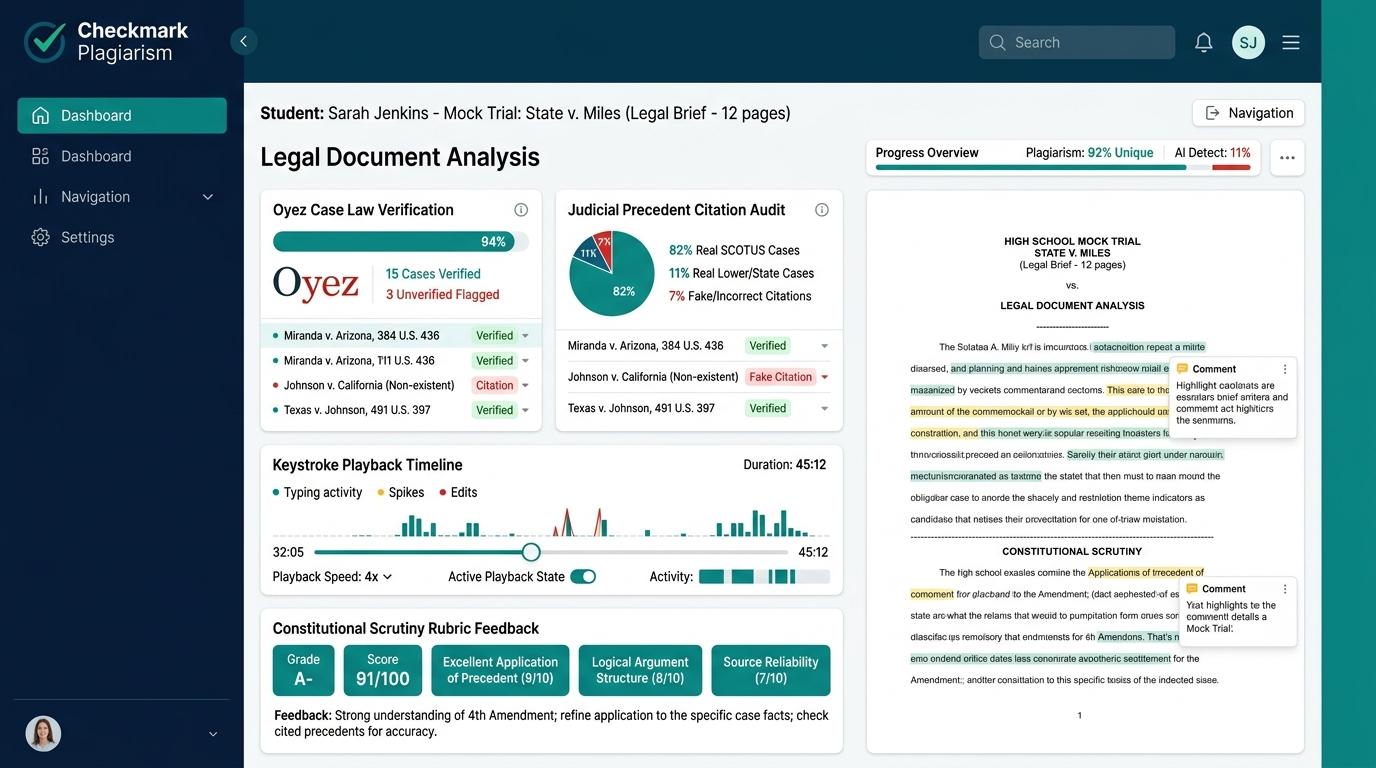
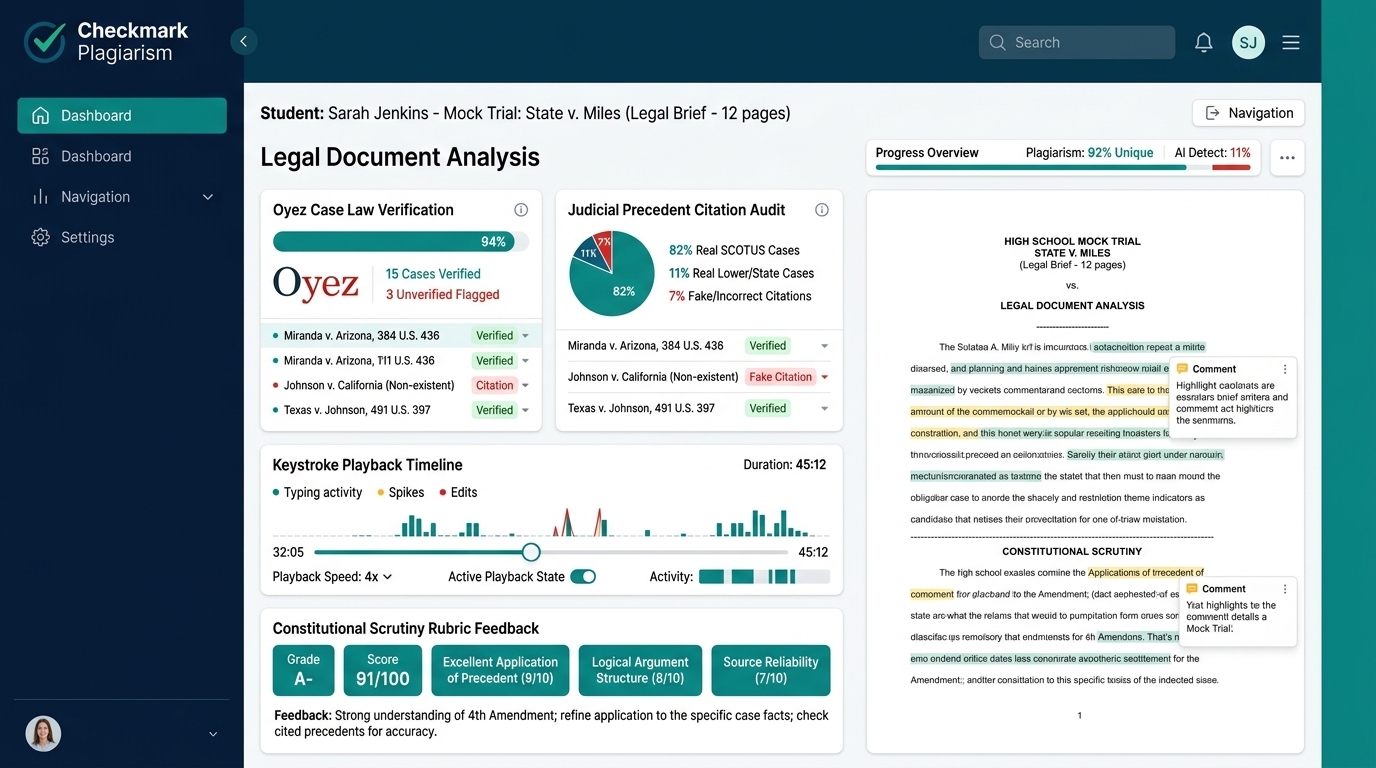
Executive Summary
In secondary Social Studies, AP U.S. Government and Politics, Constitutional Law electives, and competitive High School Mock Trial programs, legal writing assignments—such as appellate moot court briefs, pretrial evidentiary motions, and constitutional analysis essays—serve as the pinnacle of civic reasoning. However, as high school students increasingly draft submissions on 1:1 Chromebooks in Google Docs, Canvas, Schoology, and Buzz LMS, generative Large Language Models (LLMs like ChatGPT, Claude, and specialized chatbots) present an unprecedented challenge: hallucinated judicial precedents. LLMs routinely confabulate non-existent Supreme Court and Circuit Court cases, fabricate volume and page numbers in United States Reports (e.g., 542 U.S. 891), invent majority holdings, and manufacture persuasive quotes from real Supreme Court justices (such as Antonin Scalia, Ruth Bader Ginsburg, or Sonia Sotomayor) that sound completely authoritative but do not exist in any legal reporter. Traditional text-matching plagiarism checkers cannot detect these synthetic fabrications because the generated prose is novel, while generic whole-paper AI detectors generate crippling false positives on legitimate student legal writing due to the formulaic, low-perplexity nature of standard legal citations (U.S., F.3d, S. Ct.), established constitutional scrutiny tests (Lemon, Tinker, Brandenburg, Miller), and structured IRAC/CRAC legal formatting. Checkmark Plagiarism resolves this evaluative crisis through Writing Process Telemetry & Patent-Pending Essay Playback™. By combining 1x–8x keystroke video replay, external paste buffer analysis, passage-level confidence sliders, and quote-anchored rubric autograding, civics teachers and mock trial coaches can verify authentic legal research, pinpoint AI-generated hallucinations, protect honest student scholars, and conduct restorative judicial conferences that build authentic constitutional literacy.
- Oyez & Justia Reporter Lookup
- SCOTUS Scrutiny Tier Alignment
- Federal Circuit Split Validation
- FRE Evidentiary Rule Conformance
- Essay Playback™ (1x–8x Replay)
- Paste Buffer Inspector (Raw Text)
- Case-Synthesis Reading Pauses
- Passage-Level Confidence Sliders
- Student Explains Case Synthesis
- Oral Defense of Legal Reasoning
- Distinguish AI Aid vs. Fraud
- Structured Revision Opportunity
Replaces opaque black-box AI percentages with transparent, defensible primary source audits and keystroke telemetry evidence.
1. The Disciplinary Dilemma: Generative AI, Constitutional Scrutiny, and Legal Synthesis in High School Civics
High school civics, AP Government, and mock trial programs demand a sophisticated blend of textual synthesis, constitutional doctrine, and analytical precision. Whether preparing an appellate brief for a classroom Supreme Court simulation, drafting a pretrial motion to suppress evidence in an AP U.S. Government unit, or competing in regional High School Mock Trial competitions under the Federal Rules of Evidence (FRE), 9th–12th grade students must master complex legal reasoning frameworks:
Constitutional Scrutiny Tiers
Applying rational basis review, intermediate scrutiny (substantial government interest and substantially related means), and strict scrutiny (compelling government interest and narrow tailoring) across First and Fourteenth Amendment disputes.
Evidentiary Rules (FRE)
Navigating standing, ripeness, mootness, and courtroom evidentiary standards—such as balancing probative value against unfair prejudice (FRE 403) and applying hearsay exclusions and exceptions (FRE 801, 803, 804).
Structured IRAC / CRAC
Systematically moving through Issue, Rule, Application/Analysis, and Conclusion to construct logically airtight, legally defensible written briefs.
1.1 The Cognitive Rigor of Secondary Legal and Moot Court Writing
In advanced secondary social studies classrooms, legal writing serves as an incubator for critical civic participation. Unlike general descriptive essays, a legal brief requires a student to adopt an objective or persuasive legal posture, identify controlling constitutional principles, distinguish unfavorable precedents, and apply binding statutory language to a specific factual record.
For example, when evaluating a public school dress code restricting student political expression, a 12th-grade AP U.S. Government student cannot simply argue that the policy is "unfair." Instead, the student must:
- Ground their argument in the landmark standard established in Tinker v. Des Moines Independent Community School District, 393 U.S. 503 (1969), evaluating whether the expression caused a "substantial disruption of or material interference with school activities."
- Contrast Tinker with off-campus digital speech limits set forth in Mahanoy Area School District v. B.L., 594 U.S. 180 (2021).
- Distinguish school-sponsored speech doctrine under Hazelwood School District v. Kuhlmeier, 484 U.S. 260 (1988), and sexually vulgar speech under Bethel School District No. 403 v. Fraser, 478 U.S. 675 (1986).
- Analyze whether the school district's administrative interest meets the constitutional threshold required by the First and Fourteenth Amendments.
This rigorous intellectual process forces high school students to weigh competing societal values, dissect majority and dissenting judicial logic, and articulate clear legal tests.
1.2 The High School Classroom Reality: 150+ Students, 1:1 Chromebooks, and Heavy Grading Loads
In secondary schools across the country, social studies department chairs, AP Government educators, and mock trial advisers face immense operational pressures:
- Massive Student Caseloads: High school educators regularly teach 120 to 160 students distributed across 5 to 6 class periods. Grading stacks of 4-to-8-page legal briefs, moot court memorials, or Document-Based Question (DBQ) essays can easily consume 25–35 hours per assignment cycle without automated rubric assistance.
- Ubiquitous 1:1 Chromebook Environments: Students compose the vast majority of their legal briefs in cloud-based word processors (Google Docs, Canvas SpeedGrader, Microsoft 365, Buzz LMS, Schoology) during independent study or at home.
- Asymmetrical Time Pressures: Students juggling rigorous AP coursework, extracurricular athletics, mock trial scrimmages, and college applications often experience acute time panic before major brief submission deadlines.
When confronted with complex legal concepts, tight deadlines, and 1:1 digital access, students frequently turn to generative Large Language Models (LLMs) like ChatGPT, Claude, Microsoft Copilot, or specialized legal summarization bots to generate their legal arguments.
1.3 The Mechanism of Large Language Model Legal Hallucination
Generative LLMs do not operate as relational legal databases (such as Westlaw, LexisNexis, CourtListener, or Oyez). Instead, they are probabilistic next-token prediction engines trained on vast corpora of internet text. When an LLM generates text, it selects the most statistically probable sequence of words based on the user prompt and context window.
In standard academic essays, minor statistical confabulations may slip by unnoticed as awkward generalizations. In legal writing, however, this architecture causes catastrophic fabrications known as hallucinated judicial precedents.
"As the Supreme Court held in Henderson v. Oakridge School District, 542 U.S. 891 (2004), 'A blanket prohibition on student symbolic speech cannot survive strict scrutiny without empirical evidence of catastrophic educational collapse.' In his powerful dissent, Justice Scalia emphasized that 'the schoolhouse gate does not swing shut on political conscience.'"
- No Such Case: Henderson v. Oakridge School District does not exist in any federal or state legal reporter.
- Fake Reporter Citation:
542 U.S. 891contains an entirely unrelated criminal sentencing order. - Fabricated Doctrine: Public school speech is governed by Tinker / Mahanoy, not strict scrutiny requiring "catastrophic collapse."
- Manufactured Quotation: Justice Scalia never authored the quoted dissent; it was statistically synthesized.
Party A v. Party B, volume, reporter, page), AI outputs look 100% authentic to non-lawyer educators without specialized verification tools.
1.4 The Taxonomy of Fictitious Legal Authorities in High School Briefs
To spot synthetic submissions during grading, secondary civics teachers and mock trial coaches must recognize the five primary taxonomies of AI legal confabulation:
| Hallucination Taxonomy | Anatomy of the AI Error | Classroom Manifestation Example |
|---|---|---|
| 1. Pure Confabulation (Ghost Precedents) | The case name, parties, facts, and holding are entirely fabricated from whole cloth. | *Marcus v. Franklin Central School District*, claiming a 2017 SCOTUS ruling on student cyberbullying. |
| 2. Reporter Hijacking (Scrambled Citations) | Attaches real Supreme Court party names to a completely unrelated volume and page number in U.S. Reports. | Citing Tinker, but referencing 488 U.S. 361 (which is actually DeShaney v. Winnebago County). |
| 3. Manufactured Judicial Quotations | Attributes elegant, persuasive quotes to prominent real justices (Scalia, Ginsburg, Thomas, Sotomayor). | Fabricating a passionate dissent by Justice Sotomayor advocating absolute student digital privacy rights. |
| 4. Doctrinal & Scrutiny Inversions | Inverts controlling constitutional tests, asserting non-existent legal thresholds for routine civil disputes. | Applying strict scrutiny to school locker searches rather than T.L.O. reasonable suspicion. |
| 5. Evidentiary Rule Confabulations | Invents non-existent sub-clauses in the Federal Rules of Evidence or state mock trial competition packets. | Arguing "Federal Rule of Evidence 803(25): School Locker Exception" during a motion in limine. |
When high school students submit briefs filled with these fabrications, traditional plagiarism checkers fail to alert teachers because the wording is newly generated, leaving educators to either spend hours manually checking legal citations or inadvertently validate false scholarship.
2. The Pedagogical & Civic Literacy Dilemma: Why Generic AI Detectors Fail High School Legal Writing
When secondary social studies teachers and mock trial coaches attempt to police generative AI submissions using legacy text-matching tools or generic whole-paper AI detectors, they encounter a severe evaluative double-bind.
Legal writing is inherently formulaic and structured. Standard Bluebook citations (493 U.S. 378), IRAC headings, and constitutional scrutiny formulas have low perplexity.
Generic detectors flag this disciplined syntax as "85%–95% AI", falsely accusing diligent students.
If a student prompts an LLM in a casual voice or paraphrases via QuillBot, generic detectors return "0% AI".
The teacher receives zero warning that every cited Supreme Court precedent is entirely non-existent.
Generic tools evaluate only static completed text; they cannot show if a student spent 45 minutes reading Mahanoy or pasted the entire brief in 2 seconds.
Educators lack the behavioral data needed to conduct fair, restorative conferences.
2.1 The Mathematics of False Positives: Why Bluebook Formatting and IRAC Structure Trigger AI Alarms
Generic AI detection tools calculate two core statistical metrics: perplexity (the randomness or unpredictability of word choices) and burstiness (the variation in sentence length and structure).
In authentic legal writing, students are explicitly trained to use predictable, precise, and standardized language:
- Standard Case Citations: Tinker v. Des Moines Indep. Cmty. Sch. Dist., 393 U.S. 503 (1969); New Jersey v. T.L.O., 469 U.S. 325 (1985); Mahanoy Area Sch. Dist. v. B.L., 594 U.S. 180 (2021); Brandenburg v. Ohio, 395 U.S. 444 (1969); Lemon v. Kurtzman, 403 U.S. 602 (1971).
- Standard Scrutiny Formulations: "To survive strict scrutiny, the challenged policy must advance a compelling governmental interest and be narrowly tailored using the least restrictive means."
- Structured Legal Transitions: "Under the second prong of the test established in...", "Assuming arguendo that the petitioner has established standing...", "Pursuant to Federal Rule of Evidence 803(2)..."
Because these legal terms and structures are statistically dense, uniform, and low-perplexity, generic whole-paper detectors flag genuine, high-effort student briefs as synthetic. Falsely accusing an aspiring moot court student of academic dishonesty destroys teacher-student trust and demoralizes student inquiry.
2.2 The False Negative Blind Spot: Why Generic Detectors Miss 100% Synthetic Legal Briefs
Conversely, if an unmotivated student prompts an LLM with instructions like: "Write an appellate brief arguing the school violated the 4th Amendment, but use simple vocabulary and intentional sentence fragments to sound like a high school junior," the generated text achieves elevated perplexity and irregular burstiness.
Generic AI detectors assign the paper a 0% AI probability score. The student receives full credit for an assignment where every cited precedent—from the case name to the majority holding—is an absolute fabrication.
2.3 The Civic Cost of Unchecked AI Hallucinations: Undermining Democratic Inquiry
When students successfully submit hallucinated case law without detection, the civic and educational consequences are profound:
- Erosion of Fact-Based Inquiry: Students bypass the foundational civic skills of reading primary judicial opinions, understanding circuit court splits, and synthesizing complex statutory language.
- Distorted Understanding of the American Legal System: Students internalize false constitutional rules, falsely believing that courts can declare any arbitrary standard without precedent or jurisdictional authority.
- Catastrophic Failure in Competitive Mock Trial & College: High school mock trial teams that rely on synthetic citations face public disqualification by real-world attorney and judicial scoring panels during regional or state championships.
To safeguard authentic civic learning, social studies departments require an objective verification architecture that pairs legal citation ground-truth audits with keystroke-level writing process telemetry.
3. The High School Legal Evidentiary Matrix
To evaluate student legal submissions effectively, high school educators need a clear comparison of available investigative methodologies. The table below compares manual legal reporter lookups, generic whole-paper AI detectors, and Checkmark Plagiarism’s Multidimensional Integrity Suite.
| Evaluation Dimension | Manual Legal Reporter Lookup (Oyez / Justia) | Generic Whole-Paper AI Detectors | Checkmark Legal Integrity & Essay Playback™ |
|---|---|---|---|
| Verification of Case Existence | ✅ High (Direct search confirms case name & reporter volume) | ❌ None (Cannot verify if a cited precedent exists in reality) | ✅ High (Side-by-side web matching highlights verified cases vs uncited/hallucinated text) |
| Handling Legal Boilerplate & Citations | ✅ Accurate (Teacher understands Bluebook syntax) | ❌ Flawed (Flags standard legal citations as "90% AI") | ✅ Calibrated (Passage-level sliders isolate citations from generative prose) |
| Detection of AI-Generated Fabrications | ⚠️ Moderate (Catches fake citations if teacher manually checks all 10+ cites) | ❌ Zero (Paraphrased or prompted fake briefs pass undetected) | ✅ Definitive (Flagged by lack of source match + instant keystroke paste capture) |
| Keystroke & Process Telemetry | ❌ None (Only sees static completed document) | ❌ None (No visibility into drafting time or revisions) | ✅ Full Telemetry (1x–8x playback reveals drafting speed, research pauses, and rewrites) |
| External Clipboard Paste Capture | ❌ None (Cannot inspect clipboard history) | ❌ None (Treats pasted text identically to typed text) | ✅ Patent-Pending (Captures exact timestamped clipboard text even if modified) |
| Teacher Time Required (150 Submissions) | ❌ Prohibitive (30–45 hours across 5 class sections) | ⚠️ Low Time, High Noise (Triggers false-accusation disputes) | ✅ Fast & Scalable (Instant autograding + selective telemetry playback for flagged cases) |
| Defensibility in Parent/Admin Conferences | ⚠️ Moderate (Proves case is fake, cannot prove origin) | ❌ Indefensible (Black-box percentage rejected by admin) | ✅ 100% Defensible (Full keystroke video replay provides incontrovertible "receipts") |
4. Step-by-Step Civics Teacher Brief Audit Protocol
When evaluating high school appellate briefs, moot court submissions, or mock trial pretrial motions, secondary social studies teachers should follow this structured, restorative four-step audit protocol.
Rapid Citation Ground-Truth Verification
Spot-check the primary authorities cited in the brief before in-depth grading:
1. Oyez.org / Justia Search
Query the anchor SCOTUS cases to verify majority holdings, oral argument issues, and judicial lineups.
2. Reporter Volume & Page Check
If a student cites 532 U.S. 714, verify it maps to the cited case, not an unrelated maritime order.
3. Judicial Attribution Audit
Verify that quoted opinions match real opinions by the named justices (e.g. Scalia, Ginsburg, Sotomayor).
Constitutional Scrutiny and Evidentiary Sanity Checks
Audit the brief for structural legal logic and standard doctrinal scrutiny tests:
| Legal Doctrine / Rule | Common AI Hallucination Error | Authentic High School Doctrine |
|---|---|---|
| First Amendment Speech (Tinker, Fraser, Mahanoy) | Claims school policies must satisfy strict scrutiny in all classroom settings. | Governed by Tinker substantial disruption standard, not strict scrutiny. |
| Fourth Amendment Search (New Jersey v. T.L.O.) | Claims administrators need a warrant and probable cause for locker searches. | Governed by T.L.O. "reasonable suspicion" standard at inception/scope. |
| Establishment Clause (Lemon, Kennedy v. Bremerton) | Blends Lemon test with strict scrutiny, citing fake 2024 tests. | Analyzed under Kennedy historical practice or traditional Lemon prongs. |
| 14th Amendment Scrutiny Tiers (Brown, Craig) | Asserts rational basis applies to race, or strict scrutiny to youth curfews. | Strict scrutiny applies to race; intermediate to gender (Craig v. Boren). |
| Federal Rules of Evidence (FRE 403, 801, 803) | Invents "Rule 803(25): School Disciplinary Notes Exception". | Hearsay exceptions strictly defined under FRE 803(1)-(24) and business records. |
Writing Process Telemetry & Essay Playback™ Audit
Open the submission in Checkmark to inspect keystroke dynamics and external paste buffers:
- 00:00–18:00: Types IRAC headings, outlines issues, pauses 45–90s to read Mahanoy summary.
- 18:00–42:00: Drafts arguments; backspaces to adjust quote marks and page cites; refines scrutiny tests.
- 42:00–55:00: Edits counterarguments, polishes transitions, and verifies Bluebook format.
- Pattern 1 (Paste): Total time 1m 14s. Student pastes 1,200 words at 00:45. Paste buffer contains fake citations.
- Pattern 2 (Transcription): Continuous 95 WPM typing for 12 mins with 0 backspaces, 0 pauses (retyped from phone screen).
The Restorative Bench Conference
If discrepancies emerge, conduct a supportive oral defense structured as a judicial bench conference:
"Welcome, Marcus. I was reviewing your appellate brief on the First Amendment student speech case. Your brief makes some very articulate points regarding off-campus speech, but when I verified your primary authorities and reviewed our writing telemetry, I noticed a couple of things we should work through together.
Let's take a look at your citation of Henderson v. Oakridge School District at 542 U.S. 891. When I pull up that reporter volume in Google Scholar and Oyez, that case doesn't exist, and the quote from Justice Scalia appears to be generated by an AI chatbot. Furthermore, our Essay Playback shows that these two substantive arguments were pasted into the document at once without research pauses.
In the legal profession and in AP Government, citing non-existent precedents is a critical failure of integrity that undermines the entire judicial process. Let's look at the real controlling precedent—Mahanoy Area School District v. B.L.—and discuss how the Court actually ruled on off-campus speech. I'd like you to use our library resources to find two genuine cases and revise your brief."
5. Checkmark's Integrated Academic Integrity Suite in the High School Civics Classroom
Checkmark Plagiarism provides high school social studies departments, mock trial coaches, and district administrators with an integrated, educator-controlled integrity platform designed specifically for 1:1 Chromebook secondary classrooms.
Passage-Level AI Detection with Calibrated Sliders
Rather than stamping a single opaque AI percentage across a student's brief, Checkmark offers passage-level granularity. It isolates standardized Bluebook citation strings from surrounding prose, enforces honest short-text guardrails (<150w N/A), and keeps flag statuses strictly private to the educator.
Defensible Legal Plagiarism & Peer Matching
Matches student text against billions of web pages and legal databases with side-by-side clickable links. It performs cross-section peer matching across all class periods and school archives, while differentiating uncited case quotations from deliberate copy-pasting.
Patent-Pending Essay Playback™ & Paste Buffer
Watch briefs materialize stroke-by-stroke at 1x–8x replay. Checkmark’s Paste Buffer Inspector preserves the raw clipboard string at the exact millisecond of insertion—preserving evidence even if a student rewrites every sentence to evade detection.
AI Autograder with Direct LMS Passback
Upload AP Government CED rubrics or National High School Mock Trial criteria. Checkmark generates point breakdowns and quote-anchored justifications tied directly to student text, with 100% teacher final authority before syncing to Canvas SpeedGrader, Buzz LMS, or Google Classroom.
Checkmark adheres to strict student privacy standards: student legal briefs and keystroke telemetries are never used to train public or proprietary AI models. The platform is fully FERPA/COPPA compliant, secured with AES-256 encryption at rest and TLS 1.3 in transit, and integrates seamlessly via Canvas LTI 1.3, Buzz LMS, and Google Docs on 1:1 Chromebooks.
6. Real High School Classroom Case Scenarios
The following three case studies demonstrate how high school social studies educators use Checkmark to resolve complex academic integrity scenarios.
Case Study 1: 12th Grade AP Gov — Moot Court Brief on First Amendment Off-Campus Speech
AP U.S. GovernmentSetting & Assignment:
32 seniors drafting 1,200-word appellate briefs on 1:1 Chromebooks based on Mahanoy Area School District v. B.L.
The Incident:
Ethan submitted a brief citing Commonwealth v. Briarcliff Academy, 488 F.3d 612 (4th Cir. 2018) with a fake Justice Ruth Bader Ginsburg quote.
Checkmark Investigation:
- Citation Ground-Truth Audit: CourtListener and Google Scholar confirmed no case named Briarcliff Academy existed in any federal reporter;
488 F.3d 612was an unrelated maritime contract dispute. - Essay Playback™: The 1,200-word brief was completed in only 3 minutes and 12 seconds.
- Paste Buffer Inspector: At timestamp
01:45, Ethan pasted a 950-word text block containing raw prompt output from Claude.
Case Study 2: High School Mock Trial State Competition — Pretrial Motion to Suppress
Mock Trial TeamSetting & Assignment:
Competitive Mock Trial squad preparing a pretrial Motion in Limine to exclude an incriminating text message under 4th Amendment and FRE 803.
The Incident:
Sarah submitted a motion inventing a non-existent hearsay rule: "Federal Rule of Evidence 803(25): The Digital Locker Exemption."
Checkmark Investigation:
- Legal Scrutiny Audit: The coach verified that the Federal Rules of Evidence end at Rule 803(24) in competition manuals; Rule 803(25) was a synthetic hallucination.
- Transcription Telemetry: Checkmark detected steady 88 WPM typing with 0 backspaces or pauses over 14 minutes, indicating manual transcription from a smartphone.
Case Study 3: 10th Grade Civics / ELA Brief — 14th Amendment Equal Protection Analysis
10th Grade CivicsSetting & Assignment:
145 sophomores writing 750-word essays applying rational basis, intermediate scrutiny, and strict scrutiny to youth driver curfew laws.
The Incident:
Chloe's authentic essay analyzing Craig v. Boren was flagged as 91% AI by a generic detector due to formulaic legal phrasing.
Checkmark Investigation:
- Passage-Level Confidence Sliders: Showed that only standard constitutional definitions were highlighted, while all interpretive prose scored as typical human writing.
- Essay Playback™: Revealed 62 minutes of linear drafting across three study sessions, with 42 backspaces and 2–3 minute research pauses.
- Paste Inspector: Confirmed 0 external clipboard pastes; 100% authored directly in the editor.
7. Frequently Asked Questions (FAQs)
Why do generic AI detectors flag standard legal briefs as AI-generated?
Generic AI detectors measure perplexity (word unpredictability) and burstiness (sentence variation). In high school legal writing and civics, students are explicitly taught to follow rigid IRAC/CRAC formulas, use standardized Bluebook citations (___ U.S. ___), and quote established constitutional tests (e.g., Tinker substantial disruption, Lemon three-prong test). Because this syntax is formulaic and predictable, generic detectors mistakenly flag authentic student legal analysis as 80%–95% AI. Checkmark solves this by isolating citations with passage-level calibrated sliders and providing indisputable keystroke playback proof.
How do Large Language Models hallucinate non-existent judicial precedents?
LLMs are statistical sequence predictors, not searchable legal databases. When a high school student prompts a chatbot for a legal brief supporting a specific constitutional argument, the model generates words that statistically belong in legal briefs—combining common legal surnames, plausible school district names, realistic U.S. Reports volume/page numbers, and manufactured justice quotes. The model does not check whether the case exists; it simply outputs text that looks linguistically authoritative.
Can Checkmark tell the difference between copying a real case quote and pasting an AI brief?
Yes. Checkmark’s Two-Way Plagiarism & Source Viewer matches text against billions of indexed web pages, court databases, and digital encyclopedias. If a student legitimately copies a two-sentence excerpt from the Supreme Court’s Tinker opinion on Oyez, Checkmark highlights the exact source URL and marks it as an uncited or cited quotation. Conversely, if a student pastes a multi-paragraph AI-generated argument containing fabricated cases, Checkmark’s Paste Buffer Inspector captures the raw clipboard insertion, proving there is no corresponding legal record on the web.
What happens if a student manually retypes an AI-generated brief from a smartphone or second screen?
Checkmark’s Writing Process Telemetry includes proprietary Transcription Detection. When a student manually retypes text while looking at another device, their typing dynamics lack natural composing pauses, recursive sentence restructuring, and vocabulary revisions. Checkmark detects continuous, uninterrupted typing velocity (e.g., 85–110 WPM without backspaces or reading pauses) and flags the session for teacher review in Essay Playback™.
How does Essay Playback™ protect honest civics students from false AI accusations?
If a student is falsely accused of using AI due to high vocabulary or dense legal phrasing, the teacher can open Checkmark’s Essay Playback™. The 1x–8x scrubbable video replay proves the student’s organic composition process—displaying every typed word, 30–60 second pauses where the student read case materials, structural deletions, and paragraph rearrangements. This provides incontrovertible "receipts" that exonerate the student in parent-teacher and administrative conferences.
Why does Checkmark display 'N/A' on short civics exit tickets under 150 words?
Statistical linguistic analysis requires a minimum sample size of continuous prose to establish statistically reliable perplexity and burstiness metrics. Evaluating short responses (such as a 40-word warm-up identifying the three branches of government) produces unacceptable error rates. Checkmark enforces honest short-text guardrails, displaying N/A on texts under ~150 words rather than presenting misleading guesses.
How does Checkmark integrate with Canvas SpeedGrader, Buzz LMS, and Google Classroom?
Checkmark features seamless LTI 1.3 and native API integrations. High school teachers can launch Checkmark directly inside Canvas SpeedGrader, Buzz LMS, Schoology, or Google Classroom. Checkmark’s AI Autograder evaluates briefs against custom civics rubrics, and with a single click, the teacher can sync finalized rubric scores and quote-anchored written feedback straight into the LMS gradebook.
Does Checkmark comply with student privacy laws like FERPA and COPPA?
Yes. Checkmark is built under a strict Zero Model Training Guarantee: student essays, mock trial briefs, and personal data are never used to train public or proprietary AI models. The platform complies fully with FERPA, COPPA, and state student privacy regulations, utilizing enterprise-grade encryption in transit (TLS 1.3) and at rest (AES-256).
8. Conclusion: Protecting Authentic Civic & Constitutional Literacy
The ultimate goal of secondary civics, AP Government, and mock trial programs is not simply to produce students capable of mimicking legal syntax—it is to cultivate discerning, constitutionally literate citizens who can weigh conflicting evidence, dissect primary judicial rulings, and articulate reasoned arguments in defense of democratic principles.
When generative artificial intelligence automates legal synthesis through fabricated precedents, and when crude whole-paper AI detectors penalize our most dedicated student legal scholars with false accusations, civic education suffers a fundamental setback.
By equipping social studies educators with Checkmark Plagiarism’s multi-dimensional integrity platform—pairing rapid citation ground-truth audits with the indisputable forensic proof of Patent-Pending Essay Playback™—schools can stop guessing and start trusting. We can uphold rigorous constitutional standards, nurture genuine student inquiry, and empower the next generation of legal and civic leaders.
Equip Your Social Studies Department Today
Empower AP Government teachers and Mock Trial coaches with patent-pending Essay Playback™, passage-level AI detection, and quote-anchored rubric autograding for Canvas LMS and Google Classroom.