
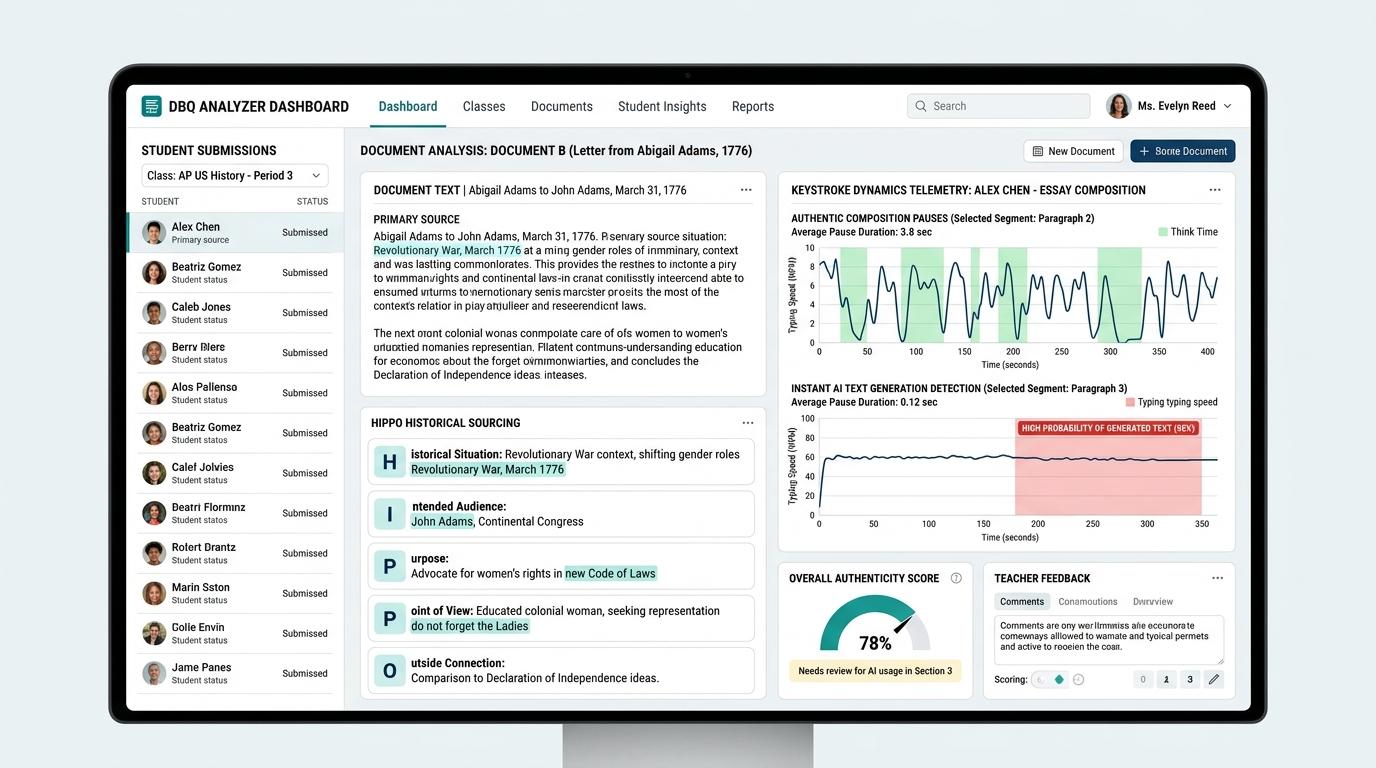
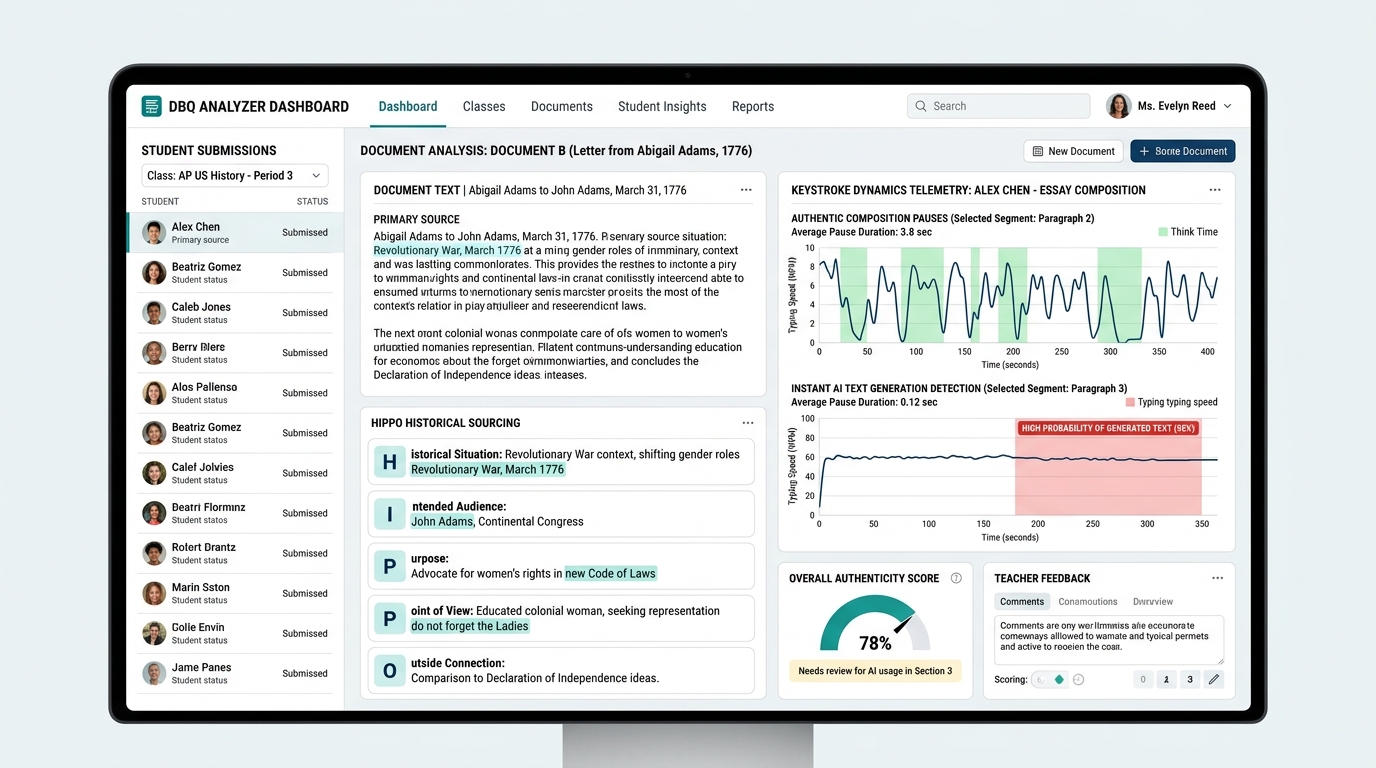
Advanced Placement (AP®) and secondary social studies educators face an unprecedented pedagogical challenge: Large Language Models (LLMs) can ingest a packet of seven historical primary sources and output a structurally compliant Document-Based Question (DBQ) essay in under thirty seconds. These synthetic essays mimic historical analysis by generating formulaic thesis statements, weaving document references, and simulating HIPPO analysis (Historical Situation, Intended Audience, Purpose, Point of View, and Outside Evidence).
Generic, whole-document AI detection tools exacerbate the problem: they routinely generate catastrophic false positives on archaic seventeenth- and eighteenth-century primary source quotes while missing sophisticated, paraphrased AI synthesis and humanizer-scrubbed text. To protect academic integrity without resorting to punitive suspicion, history educators need an evidentiary approach rooted in writing process telemetry. By pairing passage-level linguistic analysis with patent-pending Essay Playback™, history teachers, department chairs, and curriculum directors can inspect keystroke dynamics, document-to-essay cognitive synthesis pauses, and external paste forensics. This multi-factor approach empowers teachers to distinguish between authentic historical struggle and automated text generation, celebrate legitimate student inquiry, and conduct restorative, evidence-based writing conferences.
Checkmark Plagiarism empowers AP and secondary history educators by integrating patent-pending Essay Playback™ writing telemetry with passage-level AI detection, side-by-side uncited source matching, quote-anchored rubric autograding, and seamless LMS integrations across Canvas SpeedGrader, Agilix Buzz LMS, and Google Classroom.
1. The Anatomy of DBQ Rigor vs. Generative AI Synthesis
In Advanced Placement United States History (APUSH), Advanced Placement European History (AP Euro), and Advanced Placement World History: Modern (AP World), the Document-Based Question (DBQ) is the gold standard of historical literacy. Unlike standard research essays, which allow students weeks to select secondary sources, the DBQ presents an artificial, time-constrained archival laboratory. Students receive a prompt accompanied by seven curated historical documents—ranging from colonial charters and political speeches to diplomatic treaties, woodcuts, and economic manifests—and must craft a defensible thesis, contextualize the era, deploy at least four documents to substantiate an argument, source at least two documents for historical bias or context, and introduce unprovided outside evidence.
| Node | Rubric Criterion | Pts | Disciplinary Cognitive Requirement |
|---|---|---|---|
| SEC 1 | Thesis / Claim | 0–1 | Presents a defensible claim establishing a clear, nuanced line of reasoning in response to the prompt. |
| SEC 2 | Contextualization | 0–1 | Situates the argument by explaining the broader macro-historical context (preceding, concurrent, or subsequent events). |
| SEC 3 | Evidence: Doc Content & Argument | 0–2 | Accurately describes content from ≥3 documents (1 pt) and supports a defensible argument using ≥4 documents (2 pts). |
| SEC 4 | Evidence Beyond Documents (Outside Evidence) | 0–1 | Introduces at least 1 discrete, accurate, unprovided historical fact tied directly to the central argument. |
| SEC 5 | Sourcing (HIPPO / HIPP) | 0–1 | Explains HOW or WHY Historical Situation, Audience, Purpose, or Point of View is relevant to the argument for ≥2 docs. |
| SEC 6 | Complex Understanding | 0–1 | Demonstrates a complex understanding of historical development through corroboration, qualification, or nuance. |
How Generative AI Ingests and Exploits the DBQ Prompt
For modern frontier LLMs (such as GPT-4o, Claude 3.5 Sonnet, and Gemini 1.5 Pro), the DBQ is an ideal task. When a student uploads the PDF of the seven documents or pastes the raw text into a prompt along with the College Board rubric, the LLM executes a rapid, multi-step heuristic:
- Context Window Ingestion: The model embeds all seven documents into its short-term context window, indexing author names, publication dates, and key nouns.
- Formulaic Thesis Generation: The LLM generates a classic counter-argument thesis structure ("Although X caused some economic disruption, Y was primarily driven by Z because of A and B").
- Mechanical Document Matching: The model distributes documents across body paragraphs, ensuring at least four to six documents are referenced by author or document number.
- Synthetic Sourcing (The HIPPO Simulation): The LLM attaches boilerplate clauses explaining point of view or audience ("Document 3's author, John Winthrop, wrote this for a Puritan audience, which makes him biased toward religious orthodoxy").
- Knowledge Base Retrieval for Outside Evidence: The model queries its vast historical training corpus to pull a relevant proper noun (e.g., the Embargo Act of 1807 or the Treaty of Tordesillas) not present in the document excerpts.
How LLMs Exploit the 7-Document DBQ Structure
Prompt & Document Ingestion
Student pastes Prompt + 7 Document excerpts into the context window. The model tokens and indexes key dates, actors, and document headers in <2 seconds.
Algorithmic Argument Mapping
LLM clusters documents into symmetric themes: Docs 1, 3, 5 (Claim A), Docs 2, 4, 6 (Claim B), and Doc 7 (Counterclaim/Complexity), avoiding cognitive friction.
Template Sourcing Injection
Appends formulaic HIPP/HIPPO taglines to satisfy point-scoring heuristics without delving into specific historical constraints or authorial intent.
Rapid Generation & Delivery
Produces a 750–950 word essay formatted with textbook syntax, spotless transitions, and integrated outside evidence in 18 to 30 seconds.
Authentic Disciplinary Literacy vs. AI "Sourcing Mimicry"
To the untrained eye or the exhausted teacher grading their 120th paper on a Sunday evening, this AI-generated response appears exemplary. It satisfies the surface mechanics of the rubric. However, deep historiographical analysis reveals profound differences between authentic student sourcing and AI sourcing mimicry:
Authentic Student Sourcing vs. AI Sourcing Mimicry
| Rubric Dimension | Authentic Student Sourcing | AI Sourcing Mimicry |
|---|---|---|
| Document Selection & Grouping | Integrates documents messily; actively wrestles with contradictory facts and historical dissonance across primary sources. | Evenly distributes documents across rigid tripartite body paragraphs; ignores internal historical contradictions. |
| HIPPO Sourcing Depth (Point of View/Purpose) | Connects the author's specific social or political vulnerability to the exact reliability or rhetorical framing of their claim. | Uses generic attribution: "The author is biased because they are a politician / merchant / minister." |
| Outside Evidence Integration | Recalls specific lecture notes or textbook details; occasionally uses imperfect but historically accurate terminology. | Drops high-profile textbook events with encyclopedic polish and syntactically flawless textbook definitions. |
| Synthesis & Argument | Evolving line of reasoning with visible intellectual struggle, self-corrections, and authentic voice. | Symmetrical, risk-averse prose devoid of stylistic conviction or disciplinary passion. |
Deconstructing HIPPO Sourcing: Authentic vs. Synthetic
In AP social studies classrooms, educators train students using mnemonic frameworks such as HIPPO (Historical situation, Intended audience, Purpose, Point of view, and Outside evidence) or HIPP / HAPPY. The College Board rubric explicitly demands that students not merely identify a document's author, but explain how or why the document's sourcing is relevant to the argument.
"Samuel Gompers, being the president of the American Federation of Labor, had the point of view of a union leader. His purpose was to advocate for workers' rights. Therefore, his speech reflects the perspective of the working class during the Gilded Age."
Why this is mimicry: It states the obvious. It restates Gompers's title from the document source line and concludes he was pro-labor, without explaining how his craft-union ideology excluded unskilled immigrant labor or shaped his specific rhetorical appeals to civic patriotism.
"Because Gompers was trying to convince conservative middle-class reformers that the AFL was distinct from radical socialist movements like the IWW, he deliberately framed unionization around American constitutional ideals and the family wage rather than class warfare."
Why this is authentic: The student connects the author's specific rhetorical constraint (distinguishing craft unions from radicals) to the exact framing of the primary source text, advancing a genuine line of historical reasoning.
2. The Pedagogical Dilemma: Why Generic AI Detectors Fail History Classrooms
As history teachers grapple with AI-generated DBQ submissions, many turn to standalone, whole-document AI percentage checkers. However, applying opaque probabilistic AI detectors to history writing produces acute pedagogical failure modes:
1. The Archaic Text False-Positive Trap
- 17th/18th-century primary source quotes trigger low perplexity alarms.
- Block quotes from Thomas Jefferson or Edmund Burke marked as "synthetic".
- Diligent, high-performing students falsely accused of cheating.
2. The Paraphrased Synthesis Blindspot
- AI DBQs scrubbed via QuillBot or Undetectable AI register as "0% AI".
- Surface word frequency algorithms miss synthetic organizational structures.
- Cheating bypasses detectors while destroying student historical reasoning.
The Archaic Language & Direct Quotation False-Positive Trap
Probabilistic AI detectors rely heavily on perplexity (a statistical measure of word choice predictability) and burstiness (the variation in sentence length and rhythm). When analyzing modern casual prose, human writing typically exhibits high perplexity and erratic burstiness.
However, historical primary source documents break these statistical assumptions:
- High Token Predictability in Public Corpora: Primary source texts—such as John Winthrop's City upon a Hill (1630), Jonathan Edwards' Sinners in the Hands of an Angry God (1741), or the Federalist Papers (1787–1788)—are heavily represented in the training datasets of both LLMs and AI detectors. Detectors recognize these token sequences as having near-zero perplexity.
- Formal Archaic Diction: When students quote archaic syntax ("We must consider that we shall be as a city upon a hill, the eyes of all people are upon us") or emulate formal historical rhetoric, generic detectors mistake the elevated, balanced prose for machine-generated output.
- Document Excerpt Integration: When a student properly embeds 4 to 6 block quotes or direct phrases from the provided document packet, an opaque detector scores the entire document as "45% to 75% AI," conflating legitimate historical evidence with generative writing.
The False-Negative Blindspot: Paraphrased AI Synthesis
Conversely, generic AI detectors are easily bypassed by students who feed documents into an LLM and apply basic evasion techniques:
- "Humanizing" Prompts: Instructing the model to "write this DBQ at a 10th-grade reading level with occasional sentence fragments and conversational transitions."
- Multi-Step Paraphrasers: Running the AI output through paraphrasing tools (e.g., QuillBot) to swap synonyms and break predictable n-gram patterns.
- Hybrid Assembly: Copy-pasting AI-generated topic sentences and HIPPO sourcing clauses around authentic student-written summary lines.
Generic AI percentage checkers reduce complex student prose to a single black-box score (e.g., "62% Probability of AI"), providing zero actionable evidence. When a teacher confronts a student with only a percentage number, the conversation quickly devolves into defensiveness, tears, parental outrage, and administrative gridlock.
3. The DBQ Evidentiary & Telemetry Comparison Matrix
To resolve this crisis, social studies departments must transition from opaque, probabilistic guessing to multi-dimensional evidentiary verification. The table below illustrates how traditional grading, generic AI checkers, standalone plagiarism tools, and Checkmark Plagiarism's integrated suite handle the specific demands of DBQ evaluation:
DBQ Integrity & Sourcing Evaluation Matrix
| Evaluation Dimension | Traditional Rubric | Standalone AI Checker | Legacy Plagiarism Tool | Checkmark Plagiarism Suite |
|---|---|---|---|---|
| Primary Source Quote Handling | Teacher manually verifies quotes against prompt packet. | Opaque flag; treats historical syntax as AI text. | Flags provided DBQ quotes as unoriginal similarity. | Segmented side-by-side source viewer with citation contextualization. |
| HIPPO / Sourcing Analysis | Subjective evaluation; prone to grading fatigue. | Blind to analytical depth & historical reasoning. | Blind to analytical depth; cannot score sourcing. | Quote-anchored rubric engine evaluates authorial intent clauses. |
| Writing Telemetry (Playback) | None (Static final text snapshot only). | None (No keystroke dynamics or timing). | None (Static text snapshot only). | Patent-Pending Essay Playback™ (1x–8x keystroke replay). |
| External Paste Forensics | None (Cannot trace clipboard activity). | None (No clipboard inspection). | None (Cannot trace injection events). | Timestamped paste tracker stores original clipboard text. |
| Protection for Honest Writers | High (if teacher knows student voice well). | Zero (Innocent student has no objective proof). | Low (Legitimate quotes inflate similarity score). | Absolute (Keystroke replay proves authentic drafting). |
| Granularity & Transparency | High cognitive load (15–20 mins per essay). | Single black-box percentage score. | Flat percentage similarity score. | Passage-level confidence sliders + AST rubric draft. |
| Pedagogical Posture | Formative but exhausting for staff. | Punitive & adversarial. | Punitive & ambiguous. | Restorative, transparent, & coachable ("Receipts"). |
4. The Mechanics of Disciplinary Writing Telemetry: What Real DBQ Synthesis Looks Like
Historical writing is inherently non-linear, cognitively demanding, and iterative. When a student analyzes primary sources and composes an authentic DBQ, their intellectual labor leaves an unmistakable telemetric fingerprint in keystroke dynamics.
1. The "Document-to-Essay" Cognitive Toggle Cadence
In an authentic DBQ writing session, students constantly toggle their attention between the source document packet and their essay draft. This cognitive cycle manifests as distinct telemetry markers:
- Document Ingestion Pauses: Extended periods (60 to 180 seconds) of zero typing activity preceding the introduction of a new document citation, representing the time required to re-read the document excerpt.
- Lexical Wrestling: High backspace and deletion counts around historical vocabulary, proper nouns, and analytical transitions (e.g., student types "Document 4 shows that...", deletes it, types "Through the lens of the Seneca Falls Declaration...", pauses for 12 seconds, then continues).
- Thesis Refinement: Frequent cursor jumps back to the introductory paragraph to tweak the central claim after drafting body paragraphs and discovering new evidence alignments.
2. The Footprint of "Evidence Beyond the Documents" (Outside Evidence)
When students retrieve historical knowledge from memory (such as remembering Shays' Rebellion or the Stann Creek riots), the keystroke stream reflects natural cognitive retrieval:
- Retrieval Latency: A distinct 15-to-45-second pause before introducing the unprovided historical term.
- Drafting Acceleration: Rapid typing of the specific historical fact as working memory offloads the detail.
- Contextual Framing Revision: Subsequent pauses and micro-edits to integrate the outside fact directly into the paragraph's line of reasoning.
In contrast, an AI-generated essay presents outside evidence smoothly, with zero drafting hesitation, perfectly uniform syntax, and no structural revisions.
3. Detecting Transcription: Second-Screen and Phone Retyping
When students attempt to evade paste detectors by copying text generated on a smartphone or second monitor, they produce a highly unnatural keystroke profile:
- Uniform Typing Velocity: Maintaining a continuous typing speed (e.g., 75–90 WPM) across 800 words without the natural bursts and slowdowns associated with composition.
- Absence of Structural Deletions: Zero large-scale sentence restructuring, zero paragraph reordering, and minimal backspacing (limited only to minor mechanical typos).
- Lack of Reading Pauses: The student never pauses to look at the primary source document packet because they are merely transcribing pre-synthesized prose.
5. Step-by-Step History Educator DBQ Integrity Audit Protocol
When evaluating DBQ submissions—especially high-stakes benchmark exams, AP mock exams, or major unit assessments—history educators should implement this five-step, evidence-based audit protocol:
History Educator DBQ Integrity Audit Protocol
Step 1: Synchronized Document Cross-Referencing
Map all 7 primary source citations in Checkmark's Synchronized Source Viewer. Isolate direct quotations from archaic texts and ensure they are recognized as legitimate evidence rather than flagged as similarity or machine generation.
Step 2: HIPPO Depth & Line of Reasoning Audit
Examine whether the student's sourcing clauses explain how or why authorial context matters. Flag repetitive, formulaic boilerplate sourcing ("Author X is biased because they were Y") for telemetric review.
Step 3: Keystroke Telemetry & Essay Playback™ Review
Scrub the timeline at 2x–8x speed. Look for genuine 1–3 minute document reading pauses, natural backspace friction, and thesis revisions. Differentiate 45 minutes of real writing from 11 minutes of mechanical transcription.
Step 4: External Paste & Clipboard History Inspection
Inspect Checkmark's Paste Inspector to see full raw clipboard strings. Verify whether pasted items are legitimate pre-writing brainstorms or entire multi-paragraph AI synthesis drops.
Step 5: Formative Disciplinary Inquiry Debrief
If anomalies are found, conduct a restorative conference side-by-side with the student. Show them Essay Playback™ as objective visual proof, focusing on disciplinary growth rather than punitive accusations.
6. How Checkmark’s Integrated Suite Empowers History Departments
Checkmark Plagiarism provides a purpose-built academic integrity and writing assessment ecosystem tailored to the rigorous demands of secondary and postsecondary humanities education:
Synchronized Source Viewer
Direct two-way linked cards cross-referencing prompt document packets against student citations with side-by-side verification.
Patent-Pending Essay Playback™
Full 1x–8x keystroke video replay capturing drafting cadence, pauses, revisions, deletions, and cursor navigation trajectories.
Passage-Level AI Sliders
Granular sentence-by-sentence analysis with strict <150 word guardrails that displays honest N/A rather than guessing on short samples.
Paste Inspector Forensics
Complete preservation of raw pasted clipboard text, timestamps, and character counts even after manual student rewriting.
Quote-Anchored Autograder
Automated College Board 7-point scoring drafts with verbatim quote justifications, keeping teachers in 100% final authority.
FERPA Zero-Retention Security
Zero training on student writing, zero third-party brokers, and seamless LTI 1.3 sync with Canvas, Buzz, and Google Classroom.
1. Passage-Level Granularity vs. Opaque Document Scores
Instead of assigning an ambiguous whole-paper percentage, Checkmark underlines specific sentences and generates dedicated Evidence Cards in the sidebar. Each card features calibrated confidence sliders comparing typical human historical writing styles against typical AI generation patterns. Furthermore, Checkmark enforces strict short-text guardrails: any passage under ~150 words displays an honest N/A rather than guessing on insufficient sample sizes.
2. Full Clipboard Preservation on External Pastes
When students paste text into the essay editor, traditional tools lose the original clipboard content once the student makes subsequent edits. Checkmark’s Paste Inspector preserves the entire raw pasted string with a timestamp, character count, and a direct "Jump to Playback" button. Even if a student pastes an AI response and systematically changes every fourth word, the teacher can view the exact original pasted text.
3. Quote-Anchored Rubric Autograding for History Teachers
Evaluating 140 DBQs against the 7-point College Board rubric takes 25 to 35 hours per assignment. Checkmark’s AI Rubric Autograder analyzes student drafts against custom or standardized DBQ rubrics, automatically identifying and extracting verbatim quote anchors for:
- Thesis/Claim: Verifying defensibility and distinct line of reasoning.
- Contextualization: Highlighting macro-historical framing.
- Document Usage: Verifying count of documents deployed to support an argument.
- HIPPO Sourcing: Evaluating authorial point of view and purpose explanations.
- Outside Evidence: Checking historical accuracy and distinctness from document packet.
All autograded scores remain editable drafts. Teachers retain 100% final authority to adjust marks, add personalized feedback, and push finalized scores directly back to Canvas SpeedGrader, Agilix Buzz, or Google Classroom with one click.
7. Real Classroom Case Scenarios
The following realistic classroom scenarios demonstrate how writing telemetry and multi-factor integrity reporting resolve common DBQ integrity dilemmas:
The Context: An APUSH student writes an essay analyzing colonial New England social hierarchy, quoting extensively from John Winthrop’s Model of Christian Charity and seventeenth-century court records.
The Conflict: A generic AI detector flags the essay as 78% AI-Generated, citing the predictable n-gram structures of the archaic quotations and formal vocabulary. The student is distressed and faces an academic integrity referral.
The Resolution: The department chair opens Checkmark’s Essay Playback™. The telemetry reveals a 52-minute authentic writing session with 24 natural document-reading pauses, 412 backspaces, multiple sentence restructuring events, and zero external paste events. The student is immediately exonerated, and the teacher uses the passage-level sliders to explain how archaic quotes trigger generic algorithmic false alarms.
The Context: An AP European History student submits a flawless DBQ on the French Revolution, featuring sophisticated HIPPO analysis of Abbe Sieyes' What is the Third Estate? and nuanced outside evidence.
The Conflict: The prose is exceptionally polished, but a generic AI detector gives it a clean "12% AI" score due to minor human spelling mistakes.
The Resolution: The teacher reviews Checkmark’s Keystroke Velocity Telemetry. The playback shows the student typed at a steady 84 WPM for 14 uninterrupted minutes, with zero composing pauses, zero structural revisions, and zero cursor jumps back to earlier paragraphs. When asked during a formative conference to explain the line of reasoning in paragraph three, the student cannot explain the concepts and admits to copying text from ChatGPT running on a side tablet.
The Context: An AP World History student feeds a DBQ prompt on the Columbian Exchange into an LLM and runs the output through a commercial "AI humanizer" tool before submitting.
The Conflict: The essay passes surface-level AI detectors with a 0% score because the humanizer randomized sentence lengths and inserted colloquial phrasing.
The Resolution: Checkmark’s Paste Inspector flags a single paste event at minute 01:12 of 840 words. Clicking "View Original Paste" displays the exact humanized text injected into the document. Keystroke telemetry confirms the student spent only 1 minute and 45 seconds on the entire assignment. The teacher conducts a constructive conference supported by irrefutable visual evidence.
The Context: During a collaborative document study session, two students create a shared Google Doc outline analyzing the DBQ sources, which one student pastes into their draft editor before writing.
The Conflict: The paste inspector flags a 120-word external paste at the start of the writing session.
The Resolution: The teacher inspects the pasted text using Checkmark's clipboard viewer and observes it is a raw, bulleted outline containing brief historical notes. The subsequent Essay Playback™ timeline shows the student spent 48 minutes expanding those bullet points into full, authentic argumentative paragraphs with organic pauses and revisions. The paste is validated as legitimate pre-writing.
8. Frequently Asked Questions (FAQs) for History Educators
1. Why do generic AI detectors routinely flag archaic historical primary source quotes?
Generic AI detectors calculate token predictability (perplexity). Because iconic historical documents (such as the Declaration of Independence, the Magna Carta, or the Leveller Manifestos) appear thousands of times in LLM training corpora, their statistical predictability is nearly identical to AI-generated text. When students quote these sources directly, generic detectors misinterpret the low perplexity as generative AI output. Checkmark eliminates this flaw by isolating direct primary source quotations and evaluating writing process telemetry rather than relying solely on surface statistics.
2. How does Essay Playback™ distinguish between natural document-reading pauses and cheating pauses?
In an authentic DBQ drafting session, a student pauses for 30 to 120 seconds to read a primary source, then begins typing with natural variations in speed, occasional backspacing, and revisions. In contrast, when a student pauses to prompt an AI tool in another window, the subsequent typing event typically consists of either an instant multi-paragraph paste or rapid, mechanical transcription without internal analytical hesitation or structural self-correction.
3. Can students bypass keystroke telemetry using AI paraphrasers or "humanizers"?
No. While paraphrasers and text humanizers (such as QuillBot or Undetectable AI) alter surface-level vocabulary and syntax to evade static AI detectors, they cannot fabricate an authentic, 45-minute chronological keystroke history. A humanized essay will still appear in telemetry as either an instantaneous external paste or an unnatural, steady-velocity transcription devoid of genuine composing pauses and revision cycles.
4. How does Checkmark evaluate HIPPO sourcing without producing false positives?
Checkmark avoids opaque whole-document scoring by utilizing passage-level evidence cards. When an essay attempts HIPPO sourcing (Historical Situation, Intended Audience, Purpose, or Point of View), Checkmark's Rubric Autograder extracts the specific sentence and cross-references it with the historical context of the primary source. If the sourcing is authentic, the teacher sees the student's revision history and quote anchors; if the sourcing is formulaic AI mimicry, the teacher can inspect the drafting session to verify authorship.
5. What protocol should a department follow when a student claims they drafted their DBQ offline in a notes app?
Social studies departments should establish clear syllabus policies requiring all high-stakes DBQ drafting to occur within the school's approved LMS editor (Canvas, Google Docs, or Buzz with Checkmark telemetry enabled). If a student pastes a full essay from an external application, Checkmark's Paste Inspector preserves the original clipboard text. The educator can then hold a restorative conference, asking the student to walk through their document analysis notes or complete a brief, 10-minute in-person writing verification task.
6. How does quote-anchored rubric autograding support AP history teacher calibration?
During department-wide grading calibration, different teachers often apply varying subjective standards to the College Board's "Complexity" or "Sourcing" points. Checkmark’s AI Rubric Autograder standardizes initial evaluations by highlighting verbatim textual evidence anchors for each of the 7 rubric criteria. Department teams can review the same benchmark essays simultaneously, review the AI's evidence extractions, calibrate their scoring thresholds, and maintain high inter-rater reliability.
7. Is student writing retained or used to train commercial AI models?
No. Checkmark maintains a strict zero-retention and zero-training architecture. Student essays submitted through Canvas, Buzz, or Google Classroom are processed securely in memory and are never cached, shared with third-party data brokers, or used to train general AI models. Checkmark is fully compliant with FERPA, COPPA, and state-level student data privacy mandates.
8. How does Checkmark integrate with Canvas SpeedGrader, Agilix Buzz, and Google Classroom?
Checkmark connects seamlessly via 1EdTech LTI 1.3 Advantage (Assignment and Grade Services AGS 2.0 and Names and Role Provisioning Services NRPS 2.0). Teachers can view Essay Playback™, paste reports, and quote-anchored rubric drafts directly inside Canvas SpeedGrader or Buzz LMS. With a single click, teachers can approve or modify scores, which automatically sync back to the LMS gradebook.
9. Conclusion: Moving from Suspicion to Disciplinary Trust
The emergence of generative AI does not spell the end of the Document-Based Question. Rather, it demands that history educators, department chairs, and curriculum directors evolve their assessment paradigms. By moving away from arbitrary, punitive black-box AI percentage scores and embracing transparent writing process telemetry, schools can protect the rigor of historical inquiry while honoring the hard work of honest students.
With Checkmark Plagiarism’s synchronized source analysis, patent-pending Essay Playback™, external paste tracking, and quote-anchored rubric autograding, social studies departments can stop guessing and start trusting—fostering classrooms where historical thinking, source criticism, and authentic student voice thrive.