
Executive Summary & World Language Integrity Mandate
The Advanced Placement (AP) Spanish Literature and Culture course represents one of the most intellectually rigorous humanities experiences in secondary education. High school students must critically analyze 38 canonical works spanning eight centuries of Peninsular, Latin American, and U.S. Hispanic literature across six organizing themes, writing analytical commentaries (comentarios de texto) entirely in academic Spanish under strict time constraints across four Free-Response Question (FRQ) formats.
However, in 1:1 Chromebook, Google Docs, Canvas, and Schoology environments, AP Spanish Literature educators face an unprecedented academic integrity dilemma. Generative Large Language Models (LLMs) instantaneously generate polished, syntactically complex Castilian Spanish essays saturated with literary terminology (culteranismo, desdoblamiento, encabalgamiento). Yet these synthetic essays frequently suffer from fatal flaws: hallucinated textual citations, fabricated stanzas, anachronistic line attributions (such as attributing Lorca quotes to Cervantes), and generic plot summaries that fail to demonstrate authentic analytical connection between literary devices (recursos literarios) and the prompt’s thematic framework.
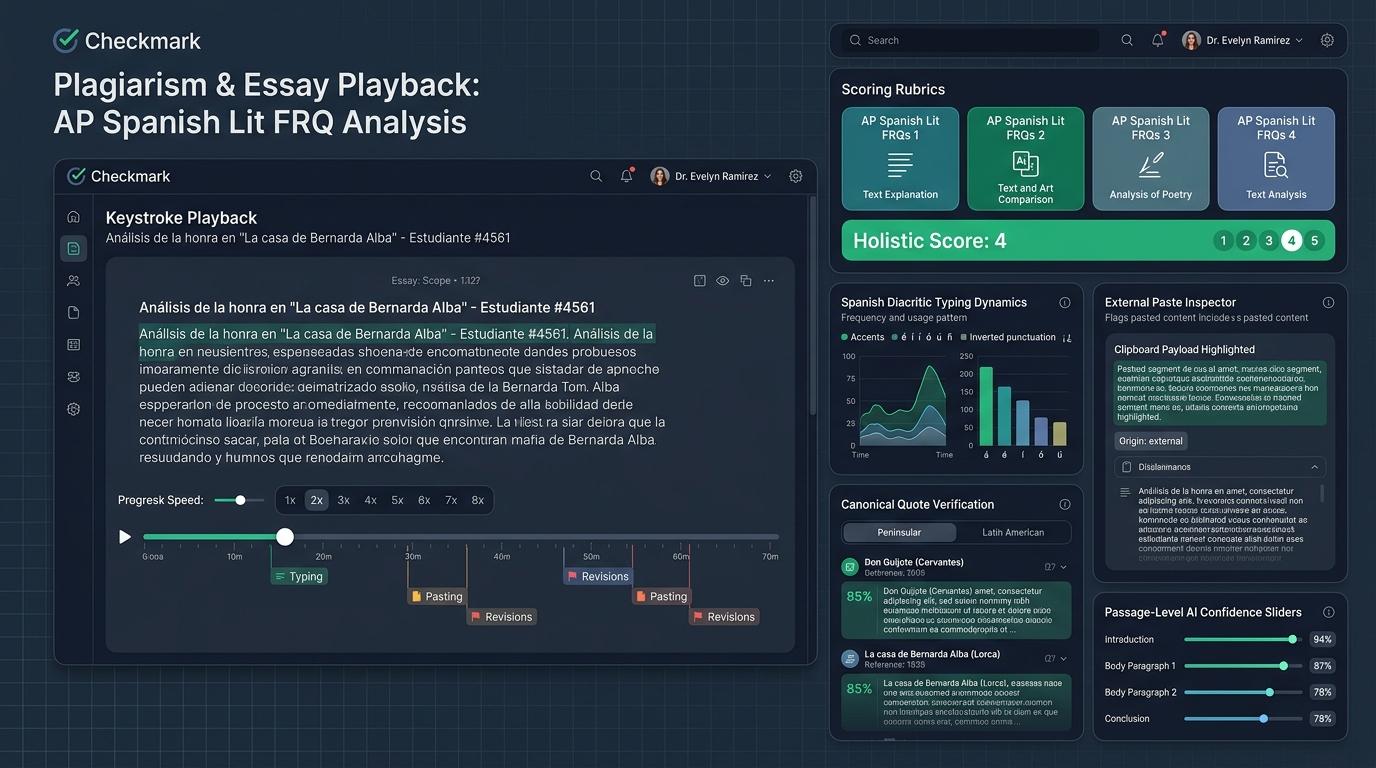
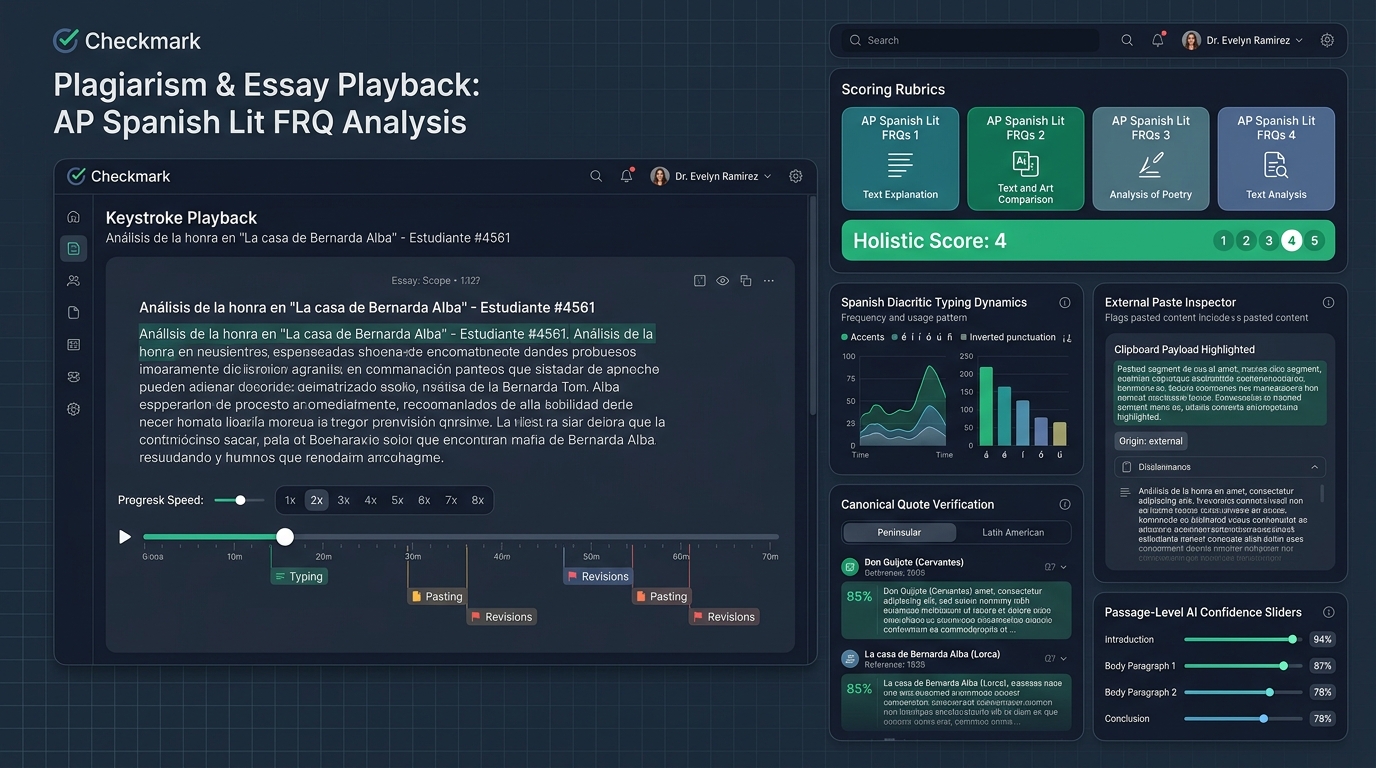
Compounding this challenge, generic whole-document AI percentage detectors fail catastrophically: they trigger aggressive false positives on legitimate student essays containing memorized literary terms, canonical quotations, and standard Spanish rhetorical transitions, while disproportionately penalizing fluent heritage and native speakers. Checkmark Plagiarism provides AP Spanish Literature teachers with a defensible, pedagogical solution through Writing Process Telemetry & Essay Playback™. By recording keystroke-by-keystroke drafting sessions (replayable at 1x–8x speed), tracking Spanish diacritic input dynamics (á, é, í, ó, ú, ñ, ü, ¡, ¿), inspecting raw external paste payloads, providing passage-level calibrated confidence sliders, and anchoring rubric grading directly to College Board 5-point criteria, Checkmark empowers educators to “Stop guessing, start trusting”—protecting honest students, diagnosing synthetic shortcuts, and conducting restorative, target-language literary conferences that foster genuine critical scholarship.
Canonical Text & Device Concordance
Cross-references citations against the 38 required texts. Identifies fabricated stanzas, misattributed lines, and nominal device name-dropping.
Writing Process Telemetry
Reconstructs continuous drafting with Essay Playback™ (1x–8x), tracking Spanish diacritic sequences (á, é, í, ó, ú, ñ) and clipboard paste buffers.
Restorative Target-Language Dialogue
Facilitates 5-minute collaborative Spanish conferences. Evaluates student oral articulation of thesis and guides growth-oriented revisions.
1. The Disciplinary Architecture of AP Spanish Literature and Culture
Advanced Placement (AP) Spanish Literature and Culture is uniquely demanding among secondary world language offerings. Unlike AP Spanish Language and Culture, which assesses communicative proficiency and cultural synthesis across interpersonal, interpretive, and presentational modes, AP Spanish Literature operates as a university-level survey of Hispanic literature. High school students are expected to engage in close textual analysis (comentario de texto), trace the evolution of literary movements from the Middle Ages (Medievo) through the Golden Age (Siglo de Oro), Romanticism, Modernism, the Generation of ’98, the Generation of ’27, the Latin American Boom, and contemporary U.S. Hispanic and feminist literature, and articulate sophisticated thematic arguments entirely in high-register academic Spanish.
College Board AP Spanish Literature Section II: Free-Response Breakdown
FRQ 1: Short Answer — Text Explanation
~15 min | 0–5 ptsRead an excerpt from one required text on the 38-work list. (1) Identify author, title, period/movement; (2) Explain thematic development within the passage.
FRQ 2: Short Answer — Text & Art Comparison
~15 min | 0–5 ptsRead an excerpt from one required text paired with a visual artwork (painting, engraving, photograph). Compare how a designated course theme is developed across both mediums.
FRQ 3: Long Essay — Single Text Analysis
~35 min | 0–5 ptsIn-depth analytical essay on an excerpt from a single required canonical work. Analyze how the author develops a theme; integrate required and selected literary devices and historical context.
FRQ 4: Long Essay — Text Comparison (2 Works)
~35 min | 0–5 ptsComprehensive comparative essay across TWO works (1 provided excerpt + 1 chosen from the 38-work list). Compare the presentation of a theme, analyzing literary features and socio-historical contexts.
The Required Canonical Reading List (38 Core Works)
The curriculum is anchored by a non-negotiable list of 38 canonical texts spanning eight centuries, diverse geographical regions (Spain, Mexico, Cuba, Argentina, Chile, Puerto Rico, Colombia, and the United States), and varied literary genres (prose, poetry, drama, and essays):
1. Medieval & Renaissance
- Don Juan Manuel: El Conde Lucanor (Exemplum)
- Anónimo: Romance del rey moro que perdió Alhama
- Anónimo: Lazarillo de Tormes (Novela picaresca)
- Garcilaso de la Vega: Soneto XXIII (“En tanto que de rosa y azucena”)
2. Baroque / Siglo de Oro
- Luis de Góngora: Soneto CLXVI (“Mientras por competir...”)
- Francisco de Quevedo: Salmo XVII (“Miré los muros...”)
- Miguel de Cervantes: Don Quijote de la Mancha
- Tirso de Molina: El burlador de Sevilla
- Sor Juana Inés de la Cruz: “Hombres necios que acusáis”
3. 19th-Century Movements
- José María Heredia: “En una tempestad” (Romanticismo)
- Gustavo Adolfo Bécquer: Rima LIII (“Volverán las oscuras...”)
- Emilia Pardo Bazán: “Las medias rojas” (Realismo / Naturalismo)
4. Modernism & Gen of ’98
- José Martí: “Nuestra América” (Ensayo)
- Rubén Darío: “A Roosevelt” (Modernismo)
- Antonio Machado: “He andado muchos caminos”
- Miguel de Unamuno: San Manuel Bueno, Mártir (Nivola)
5. Avant-Garde & Gen of ’27
- Alfonsina Storni: “Peso ancestral”
- Julia de Burgos: “A Julia de Burgos”
- Nicolás Guillén: “Balada de los dos abuelos”
- Federico García Lorca: La casa de Bernarda Alba, “Prendimiento de Antoñito...”
- Pablo Neruda: “Walking around” (Surrealismo)
6. Boom & Contemporary
- Jorge Luis Borges: “Borges y yo”, “El Sur”
- Julio Cortázar: “La noche boca arriba”
- Carlos Fuentes: “Chac Mool”
- Gabriel García Márquez: “El ahogado más hermoso...”, “La siesta del martes”
- Juan Rulfo: “No oyes ladrar los perros”
- Osvaldo Dragún: El hombre que se convirtió en perro
- Sabine Ulibarrí / Tomás Rivera: Literatura chicana
- Isabel Allende / Rosa Montero: Posboom & Contemporánea
The Six Organizing Course Themes
1. Las sociedades en contacto
Assimilation, marginalization, nationalism, imperialism, and cultural collision (Romance del rey moro, Nuestra América, A Roosevelt).
2. La construcción del género
Machismo, marianismo, patriarchy, female agency, and systemic oppression (Hombres necios, La casa de Bernarda Alba, Las medias rojas).
3. El tiempo y el espacio
Carpe diem, Memento mori, temporal rupture, and nature vs. civilization (Soneto XXIII, Soneto CLXVI, Salmo XVII, La noche boca arriba).
4. Las relaciones interpersonales
Power dynamics, familial duty, romantic disillusionment, and social alienation (El Conde Lucanor, El burlador de Sevilla, No oyes ladrar los perros).
5. La dualidad del ser
The double / alter ego, internal conflict, reality vs. illusion, and spiritual crisis (San Manuel Bueno, Mártir, Borges y yo, Don Quijote, Chac Mool).
6. La creación literaria
Metaliterature, the creative process, intertextuality, and censorship vs. freedom (Don Quijote, Borges y yo, Dos palabras, A Julia de Burgos).
The Mandatory Lexicon of Literary Terminology (Recursos Literarios)
On both the AP exam and classroom analytical essays, students cannot earn top marks by providing descriptive summaries of story events. The College Board rubrics explicitly demand that students identify, cite, and evaluate how specific recursos literarios develop the prompt’s assigned theme:
- Rhetorical Figures & Tropes: Anáfora, hipérbaton, hipérbole, metonimia, sinécdoque, prosopopeya (personificación), apóstrofe, antítesis, retruécano, oxímoron, paradoja, gradación, asíndeton, polisíndeton, elipsis, epíteto, ironía, sátira.
- Poetic & Metrical Terms: Sinalefa, hiato, encabalgamiento, estribillo, polifonía, verso libre, arte mayor vs. arte menor, rima asonante vs. consonante, redondilla, romance, soneto, silva.
- Structural & Narrative Devices: Desdoblamiento, fluir de la conciencia (stream of consciousness), monólogo interior, narrador fidedigno vs. no fidedigno, narrador omnisciente vs. testigo, perspectiva, ambiente, tono, cromatismo, arquetipo, leitmotiv, in medias res, flash-back (analepsis), prolepsis, marco narrativo (caja china / mise en abyme).
- Movements & Concepts: Carpe diem, memento mori, culteranismo (gongorismo), conceptismo, realismo mágico, realismo fantástico, costumbrismo, existencialismo, determinismo, teatro del absurdo.
2. The Acute Classroom Dilemma: GenAI in High School Spanish Literature
In modern high school environments where every student operates a school-issued Chromebook or laptop and drafts essays within Google Docs, Canvas SpeedGrader, Schoology, or Buzz LMS, generative Large Language Models (ChatGPT, Claude, Gemini, and specialized Spanish writing bots) present a multifaceted pedagogical crisis.
When high school students are tasked with writing a 35-minute comparative essay (FRQ 4) comparing the duality of being in Unamuno’s San Manuel Bueno, Mártir and Borges’s “Borges y yo”, the temptation to prompt an LLM is enormous. However, generative AI engines interact with Spanish literary analysis in highly distinctive, problematic ways that deviate sharply from authentic high school student scholarship.
1. Hyper-Polished Register Paradox
Generates archaic, flowery Castilian or formal Peninsular academic syntax (“cabe colegir que la cosmovisión...”) that diverges completely from authentic adolescent Spanish writing habits.
2. Hallucinated Citations & Attributions
Invents non-existent stanzas, fabricates dialogue between characters, or misattributes famous quotes across authors (e.g., attributing Segismundo’s monologue from Calderón to Cervantes).
3. “Recursos Literarios” Name-Dropping
Chains terms together (“el autor utiliza hipérbaton, anáfora y sinestesia”) without citing specific line numbers or explaining HOW they advance the prompt’s thematic framework.
4. Superficial Plot Retelling
Retells the narrative events of the story in chronological Spanish rather than performing the rigorous, line-by-line textual dissection (comentario de texto) required by College Board rubrics.
Pathology 1: The Hyper-Polished Academic Register Paradox
Generative AI models default to an ornate, baroque academic register. When prompted in Spanish (“Escribe un ensayo comparativo sobre el machismo en La casa de Bernarda Alba y Hombres necios que acusáis”), the LLM outputs prose such as:
“Es menester puntualizar que la opresión falocéntrica articulada por García Lorca se erige sobre una dialéctica de clausura espacial y coercitividad moral, donde el bastón de mando bernardino simboliza la hegemonía indiscutible del patriarcado interiorizado...”
While grammatically pristine, this phrasing immediately rings false in a 10th-, 11th-, or 12th-grade classroom. Whether the student is an L2 learner who normally navigates intermediate-high subjunctive agreements or a heritage Spanish speaker whose authentic writing reflects regional Latin American or U.S. bilingual phrasing, neither demographic naturally writes in the register of a 55-year-old professor from the Universidad de Salamanca. The prose lacks the idiosyncratic syntactical choices, spontaneous drafting corrections, and developmental vocabulary transitions typical of secondary students.
Pathology 2: Hallucinated Textual Citations and Line Misattributions
Because LLMs operate on probabilistic token prediction rather than authoritative textual memory, they frequently fabricate lines when asked to analyze specific passages from the 38 canonical works:
- Inventing Stanzas in Sor Juana’s Poetry: Fabricating an eight-syllable quatrain with consonant rhyme (redondilla) that sounds plausible but does not exist in “Hombres necios que acusáis”.
- Anachronistic Cross-Author Attribution: Quoting Segismundo’s famous monologue (“¿Qué es la vida? Un frenesí...”) from Calderón de la Barca’s La vida es sueño and asserting that Don Quijote said it to Sancho Panza in Chapter VIII.
- Invented Dialogue in Prose: Fabricating a direct spoken conversation between Don Manuel and Ángela Carballino in San Manuel Bueno, Mártir regarding the resurrection, when in the actual novella Unamuno communicates this exclusively through Ángela’s retrospective narrative memoir.
- Incorrect Poetic Meter and Strophic Identification: Claiming that Bécquer’s Rima LIII is written in hendecasyllabic sonnet form with Italianate tercets, when it actually consists of alternating hendecasyllabic and heptasyllabic lines in four-line stanzas with assonant rhyme.
3. The AP Scoring & Pedagogical Dilemma
High school AP Spanish Literature teachers grade dozens of multi-page FRQ essays every week. To maintain grading equity and prepare students for the national exam in May, teachers apply the official College Board 5-Point Holistic Scoring Rubric:
College Board 5-Point Holistic Scoring Matrix for AP Spanish Literature
| Score Point | Performance Level | Analytical & Textual Criteria | Linguistic & Device Control |
|---|---|---|---|
| Score 5 | Explicit, Insightful, & Effective | Clear, insightful thesis; thorough analysis of theme supported by precise, relevant textual citations; accurate literary context. | Seamless integration of recursos literarios; fluent, advanced academic Spanish with varied vocabulary. |
| Score 4 | Competent & Sufficient | Addresses prompt with clear thesis; competent analysis of theme with textual support; accurate historical/cultural context. | Discusses literary devices adequately, though some connections may be superficial; competent Spanish with minor errors. |
| Score 3 | Adequate but Limited / Descriptive | Simplistic or partially developed thesis; relies heavily on plot summary rather than analysis; vague contextual references. | Mentions literary devices nominally (name-dropping); comprehensible but repetitive or basic Spanish. |
| Score 2 | Inadequate / Inaccurate | Demonstrates misunderstanding of text or prompt; predominantly plot retelling; frequent factual and contextual errors. | Fails to explain literary devices; significant grammatical errors that impede analytical depth. |
| Score 1 | Very Inadequate / Off-Topic | Fails to address prompt; fragmented understanding of texts; virtually no analytical commentary or evidence. | Pervasive linguistic errors that severely obscure meaning. |
Why Generic AI Detectors Fail Catastrophically in World Language Classrooms
Faced with mounting stacks of essays, many high school departments have turned to generic whole-document AI percentage detectors. In the context of AP Spanish Literature, these statistical tools cause widespread pedagogical devastation:
1. False Positives on Canonical Citations
Detectors flag verbatim quotes from Cervantes, Lorca, or Sor Juana as “low perplexity AI.” Required AP terminology (desdoblamiento, culteranismo, sinalefa, polifonía) triggers high AI percentages.
2. Penalization of Heritage Speakers
Highly fluent, syntactically mature Spanish written by native/heritage high schoolers matches the statistical predictability models of AI training corpora, triggering unfair 70%+ AI flags.
3. False Positives on Academic Transitions
Standard rhetorical transitions taught in AP (“por consiguiente”, “a través del uso de”, “cabe destacar que”, “en conclusión”) are flagged as synthetic boilerplate.
4. Zero Proof Against Humanized Text
Students who pass LLM text through paraphrasers (QuillBot, Undetectable AI) bypass generic detectors completely, leaving teachers without defensible proof.
When a passionate 11th-grade heritage speaker writes an authentic, brilliant comparative analysis of “Romance del rey moro” and “Prendimiento de Antoñito el Camborio”, an opaque detector returning a “78% AI Detected” score creates a toxic, accusatory confrontation. Educators do not need an arbitrary, black-box percentage. They need transparent, defensible evidence of the student’s actual drafting session.
4. The High School World Language Evidentiary Matrix
To evaluate how different assessment and verification methods perform in high school AP Spanish Literature settings, examine the following comparison matrix:
World Language Writing Assessment Evidentiary Matrix
| Evaluation Dimension | Timed Blue-Books (Paper) | Generic Black-Box AI Detectors | Google Docs Revision History | Checkmark Telemetry & Essay Playback™ |
|---|---|---|---|---|
| Analytical Depth & Revision | Low (hand cramps, minimal revision, unedited first drafts) | N/A (does not evaluate writing, only scores text) | High (digital drafting) | Highest (encourages full digital drafting, revision, and multi-draft iteration) |
| False Positive Risk on AP Terms | None | Severe (50%–85% on standard AP terms & quotes) | Low (shows edits, but hard to prove timing) | Zero (passage-level confidence + keystroke replay verification) |
| Spanish Diacritic Telemetry (á, é, í, ó, ú, ñ) | Manual handwriting (physical accents) | None (evaluates static text strings only) | None (only shows coarse snapshot differences) | Complete Keystroke Logging (tracks dead keys, AltGr, and accent composition sequences) |
| Hallucinated Citation Detection | High (teacher spots error manually) | None (detectors cannot verify canonical accuracy) | None (cannot distinguish authentic vs. fake quotes) | Integrated Citation Audit + Paste Source Inspector |
| External Paste Buffer Retention | N/A | None (no access to clipboard history) | Partial (shows inserted text block, but loses original text if edited) | Full Raw Payload Preservation (stores 100% of pasted text with jump-to-timeline timestamps) |
| Playback & Drafting Speed Replay | None | None | None (static stepped snapshots every 5–10 minutes) | Continuous 1x–8x Replay (shows typing pauses, deletions, restructuring, and lookups) |
| Defensibility in Restorative Conferences | High (physical paper) | Zero (unsubstantiated black-box score) | Moderate (disjointed revision snapshots) | Absolute (irrefutable video-style playback receipt of authentic drafting) |
| Rubric Grading & LMS Integration | Manual paper grading (10–15 hrs/week per 150 students) | None | None | Automated AP 5-Point Rubric Autograder with SpeedGrader / Buzz / Classroom Sync |
5. The Step-by-Step Spanish Literature Teacher Audit Protocol
When evaluating AP Spanish Literature Free-Response essays (whether submitted via Google Docs, Canvas, or Buzz LMS), educators should follow this structured, five-step audit protocol to verify authentic textual analysis and thematic commentary:
Canonical Text Citation & Line-Attribution Sanity Check
Cross-reference quoted lines against the 38 required texts. Because AP Spanish Literature is restricted to specific canonical works:
- Check Quoted Stanzas & Verses: If the student quotes a 4-line redondilla from Sor Juana or an octosyllabic romance from “Romance del rey moro”, verify that those exact verses exist in the authorized anthology. If the rhyme scheme or syllabic count (cómputo silábico) appears unfamiliar, cross-reference immediately.
- Verify Narrative Chronology & Act Placement: In plays like La casa de Bernarda Alba or El burlador de Sevilla, verify that characters and events are attributed to the correct Act (Jornada / Acto). AI frequently claims Adela breaks Bernarda’s cane in Act I (it occurs at the climax of Act III).
- Cross-Author Sanity Check: Ensure famous aphorisms (“Cosas tenedes, el buen Cid”, “El hombre es el lobo del hombre”) are not erroneously inserted into Latin American Boom short stories.
Literary Device & Thematic Integration Concordance Audit
Evaluate whether the student’s discussion of recursos literarios fulfills the rigorous College Board analytical standard: Device Identification ➔ Textual Quote ➔ Mechanical Function ➔ Thematic Consequence.
“El autor se vale de recursos como el hipérbaton, la anáfora y la antítesis para embellecer el poema y resaltar el paso inexorable del tiempo y la fugacidad de la belleza juvenil.”
Problem: No lines cited. No explanation of syntax. Generic thematic filler.
“En el segundo cuarteto del Soneto CLXVI de Góngora, el hipérbaton en 'goza cuello, cabello, labio y frente' subvierte el orden sintáctico tradicional para acelerar el ritmo del poema, anticipando la gradación descendente del verso final donde la belleza culmina en 'humo, polvo, sombra, nada'—un reflejo visceral del tema de El tiempo y el espacio y el memento mori.”
Authenticity Markers: Specific quotes, exact strophic location, functional syntactic analysis.
Analyze Keystroke Dynamics & Spanish Diacritic Insertions with Essay Playback™
Open Checkmark and press Play at 2x or 4x speed to observe the physical drafting timeline:
Spanish Diacritic Key Telemetry: On standard US-International keyboards, Chromebooks, or Macs, typing an accent requires a specific multi-key sequence (dead key apostrophe ' followed by vowel a to produce á, or AltGr + n for ñ, or Shift + Alt + ? for ¿). In Essay Playback, teachers observe slight micro-pauses (200–500ms) around accented characters, occasional typing mistakes, and consistent diacritic habits—contrasting sharply with synthetic 0ms text dumps.
Inspect External Paste Buffer Payloads
Checkmark’s External Paste Inspector captures the exact raw text placed onto the document’s clipboard:
- Full Clipboard Text Retention: Even if the student subsequently rewrites, rewords, or deletes every word of the pasted text over a 30-minute session to “humanize” it, Checkmark preserves the original 100% unaltered clipboard payload.
- Jump-to-Playback Timestamps: Clicking on any paste event in the sidebar instantly jumps the playback timeline to the exact millisecond the paste occurred.
- Source Identification: Differentiate between a legitimate 2-line quote copied from an online copy of Lazarillo de Tormes versus an entire 450-word pre-generated Spanish essay originating from an external browser tab.
Conduct a Restorative Target-Language Literary Debrief
In keeping with Checkmark’s foundational principle—“Stop guessing, start trusting”—academic integrity inquiries are transformed into supportive, target-language educational conversations:
- Conduct the Conference in Spanish: Ask open-ended analytical questions:
- “Dime, ¿cómo interpretas tú el simbolismo del bastón en La casa de Bernarda Alba?”
- “En tu ensayo mencionas que este verso es un ejemplo de hipérbaton. ¿Podrías leerme el verso y explicarme cómo están desordenadas las palabras?”
- “¿Qué te llevó a comparar la dualidad de San Manuel con la de Borges en vez de Don Quijote?”
- Review Essay Playback Side-by-Side: “Mira, aquí en el minuto 12 vemos que entró este párrafo completo de golpe. Cuéntame qué pasó durante ese momento de la redacción.”
- Guide Restorative Rewriting: When students realize the teacher has objective, non-punitive keystroke receipts, defensiveness evaporates. Assign a targeted 20-minute supervised rewrite focusing on authentic voice.
6. How Checkmark Empowers High School AP Spanish Literature Educators
Checkmark Plagiarism was engineered specifically to solve the unique grading and integrity challenges of high-volume secondary humanities educators.
1. Passage-Level Confidence Sliders
Replaces opaque whole-paper AI percentages with granular, passage-level style analysis. Underlines specific suspicious sentences with calibrated sliders (Human Style vs. AI Pattern) and automatically applies “N/A” guardrails on short texts (<150 words) to prevent false flags.
2. Patent-Pending Essay Playback™
Reconstructs the complete writing process keystroke-by-keystroke at 1x–8x video replay speed. Visualizes typing bursts, revision pauses, backspaces, metrical counts, and diacritic inputs, instantly exonerating honest heritage/L2 learners falsely accused by generic detectors.
3. Raw Clipboard Paste Inspector
Records 100% of pasted external text, preserving the raw payload even after student edits. A single-click “Jump to Timeline” button directly links paste payloads to the playback scrubber.
4. Rubric-Anchored AI Autograder
Autogrades FRQ 1–4 against official College Board 0–5 holistic scoring criteria. Generates quote-anchored written justifications in Spanish or English tied directly to student prose, fully editable by the teacher before one-click grade sync to Canvas, Buzz, or Google Classroom.
Rubric-Anchored AI Autograding for High School Teachers
AP Spanish Literature teachers frequently carry 4 to 5 class sections totaling 120 to 160 students. Grading a single multi-page comparative essay (FRQ 4) for 150 students takes between 25 and 35 hours of intensive weekend grading, leading to chronic teacher burnout and delayed feedback for students.
Checkmark’s AI Autograder functions as a tireless, high-precision co-evaluator:
- Customizable 5-Point College Board Rubrics: Pre-configured with the exact criteria for AP Spanish Literature FRQ 1, FRQ 2, FRQ 3, and FRQ 4.
- Quote-Anchored Feedback in Spanish or English: The autograder identifies specific sentences in the student’s essay, evaluates the precision of their recursos literarios, verifies the thematic link, and drafts constructive feedback cards:
“Criterion: Análisis del texto y recursos literarios (Score: 4/5) — El estudiante identifica correctamente el uso del estribillo ('¡Ay de mi Alhama!') en el Romance del rey moro, pero podría profundizar en cómo la polifonía de las distintas voces (el alfaquí, el moro viejo) intensifica la crítica hacia el rey.”
- Teacher-in-the-Loop Final Authority: All AI-drafted scores and feedback cards remain provisional drafts. The teacher can adjust a score from a 4 to a 5, edit the comments in seconds, and click Publish All to push finalized grades directly into the Canvas SpeedGrader, Buzz LMS, or Google Classroom gradebook.
7. Real High School Classroom Case Scenarios
The following three case studies illustrate how Checkmark’s integrated writing telemetry, paste inspection, and rubric autograding function in real high school AP Spanish Literature classrooms:
Case Study 1: 11th Grade AP Spanish Lit — FRQ 3 (Sor Juana)
Exonerated & Score 5- Assignment: FRQ 3 Single Text Analysis on Sor Juana’s “Hombres necios que acusáis” (Theme: La construcción del género).
- Initial Anomaly: District’s generic AI checker flagged Sofia’s 650-word essay at 74% AI Detected due to rich vocabulary (“disyuntiva moral”, “coerción falocéntrica”) and dense poetic citations.
- Telemetry Investigation: Checkmark Essay Playback showed 44 minutes of active drafting, 3,420 keystrokes, 412 backspaces, 35-second syllable counting pauses for arte menor verification, and organic diacritic typing. Paste Inspector recorded only the assignment prompt.
- Pedagogical Outcome: Sofia was completely exonerated without adversarial confrontation. Checkmark Autograder awarded Score Point 5, validating her outstanding critical scholarship.
Case Study 2: 12th Grade AP Spanish Lit — FRQ 4 (Unamuno & Borges)
Diagnosed & Restorative Rewrite- Assignment: FRQ 4 Comparative Essay on San Manuel Bueno, Mártir and “Borges y yo” (Theme: La dualidad del ser).
- Initial Anomaly: Mateo submitted a 750-word essay in hyper-polished Peninsular Spanish quoting a fabricated dialogue between Don Manuel and his bishop in Madrid that does not exist in the text.
- Telemetry Investigation: Checkmark Paste Inspector revealed two 400-word blocks pasted 14 seconds apart from an external LLM session; total active drafting time was 2 minutes and 10 seconds with zero keystroke revisions.
- Pedagogical Outcome: In a supportive Spanish conference, the teacher walked through the playback timeline. Mateo acknowledged using Claude due to college application pressure, completed a supervised after-school rewrite lab, and earned an honest 4 on the rubric.
Case Study 3: 10th Grade Heritage Speaker — FRQ 2 (Romance & Art)
Protected from False Accusation- Assignment: FRQ 2 Short Answer comparing “Romance del rey moro” with a 16th-century Renaissance woodcut of Granada.
- Initial Anomaly: Elena, a Colombian-American heritage speaker, had her articulate 280-word response flagged at 68% AI Detected by a legacy statistical detector due to natural complex subordinations.
- Telemetry Investigation: Checkmark confidence sliders showed typical human style; Essay Playback captured 18 minutes of steady typing with visual pause intervals while examining the artwork and manual accent self-corrections (polifonía, alfaquí).
- Pedagogical Outcome: Elena was protected from an unfair disciplinary referral, received a 5/5 on the rubric, and remained motivated in advanced humanities studies.
8. Frequently Asked Questions (FAQs)
Q1: How does Checkmark differentiate between authorized online Spanish-English dictionaries (e.g., WordReference, RAE) and unauthorized full-essay generative AI translation?
Authentic students frequently consult authorized reference tools such as WordReference or the RAE to look up unfamiliar archaic vocabulary (e.g., almutacén, adestrar, arnés). In Checkmark’s Essay Playback™, looking up a single vocabulary term manifests as a brief 10-to-20-second pause, followed by the manual typing of a single word or short phrase integrated organically into an ongoing sentence. In contrast, unauthorized generative AI or machine translation manifests as the sudden pasting of multi-sentence paragraphs (300+ characters in 0ms) via the External Paste Inspector, completely lacking organic syntactical construction or localized word-choice deliberations.
Q2: Why do generic AI detectors fail so frequently on native and heritage Spanish speakers in AP Spanish Literature?
Generic AI detectors rely on statistical language models trained predominantly on formal, standard web text. Native and heritage Spanish speakers often write with high syntactical fluency, sophisticated vocabulary, and natural grammatical maturity that generic detectors statistically conflate with “low-perplexity” AI outputs. Checkmark avoids this structural bias by pairing passage-level calibrated linguistic analysis with objective Writing Process Telemetry. Because Checkmark verifies the physical keystrokes, pause intervals, and editing history, heritage students are evaluated on their authentic drafting process rather than an arbitrary probabilistic score.
Q3: How does Essay Playback handle non-standard keyboard layouts and Spanish diacritics on school-issued Chromebooks?
Checkmark’s telemetry engine operates at the browser and DOM level within Google Docs, Canvas, Buzz, and Schoology. It accurately captures all standard international keyboard inputs, including US-International dead-key combinations (' + a = á), Chromebook AltGr shortcuts (AltGr + e = é), Mac option keys (Option + e, then e = é), and numeric Alt codes. In Essay Playback, teachers can watch the exact sequence of keystrokes used to insert accents (á, é, í, ó, ú), tildes (ñ), and inverted punctuation (¡, ¿), confirming organic composition.
Q4: Can Checkmark’s Rubric Autograder be customized specifically for the College Board 5-point holistic scoring scales for FRQ 1 through FRQ 4?
Yes. Checkmark comes pre-loaded with official College Board 0–5 holistic scoring rubrics for all four AP Spanish Literature Free-Response questions:
• FRQ 1 (Text Explanation): 0–5 point scale evaluating identification of author/title/period and explanation of theme.
• FRQ 2 (Text and Art Comparison): 0–5 point scale evaluating thematic comparison between literature and visual art.
• FRQ 3 (Single Text Analysis): 0–5 point scale evaluating thesis, textual evidence, analysis of required literary devices, and contextualization.
• FRQ 4 (Text Comparison across 2 Works): 0–5 point scale evaluating comparative thesis, intertextual analysis, literary devices, and historical context.
Teachers can also customize rubrics or import district-specific writing standards with full one-click gradebook synchronization back into Canvas, Buzz, or Google Classroom.
Q5: How should AP Spanish Literature teachers handle student use of generative AI for initial brainstorming or historical contextualization (e.g., the Siglo de Oro or the Generation of ’98)?
World language departments should establish clear, transparent classroom AI policies that distinguish between authorized cognitive scaffolding and unauthorized authorship fraud. Using an LLM to generate a historical timeline of the Spanish Civil War or summarize the philosophical tenets of the Generation of ’98 can be permitted as pre-writing research, provided the student cites the AI interaction in an acknowledgment statement. However, generating the actual Spanish analytical commentary (comentario de texto), drafting the thesis, or selecting textual quotes must remain 100% human-authored. Checkmark’s Essay Playback allows teachers to easily verify that the actual prose composition occurred authentically in real time.
Q6: How does Checkmark protect student data privacy under FERPA and COPPA when processing AP Spanish essays?
Checkmark adheres to the highest K–12 data privacy and security standards. Student essays are processed in secure, encrypted cloud environments (AES-256 at rest, TLS 1.3 in transit) and are NEVER used to train commercial AI models. Checkmark fully complies with the Family Educational Rights and Privacy Act (FERPA), the Children’s Online Privacy Protection Act (COPPA), and state-specific student data privacy agreements (SDPAs). Student submissions remain the exclusive intellectual property of the school district.
Q7: What is the recommended pedagogical response when a student’s essay contains hallucinated quotes or fabricated literary devices?
When a teacher discovers hallucinated textual citations or fabricated stanzas, it is almost always definitive proof of generative AI shortcuts. The recommended response is restorative and pedagogical:
1. Hold a Private Conference: Meet with the student and invite them to locate the quoted lines in their physical text.
2. Examine Telemetry Receipts Together: Open Checkmark Essay Playback and show the student where the synthetic text was pasted.
3. Conduct a Supervised Rewrite: Rather than issuing an immediate zero or punitive suspension, require the student to compose an authentic analysis during a supervised study hall or writing lab, focusing on line-by-line engagement with the canonical text.
9. Conclusion: Restoring Academic Trust and Scholarly Rigor in AP Spanish Literature
The study of literature in a second language is one of the most transformative intellectual journeys a high school student can undertake. When students grapple with the haunting solitude of San Manuel Bueno, Mártir, unravel the biting feminist satire of Sor Juana’s redondillas, or analyze the fragmented realities of Cortázar and Borges, they are not merely memorizing vocabulary—they are developing empathy, critical discernment, and linguistic agility.
Generative AI threatens to hollow out this transformative experience by substituting genuine analytical wrestling with synthetic, hallucinated prose. Yet relying on punitive, opaque AI detectors only replaces one crisis with another—alienating students, generating false accusations against fluent heritage speakers, and fracturing the educator-student bond.
Checkmark Plagiarism provides high school AP Spanish Literature educators, world language department chairs, and academic integrity committees with the definitive, evidence-based alternative. By combining patent-pending Essay Playback™, Spanish diacritic telemetry, raw external paste inspection, and quote-anchored 5-point rubric autograding, Checkmark empowers teachers to uphold uncompromised academic standards while fostering a supportive classroom culture rooted in authentic scholarship.
Empower Your AP Spanish Literature Department with Checkmark
Stop guessing. Start trusting. Equip your AP Spanish Literature department with transparent writing process evidence that protects honest students, empowers teachers, and celebrates authentic literary discovery.