
In the Advanced Placement (AP) Capstone Program, the Individual Research Report (IRR / Performance Task 1) requires high school sophomores and juniors to investigate a complex problem through a dedicated academic lens, placing diverse peer-reviewed literature into active scholarly conversation under the College Board's QUEST pedagogical framework. However, the emergence of advanced Large Language Models (LLMs) has introduced acute assessment vulnerabilities: panic-driven students under strict AP Digital Portfolio deadlines increasingly prompt AI to manufacture synthetic literature reviews, hallucinated academic studies with confabulated DOIs, and superficial “on the one hand / on the other hand” pseudo-debates.
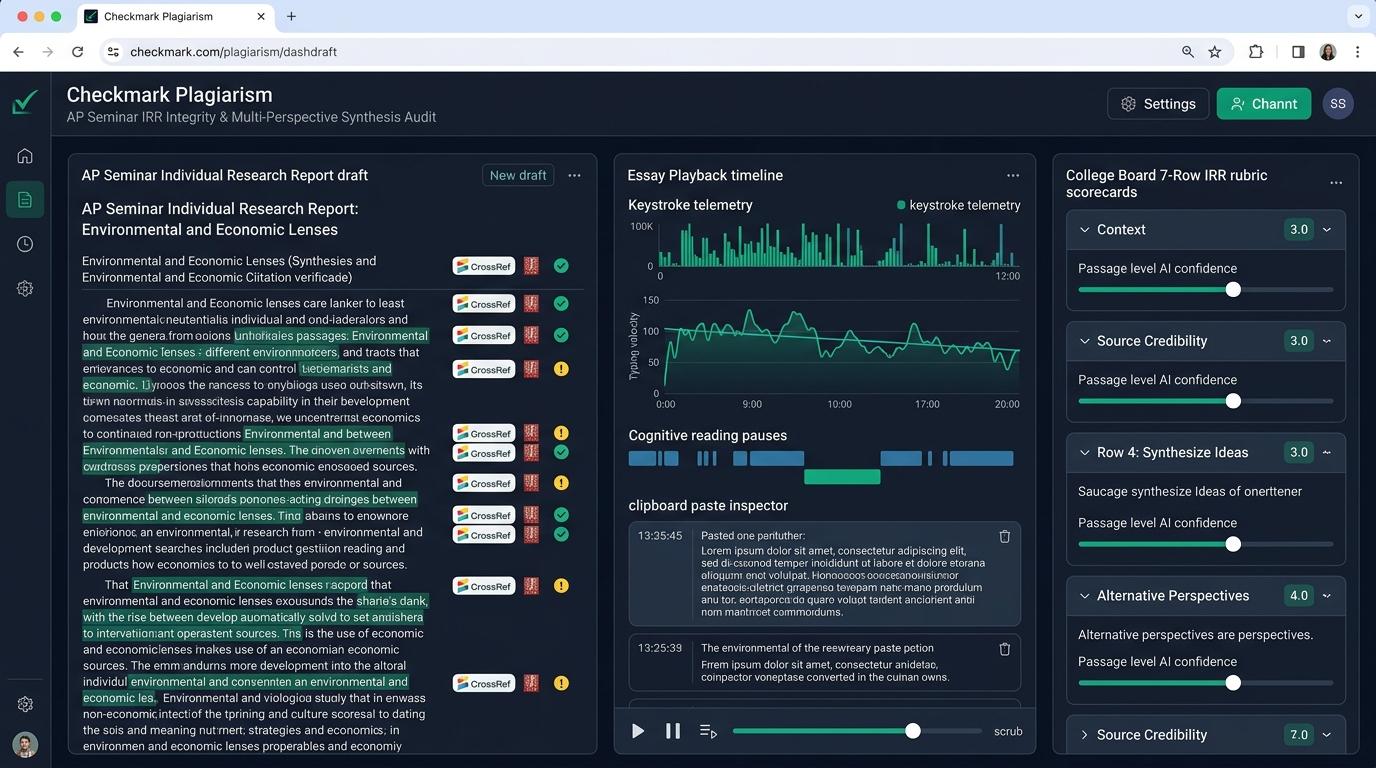
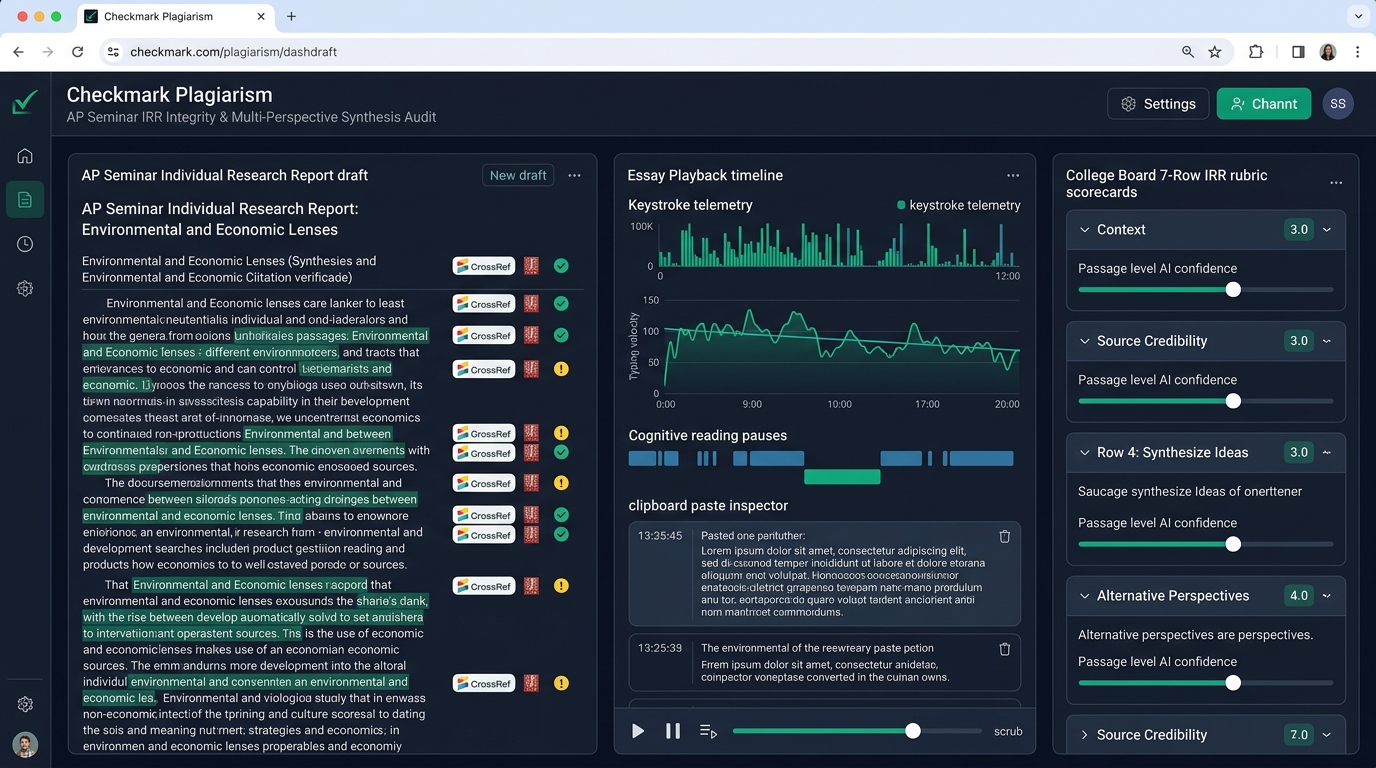
Crucially, generic black-box AI detectors fail AP educators—triggering destructive false positives on dense, authentic academic terminology and formal citation syntax while missing sophisticated AI-synthesized research papers. Checkmark Plagiarism resolves this high-stakes dilemma through a multi-dimensional evidentiary suite: combining Side-by-Side Database Source Proof, granular passage-level AI confidence sliders, and patent-pending Essay Playback™ (keystroke-by-keystroke writing telemetry with 100% paste buffer preservation). This comprehensive guide equips AP Seminar instructors, Capstone coordinators, and secondary academic integrity committees with actionable audit protocols to verify authentic scholarship, defend honest students, and facilitate restorative research debriefs.
Checkmark Plagiarism integrates directly with high school learning management systems including Canvas LMS, Google Classroom, and Agilix Buzz, empowering AP Seminar teachers to audit research integrity without invasive screen monitoring or unreliable black-box scores.
1. Anatomy of the AP Seminar IRR: Performance Task 1 and the QUEST Framework
The AP Capstone Diploma Program—comprising AP Seminar (typically taken in Grade 10 or 11) and AP Research (taken in Grade 11 or 12)—represents the College Board's premier inquiry-driven curriculum. Rather than relying on traditional high-stakes end-of-year multiple-choice examinations, AP Seminar evaluates students through two extensive, multi-month performance tasks submitted directly to the AP Digital Portfolio:
- Performance Task 1 (PT1): Team Project and Presentation (20% of AP Composite Score)
- Individual Research Report (IRR): A 1,200-word independent academic investigation (a word limit that excludes footnoted citations, the bibliography, and text in figures or tables) examining the team's overarching inquiry through a dedicated disciplinary lens.
- Team Multimedia Presentation and Defense (TMP): An 8–10 minute collaborative presentation delivering a cohesive, multi-variable solution followed by oral defense questions.
- Performance Task 2 (PT2): Individual Research-Based Essay and Presentation (35% of Composite Score)
- Individual Written Argument (IWA): A 2,000-word defensible argument synthesizing cross-curricular stimulus material with independent academic research.
- Individual Multimedia Presentation (IMP) & Oral Defense (OD): A 6–8 minute solo presentation followed by an oral defense (two questions from the teacher).
- End-of-Course Exam (45% of Composite Score): Timed textual analysis and argument synthesis under standard exam conditions.
- Multi-source academic literature review
- Specific isolated disciplinary lens
- Evaluates perspective tension & author credibility
- Official College Board 6-Row IRR Rubric (30 pts)
- College Board stimulus material integration
- Defensible normative thesis & resolution
- Evaluates counter-arguments & limitations
- Official College Board 7-Row IWA Rubric (48 pts)
Q: Question & Explore • U: Understand & Analyze • E: Evaluate Multiple Perspectives • S: Synthesize Ideas • T: Team, Transform & Transmit
- 3+ divergent peer-reviewed sources in dialogue
- Nuanced tension between disciplinary paradigms
- Methodological critique, sample bounds, and limits
- Visible, organic drafting pauses and revision bursts
- Hallucinated studies, ghost authors & fake institutions
- Confabulated DOIs (invalid CrossRef or 404 links)
- “Flattened” superficial consensus & formulaic transitions
- Rapid wholesale paste or monotonic transcription
Six Common Curricular Lenses in AP Seminar
In the IRR, student teams dissect a broad socio-scientific, economic, or policy dilemma (e.g., “How should coastal municipalities mitigate sea-level rise?”). Each team member selects one isolated curricular lens to investigate. The College Board's AP Seminar framework names eight lenses (cultural and social, artistic and philosophical, political and historical, environmental, economic, scientific, futuristic, and ethical); six common ones are shown here:
Ecological disruption, carbon sequestration dynamics, biodiversity loss, habitat fragmentation, and trophic cascades.
Capital expenditure, cost-benefit modeling, market incentives, labor disruption, and municipal tax base impact.
Biogeochemical mechanisms, technological viability, peer-reviewed clinical trials, and engineering tolerances.
Environmental justice, intergenerational equity, utilitarian versus rights-based resource allocation frameworks.
Legislative gridlock, regulatory precedent, zoning statutes, jurisdictional battles, and statutory treaty obligations.
Community identity, indigenous displacement, public perception, sociological adaptation, and demographic shifts.
The QUEST Pedagogical Framework
College Board anchors AP Seminar instruction in the QUEST inquiry cycle:
- Question and Explore (Q): Formulating an actionable, research-worthy question that avoids simplistic binary answers.
- Understand and Analyze (U): Dissecting an author's line of reasoning, underlying assumptions, and evidential backing.
- Evaluate Multiple Perspectives (E): Distinguishing an author's point of view (stance/opinion) from a true perspective (a cohesive worldview or disciplinary paradigm supported by evidence).
- Synthesize Ideas (S): Putting diverse academic voices into direct dialectical conversation—triangulating where findings corroborate, contradict, or qualify one another.
- Team, Transform, and Transmit (T): Connecting individual lens findings to the collaborative team solution.
The 2026 College Board IRR Scoring Breakdown (Rows 1–6, 30 Points)
The College Board's AP Seminar 2026 Scoring Guidelines for Performance Task 1 score the Individual Research Report across six rows for a total of 30 points. The table below summarizes those rows (see the official guidelines for the full descriptors) and pairs each with a common AI vulnerability:
| Rubric Criterion | Point Value | Core Evaluative Requirement | Common AI / Academic Integrity Vulnerability |
|---|---|---|---|
| Row 1: Understand and Analyze Context | 6 Pts (0, 2, 4, 6) | Situates a narrow, focused area of investigation in research drawn from a wide variety of appropriate sources and explains why the problem matters. | AI generates generic macro-context that fails to tie directly into the team's narrow local/substantive research question. |
| Row 2: Understand and Analyze Argument | 6 Pts (0, 2, 4, 6) | Demonstrates an understanding of the reasoning and validity of the sources' arguments. | LLM summaries flatten complex arguments into superficial bullet-point summaries without explaining internal logical validity. |
| Row 3: Evaluate Sources and Evidence | 6 Pts (0, 2, 4, 6) | Evaluates the credibility of sources and evidence and their relevance to the inquiry. | AI confabulates institutional affiliations (e.g., claiming a think-tank lobbyist is a “peer-reviewed clinical researcher”). |
| Row 4: Understand and Analyze Perspective | 6 Pts (0, 2, 4, 6) | Where synthesis is scored: Discusses a range of perspectives and draws explicit, relevant connections among them, putting the sources' arguments in dialogue. | LLMs produce shallow “Source A says X, but Source B says Y” juxtapositions without authentic dialectical tension or qualification. |
| Row 5: Apply Conventions (Attribution and Bibliography) | 3 Pts (0, 1, 2, 3) | Attributes and accurately cites the sources used, with a bibliography in a consistent style. | AI manufactures hallucinated citations, confabulated DOIs, and mixed citation formats with non-existent URLs. |
| Row 6: Apply Conventions (Grammar and Style) | 3 Pts (0, 1, 2, 3) | Writes with correct grammar and a style appropriate to an academic audience. | Fluent AI prose can mask a student's actual command of academic style, so a clean score on this row says little about authorship. |
Rows 1 through 4 are each worth 6 of the 30 available points (20% each). At the top score level, Row 4 requires going beyond identifying multiple perspectives to using details from different sources' arguments to explain how they relate, or “placing them in dialogue.” An IRR that merely catalogues isolated source summaries cannot earn that score, and this is the work LLM summaries most often flatten, which makes Row 4 the most useful row to probe in a student conference.
2. The Generative AI Crisis in High School Research: Confabulation, Ghost Sources, and Pseudo-Synthesis
High school sophomores and juniors taking AP Seminar face intense cognitive pressure. For most 15- and 16-year-olds, the IRR is their first encounter with 30-page peer-reviewed academic journal articles, statistical p-values, regression analyses, and complex theoretical frameworks.
When faced with tight deadlines for the AP Digital Portfolio, students frequently turn to generative AI tools (ChatGPT, Claude, Perplexity, Gemini). Because LLMs operate as probabilistic next-token predictors rather than deterministic research repositories, their application to academic literature reviews generates severe structural pathologies:
- Fabricated scholar names & realistic article titles
- Non-existent journal volumes and issue numbers
- Confabulated university & think-tank affiliations
- Structurally valid International DOI Foundation strings
- Resolves to 404 Not Found error in CrossRef database
- Redirects to an unrelated 2011 organic chemistry paper
- Formulaic “On the one hand... On the other hand...”
- Fails to explore genuine methodological tension
- Manufactures artificial consensus to close paragraphs
- AI rewrites paywalled academic abstracts into elevated prose
- Student exhibits zero reading comprehension of data
- Inability to explain empirical graphs during oral defense
1. Hallucinated Studies and Ghost Authors
When a student prompts an LLM: “Write an economic analysis of municipal desalination plants with three peer-reviewed 2023 studies from the Journal of Water Resources Planning and Management,” the model synthesizes plausible-sounding author names (invented examples here, such as “Dr. Elena Vance and Dr. Marcus Sterling, 2023”), realistic article titles (“Capital Expenditure Multipliers in Reverse Osmosis Infrastructure”), and realistic volume numbers. In reality, neither the authors nor the papers exist.
2. Confabulated Digital Object Identifiers (DOIs)
To bypass basic teacher scrutiny, students prompt AI to generate DOIs. The LLM produces strings adhering strictly to the International DOI Foundation format (for example, the invented string 10.1016/j.jclepro.2023.109842, which does not resolve to any article). When looked up, such DOIs yield one of two outcomes:
- A
404 Not Founderror in the CrossRef database; - A redirect to a completely unrelated paper (e.g., a 2014 organic chemistry treatise on hydrocarbon polymer chains), because the LLM recalled a valid prefix pattern from its pre-training weights and appended random numeric tokens.
3. Shallow “On the One Hand / On the Other Hand” Pseudo-Debates
Authentic academic synthesis explores methodological limitations, sample size biases, geographic constraints, and theoretical models. In contrast, generative AI produces formulaic, low-level binary juxtapositions like this illustrative example, which uses placeholder authors and an invented figure:
“On the one hand, Smith (2022) argues that carbon taxation reduces emissions by 14%. On the other hand, Johnson (2021) asserts that regulatory caps are more effective. Therefore, both perspectives offer valuable insights into climate policy.”
This superficial treatment fails Row 4 (Understand and Analyze Perspective) of the AP rubric. The student never investigates why Smith and Johnson differ—whether Smith studied European industrial sectors while Johnson evaluated North American agricultural transport.
4. Seamless Blind Patchwriting from Paywalled Abstracts
Students paste unread academic abstracts into AI tools with prompts like “Rewrite this in high-level prose to fit my IRR.” The resulting prose incorporates elevated vocabulary without the student understanding the empirical data or experimental constraints. When questioned during formative checkpoints, the student cannot explain what their cited figures mean.
3. The College Board AI Policy & AP Capstone Plagiarism Rules
High school AP Seminar teachers must navigate specific institutional mandates established by the College Board regarding generative artificial intelligence and academic integrity.
- Brainstorming search keywords & boolean strings for EBSCOhost / JSTOR
- Formatting bibliographic syntax (with mandatory human accuracy checks)
- Checking mechanical spelling, punctuation, and standard grammar
- Exploring broad research question angles during preliminary inquiry
- Prompting AI to draft paragraphs, synthesis bridges, or entire sections
- Using AI to synthesize two research papers or create literature reviews
- Generating fake citations, confabulated DOIs, or ghost author claims
- Paraphrasing or spinning AI text using humanizers (QuillBot, Undetectable AI)
0 on that component of the performance task, and the College Board reserves the right to investigate suspected inappropriate use of generative AI.
Why Generic Whole-Document AI Detectors Fail AP Seminar Teachers
Faced with digital submissions across 4–5 AP Seminar sections (100–140 students), many teachers turn to generic black-box AI percentage checkers (e.g., Turnitin AI Score, GPTZero, CopyLeaks). In the context of AP Capstone, these single-score percentage detectors produce severe pedagogical damage:
- Catastrophic False Positives on High-Level Academic Prose: Authentic AP Seminar writing is inherently formal, passive, and structured. It relies heavily on academic discourse markers (“furthermore,” “consequently,” “empirical evidence suggests,” “methodological limitations indicate”) and standard citation strings (“According to the Intergovernmental Panel on Climate Change (2023)...”). Generic detectors penalize low-perplexity, high-burstiness academic vocabulary, flagging authentic, hardworking students with high “AI probability” scores.
- False Negatives on Prompt-Injected and Paraphrased Papers: When students run AI-generated synthesis through paraphrasing tools (QuillBot, Undetectable AI) or deliberately insert typos, generic detectors drop to 0% “AI,” creating a false sense of security while fraudulent research sails into the AP Digital Portfolio.
- Unusable in Disciplinary and Parent Conferences: A single number (“64% AI Detected”) is indefensible when a parent or department chair asks: “Which specific claim did my child not write? What is the objective proof?”
4. The High School AP Capstone Evidentiary Matrix
To evaluate student research authentically without resorting to black-box guesswork, high school educators need a clear comparison of available investigative methodologies:
| Evaluative Methodology | Hallucinated Citation Detection | Multi-Perspective Synthesis Verification | Keystroke Dynamics & Time Proof | False Positive Risk on Academic Prose | Defensibility in Restorative Conferences |
|---|---|---|---|---|---|
| Traditional Paper Research Binders | Moderate: Requires manual teacher cross-referencing against printed article first pages. | Low: Shows collected articles, but cannot prove if synthesis was student-drafted. | Zero: No temporal proof of drafting speed or composition mechanics. | Zero: No automated scoring algorithms involved. | Moderate: Shows student collected materials, but lacks authorship proof. |
| Generic Black-Box AI Detectors | Zero: Checks statistical token frequency; cannot query live academic databases. | Zero: Evaluates syntax predictability, not conceptual synthesis quality. | Zero: Static snapshot analysis with zero temporal telemetry. | Extremely High: Flags authentic academic vocabulary and citation stems. | Extremely Low: Unsubstantiated black-box percentage rejected by parents/boards. |
| Native Google Docs Revision History | Low: Version snapshots collapse typing bursts into coarse 15–30 minute chunks. | Zero: Cannot evaluate source credibility or database concordance. | Low: Cannot distinguish external AI copy-pastes from legitimate quote pastes. | Zero: No algorithmic flag. | Moderate: Useful for detecting large paste blocks, but lacks granular context. |
| Checkmark Multi-Source Suite & Essay Playback™ | Definitive: Scans live web and academic databases with side-by-side quote links. | High: Passage-level confidence sliders isolate synthetic transitions vs. true analysis. | Definitive: 1x–8x keystroke video replay preserves 100% of clipboard paste buffers. | Near Zero: Calibrated passage sliders and honest short-text guardrails prevent false flags. | Absolute: Full video replay and clipboard payloads provide incontrovertible receipts. |
5. Step-by-Step AP Seminar Teacher Audit Protocol for IRRs
AP Seminar teachers and department chairs can implement this five-step protocol to systematically audit Individual Research Reports during formative check-ins and final portfolio scoring.
Test DOIs directly in CrossRef and Google Scholar; verify volume, issue, and author existence. Confirm every cited source appears in body text with specific contextual claims.
Verify author credentials within the designated lens; distinguish true academic perspectives from ideological opinions or think-tank advocacy.
Scrub Essay Playback™ (1x–8x); inspect cognitive drafting pauses, non-linear revision bursts, and distinguish genuine writing from mechanical transcription.
Inspect raw pasted clipboard text in Checkmark; differentiate legitimate database quote pastes from wholesale LLM prompt injections.
Conduct evidence-based conferencing; use the Article Explanation Test; grant a 48-hour formative revision pathway with library database research logs.
Step 1: Database Concordance & DOI Triangulation Audit
Before evaluating student prose, audit the bibliography:
- DOI Verification: Copy all DOIs directly into
dx.doi.orgor CrossRef. Confirm that each DOI resolves to the exact author, journal, and title listed in the bibliography. - Database Concordance: Run a spot-check of 2–3 cited articles in school databases (JSTOR, EBSCOhost, ProQuest, PubMed, Google Scholar). If a paper cannot be located via exact title searches in quotation marks, require the student to provide the source PDF.
- Citation-to-Body Trace: Ensure every source listed in the Works Cited appears in the body text with specific contextual claims, rather than serving as “padding” to meet source count minimums.
Step 2: Cross-Lens Disciplinary Sanity Checks
Verify that the sources cited truly align with the designated curricular lens:
- Author Credibility Audit (Row 3): Does the student cite an actual expert in the discipline? (e.g., in an Economic lens, citing a peer-reviewed economist or Treasury report rather than a high school blog or opinion piece).
- Perspective vs. Stance (Row 4): Verify whether the student evaluated contrasting perspectives (e.g., free-market deregulation vs. Pigouvian taxation) or simply presented two authors who agree on everything.
Step 3: Keystroke Telemetry & Reading-to-Synthesis Reflection Analysis
Using Checkmark's Essay Playback™, scrub through the student's writing timeline at 2x to 4x speed. Look for the authentic signature of human academic composition:
- Non-Linear Drafting: Authentic research drafting is messy. Students type a thesis, delete a sentence, pause for 90 seconds while consulting an open PDF tab, type a quote, reformat an in-text citation, and restructure topic sentences.
- Reading-to-Synthesis Reflection Pauses: A student building the Row 4 connections among perspectives will exhibit natural 30-to-120-second pauses between writing about Source A and integrating Source B.
- Transcription Detection: If the playback shows continuous, uninterrupted typing at 75 words per minute with zero backspaces or structural reorganizations, the student is mechanically transcribing text from a phone or second monitor.
Step 4: External Paste Payload & Clipboard Buffer Inspection
Checkmark captures all text pasted into the document from outside applications, preserving the original clipboard payload even if the student subsequently edits or rewrites the text:
- Wholesale LLM Pastes: Flag blocks where 300–600 words of synthetic literature review were pasted in a single keystroke event.
- Prompt Artifacts: Inspect paste histories for telltale LLM remnants (“Certainly, here is a synthesis of three sources on coastal erosion:” or “In conclusion, it is important to note...”).
- Legitimate Quote Pastes: If a student pastes a 40-word quote from a legitimate EBSCO PDF, places quotation marks around it, and spends the next 15 minutes typing analysis around it, Checkmark verifies this as authentic research practice.

Step 5: The Restorative Academic Research Debrief
When telemetry or citation audits reveal synthetic generation, initiate a supportive, restorative conference:
- Open with Evidence, Not Accusations: “Let's look at your writing replay together. I noticed this section comparing Dr. Vance and Dr. Sterling was pasted in at 11:42 PM. When I checked the DOI, CrossRef returned a 404 error. Walk me through how you found these sources.”
- The Article Explanation Test: Ask the student to open their cited PDF and explain the primary graph or methodology in their own words.
- Formative Revision Pathway: Grant a 48-hour revision window to replace hallucinated citations with authentic sources from the school library database, requiring them to document their search strings in a research log.
6. High School AP Seminar Classroom Case Scenarios
Case Study 1: The Fast Fashion Supply Chain IRR (Hallucinated NGO Report)
Confabulated Source- Classroom Setting: Grade 10 AP Seminar class, 28 students.
- Assignment: PT1 Individual Research Report on Global Supply Chains (Economic Lens).
- The Submission: A student submitted a 1,215-word IRR analyzing labor wage elasticity in Southeast Asian garment manufacturing. The paper cited a 2024 report by the “Global Fair Labor Alliance” authored by “Dr. Aris Thorne” (an organization and author invented for this illustrative case).
- The Investigation:
- The teacher clicked the cited DOI: it resolved to an unrelated 2011 marine biology paper on cephalopod camouflage.
- A search across EBSCO, JSTOR, and Google Scholar revealed that neither the “Global Fair Labor Alliance” nor “Dr. Aris Thorne” existed.
- Checkmark's Essay Playback™ revealed that at 1:14 AM, the student pasted a 480-word block containing the entire economic comparison.
- The Outcome: In the restorative conference, the student admitted to using ChatGPT-4o after struggling to access paywalled economics journals. The teacher guided the student to the school's JSTOR portal, where they located an authentic study from the International Labour Review. The student resubmitted an authentic draft with a documented research log.
Case Study 2: The Deep-Sea Mining IRR (The “Flattened Synthesis” Pseudo-Debate)
AI Transition Stems- Classroom Setting: Grade 11 AP Seminar class, 32 students.
- Assignment: PT1 Individual Research Report on Pacific Seabed Resource Extraction (Environmental Lens).
- The Submission: The paper cited authentic sources from Nature Geoscience and the International Seabed Authority, but generic AI checkers flagged it at 78% “AI-Generated.”
- The Investigation:
- The teacher opened Checkmark's Passage-Level AI Confidence Sliders. The individual evidence cards showed that the scientific quotations and methodology descriptions were completely human-authored, but the transition sentences linking the paragraphs were flagged for high AI phrasing.
- The teacher scrubbed Checkmark's Essay Playback™. The replay showed the student spent 3 hours typing dense scientific descriptions of benthic hydrothermal vents, pausing frequently to consult research notes. At the end of the session, the student prompted an AI assistant to “Make my transitions sound smoother.”
- The Outcome: The teacher confirmed the student's research was 100% authentic. Rather than issuing a punitive zero based on a black-box 78% score, the teacher coached the student on writing organic transitional logic for Row 4 synthesis, removing the synthetic stems and earning a 6 on Row 4.
Case Study 3: The Pediatric Gene Editing Ethics IRR (False Positive Exoneration)
False Positive Cleared- Classroom Setting: Grade 10 AP Seminar class, 24 students.
- Assignment: PT1 Individual Research Report on Somatic vs. Germline CRISPR-Cas9 Therapies (Ethical Lens).
- The Issue: A high-achieving English Language Learner (ELL) student submitted an impeccably structured IRR. A legacy plagiarism tool returned a 62% AI score, prompting the guidance department to suspend the student's portfolio submission.
- The Investigation:
- The AP Capstone coordinator used Checkmark's Essay Playback™ at 4x speed.
- Telemetry demonstrated 14 distinct writing sessions over 18 days totaling 7.2 hours of active composition on a school Chromebook.
- The replay showed the student drafting vocabulary lists, looking up definitions of bioethical terms (“distributive justice,” “germline modification,” “somatic alteration”), testing phrasing, and deleting/revising sentences 412 times.
- The Outcome: The student was completely exonerated. Checkmark's keystroke proof provided undeniable evidence of authentic, organic scholarship, protecting the student from an unfair academic penalty.
7. How Checkmark Plagiarism Empowers AP Capstone Educators
Checkmark Plagiarism provides an integrated, educator-controlled software suite engineered specifically to meet the rigorous demands of secondary research courses:
Granular Passage-Level AI Confidence Sliders
Rather than delivering an arbitrary single percentage that creates panic and conflict, Checkmark highlights specific sentences and paragraphs directly within the student's text. Each highlighted passage is paired with an Evidence Card in the sidebar featuring a calibrated confidence slider (Typical Human Writing Style vs. Typical AI Pattern), allowing teachers to pinpoint exactly where student prose ends and synthetic text begins.
Essay Playback™ (1x–8x Keystroke Replay)
Checkmark's patent-pending Essay Playback™ reconstructs the complete writing process from the first blank page to final submission. AP Seminar teachers can scrub through the entire writing session at 1x, 2x, 4x, or 8x speed to watch drafting, composing pauses, deletions, rewrites, and source integrations in real time.
100% External Paste Buffer Preservation
When a student pastes external text into Google Docs, Canvas, or Word, Checkmark captures and permanently stores the original clipboard contents. Even if the student rewrites, paraphrases, or rearranges every single word over the next two hours, the teacher can click a single button to view the raw original paste and jump directly to that moment in the playback timeline.
Quote-Anchored Rubric Autograding for Formative Scoring
Checkmark's AI Autograder allows teachers to upload the official College Board IRR scoring guidelines. The tool evaluates the first draft against each specific row, providing per-criterion point breakdowns, quote-anchored rationales, and formative revision prompts—while keeping the teacher in complete control of final grades.

8. Frequently Asked Questions (FAQs) for AP Seminar Educators
Q1: Does the College Board automatically disqualify an IRR if it contains an AI flag from Turnitin or another detector?
The published policies do not describe an automatic penalty for a detector flag. The College Board uses Turnitin to evaluate all final AP Digital Portfolio submissions for plagiarism and improper use of generative AI, but its AP Capstone policies also say that Turnitin is not a plagiarism detector and that its feedback should be considered in context and not simply taken at face value. Teachers must affirm that checkpoints were completed authentically and that the final submission is authentic student work. Where evidence of plagiarism or inappropriate AI use is found, the College Board reserves the right to investigate further and may ask for a student's interim work, and a student who incorporates fabricated information, such as non-existent sources, receives a score of 0 on that component of the performance task.
Q2: What should I do if an IRR contains authentic peer-reviewed sources, but the student used AI to write the connecting synthesis paragraphs?
Under the College Board AI policy, using AI to draft synthesis text constitutes unauthorized assistance. In a formative checkpoint, use Checkmark's Essay Playback™ to show the student where their organic writing stopped and the AI paste occurred. Require the student to delete the AI-generated synthesis and guide them through using the QUEST framework to articulate the relationship between the sources in their own words.
Q3: How can I tell if a student manually transcribed AI text from a phone or second monitor?
Checkmark's Essay Playback™ identifies mechanical transcription signatures through: (1) Steady, Uniform Keystroke Velocity (transcribing exhibits a flat, rapid typing rhythm of 60–85+ WPM without conceptual pauses); (2) Near-Zero Structural Revisions (transcribers rarely delete entire sentences or restructure paragraphs); and (3) Linear Monotonic Growth (word count grows in a steady, unbroken diagonal line without the plateaus and dips of authentic wrestling).
Q4: How does Checkmark prevent false AI flags on standard AP academic vocabulary and citation stems?
Checkmark utilizes multi-factor linguistic analysis combined with honest short-text guardrails (disabling AI probability on passages under ~150 words) and passage-level confidence sliders. Rather than treating formal research transitions (“According to empirical findings...”) as AI markers, Checkmark evaluates sentence structure diversity (burstiness), vocabulary predictability (perplexity), and temporal keystroke telemetry simultaneously.
Q5: Can students use AI tools like Grammarly or Wordtune while drafting their IRR?
Basic mechanical assistance (spell-checking, punctuation, standard grammar corrections) is permitted under College Board policy. However, advanced “generative rewriting,” “tone shifting,” or “sentence transformation” features cross into unauthorized ghostwriting. Checkmark's Essay Playback™ clearly shows whether a change was a simple typo correction or a wholesale sentence rewrite generated by an external plugin.
Q6: How does Checkmark integrate with Google Classroom and Canvas LMS in a 1:1 Chromebook high school?
Checkmark integrates natively via LTI 1.3 and lightweight browser extensions. When students draft in Google Docs on Chromebooks or in Canvas LMS text editors, Checkmark silently captures rich keystroke telemetry without requiring invasive webcam proctoring or spyware. Teachers access the full audit dossier directly within their LMS grading workflow.
Q7: What is the single most effective classroom intervention to prevent AI confabulation on the IRR?
Implement a mandatory Mid-Inquiry Source Triangulation Checkpoint where students must submit: (1) PDFs of their three primary peer-reviewed sources with highlighted findings; (2) A two-minute recorded or in-person “elevator pitch” explaining how their sources disagree; and (3) Draft synthesis written directly within an environment monitored by Checkmark's Essay Playback™.
9. Conclusion: Moving from Suspicion to Defensible Research Pedagogy
The rise of generative AI does not signify the end of authentic high school scholarship. Instead, it underscores the vital importance of the AP Capstone mission: teaching young scholars how to question assumptions, evaluate complex evidence, and synthesize diverse perspectives into coherent truths.
By replacing opaque, punitive black-box percentage checkers with Checkmark's transparent, multi-dimensional evidentiary suite—combining live database verification, passage-level confidence sliders, 100% paste buffer retention, and patent-pending Essay Playback™—high school educators can uphold the gold standard of academic integrity while fostering a supportive, restorative culture of inquiry.
Empower Your AP Seminar Cohort with Objective Writing Telemetry
See how Checkmark Plagiarism's patent-pending Essay Playback™, 100% paste buffer retention, and quote-anchored College Board rubric evaluations protect student scholarship and streamline AP Capstone grading.