
The culmination of the AP Capstone™ diploma, the AP Research Academic Paper (4,000–5,000 words), demands that high school seniors design, execute, and defend a year-long scholarly inquiry that addresses an authentic gap in academic literature. However, as April AP Digital Portfolio deadlines collide with college application decisions and senior fatigue, AP Research instructors face unprecedented academic integrity threats powered by Large Language Models (LLMs). Students under acute deadline panic increasingly prompt AI tools to synthesize plausible-sounding “literature gaps” that misrepresent foundational scholarship, invent hallucinated peer-reviewed citations across JSTOR and ScienceDirect, generate fabricated survey datasets complete with fictitious statistical tests (p-values, Cronbach's alpha, ANOVA tables), and compose synthetic methodology logs masking missing fieldwork.
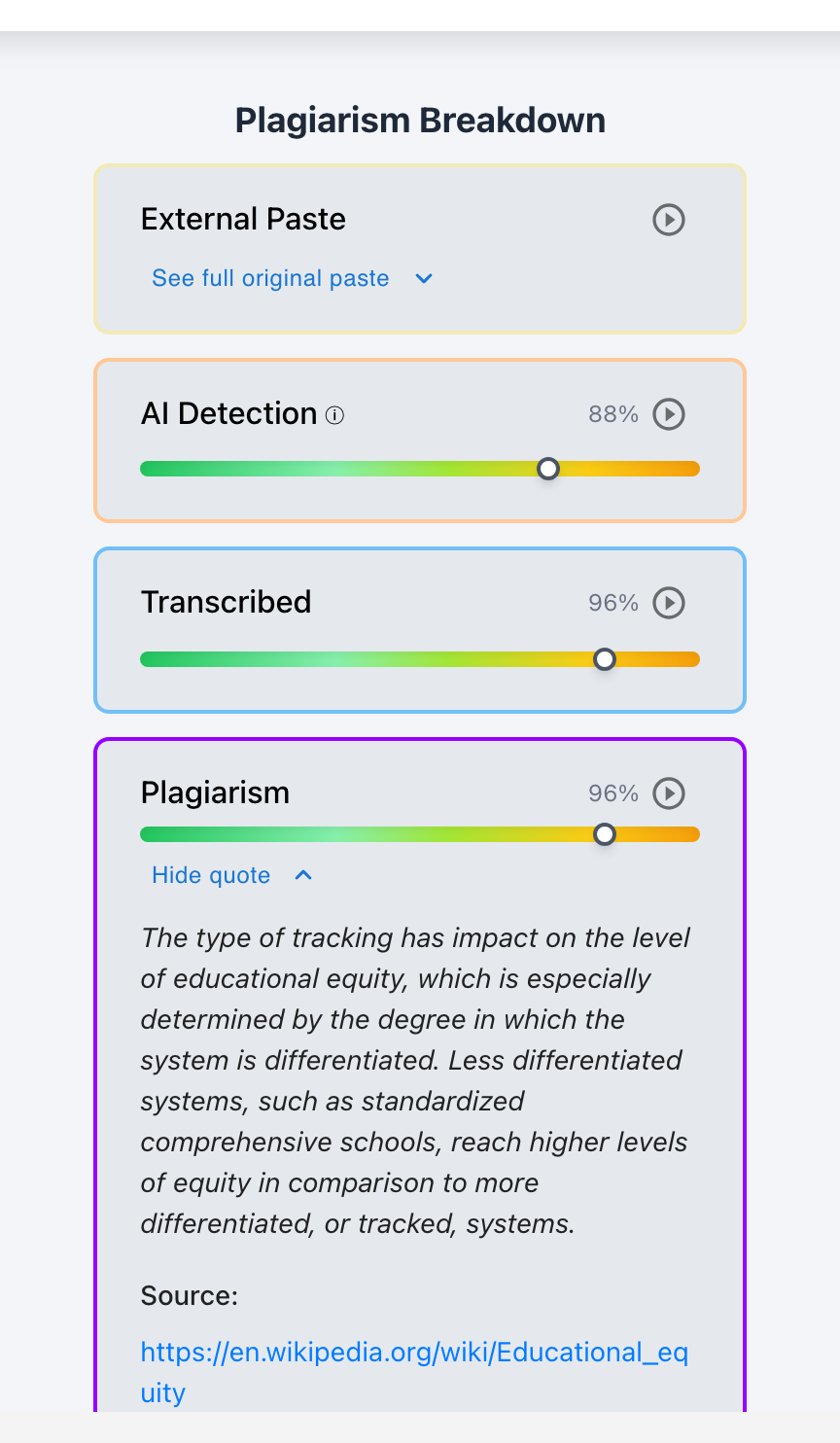
Traditional “black-box” AI percentage detectors fail catastrophically in AP Research—triggering destructive false positives on standard academic phraseology, APA/MLA reference formatting, and formal methodological prose while missing complete LLM-generated papers or humanized text. Checkmark Plagiarism resolves this crisis by pairing passage-level multi-factor linguistic analysis with patent-pending Essay Playback™ and longitudinal writing telemetry. By capturing keystroke-by-keystroke drafting velocity, natural cognitive revision pauses, and raw external clipboard paste buffers, Checkmark empowers AP Research mentors to audit the genuine intellectual lineage of every student's literature gap and empirical method log—transforming blind suspicion into verifiable, restorative academic trust.
Checkmark Plagiarism equips AP Capstone Coordinators, AP Research advisors, Seminar instructors, and secondary integrity committees with writing process telemetry and enterprise LMS integrations across Canvas LMS, Agilix Buzz, and Google Classroom.

1. The AP Research Dilemma: Scholarly Autonomy vs. Generative AI Pressures
The AP Capstone Diploma™ program—comprising AP Seminar in Grade 10 or 11 and AP Research in Grade 11 or 12—represents the pinnacle of secondary school scholarly inquiry. Unlike conventional high school research assignments that compile secondary sources into a standard report, AP Research requires students to function as primary investigators. Over the course of nine months, high school researchers must identify a genuine void in existing academic scholarship, formulate a viable and focused inquiry question, obtain Institutional Review Board (IRB) or ethical compliance approval, design an empirical methodological framework (qualitative, quantitative, or mixed methods), collect primary data, and defend their conclusions in a comprehensive 4,000- to 5,000-word academic paper accompanied by a 15- to 20-minute Presentation and Oral Defense (POD).
- Topic exploration & literature scoping
- Literature review synthesis & gap identification
- Inquiry Proposal Form (IPF) approval
- IRB & ethical compliance review
- Empirical fieldwork & lab trials
- Survey fielding / qualitative interviews
- Statistical analysis & thematic coding
- Research method log & PREP maintenance
- Results synthesis, discussion, & limitations
- Final PREP portfolio audit & attestation
- Presentation and Oral Defense (POD)
- AP Digital Portfolio late-April upload
1.1 The Anatomy of the AP Research Deliverables
To evaluate student research integrity, mentors must understand the structural components of the two mandated College Board deliverables:
-
The 4,000–5,000 Word Academic Paper: Structured like a published peer-reviewed journal article:
- Introduction & Literature Review: Contextualizes the inquiry within existing academic conversations, establishing a theoretical or empirical baseline.
- Inquiry Question & Gap Justification: Explicitly demonstrates what is missing in current scholarship and explains why this unexamined area must be investigated.
- Method, Process, or Approach: Detailed, replicable description of research design (qualitative phenomenological analysis, quantitative quasi-experimental trials, content analysis, mixed methods), participant sampling (N), data collection instruments, and ethical protections.
- Results, Findings, or Product: Presentation of raw and analyzed empirical evidence through tables, charts, statistical tests, or qualitative thematic coding matrices.
- Discussion & Analysis: Interpretation of findings in direct conversation with the foundational literature reviewed in the introduction.
- Conclusions, Limitations, & Future Directions: Honest evaluation of methodological constraints, unexpected variables, and implications for broader scholarship.
- Bibliography & Appendices: Full academic citations (APA, MLA, Chicago, or IEEE) and raw instruments (survey forms, interview protocols, consent waivers, raw data tables).
-
The Process and Reflection Portfolio (PREP):
- The Inquiry Proposal Form (IPF) approved by the teacher, along with documentation of any IRB or other required review when human subjects are involved.
- Weekly or bi-weekly annotated milestone reflections documenting research pivots, dead ends, and source evaluations.
- Mentor check-in records and physical/digital research logs recording raw timestamps of data acquisition.
1.2 The “April Crunch”: The High School Senior Pressure Cooker
The high school senior year presents an intense convergence of academic and emotional stressors. Between November and March, AP Research students juggle university early action/regular decision applications, financial aid submissions, AP exam preparation across 3–5 other Advanced Placement courses, varsity athletics, and senior milestones.
When research hits a roadblock—such as when a survey yields only 8 responses instead of the planned N=150, when an environmental biochar experiment fails to show statistically significant nitrogen adsorption, or when a planned interview subject ghosts the student—the temptation to turn to generative AI becomes acute. With the AP Digital Portfolio deadline looming in late April, a panicked high schooler can prompt an LLM to generate an entire 4,500-word paper in seconds, complete with sophisticated academic vocabulary, synthesized literature reviews, and fictitious statistical tables.
1.3 The Four Critical AI Failure Modes in AP Research
When AP Research students utilize generative AI without authorization, the integrity breakdown is far more insidious than simple copy-paste plagiarism from Wikipedia. LLMs introduce four specific academic pathologies into the research pipeline:
The LLM constructs an elegant, grammatically flawless argument claiming that Scholar A (2018) and Scholar B (2021) left a specific demographic or variable unstudied. In reality, both scholars explicitly addressed that variable, or the entire “scholarly dispute” is a hallucinated synthesis.
The model generates citations that mimic authentic scholarly formatting (for example, an invented reference formatted like Journal of Adolescent Health, Vol. 42, pp. 112–129) complete with plausible author names and synthetic DOIs (such as an invented 10.1016/j.jadohealth... string). When searched on JSTOR, PubMed, or CrossRef, the articles do not exist.
Rather than conducting 6 weeks of field surveys, the student prompts the LLM: “Generate a dataset and results section for N=180 high schoolers measuring sleep deprivation and executive dysfunction.” The AI outputs perfectly balanced descriptive statistics, Cronbach's alpha reliability scores (α = 0.88), and two-way ANOVA tables (F(2, 177) = 4.12, p = 0.018) representing zero human participants.
To satisfy PREP portfolio requirements, the student prompts the model to generate post-hoc qualitative interview transcripts, thematic coding schemes, or laboratory observation logs that match the generated results section, masking the total absence of empirical fieldwork.
2. College Board AP Capstone Scoring Standards & Academic Integrity Mandates
To effectively audit and protect student work, AP Research mentors and integrity committees must align their investigative protocols with the College Board AP Capstone Academic Paper Holistic Rubric and official policy mandates.
2.1 The AP Research Academic Paper Holistic Rubric
The AP Research Academic Paper receives a single holistic score from 1 to 5, ranging from “Report on Existing Knowledge” up to “Rich Analysis of a New Understanding Addressing a Gap in the Research Base,” and counts for 75% of the AP Research score, with the Presentation and Oral Defense providing the remaining 25%. The College Board's AP Research 2026 Scoring Guidelines describe each score level across six dimensions. The table below is a Checkmark adaptation of those dimensions, not the official rubric text, paired with the ways generative AI can distort each one:
| Rubric Dimension | Focus Area | High Score Benchmark (High Performance / Full Credit) | How Generative AI Distorts or Fakes This Component |
|---|---|---|---|
| Dimension 1 | Context & Literature Gap | Contextualizes the inquiry within a broader academic conversation and explicitly explains the scholarly gap being addressed. | Generates synthetic literature connections; manufactures artificial gaps by misrepresenting existing research or hallucinating scholarly consensus. |
| Dimension 2 | Inquiry Question / Focus | Articulates a clear, focused, feasible inquiry question that logically connects to the identified gap. | Produces high-level theoretical questions that appear sophisticated on paper but were never operationalized in physical data collection. |
| Dimension 3 | Method / Process / Approach | Justifies an intentional method aligned to the question; provides replicable details of instruments, sampling, and ethical compliance. | Synthesizes textbook methodological justifications without empirical grounding; claims human subject protections (IRB) never approved in school logs. |
| Dimension 4 | Evidence & Analysis | Presents nuanced, relevant evidence gathered through the method; executes thorough, logically sound qualitative or quantitative analysis. | Injects fabricated datasets, synthetic regression models, hallucinated quotes, or mathematically inconsistent descriptive statistics (p-values, t-tests). |
| Dimension 5 | Conclusions & Limitations | Draws nuanced conclusions directly linked to evidence; critically assesses limitations, confounding variables, and broader implications. | AI outputs generic, boilerplate limitations (“sample size was small,” “time constraints existed”) that fail to address the specific real-world flaws of actual fieldwork. |
| Dimension 6 | Conventions & Citations | Communicates clearly with scholarly conventions; cites all sources accurately with complete bibliographic references. | Generates phantom citations, broken DOIs, and mismatched in-text citations that collapse under basic library database verification. |
2.2 College Board AP Capstone Policy on Generative AI
The final academic paper, PREP reflections, and oral defense script must represent the student's original, independent intellectual work.
- Authorship Requirement: The AP Capstone policy states that all performance tasks “must be the student's own work.” Incorporating falsified or fabricated information, such as invented data, sources, or authors, earns a score of 0 on that component of the performance task, and the College Board reserves the right to investigate suspected inappropriate generative AI use as an academic integrity violation.
- Permissible AI Assistance: Using AI as an optional aid for exploring potential topics, running initial searches for sources, confirming understanding of a complex text, or checking (but not rewriting) grammar and tone, while still reading sources directly and doing one's own analysis.
- Impermissible Generative Substitution: The course description states that students may not use generative AI tools to write or create their assignments for them. In practice, that rules out having an AI formulate the inquiry question, synthesize the literature review, invent the literature gap, write the methodology, fabricate results, or generate draft prose.
Source: College Board, AP Research Course and Exam Description (AP Capstone Policy on Use of Generative Artificial Intelligence) and AP Capstone Program Policies.
2.3 Why Generic AI Percentage Detectors Break Down in AP Research
When high school mentors paste a 5,000-word AP Research draft into a generic, standalone AI detector (such as GPTZero, Copyleaks, or Turnitin's whole-document AI indicator), the result is frequently disastrous:
- Advanced high school researchers are trained to write with formal academic tone, dense nominalizations, and standardized methodological phrases: “To mitigate potential confounding variables, a quasi-experimental pretest-posttest control group design...”
- Generic detectors rely on low “perplexity” (predictability) and low “burstiness” (sentence variation).
- Formal scientific and social science prose inherently exhibits low perplexity because academic discourse follows established lexical conventions.
- RESULT: Authentic, hard-working students receive terrifying “78% AI Generated” flags on legitimate work.
- Dishonest students who use AI “humanizers” (e.g., Undetectable AI, QuillBot paraphrasing) or who prompt models with stylistic constraints (“write with irregular sentence lengths and informal rhythm”) bypass generic detectors with ease, scoring “0% AI”.
- Generic detectors cannot verify whether the cited DOI exists on JSTOR or whether the survey was fielded.
- RESULT: Fictitious papers pass uninspected, undermining academic standards and honest student effort.
Generic detectors produce an opaque, aggregate percentage number without providing primary evidence. Accusing a student of academic dishonesty based on a black-box percentage destroys student-teacher trust and leads to contentious administrative appeals with parents. AP mentors need forensic writing process telemetry and empirical evidence—not probabilistic guesses.
3. The AP Capstone Evidentiary Verification Matrix
To establish a defensible, restorative integrity protocol, AP Research teachers and department chairs should utilize the multi-dimensional evidentiary matrix below, contrasting traditional methods with Checkmark's writing telemetry suite:
| Integrity Dimension | Paper PREP Binders & Static Files | Generic Whole-Paper AI Detectors | Google Docs Version History | Checkmark Long-Form Telemetry & Essay Playback™ |
|---|---|---|---|---|
| Literature Gap Verification | Relies on student self-reporting in periodic reflection sheets. | Ineffective. Rates formal literature review phrasing as “Likely AI.” | Shows bulk edits; cannot prove student understood the source lineage. | Passage-level calibrated confidence sliders highlight synthetic claims; linked citations audit source provenance. |
| Citation Authenticity | Manual teacher spot-checking across library databases. | Blind. Cannot verify if DOIs or journal volumes actually exist. | Records pasted citations as single blocks with no source metadata. | Integrated Side-by-Side Source Matching detects web sources; identifies uncited matches and phantom references. |
| Method Log & Field Data Audit | Physical logbooks can be backfilled or forged in a single evening. | Zero capability. Evaluates text syntax, not empirical reality. | Shows timestamps of text entry, but lacks typing dynamics or pause logs. | Longitudinal Writing Velocity Curves contrast steady drafting with instant multi-thousand-character paste dumps. |
| External Text Insertion (Pastes) | Invisible once printed or exported to PDF. | Blind to whether text was typed or pasted from an LLM chat window. | Shows broad revision chunks without preserving the raw external payload. | External Paste Inspector with Full Payload Preservation stores raw pasted text even after deep rewriting. |
| Typing Forensics & Replay | None. Static final artifact only. | None. Evaluates static document state. | Coarse 15-to-30 minute interval snapshots; lacks granular key-by-key replay. | Patent-Pending Essay Playback™ (1x–8x Replay) displays real-time typing, deletions, cognitive pauses, and rewrites. |
| Transcription Detection (Copying off Phone) | Undetectable through visual inspection of final paper. | Ineffective. High-perplexity manual typing appears “human.” | Cannot differentiate composing pauses from mechanical copying. | Keystroke Dynamic Analysis flags continuous, uninterrupted typing speed devoid of natural research contemplation. |
| Rubric Feedback & Grading | Manual grading of 5,000 words takes 60–90 minutes per student. | None. Only outputs a detector percentage score. | None. Revision history tool only. | AI Autograder with AP Capstone Rubric Alignment generates draft criterion scores and quote-anchored evidence cards. |
4. Step-by-Step AP Research Mentor Audit Protocol
To ensure academic authenticity without placing unmanageable grading burdens on instructors managing 30–60 AP Research candidates, high school departments should implement this 5-Phase AP Research Audit Protocol:
Cross-examine Inquiry Proposal Form (IPF) milestones against raw survey CSVs (Google Forms timestamps), lab photos, and signed IRB consent logs. Match participant sample size N across all documents.
Spot-check 5 random citations across JSTOR, PubMed, ScienceDirect, and Google Scholar. Test DOI hyperlinks and verify that foundational scholars cited actually argue what the student claims.
Launch Checkmark Essay Playback™ to scrub through the 4,500-word drafting timeline at 2x–8x speed. Evaluate cognitive drafting curves: verify natural composing pauses, false starts, and outline revisions.
Open the Checkmark External Paste Inspector sidebar. Review raw text payloads captured during clipboard paste events and check for LLM conversational remnants or unquoted literature.
Conduct a 10-minute student conference using Checkmark evidence cards and the PREP portfolio. Ask probing methodological defense questions and transform anomalies into restorative revisions before final submission.
Phase 1: The PREP & Raw Data Concordance Audit
The most reliable defense against synthetic datasets and fictitious research logs is evidentiary concordance. An AI can easily write a convincing results section, but it cannot retroactively generate months of organic, timestamped artifacts:
- Raw Survey Telemetry: If the student conducted an online survey, require the export of the raw Google Forms / Qualtrics spreadsheet (.csv). Check submission timestamps: authentic responses trickle in over 10–21 days during school hours, showing varying completion times and occasional incomplete fields. Synthetic AI data shows identical submission dates, impossible minute-by-minute regularity, or mathematically uniform Likert distributions.
- IRB & Consent Form Concordance: Verify that the number of returned physical/digital parent consent and student assent forms matches the sample size N claimed in the Method section.
- Physical Lab Notebook & Field Artifacts: In STEM inquiries (e.g., agricultural plant growth, water quality assays, microcontroller testing), require students to upload weekly dated photos of their experimental setup with a physical handwritten index card showing the date.
Phase 2: Literature Review & Scholarly Citation Verification
Generative AI models frequently hallucinate bibliographic citations that appear authentic at first glance. Mentors can execute a rapid citation audit using the following checklist:
- The DOI Resolution Test: Click or paste 3–5 random DOIs (Digital Object Identifiers) into
https://doi.org/. Authentic DOIs resolve immediately to official publisher landing pages (Elsevier, Springer, Wiley, Sage). Hallucinated AI DOIs return404 Not Foundor resolve to entirely unrelated papers in different academic fields. - The JSTOR / PubMed Author-Title Check: Search the author's last name and primary keyword on JSTOR or Google Scholar. If the author is a real professor but the specific journal article title does not exist, the LLM hallucinated a plausible-sounding paper under a real academic's name.
- The Context Alignment Audit: For the core 2–3 foundational papers that establish the “gap,” ask the student to open the original PDF and highlight the exact paragraph where the prior researchers stated their findings. If the student cannot produce the source PDF or if the author's true conclusion contradicts the student's literature review, the gap justification was synthesized by an AI.
Phase 3: Longitudinal Writing Velocity Analysis via Essay Playback™
Writing a 4,500-word AP Research paper requires approximately 40–80 hours of active cognitive labor distributed over several months. Using Checkmark Essay Playback™, mentors can visualize and verify this drafting journey:
Features organic drafting waves distributed over months (Oct to Feb). Long cognitive pauses (1–4 mins) between synthesis paragraphs, frequent backspaces, rephrasing, and outline edits.
Flatline writing velocity over months followed by massive vertical character insertion spikes (e.g., 2,400 words in 1 second on Jan 10, and 1,800 words in 1 second on Mar 28). Zero incremental sentence formulation.
When scrubbing through Essay Playback at 2x to 8x speed:
- Look for Cognitive Hesitation & Re-Reading: Authentic high school researchers type a sentence, pause for 15–45 seconds to consult an open journal tab, delete the last clause, rewrite it, and scroll up to check terminology consistency.
- Identify Mechanical Transcription: If a student types continuously at 80 words per minute for 45 minutes straight without a single pause, backspace, or structural reorganization, they are likely copying text from a secondary screen, smartphone, or dictation tool.
Phase 4: External Clipboard Buffer Forensics
When students copy text from ChatGPT, Claude, or an AI paraphraser, they paste it into their document editor. Even if the student subsequently spends two hours manually rewording every sentence, swapping synonyms, and reformatting headings, Checkmark's External Paste Inspector preserves the original raw clipboard payload:

- Clickable Paste Markers: Checkmark flags every external paste event on the drafting timeline with a distinct visual marker.
- Raw Payload Comparison: Clicking the paste marker opens a side-by-side modal displaying the exact raw text that entered the clipboard alongside the current revised text in the draft.
- Prompt Leakage Detection: AI-generated clipboard text often contains subtle conversational artifacts that students forget to delete during initial pasting (e.g., “Here is a revised literature review addressing the gap you described:”, “In conclusion, the data demonstrates...”, or generic Markdown asterisks
**Context:**). Checkmark's payload inspector exposes these artifacts even if deleted seconds later.
Phase 5: The Restorative Oral Defense Debrief (POD Integration)
The AP Research course culminates in the 15- to 20-minute Presentation and Oral Defense (POD). Mentors should use the required in-progress checkpoint meetings, along with a pre-submission check-in, as low-stakes oral defense rehearsals to test research authenticity:
“In Section 1.2, you state that Smith (2020) failed to evaluate urban adolescent cohorts. Walk me through how you discovered that limitation in Smith's methodology, and what specific database led you to it?”
“You report a Cronbach's alpha of 0.84 for your 12-item survey instrument. Which software package or R script did you use to run that reliability calculation, and how did you handle missing survey responses?”
“Your Results section shows an almost perfect linear correlation (r = 0.91, p < 0.001). In real-world high school data, human responses are notoriously noisy. What unexpected outliers did you encounter during data collection, and why are they absent from this scatter plot?”
“Our Checkmark drafting replay shows that Section 3 (Methodology, 1,400 words) appeared in a single paste event on Sunday at 11:42 PM. Can you open your raw research notes and show me the incremental drafts and handwritten logs that preceded that paste?”
This conversational, evidence-based approach is pedagogically supportive rather than punitive. Honest students who struggled through the research will eagerly explain their methodological hiccups, spreadsheet formulas, and revision history. A student who prompted an LLM will immediately stumble on basic methodological mechanics, providing the mentor with actionable grounds for restorative intervention before the final AP Digital Portfolio submission.
5. Real-World AP Research Classroom Case Studies
The following case studies illustrate how high school AP Research instructors applied Checkmark's writing telemetry and audit protocols to resolve complex academic integrity dilemmas.
Case Study 1: The Fabricated Likert Survey in 12th Grade Behavioral Psychology
Synthetic Data Detected- The Submission: 4,800-word academic paper featuring a survey of N=220 high school peers, complete with descriptive statistics, two-way ANOVA tables, and a sophisticated literature review citing 34 sources.
- The Red Flag: Generic AI detector returned a split “42% AI” score, confusing the instructor. Mentors noticed the survey was supposedly administered during winter break when school was closed.
- The Checkmark Telemetry Audit:
- Essay Playback™ revealed that the entire 1,600-word “Results & Statistical Analysis” section was inserted via two massive external paste events spanning 90 seconds.
- The External Paste Inspector revealed the original payload contained prompt remnants: “Here is an ANOVA table and results section demonstrating statistically significant correlation...”
- Citation verification revealed that 6 out of the 34 cited papers had non-resolving DOIs and hallucinated journal volume numbers.
- The Resolution: In the restorative mentor conference, the student broke down and confessed that after only 12 classmates filled out the Google Form, panic set in over the April deadline. The mentor used the incident formatively: the student was granted a 2-week extension to analyze the real N=12 pilot data honestly, adjust the paper to a “Pilot Feasibility Study,” and discuss the limitations authentically—earning a valid score.
Case Study 2: The False-Positive Exoneration in AP STEM (Environmental Chemistry)
Student Exonerated- The Submission: A rigorous 4,600-word experimental paper detailing pyrolysis temperature variations, spectrophotometry calibration curves, and phosphate adsorption isotherms.
- The Crisis: A standalone commercial AI detector flagged the paper at “88% AI Generated,” citing uniform passive-voice scientific syntax (“The biochar was pulverized using a mortar and pestle and sieved through a 200-mesh screen to standardize particulate surface area”). The student faced an honor code referral.
- The Checkmark Exoneration:
- The instructor opened Checkmark Essay Playback™, which documented 54 distinct drafting sessions totaling 41 hours of active writing on the student's school-issued Chromebook across five months.
- Playback captured hundreds of incremental edits, chemical formula corrections, raw data table typing, and natural composing pauses averaging 45–90 seconds per paragraph.
- Checkmark's Side-by-Side Plagiarism scan confirmed that all chemical procedures cited appropriate ASTM and EPA methodology standards with correct open-source citations.
- The Outcome: The honor code accusation was immediately dismissed. The department chair used Checkmark's telemetry dossier to show parents and administrators undeniable proof of genuine student authorship.
Case Study 3: The Hallucinated Literature “Gap” in AP Humanities & Art History
Pedagogical Pivot- The Submission: 4,400-word paper claiming a “critical literature gap”: that a foundational New Deal art historian (name withheld in this illustrative case study) had “completely ignored female regionalist muralists in Midwestern post offices.”
- The Discovery: The AP mentor, familiar with New Deal art scholarship, knew that this scholar had written extensively on Midwestern women muralists.
- The Checkmark Telemetry Audit:
- Passage-level confidence sliders highlighted the entire literature gap justification as matching typical large language model rhetorical structures.
- Checkmark's External Paste Inspector revealed that the student had prompted an LLM: “Find a gap in the scholarship of [a named New Deal art historian] regarding WPA murals.” The AI, unable to find an actual gap, manufactured a false claim by misrepresenting that scholar's 1982 monograph.
- The Pedagogical Pivot: During the mentor check-in, the teacher had the student pull the scholar's actual monograph from the university inter-library loan stack. The student realized the AI had lied. The student refocused the inquiry on a genuine local gap—examining three specific municipal murals in their home county that had never been digitized or cataloged—producing an authentic, high-scoring original contribution.
6. How Checkmark Plagiarism Transforms AP Capstone Workflows
Checkmark Plagiarism was engineered specifically to solve the high-stakes integrity and workflow challenges faced by AP Capstone educators, research coordinators, and school administrators.
Keystroke-by-keystroke video replay of entire multi-month writing journeys.
- 1x–8x scrubbable speed
- Cognitive pause mapping
- Exonerates honest effort
Permanent capture of raw clipboard text even after extensive student rewrites.
- Raw payload preserved
- Timestamp & character count
- Prompt artifact scan
Granular evidence cards with calibrated confidence sliders without black-box scores.
- Calibrated confidence scale
- Perplexity & burstiness
- <150w N/A guardrail
Formative draft scoring mapped directly to College Board AP Capstone rubrics.
- Quote-anchored feedback
- Teacher final authority
- Canvas/Google/Buzz sync

1. Patent-Pending Essay Playback™ (Writing Process Telemetry)
- Keystroke-by-Keystroke Session Reconstruction: Replay the complete construction of a 5,000-word AP Research paper from blank screen to final draft at 1x, 2x, 4x, or 8x speed through Essay Playback™.
- Composing Hesitation & Revision Mapping: Visualizes natural pauses where students consult secondary literature, restructure topic sentences, or correct statistical calculations.
- The Ultimate Exoneration Dossier: Provides teachers, department chairs, and parents with undeniable visual proof of genuine student struggle, protecting hard-working students from false accusations.
2. External Paste Inspector with Complete Text Preservation
- Persistent Payload Archiving: Every external paste into the document is cataloged with exact character counts, timestamps, and preserved raw text.
- Post-Paste Rewriting Tracking: Even if a student spends hours editing, paraphrasing, or running pasted AI prose through a thesaurus, the teacher can inspect the original unedited payload with a single click.
3. Granular Passage-Level AI Analysis
- Calibrated Confidence Sliders: Rather than a single arbitrary whole-paper percentage (e.g., “64% AI”), Checkmark highlights specific passages with individual evidence cards indicating typical human vs. typical AI syntactic patterns via passage-level detection.
- Immunity to AI Humanizers: While paraphrasing tools (QuillBot, Undetectable AI) alter surface-level vocabulary to trick generic detectors, they cannot fake authentic longitudinal keystroke dynamics and temporal revision history.
- Educator-Only Flag Statuses: All flags remain strictly private to educators (Flagged, Resolved, Not Flagged) to foster supportive dialogue and prevent premature accusations.
4. AP Capstone Rubric Autograding & Quote-Anchored Feedback
- Holistic Rubric Alignment: Checkmark's AI Autograder evaluates first drafts directly against the College Board AP Research rubric, generating preliminary criterion scores and detailed written justifications.
- Quote-Anchored Justifications: Feedback cards cite exact line numbers and quotes from student prose to explain why a method justification meets the benchmark for the method dimension or lacks sufficient operationalization.
- Teacher Final Authority: All automated grades remain tentative drafts until reviewed, modified, and approved by the AP instructor, saving up to 45 minutes of grading time per scholarly paper.
5. Institutional Privacy, Ethics & Security
- Zero Model Training on Student Research: Student submissions and intellectual property are never used to train commercial AI models.
- FERPA & COPPA Compliant: Enterprise-grade encryption in transit and at rest ensures full compliance with school district data privacy standards.
- Seamless LMS Interoperability: Native integration with Google Classroom, Canvas LMS, Schoology, and Buzz LMS enables frictionless deployment across 1:1 Chromebook environments.
7. Frequently Asked Questions (FAQ)
1. How does Checkmark differentiate between authentic scholarly terminology and AI-generated text in AP Research papers?
Generic detectors rely solely on whole-document text predictability (perplexity), which causes high false-positive rates on formal academic vocabulary, statistical methodology phrases, and APA reference lists. Checkmark avoids this by combining passage-level linguistic evaluation with writing process telemetry (Essay Playback™). Even if an advanced high school researcher writes with sophisticated academic syntax, their authentic keystroke dynamics—characterized by incremental drafting, revision pauses, backspaces, and longitudinal progress over months—provide empirical proof of genuine human authorship.
2. What if an AP Research student drafted their literature review in an external tool like Google Keep, Notion, or Microsoft Word before pasting it into Google Docs?
If a student drafts offline or in another application and pastes a large block of text into their primary document, Checkmark flags the insertion as an external paste event. However, Checkmark's non-punitive framework does not treat pastes as automatic cheating. The mentor can open the External Paste Inspector and ask the student to present the version history or timestamped notes from Notion, Google Keep, or Word. Once verified, the teacher marks the flag as “Resolved” in the private educator dashboard.
3. Can Checkmark identify when a student invents fake survey data or fabricates statistical test results (p-values, Cronbach's alpha)?
While linguistic analysis alone cannot verify if a physical survey took place, Checkmark equips mentors with the audit tools necessary to expose synthetic data. First, the External Paste Inspector reveals whether complex statistical tables and results sections were typed incrementally or pasted as pre-generated blocks from an LLM. Second, Checkmark's audit protocol guides mentors to cross-reference the paper's claimed N against raw Google Forms CSV timestamps and physical consent forms in the PREP portfolio.
4. How should an AP Research mentor handle a parent conference when a student's literature gap was flagged as AI-generated?
Mentors should anchor the conference entirely in objective primary evidence using Checkmark's evidentiary dossier: (1) Open Checkmark Essay Playback™ to show the timeline: demonstrate the absence of incremental drafting and show the exact moment the literature gap was pasted. (2) Open the External Paste Inspector to show the raw payload. (3) Show the citation verification audit: demonstrate that the cited academic sources do not support the student's claimed “gap” or that the DOIs are invalid. (4) Frame the conversation around academic growth and College Board compliance: explain that catching this before the final AP Digital Portfolio submission protects the student from a score of 0 and a College Board integrity review, and provides an opportunity to revise the work authentically.
5. How does Checkmark protect honest students who write with formulaic academic structures or English as a Second Language (ESL/ELL) backgrounds?
Multilingual learners and formulaic high school writers often trigger false alarms on generic AI detectors because their vocabulary choices follow predictable patterns. Checkmark protects these students through patent-pending Essay Playback™. Because keystroke dynamics, typing rhythms, and real-time revisions cannot be faked, a multilingual student's authentic drafting history serves as unassailable forensic proof of independent authorship, instantly exonerating them from unwarranted suspicion.
6. Does using Checkmark's AI Autograder violate College Board AP Capstone scoring guidelines?
No. Checkmark's AI Autograder is an internal instructional formative tool designed for high school teachers to provide rich, rubric-aligned feedback on rough drafts during the school year. The teacher maintains 100% final authority over all scores, feedback comments, and instructional guidance. Final AP scores are assigned exclusively by College Board AP readers following official spring AP Digital Portfolio submissions.
7. How does Checkmark prevent student research papers from being scraped or used to train commercial AI models?
Unlike consumer AI platforms and questionable online editing tools, Checkmark enforces a strict Zero Data Retention / Zero Model Training Policy. Student papers, PREP portfolio artifacts, and research drafts are never ingested, indexed for public search, or used to train commercial large language models. All student data is protected under FERPA and COPPA compliance standards with robust cloud encryption.
8. Conclusion: Transforming AP Capstone Mentorship from Suspicion to Verifiable Trust
The AP Capstone research journey is one of the most transformative academic experiences available to secondary school students. It teaches young scholars how to grapple with intellectual ambiguity, design rigorous methodologies, analyze messy real-world data, and contribute original knowledge to the global academic conversation.
Generative AI does not have to spell the demise of the high school scholarly thesis. When educators rely on opaque, whole-document detector percentages, they breed an atmosphere of anxiety, false accusations, and adversarial confrontation. By shifting the paradigm to Writing Process Telemetry, patent-pending Essay Playback™, and empirical PREP data concordance, high school AP Research mentors can verify independent authorship with absolute confidence.
With Checkmark Plagiarism, educators “Stop guessing, start trusting”—safeguarding academic rigor, honoring genuine student labor, and guiding the next generation of researchers toward uncompromising scholarly integrity.