
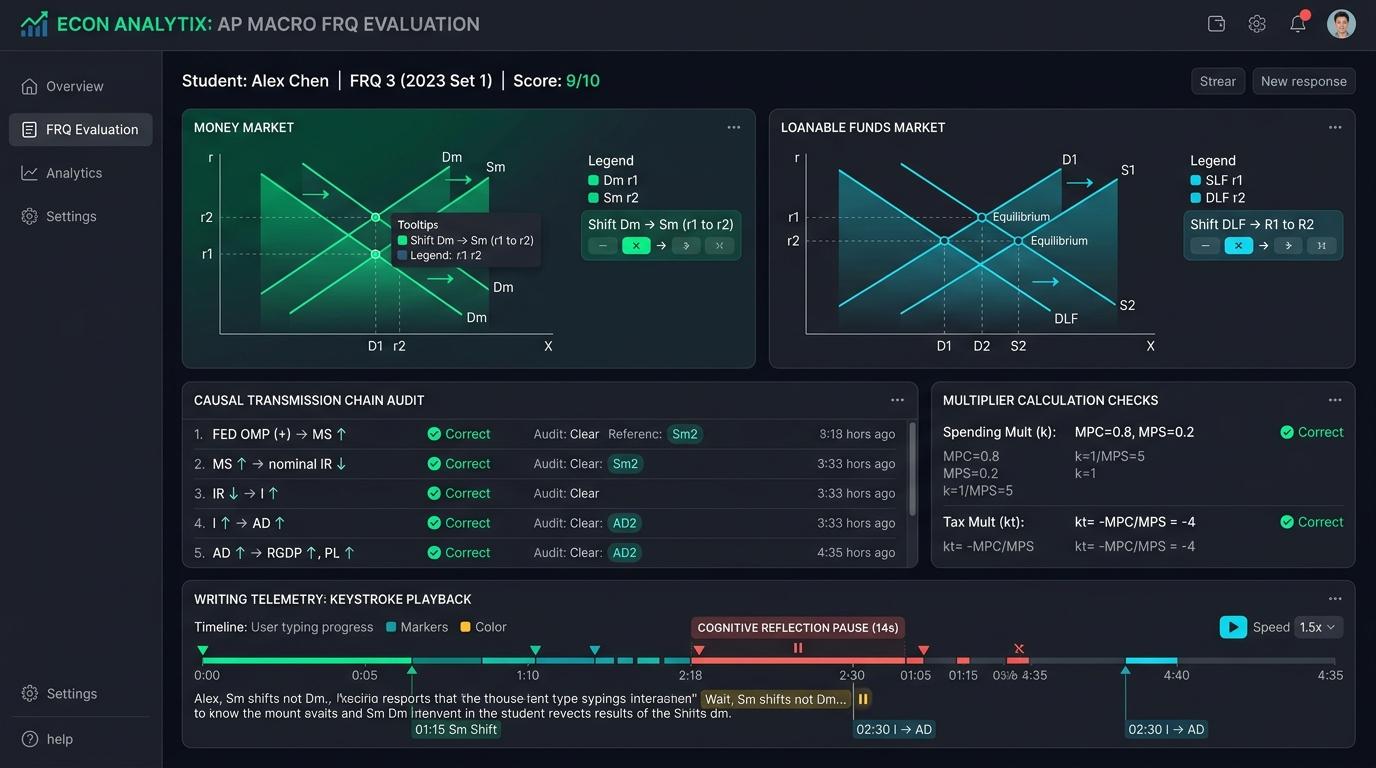
Executive Summary & Disciplinary Mandate
In high school Advanced Placement (AP) Macroeconomics, Section II Free-Response Questions (FRQs) assess a student's ability to execute rigorous multi-market policy transmission chains—linking central bank monetary interventions and fiscal budget shocks through the Money Market, Loanable Funds Market, Investment Demand, Aggregate Demand/Aggregate Supply ($AD\text{-}AS$), and long-run economic growth. With 1:1 Chromebook adoption and digital LMS submissions (Google Classroom, Canvas, AP Classroom), economics teachers managing 120–160 students across multiple class periods face a surge in generative AI shortcuts. Students prompting Large Language Models (LLMs) often submit polished, academic-sounding prose that masks fundamental economic contradictions: conflating nominal interest rates ($i$) in the Money Market with real interest rates ($r$) in Loanable Funds, inverting tax and spending multipliers, omitting non-negotiable intermediate transmission links, or generating textual graph descriptions that contradict their own derived dollar values.
When educators turn to generic, whole-document AI percentage detectors, they encounter catastrophic false positives triggered by standardized AP Econ sentence stems while missing polished, paraphrased AI fabrications. Checkmark Plagiarism resolves this scoring crisis by combining passage-level linguistic analysis with patent-pending Essay Playback™ and writing process telemetry. By capturing keystroke dynamics, mathematical scratchpad reflection pauses, and external paste payloads, economics educators can distinguish authentic economic problem-solving from LLM generation, defend honest students, and facilitate restorative whiteboard debriefs grounded in real macroeconomic mastery.
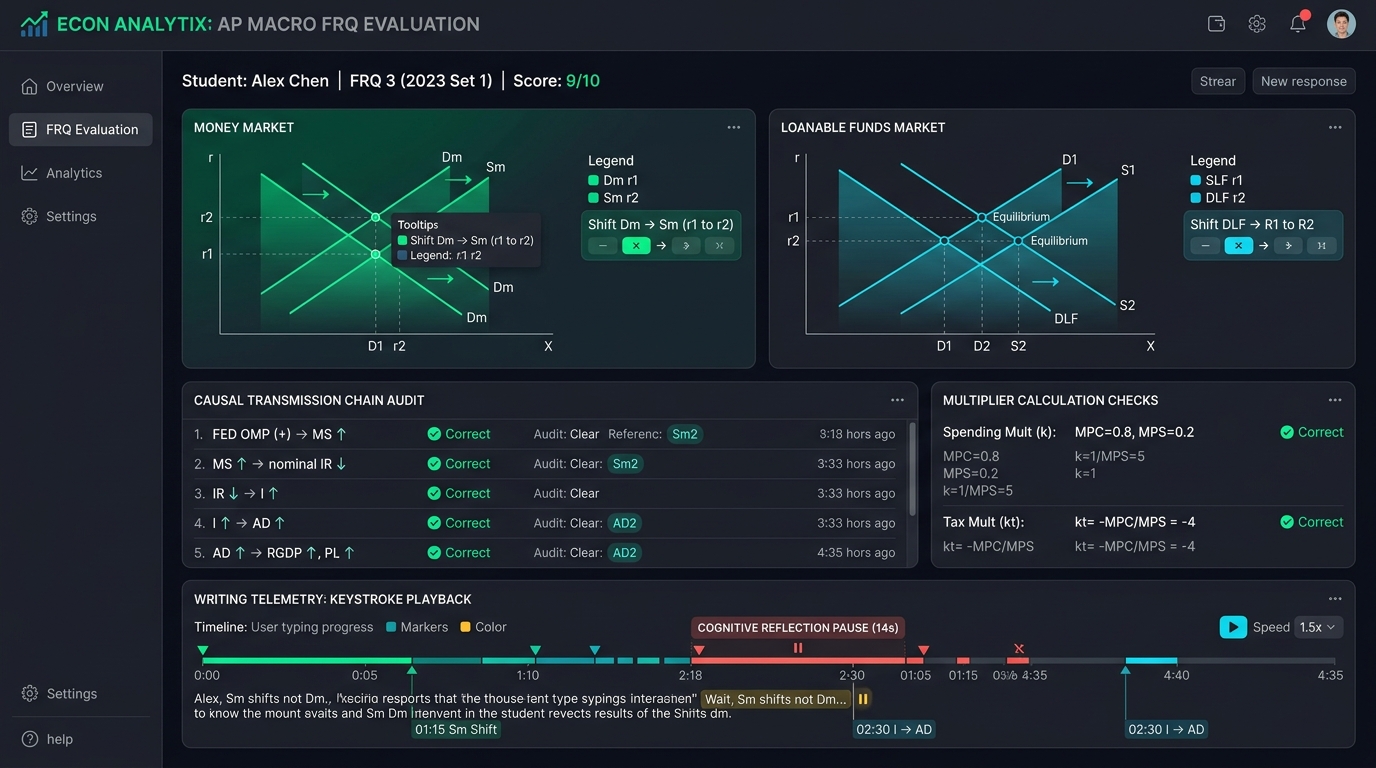
Layer 1: Multi-Market Concordance
- Nominal ($i$) vs. Real ($r$) interest rate audit
- Ample Reserves (IORB) vs. Limited Reserves (OMOs)
- Unbroken 5-step causal transmission verification
- Crowding out chain consistency ($D_{LF} \to r \to I \to AD$)
Layer 2: Multiplier Mathematical Sanity
- Marginal identities validation ($MPC + MPS = 1$)
- Spending ($1/MPS$) vs. Tax ($-MPC/MPS$) multiplier logic
- First-round tax saving leakage audit
- Balanced budget multiplier verification ($k_{bb} = 1$)
Layer 3: Keystroke Telemetry (Checkmark)
- Patent-pending Essay Playback™ (1x–8x replay)
- 15–45s scratchpad fraction & calculator pauses
- External Paste Inspector (raw clipboard payload capture)
- Passage-level confidence sliders protecting AP sentence stems
1. The Policy Derivation Crisis in High School AP Macroeconomics
Teaching Advanced Placement Macroeconomics in secondary schools requires guiding high school juniors and seniors through one of the most abstract analytical disciplines in the social studies curriculum. Unlike standard history or civics courses where students construct narrative arguments supported by primary document quotes, AP Macroeconomics demands mechanistic causal modeling. Students must operate like economic engineers: tracing how an initial policy impulse or exogenous shock ripples across interdependent financial and goods markets.
On the College Board AP Macroeconomics Exam, Section II (Free Response) accounts for 33% of the total composite score. Over a strict 60-minute window (including a 10-minute reading period), students must answer:
- One Long Free-Response Question (10 Points): An exhaustive, multi-market synthesis problem requiring students to diagnose an initial economic condition (e.g., a recessionary output gap), trace a fiscal or monetary policy response through multiple distinct graphical models, calculate spending or tax multipliers, explain the crowding out effect, and determine the long-run consequences on potential gross domestic product (real GDP) and the production possibilities curve ($PPC$).
- Two Short Free-Response Questions (5 Points Each): Targeted, high-intensity problems focusing on specific mechanisms—such as the foreign exchange market ($FOREX$), financial capital flows, banking balance sheets (T-accounts), deposit expansion, or the Phillips Curve relationship.
┌────────────────────────────────────────────────────────────────────────────────────────────────────────┐
│             THE AP MACROECONOMICS FRQ INTEGRITY DILEMMA IN 1:1 CHROMEBOOK CLASSROOMS                   │
├────────────────────────────────────────────────────────────────────────────────────────────────────────┤
│                                                                                                        │
│   [ AUTHENTIC STUDENT ECONOMIC DERIVATION ]             [ GENERATIVE LLM ECONOMIC SYNTHESIS ]          │
│   ├─ Step-by-step causal chain modeling                 ├─ Instant, polished policy summary            │
│   ├─ Explicit distinction: Nominal (i) vs. Real (r)     ├─ Conflates Money Market & Loanable Funds     │
│   ├─ Organic calculation pauses (1/MPS scratch work)    ├─ Inverts multiplier formulas (divides by MPC)│
│   ├─ Rigorous transmission: Fed -> MS -> i -> I -> AD   ├─ Omits intermediate transmission links       │
│   ├─ Graph-to-text concordance (AD shifts match math)   ├─ Contradictory prose (AD right, PL falls)    │
│   └─ Keystroke revisions & backspacing on sign errors   └─ Rapid paste payload / smooth linear typing  │
│                                │                                                │                      │
│                                └───────────────────────┬────────────────────────┘                      │
│                                                        ▼                                               │
│                                        ┌───────────────────────────────┐                               │
│                                        │  THE AP ECON TEACHER'S AUDIT  │                               │
│                                        │  • 140 FRQs to grade over     │                               │
│                                        │    a single weekend           │                               │
│                                        │  • Black-box AI detectors fail│                               │
│                                        │  • AP sentence stems trigger  │                               │
│                                        │    devastating false alarms   │                               │
│                                        └───────────────┬───────────────┘                               │
│                                                        │                                               │
│                                                        ▼                                               │
│                                      [ STATIC PROBABILISTIC AI SCAN: "84% AI" ]                        │
│                                                        │                                               │
│                         ┌──────────────────────────────┴──────────────────────────────┐                │
│                         ▼                                                             ▼                │
│       [ FALSE ACCUSATION OF HONEST AP STUDENT ]                     [ UNCHECKED AI SHORTCUT INGESTION ]│
│       • Student used formulaic College Board phrasing               • Student pasted LLM response      │
│       • "An increase in G will shift AD right by..."                • Text sounds scholarly but lacks  │
│       • Student penalized for writing precisely                     • intermediate transmission step   │
│       • Trust between AP teacher and student breaks                 • Student fails official AP exam   │
│                                                                                                        │
│   SOLUTION: Checkmark Process Telemetry + Keystroke Playback + Multi-Market Transmission Concordance   │
└────────────────────────────────────────────────────────────────────────────────────────────────────────┘
The Digital Shift and the Generative AI Threat
In the modern secondary classroom, high school teachers manage between 120 and 160 students distributed across 5 or 6 class periods. To prepare students for the digital AP exam administration and manage heavy grading loads, teachers frequently assign FRQ problem sets, unit diagnostic assessments, and timed writes through Google Classroom, Canvas LMS, Schoology, and AP Classroom.
However, the widespread deployment of 1:1 Chromebooks combined with generative Large Language Models (such as ChatGPT, Claude, and Gemini) has created an unprecedented integrity crisis:
- Frictionless Shortcutting: When presented with a complex prompt—such as explaining how a central bank's open-market purchase affects real interest rates, private investment, and capital accumulation—students can copy the prompt into an LLM and receive a complete, 300-word explanation in seconds.
- The Illusion of Fluency: Generative AI produces fluid, highly authoritative prose. To an overworked teacher skimming dozens of multi-part FRQ submissions late on a Sunday evening, the response appears competent at first glance.
- Underlying Conceptual Collapse: Beneath the surface vocabulary, LLM-generated economics responses consistently exhibit fatal structural errors. Generalist LLMs frequently hallucinate transmission steps, confuse nominal and real variables, misapply multiplier equations, and blend obsolete monetary policy tools with updated framework guidelines.
- The Failure of Generic AI Detectors: When teachers run these submissions through standard whole-document AI detectors (e.g., Turnitin AI score, GPTZero), they encounter a dual failure: high false-positive rates on honest students who write in the crisp, formulaic style rewarded by College Board rubrics, and false negatives on polished AI answers slightly tweaked by students.
2. The Multi-Market Policy Transmission Architecture of AP Macroeconomics
To evaluate whether a student's written FRQ represents authentic economic reasoning or machine generation, teachers must ground their evaluation in the explicit graphical and mathematical frameworks established by the College Board AP Macroeconomics Course and Exam Description (CED).
Macroeconomic policy analysis is governed by precise transmission chains. An authentic AP-level explanation must link an initial policy instrument through intermediate financial markets to goods markets and long-run capacity.
┌────────────────────────────────────────────────────────────────────────────────────────────────────────┐
│                 THE MULTI-MARKET POLICY TRANSMISSION CHAIN IN AP MACROECONOMICS                        │
├────────────────────────────────────────────────────────────────────────────────────────────────────────┤
│                                                                                                        │
│   [ STAGE 1: POLICY SHOCK ]                                                                            │
│   ├─ Monetary (Limited Reserves): Fed buys/sells bonds, changes Discount Rate / Reserve Requirement    │
│   ├─ Monetary (Ample Reserves): Fed adjusts administered rates (Interest on Reserve Balances - IORB)   │
│   └─ Fiscal Policy: Congress/President changes Government Spending (G) or Lump-Sum Taxes (T)           │
│                                │                                                                       │
│                                ▼                                                                       │
│   [ STAGE 2: FINANCIAL & MONEY MARKETS ]                                                               │
│   ├─ Money Market (Short-Run Liquidity):                                                               │
│   │   • Money Supply (MS) shifts against Money Demand (MD) -> Sets Nominal Interest Rate (i)           │
│   ├─ Loanable Funds Market (Long-Run Savings & Investment):                                            │
│   │   • Supply (SLF) vs. Demand (DLF) -> Sets Equilibrium Real Interest Rate (r)                       │
│   └─ Fisher Relationship: i = r + π^e (Nominal Rate = Real Rate + Expected Inflation)                  │
│                                │                                                                       │
│                                ▼                                                                       │
│   [ STAGE 3: PRIVATE INVESTMENT & EXPENDITURE ]                                                        │
│   ├─ Real Interest Rate (r) alters cost of borrowing for capital goods                                 │
│   ├─ Movement along Investment Demand Curve (I) -> Gross Private Domestic Investment changes           │
│   └─ Multiplier Expansion: Spending Multiplier k_s = 1/MPS or Tax Multiplier k_t = -MPC/MPS            │
│                                │                                                                       │
│                                ▼                                                                       │
│   [ STAGE 4: GOODS & SERVICES MARKET (AD-AS MODEL) ]                                                   │
│   ├─ Aggregate Demand Shifts: ΔAD = ΔI x k_s or ΔG x k_s                                               │
│   ├─ Short-Run Equilibrium: Price Level (PL) and Real GDP Output (Y) adjust                            │
│   └─ Output Gap Closure: Closing a Recessionary Gap (Y_1 < Y_f) or Inflationary Gap (Y_1 > Y_f)        │
│                                │                                                                       │
│                                ▼                                                                       │
│   [ STAGE 5: LONG-RUN GROWTH & CAPITAL FORMATION ]                                                     │
│   ├─ Change in Private Capital Investment (ΔI) shifts Long-Run Aggregate Supply (LRAS)                 │
│   ├─ Physical Capital Stock accumulates (or depreciates) -> Production Possibilities Curve (PPC)       │
│   └─ Crowding Out: Deficit spending -> DLF ↑ -> r ↑ -> I ↓ -> LRAS growth slows                        │
│                                                                                                        │
└────────────────────────────────────────────────────────────────────────────────────────────────────────┘
2.1 Monetary Policy Transmission: Limited Reserves vs. Ample Reserves Frameworks
One of the most common markers of an unvetted or AI-generated economics response is the confusion between the Limited Reserves and Ample Reserves monetary policy frameworks.
In recent years, the College Board updated the AP Macroeconomics curriculum to reflect modern central banking operations:
A. Limited Reserves Framework
Commercial banks hold minimal excess reserves. The Fed conducts policy by manipulating the volume of bank reserves:
- Open Market Operations (OMOs): Buying bonds expands reserves and shifts $M_S$ right ($i \downarrow$); selling bonds shrinks reserves ($i \uparrow$).
- The Discount Rate: Interest rate charged to banks borrowing directly from the Fed discount window.
- Reserve Requirement Ratio ($rr$): Statutory percentage of checkable deposits banks must hold in reserve.
B. Ample Reserves Framework
Commercial banks hold an abundance of excess reserves. The Fed steers the policy rate via Administered Rates:
- Interest on Reserve Balances (IORB): Primary benchmark rate. Lowering IORB lowers market interest rates; raising IORB pushes market rates up.
- Overnight Reverse Repurchase (ON RRP): Supplementary sub-floor rate for non-bank financial institutions.
- Integrity Flag: AI models frequently suggest open-market bond purchases in ample reserves prompts—earning 0 points on AP exams.
2.2 The Money Market vs. The Loanable Funds Market & The Fisher Relationship
A foundational pillar of AP Macroeconomics is the distinction between short-run nominal liquidity in the Money Market and long-run real capital allocation in the Loanable Funds Market.
Money Market vs. Loanable Funds Market: The Structural Dichotomy
| Feature | Money Market | Loanable Funds Market |
|---|---|---|
| Vertical Axis Variable | Nominal Interest Rate ($i$) | Real Interest Rate ($r$) |
| Horizontal Axis Variable | Quantity of Money ($M$) | Quantity of Loanable Funds ($Q_{LF}$) |
| Supply Curve Definition | Money Supply ($M_S$) (Set vertically by Central Bank) | Supply of Loanable Funds ($S_{LF}$) (National Savings: Private + Public) |
| Demand Curve Definition | Money Demand ($M_D$) (Transaction + Asset Demand) | Demand for Loanable Funds ($D_{LF}$) (Business Borrowing + Deficit Spending) |
| Analytical Time Horizon | Short-run liquidity & monetary equilibrium | Long-run savings, real capital, and investment |
| Primary Policy Driver | Central bank monetary operations (OMOs / IORB) | Fiscal deficits, national savings rates, foreign capital flows |
The bridge connecting these two distinct financial markets is the Fisher Equation:
Where $i$ = Nominal interest rate, $r$ = Real interest rate, and $\pi^e$ = Expected inflation rate.
2.3 Fiscal Policy Multipliers and Mathematical Derivations
AP Macroeconomics FRQs require students to perform precise mathematical calculations using marginal propensities and multiplier formulas.
1. Marginal Propensities Fundamental Identity
Every dollar of disposable income is either consumed ($MPC$) or saved ($MPS$).
2. Expenditure / Spending Multiplier ($k_s$)
Applies to direct injections in government purchases ($G$) or private investment ($I$).
3. Tax Multiplier ($k_t$)
Negative and smaller in magnitude because households save a portion ($(1-MPC)$) of a tax cut.
4. Balanced Budget Multiplier ($k_{bb}$)
An equal increase in $G$ and $T$ expands Real GDP by exactly the initial change in $G$.
The Crowding Out Transmission Chain
When evaluating long FRQs involving fiscal expansion, the College Board tests the Crowding Out Effect. Authentic student derivations must follow an unbroken six-stage chain:
3. The Hallucination Anatomy: How LLMs Botch High School Economics FRQs
When high school students prompt Large Language Models to complete AP Macroeconomics FRQs, the resulting text often displays specific structural flaws. Generative models operate on probabilistic word associations rather than an internal, coherent mathematical model of macroeconomics.
Failure Mode 1: Market & Rate Conflation
- Blends Money Market ($M_S/M_D$) with Loanable Funds ($S_{LF}/D_{LF}$).
- Uses nominal interest rate ($i$) on the vertical axis of a Loanable Funds explanation.
- Claims government deficit borrowing shifts the Money Supply ($M_S$).
Failure Mode 2: Multiplier Formula Inversion
- Divides by $MPC$ instead of $MPS$ (calculating $k = 1/0.8 = 1.25$ instead of $5$).
- Applies spending multiplier ($k_s$) to a tax cut, omitting initial saving leakage.
- Omits the negative sign on the tax multiplier ($Delta T \uparrow \to \Delta Y \uparrow$).
Failure Mode 3: Disconnected Transmission Links
- Jumps directly: “The Fed buys bonds, so Aggregate Demand increases and GDP rises.”
- Skips essential intermediate nodes: Reserves $\to M_S \uparrow \to i \downarrow \to I \uparrow \to AD \uparrow$.
- Loses full credit on College Board rubrics requiring every step in the chain.
Failure Mode 4: Graph-Text Contradictions
- Text claims Aggregate Demand shifts right, but price level ($PL$) decreases.
- Asserts real interest rates rise while claiming private investment increases.
- Calculates a $+\$120\text{ billion}$ GDP expansion but describes a leftward shift in $AD$.
4. The AP Scoring & Pedagogical Dilemma: Why Generic AI Detectors Fail High School Economics
When secondary social studies departments attempt to police digital FRQ submissions using generic, whole-document AI percentage detectors, they create serious pedagogical challenges.
The False Positive Crisis on Standardized AP Sentence Frames
AP Economics teachers spend months training students to write using concise, formulaic sentence frames to ensure they earn every assertion and justification point on the national exam:
“Because the Federal Reserve purchased bonds on the open market, the supply of money increases, which decreases the nominal interest rate, stimulating interest-sensitive investment demand and shifting aggregate demand to the right.”
Because these sentences are grammatically consistent, syntactically predictable, and heavily represented across hundreds of public College Board scoring keys, generic probabilistic detectors classify them as machine-generated—assigning a disciplined, honest student an 80% to 95% AI score. Checkmark eliminates this bias through passage-level confidence calibration and keystroke telemetry.
5. The High School Economics Evidentiary Matrix
To evaluate student FRQs accurately, economics educators need a multi-dimensional evidentiary framework. The matrix below compares the four primary evaluation methods used in high school social studies departments.
High School AP Economics Evidentiary Comparison Matrix
| Evaluation Dimension | Paper Blue Books (Handwritten) | Generic AI Detectors (Static Scan) | Google Docs Revision History | Checkmark Writing Telemetry & Essay Playback™ |
|---|---|---|---|---|
| Causal Chain & Mathematical Visibility | High (hand-drawn graphs & scratch math) | Zero (opaque whole-paper probability score) | Low (coarse autosave bulk snapshots) | High (two-way linked evidence cards highlight transmission links) |
| Keystroke Dynamics & Reflection Pauses | Physical erasures & margin calculations | Non-existent (evaluates static surface text) | None (cannot distinguish typing cadence from pasting) | Complete (tracks typing rhythm, 15–45s scratchpad pauses, revisions) |
| External Paste Capture & Clipboard Telemetry | Not applicable (in-class paper write) | None (blind to clipboard events) | Minimal (shows lump text without source payload) | Full timestamped payload capture with 1-click jump to playback |
| Ample vs. Limited Reserves Discrimination | Teacher must manually verify every line | Completely blind to economic framework tools | None | Passage analysis flags framework tool mismatches in context |
| False Positive Defense on AP Phrasing | Complete (student's handwriting) | Extremely Poor (heavily penalizes formulaic AP syntax) | Moderate (shows edit history if not pasted) | High (authentic drafting telemetry fully exonerates honest students) |
| Restorative Conference Support ("Receipts") | Relies on oral re-examination | Highly antagonistic (unprovable black-box score) | Weak (student claims "I drafted in Word first") | Constructive & transparent (teacher and student replay drafting timeline) |
6. Step-by-Step Economics Teacher Audit Protocol
When evaluating digital AP Macroeconomics FRQs, teachers can follow this four-step audit protocol to ensure defensible scoring and targeted pedagogical feedback.
Multi-Market Transmission Concordance Audit
- Framework Check: Did the student correctly identify an administered rate (IORB) for ample reserves or open-market operations (OMOs) for limited reserves?
- Variable Alignment: Is the nominal interest rate ($i$) strictly assigned to the Money Market and the real interest rate ($r$) to Loanable Funds?
- Unbroken Chain: Did the student include every intermediate link: $\text{Fed Action} \to \text{Reserves} \to i/r \to I \to AD \to Y/PL$?
Multiplier Mathematical Sanity Check
- Identity Verification: Does $MPC + MPS = 1$? (e.g., if $MPC = 0.75$, does $MPS = 0.25$?)
- Formula Selection: Was $k_s = 1/MPS$ applied to spending and $k_t = -MPC/MPS$ applied to taxes?
- Concordance: Does the calculated dollar change in Real GDP match the directional shift described in the $AD\text{-}AS$ text?
Writing Telemetry & Essay Playback™ Review
- Scrub Timeline: Replay the student's drafting session at 2x to 4x speed in Checkmark Essay Playback™.
- Cognitive Pauses: Look for natural 15- to 45-second composing pauses during fraction calculations and graph shifts.
- Paste Inspector: Check if multi-paragraph policy solutions were pasted in a single 1-second burst without prior typing.
Restorative Economics Integrity Debrief & Whiteboard Reconstruction
- Collaborative Timeline Review: Open the playback report alongside the student in a supportive conference.
- Whiteboard Oral Walkthrough: Hand the student a marker and ask them to sketch the transmission chain on a whiteboard.
- Diagnostic Remediation: Treat AI shortcuts as indicators of conceptual confusion regarding multipliers or loanable funds.
7. High School Classroom Case Scenarios
The following three scenarios illustrate how writing process telemetry and economic concordance checks operate in real high school settings.
12th Grade AP Macro Unit 4 FRQ — The Crowding Out Hallucination
The Problem:
A student submitted a sophisticated response asserting that government deficit spending “causes the money supply curve in the money market to shift leftward, driving up nominal interest rates and causing aggregate supply to shift left.”
The Checkmark Resolution:
- Economic Concordance: Deficit borrowing occurs in Loanable Funds ($D_{LF} \uparrow$), affecting Real Interest Rates ($r$) and Investment Demand ($I$), not Money Supply or Aggregate Supply.
- Paste Inspector: Essay Playback™ revealed 280 words pasted from an external tab in 0.8 seconds without prior drafting.
- Outcome: In a restorative whiteboard debrief, the student admitted using ChatGPT. The teacher retaught the 6-stage Crowding Out chain, resolving the misconception before the AP exam.
11th Grade AP Econ Timed Multiplier FRQ — False Positive Exonerated
The Problem:
A high-achieving student wrote a disciplined multiplier proof ($MPC=0.8, k_s=5, k_t=-4$). A generic whole-document AI detector flagged the submission as 89% AI-generated due to formulaic College Board phrasing.
The Checkmark Resolution:
- Essay Playback™: Verified 18 minutes of continuous composition with 35- to 40-second calculator scratchpad pauses.
- Revision Pattern: Captured organic backspacing to correct a negative sign error on the tax multiplier.
- Outcome: The student was immediately awarded full 5/5 credit with zero disciplinary friction; parent trust remained completely intact.
12th Grade AP Macro Exam — Ample vs. Limited Reserves Mismatch
The Problem:
The exam prompt explicitly specified an economy with ample reserves. The student submitted a 300-word response instructing the Federal Reserve to conduct open-market bond purchases and lower reserve requirements.
The Checkmark Resolution:
- Framework Mismatch: In ample reserves, administered rates (IORB) are the primary tool; open market operations earn 0 credit on AP rubrics.
- Paste Inspector: Checkmark captured a single paste payload matching an outdated online LLM prompt.
- Outcome: The teacher used the telemetry to show why generalist AI models fail on updated College Board CED standards.
8. How Checkmark Plagiarism Empowers High School Economics Educators
Checkmark Plagiarism provides high school social studies departments with a purpose-built academic integrity and assessment suite designed specifically for secondary classrooms.
1. Patent-Pending Essay Playback™
Reconstructs the student's complete writing session keystroke by keystroke at 1x to 8x speed. Observe scratchpad calculator pauses, formula sign corrections, and transmission drafting cadence in real time.
2. External Paste Inspector
Captures every clipboard paste event with exact millisecond timestamps and word counts. Preserves the raw pasted payload even if the student subsequently paraphrases or edits the text.
3. Passage-Level Calibrated Sliders
Replaces opaque whole-paper percentages with sentence-level evidence cards. Eliminates false positives on formulaic College Board sentence stems and enforces short-text guardrails (<150 words).
4. Quote-Anchored Rubric Autograding
Aligns student FRQ writeups directly to custom College Board scoring rubrics. Generates point recommendations with written justifications anchored directly to student quotes, syncing back to Canvas and Google Classroom.
9. Frequently Asked Questions (FAQs)
1. Why do generic AI detectors flag standard AP Economics sentence stems as AI-generated?
Generic AI detectors calculate linguistic perplexity (word predictability) and burstiness (sentence length variation). In AP Macroeconomics, students are explicitly trained to use uniform, standardized sentence frames (e.g., “An increase in government spending will increase aggregate demand, shifting the curve to the right...”) to earn points on College Board rubrics. Because these sentence structures are highly predictable and frequent in educational training data, generic detectors misclassify them as AI text. Checkmark eliminates this problem by pairing passage-level analysis with keystroke telemetry, proving that the predictable phrasing was typed organically.
2. How does Essay Playback™ distinguish between typing an economic derivation from memory versus copying from a phone or second screen?
When a student types an authentic economic derivation from memory or active reasoning, their keystroke dynamics display natural variation: short composing pauses when calculating fractions ($1/MPS$), burst typing on familiar terms, and immediate backspacing to correct typographical or sign errors. When a student transcribes text while reading from a phone or second monitor, the typing rhythm is mechanical and continuous, lacking calculation pauses or conceptual revisions.
3. How does Checkmark handle short-answer AP economics responses under 150 words?
Generic detectors frequently produce wild guesses when evaluating short texts because the sample size is statistically insufficient. Checkmark implements strict, honest guardrails: for submissions below ~150 words (such as brief warm-ups or single-part short FRQs), the AI detection module displays N/A rather than generating an unreliable score, while still providing complete keystroke playback and paste inspection.
4. Can Checkmark detect when a student uses an "AI Humanizer" to bypass detection?
Yes. Commercial AI humanizers and paraphrasers (such as QuillBot or Undetectable AI) alter surface vocabulary to evade probabilistic text scanners. However, they cannot fake authentic writing telemetry. A student who runs an LLM response through a humanizer must still paste the resulting text into their document. Checkmark’s External Paste Inspector captures the paste payload instantly, while Essay Playback™ shows the total absence of organic drafting.
5. What is the difference between Ample Reserves and Limited Reserves, and why is this critical for integrity audits?
In a limited reserves framework (pre-2008), the Fed uses open-market operations, the discount rate, and reserve requirements to alter the money supply. In an ample reserves framework (current Fed operating regime), the banking system has excess reserves, so the Fed uses administered rates—primarily Interest on Reserve Balances (IORB)—to control the policy rate. Generalist AI models frequently mix these two frameworks. Identifying this conceptual mismatch allows teachers to detect unverified AI generation while providing targeted instruction.
6. How does Checkmark support restorative parent-teacher conferences regarding academic integrity?
Accusing a high school student of cheating based solely on a "75% AI" score often leads to defensive, unproductive meetings. Checkmark provides objective, transparent evidence ("receipts"). Teachers can open Essay Playback™ and review the writing session alongside parents and students, showing keystroke timing, paste events, and drafting history. This shifts the conference from an adversarial confrontation to a constructive conversation about study habits and authentic learning.
7. Does Checkmark integrate with learning management systems like Canvas and Google Classroom?
Yes. Checkmark integrates natively with Google Classroom, Canvas LMS, Schoology, Buzz LMS, and Microsoft 365. Teachers can import assignments, evaluate submissions with keystroke telemetry, and sync finalized grades and rubric feedback directly back into their LMS gradebook.
10. Conclusion: Defending Economic Rigor with Writing Process Telemetry
Teaching high school AP Macroeconomics is about empowering students to trace the causal architecture of modern economies. When students rely on unvetted LLM shortcuts, they cheat themselves of the quantitative intuition and multi-market synthesis required for collegiate success and civic literacy.
By equipping social studies departments with Checkmark Plagiarism and patent-pending Essay Playback™, educators can look beyond surface prose, celebrate honest student problem-solving, and ensure that every policy derivation and multiplier calculation represents genuine economic mastery.
Ready to bring writing telemetry & causal verification to your AP Economics classroom?
Empower your social studies department with Checkmark's multidimensional integrity platform today.