
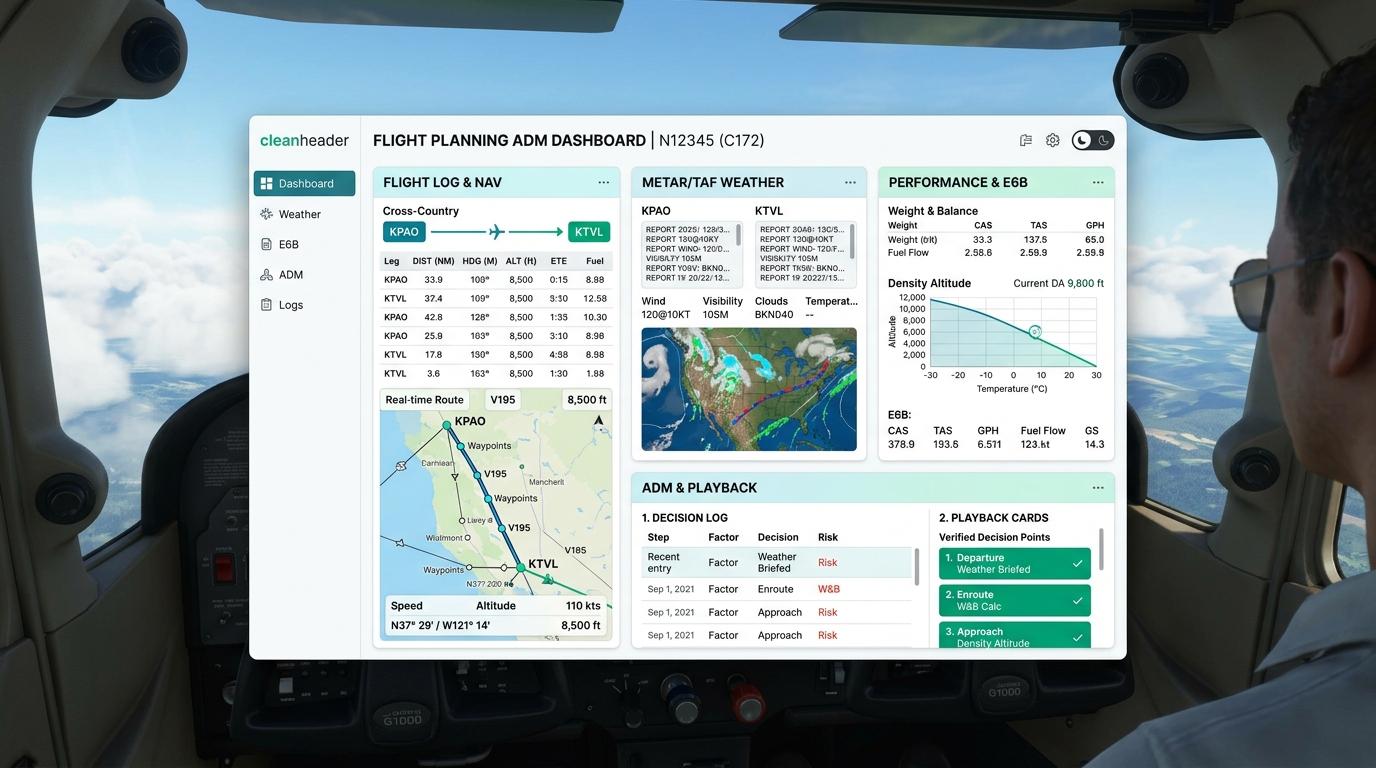
In collegiate aviation programs and FAA Part 141 approved flight schools, pre-flight ground writeups, cross-country navigation logs (navlogs), weather briefs, and emergency procedure analyses are not mere academic exercises—they are life-critical demonstrations of Aeronautical Decision-Making (ADM). However, the unchecked proliferation of Generative AI has created a severe aviation safety hazard. Student pilots are increasingly using Large Language Models (LLMs) to synthesize polished, textbook-fluent pre-flight dossiers that fabricate calm weather on active thunderstorm corridors, calculate aerodynamically impossible density altitude figures, overlook critical Notice to Air Missions (NOTAM) runway closures, and output unvetted, out-of-sequence emergency checklists.
When faculty audit these submissions with legacy “black-box” AI detectors, the software routinely triggers false alarms on standardized FAA acronyms (METAR, TAF, VFR, IFR, POH, Vno, Vy) while missing dangerous AI-generated operational hallucinations. Checkmark Plagiarism provides collegiate aviation departments, Chief Flight Instructors (CFI/CFII), and Aviation Safety Review Boards with an empirical, non-punitive solution. Powered by Writing Process Telemetry and patent-pending Essay Playback™, Checkmark captures the granular keystroke dynamics, raw external paste buffers, and mathematical calculation pauses that distinguish authentic aeronautical reasoning from cut-and-paste generative text. This multi-dimensional evidence protects students against wrongful AI accusations, upholds Aviation Accreditation Board International (AABI) and FAA Part 141 regulatory compliance, and ensures that only genuinely competent pilots advance to the cockpit.
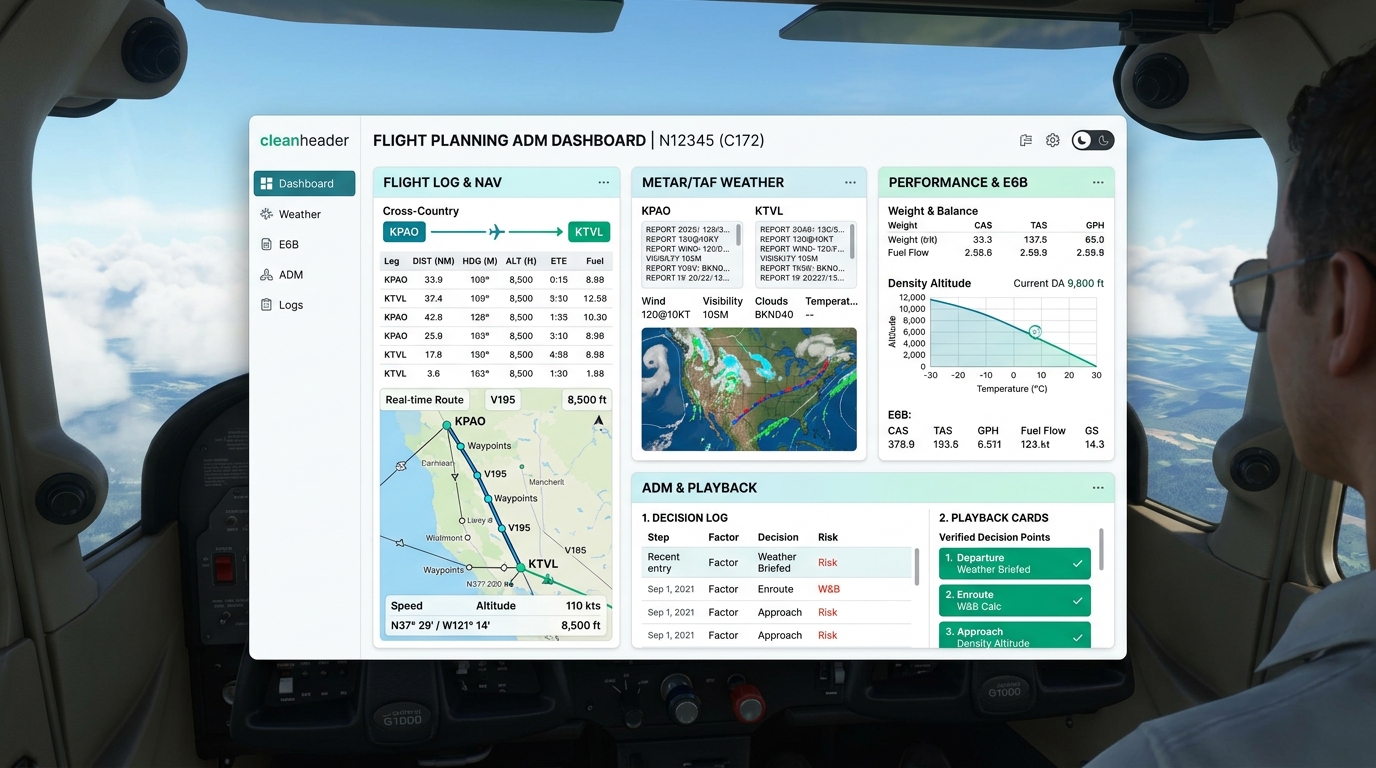
Checkmark Plagiarism provides flight training institutions with an enterprise-grade suite of forensic tools, including keystroke-by-keystroke writing process playback, passage-level AI confidence scoring, ACS-aligned rubric autograding, and direct LMS integration with Canvas LMS, Agilix Buzz, and Google Classroom.
1. The Crisis of Synthetic Flight Planning in Collegiate Aviation
Collegiate aviation education occupies a unique position in higher education: academic coursework directly bridges the gap between theoretical classroom knowledge and immediate physical safety at 10,000 feet Mean Sea Level (MSL). In programs operating under 14 CFR Part 141, every cross-country flight planning assignment, stage-check oral briefing packet, and written emergency diversion scenario serves as a prerequisite filter before an instructor signs off on a solo endorsement or stage check completion.
Today, this rigorous gatekeeping mechanism is undergoing an unprecedented crisis driven by Large Language Models.
- Assignment: 250 NM Cross-Country Briefing & Navlog
- Raw Inputs: Live METAR, TAF, Winds Aloft, NOTAMs
- Complex Math: Weight & Balance, Density Altitude, E6B
- Temptation: Prompting LLM for Fast, Fluent Writeup
- FAA Part 141: Chief Flight Instructor oversight & stage checks
- AABI Criteria 3 & 5: Outcomes assessment in ADM & safety
- Aviation Safety Board: SMS hazard reporting (AC 120-92)
- 14 CFR § 91.103: Mandatory pre-flight action compliance
Triggers false positives on standard FAA acronyms (VFR, IFR, POH, AGL, MSL, Vy). Punishes honest students reciting memory items.
AI hallucinations pass as valid prose. Zero proof of manual E6B calculation. Pilot enters cockpit without true emergency decision logic.
1.1 The High Stakes of Pre-Flight Briefings in FAA Part 141 Flight Training
Under Federal Aviation Regulation 14 CFR § 91.103 (Preflight Action), each pilot in command must, before beginning a flight, become familiar with all available information concerning that flight, including:
- Weather Reports and Forecasts: Decoding live METARs, Terminal Aerodrome Forecasts (TAFs), Pilot Weather Reports (PIREPs), Graphical Forecasts for Aviation (GFAs), and convective SIGMETs/AIRMETs.
- Fuel Requirements: Calculating precise fuel burn rates, climb reserves, cruise endurance, and statutory 30-minute daytime (or 45-minute nighttime) VFR reserves under 14 CFR § 91.151 (and 45-minute IFR reserves under § 91.167).
- Runway Lengths & Takeoff/Landing Distances: Accurately interpolating Pilot’s Operating Handbook (POH) performance charts against pressure altitude, ambient temperature, headwind/crosswind components, and runway surface conditions.
- Air Traffic Delays and NOTAMs: Identifying temporary flight restrictions (TFRs), unserviceable navigational aids (VORs/NDBs), closed runways, and active military operating areas (MOAs).
In a Part 141 curriculum, ground instructors, Assistant Chiefs, and Check Airmen require students to submit written pre-flight dossiers detailing their operational reasoning. These writeups assess whether a student pilot possesses the cognitive framework required to recognize impending hazards, calculate critical abort points, and execute sound Aeronautical Decision-Making (ADM).
1.2 The Allure of Generative AI for Aviation Students
Ground school demands hundreds of hours of painstaking manual calculations, cross-referencing sectional charts, measuring true courses with plotters, computing wind correction angles on mechanical E6B or electronic flight computers, and compiling comprehensive narrative justifications for route selection and emergency diversion alternates.
Faced with heavy academic loads, flight line scheduling pressures, and complex stage exams, students increasingly turn to generative AI tools (such as ChatGPT, Claude, and Gemini) to generate their written flight documentation. Prompts such as:
- “Write a comprehensive pre-flight briefing for a Piper Archer flight from Purdue Airport (KLAF) to Cedar Rapids (KCID) including weather decode, weight and balance, and diversion alternates.”
- “Explain the emergency procedure decision logic for an electrical fire in flight on a Cessna 172S Skyhawk Nav III according to the POH.”
- “Write an Aeronautical Decision Making (ADM) reflection applying the DECIDE and 5P models to an unexpected vacuum system failure in IMC.”
Generative LLMs produce remarkably articulate, professionally structured prose filled with standard aviation jargon. However, underneath this veneer of fluency lies catastrophic operational misinformation.
1.3 The Fatal Hallucinations: How LLMs Fabricate Calm Weather, Disregard Density Altitude, and Mutilate Emergency Procedures
Unlike authorized Electronic Flight Bags (EFBs) like ForeFlight or Garmin Pilot—which ingest real-time digital feeds from the National Weather Service (NWS) and FAA Aviation Weather Center (AWC)—general-purpose LLMs do not execute real-time deterministic aerodynamic computations. They predict probabilistic tokens based on generalized training corpora.
When applied to aviation writeups, LLMs introduce four life-threatening categories of hallucinations:
- Location: KDEN (Denver Intl) | Elevation: 5,431' MSL
- Atmospheric Data: OAT: 34°C (93°F) | Altimeter: 29.82 inHg
- Pressure Altitude: 5,531' MSL
- Calculated Density Altitude: 8,840' MSL (Severe loss of lift & thrust)
- Aircraft: Cessna 172S (Max Gross Weight 2,550 lbs)
- Actual POH 50-ft Obstacle Roll: ~2,650 ft | Climb Rate: < 350 fpm
The chatbot synthesized plausible-sounding prose while completely ignoring temperature lapse rates and field elevation physics.
Weather & Meteorological Hallucinations
LLMs frequently synthesize plausible-sounding METAR and TAF strings that bear zero relationship to real meteorological conditions. A prompt submitted during a violent frontal passage across the Midwest may yield an AI response asserting KLAF 181853Z 24008KT 10SM CLR 22/12 A3002, describing benign VMC while the active airport was experiencing 35-knot convective wind shear and severe icing aloft.
Density Altitude & W&B Fabrications
Density altitude requires multi-variable math: pressure altitude adjusted for non-standard ISA temperature deviations. LLMs regularly hallucinate intermediate steps or invent baseline sea-level figures for high-altitude mountain airports (e.g., Leadville KLXV or Flagstaff KFLG). Furthermore, LLMs frequently invent Center of Gravity (CG) moment arms, placing an overloaded aircraft safely in limits when manual math proves an aft-CG stall-spin trap.
Fabricated NOTAMs & Closed Runway Omissions
NOTAM processing requires meticulous parsing of FAA/ICAO alphanumeric codes. Generative models commonly invent synthetic NOTAMs (e.g., “Runway 10/28 closed for mowing”) while completely missing critical real-world notices such as unlighted 400-foot construction cranes on final approach, GPS RAIM outages along RNAV routes, or temporary tower closures.
Out-of-Sequence & Non-POH Emergency Flows
Aircraft manufacturers establish strict emergency memory items in the Pilot’s Operating Handbook (POH/AFM). In an in-flight engine fire, the POH flow requires immediate fuel cutoff, mixture idle cut-off, fuel pump off, and cabin heat closed. LLMs frequently scramble these critical sequences—suggesting fuel pumps be turned on (pumping high-pressure avgas onto fire) or advising unvetted glide configurations that sacrifice altitude before establishing Vbg.
1.4 The Institutional Risk: FAA Stage Checks, AABI Accreditation, and SMS Audits
When student pilots submit AI-generated writeups, the institutional liability for collegiate aviation programs is immense:
- FAA Part 141 Examining Authority Audits: Flight schools holding FAA Examining Authority under 14 CFR § 141.63 are subject to unannounced FAA Flight Standards District Office (FSDO) surveillance. If FAA inspectors discover stage check flight records containing unverified, inaccurate, or fabricated pre-flight calculations, the school risks immediate suspension or revocation of its examining privileges.
- AABI Accreditation Standards (Criteria 3 & 5): The Aviation Accreditation Board International (AABI) mandates that accredited flight degree programs demonstrate rigorous assessment of student learning outcomes in aeronautical decision-making, safety culture, and regulatory compliance. Submitting synthetic text compromises institutional learning portfolios.
- Safety Management Systems (SMS) Compliance: Modern collegiate flight departments operate under structured SMS frameworks (FAA Part 5 / AC 120-92). Allowing unverified, ghostwritten pre-flight planning into the flight line pipeline represents an unmitigated operational hazard that directly threatens flight line safety.
2. Why Traditional Integrity Tools Fail Collegiate Aviation
When aviation department chairs and chief instructors attempt to address this threat using standard higher-education plagiarism and AI detection tools, they run into massive technical and procedural roadblocks.
Aviation writeups are saturated with standardized FAA nomenclature, METAR/TAF codes, and POH verbatim memory items. Generic AI classifiers evaluate sentence predictability (perplexity). Because standard aviation phraseology is formulaic and rigid, generic detectors flag 100% authentic, hand-calculated student flight plans with 80%+ AI scores.
A generic detector evaluates only static prose rhythm. It cannot cross-reference whether the temperatures, winds, and altimeter settings cited in the student's text match actual NWS historical weather archives for that Zulu timestamp.
Students who prompt an LLM and run the output through paraphrasers easily bypass traditional detectors. The resulting text appears “human” to legacy tools, even though the emergency procedures contained within are procedurally fatal.
Static PDF/Word upload systems capture only the final finished document. They provide zero telemetry showing the student struggling through E6B interpolation, plotting navlog legs, or deliberating between diversion airports over a 2-hour drafting session.
2.1 The False-Positive Trap: Aviation Acronyms, POH Memorization, and Standardized ACS Phraseology
Standard AI detection algorithms operate by computing statistical metrics on static text strings:
- Perplexity: A measure of how likely each subsequent word is based on a general language model.
- Burstiness: The variation in sentence length and syntactic complexity across a document.
In an aeronautical science writeup, authentic writing is inherently low in perplexity and low in burstiness. The FAA Airman Certification Standards (ACS), Federal Aviation Regulations, and aircraft POH manuals demand strict adherence to standardized terminology. Consider this authentic, student-written emergency brief:
“In the event of an engine failure immediately after takeoff with runway remaining, lower the nose immediately to maintain Vx (62 KIAS) or Vy (74 KIAS), retard throttle to idle, and land straight ahead. If below 1,000 ft AGL, do not attempt the impossible turn. Maintain Vbg (68 KIAS), select landing site within 30 degrees of centerline, fuel shutoff valve OFF, mixture IDLE CUTOFF, ignition OFF, flaps as required, master switch OFF prior to touchdown.”
Because this passage contains memorized POH boldface items, standardized speeds (Vx, Vy, Vbg), and rigid procedural steps, generic AI detectors routinely classify it as 85%–95% AI-generated.
When an Assistant Chief Instructor confronts an honest student pilot based solely on this black-box percentage, the student's morale is shattered, trust in the safety culture evaporates, and faculty waste hours in contentious, unresolvable academic integrity hearings.
2.2 The False-Negative Hazard: Plausibly Worded, Aerodynamically Lethal AI Outputs
Conversely, a student who utilizes generative AI to fabricate a narrative description of an Aeronautical Decision-Making scenario (e.g., “Reflecting on my cross-country flight, I noticed subtle shifts in the barometric trend as we approached the cold front...”) can easily introduce conversational sentence lengths and varied vocabulary that fool generic detectors into reporting a clean 0% AI score.
The software gives the briefing a green light, yet the underlying calculations—interpolating takeoff roll at an 8,000-foot density altitude airport with a 12-knot tailwind—are lethally flawed. Legacy academic integrity platforms are completely incapable of evaluating whether the numbers, physics, and aeronautical logic are sound.
2.3 The Inadequacy of Native LMS Revision Histories (Canvas, Buzz, Google Docs)
Collegiate flight programs often attempt to verify writing authenticity by examining native revision histories in Google Docs or Canvas SpeedGrader. However, native LMS revision histories were never built for rigorous forensic flight audit:
- Coarse Snapshot Grouping: Google Docs and Canvas bundle keystrokes into aggregate 5-to-15-minute batches, obscuring whether a 500-word emergency decision tree was organically typed or pasted in bulk.
- Loss of Clipboard Telemetry: If a student pastes raw text from ChatGPT into Google Docs and then makes minor manual edits over 20 minutes, the native revision history reflects 20 minutes of “active editing,” masking the external generative origin.
- Zero Calculation Telemetry: Native revision histories do not track the temporal pauses where a student paused to cross-reference an E6B flight computer, consult an airport diagram, or calculate weight-and-balance moments.
3. The Aviation Ground School Evidentiary Matrix
To establish a defensible, safety-centered evaluation standard, collegiate aviation departments must compare their available verification mechanisms across operational, pedagogical, and evidentiary dimensions:
| Evidentiary Dimension | Traditional Paper Navlog / E6B | Generic “Black-Box” AI Detector | Native LMS History (Canvas / Docs) | Checkmark Essay Playback™ |
|---|---|---|---|---|
| Evidence Type | Static physical sheet | Probabilistic score (e.g. “78% AI”) | Coarse, batched timestamp snapshots | Full millisecond keystroke telemetry & replay |
| Aviation Acronym Resistance | N/A (Handwritten) | Severe Failure: massive false flags on VFR, IFR, POH, ACS terms | N/A | Immune: Passage-level calibration separates POH terms from narrative |
| External Paste Tracking | None | None | Flags block paste, discards original payload after edits | Preserves 100% of raw external paste buffer with 1-click timeline jump |
| Temporal Drafting Telemetry | None | None | Coarse 5–15 minute clusters | Scrubbable 1x–8x playback showing exact typing, pause, & revision speed |
| Computational Pause Analysis | Verifiable only if scratch paper is retained | Completely blind | Cannot distinguish composing from calculating | Captures cognitive calculation pauses (e.g. 90-sec pauses for E6B / POH tables) |
| Transcription Detection | None | Completely blind | Blind to steady-rate typing from secondary screen | Identifies mechanical typing dynamics (copying from phone or second screen) |
| Safety Culture & Pedagogy | Time-consuming manual cross-checks | Punitive, adversarial, and unprovable | Basic audit trail with high ambiguity | Restorative & supportive: Clear visual receipts for Socratic oral debriefs |
| AABI & FAA Audit Readiness | High paper storage burden | Legally indefensible in student appeals | Insufficient metadata for formal FAA defense | Instant, exportable forensic dossiers validating authentic student ADM |
4. Deep Dive: The Core Components of Flight Training Writeups & Where AI Infiltrates
To effectively audit flight training portfolios, aviation faculty must understand the precise technical domains where student pilots interact with flight data, and how generative models subtly compromise each area.
- Authentic Components: METAR, TAF, PIREPs, Winds Aloft (FB), Convective SIGMETs, NOTAMs.
- AI Failure Mode: Hallucinates synthetic weather strings; ignores active fronts, wind shear, icing layers aloft, and microclimate altimeter spikes.
- Authentic Components: Center of Gravity (CG) envelope, moment arms, Takeoff/Landing ground roll interpolations, Pressure & Density Altitude.
- AI Failure Mode: Confuses Pressure Altitude with Density Altitude; invents baseline sea-level performance at mountain fields; places out-of-envelope aft-CG loadings within limits.
- Authentic Components: Application of FAA DECIDE, 5P, PAVE, IMSAFE, and 3P models to real-world flight legs, terrain clearances, and fuel reserves.
- AI Failure Mode: Generates generic, textbook-platitude essays that lack specific cross-country waypoints, obstacle elevations, or real-time diversion triggers.
- Authentic Components: POH-certified memory items, electrical fire isolation sequences, partial power loss forced-landing site selection, glide radius (Vbg vs AGL).
- AI Failure Mode: Scrambles critical emergency flows (e.g. fuel pump ON during engine fire); recommends unvetted aerodynamic maneuvers; hallucinates runway lengths.
4.1 Weather Briefings & Telemetry Concordance
In an authentic weather briefing writeup, a student pilot accesses the FAA Aviation Weather Center or an approved EFB, retrieves active raw alphanumeric reports, and translates them into operational flight impacts:
- METAR Interpretation: Extracting ceiling, visibility, temperature/dewpoint spread (carburetor icing potential), altimeter setting, and peak gusts.
- TAF Evolution: Projecting how visual meteorological conditions (VMC) may deteriorate into marginal VFR (MVFR) or instrument meteorological conditions (IMC) along the flight corridor over a 4-hour window.
- Winds and Temperatures Aloft (FB): Selecting optimal cruising altitudes based on headwind components, freezing levels, and true airspeed performance.
- NOTAM Evaluation: Checking runway lighting outages, taxiway closures, obstructions, and airspace restrictions along the route.
The Generative AI Infiltration: When prompted, LLMs frequently synthesize plausible but completely fabricated METAR/TAF codes. An LLM may generate a weather brief based on typical historical averages rather than live conditions, completely omitting an active squall line or low-level wind shear alert (LLWS). Faculty can immediately spot this by cross-referencing the writeup's cited weather data against archival NOAA/NWS data for the assigned flight planning date.
4.2 Weight & Balance, Density Altitude, and Performance Computations
Performance planning requires rigorous mathematical discipline across standardized flight formulas:
The Generative AI Infiltration: LLMs are notorious for failing at non-linear mathematical interpolation. An LLM will frequently output an exact integer for takeoff distance over a 50-foot obstacle that matches a single row in the POH table (e.g. standard temperature at sea level), ignoring the fact that the assignment specified a 32°C afternoon at an airport with a 4,200-foot field elevation.
4.3 Aeronautical Decision-Making (ADM) Frameworks
The FAA requires pilots to master structured ADM models to eliminate hazardous attitudes (Anti-Authority, Impulsivity, Invulnerability, Macho, Resignation):
- Detect change has occurred
- Estimate need to counter change
- Choose desirable outcome
- Identify actions to control change
- Do necessary corrective action
- Evaluate effect of action
- Plan: Weather, route, airspace
- Plane: Mechanical, fuel, avionics
- Pilot: IMSAFE, fitness, currency
- Passengers: Comfort, pressures
- Programming: GPS, autopilot
- P: Pilot (IMSAFE compliance)
- A: Aircraft (airworthiness, fuel)
- V: enVironment (weather, terrain)
- E: External Pressures (get-there-itis)
- I: Illness & medical symptoms
- M: Medication & side effects
- S: Stress (psychological & workload)
- A: Alcohol (8 hrs bottle-to-throttle / 0.04)
- F: Fatigue & sleep deficit
- E: Emotion & acute anxiety
The Generative AI Infiltration: AI-generated ADM writeups are characterized by high-level generalizations and formulaic platitudes. The writeup will state “I will use the DECIDE model to evaluate any changes in the flight,” but completely fails to identify concrete trigger points (e.g., “If cloud bases drop below 2,500 ft AGL at Checkpoint Delta, I will execute an immediate 180-degree standard-rate turn toward my alternate, KBAK, which has an active ceiling of 4,500 ft and 10 miles visibility”).
4.4 In-Flight Emergency Diversion Trees & System Failures
In flight writeups, students are tasked with establishing emergency diversion decision trees:
- Immediate Glide Configuration: Trimming for Vbg, determining best glide range radius (1.5 NM per 1,000 ft AGL in standard trainers).
- Forced Landing Site Selection: Evaluating wind direction, field length, terrain slope, surface obstacles (power lines, ditches), and proximity to civilization.
- Troubleshooting & Cause Identification: Systematic fuel selector switching, auxiliary fuel pump activation, mixture adjustment, magneto checking, primer locked.
- Emergency Communication & Transponder Codes: Setting transponder to Squawk 7700, broadcasting Mayday on 121.5 MHz or active ATC frequency, activating 406 MHz ELT.
The Generative AI Infiltration: LLMs regularly produce generic emergency checklists that blend procedures across different aircraft types—such as recommending retractable gear extension procedures or constant-speed propeller pitch settings for a fixed-gear, fixed-pitch Cessna 172—or recommending procedures that violate specific POH emergency directives.
5. Step-by-Step Aviation Faculty Audit Protocol
To maintain unassailable academic standards and flight line safety without alienating honest student pilots, collegiate aviation faculty and Part 141 chief instructors should adopt this four-phase audit protocol:
Cross-reference cited METAR/TAF/NOTAM data against archival NWS/FAA records for the Zulu date.
Inspect W&B moments and DA charts. Verify cognitive pauses (60–120s) for E6B and POH lookups.
Scrub 1x–8x playback to observe organic drafting, backspaces, and check raw clipboard paste buffers.
Conduct Socratic, scenario-based questioning during oral exam using Checkmark evidence cards.
Phase 1: Environmental & Regulatory Telemetry Concordance Check
Before inspecting the student's prose for AI markers, faculty should verify the empirical accuracy of the baseline flight data:
- Archival Weather Alignment: Compare the student’s cited METAR/TAF strings with archival data retrieved from NOAA’s National Centers for Environmental Information (NCEI) or the FAA Aviation Weather Center for the assigned Zulu timestamp. If the student writes about 5-knot winds and clear skies while the archival data shows an active convective AIRMET with 25-knot gusts, the briefing was synthesized independently of real-world flight data.
- Chart Supplement & NOTAM Verification: Check whether the student's route accounts for active Temporary Flight Restrictions (TFRs) or runway closures listed in historical NOTAM logs for that date.
- Airframe POH Specification Check: Verify that all cited airspeeds (Vr, Vx, Vy, Va, Vfe, Vno, Vne, Vbg) match the exact year, model, and engine variant of the university’s specific training fleet.
Phase 2: Computational Timeline & Mathematical Pause Analysis
Authentic flight planning is inherently non-linear and mathematically intensive. A student pilot calculating a 5-leg cross-country navlog must measure true course on a sectional, calculate magnetic variation, interrogate winds aloft to compute wind correction angle and groundspeed on an E6B, and calculate leg time and fuel burn.
When examining the student's drafting session in Checkmark Plagiarism, faculty should observe distinct cognitive calculation pauses:
- The E6B Pause: Pauses of 45 to 120 seconds between inputting groundspeed and heading figures, during which the student is physically rotating an E6B or typing into an electronic flight computer.
- The POH Table Lookup Pause: Pauses of 60 to 180 seconds before entering takeoff ground roll and landing distance values, representing active chart reading and interpolation.
- The Revision Dynamics: Organic corrections where a student types an incorrect magnetic heading, realizes they added variation instead of subtracting it (“East is least, West is best”), deletes the number, and inputs the corrected figure.
If an entire multi-leg navigation log and performance calculation section appears on the screen in a single, instantaneous paste block (or is typed mechanically at 90 words per minute without a single calculation pause), the data was generated externally.
Phase 3: Keystroke Telemetry & Essay Playback™ Forensic Inspection
Using Checkmark’s patent-pending Essay Playback™, the Chief Flight Instructor or stage check examiner scrubs through the entire writing session:
- Scrubbing at 1x to 8x Speed: Watch the construction of the flight plan in real time. Authentic student pilots demonstrate natural drafting rhythms: composing justifications, pausing to consult sectionals, rewording emergency procedures, and refining personal minimum thresholds.
- External Paste Buffer Inspection: If external text was introduced, Checkmark's paste inspector displays the exact original text copied into the clipboard—even if the student subsequently spent 45 minutes paraphrasing or deleting sentences.
- Transcription Dynamics Detection: If a student attempts to evade paste tracking by manually re-typing an AI-generated briefing from a smartphone or secondary monitor, Checkmark's Transcription Detection identifies the mechanical, uniform inter-keystroke intervals (IKIs) and the total absence of natural composing pauses.
Phase 4: Supportive, ACS-Aligned Stage-Check Oral Debrief
When telemetry indicates that a student pilot relied on unvetted generative AI, the ensuing conversation should not be a punitive confrontation. In aviation, safety culture relies on non-punitive reporting and restorative learning.
The Chief Flight Instructor or stage check examiner should use the Checkmark evidence dossier as a coaching tool during the FAA stage check oral evaluation:
- The Socratic Technical Probe:
“I reviewed your pre-flight briefing for the cross-country to Cedar Rapids. Let’s walk through your density altitude calculation at our en-route fuel stop. Open the POH to page 5-16 and show me how you derived this 1,150-foot landing ground roll at 30°C.”
- The Decision-Tree Stress Test:
“Your writeup mentions an immediate return to the airport if an alternator failure occurs in IMC. Walk me through your electrical load shedding sequence. Which avionics bus do you isolate first, and how many minutes of battery reserve do you actually have for your standby attitude indicator?”
- Reviewing the Playback Together:
“I noticed this entire 4-page weather analysis and performance log was pasted into your document in three seconds. In aviation, outsourcing your flight planning means entering the cockpit with unvetted numbers. Let's sit down right now with a physical E6B and POH and build this navlog together so you are safe to fly.”
This approach transforms a potential disciplinary clash into a life-saving pedagogical intervention.
6. How Checkmark Plagiarism Powers Collegiate Aviation Departments
Checkmark Plagiarism is engineered specifically to provide educational institutions with transparent, defensible, and pedagogically sound evidence. For collegiate aviation programs, Checkmark provides a dedicated suite of specialized capabilities:
Patent-Pending Essay Playback™
1x to 8x timeline scrubbing visualizes cognitive E6B pauses, chart reading intervals, and authentic ADM reasoning keystroke-by-keystroke.
Raw External Paste Inspector
Captures 100% of clipboard text and preserves original text across subsequent manual edits with a direct “Jump-to-Timeline” replay button.
Passage-Level Confidence Sliders
Granular paragraph analysis ignores memorized POH boldface memory items and standard acronyms (VFR, IFR, Vy), eliminating false positives.
ACS-Aligned Rubric Autograder
Generates provisional first-draft grading tied to FAA ACS criteria with quote-anchored justifications while Chief Instructors retain 100% final grade control.
Transcription Dynamics Engine
Flags mechanical typing cadences from secondary screens or smartphones, distinguishing manual copying from genuine organic problem-solving.
Enterprise Privacy & Zero Training
Student flight plans NEVER train public AI models. Full FERPA, COPPA, and AABI compliance with enterprise SSO for Canvas, Buzz, and Google.

7. Institutional Policy Framework for Collegiate Aviation Programs
To establish clear operational expectations, aviation department chairs and Chief Flight Instructors should implement an institutional AI governance policy tailored to flight training:
• Electronic Flight Bags (EFBs): ForeFlight, Garmin Pilot, Jeppesen FliteDeck.
• Official Meteorological Feeds: FAA Aviation Weather Center (aviationweather.gov), 1800wxbrief.
• Computational Aids: E6B flight computers (mechanical/electronic), official manufacturer POH apps.
• Pedagogical Role: Real-time, deterministic, safety-critical flight data management.
• Socratic AI Tutors: Quizzing memory items, clarifying aerodynamic theory, explaining FARs.
• Grammar & Formatting: Basic editing of personal flight reflections and internship applications.
• Pedagogical Role: Conceptual learning and knowledge reinforcement under student control.
• Outsourced Flight Planning: Prompting an LLM to generate navlogs, W&B, or weather decodes.
• Fabricated ADM Narratives: Generating artificial emergency diversion writeups or stage check logs.
• Unvetted Checklist Synthesis: Using LLMs to construct non-POH abnormal/emergency checklists.
• Policy Consequence: Mandatory Stage Check Ground Failure; mandatory safety debrief; SMS hazard report.
7.1 Defining Authorized Electronic Flight Bags (EFBs) vs. Unauthorized Generative LLMs
Syllabi must clearly differentiate between deterministic aviation calculation software (ForeFlight, Garmin Pilot, electronic E6Bs) and generative language models (ChatGPT, Claude). While EFBs pull certified, live FAA data feeds, LLMs generate probabilistic text that cannot be verified for flight safety.
7.2 Safety Management Systems (SMS) Non-Punitive Reporting Integration
Integrate AI flight planning violations into the department’s SMS reporting structure. If a student inadvertently relies on an AI tool due to flight planning time pressure, encourage transparent self-reporting. Treat the incident as a hazard identification opportunity to reinforce pre-flight diligence before flight line dispatch.
7.3 Standard Operating Procedures (SOP) for Stage Check Ground Portfolios
Mandate that all stage-check flight planning writeups be drafted within an integrated, telemetry-monitored environment (such as Canvas or Buzz equipped with Checkmark Plagiarism). Require students to submit their completed dossier at least 24 hours prior to their scheduled oral stage check, allowing Assistant Chiefs to complete telemetry audits before entering the briefing room.
8. Frequently Asked Questions (FAQ)
Q1: Why do standard AI detectors flag legitimate student flight plans filled with POH emergency procedures?
Standard AI detectors evaluate text predictability (perplexity) and structural variety (burstiness). In aviation, emergency checklists and regulatory writeups require strict adherence to standardized FAA terminology and manufacturer POH memory items (e.g., “Mixture - IDLE CUTOFF; Fuel Shutoff Valve - OFF”). Because this language is rigid and repetitive, generic algorithms mistake authentic student memorization for AI-generated text. Checkmark eliminates this flaw through passage-level calibrated confidence sliders that evaluate linguistic context while ignoring standard POH nomenclature.
Q2: How does Checkmark differentiate between a student using ForeFlight for flight planning vs. using ChatGPT to fake an ADM briefing?
When a student uses ForeFlight or Garmin Pilot, they export certified navlogs and manually interpret the figures into their written stage check briefing. Checkmark’s Essay Playback™ reveals the student actively typing their narrative interpretations, pausing to cross-reference performance charts, and adjusting headings. Conversely, when a student prompts ChatGPT, Checkmark’s external paste inspector captures the instantaneous clipboard dump of unvetted text, complete with the original prompt instructions and hallucinated meteorological data.
Q3: What happens if a student manually re-types an AI-generated briefing from a phone or second screen to evade paste detection?
This evasive technique is known as transcription. When a student manually copies text from an external display, their keystroke dynamics exhibit distinct mechanical markers: steady typing cadences without the natural composing pauses, false starts, and mathematical recalculations that accompany authentic aeronautical problem-solving. Checkmark’s Transcription Detection identifies these unnatural cadences and flags them for faculty review.
Q4: How does Essay Playback support FAA Part 141 stage check documentation and AABI accreditation audits?
During FAA FSDO surveillance or AABI accreditation visits, flight departments must demonstrate that stage check evaluations rigorously assess student learning outcomes. Checkmark allows Chief Flight Instructors to export complete, tamper-proof evidentiary dossiers showing the full keystroke drafting history, calculation pauses, and authentic ADM reasoning of any student pilot, providing undeniable proof of regulatory compliance and institutional rigor.
Q5: Can Checkmark verify mathematical interpolation in density altitude and takeoff distance calculations?
Yes. Checkmark’s Essay Playback™ timeline records the exact duration of time a student spends between entering data fields. When a student pilot pauses for 90 seconds between reading an altimeter setting and entering a calculated takeoff ground roll over a 50-foot obstacle, the timeline provides clear evidence of active chart interpolation. Conversely, if a student inputs complex multi-variable interpolations instantly, examiners can easily identify outsourced data.
Q6: How should a Chief Flight Instructor handle an oral stage-check debrief when unauthentic decision logic is detected?
Aviation educators should maintain a supportive, safety-centered approach. Rather than initiating an adversarial cheating confrontation, the instructor should open the Checkmark Essay Playback alongside the student during the pre-flight oral debrief. By asking Socratic, scenario-based questions (e.g., “Walk me through the density altitude formula you used here, and show me on the POH chart how you got this ground roll”), the instructor uses the evidence to identify knowledge gaps, reinforce aeronautical safety, and ensure the student is genuinely competent before flight release.
Q7: Does Checkmark store proprietary university flight training materials or student pilot records to train public AI models?
No. Checkmark operates under a strict Zero Data Retention policy. Student flight plans, navigation writeups, stage check evaluations, and proprietary flight school syllabi are never used to train public or proprietary AI models. Checkmark is fully compliant with FERPA, COPPA, and enterprise cloud security encryption standards.
Conclusion: Stop Guessing, Start Trusting in Collegiate Aviation
The integration of Generative AI into higher education has raised the stakes for flight training programs. In aviation, the consequence of unverified academic work is not merely an inflated grade point average—it is a student pilot entering the national airspace system without the cognitive decision-making skills required to survive in-flight emergencies.
Collegiate aviation faculty, Chief Flight Instructors, and safety review boards cannot rely on black-box percentage detectors that punish honest students while ignoring dangerous aerodynamic hallucinations. By deploying Checkmark Plagiarism’s Writing Process Telemetry, Essay Playback™, and ACS-aligned rubric autograding, aviation programs replace suspicion with objective evidence.
Aviation educators gain the definitive “receipts” needed to protect student rights, ensure FAA and AABI compliance, and build a culture of genuine aeronautical excellence.
Equip Your Flight Department with Transparent Writing Telemetry
Discover how Checkmark Plagiarism empowers Part 141 flight schools and collegiate aviation departments to verify authentic aeronautical decision-making and protect flight line safety.