
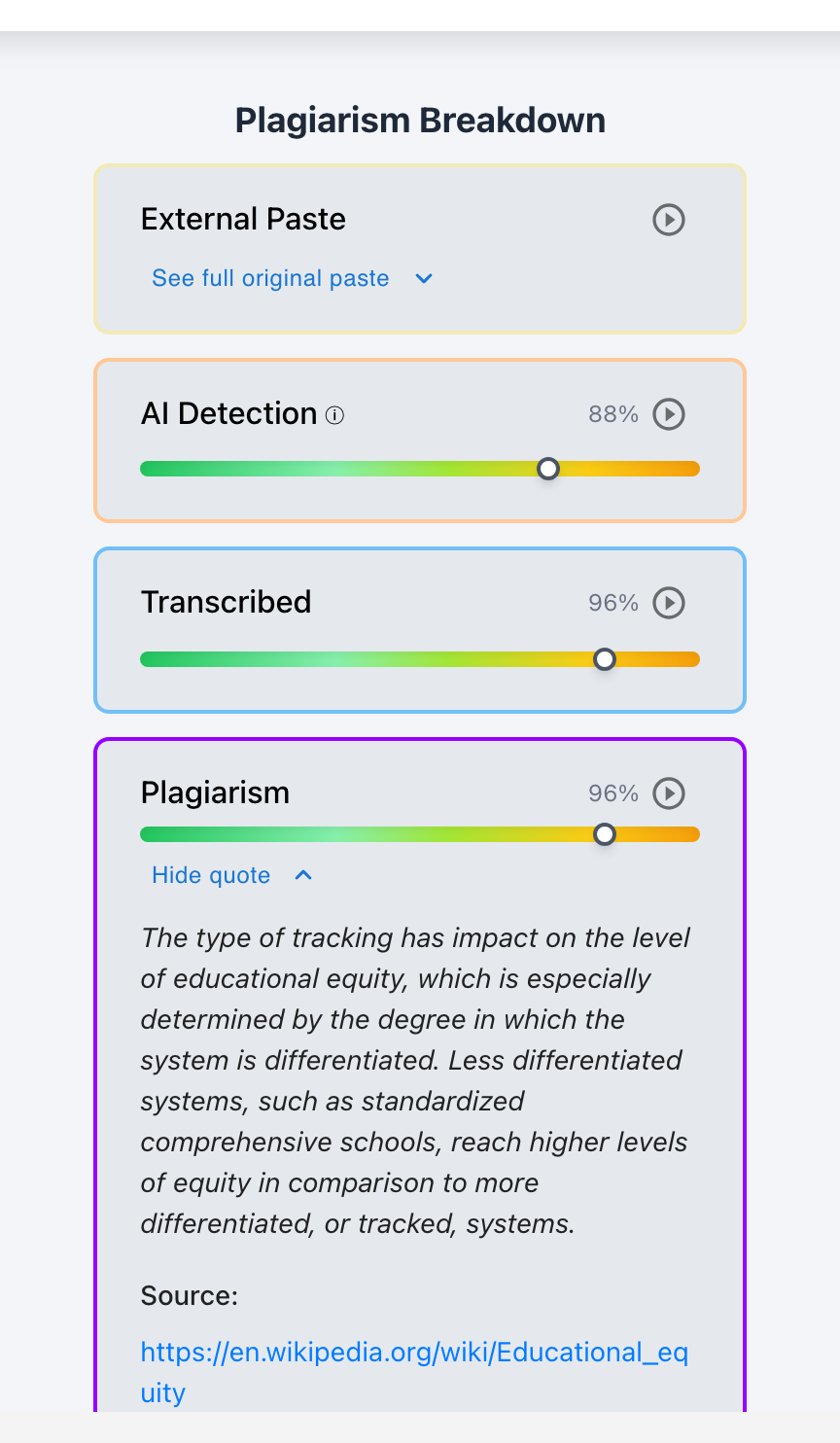
In High School Advanced Placement (AP) Music Theory, mastering 18th-century Common Practice voice leading across four-part SATB (Soprano, Alto, Tenor, Bass) textures represents the intellectual pinnacle of the secondary music curriculum. From Section II Free-Response Question 5 (Realization of a Figured Bass) and Question 6 (Realization of a Roman Numeral Progression) to Question 7 (Harmonization of a Melody), students must navigate intricate counterpoint constraints—eliminating parallel octaves and fifths, resolving tendency tones (î→î: ˆ7→ˆ1, ˆ4→ˆ3), obeying voice-spacing boundaries, and applying strict triad doubling rules. However, the ubiquity of 1:1 Chromebooks, cloud notation suites (Flat.io, MuseScore, Noteflight), and generative AI harmonic solvers has created an acute assessment crisis: students can generate mathematically sanitized part-writing solutions in three seconds, bypassing the essential, iterative trial-and-error counterpoint process. Legacy text-matching engines are oblivious to musical notation and Roman numeral syntax, while generic whole-document AI detectors trigger rampant false alarms on standardized music terminology (cadential six-four, secondary dominant, Neapolitan sixth). Checkmark Plagiarism resolves this crisis through Writing Process Telemetry & Patent-Pending Essay Playback™. By combining 1x–8x keystroke video replay, voice-pair interval reflection pauses, external paste buffer analysis, passage-level confidence sliders, and quote-anchored rubric autograding, high school music educators can verify authentic auditory and contrapuntal problem-solving, protect honest student composers, and conduct supportive, restorative piano conferences at the music stand.
Checkmark Plagiarism empowers high school music teachers, fine arts directors, and AP coordinators with an integrated academic integrity and evaluation platform, uniting keystroke process playback with side-by-side source comparison, passage-level AI writing detection, quote-anchored rubric autograding, and direct LTI 1.3 integrations for Canvas LMS and Agilix Buzz LMS.

A comprehensive multi-tier framework for validating authentic 18th-century Common Practice counterpoint and keystroke telemetry
• Digital Notation / Text-Based Roman Numeral Realization / Voice-Leading Justification Writeup
• Target Texture: 18th-Century Common Practice SATB Chorale (Bach Style)
- 6 Voice-Pair Interval Check: S-A, S-T, S-B, A-T, A-B, T-B for P5 / P8
- Tendency Tone Resolution: ˆ7→ˆ1 in outer voices, ˆ4→ˆ3 in V7
- Doubling & Spacing: Root/5th in root triads, 3rd in ii°6/ii6, 5th in Cad 6/4
- Chromatic Accidental Check: Raised ˆ7 in minor, secondary dominants
- 1x–8x Video Replay: Step-by-step note drafting and revision timeline
- Note Velocity Curves: Measures typing tempo and cadence dynamics
- Reflection Pause Analysis: Tracks 15–45s thinking pauses at complex chords
- External Paste Inspector: Catches web solver dumps and MusicXML strings
- Outer-Voice Playback: Student plays S and B lines together on piano
- Inner-Voice Singing: Sings Alto/Tenor line against bass foundation
- Dilemma Articulation: Explains voice-leading choices (Cad 6/4 to V7)
- Aural Skill Growth: Replaces adversarial suspicion with musicianship
Replaces opaque AI percentage scores with transparent, defensible counterpoint and keystroke proof.
1. The Disciplinary Challenge: Voice Leading, Figured Bass, and Algorithmic Solvers in AP Music Theory
High School AP Music Theory occupies a uniquely demanding position in secondary education. Unlike standard academic courses where students demonstrate proficiency through textual exposition or linear algebra, AP Music Theory requires high schoolers to operate simultaneously across three distinct musical dimensions:
-
1. Vertical Harmonic Syntax: Deciphering figured bass symbols, identifying chord roots, determining inversions, and managing functional harmonic progressions (
I → IV → vii°6 → I6 → ii6 → V7 → I). - 2. Linear Contrapuntal Voice Leading: Weaving four independent, singable melodic lines (Soprano, Alto, Tenor, Bass) that honor 18th-century Common Practice counterpoint principles established by J.S. Bach and codified in the College Board AP Music Theory Course and Exam Description (CED).
- 3. Internal Psychoacoustic Audition (Audiation): Mentally hearing the harmonic tension, tendency tone resolutions, and cadence structures without continuous external piano feedback.
In high schools across the country, music department chairs, band directors, orchestra leaders, and choir directors frequently teach AP Music Theory to sections of 25–35 advanced student musicians. Daily homework and formative assessments involve part-writing exercises, figured bass realizations, and melodic harmonizations. With high schools operating in 1:1 Chromebook environments and adopting web-based notation platforms (such as Flat.io, Noteflight, MuseScore, and Sibelius Cloud) integrated into Google Classroom, Canvas LMS, Schoology, and Buzz LMS, students complete their assignments digitally.
| FRQ Question Type | Points | Musical Texture & Input | Key Voice-Leading Challenges |
|---|---|---|---|
|
Question 5: Figured Bass Realization |
7 pts |
Realization of a Figured Bass • Given: Bass line with figures • Required: SATB 4-part chorale • Key: Major or Minor |
• Soprano line contour & independent motion (contrary/oblique to bass) • Realizing figures (e.g., 6, 6/5, 4/3, 4/2, 6/4-5/3) • Strict doubling rules & cadence formulas |
|
Question 6: Roman Numeral Progression |
10 pts |
Realization of a Roman Numeral Progression • Given: Key signature & Roman numerals • Required: Complete 4-part SATB chorale |
• Constructing all 4 SATB voices from scratch • Secondary dominants ( V7/V, V7/iv) and diminished 7ths (vii°7, viiø7)• Resolving leading tones and chordal 7ths correctly |
|
Question 7: Melodic Harmonization |
9 pts |
Harmonization of a Melody • Given: Soprano melody (phrase) • Required: Bass line + Roman Numeral Analysis |
• Composing an authentic, contrapuntal bass line • Formulating functional Roman numeral analysis • Establishing PAC / IAC / HC cadential targets |
The Inherent Cognitive Struggle of Part-Writing
Authentic student part-writing is inherently non-linear, messy, and characterized by intensive trial and error. When a high school student sits down to realize a figured bass line in FRQ 5 or construct an SATB chorale from Roman numerals in FRQ 6, they cannot simply write left-to-right in a single pass without encountering voice-leading impasses.
To successfully connect Chord A to Chord B, the student must simultaneously evaluate six distinct voice pairs:
Voice Pairs = { S–A, S–T, S–B, A–T, A–B, T–B }
Check for parallel 5ths/8ves, spacing violation (>1 octave), voice crossing (Alto higher than Soprano).
Verify parallel intervals between high melody and tenor counterpoint; check contrary motion.
Outer-voice frame: Strict direct/hidden 5ths & 8ves rule; leading tone resolution (ˆ7→ˆ1); PAC cadence proof.
Inner voices must remain ≤1 octave apart. Check for voice crossing (Tenor higher than Alto) and static lines.
Check vertical intervals forming triads; verify tendency tone (ˆ4→ˆ3 in V7) and avoidance of P5/P8 parallels.
Tenor-to-Bass distance may exceed an octave; check for parallel 5ths/8ves when bass steps and tenor leaps.
The 7 Mandatory Contrapuntal Checks per Chord Transition:
- 1. Parallel Perfect Intervals: Are any two voices moving in the same direction into a perfect fifth (P5) or perfect octave (P8)?
- 2. Direct (Hidden) Fifths and Octaves: Are the outer voices (S–B) leaping in similar motion into a P5 or P8 where the soprano does not move by step?
- 3. Voice Crossing and Overlap: Did the tenor rise above the alto? Did the alto drop below the previous bass note?
- 4. Spacing Boundaries: Is the vertical distance between Soprano and Alto ≤ 1 octave? Is the distance between Alto and Tenor ≤ 1 octave? (The Bass-to-Tenor gap may exceed an octave).
- 5. Tendency Tone Resolutions: In a dominant seventh (
V7) or secondary dominant (V7/V), did the leading tone (ˆ7) resolve up by step to tonic (ˆ1) in the outer voices? Did the chordal seventh (ˆ4) resolve down by step to the third of the tonic triad (ˆ3)? - 6. Triad Doubling Protocols: In root-position triads, double the root. In first-inversion triads (
I6, IV6), double the root or fifth. In supertonic first inversion (ii6), double the bass (scale degree ˆ4). In cadential 6/4 (I6/4 → V → I), double the fifth (scale degree ˆ5). In diminished triads (vii°6), double the third. - 7. Melodic Interval Sanity: Are augmented intervals (especially the augmented second ˆ6 ↔ ˆ7 in harmonic minor keys) strictly avoided?
2. How High School Students Exploit Generative AI and Web Solvers in Music Theory
The cognitive friction of manual voice leading creates a strong temptation for time-pressured high school students. When faced with a 10-point FRQ 6 assignment due at 11:59 PM on Canvas, students on 1:1 Chromebooks can turn to several automated workarounds:
A. Large Language Models (ChatGPT, Claude, Copilot)
Students copy the Roman numeral progression (e.g., Bb Major: I - vi - ii6 - Cad6/4 - V7 - I) into an LLM and prompt:
“Write out the exact SATB pitches in four parts with no parallel fifths or octaves for this AP Music Theory progression.”
The LLM outputs pitch matrices (e.g., S: Bb4-Bb4-C5-D5-C5-Bb4 | A: F4-G4-F4-F4-Eb4-D4 | T: D4-Eb4-D4-Bb3-A3-F3 | B: Bb3-G3-Eb3-F3-F3-Bb2).
B. Algorithmic Voice-Leading Engines & Music Plugins
Dedicated browser-based solver tools, Python music21 scripts, and third-party notation plugins can calculate voice leadings using brute-force graph search algorithms. These tools output finished MusicXML or MIDI files in under three seconds.
C. Digital Cheat Sheets and Modern Jazz/Pop Shortcuts
Students prompt AI to “harmonize” a melody, which frequently injects non-classical voice leadings (parallel fifths, unresolved seventh chords, omitted triad roots, rootless ninth chords, or parallel voice movements) typical of modern pop or jazz lead-sheet arranging, flagrantly violating classical 18th-century Bach chorale conventions.
- • Non-Linear Voice Construction: Writes outer voices (S & B) first to establish contrapuntal framework, then weaves inner voices (A & T) to fill harmonic sonorities.
- • Reflection Pauses at Critical Chords: Pauses 15–45 seconds before resolving
V7/V, cadential6/4, orii6chords to audit voice pairs. - • Deletion & Revision Clusters: Places a tenor pitch, notices a parallel fifth with the bass, deletes it, and tests an alternate inner-voice inversion.
- • Instant Linear Matrix Generation: Outputs complete SATB chords simultaneously across all 4 staves in a single uninterrupted 3-second burst.
- • Zero Reflection Pauses: Zero hesitation between chord inversions, secondary dominants, or cadential 6/4 chords.
- • Stylistic Hallucinations / Jazz Artifacts: Often leaves chordal 7ths unresolved, creates voice overlaps, or drops roots in favor of smooth modern jazz sonorities.
- • Paste Buffer Payload: Entire SATB chord structure pasted into notation editor or text box from external clipboard.
3. The AP Scoring & Pedagogical Dilemma: Why Generic AI Detectors Fail
When music educators suspect that a student used an automated solver for an AP Music Theory part-writing task or analytical writeup, traditional plagiarism checkers and generic AI detectors create massive pedagogical failures.
The Lexical & Syntactic Trap
Generic text-based AI detectors (which evaluate perplexity and burstiness in standard English prose) fail catastrophically when applied to music theory:
- 1. Standardized Music Terminology Triggers False Positives: Music theory writeups require highly codified, repetitive phrasing:
“The cadential I6/4 resolves to V7 with the soprano sustaining scale degree ˆ5 before resolving to the tonic I in a Perfect Authentic Cadence.”Because these terms have extremely low perplexity (there are only so many ways to describe a cadential six-four or a
V7/Vsecondary dominant), generic AI detectors flag honest student writeups as 85%–99% AI-generated. - 2. Total Blindness to Music Notation & Chord Matrices: Generic detectors cannot parse MusicXML, pitch shorthand (
S: D5→C#5→D5), or figured bass notation (6/5 - 4/3 - 7). When students paste external solver outputs directly into digital score assignments or LMS text fields, generic detectors report “No AI detected” or fail to evaluate the file entirely. - 3. Inability to Distinguish Classical Rules from Modern Hallucinations: A generic detector cannot audit whether an inner voice committed a parallel octave or failed to resolve the leading tone in a minor key.
“In measure 3, the progression utilizes a secondary dominant V7/V to tonicize the dominant key. The leading tone F# resolves upward to G in the soprano, while the chordal seventh C resolves downward to B in the alto, establishing a clear half cadence.”
- Calculates statistical token perplexity on standardized musical terminology
- “secondary dominant”, “leading tone resolves upward”, “half cadence” = Highly Predictable Tokens
- RESULT: “94% AI GENERATED” (FALSE POSITIVE ALARM!)
• A diligent AP Music Theory student who mastered voice-leading terminology is falsely accused.
• Teacher-student trust is fractured; parents demand meetings; educator wastes hours defending score.
• The Checkmark Solution: Process telemetry and Essay Playback™ examine actual drafting keystrokes, voice-pair interval reflection pauses, and paste payloads.
4. The High School Music Theory Evidentiary Matrix
To evaluate part-writing and voice-leading authenticity objectively and supportively, high school educators need a multi-dimensional evidentiary framework that moves beyond opaque percentages.
| Evidentiary Dimension | Paper Manuscript Staff Paper | Generic Whole-Doc AI Detector | Google Docs / LMS Standard Revision History | Checkmark Process Telemetry & Playback |
|---|---|---|---|---|
| 1. Voice-Leading Revision History | High: Eraser marks indicate contrapuntal trial and error. | Zero: Evaluates only static text strings; ignores notation. | Poor: Coarse snapshots (every 5–15 mins); misses inner-voice micro-edits. | Complete: Granular keystroke-by-keystroke 1x–8x video replay. |
| 2. External Paste Payload Capture | N/A: Physical ink or pencil on printed AP staff sheets. | Zero: Blind to source of text or MusicXML strings. | Poor: Shows text inserted; loses original external clipboard payload structure. | Defensible: Preserves complete external clipboard payload. |
| 3. Cognitive Pause & Reflection Telemetry | Observable in class; unobservable on take-home assignments. | Zero: No timing, velocity, or pause data captured. | Zero: No keystroke interval or latency telemetry recorded. | High: Measures note placement latency and voice-pair auditing. |
| 4. False-Positive Protection on Standardized Jargon | Zero: Student-drawn notation and manual Roman numerals. | Extreme (>60%): Flags standard Roman numeral syntax. | Moderate: Flags large text insertions even when from student scratchpads. | Zero: Calibrated passage sliders and process playback. |
| 5. Restorative Conference Support at the Music Stand | Subjective: Requires manual piano test without replay proof. | Destructive: Opaque percentage creates adversarial standoff. | Weak: Incomplete snapshot evidence confuses parents and administrators. | Empowering: Objective timeline grounds supportive dialog. |
5. Step-by-Step Music Theory Teacher Audit Protocol
When evaluating take-home or digital SATB part-writing assignments (FRQ 5, FRQ 6, or FRQ 7), high school music educators can follow this five-step protocol to verify authenticity and provide targeted contrapuntal coaching.
Audit all 6 voice pairs for P5/P8, tendency tones, and doubling rules.
Check raised ˆ7 in minor, secondary dominants, and Cad 6/4 metric placement.
Scrub 1x–8x replay: verify outer-voice priority and chord reflection pauses.
Inspect raw clipboard payload for web solver dumps or MusicXML payloads.
Restorative piano stand session: student plays outer voices, sings inner lines.
Step 1: Voice-Leading & SATB Doubling Concordance Audit
Before opening process telemetry, conduct a rapid technical audit of the student’s part-writing:
- Parallel Fifths and Octaves: Trace each voice pair across all chord connections.
- Direct (Hidden) Fifths/Octaves: Check outer voices (S–B) moving into P5 or P8 via similar motion.
- Voice Spacing: Verify |S – A| ≤ 8ve and |A – T| ≤ 8ve.
- Tendency Tones: In
V7 → IorV7/V → V, ensure ˆ7 → ˆ1 in soprano/bass and ˆ4 → ˆ3 in inner voices. - Doubling Rules:
- Root position triads: Double the root.
- First inversion triads (
I6, IV6): Double the root or fifth. - Supertonic first inversion (
ii6): Double the third (the bass note, ˆ4). - Cadential six-four (
I6/4orV6/4-5/3): Double the fifth (the bass note, ˆ5). - Diminished triads (
vii°6, ii°6): Double the third (never the diminished fifth or leading tone root).
Step 2: Harmonic Syntax & Accidental Sanity Checks
Inspect the score for signature AI solver artifacts:
- Minor Key Leading Tone Neglect: AI solvers frequently forget to raise the leading tone (ˆ7) in harmonic minor (e.g., using G♮ instead of G♯ in A minor for a
Vorvii°6chord). - Metric Placement of Cadential 6/4: Ensure the cadential
I6/4occurs on a metrically stronger beat than the resolvingVchord. - Secondary Dominant Spelling: In
V7/V, ensure the chromatically raised pitch (e.g., F♯ in C Major) appears in the correct voice and resolves upward by half-step.
Step 3: Essay Playback™ Keystroke & Latency Replay
Open Checkmark’s Essay Playback™ to review the student’s drafting session:
- Natural Outer-Voice Priority: Authentic students almost always draft the Bass and Soprano lines first to establish the contrapuntal framework, then insert Alto and Tenor pitches.
- Voice-Pair Auditing Pauses: Observe natural 10–30 second pauses between chord entries where the student checks for parallel fifths or recalculates pitch spellings.
- Micro-Revision Bursts: Authentic drafts exhibit frequent backspacing and pitch substitutions (e.g., changing an Alto E4 to G4 after realizing the Tenor needed the third).
Step 4: External Paste Buffer & Clipboard Inspection
Use Checkmark’s Paste Inspector to examine any text or notation block inserted via clipboard:
- Identify if an entire 4-part chorale progression was pasted in a single timestamped event (t = 0.0s).
- Inspect the raw clipboard payload: Did the student paste a structured MusicXML snippet, ASCII chord progression, or chatbot response?
Step 5: Restorative Piano Keyboard & Singing Debrief
Invite the student to the classroom piano or keyboard workstation:
- Play Outer Voices (S–B): Ask the student to play the Soprano and Bass lines together on the piano.
- Sing Inner Voices: Ask the student to sing their composed Tenor or Alto line while playing the bass note.
- Explain Voice-Leading Choices: Ask: “What led you to double the third in this ii6 chord rather than the root?” or “How did you resolve the leading tone in this secondary dominant?”
- Transform Integrity into Aural Growth: If unauthorized AI assistance occurred, guide the student through correcting the voice leading at the piano, restoring trust and reinforcing 18th-century counterpoint mastery.
6. Real High School AP Music Theory Case Scenarios
The following three case studies illustrate how process telemetry and voice-leading audits operate in real high school classrooms.
Marcus (Trumpet): Submitted flawless SATB realization (g: i - iv6 - V6/4-5/3 - i - ii°6 - V - i) within 4 minutes on Flat.io.
Elena (Cello): Flagged as “92% AI” by legacy tool on 150-word justification for D: I - vi - ii6 - V7/V - V7 - I.
Jordan (Jazz Band): Submitted jazz chord sequence (Fmaj7 - Dm9 - Gm11 - C13 - Fmaj7) with parallel 5ths between Alto & Bass.
7. How Checkmark Plagiarism Empowers High School AP Music Theory Instructors
Checkmark Plagiarism integrates a purpose-built suite of tools engineered specifically for high school educators:
- • Reconstructs the complete part-writing drafting timeline note-by-note and word-by-word.
- • Visualizes voice-leading trial-and-error, voice-pair audit pauses, and inner-voice rewrites.
- • Captures and preserves exact external clipboard payloads (MusicXML, MIDI, ASCII chord matrices).
- • Proves whether part-writing was composed in-app or imported from external generative solvers.
- • Replaces blunt whole-paper percentage scores with granular passage-level evaluations.
- • Calibrated specifically to eliminate false alarms on standard music theory syntax and terminology.
- • Pre-grades free-response writeups against official College Board AP Music Theory CED rubrics.
- • Provides quote-anchored justifications for voice-leading errors, doubling flaws, and cadences.
- • Direct 1-click gradebook sync to Canvas LMS, Google Classroom, Buzz LMS, and Schoology.
Student compositions, musical scores, and analytical writeups are NEVER used to train commercial AI models. High school fine arts departments enjoy enterprise-grade privacy protection with zero third-party data caching.
8. Frequently Asked Questions (FAQs) for High School Music Theory Educators
Q1: Can students use generative AI to complete AP Music Theory sight-singing or melodic dictation tasks?
While generative AI cannot physically sing during in-class timed assessments, students can prompt multimodal models to transcribe audio dictation files into pitch names or generate sight-singing solfège syllables for take-home assignments. Checkmark’s Essay Playback™ and audio-submission timestamps allow teachers to verify whether students engaged in authentic multi-pass listening cycles or pasted instant pitch sequences.
Q2: Why do generic AI detectors assign high AI scores to students’ Roman numeral analysis explanations?
Generic AI detectors measure text predictability (perplexity). Because AP Music Theory uses standardized, formulaic vocabulary (cadential six-four, secondary dominant, Neapolitan chord, deceptive cadence, parallel octaves), authentic student writing exhibits low perplexity, triggering false positive flags. Checkmark eliminates this flaw by evaluating keystroke process telemetry and passage-level context rather than statistical token frequency.
Q3: How does Checkmark detect when a student uses an online voice-leading solver?
Online solvers generate finished SATB pitch arrays or MusicXML data in a single computation. When a student copies and pastes this output into their digital assignment, Checkmark’s Paste Inspector captures the exact timestamp, character count, and clipboard payload, contrasting the instant insertion against the natural, iterative drafting dynamics of authentic counterpoint composition.
Q4: Does Checkmark integrate directly with cloud notation tools like Flat.io and Noteflight?
Yes. Checkmark captures revision telemetry across standard browser-based editors, Google Docs, Canvas LMS SpeedGrader, Buzz LMS, and embedded assignment fields, providing seamless playback regardless of whether students submit text justifications or digital notation files.
Q5: What is the recommended protocol when a student’s part-writing contains zero voice-leading errors but was completed in under two minutes?
Do not issue an immediate punitive penalty. Instead, conduct a restorative conference at the piano keyboard. Ask the student to play the outer voices and sing the inner Alto or Tenor line. If the student cannot demonstrate auditory familiarity or explain their voice-leading choices, use Checkmark’s playback timeline as an objective, non-adversarial basis to guide them through manual recomposition.
Q6: How does Checkmark protect student privacy under FERPA and COPPA?
Checkmark adheres to strict zero-retention and zero-model-training data architectures. Student musical compositions, score files, analytical essays, and keystroke logs are never stored in public LLM training repositories or commercial databases, ensuring 100% compliance with secondary school district privacy mandates.
Q7: Can Checkmark’s rubric autograder assist with high-volume grading across multiple AP Music Theory sections?
Yes. Checkmark’s Teacher-in-the-Loop Autograder evaluates student written justifications and harmonic analyses against College Board AP Music Theory scoring guidelines, generating draft rubric scores and evidence-anchored comments. Teachers retain 100% editorial authority to adjust scores before syncing finalized grades directly into Canvas, Schoology, Google Classroom, or Buzz LMS.
Conclusion: Fostering Authentic Musical Literacy
In the 21st-century music classroom, our goal is not to police students with punitive algorithms, but to nurture genuine musical intuition, audiation, and counterpoint mastery. By moving away from opaque black-box AI detectors and embracing Writing Process Telemetry & Essay Playback™, high school AP Music Theory educators can protect honest students, unmask algorithmic shortcuts, and turn every part-writing challenge into a transformative musical dialogue at the piano.
To learn more about implementing keystroke playback and defensible academic integrity tools in your secondary music department, visit checkmarkplagiarism.com.