
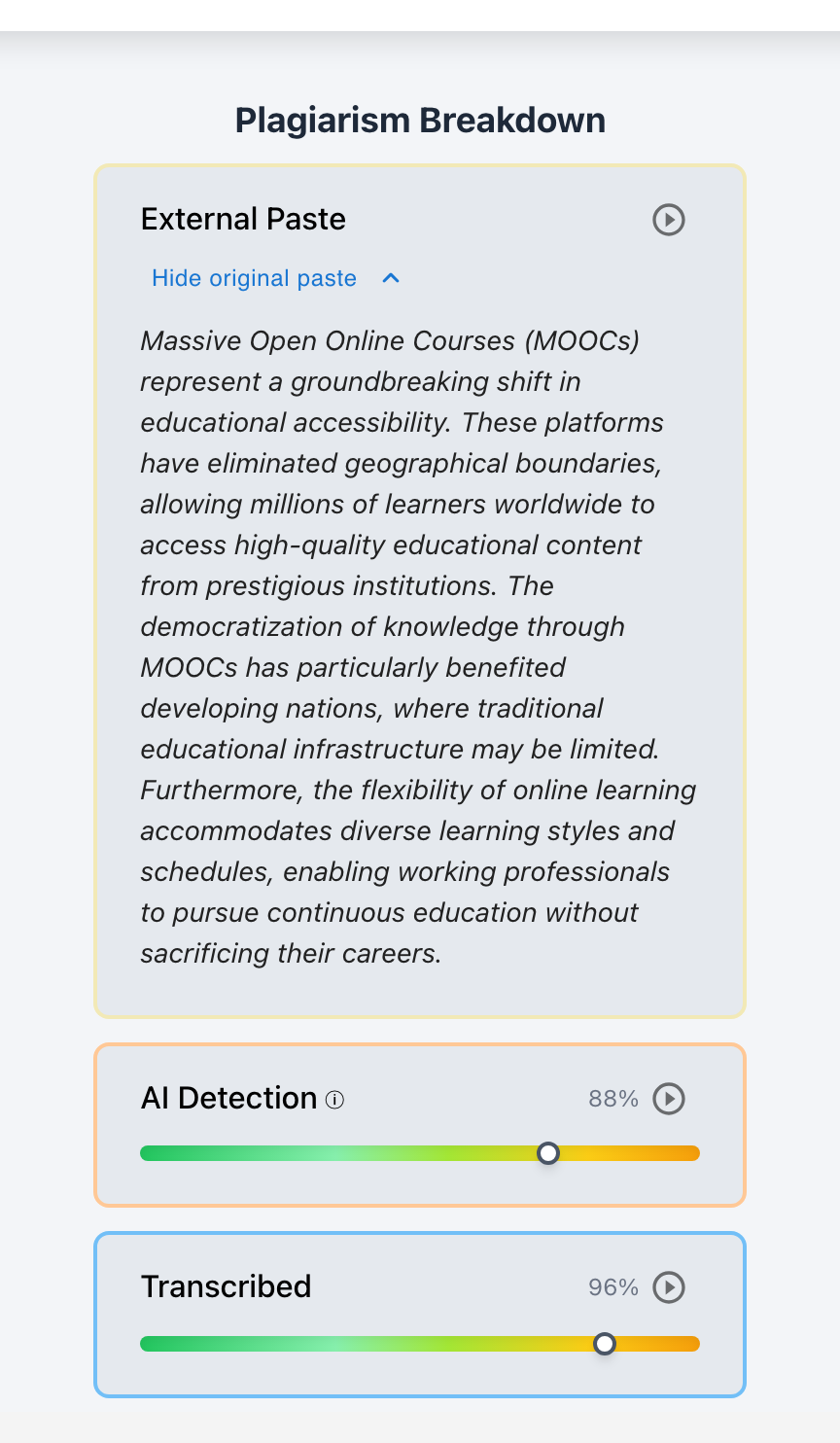
In the rigorous landscape of High School Advanced Placement (AP) Music Theory, evaluating student mastery across melodic dictation, harmonic dictation, voice-leading rules, and Roman Numeral Analysis (RNA) writeups presents a distinct pedagogical dilemma. With high school students completing prep work, take-home harmonic analyses, and free-response justifications on 1:1 Chromebooks via Google Docs, Canvas, Schoology, and Buzz LMS, generative AI bots (such as ChatGPT, Claude, and specialized music tools) have introduced widespread authorship uncertainty. While generative Large Language Models (LLMs) can rapidly synthesize scholarly-sounding music theory prose dense with standard terminology (secondary dominants, cadential 6/4, parallel fifths, Neapolitan sixth chords), they routinely hallucinate acoustic reality, misidentify chord inversions, and commit fatal four-part voice-leading errors. Furthermore, legacy text-matching engines fail because generated analyses are novel text, while generic whole-paper AI detectors generate crippling false positives on authentic student writeups due to the inherently low perplexity of standardized music shorthand (I - IV - V6/4-5/3 - I). Checkmark Plagiarism resolves this challenge through Writing Process Telemetry & Patent-Pending Essay Playback™. By analyzing 1x–8x keystroke video replay, auditory listening-pause intervals, external paste buffers, passage-level confidence sliders, and quote-anchored rubric autograding, high school music educators can verify authentic auditory processing, protect honest musicians, and conduct restorative piano debriefs that elevate genuine musical literacy.
Checkmark Plagiarism provides high school music educators, department chairs, and district fine arts coordinators with comprehensive, defensible authorship verification, uniting keystroke process playback with side-by-side source comparison, passage-level AI writing detection, quote-anchored rubric autograding, and direct LTI 1.3 integrations for Canvas LMS and Agilix Buzz LMS.

How secondary music educators bridge score-to-prose concordance, keystroke telemetry, and keyboard debriefs
• Aural Artifacts: 3-Pass Melodic Dictation / Harmonic Outer-Voice Solfège Notations
• Analytical Prose: Roman Numeral Justifications / Voice-Leading Audits / Cadence Classifications
- Pitch & Inversion Concordance
- Voice-Leading Spot-Check (SATB)
- Chromatic Harmony Audit
- Cadence Ground-Truth Check
- 1x–8x Keystroke Video Replay
- 3-Pass Auditory Listening Pauses
- External Paste Buffer Inspector
- Passage-Level Confidence Sliders
- Student plays/sings outer voices
- Explains voice-leading choices
- Aural verification at keyboard
- Restores trust & growth mindset
Replaces opaque black-box AI scores with transparent, defensible musical and keystroke evidence.
1. The Disciplinary Dilemma: Generative AI, Aural Skills, and Harmonic Analysis in High School AP Music Theory
High School AP Music Theory occupies a uniquely demanding position in secondary education. Unlike standard humanities courses that rely strictly on textual synthesis, or STEM courses centered on mathematical derivations, AP Music Theory requires students to seamlessly unite two fundamentally different cognitive domains:
- 1. Aural & Psychoacoustic Skills: Real-time auditory processing, pitch interval recognition, rhythmic subdivision, melodic dictation over multi-pass listening cycles, sight-singing, and harmonic dictation tracking the outer soprano-bass counterpoint.
- 2. Structural & Compositional Written Rules: Rigorous 18th-century common-practice voice leading, part-writing from figured bass and Roman numerals, realization of four-part SATB (Soprano, Alto, Tenor, Bass) textures, identification of phrase cadences (PAC, IAC, HC, DC, Plagal), and advanced chromatic analysis (secondary dominants, Neapolitan chords, augmented sixth chords).
In a typical high school setting—where music directors and AP theory instructors balance 120–160 students across concert bands, symphony orchestras, choirs, and advanced academic theory sections—the grading workload is formidable. Teachers regularly assign take-home score analyses, digital sight-singing reflections, harmonic error-detection writeups, and melodic dictation self-assessments via 1:1 Chromebooks, Google Docs, Canvas SpeedGrader, Schoology, and Buzz LMS.
Uploaded score image, audio description, or Bach chorale part-writing excerpt fed into ChatGPT / Claude / multimodal bot.
Ingests musical symbols or textual chord sequences as statistical tokens • Pulls generalized textbook jargon (“authentic cadence”, “predominant function”, “voice leading”) • Lacks true auditory perception, acoustic playback, and strict SATB vertical/linear rule logic.
“In measure 4, the progression resolves from a cadential I6/4 to a root-position V7 before settling on the tonic I in F Major. The soprano moves stepwise from G to F, while the tenor leaps to the leading tone E to complete a robust authentic cadence with doubled roots.”
- Relative Key Error: Score is in D Minor, NOT F Major.
- Cadential 6/4 Error: Chord is properly labeled
V6/4-5/3, NOT an independentI6/4. - Fatal Parallel 5th: Tenor created an egregious parallel fifth with the bass (A-E to D-A).
- Leading Tone Omission: Leading tone (C#) was completely omitted, causing improper doubling.
The Arrival of Multimodal AI in the High School Music Classroom
With the rapid emergence of multimodal LLMs capable of analyzing uploaded score images and generating natural-language text, high school theory students frequently outsource their analytical homework. When confronted with a challenging Bach chorale excerpt, a complex Mozart keyboard exposition, or an unfamiliar melodic dictation audio file, a student can upload a screenshot or type a brief prompt into an AI assistant.
Within seconds, the chatbot generates a polished analytical narrative. The generated writeup fluently discusses tonic prolongations, subdominant preparations, deceptive resolutions, and passing tones.
However, because generative LLMs operate on statistical token probability rather than auditory audition or rule-based counterpoint validation, they routinely make catastrophic music-theoretical errors:
- Confusing Relative Keys: Treating D minor as F major or A minor as C major because they share identical key signatures.
- Inventing Phantom Chord Inversions: Labeling a standard root-position dominant seventh (
V7) as a third-inversion four-two chord (V4/2) without bass note verification. - Ignoring Part-Writing Voice-Leading Rules: Praising voice leading that contains obvious parallel fifths, parallel octaves, voice crossing, or unresolved leading tones.
- Failing Melodic Dictation Realism: Producing complete transcriptions in a single instant with zero evidence of the cyclical, multi-pass listening strategy mandatory in AP Music Theory.
The Evaluative Double-Bind: Why Generic AI Detectors Harm Music Students
When high school music educators suspect unauthorized AI assistance in student writeups, traditional edtech detection tools exacerbate the problem:
| Detection Failure Mode | Classroom Impact on High School Music Students & Teachers |
|---|---|
| 1. Rampant False Positives on Honest Student Harmonic Analyses |
Music theory terminology is inherently standardized and repetitive (I - IV - V7 - I, ii6 - V - I, PAC). Generic detectors flag this low-perplexity syntax as “90% AI”, falsely accusing diligent students.
|
| 2. Blindness to AI-Generated Fabrications & Voice-Leading Errors | If a student runs an AI analysis through a paraphraser or prompts the bot for casual phrasing, generic detectors return “0% AI”, hiding fatal analytical hallucinations and score mismatches. |
| 3. Inability to Track Aural Cognitive Listening Cycles (Dictation) | Standard tools analyze only static final text; they cannot show whether a dictation was built note-by-note across audio listenings or pasted wholesale in two seconds from an external clipboard. |
To establish an equitable, transparent, and pedagogically sound learning environment, secondary music departments need a comprehensive evidentiary framework. This framework must pair Score-to-Prose Concordance Audits with Checkmark’s Writing Process Telemetry and Patent-Pending Essay Playback™.
2. Anatomy of AI Hallucinations in AP Music Theory & Voice-Leading Writeups
Understanding the underlying mechanics of generative AI errors allows AP Music Theory teachers to rapidly spot synthetic submissions during routine grading. Generative LLMs process music as text strings or tokenized image segments rather than auditory sound waves or rigorous counterpoint rule trees. This produces four consistent failure modes.
Fabricating pitch/rhythm solutions without the iterative temporal cadence of 3-pass listening cycles.
Inverting chord figures, confusing cadential 6/4 with tonic I, and hallucinating modulations on passing tones.
Overlooking parallel 5ths/8ves, unresolved 7ths, leading-tone leaps, and voice crossings.
Describing nonexistent cadences, misreading alto/tenor clefs, and claiming false meter signatures.
2.1 The Aural Dictation Disconnect: Melodic & Harmonic Multi-Pass Audition
On the AP Music Theory exam, Free-Response Questions (FRQs) 1 and 2 (Melodic Dictation) and FRQs 3 and 4 (Harmonic Dictation) follow strict College Board audio administration protocols:
- Melodic Dictation: 3 to 4 listening passes (Pass 1: overall contour, rhythm, pitch range, and cadence; Pass 2: first and second measure pitch-by-pitch solfège; Pass 3: interior leaps and syncopations; Pass 4: final notation check and rhythm dots).
- Harmonic Dictation: 3 to 4 listening passes (Pass 1: bass line skeleton and final cadence; Pass 2: soprano melody and outer-voice counterpoint; Pass 3: Roman numerals and harmonic quality; Pass 4: interior voice realization and inversion checking).
When high school students submit written reflections or digital score transcriptions of dictation exercises, genuine student drafting mirrors these distinct listening cycles. An authentic keystroke timeline displays rhythmic bursts of typing interspersed with 15–30 second cognitive pauses matching the audio replays, accompanied by frequent backspacing and interval adjustments.
In contrast, an AI-generated dictation writeup or copied solution appears either as a single block paste from an external clipboard or as a continuous, unhesitating typing stream with zero reflective listening pauses.
2.2 Roman Numeral Analysis & Figured Bass Confabulations
Roman Numeral Analysis (RNA) requires identifying the root, quality, inversion, and functional harmonic purpose of every vertical sonority within a tonal context. Generative LLMs frequently make foundational errors in standard AP convention:
The Error: LLMs regularly label a cadential six-four chord as a standalone tonic inversion: I6/4 - V7 - I.
AP Music Theory Standard: In the AP curriculum and common-practice theory, the cadential six-four is functionally a dominant harmony with double suspensions/appoggiaturas resolving down by step (6–5 and 4–3 above the bass). It must be analyzed as V6/4-5/3 or Cad 6/4 - V - I. An AI writeup asserting that “the tonic triad appears in second inversion to provide stable harmonic resting” reveals a total misunderstanding of dominant prolongation.
The Error: Inverting figured bass numbers or failing to distinguish between V7 (root position), V6/5 (first inversion, 3rd in bass), V4/3 (second inversion, 5th in bass), and V4/2 (third inversion, 7th in bass).
Classroom Example: An AI will frequently describe a bass note moving from Fa to Mi as a “root-position dominant resolving to tonic,” missing that Fa in the bass necessitates a V4/2 resolving to a first-inversion tonic I6.
The Error: Mislabeling secondary dominants (e.g., V/V, V7/iv, vii°7/V) as random modal borrowings or modulating to foreign keys for a single passing chord.
Classroom Example: In C Major, encountering a D - F# - A - C chord resolving to G - B - D. An LLM often writes: “The piece briefly modulates to G major and establishes a new tonic,” rather than recognizing the local secondary dominant function (V7/V) that remains anchored in the home key.
The Error: Misidentifying the Neapolitan Sixth (N6 or bII6) as a standard minor second chord, or confusing the three distinct national varieties of Augmented Sixth chords:
- Italian 6th (
It+6):Le - Do - Fi(1 tonic, 1 3rd, augmented 6th). - French 6th (
Fr+6):Le - Do - Re - Fi(includes scale degree 2, containing a whole-tone sonority). - German 6th (
Gr+6):Le - Do - Me - Fi(includes minor 3rd, resolves toV6/4-5/3to avoid parallel 5ths).
Generative bots routinely invent fifths in Italian sixth chords or describe French sixth chords as diminished triads.
| Chord Classification | Common AI Generative Hallucination | AP Music Theory Ground Truth |
|---|---|---|
| Cadential 6/4 | Labels as independent tonic triad I6/4 with stable tonic resting function |
Functional dominant V6/4-5/3; 6–5 and 4–3 linear step resolutions over bass |
Secondary Dominant (V/V, V7/ii) |
Claims permanent key modulation on every applied chromatic accidental | Secondary function (V7/V, V/iv) tonicizing subsequent diatonic root |
Neapolitan Sixth (N6 / bII6) |
Misinterprets as diatonic ii or flat supertonic in root position |
Major triad built on lowered 2nd (Ra-Fa-Le), almost always in 1st inversion |
German Augmented 6th (Gr+6) |
Asserts direct resolution to root V, ignoring resulting parallel fifths |
Must resolve through V6/4-5/3 or Cad 6/4 to avoid parallel 5ths (Mozart fifths) |
2.3 Fatal Voice-Leading Rule Violations in AI-Authored Part-Writing
Part-writing in four-voice SATB texture is the core of AP Music Theory Free-Response Questions 5, 6, and 7. The College Board enforces strict voice-leading deductions for classical contrapuntal errors.
When students use AI to generate explanations of their part-writing or writeups on error-detection assignments, the AI routinely generates prose that endorses or obscures fatal contrapuntal errors:
Excerpt: SATB Part-Writing Exercise (FRQ 5 / Figured Bass in G Minor)
“The voice leading between mm. 2-3 demonstrates flawless classical counterpoint. The soprano moves from D5 down to C5 while the bass steps from G2 to F2, creating a resonant harmonic motion. The alto holds Bb4 while the tenor moves forcefully from G3 to C4, completing full triad voicing.”
- Parallel Fifths: Bass has G2→F2 while Soprano has D5→C5 (direct parallel 5ths).
- Unresolved Leading Tone: In G minor, the leading tone F# was omitted or left unresolved.
- Voice Crossing: Tenor moving to C4 crosses above the Alto Bb4.
- Verdict: The AI generated empty praise while completely ignoring three mandatory AP rubric deductions.
Major Voice-Leading Rule Deductions Overlooked by AI:
- Parallel Fifths and Octaves: Two voices moving in the same direction by parallel motion from one perfect fifth/octave to another. LLMs cannot calculate vertical intervals between moving horizontal vectors simultaneously.
- Direct (Hidden) Fifths and Octaves: Soprano and bass moving in similar motion into a perfect fifth or octave with a leap in the soprano voice.
- Unresolved Leading Tones: In outer voices, scale degree
7(leading tone) must resolve up by half step to1(tonic) in dominant-to-tonic progressions (V - IorV7 - I). AI writeups routinely leave leading tones unresolved or drop them down by third. - Seventh Resolutions: The chordal 7th of any seventh chord (
V7,iiø7,vii°7) must resolve downward by step. AI models routinely leap upward from the seventh to double a root. - Improper Doubling & Voice Crossing: In root-position major/minor triads, doubling the root is standard. Doubling the leading tone or doubling the 3rd in a major triad (except in deceptive
V - viprogressions) incurs major AP scoring penalties. Voice crossing (e.g., tenor singing above alto) or voice overlap severely disrupts SATB clarity.
2.4 Score-to-Prose Concordance Mismatch
When generative AI tools are prompted with incomplete musical information or low-resolution score images, they confabulate structural features that contradict the actual musical notation:
- Modulation Hallucinations: Generative bots frequently declare transitions to distant foreign keys (such as modulating from E-flat Major to F-sharp Minor) when the music simply contains an unaccented chromatic passing tone.
- Clef Misreadings: LLMs regularly misinterpret alto clef (viola) or tenor clef (cello/bassoon) as treble clef, shifting every note in their harmonic narrative by a third or a fifth.
- Cadence Misclassification: Confusing Deceptive Cadences (
V - viorV - VI) with Authentic Cadences (V - I), or failing to notice that an imperfect authentic cadence (IAC) has scale degree 3 or 5 in the soprano rather than the tonic scale degree 1.
3. The AP Music Theory Evidentiary Matrix
To evaluate student submissions fairly without relying on unscientific black-box scores, high school music departments must establish a multi-evidence framework. Below is a direct comparison of traditional red-pen manuscript grading, generic AI detectors, and Checkmark Plagiarism’s integrated telemetry suite.
| Capability / Metric | Paper Manuscript / Red Pen | Generic AI Text Detectors | Checkmark Plagiarism Suite |
|---|---|---|---|
| Whole-Assignment Accuracy & False-Positive Risk | High for final notation; impossible to verify digital take-home drafting steps | Opaque whole-paper % score; rampant false flags on RNA formulas (I - IV - V7) |
Replaces percentages with passage-level calibrated confidence sliders & telemetry |
| Writing Process History & Keystroke Dynamics | None (Evaluates static submitted paper/PDF) | None (Only analyzes final text string in isolation) | Patent-Pending Essay Playback™ (1x–8x scrubbable video replay) |
| Auditory Listening-Pause Telemetry (Dictation) | None (Cannot track audio cycles on digital drafts) | None (Completely blind to temporal listening cycles) | Accurately tracks 15–30s cognitive drafting pauses matching audio passes |
| External Clipboard & Paste Buffer Inspector | None | None | Preserves original external text before student retyping or thesaurus editing |
| Mechanical Transcription Detection (2nd Screen/Bot) | None | None | Detects steady, zero-pause retyping from external phones or secondary screens |
| Short-Answer Guardrails (<150 Words / FRQ Checks) | Manual teacher review | Unreliable; massive false positives on short prompts | Honest <150w N/A disclaimer prevents unprovable accusations |
| Quote-Anchored AP Music Theory Rubric Feedback | Manual, labor-intensive grading across 150+ students | None | AI Autograder with direct SATB quote anchors & LMS gradebook passback |
4. Step-by-Step High School Music Teacher Audit Protocol
When evaluating take-home harmonic analyses, melodic dictation writeups, or part-writing error justifications, high school AP Music Theory teachers should apply a structured, four-tier audit protocol. This protocol shifts the classroom dynamic from adversarial suspicion to objective, evidence-based coaching.
Check assigned score against writeup: key, clefs, inversions, and cadences.
Spot-check parallel 5ths/8ves, leading tones, 7th resolutions, and doublings.
Scrub 1x–8x timeline: verify listening pauses & inspect paste buffers.
Non-punitive conference: student plays/sings outer voices, rebuilding mastery.
Step 1: Score-to-Prose & Roman Numeral Concordance Audit
Begin by cross-referencing the student’s submitted written analysis against the assigned score or audio passage:
- Key Signature and Tonal Center Verification: Does the student’s analysis correctly identify minor vs. relative major? If the piece is in F# minor (3 sharps) and the writeup constantly refers to the tonic as A major without any modulation analysis, check for LLM token confusion.
- Clef and Pitch Integrity: Verify whether the analysis accounts for alto or tenor clefs if assigned. Generative vision models frequently read tenor clef as treble clef, resulting in Roman numerals that are off by exactly a third or fifth.
- Cadence Classification Alignment: Match the labeled cadences against the score’s terminal measures. If measure 8 ends on a clear Half Cadence (
V) with scale degree2in the soprano, but the writeup asserts a Perfect Authentic Cadence (V - I), the student may have pasted a generalized AI response.
Step 2: Voice-Leading & Figured Bass Rules Spot-Check
Perform a targeted check of the student’s analytical justifications against common-practice contrapuntal rules:
- Outer-Voice Counterpoint Audit: Check the soprano and bass movement at every cadence and chord transition. If the score clearly exhibits parallel octaves between soprano and bass, but the student’s writeup describes the motion as “independent contrary motion that reinforces vocal independence,” the prose is detached from musical reality.
- Seventh Chord Resolution Check: Look at every labeled seventh chord (
V7,ii7,vii°7). Does the student’s prose correctly account for the downward step resolution of the chordal 7th? - Leading Tone Tracking: In dominant harmonies (
V,V7,vii°), verify that the leading tone resolves upward to the tonic when in an outer voice. If the writeup discusses the leading tone moving downwards to form a full triad, flag the passage for review.
Step 3: Keystroke Telemetry & Auditory Pause Analysis via Essay Playback™
Open the submission in Checkmark Plagiarism to review the student’s drafting session in patent-pending Essay Playback™:
I - vi - ii6/5 - V6/4-5/3 - I) were pasted instantaneously from an external clipboard. Preserves original clipboard text even if edited.
- Scrub Through the Timeline: Use the playback slider to watch the document take shape. Authentic harmonic analysis involves recursive jumping between measures, revising chord quality labels (e.g., changing
iitoii°upon noticing a flat), and adjusting Roman numeral cases. - Audit External Pastes: Click on any highlighted paste block in the Paste Buffer Inspector. Checkmark captures and displays the exact string that entered the document from outside the browser session, allowing you to see if an entire AI-generated harmonic breakdown was inserted at once.
- Exonerate Diligent Students: If a generic detector flagged a student’s legitimate writeup due to dense formulas (
V7/V -> V -> I), Essay Playback™ provides clear evidence of authentic human thought—showing individual keystrokes, thoughtful pauses, and organic revision cycles.
Step 4: The Restorative Piano / Keyboard Debrief
If significant discrepancies emerge between the score, the keystroke telemetry, and the written analysis, schedule a brief (5–10 minute) Restorative Piano Debrief during office hours, advisory period, or sectionals.
The goal of this conference is not punitive confrontation, but restorative musical growth:
“Thanks for meeting with me, Julian. I was reviewing your harmonic analysis on the Bach Chorale in G Minor. Your writeup uses some very advanced terminology, but when I look at the score and our writing process telemetry, there are a few interesting things I’d love to explore together.
Let’s sit at the piano. Could you play the bass line for measures 3 and 4 while I play the soprano? Now, as we listen to that progression, what do your ears hear at the cadence? Does it feel like an authentic cadence or a half cadence? Let’s sing the leading tone together and see where it resolves.
In your writeup, it mentions a stable I6/4 chord and smooth contrary motion, but at the keyboard, we can hear that strong dominant pull and the parallel fifths. Tell me about how you arrived at this analysis during your drafting session.”
By transitioning the dialogue to the acoustic keyboard, the educator removes defensiveness. A student who genuinely understands the material will quickly play, sing, or clarify their analytical intentions; a student who outsourced the work to an AI bot will immediately recognize the gap between synthetic text and auditory reality.
5. Checkmark’s Integrated Academic Integrity Suite in the AP Music Theory Classroom
Checkmark Plagiarism is engineered specifically to meet the evidentiary, pedagogical, and workflow needs of secondary educators, department chairs, and administrators.

- Passage-Level Granularity: Underlines specific suspicious sentences with calibrated confidence sliders based on perplexity and burstiness.
- Honest Short-Text Guardrails (<150 Words): Automatically displays
N/Afor short FRQ chords or listening warmups to prevent false positives. - Educator-Only Flag Statuses: Keeps algorithmic flags strictly private to teachers, preventing automated student penalties.
- Side-by-Side Source View: Synchronized text alignment against billions of web pages and music repository writeups.
- Cross-Period Cohort Matching: Compares submissions across Period 2 Band and Period 5 Choir without leaking student data.
- Uncited Source Differentiation: Separates poor citation formatting from deliberate copy-pasting.
- Quote-Anchored AP Rubrics: Generates point breakdowns and feedback tied directly to specific measures.
- Teacher Final Authority: All AI rubric evaluations remain editable draft suggestions until teacher approval.
- LMS Sync: One-click passback to Canvas SpeedGrader, Buzz LMS, Schoology, and Google Classroom.
- Zero Model Training Guarantee: Student music and writeups are never used to train commercial AI models.
- FERPA & COPPA Compliant: Enterprise-grade TLS 1.3 in transit and AES-256 encryption at rest.
- 1:1 Ecosystem: Native Chrome extensions for Google Docs on Chromebooks and Single Sign-On (SSO).
6. Real High School Classroom Case Scenarios
The following three case studies illustrate how Checkmark’s multidimensional integrity suite resolves real-world academic integrity scenarios in secondary music programs.

Bach Chorale Harmonic Analysis Writeup
Assignment: A comprehensive 350-word harmonic analysis of J.S. Bach’s Chorale No. 42 (Es ist genug), requiring Roman numerals, inversion figures, cadence identifications, and non-harmonic tone classifications.
The Problem: Maya, a sophomore violinist and dedicated theory student, submitted a rigorous, articulate analysis. When the teacher ran the essay through a generic text-based AI detector, the tool returned an 88% AI-Generated Probability score because of Maya’s standard music theory phrasing (“In m. 3, the harmony initiates a cadential 6/4 resolving to V7 on beat 3 before completing a Perfect Authentic Cadence on the tonic G major triad”).
- Passage-Level Sliders: Confirmed the elevated score was driven entirely by formulaic Roman numeral labels.
- Essay Playback™: Replaying Maya’s 48-minute timeline proved she drafted measure-by-measure, spent 6 minutes on measure 2, and backspaced twice to fix a 7–6 suspension to 4–3.
- Paste Inspector: Verified 0 external pastes; 100% native keyboard input.
Pedagogical Outcome: Maya was immediately exonerated with zero disciplinary referral. The teacher used Checkmark’s rubric autograder to award full points and provide formative praise on her accurate non-harmonic tone classifications.
Take-Home Melodic Dictation in 6/8 G Major
Assignment: A take-home melodic dictation based on an audio excerpt in G major, compound duple meter (6/8), requiring students to document their step-by-step melodic transcription and interval solfège reasoning.
The Problem: Tyler, an 11th-grade tenor, submitted a flawless transcription and analytical reflection within 4 minutes of the assignment being posted online. The submission used bizarre, overly academic phrasing (“The undulating compound contour exhibits an archetypal arch form centered around the dominant axis”).
- Essay Playback™ Replay: Tyler’s entire session lasted only 52 seconds with zero audio listening pauses.
- Paste Buffer Inspector: At timestamp
00:34, Tyler pasted a 240-word block from an external clipboard. - Raw Clipboard Capture: Captured the exact ChatGPT prompt response: “Analyze this 6/8 G major melody and write a paragraph explaining the solfege and contour.”
Pedagogical Outcome: Rather than issuing an automatic zero, the teacher held a 10-minute restorative conference at the piano. The teacher played the 6/8 melody and guided Tyler through singing the tonic arpeggio and identifying the dotted-quarter cadence. Tyler was permitted a supervised retake using proper multi-pass listening protocols.
SATB Voice-Leading Justification Writeup
Assignment: A part-writing error-detection assignment where students analyze an SATB chord progression in E minor, identify three voice-leading errors, and write justifications explaining how to correct them.
The Problem: Jordan, a senior trombonist, submitted an analysis identifying a “Neapolitan Sixth chord in measure 2 resolving directly to an Italian Augmented Sixth.” However, the assigned musical excerpt in E minor contained only natural diatonic pitches without a single accidental (no F-natural for an N6 and no A#/C-natural configuration for an augmented 6th).
- Score Concordance Audit: Revealed an immediate factual disconnect—the AI hallucinated chromatic chords that did not exist in the assigned score.
- Essay Playback™: Showed Jordan typed the writeup in a single 3-minute burst with zero backspacing, maintaining a steady 92 WPM.
- Transcription Telemetry: Flagged the session as a manual transcription from a secondary mobile phone screen.
Pedagogical Outcome: The teacher held a restorative debrief at the keyboard. The teacher played measure 2 (a standard ii°6 resolving to V) and helped Jordan hear the actual voice-leading error (parallel fifths between tenor and bass). Jordan corrected the analysis and earned full mastery.
7. Frequently Asked Questions (FAQs)
Common questions from high school AP Music Theory teachers, band and choir directors, fine arts department chairs, and curriculum supervisors.
1. Why do generic AI detectors flag standard Roman Numeral Analyses as AI-generated?
Generic AI detectors measure perplexity (word predictability) and burstiness (sentence structure variation). In AP Music Theory, analytical prose and Roman numeral sequences are highly standardized, concise, and formulaic (e.g., I - IV - V6/4-5/3 - I or “The cadential 6/4 resolves down by step to the dominant seventh”). Because this syntax matches the high-probability patterns favored by LLMs, generic whole-paper detectors assign artificially elevated AI scores (often 75%–95%) to honest student work. Checkmark solves this by eliminating arbitrary percentages, using passage-level calibrated sliders, and providing definitive proof through keystroke replay.
2. How does Essay Playback™ prove a student completed an authentic melodic dictation?
Authentic melodic dictation requires temporal, multi-pass auditory processing. When a high school student listens to a melody over 3 to 4 passes, their typing timeline in Essay Playback™ displays clear 15–30 second cognitive listening pauses, followed by short bursts of typing (meter, contour, solfège notes), and frequent backspacing to fix rhythmic values or accidental intervals. An outsourced or AI-generated dictation shows zero auditory listening pauses, appearing either as a block clipboard paste or an uninterrupted typing stream.
3. Can Checkmark detect when a student types an AI analysis while looking at a smartphone screen?
Yes. Checkmark’s Mechanical Transcription Detection tracks keystroke dynamics, inter-key latency, and revision distributions. When a student composes authentically, typing speed varies dynamically as they think, evaluate counterpoint rules, and revise voice leading. When a student transcribes text from a secondary device or mobile phone, typing velocity becomes mechanical and steady (e.g., 85–110 WPM) with virtually zero pauses, backspaces, or internal measure edits.
4. How does the Paste Buffer Inspector work if a student edits the pasted text afterwards?
When external text is pasted into a Google Doc, Canvas essay box, or LMS editor, Checkmark’s clipboard inspector intercepts and stores the exact raw string at that timestamp. Even if the student subsequently rewrites sentences, swaps vocabulary with a thesaurus, or deletes sections, the teacher can click “Jump to Playback” in Checkmark to view the original pasted source text prior to any modifications.
5. Why does Checkmark display ‘N/A’ on short FRQ answers under 150 words?
Statistical language modeling requires a sufficient token sample size (typically 150–250 words) to evaluate perplexity and burstiness reliably. On short responses—such as a single-measure chord identification or a brief 50-word sight-singing reflection—generic detectors guess recklessly, producing catastrophic false positives. Checkmark enforces honest short-text guardrails, displaying N/A on texts under 150 words and directing educators to rely on keystroke playback and score concordance.
6. How does Checkmark integrate with Canvas SpeedGrader, Buzz LMS, and Google Classroom?
Checkmark features seamless LTI 1.3 Enterprise Integration and Chrome extensions for 1:1 Chromebook environments. When grading in Canvas SpeedGrader, Buzz LMS, or Google Classroom, the Checkmark evaluation panel embeds directly into the teacher’s interface. Teachers can review Essay Playback™, inspect paste buffers, review quote-anchored rubric scoring, and pass finalized grades and comments straight into the LMS gradebook with a single click.
7. Are high school music compositions and student essays safe under FERPA and COPPA?
Yes. Checkmark operates under a strict Zero Model Training Guarantee. Student work, harmonic writeups, and compositions are never cached, monetized, or fed into public or proprietary generative AI models. Checkmark is fully compliant with FERPA, COPPA, and state student data privacy laws, utilizing enterprise-grade encryption both in transit (TLS 1.3) and at rest (AES-256).
8. Conclusion: Moving From Suspicion to Restorative Music Mastery
In the secondary AP Music Theory classroom, the objective of academic integrity is not to catch students in gotcha moments, but to nurture genuine, lifelong musicianship. When students resort to generative AI for take-home harmonic analyses or dictation exercises, they miss out on the deep cognitive joy of ear training, counterpoint discovery, and analytical fluency.
By replacing opaque black-box AI detectors with Checkmark Plagiarism’s Multidimensional Integrity Suite—combining Score-to-Prose Concordance Auditing, patent-pending Essay Playback™, clipboard paste inspection, and supportive restorative piano debriefs—high school music educators can:
- Exonerate and protect honest students whose rigorous music theory shorthand triggers generic detector false flags.
- Detect synthetic and hallucinated analyses with objective, unassailable keystroke and musical evidence.
- Save hours of weekend grading through teacher-controlled, quote-anchored rubric autograding synced directly to Canvas, Buzz, and Google Classroom.
- Foster an open, restorative classroom culture anchored in trust, musical growth, and authentic artistic expression.
Stop Guessing. Start Trusting.
Empower your high school music department with defensible writing process telemetry, keystroke playback, and restorative grading workflows.