
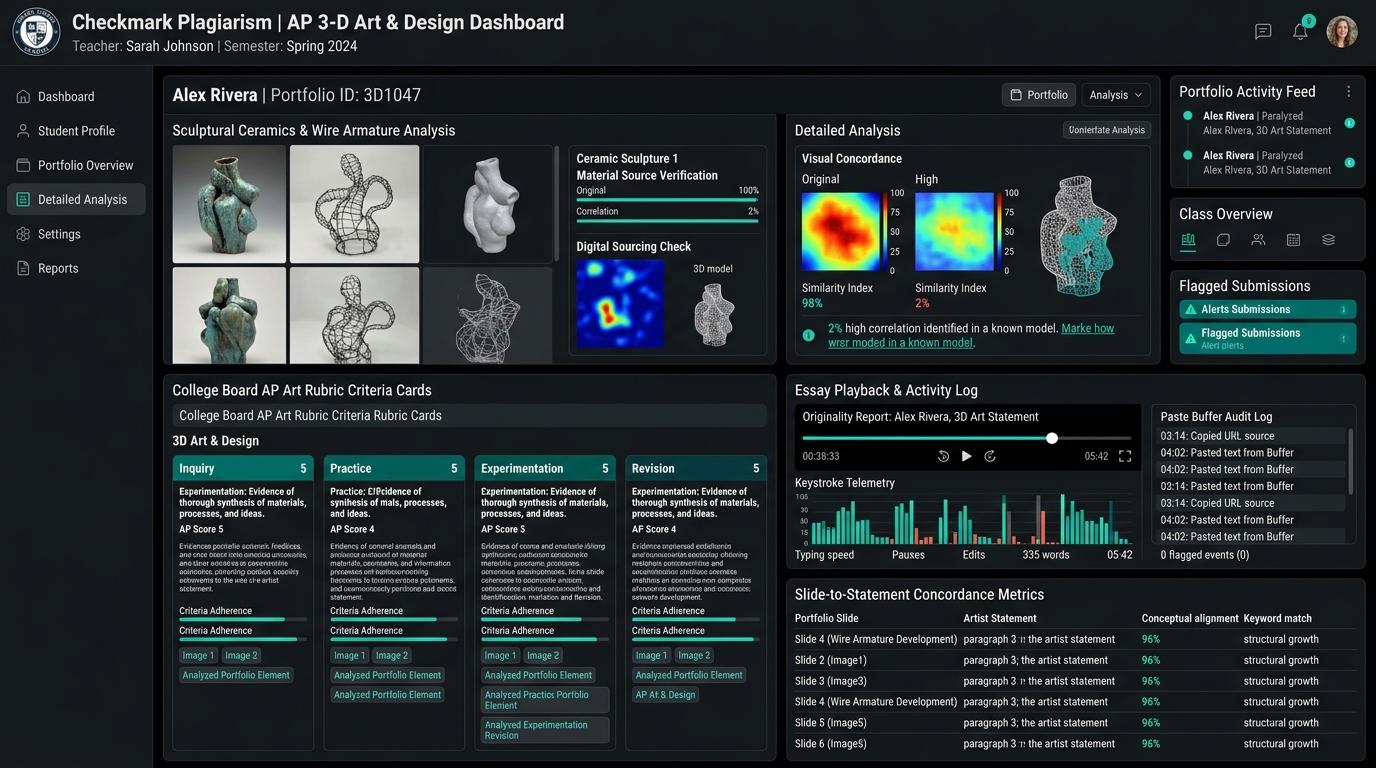
Executive Summary & Studio Integrity Mandate
In the College Board AP 3-D Art and Design portfolio, the Sustained Investigation (SI) written evidence is one of the most compressed, high-stakes writing tasks in secondary education. Across two mandatory prompts totaling just 1,200 characters (approximately 180–220 words), high school students must articulate the conceptual inquiry guiding their 15-slide digital submission (Question 1, max 600 characters) and explicitly defend how their work demonstrates iterative practice, physical experimentation, and structural revision (Question 2, max 600 characters).
Under the pressure of tight character constraints and looming portfolio submission deadlines, an alarming number of ceramics, sculpture, jewelry, and architectural modeling students turn to generative Large Language Models (LLMs). The resulting output is instantly recognizable to experienced studio educators: hyper-inflated, pseudo-intellectual gallery catalog prose (“interrogating the liminal phenomenological dialectics of post-industrial organic biomorphic decay”) that completely erases the student's real physical studio struggle—such as glaze crawl at Cone 6, clay shrinkage cracks, collapsed wire armatures, weld penetration flaws, or structural cantilever failures.
When AP Readers evaluate these submissions against College Board Rubric Rows A, B, and C, this disconnect causes immediate point deductions because the written claims fail to match the physical evolution displayed across the 15 visual slides. Standard black-box AI detectors fail catastrophically on these micro-texts by either returning “insufficient text” errors or generating false alarms on authentic, specialized design terminology. Checkmark Plagiarism resolves this crisis through Spatial Inquiry Telemetry: combining patent-pending Essay Playback™ (1x–8x scrubbable keystroke replay), an External Paste Buffer Inspector, Passage-Level AI Confidence Sliders with honest short-text guardrails (<150w N/A), and Teacher-in-the-Loop AP Rubric Autograding. By linking physical studio artifacts (kiln logs, test tiles, maquettes) with transparent digital writing history, visual arts educators can verify genuine spatial exploration, protect honest student artists, and restore meaningful pedagogical dialogue at the studio worktable.
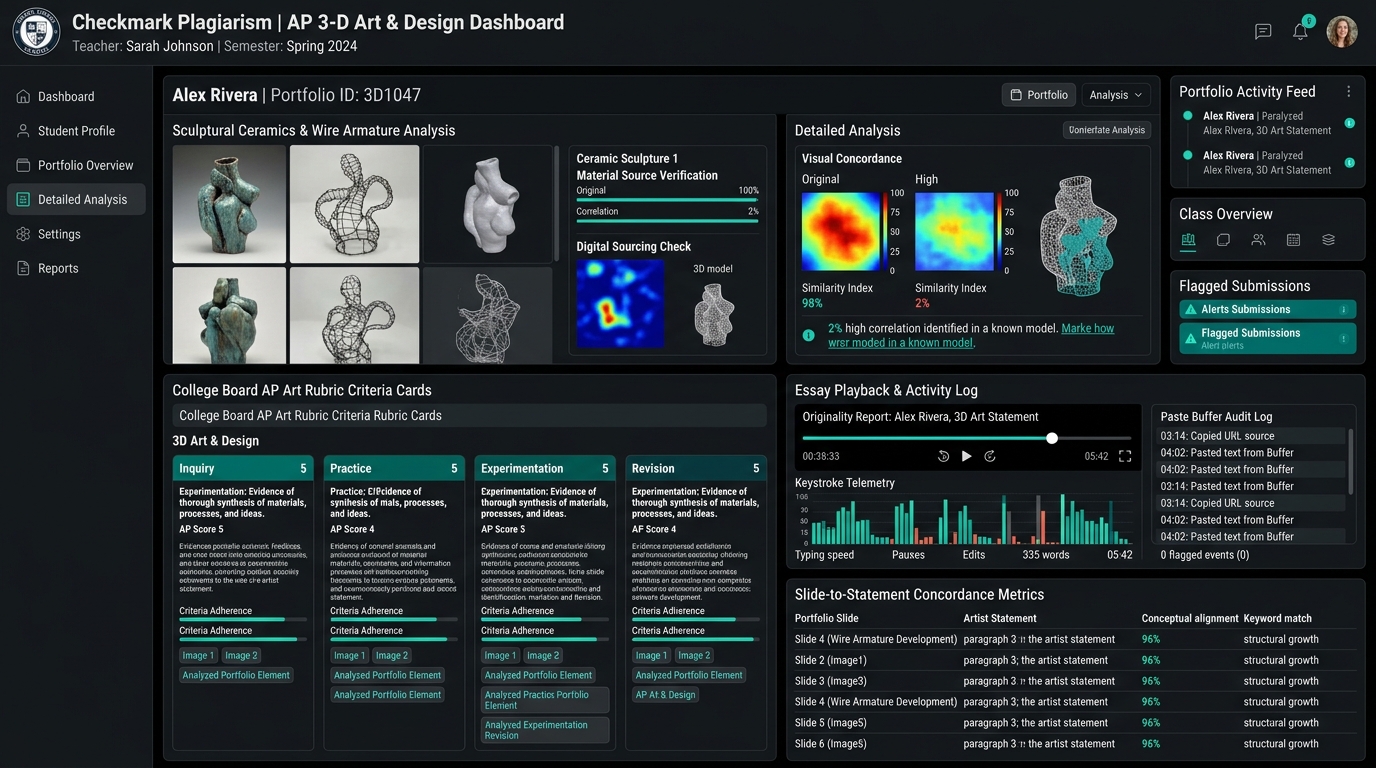
Physical Studio Workbench
- Raw Materials: Stoneware clay, plaster, wire, timber, steel
- Physical Failures: Shrinkage cracks, glaze crawling, joint shear
- Studio Artifacts: Kiln firing logs, test tiles, rough maquettes
- Dimensional Evolution: Progressive structural prototypes
15 Digital Portfolio Slides
- Dimensional Views: 360-degree angles, interior voids, scale
- Process Documentation: Material trials, structural fixes
- Written Evidence (1,200 chars total across Q1 and Q2)
- College Board Rubric Rows A (1 pt), B (2 pts), & C (2 pts)
Checkmark Spatial Telemetry
- Patent-pending Essay Playback™ (1x–8x keystroke replay)
- Tactile Reflection Pauses (verifying dimensions on sculpture)
- External Paste Inspector (preserves clipboard source text)
- Teacher-in-the-Loop AP Rubric Autograder (Canvas/Buzz sync)
1. The College Board AP 3-D Art and Design Portfolio Architecture & The Written Evidence Mandate
In the landscape of Advanced Placement examinations, the AP Art and Design program stands apart. Rather than sitting for a traditional timed, paper-and-pencil or computer-based exam in May, high school studio art students submit a comprehensive digital portfolio through the AP Digital Portfolio (APDP) platform. For students enrolled in AP 3-D Art and Design—encompassing ceramics, sculptural fabrication, architectural model-making, jewelry and metalsmithing, fiber arts, glass, and site-specific installation art—the portfolio is split into two foundational sections:
Selected Works (5 Works / 10 Images)
5 distinct digital submissions (consisting of 2 images per work, for a total of 10 images) demonstrating 3-D design skills, synthesis of materials, processes, and ideas, and mastery of dimensional principles.
Sustained Investigation (15 Slides + Written Evidence)
15 digital slides documenting an in-depth inquiry into a specific 3-D spatial question, accompanied by two mandatory written prompts totaling 1,200 characters.
“Identify the question or inquiry that guided your sustained investigation.”
Evaluated under: Rubric Row A: Inquiry (1 Point Available). Requires clear formulation of a guiding spatial/conceptual inquiry sustained across all 15 slides.
“Describe how your sustained investigation shows evidence of practice, experimentation, and revision guided by your inquiry.”
Evaluated under: Rubric Row B: Practice, Experimentation, & Revision (2 Points) and Rubric Row C: Materials, Processes, & Ideas (2 Points).
The Three-Row College Board Scoring Rubric
To understand why written statements hold make-or-break significance for high school art students, educators must examine the precise scoring criteria utilized by College Board AP Readers during the annual June portfolio reading:
| Rubric Row | Category | Max Score | Scoring Criteria & Evidence Requirements |
|---|---|---|---|
| Row A | Inquiry | 1 pt |
Score 1: Written inquiry identifies a guiding question or inquiry, and visual evidence demonstrates sustained inquiry. Score 0: Written evidence does not identify an inquiry, or visual evidence does not demonstrate inquiry. |
| Row B | Practice, Experimentation, & Revision | 2 pts |
Score 2: Visual and written evidence demonstrates practice, experimentation, AND revision guided by inquiry. Score 1: Visual and written evidence demonstrates practice, experimentation, OR revision, but not all three, or they are not clearly guided by inquiry. Score 0: Little or no evidence of practice, experimentation, or revision. |
| Row C | Materials, Processes, & Ideas | 2 pts |
Score 2: Visual and written evidence demonstrates synthesis of materials, processes, and ideas. Score 1: Visual evidence demonstrates relationships among materials, processes, and ideas, but synthesis is not fully realized in written and visual forms. Score 0: Little or no evidence of relationships among materials, processes, and ideas. |
The Dimensional Design Elements and Principles
Unlike 2-D Art and Design or Drawing portfolios, which operate primarily on a flat plane, AP 3-D Art and Design requires students to engage with physical reality in three dimensions:
1. Mass & Volume
The physical density, perceived weight, solid displacement, and internal spatial capacity of an object.
2. Positive & Negative Space
The physical occupied material versus intentional voids, perforations, openings, and activated surrounding environment.
3. Balance & Gravity
Symmetrical, asymmetrical, or radial physical equilibrium; managing center of mass and structural cantilevers.
4. Texture & Tactility
Surface finishes ranging from coarse grog, exposed wood grain, and chiseled stone to polished glaze, sanded resin, and woven fiber.
5. Scale & Proportion
The physical dimensions of the sculpture in relation to human scale, architectural surroundings, and component relationships.
6. Structural Integrity & Joinery
Mechanical fasteners, mortise-and-tenon joints, weld beads, solder seams, slip-and-score clay bonding, and tensile cable rigging.
For a student to earn maximum marks (Score 2 in Row B and Score 2 in Row C), the written commentary in Question 2 cannot merely be a poetic description of the final sculpture. It must be an exact, transparent, technical account of how physical materials were tested, how unexpected structural or thermal failures occurred, and how the student engineered sculptural revisions to resolve those physical challenges.
2. The Studio Dilemma: “Pretentious Catalog Copy” vs. Physical Studio Reality
High school studio art classrooms are intense, tactile, messy environments. Ceramics students spend dozens of hours wedging clay, centering 10-pound lumps on the pottery wheel, trimming foot rings, testing glaze combinations on bisque tiles, and monitoring kiln firings. Sculpture and metalsmithing students wrestle with pneumatic grinders, plasma cutters, MIG welders, wood lathes, and toxic resin degassing chambers.
However, when April arrives and AP Art teachers instruct their students to draft their mandatory 1,200-character Sustained Investigation statements in the AP Digital Portfolio, a psychological barrier emerges.
The LLM Hallucination Trap in 3-D Art
Generative AI models are trained on millions of museum catalog entries, gallery press releases, and academic art criticism. When prompted by a high schooler, the model produces fluent, grandiose, high-abstraction prose.
What the LLM cannot do is experience the physical constraints of the physical world. It does not know that:
Stoneware Clay Shrinks 12%–15%
If a student joins wet clay handles to a leather-hard vessel without matching moisture content, differential shrinkage causes tensile stress cracks during drying.
Cone 06 vs. Cone 6 Glaze Melting
A Cone 06 low-fire glaze applied to a Cone 6 stoneware body will run off the pot, fuse to the kiln shelf, and ruin both the piece and the kiln furniture.
Plaster Armatures Require Structural Ribs
Wet plaster has tremendous compressive strength but near-zero tensile strength; unreinforced copper wire sags catastrophically under wet plaster load.
Welding Thin-Gauge Sheet Metal
An unshielded arc weld on 22-gauge steel sheet blows burn-through holes instantly unless amperage is dialed down and copper heat sinking is applied.
Concrete Comparison: Authentic Studio Reflection vs. Synthetic Catalog Copy
“In Slides 1-3, my wire armatures bent under 10 lbs of wet plaster, causing the ribcages to slump. To solve this, I experimented in Slide 4 with 1/4-inch threaded steel rods bolted to a plywood base. In Slides 6-8, I tested Cone 6 stoneware with 30% grog to prevent drying cracks in thick joints. When my crawl glaze flaked off in Slide 11, I adjusted the biscuit firing to Cone 04 and applied a magnesium-heavy slip, creating controlled volcanic textures across the final spine assemblies in Slides 12-15.”
• Row B Score: 2 / 2 — Clear practice, experimentation, & revision tied directly to specific slide numbers.
• Row C Score: 2 / 2 — Synthesizes grogged clay, steel rods, slip, and skeletal inquiry ideas.
• Predicted AP Portfolio Score: 5
“My sustained investigation navigates the liminal boundary between organic skeletal vulnerability and rigid architectural permanence. Through an iterative dialogic process, I deconstruct spatial hierarchies by juxtaposing ephemeral materiality with enduring structural geometries. My practice synthesizes biomorphic volumetric expansion with negative space, allowing the physical forms to interrogate anthropocentric fragility while fostering a profound ontological meditation on the transience of modern environmental frameworks and sculptural evolution.”
• Row B Score: 1 / 2 — Vague philosophical buzzwords; zero references to specific slides or physical revisions.
• Row C Score: 1 / 2 — Abstract concepts with zero technical explanation of actual fabrication processes.
• Predicted AP Portfolio Score: 3 or 4 (Severe point deduction)
When an AP Reader reviews the portfolio, the synthetic statement is an immediate red flag. The student used 594 characters to say absolutely nothing about their physical materials (clay, steel, plaster, wire), named zero specific slide numbers, and failed to explain a single concrete revision. The student receives a 1 out of 2 on Row B and a 1 out of 2 on Row C, dropping their overall AP score from a 5 to a 3 or 4.
3. The AP Reader & Due Process Dilemma: Why Generic Detectors Fail on 600-Character Statements
When art educators suspect that a student used an LLM to generate their Sustained Investigation statement, their first instinct is often to paste the 600-character paragraph into a generic AI detector (such as Turnitin's whole-document score, GPTZero, or CopyLeaks).
This approach creates severe pedagogical and technical crises:
Threshold Collapse (<150 Words)
A 600-character prompt contains only 85 to 110 words. Statistical NLP detectors require a minimum of 250–500 words to calculate burstiness and perplexity distributions. Below 150 words, statistical variance approaches zero, causing the detector to either crash with “Text too short” or output an uncalibrated random score.
High-Vocabulary False Positives
An honest AP Art student writing concise technical sentences (“I welded 1/8-inch mild steel rods using oxy-acetylene torch brazing with flux-coated bronze filler”) produces high technical noun density and low conversational filler. Generic detectors mistake this low perplexity for machine generation, flagging authentic students as “94% AI.”
“AI Humanizer” Evasion
A student who ran an AI statement through QuillBot or Undetectable AI registers “0% AI.” The text remains 100% disconnected from the physical sculptures, yet easily passes generic statistical detectors.
Due Process Breakdown
An art teacher accuses a student of cheating based solely on a black-box 88% detector score. The student and parents bring the 15 finished physical ceramic sculptures to the conference. Administration overturns the allegation because the teacher has zero forensic drafting proof.
Visual arts departments do not need speculative probability scores. They need transparent, defensible process telemetry that records the authentic human labor of translating physical 3-D studio discovery into written words.
4. The AP 3-D Art Evidentiary Matrix
To evaluate how different integrity verification methodologies perform in high school 3-D art and design environments, consider the following comprehensive comparison matrix:
| Evaluation Dimension | Paper Sketchbooks | Generic AI Detectors | Google Docs Version History | Checkmark Spatial Telemetry & Essay Playback™ |
|---|---|---|---|---|
| Granularity of Analysis | Qualitative inspection of drawings & glaze notes. | Opaque whole-text % score (e.g. “82% AI”). | Macro snapshots every 5–15 mins; collapses rapid typing. | Passage-Level Confidence Sliders with phrase-by-phrase metrics. |
| Short-Text Viability (<150w / 600 chars) | High qualitative value, unlinked to digital submission. | Fails completely; wild false positives or crash errors. | Shows coarse text blocks added between autosave intervals. | Honest Guardrails: Displays N/A for micro-samples <150w. |
| Spatial-Physical Concordance | Direct physical observation in studio. | Zero awareness of physical artwork or slides. | Zero awareness of physical artwork or digital slides. | Slide-to-Text Concordance Audit integrated with AP Rubric. |
| Keystroke Dynamics & Video Replay | None (paper medium). | None. | Coarse character diffs; cannot reconstruct typing rhythm. | Patent-Pending Essay Playback™ (1x–8x) video keystroke replay. |
| External Paste Buffer Inspection | N/A. | None. | Shows paste as instant block with no source data. | External Paste Inspector: Captures timestamp & raw pre-edit payload. |
| Tactile Reflection Pause Tracking | Observational memory only. | None. | None. | Identifies 15–45s pauses where student inspects 3-D object. |
| AP Rubric Autograding & LMS Sync | Manual paper rubric grading; time-consuming. | None; detection only. | None. | Teacher-in-the-Loop Autograder: Quote-anchored AP Row A/B/C sync. |
| Due Process Defensibility | Subjective teacher opinion. | Highly vulnerable; easily challenged by parents. | Weak; shows fast appearance but cannot prove source. | Indisputable Forensic Receipts: Video replay and paste buffer logs. |
5. The Step-by-Step 3-D Art Teacher Audit Protocol
To ensure academic integrity, protect genuine student labor, and guide high school artists toward maximum AP portfolio scores, visual arts faculty and department chairs should implement this 5-Phase Spatial Inquiry Audit Protocol:
Slide-to-Commentary Physical Concordance Audit
Before opening digital telemetry, the AP 3-D Art teacher performs a visual and textual concordance cross-check:
- Inquiry Concordance (Row A): Read Question 1 (max 600 chars). Does the inquiry formulate an open-ended question about 3-D relationships (e.g., “How can modular ceramic units convey the tension between industrial geometric containment and organic viral expansion?”)? Cross-check against Slides 1–15 to confirm visual exploration.
- Practice, Experimentation, & Revision Concordance (Row B): Check Question 2 for three specific anchors: initial technique mastery (Practice), material trials like slip formulas or alloy ratios (Experimentation), and explicit references to how a failed piece in an early slide was physically redesigned in a later slide (Revision).
- The “Jargon Red Flag”: If Question 2 contains multi-syllabic philosophical abstractions (“transcending hegemonic paradigms of anthropomorphic space”) but fails to mention a single raw material, physical tool, or slide number, flag the submission for forensic telemetry review.
Studio Milestone & Material Failure Archaeology
A major advantage of 3-D studio teachers is that student work exists in physical space. Teachers should maintain and cross-reference a Physical Studio Trail:
Kiln Firing Logs
Bisque and glaze firing date records, cone shut-off temperatures, and reduction/oxidation atmospheres.
The “Mishap Graveyard”
Broken test tiles, exploded greenware remnants, cracked solder seams, and failed plaster molds stored in studio shelving.
Process Sketchbooks
Physical books containing hand-drawn dimensional schematics, joinery diagrams, glaze recipes, and material receipts.
Analyzing Keystroke Sessions & Tactile Reflection Pauses with Essay Playback™
When students compose their statements in Google Docs, Canvas LMS, or Buzz LMS integrated with Checkmark, teachers open Essay Playback™ to scrub the writing session at 1x to 8x speed:
Pattern A: Authentic Studio Drafting
Non-linear typing, natural backspacing, measurement checks, and 15–45s pauses where the student inspects their physical sculpture.
Pattern B: Mechanical Transcription
Robotic typing at constant 55+ WPM with zero pauses or backspaces, transcribing off-screen AI text from a phone or second device.
Pattern C: Paste Buffer Dump
Instantaneous insertion of 500+ characters in 0.05 seconds, followed by minor word-swapping or superficial paraphrasing.
Inspecting External Paste Buffer Payloads
When a student pastes text from an LLM into their document, Checkmark's External Paste Buffer Inspector captures:
- Timestamped Clipboard Capture: Records the exact date, minute, and second the paste occurred.
- Payload Size & Character Count: Shows the exact character payload inserted in a single keystroke (e.g.
+598 characters). - Historical Text Preservation: Preserves the exact raw clipboard text—even if the student later spends an hour rewriting or deleting every sentence.
- Jump-to-Playback: Instantly jumps the Essay Playback™ video directly to the millisecond of insertion.
Conducting Restorative Studio Pedestal Debriefs
The core philosophy of Checkmark is “Stop guessing, start trusting.” When telemetry reveals unauthentic text, the response is never punitive expulsion. Instead, the teacher conducts a 5-to-10 minute restorative studio conference right at the student's workbench:
Place the physical piece on the pedestal: “You spent 50 hours throwing these forms. The craftsmanship is real.”
“When Readers see 'liminal dialectics,' they see no evidence of your glaze tests. This will drop you to a 1 in Row B.”
Open Checkmark Playback together: “Let's talk about the deadline anxiety that made you feel your own studio words weren't enough.”
Ask: “What broke in Slide 4? How did you fix it in Slide 7?” Have the student draft the real 600-character statement right there.
6. How Checkmark Plagiarism Empowers AP Art & Design Programs
Checkmark Plagiarism provides a complete, educator-first suite tailored specifically to the nuanced demands of secondary visual arts and AP studio disciplines:
Passage-Level AI Confidence Sliders
Underlines specific suspicious sentences rather than generating opaque black-box document scores. Provides calibrated Perplexity and Burstiness metrics.
Honest Guardrail: Automatically displays N/A on texts <150 words to eliminate false positives on concise statements.
Patent-Pending Essay Playback™
1x to 8x scrubbable video replay of the full writing session. Visualizes revision bursts, cursor movements, backspaces, and formatting adjustments.
Studio Intelligence: Highlights Tactile Reflection Pauses where students verify physical sculpture details.
External Paste Buffer Inspector
Captures full raw text payloads from external LLM prompt dumps. Retains original pasted text even after line-by-line manual paraphrasing.
One-Click Scrub: “Jump to Playback” button navigates directly to the exact millisecond of text insertion.
Teacher-in-the-Loop AP Rubric Autograder
Pre-configured with College Board AP Art & Design Rubrics (Rows A, B, C). Generates draft point scores with quote-anchored written justifications.
LMS Sync: Direct gradebook sync with Canvas LMS, Agilix Buzz, and Google Classroom.
7. Real High School Studio Case Scenarios
Cone 6 Stoneware Glaze Delamination vs. AI “Liminality” Prompt
Student & Focus: Maya K., 12th Grade AP 3-D Art student investigating biomorphic sea coral structures using wheel-thrown and altered stoneware clay bodies.
The Incident: Under deadline pressure for the spring portfolio lock, Maya submitted a Question 2 statement reading: “My sustained investigation deconstructs anthropocentric oceanography through an ontological interrogation of calcareous biomorphic decay. I synthesize liminal porcelain geometries with fluid organic glaze vectors to manifest ecological precarity.”
The Audit: Slides 1–6 showed coarse brown stoneware vessels with severe glaze crawling (bare exposed clay) and base shrinkage cracks. Slides 7–11 showed test tiles with varied feldspar fluxes. Slides 12–15 showed vitrified coral forms. Checkmark's Paste Inspector flagged a single paste event of 591 characters at 11:42 PM from an external browser tab. Essay Playback™ confirmed the text appeared instantaneously with zero drafting history.
The Intervention & Outcome: In the ceramics studio, the teacher put Maya's cracked test pot on the wheel and asked her why the glaze crawled. Maya explained that low bisque firing at Cone 08 left residual dust, and fine clay caused shrinkage cracks. She fixed this by adding 20% kyanite grog and firing to Cone 04 bisque before applying a high-magnesium crawl glaze. The teacher had Maya rewrite Question 2 using her real studio words. Maya achieved a perfect Score 2 on Row B and Score 2 on Row C, ultimately earning a top Score 5 on her AP Portfolio.
Cantilevered Basswood Architectural Model Exonerated by Essay Playback™
Student & Focus: Liam R., 11th Grade AP 3-D Art student investigating structural tension, load distribution, and cantilevered spans in urban high-density modular housing models.
The Incident: Liam submitted a concise, technical 588-character statement detailing truss angles, tensile cable rigging, and wood glue shear failures. A generic commercial AI detector flagged the text as “92% AI-Generated” due to the low-perplexity, jargon-dense phrasing (“gusset plate reinforcement”, “cantilever deflection”, “tensile cable cross-bracing”). Liam faced an academic integrity referral.
The Audit: The fine arts department chair opened Liam's drafting history in Checkmark. Essay Playback™ revealed an 84-minute active drafting session with keystroke-by-keystroke composition, 30–60s calculation pauses to adjust span ratios from “1:4” to “1:6”, and continuous trimming to fit within the 600-character ceiling. Zero external paste events occurred.
The Outcome: Liam was immediately and completely exonerated. The department chair used Checkmark's video playback in a conference with the principal to demonstrate that Liam's elevated vocabulary was the authentic voice of a gifted young designer. The referral was dismissed with zero penalty.
Copper Electroforming & Warp-Tension Revisions Validated
Student & Focus: Chloe T., exploring the synthesis of rigid electroformed copper armor plates with flexible hand-woven tapestry fibers.
The Incident: Chloe's Question 2 statement contained an intricate technical breakdown of copper electroforming baths, acid electrolyte ratios, and loom warp tension adjustments. The department ran a routine pre-submission audit.
The Audit: Studio archaeology confirmed handwritten chemical logs detailing copper sulfate solution grams-per-liter and rectifier voltage settings (0.5V vs 1.5V) in Chloe's physical sketchbook. Checkmark Playback proved organic drafting across 12 revision cycles as Chloe balanced character counts.
The Outcome: Chloe's portfolio was verified as 100% authentic, submitted with complete confidence, and awarded a top Score 5 by College Board AP Readers.
8. Frequently Asked Questions (FAQ)
1. What are the exact character limits and written prompts for the AP 3-D Art and Design Sustained Investigation?
In the AP Digital Portfolio (APDP), the Sustained Investigation written section consists of two mandatory prompts, each capped at 600 characters maximum (including spaces and punctuation), for a total of 1,200 characters:
- Question 1: “Identify the question or inquiry that guided your sustained investigation.” (Max 600 chars / ~85–110 words, evaluated under Row A: Inquiry, 1 pt).
- Question 2: “Describe how your sustained investigation shows evidence of practice, experimentation, and revision guided by your inquiry.” (Max 600 chars / ~85–110 words, evaluated under Row B: 2 pts, Row C: 2 pts).
2. Why do generic AI detectors fail on AP 3-D Art written statements?
Generic AI text detectors rely on statistical language models analyzing perplexity and burstiness across large word counts (typically 250–500 words minimum). At 600 characters (~90 words), sample sizes are far too small, triggering either “insufficient text” errors or severe false positives. Furthermore, concise technical descriptions of ceramic glazes, weld beads, or wood joinery have low natural perplexity, triggering false AI alarms on diligent human students.
3. What is the College Board's official policy on AI usage in AP Art and Design portfolios?
The College Board states that all work submitted in AP Art and Design portfolios must be the student's own authentic work. While generative AI may be used as a research or brainstorming tool in early concept development, students cannot submit AI-generated imagery as their own artwork, nor can they submit AI-generated text as their written Sustained Investigation statements. Any AI assistance used must be explicitly cited; uncredited AI text constitutes a violation of the AP Academic Integrity Policy and can result in portfolio cancellation.
4. How does Checkmark prevent false AI accusations on high-scoring student artists?
Checkmark uses a multi-layered protection architecture: (1) Honest Short-Text Guardrails that display N/A on samples under 150 words rather than outputting speculative percentages, (2) Essay Playback™ Video Telemetry (1x–8x) proving organic keystroke-by-keystroke composition, and (3) External Paste Buffer Forensics verifying whether text was composed natively or pasted in a single millisecond.
5. What should an AP 3-D Art teacher do if a student used an LLM to generate their statement?
Follow the Restorative Studio Pedestal Conference Protocol: Meet privately at the student's workbench with their physical artwork, explain how hollow AI jargon (“liminal dialectics”) hurts their AP score by omitting real materials and slide numbers, review Checkmark's paste logs together to explore the root anxiety, and guide the student to re-draft an authentic 600-character statement detailing real studio failures and technical fixes.
6. Can students use AI tools to check grammar or character count in their statements?
Basic spellcheckers and character counters are permissible. However, students should avoid generative LLM rewriters or “AI humanizers,” which routinely strip away specific physical studio terminology and slide cross-references required by AP Readers for Rubric Rows B and C.
7. How does Checkmark integrate with learning management systems like Canvas, Buzz, and Google Classroom?
Checkmark integrates natively via standard LTI 1.3 and LMS APIs. When students compose written statements in Google Docs, Google Classroom, Canvas LMS, or Buzz LMS, Checkmark captures writing telemetry in the background. Teachers can review Essay Playback™, audit paste logs, and use the Teacher-in-the-Loop AP Rubric Autograder to pass finalized scores directly into the LMS gradebook with a single click.
9. Conclusion & Strategic Guidance for High School Visual Arts Departments
In an era of ubiquitous generative artificial intelligence, the physical studio remains one of the purest sanctuaries of authentic human learning. When a high school student wedges clay, pours bronze, welds steel, or weaves fiber, they engage in a profound, tactile dialogue with the physical laws of nature—experiencing gravity, thermal stress, shear resistance, and material transformation.
The mandatory 1,200-character Sustained Investigation statement is not a decorative artist statement; it is the technical engineering log of that physical dialogue.
When students succumb to the temptation of generative AI, they rob themselves of the credit they earned through dozens of hours of intense physical labor, submitting hollow catalog cliches that damage their AP portfolio scores. By equipping visual arts faculty with Checkmark Plagiarism, secondary schools can:
1. Eliminate Guesswork
Replace opaque, speculative black-box AI percentages with transparent, defensible keystroke video replay and paste buffer forensics.
2. Protect Honest Artists
Provide students with undeniable digital proof of their authentic drafting process, protecting them from false-positive accusations.
3. Maximize AP Scores
Guide students to write precise, slide-anchored technical commentary that fulfills every requirement of College Board Rubric Rows A, B, and C.
4. Foster Restorative Growth
Transform academic integrity into an inspiring, studio-centered dialogue that honors the authentic, messy, beautiful truth of the artistic process.
Equip Your Visual Arts Faculty with Checkmark
Bring transparent writing process telemetry, honest short-text guardrails, and quote-anchored AP rubric autograding to your district's fine arts and AP Capstone programs.