
Executive Summary & SLA Integrity Directive
Evaluating foreign language writing proficiency across multi-week portfolios presents an existential pedagogical challenge in the era of Neural Machine Translation (NMT) and Large Language Models (LLMs). When students can generate idiomatic, morphosyntactically flawless Spanish, French, German, Mandarin, Italian, or Japanese compositions in seconds using tools like DeepL, Google Translate, or ChatGPT, static text evaluation ceases to measure actual language acquisition. Furthermore, legacy black-box AI detectors fail catastrophically in Second Language Acquisition (SLA) contexts—routinely flagging authentic, formulaic novice writing as “AI-generated” (false positives) while passing sophisticated, machine-translated paragraphs as “100% human” (false negatives).
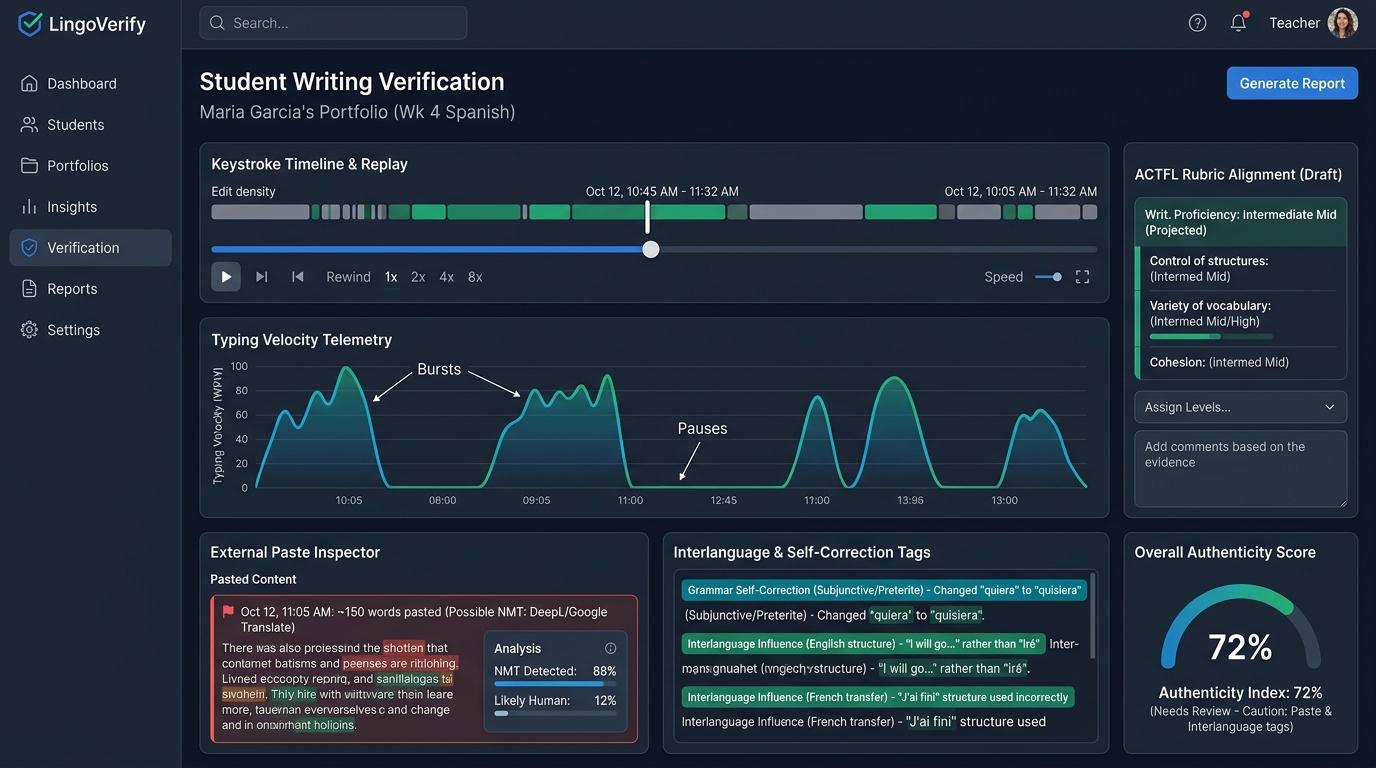
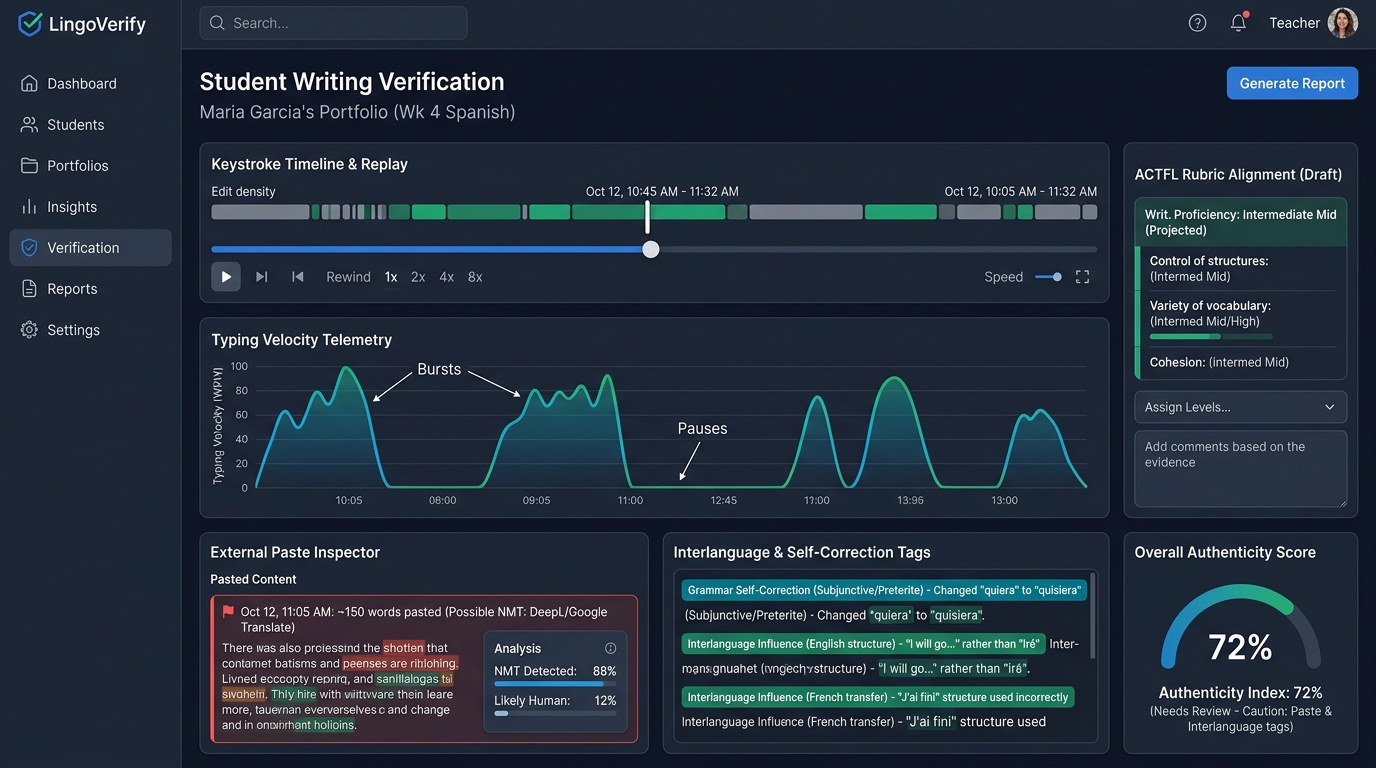
The definitive solution is Writing Process Telemetry and Patent-Pending Essay Playback™. Rather than guessing at student authenticity from a static final document, language educators use draft replay to analyze the real-time cognitive biometrics of second-language composition: typing velocity (10–25 WPM), inflectional self-corrections, lexical retrieval pauses, and accent keyboard interactions. This guide establishes a longitudinal portfolio verification framework for AP/IB, Dual-Language Immersion, and collegiate faculty to distinguish spontaneous L2 drafting from machine translation dumps, conduct restorative student conferences, and cultivate genuine target-language fluency.
1. The Portfolio Assessment Crisis in World Language Education
In modern foreign language pedagogy—grounded in the proficiency standards of the American Council on the Teaching of Foreign Languages (ACTFL) and the Common European Framework of Reference for Languages (CEFR)—the multi-week writing portfolio represents the pinnacle of authentic assessment. Unlike high-stakes, single-sitting timed exams that assess immediate retrieval under stress, longitudinal portfolios allow learners to:
- Synthesize complex cultural themes over extended inquiry and research cycles.
- Integrate newly acquired morphosyntactic structures (e.g., subjunctive moods, relative clauses, case inflections, aspectual distinctions).
- Engage in recursive self-editing, peer review, and instructor-guided revision.
- Document longitudinal progress along the proficiency continuum from Novice to Intermediate to Advanced.
However, the widespread accessibility of neural translation engines (such as DeepL and Google Translate) and multilingual generative AI models has fundamentally undermined portfolio evaluation.
- L1 Concept → L2 Lexical Search: Student accesses target-language vocabulary from working memory.
- Morphosyntactic Assembly: Active conjugation, gender/number agreement, and case selection.
- Character-by-Character Typing: Deliberate input with natural hesitation and inflectional self-corrections.
- Interlanguage Neural Growth: Repeated production strengthens target-language retrieval pathways.
- L1 Concept → Full English Essay: Student outlines and writes entire arguments in native English.
- Automated Neural Translation: Text pasted into DeepL / ChatGPT / Google Translate.
- Monolithic Clipboard Injection: Single 0.0-second paste event injects 200+ target-language words.
- Stagnant Interlanguage: Student cannot read, pronounce, or explain the submitted grammar.
The Fundamental Assessment Dilemma: Polished static text can no longer be trusted as proof of learning. To preserve the validity of multi-week language portfolios, educators must audit the temporal writing process.
When students bypass the cognitive struggle of target-language formulation by writing in their native language (L1) and translating full paragraphs into the target language (L2), instructors receive polished, native-sounding submissions that completely mask severe communicative deficits. To preserve the portfolio as a valid diagnostic instrument, educators must transition from evaluating static text artifacts to auditing the temporal writing process through which that text was generated.
2. Second Language Acquisition (SLA) & The Spectrum of Digital Assistance
To establish fair, transparent, and pedagogically sound integrity policies, World Language faculty and Second Language Acquisition (SLA) specialists must clearly delineate between legitimate language-learning tools and unauthorized authorship substitution.
2.1 Applied Linguistics Foundations: Why Cognitive Struggle Matters
Second language writing is not merely a method for transcribing thought; it is an essential engine of cognitive language acquisition. Decades of SLA research highlight four core theoretical principles governing authentic written production:
| SLA Theory | Primary Theorist | Practical Implication for Writing |
|---|---|---|
| The Output Hypothesis | Merrill Swain (1985, 1995) | Learners acquire language by being pushed to produce output. Struggling to formulate clauses forces “noticing the gap” between intent and capability. |
| Interlanguage Theory | Larry Selinker (1972) | A learner's language is a dynamic, evolving rule system between L1 and L2. Errors and self-corrections are systematic, necessary evidence of learning. |
| The Affective Filter Hypothesis | Stephen Krashen (1982) | High anxiety, fear of failure, or adversarial surveillance blocks acquisition. Process verification must foster trust and supportive growth, not paranoia. |
| Cognitive Load in L2 Composition | John Sweller / Kellogg (1990, 1996) | Writing in L2 demands simultaneous lexical retrieval, syntactic ordering, and motor execution, creating distinct burst-and-pause typing tempos. |
When a student uses a machine translation engine to draft entire sentences or paragraphs, they short-circuit Swain's Output Hypothesis. The learner never notices grammatical gaps, never tests morphological hypotheses, and never develops automated retrieval pathways in the target language.
2.2 The 4-Tier Spectrum of Digital Language Assistance
Educators must define explicit boundaries in their course syllabi. Not all digital assistance is illicit; modern language professionals utilize digital resources constantly. The critical distinction lies in cognitive agency.
Lexical Retrieval Aids (Isolated Vocabulary)
Tools: WordReference, Linguee, Leo, Pleco, Jisho, Duden, Larousse.
SLA Impact: The student actively selects the target word from multiple dictionary options and manually integrates it into their own syntactic sentence frame.
Morphological & Input Utilities
Tools: Spanish verb conjugation tables, language accent bars, Pinyin/Kana IMEs, spellcheckers.
SLA Impact: Supports mechanical typing and inflectional recall while keeping the student in control of narrative logic and grammar construction.
Full-Clause / Sentence Machine Translation
Tools: DeepL Pro, Google Translate, Apple Translate, Reverso Context.
SLA Impact: Completely bypasses clause assembly, grammatical synthesis, and tense negotiation. Outsources interlanguage development to neural engines.
Generative AI / LLM Autonomous Co-Authors
Tools: ChatGPT (GPT-4o), Claude 3.5 Sonnet, Google Gemini, Microsoft Copilot.
SLA Impact: Outsources ideation, cultural perspective, vocabulary selection, syntactic structures, and discourse markers. Total absence of student authorship.
2.3 Morphosyntactic Signatures of Machine Translation Across Target Languages
Machine-translated and LLM-generated L2 texts exhibit specific linguistic anomalies that clash violently with natural learner developmental trajectories. Understanding these markers helps instructors spot inconsistencies during portfolio evaluations.
🇪🇸 Spanish (Español)
Morphosyntactic Signatures- Premature Subjunctive Mastery: Intermediate-Low learners spontaneously producing complex hypothetical clauses with pluperfect subjunctive and conditional perfect (“Si me hubiera enterado de la verdad, no habría actuado de esa manera”), when course benchmarks only cover the present indicative and preterite/imperfect distinction.
- Unnatural Clitic and Passive Constructions: Overuse of passive voice (“El libro fue escrito por...”) instead of authentic reflexive passive (“Se escribió el libro...”), or hyper-correct placement of double object pronouns (“Se lo entregué” without hesitation).
- L1 Calques vs. Idiomatic Rendering: Translating “to make a decision” as “hacer una decisión” (authentic novice error) vs. machine translation rendering the idiomatic “tomar una decisión” alongside vocabulary 3 levels above the student's speaking ability.
🇫🇷 French (Français)
Morphosyntactic Signatures- Complex Hypothetical & Subjunctive Sequencing: Flawless use of the subjonctif passé or conditionnel passé deuxième forme in Level II/III submissions.
- Partitive vs. Definite Article Precision: Zero errors in partitive transformations under negation (“Je n'ai pas de...” vs. “Je n'ai pas des...”), an error that persists across authentic Intermediate and Advanced-Low writers.
- False Friend Handling: Sophisticated contextual disambiguation of words like actuellement (currently vs. actually) or assister à that learners routinely confuse.
🇩🇪 German (Deutsch)
Morphosyntactic Signatures- Subordinate Clause Verb-Final Perfection (Nebensatz): Flawless recursive subordinate clauses with multi-part verb clusters at the absolute end (“...weil er gestern trotz des schweren Sturms pünktlich an der Universität angekommen sein soll”).
- Adjective Declension & Case Congruence: Complete absence of weak/strong/mixed adjective inflection errors across dative and genitive cases—an area where human learners exhibit frequent slips of the pen.
- Modal Particle Injections: Inappropriate placement of subtle native conversational particles (doch, ja, denn, halt, mal) rarely mastered prior to C1/ACTFL Superior levels.
🇨🇳 Mandarin Chinese (中文 - 汉语)
Morphosyntactic Signatures- Advanced Measure Words (量词): Effortless integration of highly specific, rare measure words (一尾鱼, 一封信, 一栋建筑) alongside novice-level discourse structures.
- Four-Character Idiomatic Expressions (成语 - Chéngyǔ): Insertion of classical idioms (半途而废, 津津有味, 循序渐进) in simple narrative essays about daily school life.
- Complex Directional & Resultative Complements: Intricate constructions (跑了进去, 听得懂, 拿不出来) without a single character stroke deletion or IME phonetic correction during typing.
🇮🇹 Italian & 🇯🇵 Japanese (日本語)
Morphosyntactic Signatures- Italian (Italiano): Flawless concordance of past subjunctive (congiuntivo imperfetto/trapassato) after verbs of opinion (“Non pensavo che tu fossi già arrivato”).
- Japanese (日本語): Flawless switching between plain form (da/dearu), polite form (desu/masu), and complex honorifics (keigo - sonkeigo / kenjougo), alongside immaculate particle selection (wa vs. ga, ni vs. de).
3. The Pedagogical Dilemma: Psychological Safety vs. Linguistic Integrity
Foreign language education faces a profound ethical dilemma when confronting digital dishonesty.
The Risk of Over-Policing & Adversarial Suspicion
- Elevates Stephen Krashen's Affective Filter, paralyzing expressive risk-taking.
- False AI detector flags traumatize earnest, non-native learners.
- Destroys teacher-student rapport and creates adversarial classroom dynamics.
- Invasive webcam proctoring turns formative writing into stressful surveillance.
The Risk of Unchecked Translation Outsourcing
- Destroys the diagnostic validity of longitudinal portfolio grading.
- Cripples oral communication readiness and real-time communicative competence.
- Demoralizes honest, hard-working students who struggle through manual drafting.
- Inflates grades without actual SLA proficiency growth.
3.1 Why Statistical AI Detectors Create Catastrophic False Positives in L2
Many educational institutions have attempted to screen foreign language essays using legacy statistical AI detectors. This approach is mathematically and pedagogically flawed.
- Restricted vocabulary inventory
- Repetitive syntactic sentence frames
- Uniform S-V-O patterns (“Yo voy...”, “Yo tengo...”, “Me gusta...”)
Flagged as 85–95% AI-Generated. Penalizes honest learners for normal developmental language constraints.
- Highly diverse, idiomatic lexicon
- Dynamic clause lengths and poetic rhythms
- Natural native transitions and authentic cadence
Rates translated essay as “100% Human”, allowing complete machine translation outsourcing to pass undetected.
- The Perplexity Penalty on Novice Writers: Statistical AI detectors measure perplexity (word predictability). Because beginning and intermediate language learners write with simple, highly predictable vocabulary, their essays naturally score in the lowest perplexity percentiles. Statistical tools interpret this formulaic simplicity as an LLM signature, generating devastating false accusations against non-native writers.
- The Burstiness Paradox: Human native writers vary their sentence lengths dynamically (high burstiness), whereas language learners write in short, uniform declarative sentences. Because generic AI detectors associate low burstiness with automated text generation, authentic student essays are systematically flagged.
- The DeepL Cloaking Effect: DeepL transforms basic English thoughts into rich, varied, idiomatic L2 sentences. The resulting text exhibits high perplexity and burstiness. Consequently, statistical AI detectors pass machine-translated work with clean scores, allowing genuine academic dishonesty to slip through undetected.
3.2 The Solution: “Stop Guessing, Start Trusting” Through Writing Process Telemetry
To eliminate false accusations and protect student psychological safety, language departments must adopt Checkmark Plagiarism’s core philosophy: “Stop guessing, start trusting.”
By capturing the real-time keystroke dynamics, pauses, and revisions of the drafting process, instructors obtain objective, empirical proof of student composition. When an educator can watch a student type, backspace, re-conjugate a verb, and look up an isolated noun in real time, the need for black-box probabilistic guesswork vanishes entirely.
4. The World Language Telemetry Matrix: Static Text vs. Essay Playback™
How does writing process telemetry differ from conventional submission review and legacy edtech tools? The matrix below outlines core capabilities across assessment methodologies.
| Evaluation Dimension | Static File (.pdf/.docx) | Google Docs Rev. History | Legacy AI Detectors | Checkmark Essay Playback™ |
|---|---|---|---|---|
| Keystroke-by-Keystroke Timeline | ❌ None | ❌ Snapshot Batches | ❌ None | ✅ Full 1x–8x Replay with exact pauses |
| External Paste Detection & Text Storage | ❌ Invisible | ⚠️ Ambiguous Paste Blocks | ❌ Invisible | ✅ Preserves full pasted clipboard string |
| L2 Typing Velocity (WPM Telemetry) | ❌ None | ❌ None | ❌ None | ✅ Real-time WPM burst/pause graphs |
| Morphological Self-Correction Tracking | ❌ Final State Only | ❌ Rare Mid-States | ❌ Final State Only | ✅ Visible in-line backspace events |
| Lexical Search Pauses (Cognitive Retrieval) | ❌ Invisible | ❌ Invisible | ❌ Invisible | ✅ Highlighted pause durations (s) |
| Second-Screen Transcription Detection | ❌ Blind | ❌ Blind | ❌ Blind | ✅ Flagged via isochronous typing tempo |
| Novice L2 False Positive Vulnerability | N/A | N/A | 🚨 Extreme Hazard (>60%) | 🛡️ 100% Protected (Empirical History) |
5. Keystroke Biometrics of L2 Composition: What Authentic Drafting Looks Like
When language learners compose in an emerging tongue, their neuro-cognitive processes produce distinct temporal fingerprints. By examining keystroke velocity, pause intervals, and backspace patterns, educators can immediately differentiate spontaneous production from external translation.
Characteristics: Recursive backspacing, inflectional self-corrections, natural burst-and-pause rhythm.
Characteristics: Monolithic block insertion; zero keystrokes; advanced subjunctive clauses appearing instantly.
Characteristics: Isochronous key intervals; zero morphological hesitation; zero backspaces on complex French subjunctive.
5.1 Authentic L2 Drafting Signatures
- The “Burst-and-Pause” Cadence (10–25 WPM Average): In a developing language, writers cannot compose continuously. They type in short syntactic bursts (2–5 words), followed by cognitive micro-pauses (1.5–5.0 seconds) to retrieve vocabulary, select gender agreements, or verify verb endings.
- Morphological and Orthographic Backspacing: Genuine L2 writers make frequent inflectional corrections. In Spanish, an authentic student might type “hablaba”, immediately backspace three characters, and type “é” (hablé) as they consciously decide between the preterite and imperfect. In German, a student might type a noun, pause, backspace, and capitalize the initial letter to satisfy German orthographic rules.
- Lexical Lookup Pauses: When an authentic learner accesses a digital dictionary (e.g., WordReference), the playback timeline records a brief 5–15 second pause, followed by the deliberate, character-by-character typing of a single isolated word.
- IME & Accent Tool Interactions: In French, Spanish, German, Italian, Mandarin, or Japanese, authentic drafting shows consistent interaction with accent menus, keyboard hotkeys, or IME conversion bars (such as selecting appropriate Chinese Hanzi from Pinyin candidate lists).
5.2 Translation Abuse Signatures
- The Monolithic Paste Event: The student drafts their essay in English in another window, translates it via DeepL, copies the target-language output, and pastes 100–300 words into the LMS editor in a single 0.0-second event. Checkmark’s external paste inspector captures the exact timestamp, character count, and full preserved text of the paste.
- The “Copy-Paste-Tweak” Mask: Some students attempt to circumvent paste detection by pasting a machine-translated paragraph and then manually changing 3–4 words (e.g., swapping a synonym or fixing an obvious noun). Checkmark’s timeline captures both the initial massive paste and the subsequent minor superficial edits, preserving the original pasted string in the forensic inspector.
- The Second-Screen Transcription Fingerprint: To avoid paste detection altogether, a student might place a phone or second monitor next to their keyboard displaying Google Translate, manually retyping the translated foreign text into the assignment editor. This creates a distinct transcription signature: high, unbroken typing velocity (45–70 WPM) far exceeding the student’s oral fluency, isochronous inter-keystroke intervals without natural cognitive pauses, and zero inflectional backspacing.
6. Step-by-Step World Language Faculty Portfolio Protocol
To implement draft replay effectively across multi-week language units, foreign language departments should follow this structured, five-phase institutional protocol.
Phase 1: Baseline
Conduct a 15-minute in-class writing diagnostic to record individual student typing speed, error patterns, and pause profiles.
Phase 2: Milestones
Structure multi-week portfolios into mandatory LMS milestones: Outline → Rough Draft → Peer Review → Final Polish.
Phase 3: Telemetry Audit
Check paste buffer cards, scrub 4x–8x playback for authentic pauses, and evaluate passage-level confidence sliders.
Phase 4: Restorative
Conduct brief, supportive formative conferences using timestamped playback evidence rather than punitive confrontations.
Phase 5: Policy
Standardize departmental syllabus integrity policies and archive verified portfolio samples for ACTFL accreditation.
Phase 1: Baseline Telemetry Calibration (Week 1)
At the start of the semester or portfolio cycle, conduct a 15-minute, in-class spontaneous writing diagnostic within the Checkmark-integrated editor (Canvas LMS, Buzz LMS, Google Classroom, or Google Docs).
- Task: Students respond to an open-ended cultural prompt (e.g., describing a personal memory or discussing a cultural tradition) using only approved bilingual dictionaries.
- Objective: Establish the student's personal baseline typing cadence (WPM), pause profile, vocabulary inventory, and characteristic grammatical error patterns. This baseline serves as a reference profile for all subsequent portfolio submissions.
Phase 2: Structured Multi-Draft Milestones in LMS (Weeks 2–3)
Structure the multi-week portfolio assignment into distinct, mandatory developmental checkpoints, requiring all drafting to occur within the tracked environment:
- Milestone 1: Lexical Brainstorming & Outline: Students list target vocabulary words and rough bullet points.
- Milestone 2: First Working Draft (Brouillon / Borrador): Students compose rough narrative or argumentative paragraphs.
- Milestone 3: Peer Feedback & Morphosyntactic Self-Correction: Students review their own prose, deliberately refining agreement, tense consistency, and transitional connectors.
- Milestone 4: Final Polished Portfolio Submission: The completed multi-draft essay.
Phase 3: Telemetry Audit & Playback Scrubbing (Week 4)
When evaluating final portfolio submissions, teachers conduct an efficient, three-step telemetry check:
3-Step Teacher Telemetry Audit Workflow
Total External Pastes: 0–3 isolated vocabulary words → ✅ Normal dictionary usage. Massive multi-sentence blocks → ⚠️ Flag for review.
Visible composing pauses & verb conjugation backspaces → ✅ Spontaneous L2 drafting. Flat, continuous typing with zero linguistic pauses → ⚠️ Potential transcription.
Passage flagged with calibrated evidence card → Check against Playback. Short text (<150 words) → Guardrail active (N/A displayed).
Phase 4: Restorative, Evidence-Based Formative Debrief
If a portfolio submission contains large translation paste events or mechanical transcription signatures, instructors avoid punitive accusations. Instead, they schedule a brief, supportive formative conference.
Teacher: “Thank you for meeting with me, Lucas. I was reviewing your French portfolio essay on environmental sustainability. You have some great cultural insights here. I pulled up your Essay Playback timeline in Checkmark, and I noticed that around minute 14, two complete paragraphs—about 180 words—appeared in the document in a single paste event featuring advanced subjunctive structures like 'bien que nous ayons fait des progrès'.”
Student: “I was having a lot of trouble expressing my ideas, so I wrote that part in English and put it into DeepL because I wanted it to sound professional.”
Teacher: “I completely understand that frustration—writing about complex topics in a second language is challenging, and it is tempting to use translation tools to make your thoughts sound polished. But in this course, our goal isn't to evaluate DeepL's French; our goal is to help your interlanguage grow. When DeepL writes the sentence, your brain misses the chance to practice conjugating verbs and structuring clauses.
Let's look at this passage together right now. How could we rewrite this first sentence using the vocabulary and structures we've learned in Unit 3, even if it's simpler? I'll give you full credit for revising this section directly in the editor using your own words.”
By grounding the conversation in objective timeline evidence (“receipts”), the confrontation is completely defused. The student cannot deny the reality of the paste, yet they feel supported rather than condemned, turning an integrity violation into a powerful language acquisition milestone.
Phase 5: Departmental Calibration & Syllabus Policy Standardization
World language department chairs and curriculum directors should establish standardized language policies across all course levels.
“In this course, written assignments are designed to develop your active target-language proficiency (SLA interlanguage). Writing is an interactive, developmental thinking process.
• PERMISSIBLE TOOLS: You are encouraged to use approved online bilingual dictionaries (such as WordReference.com or Linguee) to look up isolated words or short expressions.
• PROHIBITED TOOLS: The use of full-sentence machine translation engines (e.g., DeepL, Google Translate) and generative AI co-writers (e.g., ChatGPT) is strictly prohibited unless explicitly authorized for a specific comparative activity.All portfolio writing is drafted within our LMS using Checkmark Essay Playback™ to capture your writing process. Your authentic drafting history, revisions, and self-corrections serve as verified proof of your original authorship and language growth.”
7. Real Classroom Scenarios: Distinguishing Authentic L2 Production
To illustrate the precision of writing process telemetry, examine three real-world case studies from high school AP and collegiate language classrooms.
The False AI Detector Flag
Problem: Static text flagged as 82% AI-Generated by a legacy detector due to formulaic persuasive sentence frames (“En primer lugar...”). Student was distraught.
Telemetry Audit: 42-minute session, typing velocity of 16 WPM, 47 verb conjugation edits, and verified WordReference tabs for biodiversidad.
The DeepL Paragraph Paste
Problem: Polished vacation narrative with flawless passé simple verbs. Scored 0% AI on generic detectors, but teacher was suspicious.
Telemetry Audit: 3-minute total session time; 1 paste event injecting 215 words at timestamp 00:01:42. Preserved clipboard inspector matched DeepL engine output.
The Second-Screen Retype
Problem: Essay submitted with perfect Hanzi and rare classical idioms (成语). 0% Plagiarism / 0% AI score on traditional checkers.
Telemetry Audit: 18-minute session with mechanical 58 WPM velocity, zero candidate selection corrections, and isochronous keystroke intervals.
8. Checkmark Plagiarism: The Complete Tooling Suite for Language Educators
Checkmark Plagiarism provides a fully integrated, multi-dimensional academic integrity and feedback platform built specifically to support formative learning and objective evidence.
| Core Feature Pillar | Specific World Language Pedagogical Advantage |
|---|---|
| Patent-Pending Essay Playback™ | Reconstructs every keystroke, pause, and backspace at 1x to 8x speed. Visualizes the true cognitive struggle of L2 sentence formulation. |
| External Paste Inspector & Full Text Storage | Captures and timestamps every external clipboard injection. Stores the full original pasted text even if later rewritten or camouflaged. |
| Passage-Level AI Sliders & Short-Text Guardrails | Underlines suspicious passages with calibrated confidence cards instead of opaque whole-paper scores. Displays N/A on texts <150 words. |
| Multilingual Plagiarism & Peer Matching | Scans billions of live foreign-language web pages, news publications (El País, Le Monde, Der Spiegel), and peer submissions with side-by-side quote links. |
| Teacher-in-the-Loop AI Rubric Autograder | Autogrades L2 essays against custom ACTFL/CEFR proficiency rubrics, producing quote-anchored formative feedback. Teacher retains 100% final authority. |
| LMS & Gradebook Sync | Deep LTI 1.3 integration with Canvas LMS, Buzz LMS, and Google Classroom with direct 1-click gradebook passback. |
| FERPA / COPPA Compliant Zero Model Training | Zero student data retention for LLM training. Complete privacy protection for K-12 school districts and university systems. |
8.1 Passage-Level AI Detection with Honest Guardrails
Unlike legacy detectors that issue a single, punitive whole-document percentage (e.g., “78% AI”), Checkmark provides passage-level granularity. Specific clauses are highlighted and paired with interactive evidence cards in the sidebar displaying calibrated confidence sliders (typical human L2 developmental writing vs. typical AI pattern). Furthermore, for short responses under 150 words, Checkmark displays N/A, refusing to make irresponsible statistical guesses on insufficient sample sizes.
8.2 Two-Way Linked Multilingual Plagiarism Matching
When students copy content from foreign language websites, online news outlets (e.g., El País, Le Monde, Der Spiegel, Xinhua), or peer submissions, Checkmark's two-way linked evidence cards allow educators to click any highlighted phrase in the essay and jump directly to the exact matched source quote with a live clickable link.
8.3 Teacher-Controlled Rubric Autograding with LMS Passback
Checkmark's AI Autograder accelerates formative feedback cycles across large student cohorts:
- Evaluates essays against custom ACTFL proficiency rubrics (e.g., Language Control, Vocabulary Usage, Cultural Awareness, Textual Organization).
- Generates quote-anchored formative feedback cards tied directly to the student's target-language sentences.
- Teacher Final Authority: All AI-suggested marks remain editable drafts until approved by the teacher.
- Direct LMS Grade Passback: Pushes approved rubric scores and narrative comments directly into Canvas LMS, Buzz LMS, or Google Classroom gradebooks with a single click.
9. Frequently Asked Questions (FAQs)
1. How does Checkmark Essay Playback handle non-Latin keyboards, such as Mandarin Pinyin IMEs, Japanese Kana, or Cyrillic?
Checkmark's telemetry engine natively captures input method editor (IME) composition events across all major operating systems (macOS, Windows, iOS, ChromeOS). When a student types in Mandarin Chinese using Pinyin, the playback timeline records the phonetic keystrokes, candidate selection interactions, and character conversions. This allows educators to verify that the student actively composed the characters rather than pasting pre-converted Hanzi blocks.
2. Can Essay Playback differentiate between looking up a word in WordReference versus translating an entire sentence in DeepL?
Yes, distinctly. When a student uses an approved online dictionary like WordReference, Linguee, or Leo, the telemetry timeline displays a brief 5–15 second pause, followed by the deliberate, character-by-character manual typing of an isolated word (1–2 words). In contrast, machine translation usage produces either a 0.0-second clipboard injection of an entire multi-sentence clause (30–150+ words) or a mechanical transcription pattern where complex multi-word idioms are typed without a single pause or inflectional correction.
3. What if a student claims they drafted their foreign language essay offline in Apple Notes or Microsoft Word and pasted it into the LMS?
Checkmark offers native extensions and integrations for Google Docs, Canvas LMS, Buzz LMS, and Microsoft Word. However, if a student pastes an entire essay into the LMS at once from an untracked third-party app, Checkmark’s paste inspector flags the monolithic injection and preserves the full pasted text. Under a standardized department policy, students are instructed to draft within tracked environments. If an offline paste occurs, the teacher can review the student's historical baseline profile and conduct a brief 3-minute oral check-in to confirm the student can explain the grammar and vocabulary used in the pasted text.
4. How do writing process replays protect English Language Learners (ELL / ESL) and non-native writers from false AI accusations?
Non-native writers frequently use formulaic sentence structures, repetitive transitions, and limited lexical palettes, which generic probabilistic AI detectors routinely misidentify as AI-generated text. Checkmark protects non-native students by providing undeniable, empirical proof of human authorship: the complete timeline replay showing keystrokes, deletions, dictionary pauses, and sentence restructuring. This physical evidence completely overrides statistical guesswork and protects students from unfair disciplinary action.
5. How does Checkmark distinguish between speech-to-text voice dictation in the target language and pasted machine translation?
Voice dictation produces text insertion in discrete multi-word acoustic bursts (typically 3–8 words every few seconds) accompanied by distinct speech-engine correction artifacts (e.g., auto-punctuating or replacing homophones). Monolithic machine translation pastes appear as massive single-timestamp blocks (50–300+ words in 0.0 seconds). If a student with an IEP or 504 accommodation uses approved target-language speech-to-text tools, the cadence exhibits natural oral phrasing pauses rather than instantaneous clipboard dumps.
6. Can students bypass draft replay by using “AI Humanizers” or text spinners on their machine-translated foreign language text?
No. While tools like QuillBot or “Undetectable AI” modify vocabulary and syntax to evade static probabilistic detectors, they cannot fake authentic human writing telemetry. A student who runs a translated French or Spanish essay through a humanizer must still either paste the resulting text into the LMS (generating an immediate paste flag in Checkmark) or retype it manually (generating an identifiable mechanical transcription signature with zero natural linguistic reflection pauses).
7. Does Checkmark store student language portfolios to train commercial AI models?
No. Checkmark maintains a strict zero-model-training policy. Student submissions, keystroke telemetry, drafts, and portfolio artifacts are never used to train public or proprietary AI models. Checkmark is fully FERPA and COPPA compliant, utilizing enterprise-grade encryption in transit and at rest to ensure that student writing remains entirely confidential and protected within the school or university ecosystem.