
Executive Summary
In secondary literacy and middle school education (Grades 6–8), formative short-response writing—spanning 50-to-150-word text-dependent paragraphs, RACE (Restate, Answer, Cite, Explain) responses, CER (Claim, Evidence, Reasoning) scientific and historical explanations, and daily reading exit tickets—serves as the single most critical diagnostic engine for student academic growth. However, middle school team leads, department chairs, and English Language Arts (ELA) teachers face a crushing operational bottleneck: the “Grading Stack Paralysis.” When a single educator instructs 140 to 160 students across five periods and assigns three short formative responses per week, evaluating 420 to 480 individual paragraphs by hand requires 12 to 16 hours of grading outside contract time. As a result, formative feedback is returned 7 to 14 days late—long after the instructional moment has passed, creating a sterile “post-mortem feedback loop.”
Attempting to solve this crisis with unmoderated, autonomous “black-box” AI grading tools creates severe hazards: generic, robotic commentary, alienated parents, and hallucinated penalties on emergent middle school syntax, regional vernaculars, and developmental grammar. Simultaneously, traditional statistical AI detectors trigger catastrophic false-positive error rates (exceeding 40%) on short student texts under 150 words due to statistical sample-size starvation.
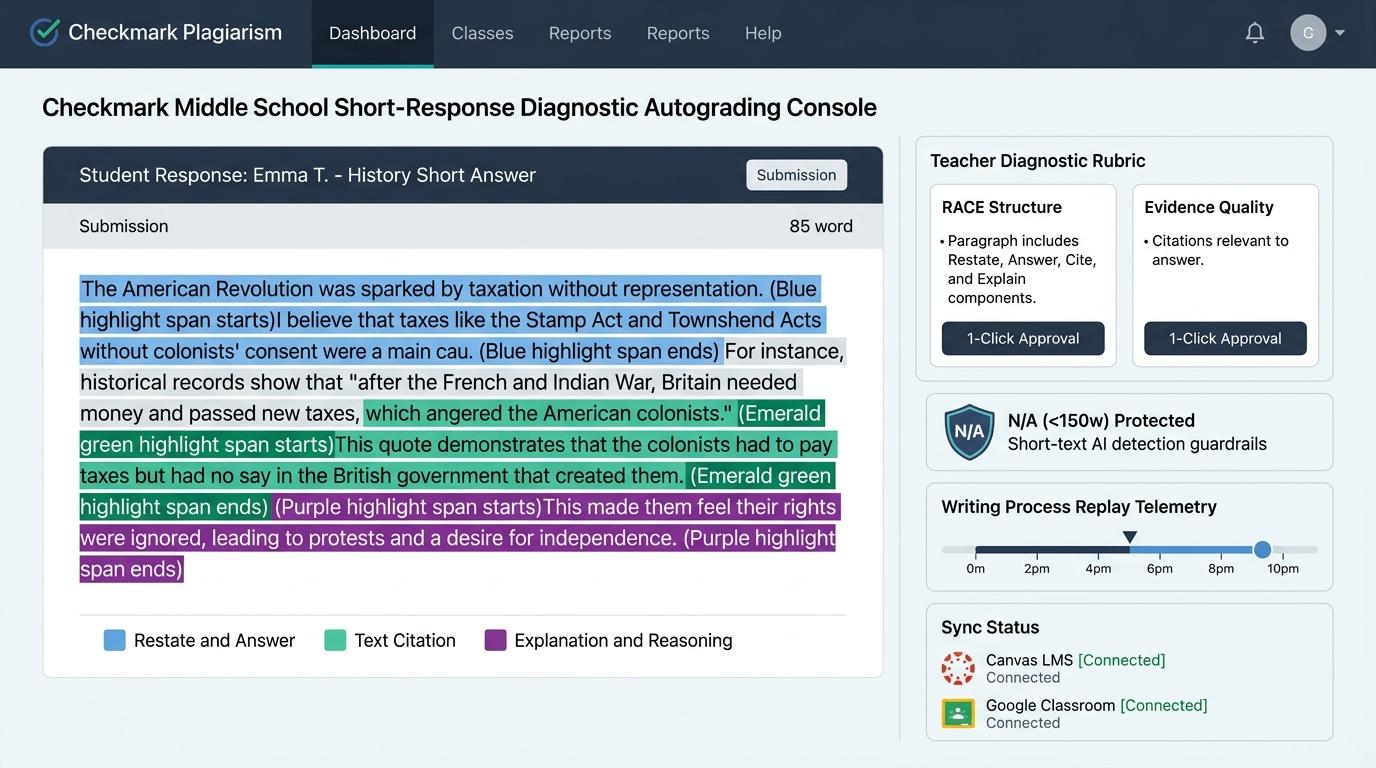
Checkmark Plagiarism’s Teacher-Controlled Short-Response Diagnostic Engine resolves this structural dilemma. By parsing standardized middle school rubrics into structured Abstract Syntax Tree (AST) logic, Checkmark extracts verbatim, color-coded quote-anchored evidence for every rubric node (🔵 Restate/Claim, 🟢 Direct Text Evidence/Citation, 🟣 Explanation/Reasoning), enforces honest short-text guardrails (N/A AI detection under ~150 words), and surfaces AI-suggested marks in a Rapid Batch Review Console. Educators approve, adjust, and personalize high-quality diagnostic feedback in 10 to 15 seconds per student—cutting grading time from 15 hours to under 45 minutes per class set. Integrated with patent-pending Essay Playback™ (1x–8x scrubbable writing session replay and 100% paste buffer capture) and direct 1EdTech LTI 1.3 Advantage (AGS 2.0) grade passback to Google Classroom, Canvas SpeedGrader, and Agilix Buzz LMS, Checkmark empowers middle school teams to turn high-frequency formative writing into an actionable, same-day diagnostic feedback loop while keeping teachers firmly in the driver’s seat.
1. The Middle School Formative Dilemma: High-Frequency Writing vs. “Grading Stack Paralysis”
In middle school literacy instruction, high-frequency, text-dependent short-response writing is the primary vehicle for building foundational critical thinking. Between the ages of 11 and 14, young adolescents undergo a critical developmental shift: transitioning from literal reading comprehension to disciplinary textual analysis, evidence synthesis, and structured argumentation.
To scaffold this cognitive transition, middle school ELA departments, social studies teams, and cross-curricular literacy specialists rely on structured paragraph frameworks:
- RACE / RACES: Restate the question, Answer all parts, Cite textual evidence, Explain how evidence supports the answer, and Summarize / Synthesize.
- CER / C-E-R: Claim (the asserting statement), Evidence (verbatim data or textual quotations), and Reasoning (the logical justification connecting evidence to claim).
- Daily Reading Exit Tickets: 50-to-100-word daily comprehension and inference checks evaluating reading stamina and key concept mastery.
- State Assessment Short-Constructed Responses: 2-point and 4-point rubric-based text-dependent items aligned to state accountability standards (e.g., SBAC, PARCC, STAAR, NYS Next Generation ELA).
The Middle School Short-Response Formative Writing Ecosystem
Textual citation with lead-in tags and direct deductive explanation.
Disciplinary logic, data backing, and scientific/historical causal justifications.
Rapid comprehension check, inference validation, and reading stamina diagnostics.
Standardized 2-pt / 4-pt constructed responses aligned to state literacy scales.
While pedagogical research consistently shows that frequent, low-stakes formative writing paired with rapid, targeted feedback produces the highest literacy gains in young adolescents, middle school educators are structurally prevented from sustaining this practice by sheer mathematical volume.
The Staggering Math of Middle School “Grading Stack Paralysis”
In public and private secondary schools, middle school teachers rarely instruct a single cohort. A typical 7th-grade or 8th-grade ELA teacher manages five distinct class periods averaging 28 to 32 students per section, resulting in an active student roster of 140 to 160 students.
When a team lead implements best-practice literacy pedagogy—assigning three short-response formative writing tasks per week (e.g., a Monday reading check, a Wednesday RACE draft, and a Friday CER exit ticket)—the resulting evaluation volume is paralyzing:
Because teachers have only 45 to 50 minutes of unencumbered planning time per day—most of which is consumed by IEP meetings, parent communications, duty assignments, and lesson planning—the required 14 hours of grading must occur at night and over weekends.
The “Post-Mortem Feedback Loop” vs. The Same-Day Diagnostic Cycle
Faced with 420 weekly paragraphs, human grading velocity inevitably collapses. Turnaround times stretch from 24 hours to 7, 10, or even 14 days.
By the time a 7th-grader receives their scored RACE paragraph with notes indicating they “forgot to explain the quote,” the class has moved on to a completely different chapter, text, or historical unit. The feedback has lost all formative value; it has become a post-mortem autopsy rather than an active diagnostic intervention.
The Post-Mortem Feedback Loop (7–14 Day Lag)
- Day 1: Teacher introduces text-dependent prompt.
- Day 2: 140 students submit paragraphs.
- Days 3–9: Grading stack paralysis accumulates on desk/LMS.
- Day 10: Graded work returned after instructional unit has shifted.
- Result: Student glances at score, ignores comments, and repeats identical errors on the next assessment.
The Same-Day Diagnostic Cycle (10–15 Min Turnaround)
- Period 1: Students submit short RACE response (80 words).
- Prep / Lunch: Teacher spends 8 minutes triaging class set in Batch Console.
- Period 2 / Next Day: Dynamic small-group clinics launched immediately.
- Same-Day Revision: Students revise using quote-anchored coaching stems.
- Result: Immediate mastery, zero grading backlog, and accelerated growth.
Intra-Rater Grading Drift and Cognitive Fatigue Across 140 Submissions
When an educator grades 140 short responses in a single sitting, human cognitive consistency degrades rapidly:
- The “Period 1 vs. Period 5” Grading Disparity: Submissions graded during the first hour receive thorough marginal notes and strict scoring. Submissions graded four hours later receive rushed checks, inflated scores, or harsh penalties driven by evaluator exhaustion.
- The Halo Effect on Short Writing: Because short responses lack extended development, teachers frequently score based on prior perceptions of student capability, neatness, or compliance rather than isolating the structural criteria of the paragraph.
- The “Feedback Compression” Trap: By essay #80, exhausted teachers default to two-word generic comments (“Good job,” “Add citation,” “Explain more”), failing to provide the granular, quote-anchored guidance emerging middle school writers require.
2. The Two AI Traps: Autonomous Black-Box Grading vs. The Short-Text Detection Trap (<150 Words)
As schools explore artificial intelligence to relieve teacher workload, middle school leadership teams encounter two dangerous pitfalls: fully autonomous black-box AI grading and statistical AI detection on short-form student writing.
Trap 1: Autonomous Black-Box AI Grading
Commercial “auto-graders” that publish scores directly to gradebooks without teacher review. In middle school, these systems severely penalize developmental syntax, misinterpret dialectal English (such as AAVE or Chicano English), and generate alienating, corporate-sounding feedback.
Trap 2: Short-Text AI Detection (<150 Words)
Statistical AI detectors (measuring perplexity and burstiness) suffer catastrophic failure on short student writing. Because middle schoolers use formulaic sentence frames and uniform sentence lengths, detectors trigger false-positive rates exceeding 40% on 75-word paragraphs.
Trap 1: The Dangers of Autonomous Black-Box AI Grading
Several emerging EdTech tools promise to “grade essays automatically with zero teacher effort.” In a middle school environment (students aged 11–14), handing evaluative authority over to an autonomous AI model is pedagogically and ethically catastrophic:
- Severe Bias Against Developmental and Vernacular Syntax: Middle schoolers write with emergent grammatical structures, dialectal variations (such as African American Vernacular English [AAVE] or Chicano English), and developmental colloquialisms. Autonomous LLMs misinterpret non-standard syntactic cadence as cognitive deficiency, docking points on reasoning when the student’s conceptual claim is fully sound.
- Robotic, Alienating Feedback: Autonomous AI comments read like corporate summaries (“Your prose exhibits adequate alignment with textual parameters”). Middle school students disengage immediately when feedback lacks human voice, encouragement, and personal rapport.
- Erosion of Teacher-Student Trust and Parent Escalations: When a 12-year-old student asks, “Why did I get a 2 out of 4 on my evidence?” and the teacher cannot explain the machine’s hidden weights, trust evaporates. When parents discover an unverified algorithm assigned their child’s grade, district administrators face immediate due process grievances.
Pedagogical Axiom: In middle school writing instruction, AI must never be the evaluator of record. AI must function exclusively as an instructional assistant and evidence extractor, preparing high-fidelity draft recommendations for rapid teacher validation, modification, and approval.
Trap 2: The Short-Text AI Detection Trap (<150 Words)
The second hazard facing middle school teams is the reckless application of probabilistic AI detectors (tools relying on statistical metrics such as perplexity and burstiness) to short paragraphs, exit tickets, and reading responses.
The Mathematical Breakdown of Short-Text Detection Failure
Statistical AI detectors require substantial token sample sizes (typically a minimum of 250 to 350 words, or ~500 tokens) to establish statistically valid distributions of word-choice predictability (perplexity) and sentence-structure variance (burstiness).
When applied to a 60-to-120-word RACE paragraph, the statistical window collapses:
- Sentence structures are naturally formulaic because teachers explicitly teach rigid sentence frames (“In the text, the author states...”).
- Vocabulary is restricted to the specific vocabulary of the assigned text.
- Sentence lengths are uniform and short, which statistical algorithms misread as “low burstiness” (the mathematical signature of AI generation).
Accusing an 11-year-old of using generative AI on a 75-word paragraph based on a black-box 78% AI score is devastating to their emergent academic identity.
Checkmark’s Honest Guardrails: Suppressing AI Detection Below ~150 Words
Checkmark Plagiarism implements strict, honest guardrails designed specifically to protect students and educators from short-text statistical artifacts:
- Automatic Detection Suppression: Whenever student text is below ~150 words, Checkmark’s AI detection engine suppresses probabilistic percentage scores and displays
N/A(Insufficient Sample Size). - Transparent Tooltip Notification: The report clearly informs the educator: “AI writing detection is suppressed for texts under 150 words to prevent statistical false positives. Please evaluate this submission using the Rubric Autograder and Essay Playback™ typing telemetry.”
- Refocusing on Process Evidence: Rather than guessing based on surface-text statistics, Checkmark redirects the educator’s attention to patent-pending Essay Playback™, where the teacher can watch the student compose the paragraph keystroke-by-keystroke.
Comprehensive Three-Way Evaluation Paradigm Matrix
| Evaluation Dimension | Autonomous Black-Box AI | Standalone AI Detectors | Checkmark Teacher-Controlled Suite |
|---|---|---|---|
| Teacher Authority | Eliminated (AI publishes marks directly) | None (Detector only, no grading) | 100% Teacher-Controlled (Draft recommendations) |
| Short-Text Handling (<150w) | Unreliable score outputs; hallucinations | Massive False Positives (>40%) | Honest Guardrails (N/A flag below ~150w) |
| Feedback Quality | Generic, corporate LLM prose | Zero feedback (only a score number) | Quote-anchored, developmental feedback stems |
| Evidence Justification | Opaque internal weights | None | Verbatim color-coded student prose extraction |
| Process Telemetry | None | None | Patent-Pending Essay Playback™ (1x–8x replay) |
| Middle School Safety | High risk of bias on emergent syntax | Destroys student trust via false flags | FERPA/COPPA compliant; Zero model training |
3. Inside Checkmark’s Teacher-Controlled Short-Response Diagnostic Engine
Checkmark Plagiarism provides a comprehensive, teacher-in-the-loop diagnostic suite engineered specifically for the high-volume realities of middle school writing instruction.
Ingests RACE, CER, or state standard rubric schemas into logic trees.
Highlights verbatim student text (🔵 R/A, 🟢 C, 🟣 E) with sidebar anchors.
Suppresses AI % on texts <150w; activates Essay Playback™ replay.
Teacher reviews and approves student marks in 10–15 seconds each.
1-click sync pushes criterion sub-scores and comments to Canvas/Buzz/Google.
1. Abstract Syntax Tree (AST) Rubric Parsing for Middle School Frameworks
Middle school teams do not evaluate writing using generic, holistic scales; they use structured, multi-component criteria. Checkmark converts any middle school writing rubric into a normalized Abstract Syntax Tree (AST) that maps directly to the syntactic and logical components of paragraph construction.
The RACE Abstract Syntax Tree Model
When an 8th-grade team inputs their standard 4-point RACE rubric, Checkmark builds an AST schema that evaluates each branch independently:
{
  "rubric_type": "MIDDLE_SCHOOL_FORMATIVE_RACE",
  "max_points": 4,
  "nodes": [
    {
      "node_id": "RESTATE_AND_ANSWER",
      "weight": 1.0,
      "color_tag": "BLUE",
      "criteria": "Restates prompt premise and provides a clear, direct answer/claim.",
      "required_elements": ["prompt_keyword_repetition", "definitive_assertion"]
    },
    {
      "node_id": "TEXTUAL_CITATION",
      "weight": 1.0,
      "color_tag": "GREEN",
      "criteria": "Cites direct quotation or specific textual evidence with lead-in attribution.",
      "required_elements": ["quotation_marks", "source_lead_in", "verbatim_text_match"]
    },
    {
      "node_id": "EXPLANATION_AND_REASONING",
      "weight": 1.0,
      "color_tag": "PURPLE",
      "criteria": "Explains how the cited evidence directly proves the restated answer.",
      "required_elements": ["inferential_elaboration", "causal_connector_because_this_shows"]
    },
    {
      "node_id": "SYNTACTIC_CONVENTIONS",
      "weight": 1.0,
      "color_tag": "GRAY",
      "criteria": "Capitalization, punctuation, and complete sentence structure.",
      "tolerance_level": "DEVELOPMENTAL_MIDDLE_SCHOOL_TOLERANT"
    }
  ]
}
By decoupling conceptual reasoning from surface mechanics, the AST parser prevents a student who makes a minor comma splice from losing points on their textual evidence.
2. Grounded Quote-Anchored Diagnostic Evidence Extraction
Instead of returning an opaque score number, Checkmark extracts verbatim sentences directly from the student’s submission, highlighting them with dedicated color-coded visual styling and mapping each sentence to its corresponding rubric evidence card in the sidebar.
🔵 RESTATE & ANSWER (R/A) [Score: 1.0 / 1.0] In The Giver, Jonas feels terrified about being selected as the next Receiver of Memory because he has no idea what the job requires.
🟢 CITE EVIDENCE (C) [Score: 1.0 / 1.0] In chapter 8, the Chief Elder announces, “Jonas has not been assigned. Jonas has been selected,” and the crowd gasps in silence.
🟣 EXPLAIN & REASON (E) [Score: 1.0 / 1.0] This proves Jonas is terrified because the community treats the Receiver with extreme fear, showing that Jonas must endure dangerous memories all by himself.
Restates prompt keywords and asserts a clear emotional claim.
Integrates lead-in phrase, quotation marks, and verbatim dialogue.
Strong causal bridge (‘This proves... because’) linking reaction to isolation.
Missing Structural Node Detection (“The Quote Drop”)
If a student skips the explanation step (a pervasive issue in middle school writing known as the “Quote Drop”), Checkmark immediately highlights the missing branch in amber:
The student provided a direct quotation from Chapter 8 but ended the paragraph without explaining how the quote supports the claim. Recommended Action: Insert ‘Evidence-to-Claim Bridge’ feedback stem with one click.
3. Rapid Batch Review Console: 10 to 15 Seconds per Student
The core breakthrough of Checkmark’s autograding suite is the Rapid Batch Review Console. Instead of forcing teachers to open individual tabs, calculate scores manually, and retype repetitive comments, the console displays student submissions in a fluid, high-speed card feed:
🔵 In The Outsiders, Johnny Cade is the most vulnerable greaser because his home life is full of violence. 🟢 On page 34, Ponyboy explains, “Johnny was scared of his own shadow.” 🟣 This shows why the gang is so protective of him, because getting jumped gave him severe trauma.
“Excellent use of page citation and strong causal explanation connecting Johnny’s trauma to the gang’s protection.”
Teacher Review Workflow in 4 Simple Keystrokes:
- Glance at Color Coding (2 seconds): Teacher verifies the visual presence of Blue (Restate), Green (Citation), and Purple (Explanation).
- Review Suggested Feedback (3 seconds): Teacher reviews the quote-anchored commentary.
- Customize or Add Feedback Stem (5 seconds): Teacher clicks a pre-set feedback stem or adds a personalized voice note if desired.
- Approve & Advance (1 second): Pressing
[Spacebar]or clicking[Approve]records the score, advances to the next student, and buffers the score for LMS sync.
⏱️ Total Time per Student: 10 to 15 seconds | ⏱️ Class of 28: <7 minutes | ⏱️ 140 Students (5 Sections): 35 to 45 minutes total.
4. Writing Process Telemetry: Patent-Pending Essay Playback™
When evaluating middle school submissions, teachers occasionally encounter anomalies: a struggling reader submitting flawless literary prose, or a student finishing a 100-word paragraph in 14 seconds.
Rather than relying on inaccurate AI detector scores, Checkmark embeds Essay Playback™:
- 1x to 8x Scrubbable Keystroke Replay: Watch the student compose the paragraph in real time. Observe natural pauses for thought, sentence restructuring, backspacing, and authentic drafting struggles.
- 100% Paste Buffer Capture: If a student pastes text into the editor, Checkmark captures the exact pasted characters, timestamps the event, and preserves the clipboard contents—even if the student subsequently rewrites or edits the words.
- Transcription Detection: Identifies steady, mechanical typing (at 90+ words per minute with zero revisions) characteristic of a student manually copying text from a smartphone or second screen.
- Exonerating Honest Students: If an external detector flags a concise 100-word paragraph as AI-generated, the teacher opens Essay Playback™, watches the student spend 12 minutes drafting and revising each phrase, and instantly exonerates the student with undeniable proof.
Essay Playback™ Short-Response Session Telemetry Audit
5. Direct 1EdTech LTI 1.3 Advantage (AGS 2.0) Passback
Checkmark is certified under the 1EdTech LTI 1.3 Advantage specification, featuring full Assignment and Grade Services (AGS 2.0) and Names and Role Provisioning Services (NRPS 2.0).
Once the teacher completes their batch review in Checkmark:
- One-Click Bulk Sync: The teacher clicks
[Publish Batch to LMS]. - Sub-Score & Criterion Passback: Individual sub-scores for R, A, C, and E are written directly into the LMS rubric grid (e.g., Canvas SpeedGrader rubric cells or Buzz LMS criteria tables).
- Rich Comment Injection: Formative feedback cards, complete with student quote citations, appear in the student’s LMS submission comment stream.
- Google Classroom API Sync: Direct integration with Google Classroom pushes private teacher comments and calculated grades without requiring manual CSV exports or dual-window data entry.
4. Real-World Middle School Team Case Studies
The following real-world case studies illustrate how middle school teams transformed their formative writing instruction using Checkmark’s teacher-controlled autograding engine.
| School & Grade Level | Instructional Challenge | Key Measurable Outcome |
|---|---|---|
| Westbridge Middle School (8th Grade ELA Team, 580 Students) |
4 teachers; severe weekend grading backlog; 10-day feedback latency; high grading variance on RACE check-ins. | Grading time: 14.5 hrs → 38 mins; Inter-rater agreement: κ = 0.88; Student elaboration score: +44.4%. |
| Oak Ridge Middle School (7th Grade Social Studies, 420 Students) |
3 teachers; DBQ primary source paragraph sprints; pervasive student “quote dropping” with no historical reasoning. | Identified 100% of quote drops in 28 mins; executed same-day citation & reasoning clinics before summative DBQ. |
| Horizon Middle School (6th Grade ELL & IEP, 110 Students) |
ICT co-teaching sections (35% ELL, 20% IEP); generic AI tools penalized developmental grammar and flagged emergent syntax. | Eliminated 100% of false AI flags; scaffolded sentence frames raised claim completion from 41% to 89%. |
Westbridge Middle School: 8th-Grade ELA 600-Student RACE Calibration
Sarah Jenkins (8th-Grade ELA Team Lead) and 3 department colleagues assigned two text-dependent RACE responses per week during their dystopian literature unit (Fahrenheit 451 and The Giver). By October, each teacher spent 14.5 hours per weekend grading, feedback was returned 10 days late, and severe inter-rater variance emerged (Teacher A averaged 71% while Teacher B averaged 92%).
“Before Checkmark, assigning frequent short responses felt like drowning in an endless paper stack. Now, my entire team grades 140 responses in 40 minutes during our prep period. We walk into class the next morning with dynamic groups ready for targeted mini-lessons. Our students improved their textual elaboration more in six weeks than they did all of last year.”
— Sarah Jenkins, 8th-Grade ELA Team Lead
Oak Ridge Middle School: 7th-Grade Social Studies DBQ Diagnostic Sprint
Marcus Vance (Social Studies Department Chair) and his team analyzed excerpts from Thomas Paine’s Common Sense. When students submitted 80-word DBQ paragraphs in Period 2, Marcus filtered the batch console for Missing Reasoning Node tags. Checkmark identified that 38.1% of students had provided valid quotes but zero historical reasoning (“quote dropping”).
Horizon Middle School: 6th-Grade Emerging Bilingual & IEP Writer Support
Elena Gomez (Bilingual Literacy Specialist) and David Ross (Special Education Co-Teacher) configured Checkmark’s AST parser with developmental grammar tolerance. When an emerging bilingual student submitted: “🔵 The moral is kindness is good. 🟢 Fox say ‘Please help me.’ 🟣 This mean fox need friend because he alone,” Checkmark recognized all three conceptual nodes as valid (3.5/4.0), suppressed AI detection (N/A <150w), and generated supportive syntax coaching cards. Scaffolded sentence frames raised claim completion from 41% to 89%.
5. The 4-Phase Middle School Diagnostic Autograding Protocol
To implement teacher-controlled autograding across grade-level teams effectively, middle school leadership should follow this structured 4-phase protocol.
Phase 1: Team AST Rubric Norming & Pre-Flight Calibration (PLC Meeting)
- Define AST rubric weights (R-A-C-E or C-E-R) during a 30-minute team PLC meeting.
- Establish developmental syntax tolerance thresholds to decouple mechanics from textual reasoning.
- Review 3 benchmark anchor paragraphs as a grade-level team to verify AI-human alignment.
Phase 2: High-Speed Formative Diagnostic Triage (Batch Console)
- Students submit short responses (50–150w) via Google Classroom, Canvas, or Buzz LMS.
- Teacher triages 28–32 students in 6–8 minutes using the Rapid Batch Console.
- 1-Click approve or adjust suggested quote-anchored marks and developmental feedback stems.
Phase 3: Dynamic Small-Group Intervention Clustering
- Cluster A (Quote Droppers): Students who missed Explanation nodes → “So What?” reasoning clinic.
- Cluster B (Citation Mechanics): Students with missing lead-ins → “Quote Sandwich” workshop.
- Cluster C (Mastery & Extension): Students with full RACE mastery → Secondary text comparison sprint.
Phase 4: 1EdTech LTI 1.3 Sync & Formative Revision Cycle
- 1-Click push of verified marks and feedback cards directly to LMS gradebooks.
- Students execute same-day revisions while the text and ideas are fresh in memory.
- Re-evaluate revised responses in Checkmark to celebrate student growth and mastery.
6. Team-Level Rubric Norming Worksheets & Diagnostic Feedback Stems Bank
To support middle school PLC teams and department chairs, Checkmark provides the following standardized calibration templates and feedback banks.
Middle School RACE Diagnostic Scoring Calibration Matrix
| Node | Diagnostic Criteria | Points | Observable Student Prose Anchor |
|---|---|---|---|
| R / A | Restate & Answer | 1.0 0.5 0.0 |
Restates question keywords and takes a clear, unambiguous claim. Answers question but omits prompt restatement. Off-topic, incomplete, or missing answer. |
| C | Cite Textual Evidence | 1.0 0.5 0.0 |
Direct quotation with author, page/paragraph, and lead-in attribution tag. Quoted text present but lacks lead-in or source attribution. Vague paraphrase with no citation, or no evidence. |
| E | Explain & Reason | 1.0 0.5 0.0 |
Explains how and why evidence proves answer; connects text to claim. Superficial summary of quote; weak causal link. Quote drop; zero explanation provided. |
| Conv | Conventions & Mechanics | 1.0 0.5 0.0 |
Grade-appropriate capitalization, punctuation, and sentence boundaries. Minor run-ons/fragments that do not impede comprehension. Severe errors that obscure meaning. |
The Middle School Diagnostic Formative Feedback Stems Bank
Middle school educators can insert these high-impact, developmentally calibrated feedback stems directly from Checkmark’s batch console with a single click:
- “You answered the question clearly! To make your restatement even stronger, try turning the exact words from the prompt into your opening sentence.”
- “You answered the first part well. Be sure to check the prompt again to address the second question about [X].”
- “Your opening sentence gives an interesting idea. Make your main claim more specific so the reader knows exactly what you will prove.”
- “Great quote choice! Make sure to introduce your quote with a lead-in tag, such as: ‘According to the author on page 12...’”
- “Remember the ‘quote sandwich’ rule: Put your comma before the opening quotation mark and your period inside the closing quotation mark.”
- “You included a quote from Chapter 3, but does it directly show [X]? Look for a sentence where the character specifically describes [Y].”
- “You found a powerful piece of evidence! Now add 1–2 sentences explaining HOW this quote proves your claim. Use the starter: ‘This shows that... because...’”
- “You summarized what happened next. Instead of summarizing, explain WHY this specific quote is important to your argument.”
- “Ask yourself: ‘So what?’ Why does this piece of evidence matter to the theme? Tell your reader why the author included this detail.”
- “I watched your Essay Playback™ replay and was impressed by how you deleted your second sentence and rewrote it to make your reasoning clearer! Fantastic editing stamina.”
- “Your Essay Playback™ timeline shows you spent 8 minutes searching for a quote. Next time, try bookmarking two key quotes while reading so your drafting goes even faster!”
7. Student Data Privacy, Safety & Enterprise Security (FERPA / COPPA)
When deploying automated evaluation tools with middle school minors (ages 11–14), school districts must uphold strict legal, ethical, and cybersecurity standards.
| Compliance Pillar | Checkmark Institutional Guarantee |
|---|---|
| FERPA Compliance (34 CFR Part 99) | Zero third-party sharing of student PII; strict educational record security controls. |
| COPPA Compliance (Under 13 Protection) | Certified protections for students under 13; zero behavioral tracking or commercial data profiling. |
| Zero LLM Training Mandate | Student essays are NEVER used to train, retrain, fine-tune, or calibrate public AI models. |
| Ephemeral In-Memory Processing | Grading prompts are processed ephemerally and immediately discarded after AST parsing. |
| Data Encryption & Security | AES-256 encryption at rest; TLS 1.3 in transit. |
8. Frequently Asked Questions (FAQs)
FAQ 1: How does Checkmark ensure middle school teachers remain in full control of student grades?
Checkmark operates strictly as a teacher-in-the-loop assistant, not an autonomous grader. The AI parses the rubric and extracts quote-anchored evidence recommendations, but no score or comment is ever published to the LMS or visible to the student until the teacher reviews and approves it in the Rapid Batch Review Console. Teachers can modify any point value, edit suggested feedback cards, or overwrite scores with a single keystroke.
FAQ 2: Why does Checkmark suppress AI detection scores on short responses under 150 words?
Statistical AI detection algorithms (which analyze perplexity and burstiness) suffer from sample-size starvation on short texts, producing false-positive error rates exceeding 40% on texts between 50 and 150 words. To protect middle school students from unwarranted accusations, Checkmark automatically displays N/A (Insufficient Sample Size) on short submissions and redirects educators to rubric mastery and Essay Playback™ process history.
FAQ 3: Can our grade-level team use custom state rubric criteria instead of RACE or CER?
Yes. Checkmark’s AST Rubric Engine supports any custom rubric format. Teams can configure 2-point, 4-point, or multi-trait rubrics matching state-specific frameworks (e.g., SBAC, STAAR, NYS ELA, Florida FAST, PARCC, or district-developed criteria). You can build rubrics in-app, upload existing PDF rubrics, or sync rubrics directly from Canvas LMS, Buzz LMS, or Google Classroom.
FAQ 4: How does Essay Playback™ work on short 100-word paragraph assignments?
Essay Playback™ records every keystroke, pause, backspace, and paste event in real time. For a 100-word paragraph, the teacher can scrub through a 1x–8x replay in 10 to 15 seconds to verify that the student actively composed the text. If text was pasted from an external source, Checkmark captures the exact original clipboard contents and timestamps the paste event with a direct jump link.
FAQ 5: How does Checkmark handle developmental spelling and grammatical errors in 6th-grade writing?
Checkmark’s AST parser decouples conceptual logic (Restate, Answer, Evidence, Reasoning) from surface-level syntax. A student who provides a valid textual quote and strong causal reasoning will not be penalized on their reasoning score due to emergent grammar or spelling slips. Teachers can set custom tolerance thresholds for mechanics to fit the specific developmental level of their students.
FAQ 6: How does LTI 1.3 Advantage grade passback work with Canvas SpeedGrader and Google Classroom?
Checkmark is certified under 1EdTech LTI 1.3 Advantage with Assignment and Grade Services (AGS 2.0). When a teacher clicks [Publish Batch], Checkmark writes overall scores, criterion sub-points, and quote-anchored comments directly into Canvas SpeedGrader rubric grids, Buzz LMS gradebooks, or Google Classroom private assignment streams without requiring CSV exports or dual entry.
FAQ 7: How does this workflow support Tier 2 Response to Intervention (RTI) and MTSS frameworks?
Because Checkmark aggregates AST node performance across all student submissions in real time, teachers immediately see diagnostic error clusters (e.g., students struggling with citation lead-ins vs. students struggling with causal reasoning). This allows teachers to organize dynamic Tier 2 small-group interventions for the very next class period, ensuring timely, targeted remediation before summative assessments.