
Executive Summary & SLA Integrity Directive
The rapid proliferation of advanced Neural Machine Translation (NMT) engines—predominantly DeepL, Google Translate, and Apple Translate—alongside multimodal generative AI has triggered an unprecedented assessment crisis across K-12 and collegiate World Language, Dual-Language Immersion, and AP/IB language classrooms (Spanish, French, German, Chinese, Japanese, and Italian). When language learners draft essays in English within external tabs, run their text through neural translation engines, and inject target-language paragraphs directly into assignments, traditional static text evaluation collapses.
Legacy probabilistic AI detectors fail catastrophically in Second Language (L2) contexts. Because developing language learners write with restricted lexicons, formulaic syntactic structures, and repetitive sentence frames, statistical detectors routinely flag authentic student compositions as AI-generated (false positives). Conversely, DeepL's polished, grammatically pristine translations generate natural human-like perplexity profiles that easily bypass generic statistical classifiers (false negatives).
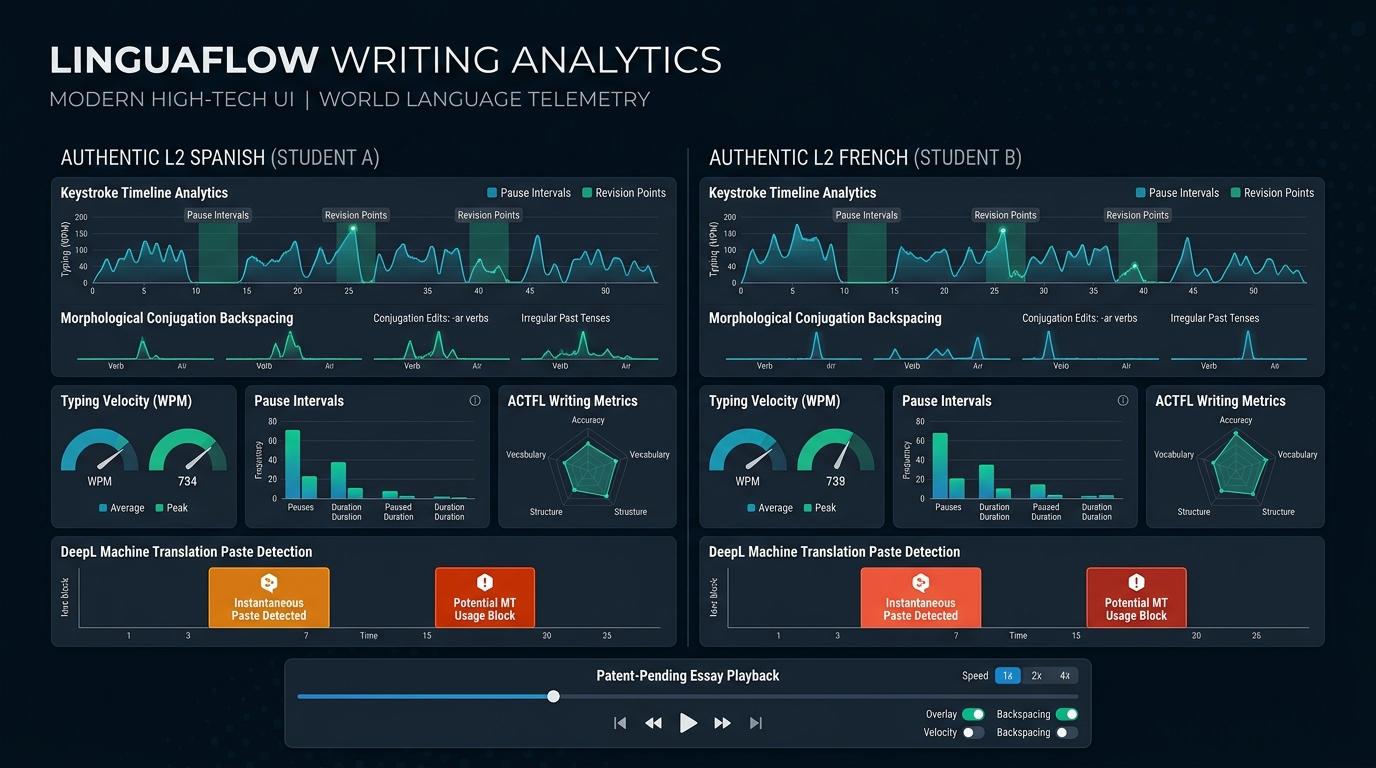
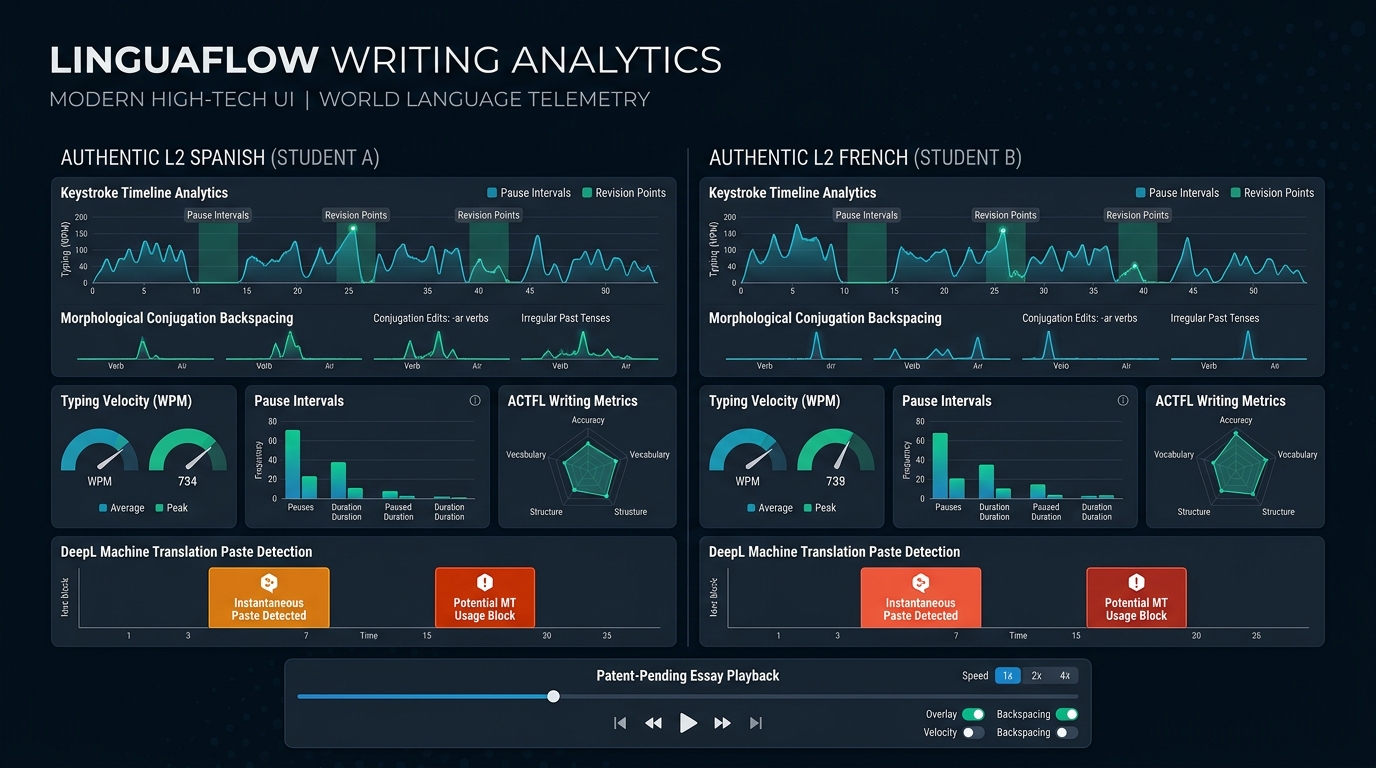
The definitive solution lies in Writing Process Telemetry and Patent-Pending Essay Playback™. By capturing real-time temporal typing dynamics, teachers can contrast the undeniable physiological and cognitive signatures of authentic L2 composition—depressed typing velocity (12–25 WPM), frequent inflectional/conjugational backspacing, and lexical lookup pauses—against the telltale fingerprints of translation abuse: instantaneous clipboard injections (100–300 words in 0.0 seconds) or isochronous manual transcription from secondary screens. This comprehensive guide equips World Language educators, department chairs, and curriculum directors with forensic telemetry frameworks, permissible reference tool policies, restorative conference protocols, and classroom case studies to uphold academic rigor while protecting student trust.
For decades, foreign language educators evaluated written proficiency through structured output: short paragraph responses in Level I/II, reflective narrative journals in Level III/IV, and timed cultural comparison or argumentative synthesis essays in Advanced Placement (AP) and International Baccalaureate (IB) courses. Writing served as the primary window into a student's interlanguage—the dynamic, evolving linguistic system that bridges their native tongue (L1) and their developing target language (L2).
1. The Assessment Crisis in Modern World Language Classrooms
The mainstream adoption of high-accuracy Neural Machine Translation (NMT) and Large Language Models (LLMs) has fundamentally severed the link between the final written artifact and the student's actual linguistic competence. When evaluating a completed document, educators can no longer assume that advanced subordinate clauses, correct subjunctive moods, or sophisticated idiomatic expressions represent true cognitive acquisition.
- L2 Ideation & Lexical Retrieval: Student retrieves foreign vocabulary from mental lexicon.
- Morphosyntactic Assembly: Active conjugation, gender agreement, and case inflections.
- Target-Language Typing: Character-by-character typing with natural hesitation pauses.
- Immediate Self-Correction: Backspacing to fix verb stems, adjective agreements, and accents.
- Neural Consolidation: Repeated communicative output strengthens interlanguage fluency.
- L1 English Ideation: Student drafts complex thoughts entirely in native English.
- Tab Switch to DeepL: Student inputs English text into Neural Machine Translation.
- Instant NMT Conversion: DeepL outputs grammatically pristine target-language prose.
- Clipboard Injection (Paste): 200+ words pasted into LMS editor in 0.0 seconds.
- Illusion of Competence: Submission displays advanced syntax with zero mental struggle.
The Core Assessment Reality: When both submissions produce identical-looking final text, static inspection fails. Only Writing Process Telemetry exposes the temporal reality of how the essay came into existence.
1.1 The Cognitive Collapse of Bypassing the Output Hypothesis
In applied linguistics, Merrill Swain's Output Hypothesis establishes that second language acquisition does not occur through passive input alone; learners must be pushed to produce spoken or written language. The cognitive struggle of formulating a sentence forces learners to:
Notice the Gap
Recognize what they want to communicate versus what linguistic resources they currently possess in their active memory.
Test Hypotheses
Experiment with grammatical structures, verb endings, and word order (e.g., trying a relative clause or stem-changing verb).
Metalinguistic Reflection
Consciously evaluate structural rules (e.g., deciding between Passé Composé and Imparfait, or navigating Por vs. Para).
When a student delegates sentence formulation to DeepL, this vital cognitive feedback loop is completely bypassed. The student produces a final document showcasing advanced subjunctive clauses, idiomatic colloquialisms, and flawless adjective agreement, yet their neurological interlanguage remains completely stagnant.
1.2 The “Translation Trap” in Secondary and Higher Education
Surveys of secondary and postsecondary foreign language departments reveal that machine translation is the single most widespread form of unapproved digital assistance:
of secondary language teachers encounter weekly submissions featuring vocabulary and grammar far exceeding assigned curricular levels.
of students who use machine translation conflate full-sentence neural generation with looking up an isolated word in a dictionary.
educators face acute grading distortions when take-home essays sound native but in-class oral synthesis stalls completely.
To resolve this crisis, educators must move beyond evaluating static text and examine the temporal writing process through which that text was produced.
2. Why Statistical AI Detectors Fail Catastrophically in L2 Writing
When generative AI detectors entered the edtech market, many schools attempted to use them to screen World Language essays. However, statistical AI detection engines—calibrated primarily on native English prose—produce devastating failure rates when applied to second-language writing.
- Limited vocabulary palette and formulaic sentence stems (e.g., “Yo pienso que...”)
- Repetitive subject-verb-object syntax and simple sentence lengths
- Calculated by AI detector as: Low Perplexity & Near-Zero Burstiness
Flagged as 85–95% AI-Generated, punishing honest, diligent students for normal developmental writing constraints.
- Sophisticated native phrasing, nuanced subordinations, and varied clause lengths
- Rich idiomatic transitions and literary-grade lexical collocations
- Calculated by AI detector as: High Natural Perplexity & High Burstiness
Scored as 0% AI (Clean Human), allowing unauthorized full-paragraph machine translation pastes to slip through undetected.
2.1 The Mathematics of the False Positive: Low Perplexity & Low Burstiness
Statistical AI detectors evaluate text using two primary mathematical metrics:
- Perplexity (Word Predictability): A measure of how likely a language model is to predict the next word in a sequence. High perplexity indicates unexpected, creative word choices; low perplexity indicates highly predictable sequences.
- Burstiness (Sentence Variation): A measure of structural diversity across sentence lengths, clause complexities, and cadence. Human native writers alternate between short punchy sentences and long, complex subordinate clauses (high burstiness).
Developing language students operate with strict lexical constraints. A Spanish II student writing about their daily routine will write:
“Me despierto a las siete. Me cepillo los dientes. Luego, desayuno huevos con pan. Voy a la escuela en autobús.”
Because this text uses introductory grammar patterns with uniform subject-verb-object structures, an AI detector calculates extremely low perplexity and near-zero burstiness. As a result, generic AI detectors routinely label authentic, hard-working novice and intermediate language students as AI frauds, causing severe emotional distress and destroying classroom rapport.
2.2 The False Negative: Why DeepL Slips Under the Radar
Neural Machine Translation engines like DeepL use specialized transformer models trained on billions of aligned bilingual professional translations, literary texts, and international diplomatic proceedings. When DeepL translates an English paragraph into French, Spanish, or German, it outputs natural idiomatic turn-of-phrase expressions, complex syntactic inversions, and sophisticated vocabulary with high natural perplexity.
Because DeepL is not generating conversational padding (such as “As an AI language model...” or formulaic bulleted structures), its output exhibits the statistical hallmarks of an educated native speaker. Statistical AI detectors inspect the text, find high lexical richness, and output a 0% AI probability score—completely missing a 300-word unauthorized translation paste.
| Feature / Capability | Legacy AI Detectors | Checkmark Writing Telemetry Suite |
|---|---|---|
| Authentic Novice L2 Writing | ❌ High False Positives (Penalizes simple syntax) | ✅ 100% Protected (Verifiable typing struggle) |
| DeepL / MT Paste Detection | ❌ Blind (Scores as 0% AI human text) | ✅ 100% Detected (0.0-sec injection receipts) |
| Second-Screen Phone Typing | ❌ Blind (No paste event in LMS) | ✅ Flagged via Isochronous Cadence & 0 Backspaces |
| Single-Word Dictionary Lookup | ❌ Indistinguishable from whole essay generation | ✅ Differentiated from MT Pastes (≤2 words) |
| Actionable Student Evidence | ❌ Opaque 0–100% statistical score | ✅ Scrubbable Video Replay (“Receipts”) |
| FERPA Zero-Training Guarantee | ❌ Submissions Retained to train models | ✅ Ephemeral in-memory processing in RAM |
3. The Telemetry of Authentic L2 Drafting vs. Machine Translation Pastes
Writing in a non-native language is one of the most cognitively demanding tasks in education. When captured by high-resolution keystroke logging, the physical act of typing in a target language leaves unmistakable behavioral markers.
3.1 The Behavioral Signatures of Authentic L2 Composition
When an intermediate student writes authentically in a target language, their keystroke dynamics display four distinct characteristics:
Depressed Typing Velocity (12–25 Words Per Minute)
Even students who type 60+ WPM in English experience a massive drop in typing speed when composing in Spanish, French, German, Chinese, or Japanese. The brain must encode concepts, locate foreign vocabulary, retrieve morphological endings, and navigate target-language keyboard layouts or accent key combinations (e.g., Option + e, Alt + 0233, or IME character pickers).
High-Frequency Morphosyntactic Backspacing
Authentic L2 drafting is defined by iterative self-correction. Students regularly type a verb root, pause, backspace two or three characters to change a tense ending, or backspace to fix noun-adjective gender and number agreement:
- Spanish Example: Typing
las casas blanc→ backspacing 5 characters → typingblancas(number/gender agreement). - French Example: Typing
elle est allé→ pausing 3 seconds → backspacing → addingefor feminine agreement (allée). - German Example: Typing
Ich habe das Buch ge...→ pausing 6 seconds → typinggelesen(verb-final subordinate clause order).
Lexical Pauses (3 to 15-Second Inter-Word Lulls)
Authentic language learners pause frequently between words or clauses. These pauses correlate directly with cognitive memory retrieval, mental conjugation charts, or brief consults with permissible reference tools like WordReference or bilingual flashcards.
Non-Linear Revision Cycles
Students regularly navigate their cursor back into previously typed sentences to adjust pronouns, insert missing prepositions, or add missing accent marks and umlauts as they reread their sentences.
3.2 The Forensic Signatures of Machine Translation Abuse
In contrast, unauthorized machine translation submissions exhibit glaring anomalies across the telemetry timeline:
1. Instant Clipboard Injections
The student pastes 150 to 400 words of complex target-language text in a single millisecond timestamp. The document word count surges vertically with zero preceding keystrokes or target-language composing time.
2. Retroactive Camouflage Edits
To disguise a paste, a student spends 5 minutes making superficial tweaks—changing a single synonym or adding a typo. High-resolution telemetry proves that 98% of the core prose originated from an external paste event.
3. Isochronous Phone Transcription
The student translates text on a phone and types it into the laptop. This creates a mechanical flatline cadence (35–50 WPM), zero morphological backspaces, and rhythmic 8–12 second pauses at the start of each sentence.
4. Permissible Lexical Aids vs. Prohibited Machine Translation
A foundational challenge in World Language pedagogy is drawing a clear, enforceable boundary between authorized reference tools and academic misconduct. Teachers want students to consult dictionaries, but they must prevent full-sentence neural generation.
Target-Language Growth & Lexical Lookup
- Bilingual Dictionaries: WordReference, Collins, Leo for isolated words
- Reverse Lexical Lookups: Linguee single-word queries
- Static Verb Charts: Consulting verb conjugation reference tables
- Teacher-Provided Vocab Lists: Quizlet flashcard review
Requires Explicit Teacher Authorization
- Digital Grammar Checkers: LanguageTool, BonPatron
- Conjugation Apps: SpanishDict automated verb fill-ins
- Target-Language Spellcheck: Built-in OS spellcheckers
- Thesaurus Tools: Advanced synonym finders
Strictly Banned Cognitive Offloading
- Full-Sentence / Paragraph MT: DeepL, Google Translate, Apple Translate
- Generative AI Essay Drafting: ChatGPT, Claude, Gemini
- Back-Translation Workflows: EN → L2 → EN → L2 paraphrasing
- Second-Screen Transcription: Typing directly from phone translator
4.1 Telemetry Differences: WordReference Lookup vs. DeepL Generation
Keystroke telemetry provides mathematical clarity between a student looking up a solitary word versus translating an entire thought.
- Student types authentically: “En el campo, nosotros vimos muchos...” (Typed at 16 WPM).
- Student pauses for 12 seconds (Switches tab to WordReference to search “sunflower”).
- Student returns to essay tab and types:
g-i-r-a-s-o-l-e-scharacter-by-character. - Student continues typing: “que eran muy altos y amarillos.”
- Student sits with empty document for 20 minutes (Writing English draft in DeepL tab).
- In a single 0.0-second event, 45 words are pasted:
[PASTE: "En el campo, vimos innumerables girasoles que se extendían hasta el horizonte..."] - Zero target-language typing time; advanced syntax (“innumerables”, “se extendían”) inserted instantaneously.
5. Checkmark Plagiarism’s World Language Writing Telemetry Suite
To empower World Language educators and eliminate speculative AI guessing, Checkmark Plagiarism integrates a dedicated suite of writing process analytics specifically tailored for foreign language acquisition.
Patent-Pending Essay Playback™ (1x–8x Replay)
Records every keystroke, backspace, pause, and cursor movement in a lightweight, encrypted telemetry stream.
- Observe Linguistic Struggle: Watch French students hesitate between avoir and être auxiliary verbs.
- Verify In-Document Time: Confirm whether a 250-word Spanish essay took 35 minutes or 12 seconds.
- Zero Ambiguity: Replaces opaque percentage scores with concrete visual proof of how text was built.
External Paste Buffer Inspector
Preserves 100% of pasted clipboard content, timestamping the insertion and providing clickable playback links.
- Lexical vs. Block Classification: Instantly flags single vocabulary words (≤2 words) vs 250-word blocks.
- Deep Historical Retention: Keeps original pasted text even if the student subsequently rewrites or edits it.
- Side-by-Side Comparison: Compare preserved clipboard text directly against DeepL engine phrasing.
Transcription Cadence Detection
Evaluates Inter-Keystroke Interval (IKI) distributions to catch students manually copying from mobile screens.
- Human Composition Variance: Detects natural bursts and pauses (high IKI standard deviation >250ms).
- Isochronous Signature: Flags mechanical, flatline typing (110ms ± 20ms) with zero backspaces.
- Zero-Backspace Warning: Flags 200+ word essays typed with zero grammatical corrections.
Teacher-in-the-Loop ACTFL Rubric Autograding
Calibrated specifically for World Language frameworks (ACTFL, CEFR, and AP/IB Language Rubrics).
- Quote-Anchored Feedback: Generates criterion justifications anchored to student prose.
- Teacher Final Authority: Automated scores remain provisional drafts until teacher approves.
- One-Click LMS Passback: Direct sync to Canvas SpeedGrader, Buzz LMS, and Google Classroom.

6. Real-World World Language Case Studies
To illustrate how keystroke telemetry operates in practice, consider three real-world scenarios from secondary and AP language classrooms.
| Classroom Context | Suspected Behavior | Telemetry Finding & Resolution |
|---|---|---|
| AP Spanish Language (200-Word Essay) | Flawless Subjunctive vs. Oral Speaking Baseline | 240 words pasted in 1.8 seconds → Restorative rewrite required |
| French III Narrative (Passé vs. Imparfait) | Generic AI Detector Flagged 92% AI | 42 mins active typing, 68 backspaces → Exonerated: Authentic struggle |
| German II Portfolio (Daily Routine Writing) | Flawless Word Order & Complex Cases | Isochronous 42 WPM, 0 backspaces → Second-screen iPhone translation caught |
AP Spanish Cultural Comparison: Unmasking DeepL Subjunctive Injections
An AP Spanish student submitted a 220-word cultural comparison with advanced imperfect subjunctive clauses (“Si tuviera la oportunidad...”). A legacy AI detector scored it as 8% AI (Human) due to DeepL's natural phrasing.
Total active writing time: 1 minute 14 seconds. The student typed 18 characters (“En mi comunidad...”) followed by a single paste event of 202 words (92% of the submission). Preserved clipboard text matched DeepL.
During an Essay Playback™ conference, the student admitted to translating their English draft via DeepL. The student completed a supervised rewrite focusing on authentic circumlocution.
French III Narrative: Exonerating an Honest Student
A student's childhood vacation narrative was flagged with a 94% AI-Generated probability by a standard statistical AI detector. The student maintained they drafted it using only their textbook and WordReference.
Composing time: 54 minutes at 16 WPM. Keystrokes documented 84 backspace events capturing auxiliary verb struggle (nous avons allé → backspace 10x → nous sommes allés). Only 2 single-word dictionary pastes.
Full exoneration. The 94% AI score was proven to be a false positive caused by formulaic novice syntax. The teacher praised the student's authentic revision process and awarded full credit.
German II Writing Portfolio: Catching Second-Screen Phone Transcription
A 210-word daily routine essay demonstrated flawless German subordinate word order (verb-final with weil and dass) and complex dative case endings. Document history showed 0 paste events.
Typing speed: steady 25.6 WPM with zero backspaces across 210 words. A regular 9-second pause preceded each sentence, followed by continuous error-free typing of complex German case endings.
Faced with the zero-backspace cadence report, the student admitted placing an iPhone on the keyboard and manually typing sentences translated by Apple Translate. Supervised rewrite assigned.

7. The 4-Phase World Language Writing Telemetry Protocol
To implement writing telemetry seamlessly into departmental workflows, World Language educators should follow this 4-phase operational framework:
Pre-Submission Scaffolding
Define permissible lexical tools (WordReference) and ban full-sentence MT (DeepL). Normalize linguistic error as a natural part of grading.
Post-Submission Triage
Filter submissions by paste percentage (>20%), typing velocity (<5 mins for 200 words), and zero-backspace anomalies in advanced grammar.
Restorative Conference
Screen-share Essay Playback™ alongside student. Ask growth-oriented questions (“Walk me through how you formulated this sentence”).
Revision & Mastery
Assign structured in-class rewrites using permissible tools. Track longitudinal typing velocity and backspace patterns to confirm SLA growth.
8. Departmental Syllabus Policy Models & Restorative Conference Scripts
Clear syllabus language eliminates ambiguity, establishing transparent standards for students, parents, and administrators.
1. Philosophy of Language Acquisition:
In this course, our primary goal is developing your authentic communicative ability in [Language]. True language acquisition requires cognitive effort, making mistakes, and learning to circumlocute (talk around words you do not know). Using automated software to generate, translate, or rewrite text deprives your brain of essential neural practice.
2. Permissible Digital Reference Aids (Encouraged):
• Online Bilingual Dictionaries (e.g., WordReference, Collins): You may look up isolated words, idioms, or verify gender/part of speech.
• Online Conjugation Reference Tables: You may verify verb conjugations using static charts.
• Physical Textbooks and Teacher-Provided Vocab Sheets.
3. Prohibited Digital Tools (Academic Misconduct):
• Neural Machine Translation Engines (DeepL, Google Translate, Apple Translate): Entering English phrases, sentences, or paragraphs to generate target-language text is strictly prohibited.
• Generative AI Chatbots (ChatGPT, Claude, Gemini): Using AI to draft, rephrase, or translate compositions is prohibited.
• Second-Screen Transcription: Typing target-language text directly from a phone or translation app.
4. Telemetry Verification:
All writing assignments must be composed directly in the designated digital platform. Our department uses Checkmark Plagiarism and Essay Playback™ to verify authentic typing timelines, drafting pauses, and revision history. Submissions resulting from clipboard pasting of translated blocks or mechanical transcription will require an in-person restorative conference and a supervised rewrite.
8.1 Restorative Conference Script for World Language Teachers
When meeting with a student whose submission shows machine translation telemetry, use this structured script to maintain a constructive, educational dialogue:
“Thank you for meeting with me today, Alex. I want to look over your Spanish cultural comparison essay with you. You chose a fantastic topic with the Day of the Dead traditions.”
“Thanks. I worked really hard on it.”
“Let's open up the Essay Playback™ timeline on Checkmark. Our system records the typing and revision history as you write. I want to show you what I'm seeing here at the two-minute mark. Right here at 02:15, we see an external paste event of 185 words appearing in 0.0 seconds. The text uses advanced subjunctive clauses like ‘hubiéramos querido’ and idiomatic phrases that we haven't covered yet in Spanish III. Can you walk me through where that text came from?”
[Hesitates] “I wrote it in English first because I didn't know how to say what I wanted to say, and then I put it through DeepL.”
“I really appreciate your honesty, Alex. I completely understand how overwhelming it feels to write complex thoughts in a new language. But when DeepL writes the sentences for you, your brain doesn't get the practice of connecting the words and verb endings. In this class, I grade your effort and interlanguage, not perfection. Let's do a fresh draft in class tomorrow using WordReference for single words. I know you can express these ideas with your own words.”
9. Student Data Privacy, FERPA Compliance & Zero-Training Guarantees
When deploying writing telemetry and autograding software across a school district, student data privacy and legal compliance are paramount.
Ephemeral RAM Processing
Student essays and telemetry streams are evaluated in volatile memory and purged immediately post-analysis. No unencrypted text persists in permanent storage.
District-Isolated Encryption
Encrypted with AES-256 at rest and TLS 1.3 in transit. District tenant data is strictly segregated, preventing cross-institution data exposure.
Zero AI Model Training
Student compositions are never used to train, fine-tune, or calibrate public or proprietary AI models. Full compliance with FERPA, COPPA, and NY Ed Law 2-D.
10. Frequently Asked Questions (FAQs)
1. How does Checkmark distinguish between a student looking up a word on WordReference vs. translating a whole paragraph on DeepL?
Checkmark's telemetry logs differentiate between micro-lookups and bulk generation. A student using WordReference will type their essay continuously in the target language, pause for 5–15 seconds to look up an unfamiliar term, and then type that solitary word (4–12 characters) directly into the sentence. In contrast, DeepL abuse involves typing virtually no target-language prose in the document, followed by a massive, instantaneous clipboard paste event (100–300 words in 0.0 seconds) or an isochronous, zero-backspace typing cadence.
2. Why shouldn't World Language teachers rely on standard AI detectors like GPTZero or Turnitin AI detection?
Standard statistical AI detectors rely on English language models to calculate perplexity and burstiness. Developing L2 learners naturally write with limited vocabulary and repetitive syntax, which triggers severe false positives, unfairly accusing honest students of cheating. Furthermore, Neural Machine Translation tools like DeepL produce grammatically rich, natural prose that scores as “Human” on statistical detectors (false negatives). Writing telemetry provides empirical proof based on actual typing behavior, not statistical guessing.
3. How does Essay Playback™ capture typing if a student works offline or on a different device?
Checkmark integrates directly into the student writing environment (via Canvas LMS, Buzz LMS, Google Classroom, and Google Docs add-ons). The lightweight telemetry engine records keystroke events locally in the browser buffer and syncs the encrypted stream when connected. If a student drafts offline in an unmonitored external document and pastes the completed text, Checkmark flags the bulk paste event and prompts the student to provide the authentic revision history.
4. Can students bypass telemetry by retyping translated text from their phone screen?
No. Retyping translated text from a secondary screen produces a distinct isochronous transcription signature. Checkmark's cadence analysis detects the absence of natural composition pauses, uniform Inter-Keystroke Intervals (IKIs), and an unnatural complete lack of backspacing within complex grammatical structures (such as verb conjugations, adjective agreements, and subjunctive moods).
5. What is the recommended departmental policy for students who claim they “drafted in Microsoft Word first”?
World Language departments should establish a clear policy requiring all compositions to be drafted directly within the LMS or integrated Google Doc environment. If a student pastes their draft from Word, Checkmark's Paste Buffer Inspector allows the teacher to inspect the paste. If the student cannot provide an authentic keystroke timeline, the departmental policy should require an in-class, supervised rewrite.
6. How does Checkmark support non-Latin scripts like Chinese (Pinyin IME) and Japanese (Hiragana/Kanji)?
Checkmark's telemetry engine fully supports Input Method Editors (IMEs). For Chinese and Japanese, Checkmark tracks both the underlying keystroke entry (Pinyin or Romaji) and the character candidate selection events. Authentic composition displays natural pauses during character conversion and selection, whereas machine-translated pastes bypass the IME selection process entirely via direct unicode clipboard insertion.
7. How does Checkmark integrate with LMS gradebooks like Canvas SpeedGrader and Buzz LMS?
Checkmark integrates natively via LTI 1.3. Teachers can view Essay Playback™ and the telemetry report directly within Canvas SpeedGrader or Buzz LMS. When using the AI Rubric Autograder, teachers can review, edit, or approve criterion scores with one click, and the finalized grade and feedback sync automatically to the LMS gradebook.
Conclusion: Stop Guessing, Start Trusting in World Language Writing
World Language education stands at a pivotal crossroads. As Neural Machine Translation and generative AI continue to evolve, evaluating language acquisition based solely on final submitted text is no longer pedagogically sound or defensible.
By transitioning to Writing Process Telemetry and Patent-Pending Essay Playback™, World Language departments can:
- Exonerate and Protect Honest Students from catastrophic false positive AI flags.
- Accurately Identify Machine Translation Pastes with transparent, timestamped evidence.
- Foster Restorative Learning Conversations that guide students away from digital shortcuts and back toward authentic language acquisition.
- Automate Rubric Grading Workflows while keeping teachers firmly in the loop.
Transform World Language Writing Integrity in Your School
Equip your department with patent-pending Essay Playback™, external paste buffer inspection, and ACTFL rubric autograding. Protect student trust and guarantee authentic second language acquisition.