
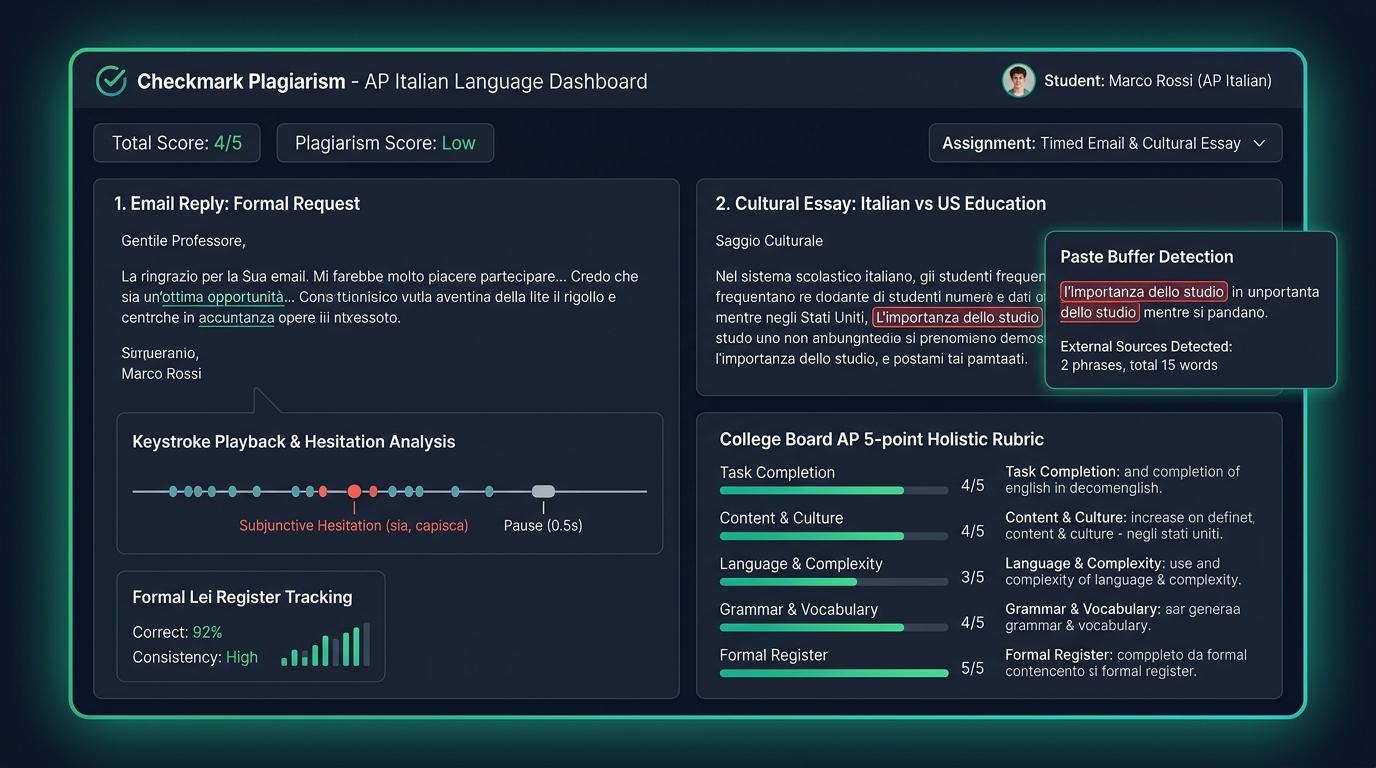
Executive Summary & World Language Integrity Mandate
Evaluating digital writing in the Advanced Placement (AP®) Italian Language and Culture classroom has become one of the most intricate pedagogical challenges in secondary World Language education. With high school students composing on 1:1 Chromebooks, Canvas LMS, Buzz, and Google Classroom, the boundary between authentic second-language acquisition (L2) and unauthorized digital assistance—ranging from Neural Machine Translation (DeepL, Google Translate) to generative Large Language Models (ChatGPT, Claude)—is increasingly blurred.
Generic, whole-document statistical AI text detectors fail catastrophically in AP Italian: they trigger routine false-positive alarms on standard, high-scoring epistolary formulas (Gentile Dottore, In attesa di un Suo cortese riscontro, Distinti saluti) while failing completely to catch machine-translated syntax or external clipboard paste injections. Authentic student Italian is defined not by flawless lexical probability, but by temporal drafting cadence, conjugation hesitation pauses, self-corrected gender/number agreements, and natural register maintenance. By integrating linguistic error analysis with Checkmark Plagiarism’s patent-pending Essay Playback™, External Paste Buffer Inspector, and AP-aligned rubric autograding, high school AP Italian teachers can replace opaque guesswork with objective, defensible writing process telemetry—protecting honest students, upholding AP exam standards, and fostering meaningful target-language growth.
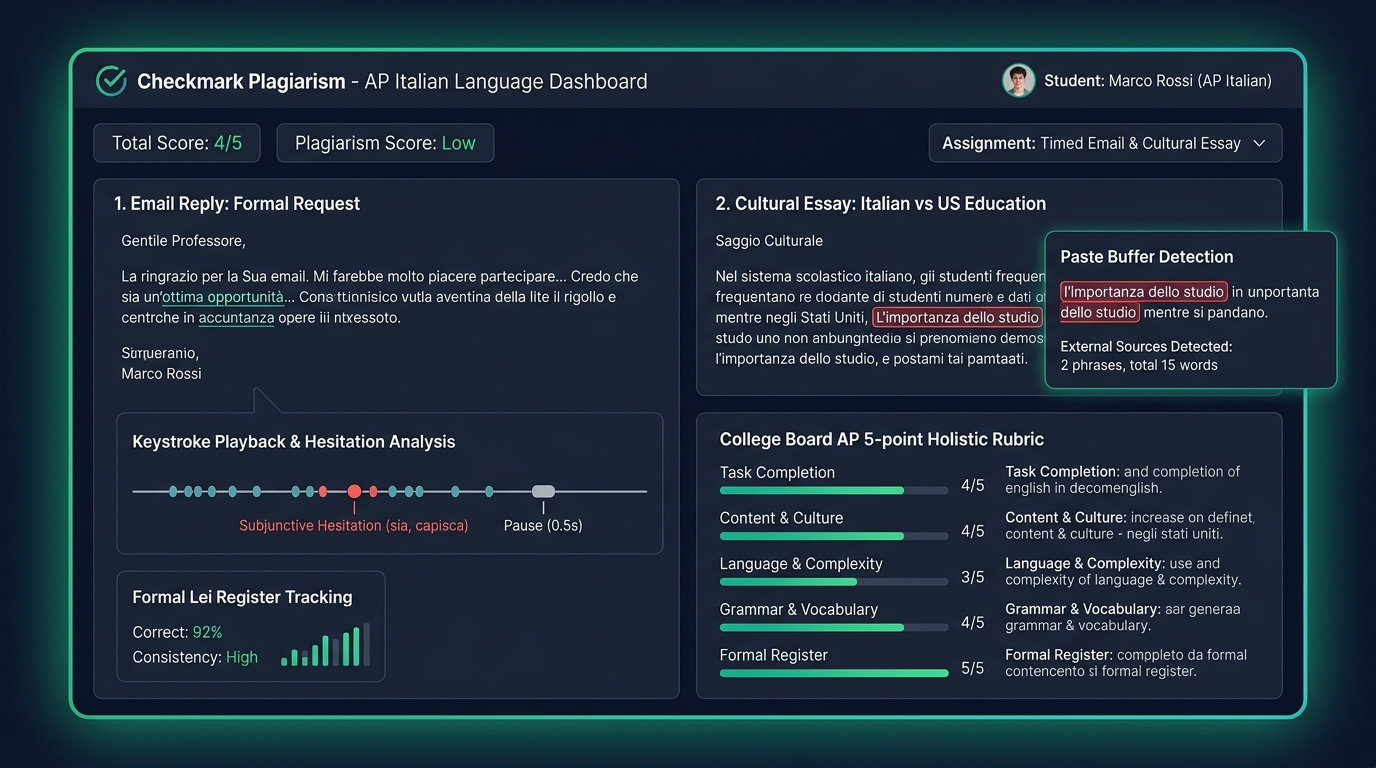
Authentic High School L2 Writing
- Real-Time Keyboard Drafting: Composed letter-by-letter with dynamic burstiness.
- Cognitive Hesitation Pauses: 2–6 second delays on irregular verb stems and subjunctive endings.
- Active Self-Corrections: Backspacing to adjust gender/number agreements (le problemi → i problemi).
- Intermediate Discourse Flow: Organic transitional markers and standard ACTFL Intermediate-High structures.
Unauthorized Machine Intervention
- External Translation Ingestion: English prompt converted in DeepL or ChatGPT and pasted in seconds.
- Zero Hesitation Latency: Flat metronomic cadence (250–320 ms) when manually transcribed from phone.
- Hyper-Formal Bureaucratese: Archaic administrative jargon (all’uopo, in ottemperanza a quanto esposto).
- Hallucinated Stimulus Citations: Invented audio statistics or misattributed graphic data points.
1. The Digital Writing Crisis in High School AP Italian Classrooms
Across high schools nationwide, AP Italian Language and Culture educators carry a demanding instructional mandate. Under the College Board curriculum framework, students are expected to perform at the ACTFL Intermediate-High to Advanced-Low proficiency levels across interpersonal, interpretive, and presentational communication modes.
However, the widespread transition to digital composition on 1:1 school Chromebooks, Google Docs, Canvas SpeedGrader, Buzz, and Schoology has introduced unprecedented integrity vulnerabilities. When high schoolers face the cognitive strain of composing complex Italian prose under tight time constraints, the temptation to open a hidden browser tab or look at a smartphone running DeepL, Google Translate, ChatGPT, or Claude is intense.
For AP Italian educators, who often manage 120–150 students across multiple levels (Italian 1 through AP Italian), grading stacks of 400-word cultural essays without objective forensics creates two unacceptable outcomes:
- Wrongful Accusation of Diligent Students: High-achieving or heritage students who master sophisticated transitional markers (per quanto concerne, ne consegue che) or subjunctive hypothetical clauses are penalized by generic AI detectors.
- Undetected Digital Fraud: Students who copy-paste machine-translated paragraphs receive unearned 5/5 rubric scores, only to collapse on the timed, paper-and-pencil/lockdown digital AP exam in May.
To establish authentic language verification, educators must ground their assessment protocols in the rigorous structural requirements of the AP Italian exam.
2. Anatomy of Section II Free-Response: The Two Core AP Italian Writing Tasks
The Free-Response section of the AP Italian Language and Culture Exam accounts for 50% of the total composite score. Part A evaluates written communication through two distinct, rigorously structured tasks. Understanding their architectural constraints is essential for identifying synthetic manipulation.
Task 1: Interpersonal Writing
12.5% Exam WeightRisposta a un’email (Timed Email Reply)
- Time Allocated: Exactly 15 Minutes.
- Target Length: ~100–150 words.
- Communication Register: Strict Formal Register (Forma di cortesia: Lei, Suo, Le, La).
- Required Elements:
- Formal epistolary greeting (Saluto formale).
- Direct answers to all embedded prompt questions.
- At least one formal request for further details or clarification.
- Formal closing formula and professional sign-off (Congedo).
Task 2: Presentational Writing
15% Exam WeightTema argomentativo (Persuasive Cultural Essay)
- Time Allocated: 55 Minutes total (15 min stimulus analysis + 40 min drafting).
- Target Length: 300–400+ words.
- Input Stimuli Required:
- Fonte 1: Print Article (Articolo giornalistico).
- Fonte 2: Graphic/Chart/Infographic (Tabella o grafico).
- Fonte 3: Audio Track / Podcast (Registrazione audio).
- Required Elements: Clear thesis, multi-source synthesis, explicit source citations (Secondo la Fonte 1...), advanced syntax (subjunctive, hypothetical clauses).
The 15-Minute Interpersonal Dilemma
In a 15-minute timed write, a student typing 120 words of Italian must maintain an active typing cadence of roughly 8–10 words per minute while actively managing verb conjugations, adjective agreements, and formal pronouns.
When an AP Italian teacher opens a submission and observes that a 140-word email was pasted in a single 2-second keystroke transaction at minute 14:30, or displays archaic administrative vocabulary like all’uopo or la scrivente intende significare, digital translation is almost certainly present.
The 55-Minute Cultural Synthesis Challenge
Task 2 requires students to synthesize three authentic sources to write a persuasive essay on an essential cultural, social, or historical question connected to the six College Board AP Italian themes:
1. Famiglia e comunità
Families & Communities
2. Scienza e tecnologia
Science & Technology
3. Bellezza ed estetica
Beauty & Aesthetics
4. Vita contemporanea
Contemporary Life
5. Sfide globali
Global Challenges
6. Identità pubblica/privata
Personal & Public Identity
Students are given 6 minutes to read the prompt and Source 1 (print text), 3 minutes to analyze Source 2 (infographic or data table), and twice-played audio for Source 3 (a 2-to-3 minute radio broadcast, interview, or lecture). They then have 40 minutes of uninterrupted writing time to compose an essay of at least 300–400 words. The essay must synthesize all three sources rather than merely summarizing them sequentially.
3. Linguistic Markers of Authentic High School AP Italian vs. Synthetic AI Output
To identify unauthorized AI assistance, educators must understand the specific linguistic boundary between authentic L2 high school production and machine-generated Italian.
| Grammatical Dimension | Authentic Student Drafting (L2) | Machine Translation / Generative AI |
|---|---|---|
| Subjunctive Mood (Il Congiuntivo) |
Targeted use of presente and passato; occasional hesitation, backspacing, or simplification into indicative. | Flawless deployment of complex trapassato congiuntivo, literary concessives (quantunque, sebbene), and rare plural inflections. |
| Hypothetical Clauses (Il Periodo Ipotetico) |
Occasional tense mismatch: “Se avrei tempo, andrei...” (classic conditional error) or simple Type 1/2 structures. | Flawless Periodo Ipotetico Type 3: “Qualora si fosse verificata tale eventualità, ne sarebbe conseguito...” |
| Combined Pronouns (Pronomi Combinati) |
Common separation or hesitation: “Lo do a lui” or typing friction around glielo vowel adjustments. | Effortless elision and cluster: “Gliel’ho fatto presente senza esitazione alcuna,” with zero typing hesitation. |
| Discourse Markers (Connettivi Testuali) |
Standard AP curriculum list: in primo luogo, tuttavia, d’altra parte, in sintesi, per quanto riguarda. | Hyper-formal burocratese: alla luce di quanto premesso, in virtù del summenzionato, all’uopo. |
| Epistolary Register (Forma di Cortesia: Lei) |
Formulaic, memorized templates with possible minor slip into informal second-person (tu possessives). | Ornate, legalistic formalities: “Ci pregiamo di significarLe,” “con osservanza e deferenza.” |
| Idiomatic Phrasing (Calchi Sintattici) |
Occasional English calques: “guardare per” (for cercare), “dipendere sopra” (for dipendere da). | Flawless contemporary Italian idioms translated with perfect pragmatic nuance and zero cognitive hesitation. |
1. Subjunctive Mood (Il Congiuntivo) & Hypothetical Clauses (Il Periodo Ipotetico)
In the AP Italian curriculum, mastering the four tenses of the subjunctive—Congiuntivo presente (che io parli), passato (che io abbia parlato), imperfetto (che io parlassi), and trapassato (che io avessi parlato)—is the benchmark of upper-tier performance.
High school learners actively grapple with trigger verbs (credere che, dubitare che, preferire che, benché, affinché) and hypothetical conditions:
- Periodo ipotetico della realtà (Type 1): Se piove, non esco. (Composed effortlessly by students).
- Periodo ipotetico della possibilità (Type 2): Se avessi i soldi, viaggerei in Italia. (Requires conscious drafting effort).
- Periodo ipotetico dell’irrealtà (Type 3): Se avessi saputo la verità, mi sarei comportato diversamente. (High cognitive friction, visible backspacing and verb stem editing).
🔍 The Synthetic AI Fingerprint:
When an LLM (such as GPT-4) or DeepL translates an English prompt into Italian, it routinely introduces advanced concessive clauses (quantunque, sebbene, ancorché) paired with rare third-person plural imperfect subjunctive endings (giungessero, comprendessero) that are virtually never drafted spontaneously by high school non-native writers in a 40-minute timed environment.
2. The Intrusion of Italian Bureaucratese (Il Burocratese)
One of the most telling indicators of machine translation in high school Italian is the sudden appearance of burocratese—the archaic, hyper-formal administrative jargon historically characteristic of Italian legal decrees and ministerial correspondence.
When high school students type complex English sentences like “Regarding the issue mentioned above, we must take into account...” into DeepL or an LLM, the translation engine frequently outputs:
- La scrivente intende all’uopo evidenziare che... (The undersigned intends in this regard to highlight that...)
- In ottemperanza a quanto sopra esposto... (In compliance with what is stated above...)
- Si rende d’uopo esperire ogni utile tentativo... (It becomes necessary to carry out every useful attempt...)
A 10th or 11th-grade student who stumbles over the present tense irregular conjugations of andare or uscire does not naturally compose all’uopo or in ottemperanza. This vocabulary reveals an external algorithmic origin.
3. Archaic Historical Tenses (Il Passato Remoto) in Contemporary Essays
In modern standard Italian, contemporary expository essays and cultural analyses almost exclusively employ the passato prossimo (ho fatto, siamo andati, hanno sviluppato) to describe past events with present relevance, reserving the passato remoto (ebbe, fecero, andò) for distant historical narratives or literary texts.
When students feed English narrative text into older machine-translation models, the algorithms frequently default to literary passato remoto conjugations (egli pervenne alla conclusione che..., essi considerarono...). Finding literary passato remoto interspersed in a student’s discussion of 21st-century social media trends or sustainable tourism is an immediate pedagogical flag.
4. Combined Pronouns (I Pronomi Combinati) & Particle Mechanics
Authentic high school Italian writing exhibits visible structural friction around combined object pronouns (glielo, gliela, gliene, me lo, ce l’ha, ve ne). Students frequently hesitate over:
- Vowel changes (mi + lo → me lo).
- Indirect pronoun consolidation (a lui + lo → glielo; a lei + lo → glielo).
- Agreement of past participles with preceding direct object pronouns (Le lettere? Le ho scritte ieri.).
In an authentic student draft, keystroke telemetry captures pauses of 3,000 to 7,000 milliseconds as the student mentally navigates these rules. In contrast, an AI paste inserts flawless pronoun-participle agreements with zero drafting latency.
4. The AP Scoring & Pedagogical Dilemma: Why Generic Detectors Fail
The College Board AP Italian Language and Culture scoring guidelines utilize a 5-point holistic rubric across five performance levels (5: Strong, 4: Good, 3: Fair, 2: Weak, 1: Poor).
| Score Level | Task Completion & Synthesis | Language Usage & Syntax | Register & Conventions |
|---|---|---|---|
| 5 – Strong | Comprehensive completion; all prompt questions answered; insightful 3-source synthesis. | Rich vocabulary; complex structures (subjunctive, hypothetical); minimal errors. | Consistent formal register (Lei); precise epistolary/expository conventions. |
| 4 – Good | Good completion; answers all prompts; synthesizes sources with minor omissions. | Varied vocabulary; some complex structures; occasional non-impeding errors. | Generally consistent register; few minor lapses (e.g. occasional possessive slip). |
| 3 – Fair | Satisfactory completion; basic answers; summarizes sources rather than synthesis. | Adequate vocabulary; simple sentences dominate; frequent errors without obscuring meaning. | Inconsistent register (frequent shifts between formal Lei and informal tu). |
| 2 – Weak | Partial completion; ignores prompt questions; poor or inaccurate source integration. | Limited vocabulary; fragmented structures; frequent errors that impede comprehension. | Inappropriate register; severe English structural interference and calques. |
| 1 – Poor | Minimal completion; almost no source connection; off-topic response. | Severely limited vocabulary; pervasive structural failure; incomprehensible prose. | No awareness of register; illegible conventions. |
The False-Positive Trap of Generic AI Detectors
Generic commercial AI detectors rely on statistical language models trained to compute perplexity (how predictable a word is given preceding context) and burstiness (variation in sentence lengths).
This architecture produces massive false alarms in World Language classrooms due to the formulaic nature of AP exam training:
“Gentile Direttore, La ringrazio per la Sua cortese email. In riferimento a quanto richiesto, Le confermo la mia disponibilità per sostenere il colloquio in data...”
The generic detector evaluates these exact sequences as having near-zero perplexity because they match millions of standard formal Italian letters in web training data. The detector outputs a “96% AI Generated” score. Conversely, when a student pastes an entire paragraph translated from English by DeepL, the detector returns a low AI score because machine translation retains non-native syntactic calques that appear “unpredictable” to an English-centric LLM detector.
Generic AI detectors penalize students for memorizing required AP formulas while failing to catch actual unauthorized machine translation.
5. The High School World Language Evidentiary Matrix
To evaluate student writing reliably, high school world language departments need a clear evidentiary framework comparing traditional and modern verification methods.
| Verification Dimension | In-Class Paper Timed Writes | Generic Statistical AI Detectors | Google Docs Revision History | Checkmark Telemetry & Essay Playback™ |
|---|---|---|---|---|
| Hardware Environment | Pen & lined paper only | Any Chromebook / LMS submission | Chromebooks / Google Docs | Chromebooks, Canvas LMS, Buzz, Google Docs |
| Subjunctive Hesitation Telemetry | Visible physical pen cross-outs & pauses | Completely invisible | Missed (snapshots aggregate 2–5 min) | Precision millisecond pause tracking on verb inflection keys |
| Epistolary Salutation False-Positive Rate | Human evaluated; 0% false alarms | Severe False Positives (80%+) | Shows text presence; no cadence data | 0% false alarms; confirms organic letter-by-letter drafting |
| External Clipboard Paste Payload | Physically prevented | Undetected if text is lightly edited | Shows large block addition; no payload | Captures full timestamped text, origin timing, & delta replay |
| Audio & Chart Source Synthesis | Manual teacher inspection | Cannot verify source attribution | Cannot link writing to source data | Correlates note-taking cadence with source citation flow |
| Restorative Parent & Student Conference | High credibility; low digital prep | Opaque; high parent conflict & pushback | Weak; easily contested by parents | Indisputable visual video-style replay with 1x–8x playback |
| AP Rubric Autograding & Feedback | Zero automation; hours of grading | None; binary text score only | None | Instant draft rubric scoring with quote-anchored justifications |
6. Step-by-Step AP Italian Teacher Audit Protocol
When evaluating timed digital writing assignments in AP Italian, educators should follow a five-step investigative protocol that pairs linguistic analysis with writing process telemetry.
Step 1: Linguistic Register & Formal Lei Concordance Audit
Check for unbroken formal register (Lei) vs. informal slips (tu), and capitalized pronouns (La, Le, Sua).
Step 2: 3-Source Synthesis & Citation Sanity Check
Verify authentic integration of Fonte 1 (print), Fonte 2 (chart), and Fonte 3 (audio). Watch for hallucinated statistics or quotes.
✓ Fonte 1: Come indicato nell’articolo della Fonte 1...
✓ Fonte 2: La tabella nella Fonte 2 dimostra che il 64% dei giovani...
✓ Fonte 3: L’esperto intervistato nella Fonte 3 sottolinea che...
Step 3: Keystroke Dynamics & Conjugation Pause Analysis (Essay Playback™)
Replay the session at 2x–4x speed. Verify natural cognitive pauses during verb stem and subjunctive inflections.
Authentic Cadence: [00:12] "Sebbene " → [PAUSE 4.2s] → "il problema " → [PAUSE 3.1s: Subjunctive Search] → "sia " → [PAUSE 1.8s] → "difficil" → [BACKSPACE x2] → "e da risolvere..."
Mechanical Cadence: [00:12] "Sebbene" [320ms] "il" [290ms] "problema" [310ms] "sia" [305ms] "difficile" [295ms] (Zero hesitation; transcription)
Step 4: External Paste Buffer Inspection
Audit clipboard injections. Inspect preserved paste payloads for DeepL/LLM imports and compare them with subsequent minor student edits.
Step 5: Supportive Restorative Target-Language Oral Debrief
Conduct a supportive 3-minute Italian conversation using playback evidence to guide growth without punitive friction.
👩🏫 Docente (Teacher):
“Ciao Marco. Ho letto il tuo saggio sulle sfide ambientali. Hai usato un’espressione molto interessante: ‘alla luce delle considerazioni testé delineate’. Mi puoi spiegare cosa significa questa frase con parole tue?”
🧑🎓 Studente (Marco):
“Ehm... parla delle cose dette prima...” (Hesitates, unable to define ‘testé delineate’ or parse the formal syntax).
👩🏫 Docente (Teacher — Opens Checkmark Essay Playback™ on laptop):
“Guardiamo insieme la registrazione della tua sessione di scrittura. Vedi qui al minuto 18? Questo blocco di 250 parole è apparso in due secondi. Capisco che il tempo era limitato e volevi fare un ottimo lavoro per l’esame AP. Ma l’esame di maggio sarà fatto senza strumenti esterni. Dimmi: cosa è successo durante questa stesura?”
🧑🎓 Studente (Marco):
“Ero in ansia per il tempo e non ricordavo come coniugare il congiuntivo, quindi ho usato DeepL per tradurre il mio paragrafo dall’inglese.”
🎯 Pedagogical & Restorative Outcome:
No disciplinary record. The student is assigned a 25-minute supervised rewrite on Chromebook with active Essay Playback™ logging, focusing on targeted subjunctive scaffolding and authentic communication.
7. Real High School Classroom Case Studies
The following real-world scenarios demonstrate how Checkmark’s multi-factor telemetry resolves complex integrity challenges in Grades 9–12 Italian programs.
Venice Tourism Crowd Control
Issue: Generic detector flagged memorized AP epistolary formulas as 94% AI Generated.
Telemetry: Essay Playback™ showed 14 min 12 sec of continuous typing, with 4-second hesitation pauses before typing vorrei chiederLe and backspace corrections from possono to possano.
Youth Unemployment in Italy
Issue: Flawless burocratese essay submitted with sophisticated economic jargon.
Telemetry: Paste Inspector captured a 385-word clipboard transaction at minute 28:14 (42 ms). Preserved payload matched DeepL output and revealed a hallucinated statistic absent from Fonte 3.
Gastronomic Biodiversity
Issue: District AI detector flagged advanced hypothetical syntax as 88% AI Generated.
Telemetry: 48-minute writing log showed 47 backspace revisions, 11 minutes of preparatory note-taking, and 100% human drafting dynamics.
8. Checkmark Plagiarism: Built for World Language Educators
Checkmark Plagiarism provides high school world language teachers, department chairs, and administrators with an integrated suite of tools designed specifically for secondary language classrooms.
Patent-Pending Essay Playback™
Reconstructs the complete writing session keystroke-by-keystroke. Scrub from 1x to 8x speed to watch student drafting, conjugation hesitation pauses, and real-time revisions.
External Paste Buffer Inspector
Captures and permanently preserves full raw clipboard text at the exact millisecond of injection, tracking subsequent student modifications for clear evidentiary conferences.
Passage-Level AI Confidence Sliders
Eliminates misleading whole-paper percentages; provides sentence-level confidence sliders with honest N/A disclaimers for short texts under 150 words.
AP Rubric Autograder with LMS Sync
Generates draft scores against College Board 5-point rubrics with quote-anchored justifications, pushing approved scores directly to Canvas, Buzz, or Google Classroom.
9. Frequently Asked Questions (FAQs)
1. Why do generic AI detectors flag memorized AP Italian email greetings as AI-generated text?
Generic commercial AI detectors measure lexical perplexity—the mathematical predictability of word sequences. Standard AP Italian epistolary formulas such as Gentile Sig./Dott., La ringrazio per la Sua cortese risposta, and In attesa di un Suo cortese riscontro appear frequently across millions of Italian web documents. Because these phrases are grammatically standard and highly predictable, generic detectors assign them low perplexity scores and falsely classify them as AI-generated. Checkmark solves this problem through Essay Playback™, verifying that the student typed these formulas keystroke-by-keystroke during the timed writing session.
2. How does Checkmark differentiate between Google Translate/DeepL and generative AI like ChatGPT?
Neural Machine Translation (NMT) tools like DeepL and Google Translate convert a student’s original English ideas into Italian while preserving the student’s underlying paragraph structure, argument flow, and L1 syntactic patterns (calques). Generative LLMs, by contrast, synthesize new arguments and frequently invent complex administrative language (burocratese) or hallucinate non-existent source citations. Checkmark’s External Paste Buffer Inspector catches both methods by detecting external clipboard injections and preserving the raw imported payload for teacher review.
3. Can students bypass Essay Playback™ by manually retyping text from a phone or second screen?
No. When a student retypes pre-translated text from a second screen, their keystrokes exhibit mechanical transcription dynamics: a flat, metronomic cadence of 250–350 ms per character with zero pauses before complex subjunctive verb conjugations, no backtrack corrections for gender/number agreements, and zero structural revisions. Checkmark’s writing telemetry visualizes this lack of cognitive hesitation, clearly distinguishing mechanical transcription from authentic second-language composition.
4. How does Checkmark handle the 150-word minimum threshold for AI detection?
Computational linguistics research confirms that statistical text classifiers are fundamentally unreliable on short text samples. Checkmark enforces a strict guardrail: for submissions under ~150 words (such as short AP email warm-ups or brief cultural reflections), the AI detection score displays N/A rather than generating an unreliable guess. Educators rely instead on keystroke playback and paste inspection to verify student authorship.
5. What is Italian burocratese, and why is it a primary indicator of digital translation?
Burocratese is the formal, archaic administrative jargon historically used in Italian governmental decrees and legal correspondence (e.g., all’uopo, la scrivente intende significare, in ottemperanza a quanto sopra). High school learners do not acquire this vocabulary in AP Italian courses. When these archaic terms appear in a student’s essay on modern social media or environmental challenges, it indicates that an English sentence was routed through an advanced neural translation tool or LLM.
6. How does Checkmark protect student privacy under FERPA and state student data laws?
Checkmark Plagiarism is fully compliant with FERPA, COPPA, and state student privacy regulations. All student essays, keystroke telemetry, and grading data are encrypted in transit and at rest on secure cloud infrastructure. Crucially, Checkmark adheres to a strict zero-training privacy policy: student submissions are never used to train, refine, or fine-tune commercial AI foundation models.
7. How does Checkmark save time for high school teachers with large student loads?
High school world language teachers managing 120–160 students across five or six class periods often spend 15–20 hours grading weekend essay sets. Checkmark’s AI Autograder generates rubric-aligned first-draft scores, criterion-by-criterion justifications, and quote-anchored feedback cards in seconds. Teachers review and adjust the feedback in an intuitive interface, then push finalized scores directly to the Canvas, Buzz, or Google Classroom gradebook with a single click—cutting grading time by up to 70% while maintaining rigorous instructional standards.
10. Transforming AP Italian Writing Integrity: From Guesswork to Trust
Teaching high school students to write persuasively and idiomatically in Italian requires immense dedication from both educators and learners. Academic integrity tools should support this relationship—not undermine it with arbitrary, black-box percentage scores.
The Old Model (Black-Box Scores)
- Opaque whole-document percentage scores
- Routine false alarms on required AP formulas
- Machine translation and DeepL missed entirely
- Adversarial student accusations and parent pushback
- Exhausting weekend manual grading workloads
The Checkmark Model (Process Telemetry)
- Granular passage-level sliders with
N/Aguards - 1x–8x Essay Playback™ showing conjugation pauses
- Paste Buffer Inspector with payload preservation
- Restorative oral debriefs grounded in telemetry
- AP Rubric Autograder with 1-click Canvas/Buzz sync
By replacing opaque AI detectors with Essay Playback™, External Paste Inspection, and quote-anchored rubric feedback, high school AP Italian teachers can protect honest students, address unauthorized tool use constructively, and ensure every student develops authentic, lasting proficiency in Italian language and culture.