
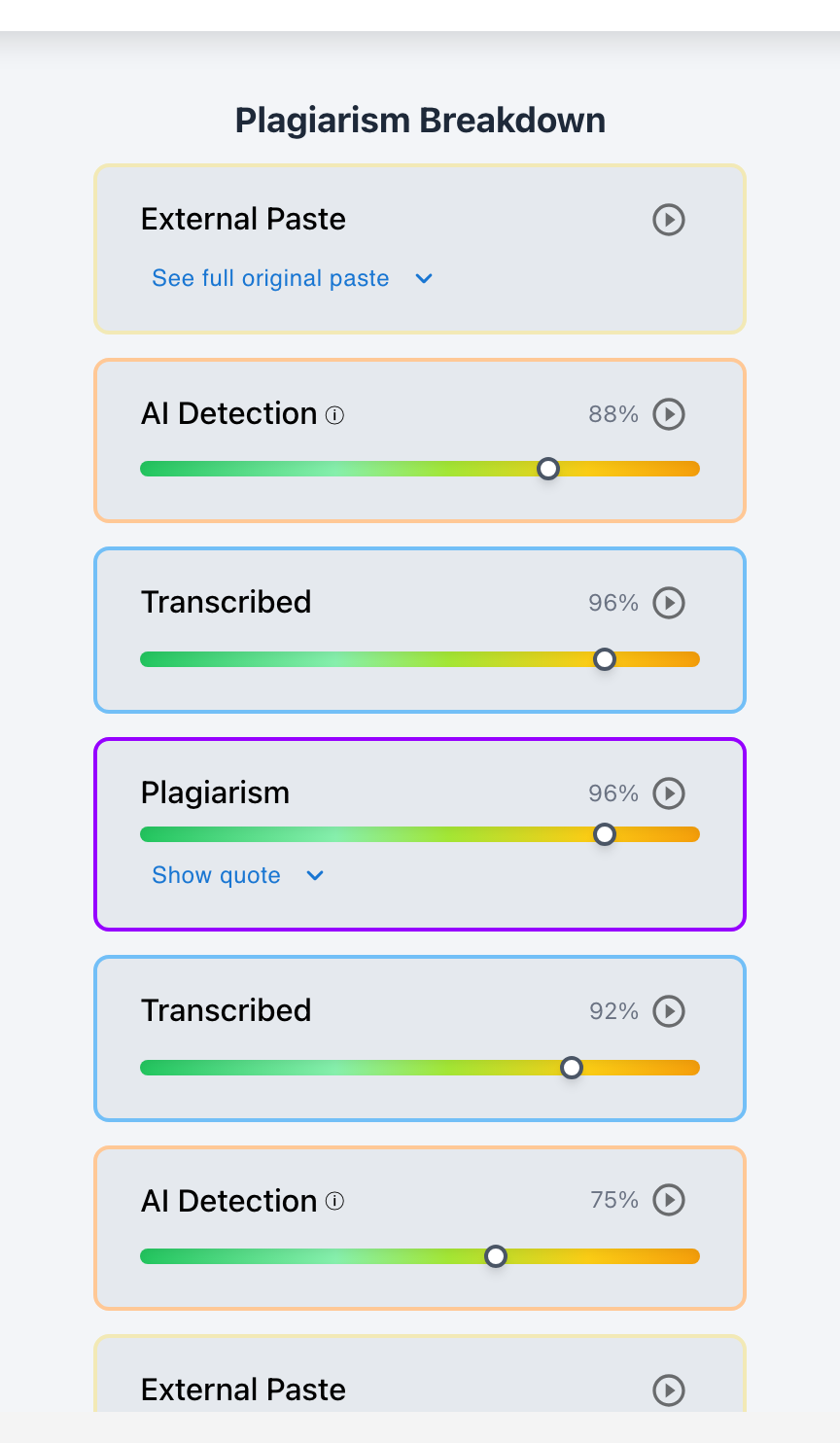
For a standard 1,500-word analytical or research essay, any active drafting duration under 35 minutes is physically and cognitively impossible for an authentic human writer composing in real time. Authentic composition of a 1,500-word paper requires a biological minimum of 2.5 to 4.5 active hours of keyboard engagement.
When students claim they "wrote an entire 5-page research paper in 20 minutes," they are confusing casual stream-of-consciousness typing with academic composition. Drafting an essay requires executing multiple complex cognitive operations in parallel: retrieving facts, formulating arguments, choosing precise vocabulary, integrating quotations, checking syntax, and correcting typos. Establishing empirical time-to-word-count thresholds allows teachers to evaluate document histories with objective clarity rather than guesswork.
Below is a comprehensive guide to empirical writing speed benchmarks for secondary and higher education.
Checkmark Plagiarism calculates active drafting duration by pairing essay writing playback with AI detection, plagiarism detection, autograding, and integrations with Canvas and Google Classroom.
Empirical Writing Duration Benchmarks by Word Count
500-Word Short Response
Human Baseline: 45 to 75 active minutes.
Impossibility Threshold: Under 12 minutes (flags external paste or AI).
1,000-Word Standard Essay
Human Baseline: 1.8 to 3.2 active hours.
Impossibility Threshold: Under 25 minutes (flags external paste or AI).
1,500-Word Research Paper
Human Baseline: 2.8 to 4.5 active hours.
Impossibility Threshold: Under 35 minutes (flags external paste or AI).
3,000-Word Capstone / Term Paper
Human Baseline: 6.5 to 12.0 active hours.
Impossibility Threshold: Under 1.5 hours (flags external paste or AI).
Why True Drafting Takes 4x Longer than Typing Tests
There is a massive distinction between mechanical copy-typing and original drafting:
- Typing Test Velocity: Typing pre-existing text from a screen averages 60–80 WPM (requiring only 15 minutes for 1,000 words).
- Cognitive Drafting Velocity: Synthesizing original arguments averages 10 to 18 net WPM when factoring in thinking pauses, researching sources, and revising sentences.
- The Backspace Tax: Human self-editing consumes 20% to 30% of total keyboard time—typing 1,300 words to yield 1,000 finished words on the page.
Read more in how Checkmark writing process analysis works.
Comparison: Authentic Drafting Time vs. "Impossible Speed" Signatures
Authentic Drafting (1,200 Words)
- Total active typing time: 3 hours and 15 minutes.
- Net velocity: 12 words per minute.
- 22% backspaces with active sentence rewrites.
- Gradual word count growth across multiple sessions.
Impossible Speed Signature (1,200 Words)
- Total active typing time: 8 minutes.
- Net velocity: 150 words per minute (impossible).
- <1% backspaces; zero sentence rewrites.
- Word count jumps vertically via clipboard paste.
A 5-Step Educator Protocol for Drafting Speed Audits
Drafting Duration Audit Checklist:
- 1. Open the student's submission in Checkmark Playback inside Canvas SpeedGrader.
- 2. Compare the Active Typing Time against the Empirical Benchmark table for that word count.
- 3. If active typing is below the Impossibility Threshold, review the Paste Event Log.
- 4. Check if the student can produce offline drafting files (Word .docx or handwritten notes).
- 5. If no offline proof exists and time is under the threshold, initiate an academic integrity inquiry.
How Checkmark Plagiarism Powers Speed Diagnostics
Checkmark Plagiarism combines **AI detection, essay writing playback, static AI detection, plagiarism detection, autograding, and Canvas/Google Classroom integrations** to automatically calculate true active drafting time and flag impossible speed anomalies.
Frequently Asked Questions
How long should it take to write a 1,000-word essay?
Composing a high-quality 1,000-word analytical essay requires an authentic human writer between 1.8 and 3.2 active hours of drafting and revision.
Can a fast typer write an essay in 15 minutes?
A fast typist can type 1,000 words of pre-written text in 15 minutes, but composing original academic arguments from scratch in 15 minutes is cognitively impossible.
What does active typing time mean?
Active typing time measures the minutes where a student was actively striking keys or editing text, filtering out inactive idle time when a tab was left open.
What if a student drafted an essay offline in Word?
Ask the student to share their original Microsoft Word or Pages file, which contains internal metadata proving active editing hours and creation timestamps.
How does writing speed correlate with AI detection?
Submissions completed in under the Impossibility Threshold strongly correlate with AI generation, whereas high AI scores with 4+ hours of typing are false positives.
How does Checkmark Plagiarism integrate with Canvas LMS?
Checkmark provides certified LTI 1.3 integration, SpeedGrader sidebar embeds, two-way grade passback, and single sign-on (SSO).
What is net drafting velocity?
Net drafting velocity is total finished words divided by total active hours—averaging 10 to 18 WPM for authentic human composition.
Can students fake active drafting hours?
Simulating 3+ hours of realistic typing rhythms, pauses, and backspaces requires more time and physical effort than actually writing the paper honestly.
What should a teacher do if an essay was written suspiciously fast?
Hold a brief 2-minute oral check-in: ask the student to explain where the document was composed, define vocabulary, and show their notes.
Why are duration benchmarks essential for academic integrity?
Because biological time constraints provide objective physical boundaries, eliminating subjective arguments and protecting student fairness.
Objective Ground Truth Grounded in Biological Reality
Human thought takes time. By establishing empirical writing duration benchmarks with Checkmark Plagiarism, educators can protect authentic student effort, clear false positives with certainty, and ensure that every paper is evaluated with empirical fairness.
Checkmark Plagiarism supports this comprehensive approach with AI detection, essay writing playback, static AI detection, plagiarism detection, autograding, and integrations with Canvas and Google Classroom.
See how Checkmark pairs drafting duration benchmarks with multi-signal detection to evaluate writing speed inside your LMS. View a sample report or request a demonstration.