
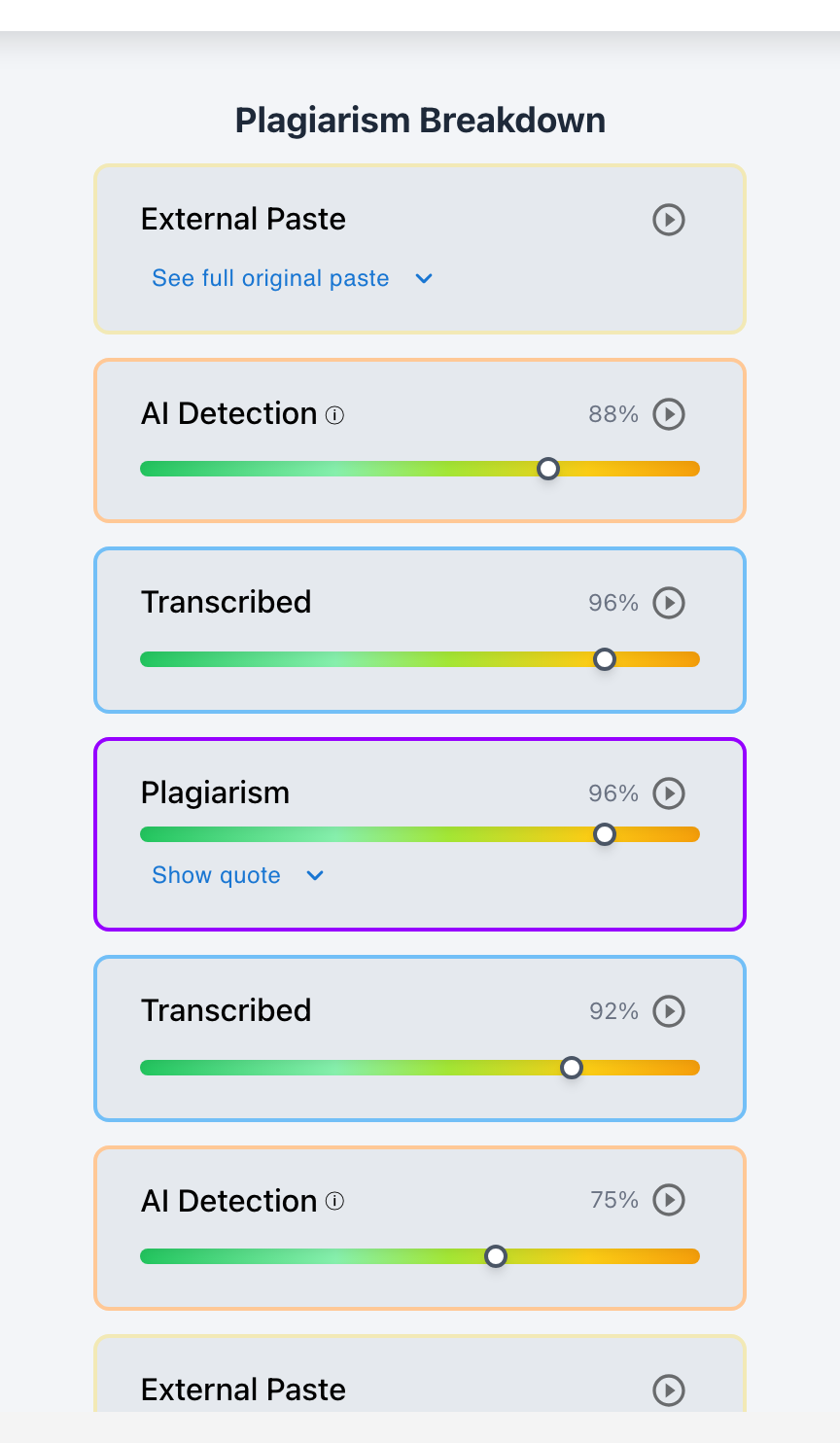
Teachers detect patchwriting by analyzing four distinct forensic patterns: fragmented similarity matches in plagiarism reports (where 3- to 5-word phrases light up in strips across a paragraph), syntactic mirroring (where the grammatical clause structure of the original source is copied exactly with swapped synonyms), sudden jumps in academic vocabulary density, and keystroke playback telemetry in Checkmark showing the student transcribing source sentences word-by-word while replacing words.
Coined by composition scholar Rebecca Moore Howard in A Plagiarism Pentimento (Journal of Teaching Writing), "patchwriting" is defined as copying from a source text and deleting some words, altering grammatical structures, or plugging in one-for-one synonyms. While novice writers often rely on patchwriting because they struggle to comprehend difficult scholarly texts, patchwriting is academically unacceptable in finalized research papers because it fails to represent original thinking. Knowing how to detect patchwriting allows educators to provide targeted pedagogical remediation before it becomes habitual dishonesty.
Below is a comprehensive guide on detecting and resolving patchwriting in student essays.
Checkmark Plagiarism detects patchwriting by pairing plagiarism detection with AI detection, essay writing playback, autograding, and integrations with Canvas and Google Classroom.
The 4 Forensic Red Flags of Patchwriting
1. "Striped" Fragment Matching
In Checkmark's Plagiarism report, the paragraph lights up with alternating highlighted 4-word fragments interspersed with single swapped synonyms.
2. 1-to-1 Syntactic Architecture Mirroring
The student preserves the source's exact clause order, passive verb constructions, and transition phrases while replacing isolated nouns and adjectives.
3. Awkward Synonym Distortions
Because the student relied on a thesaurus without understanding context, common terms are replaced with bizarre synonyms (e.g., "sinister climate change").
4. Step-by-Step Replacement Telemetry
Writing Playback captures the student typing a complete source sentence, highlighting individual words, and typing replacement synonyms one by one.
Why Patchwriting Differs from True Paraphrasing
Understanding the cognitive gap between patchwriting and authentic synthesis:
- Patchwriting (Surface-Level Mechanics): The student keeps the source text open in front of them, looking back and forth while changing every third word. The student never truly digests the idea.
- Authentic Paraphrasing (Cognitive Synthesis): The student reads the source, puts it away completely, thinks about what it means, and explains the core concept in their own unique voice and sentence architecture.
- The Attribution Requirement: Even if a paraphrase is completely original in structure, it still requires an explicit in-text citation crediting the original author.
Read more in how Checkmark writing process analysis works.
Comparison: Original Source vs. Patchwriting vs. True Paraphrase
Original Source Text
"Urbanization creates severe ecological fragmentation, disrupting wildlife corridors and accelerating biodiversity loss across metropolitan regions."
Patchwriting (Unacceptable)
"City expansion produces intense environmental fragmentation, disturbing animal pathways and speeding up species reduction in urban areas." (No citation)
True Paraphrase (Acceptable)
"When cities expand rapidly, they divide natural habitats, making it difficult for native animals to survive (Smith, 2024)."
A 5-Step Educator Protocol for Resolving Patchwriting
Patchwriting Remediation Checklist:
- 1. Open the student's submission in Checkmark Plagiarism inside Canvas SpeedGrader.
- 2. Review the Fragmented Similarity Highlight: examine the side-by-side source comparison card.
- 3. Inspect Writing Playback: check how the paragraph was composed and edited.
- 4. Hold a supportive conference: "I see you were trying to put this source into your own words. Let's practice summarizing this idea with the article closed."
- 5. Require an immediate revision where the student rewrites the section using true conceptual synthesis.
How Checkmark Plagiarism Powers Patchwriting Diagnostics
Checkmark Plagiarism combines **AI detection, essay writing playback, static AI detection, plagiarism detection, autograding, and Canvas/Google Classroom integrations** to automatically identify syntactic mirroring, highlight synonym substitutions, and display side-by-side source comparisons.
Frequently Asked Questions
What is patchwriting in student essays?
Patchwriting is the practice of copying sentences from a source and changing a few words or swapping synonyms while keeping the original grammatical structure intact.
Is patchwriting considered plagiarism?
Yes. In academic writing, patchwriting is considered a form of plagiarism because it borrows an author's sentence structure without genuine synthesis or proper quotation marks.
Why do students patchwrite instead of paraphrasing?
Students usually patchwrite when they find a scholarly text too difficult to understand, resorting to mechanical synonym swapping rather than true conceptual synthesis.
How does Checkmark detect patchwriting?
Checkmark's Plagiarism Engine identifies fragmented matching clusters, syntactic clause alignments, and side-by-side source comparisons in SpeedGrader.
How can teachers help students avoid patchwriting?
Teach the "Read, Close, Write" method: have students read a source paragraph, close the window or book, and write down what they remember in their own words.
How does Checkmark Plagiarism integrate with Canvas LMS?
Checkmark provides certified LTI 1.3 integration, SpeedGrader sidebar embeds, two-way grade passback, and single sign-on (SSO).
What does patchwriting look like in Writing Playback?
It shows the student copying or typing a source sentence, highlighting individual words, and replacing them one by one with synonyms from a thesaurus.
Should students be penalized harshly for patchwriting?
In introductory courses, patchwriting is usually a developmental learning issue best addressed through coaching and revision rather than severe disciplinary penalties.
What is the difference between quoting and patchwriting?
Quoting uses exact words within quotation marks with a citation. Patchwriting alters a few words without quotation marks, creating pseudo-original text.
Why is writing playback essential for patchwriting cases?
Because playback proves the student was actively struggling to rephrase rather than pasting AI text, allowing teachers to provide appropriate developmental feedback.
Transforming Patchwriting into Authentic Comprehension
Developing genuine synthesis skills is a vital milestone in a student's academic journey. By diagnosing patchwriting with precision and analyzing drafting telemetry with Checkmark Plagiarism, educators can guide students from mechanical copying to authentic, independent scholarly expression.
Checkmark Plagiarism supports this comprehensive approach with AI detection, essay writing playback, static AI detection, plagiarism detection, autograding, and integrations with Canvas and Google Classroom.
See how Checkmark pairs patchwriting detection with multi-signal forensics to evaluate student paraphrasing. View a sample report or request a demonstration.