
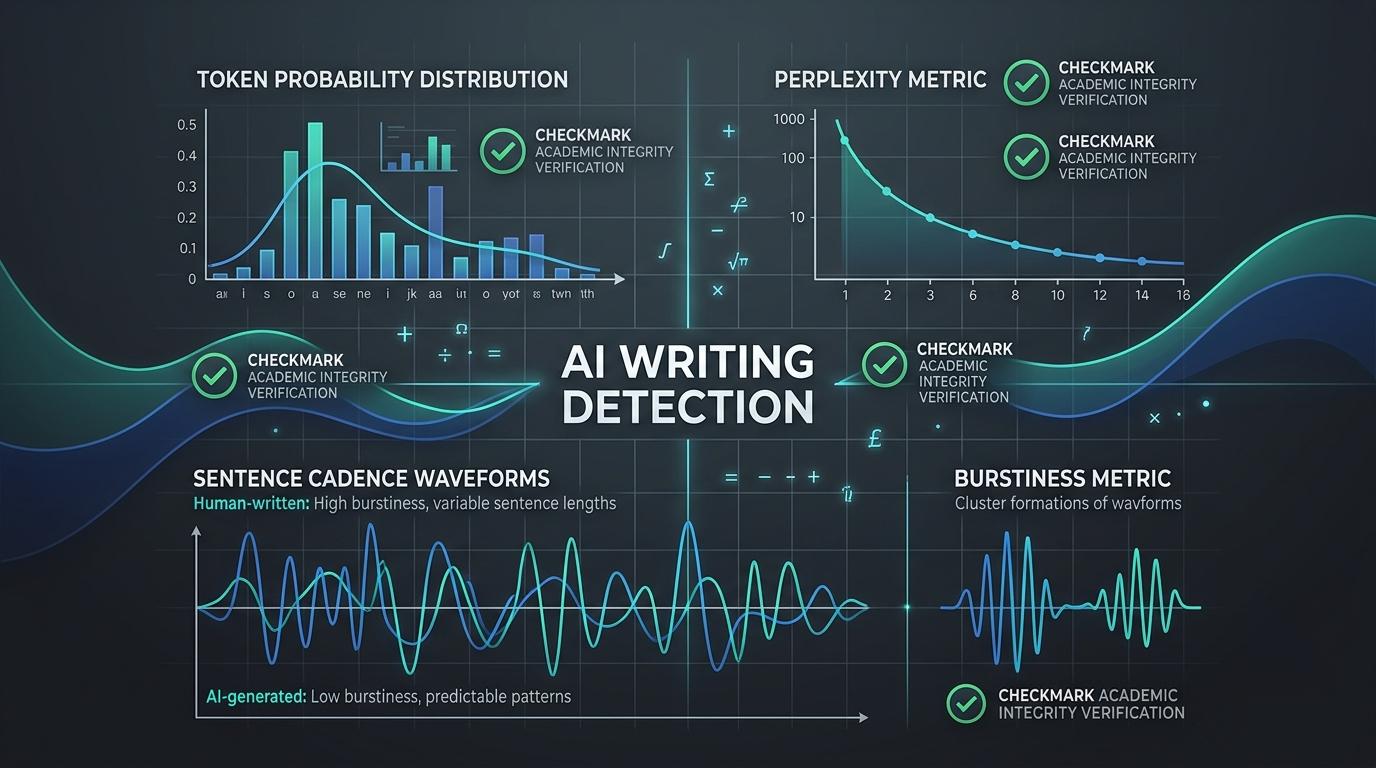
When educators evaluate student essays for artificial intelligence generation, they are frequently confronted with opaque, black-box probability scores (e.g., “87% AI-Generated”). Behind these scores lie two foundational Natural Language Processing (NLP) metrics: Perplexity (PPL, a mathematical measure of word choice predictability) and Burstiness (B, a statistical measure of sentence length and structural cadence variance). While Large Language Models (LLMs) naturally generate low-perplexity, low-burstiness prose characterized by uniform sentence lengths and statistically optimal tokens, relying on either metric in isolation creates an unacceptably high rate of false positives—disproportionately penalizing English Language Learners (ELLs), neurodivergent students, and disciplined technical writers. Checkmark Plagiarism solves this diagnostic crisis by moving beyond static NLP classifiers. By combining passage-level perplexity and burstiness analysis with patent-pending Essay Playback™ keystroke dynamics, external paste buffer preservation, side-by-side web/peer plagiarism matching, and teacher-in-the-loop rubric autograding, Checkmark replaces arbitrary scores with transparent, defensible process evidence—ensuring that educators can “Stop guessing, start trusting.”
Checkmark Plagiarism transforms academic integrity by combining passage-level AI detection with patent-pending Essay Playback™ keystroke dynamics, side-by-side web and peer plagiarism matching, quote-anchored rubric autograding, and enterprise integrations for Canvas LMS, Google Classroom, and Buzz LMS.
The AI Detection Crisis: The Danger of Black-Box Probabilities
Since the widespread deployment of generative artificial intelligence in education, teachers, department chairs, and academic integrity officers have faced an unprecedented dilemma: How can institutions verify genuine student authorship without turning classrooms into hostile, adversarial environments?
Early attempts to solve this challenge relied on first-generation AI detectors that output a single, whole-document percentage score. A teacher uploads a 1,500-word history essay, and the software returns a binary verdict: “94% AI-Generated.”
Yet, when educators press software vendors on how that 94% figure was calculated, the explanation is often obscured behind proprietary algorithms and opaque neural networks. The consequences of this opacity are severe:
- Unwarranted Disciplinary Accusations: Students with authentic writing styles—particularly those who write concisely or adhere rigidly to standard academic structures—are falsely accused of academic dishonesty.
- Erosion of Student-Teacher Trust: The threat of an arbitrary AI flag creates an atmosphere of anxiety, prompting students to second-guess their organic vocabulary and avoid sophisticated syntax.
- Institutional Vulnerability: Academic integrity boards and school districts face legal and ethical pushback when disciplinary actions are challenged without concrete, reproducible evidence.
- Vulnerability to “AI Humanizers”: Commercial paraphrasing tools (such as QuillBot, Undetectable AI, and HideMyAI) deliberately manipulate surface-level vocabulary to bypass simplistic NLP filters, allowing unauthorized AI generation to slip past uncalibrated tools while honest students remain exposed.
- Single whole-paper percentage (e.g., “85% AI”)
- Opaque neural classification with no audit trail
- High false-positive rate on ESL and STEM technical writing
- Easily fooled by synonym swappers & paraphrasers
- Adversarial philosophy: “Guilty until proven innocent”
- Granular passage-level confidence sliders
- Transparent Perplexity & Burstiness metric cards
- Patent-Pending Essay Playback™ keystroke replay (1x–8x)
- External paste buffer tracking & 100% raw text capture
- Pedagogical philosophy: “Stop guessing, start trusting”
To establish fair, transparent, and legally defensible academic integrity standards, educators must look under the hood of computational linguistics. Understanding the mathematical mechanics of Perplexity and Burstiness is the essential first step toward recognizing why isolated NLP metrics fail—and why comprehensive, multi-factor verification is the only viable path forward.
The Computational Linguistics Foundation: What Are Perplexity and Burstiness?
At the core of statistical natural language processing, transformer-based language models evaluate text through probability distributions over vast token vocabularies. When evaluating whether a passage exhibits the hallmarks of machine generation, NLP algorithms primarily measure two mathematical dimensions: Perplexity and Burstiness.
Evaluates the conditional probability of each individual word given its preceding context.
Evaluates the mathematical variance in sentence lengths, clause structures, and syntactic rhythm.
1. Perplexity (PPL): The Predictability and Surprise of Word Choice
In information theory and computational linguistics, Perplexity measures how well a probabilistic language model predicts a sample of text. Formally, it is the exponentiated cross-entropy of the text under a given language model.
Let a text sequence W consist of N tokens: W = (w1, w2, w3, …, wN). The conditional probability of the sequence is the product of token probabilities given all prior context:
Intuition: If every word in a sentence is virtually guaranteed by the preceding context (high probability P), the negative log-likelihood approaches zero, driving Perplexity to a very low value.
| Context: “The scientist conducted an...” | Probability P(wi | context) | Negative Log Likelihood | PPL Contribution |
|---|---|---|---|
| “experiment” | 0.72 (Very High) | -ln(0.72) = 0.33 | Low (Typical AI) |
| “investigation” | 0.18 (Moderate) | -ln(0.18) = 1.71 | Medium |
| “unorthodox audit” | 0.004 (Very Low) | -ln(0.004) = 5.52 | High (Typical Human) |
Why Large Language Models Cluster in Low Perplexity Valleys
Autoregressive transformer models (such as GPT-4, Claude 3.5, and Gemini 1.5) operate by predicting the next most probable token from a probability distribution over a vocabulary of 50,000 to 100,000 tokens. During generation, decoding strategies (such as temperature scaling, top-k filtering, and nucleus / top-p sampling) deliberately constrain the model to high-probability paths to maintain factual coherence and grammatical fluency.
As a result:
- LLM Text is Statistically “Expected”: The model consistently selects words that have high conditional probability given the preceding context.
- Low Mathematical Surprise: The cross-entropy remains low throughout the entire essay, resulting in a compressed Perplexity value (PPL ≈ 10 – 35 on standard benchmark evaluation models).
Why Authentic Human Writing Exhibits High and Volatile Perplexity
Human cognition does not generate language through statistical next-token optimization. Authentic human prose is shaped by personal memories, regional idioms, emotional emphasis, non-linear brainstorming, specialized domain jargon, and deliberate stylistic choices.
- Idiosyncratic Word Pairings: A student might write: “The protagonist’s ambition curdled into resentment,” or “The policy was an administrative headache wrapped in red tape.” While an LLM prefers “turned into” or “complex regulatory challenge”, the human chooses expressive, unpredictable metaphors.
- High Mathematical Surprise: When evaluated against an NLP language model, these authentic human choices have low conditional probabilities (P < 0.01), driving the cumulative cross-entropy up and yielding a significantly higher Perplexity (PPL ≈ 60 – 150+).
2. Burstiness (B): The Structural and Rhythmic Variance of Writing
While Perplexity evaluates word-level predictability, Burstiness evaluates sentence-level and clause-level structural variance. In linguistics, burstiness describes the degree to which stylistic properties (sentence length, clause complexity, and local perplexity) cluster in “bursts” rather than remaining uniformly distributed.
Let an essay consist of M consecutive sentences, where the length (word count) of the j-th sentence is denoted by lj: L = (l1, l2, l3, …, lM).
Sentences cluster tightly around μL ≈ 16–22 words with a tiny standard deviation (σL ≈ 3–5 words), yielding BL ≈ 0.15 – 0.35.
High rhythmic volatility with μL ≈ 18 words and σL ≈ 12–20 words, yielding BL ≈ 0.65 – 1.25+.
The 2D Vector Space Matrix: How Perplexity and Burstiness Interact
When natural language processing classifiers evaluate text, they do not look at PPL or B in a vacuum. Instead, they map text passages into a Two-Dimensional Linguistic Vector Space (PPL × B).
Linguistic Markers: Controlled domain jargon (lowering PPL) combined with erratic human sentence lengths (high B).
- STEM lab reports & mathematical proofs
- Legal briefs & medical protocols
- Formula-scaffolded AP DBQ essays
Linguistic Markers: Rich, diverse vocabulary paired with highly varied sentence architecture and emotional metaphors.
- Advanced literary analysis & humanities capstones
- Personal narratives & creative nonfiction
- Philosophy dissertations & persuasive essays
Linguistic Markers: Highly predictable token sequences with monotonous, uniform sentence cadence.
- Direct outputs from ChatGPT, Claude, or Gemini
- Unedited AI drafting without human revision
- Standard AI transitional markers (“Furthermore...”)
Linguistic Markers: Obscure thesaurus synonyms injected into uniform AI sentences to bypass perplexity filters.
- QuillBot, Undetectable AI, and HideMyAI outputs
- Artificially spiked vocabulary with rigid syntax
- Fools naive NLP detectors, but caught by Playback
The False-Positive Trap of Isolated Metrics: Why Single-Heuristic Detection Fails
The fundamental reason educators must not rely on simple AI detection scores is that measuring Perplexity or Burstiness in isolation creates severe statistical false-positive traps.
Detectors assuming “predictable equals machine” penalize multilingual students who write with standardized, high-frequency English vocabulary, as well as STEM students using universal terminology (“centrifuged at 3,000 RPM”).
Detectors assuming “uniform cadence equals machine” penalize students following structured pedagogical frameworks (CER, PEEL, RACE, MEAL) or writing under timed AP/SAT conditions where uniform 18-word sentences ensure clarity.
| Evaluation Dimension | Human Writing Characteristics | Raw AI Model (GPT-4/Claude) | “Humanized” AI Output | False-Positive Trigger in Isolated Analysis | Checkmark Multi-Factor Verification |
|---|---|---|---|---|---|
| Perplexity (PPL) | High (60–150+); volatile; unexpected idioms and personal voice | Low (10–35); compressed; optimal statistical tokens | Artificially High (70–180); forced rare synonyms | High Risk: Flags ESL writers, concise answers, and STEM lab reports | Evaluated at passage level with calibrated confidence sliders |
| Burstiness (B) | High (0.65–1.25+); wide mix of 3-word and 45-word clauses | Low (0.15–0.35); uniform 16–22 word sentences | Moderate (0.35–0.55); synthetic punctuation tweaks | High Risk: Flags CER/PEEL scaffolds, 5-paragraph essays, timed exams | Correlated with structural syntax and keystroke cadence |
| Vocabulary Palette | Contextual, idiosyncratic, domain-specific, emotional | Broad, balanced, neutral, highly formal | Strained, thesaurus-heavy, syntactically awkward | Moderate Risk: Flags articulate or neurodivergent writers | Linked to student’s historical typing and revision vocabulary |
| Syntactic Transitions | Varied, informal, non-linear, occasional structural flaws | Monotonous (Furthermore, Moreover, In conclusion) | Disjointed, irregular punctuation splits | Moderate Risk: Flags taught transition lists | Contextualized within authentic composing pauses |
| Drafting History | Temporal keystrokes, backspaces, micro-pauses, reorganizations | Instant 0-second paste or linear high-speed transcription | External copy-paste event followed by surface rewrites | Zero Risk: Process evidence definitively proves human effort | Essay Playback™ replays writing session at 1x–8x speed |
Why Static NLP Classifiers Are Insufficient: The Multi-Factor Solution
Because static NLP metrics (perplexity, burstiness, n-gram entropy) can be distorted by educational scaffolding or manipulated by paraphrasing tools, isolated text analysis cannot serve as the sole basis for academic integrity decisions.
Checkmark Plagiarism resolves this problem by embedding statistical NLP within a Five-Pillar Multi-Factor Verification Suite. Rather than guessing from surface text, Checkmark provides educators with comprehensive, multi-dimensional evidence (“receipts”) that capture the entire lifecycle of a document.
Calibrated confidence sliders & <150w honest guardrails.
Keystroke dynamics, 1x–8x video replay, and cognitive pauses.
100% raw text retention on clipboard events with jump to diff.
Side-by-side live web & student peer archive matching.
Teacher-in-the-loop autograde drafts with 1-click LMS passback.
Pillar 1: Granular Passage-Level Analysis with Honest Guardrails
Checkmark discards the flawed concept of the “whole-document percentage score.” In real classrooms, student writing is rarely 100% human or 100% AI. A student might write their own introduction, use an AI tool to draft a complex body paragraph, and write their own conclusion.
- Underlined Passage Granularity: Specific sentences are underlined directly within the essay text.
- Calibrated Confidence Sliders: Clicking any highlighted passage opens a sidebar evidence card displaying a calibrated scale from Typical Human Writing Style to Typical AI Pattern, showing educators exactly why a passage was flagged.
- Educator-Only Flag Statuses: Flags (Flagged, Resolved, Not Flagged) are private to educators, allowing teachers to review context before having a conversation with the student.
“Furthermore, the socioeconomic implications of this policy manifest in disparate educational opportunities across urban and rural municipalities, exacerbating systemic inequality.”
- Local Perplexity (PPL): 18.4 (Very Low • Expected Tokens)
- Local Burstiness (B): 0.21 (Monotonous • 3 consecutive 19-word clauses)
The Strict <150-Word Honest Guardrail
In short text sequences (exit tickets, reading checks, short answers under 150 words), the statistical sample size N is too small for cross-entropy distributions to converge. The standard error explodes:
While generic AI detectors still display confident probabilities on 40-word snippets, Checkmark enforces a strict guardrail: text submissions under ~150 words display N/A. This prevents teachers from making life-altering accusations based on statistically invalid sample sizes.
Pillar 2: Patent-Pending Essay Playback™ and Keystroke Dynamics
The definitive antidote to AI detection false positives is Writing Process Evidence. Even if an ESL student’s essay exhibits low perplexity, or a STEM report exhibits low burstiness, their keystroke dynamics provide irrefutable proof of human authorship.
Checkmark’s patent-pending Essay Playback™ reconstructs the complete writing session keystroke-by-keystroke:
- Timeline Scrubbing (1x to 8x Speed): Educators can scrub through the entire writing session like a video, watching words appear, get deleted, reorganized, and refined.
- Composing Pauses vs. Typing Cadence:
- Micro-Pauses (200ms – 1,000ms): Natural cognitive word-retrieval pauses between words.
- Macro-Pauses (5s – 120s+): Structural planning pauses where a student stops typing to read a source, outline an idea, or rethink a paragraph.
- Transcription Detection: If a student uses a phone or second monitor to manually retype an AI-generated essay, Checkmark detects the mechanical, steady cadence—characterized by continuous typing without natural composing pauses, spontaneous structural deletions, or organic brainstorming edits.
Pillar 3: External Paste Buffer Preservation with 100% Raw Text Capture
One of the most common ways students incorporate AI writing (or illicit web copying) is through clipboard paste events.
When a paste event occurs, Checkmark does not simply record that a paste happened:
- Timestamped Clipboard Interception: Captures the exact millisecond the paste occurred.
- 100% Raw Text Preservation: Checkmark permanently stores the complete original text string pasted into the document.
- Post-Paste Revision Tracking: Even if the student subsequently spends two hours rewriting, deleting, or paraphrasing every single word of the pasted text to evade detection, Checkmark’s “Jump to Playback” button shows educators the exact raw text that was originally inserted.
“The Industrial Revolution served as a pivotal watershed moment in European history, catalyzing unprecedented urbanization and fundamentally reorganizing the social fabric of Victorian society through mechanized textile production...”
Pillar 4: Defensible Plagiarism Detection & Peer Matching
AI detection should never operate without robust plagiarism detection. Checkmark scans billions of live web pages, digital encyclopedias, open-access academic publications, and private student repositories:
- Two-Way Linked Evidence Cards: Clicking any highlighted passage in the essay scrolls directly to the corresponding card in the sidebar, displaying side-by-side quote comparisons with direct clickable links to the original web source.
- Uncited Source Differentiation: Differentiates between intentional verbatim copying and poorly formatted citations, allowing teachers to deliver targeted citation coaching rather than punitive discipline.
- Student-to-Student Peer Match Detection: Detects copying across submissions within the same school, cohort, or assignment without compromising student data privacy.
Pillar 5: Teacher-in-the-Loop AI Rubric Autograder & LMS Sync
Checkmark connects integrity verification directly with formative assessment:
- First-Draft Grading: Autogrades essays against custom rubrics, generating per-criterion point breakdowns and quote-anchored feedback tied directly to student prose.
- Teacher Final Authority: AI grades remain drafts until reviewed, modified, and approved by the educator.
- Direct LMS Passback: Seamless one-click score and feedback synchronization with Canvas LMS, Buzz LMS, and Google Classroom.
Real-World Case Studies: Multi-Factor Analysis in Action
To understand how perplexity, burstiness, and process evidence operate in practice, consider three realistic classroom scenarios.
The Dilemma: A student analyzed an 18th-century speech. The essay alternated between direct quotes containing archaic syntax (which produced extreme perplexity spikes) and formulaic AP transition stems (which produced low-perplexity valleys). A generic black-box detector averaged these extremes and flagged the essay as 74% AI-Generated.
The Dilemma: In a CRISPR-Cas9 methodology section, the student followed standard scientific protocol (“The bacterial culture was incubated at 37°C...”). Because every word was statistically expected, a commercial detector flagged the section as 89% AI-Generated.
The Dilemma: A native Spanish speaker acquiring academic English wrote a Silk Road essay using simple, standardized vocabulary and taught ESL sentence templates. A legacy detector output an 84% AI score.
The 4-Phase Linguistic Adjudication Protocol for Educators
When reviewing submissions flagged by automated tools, educational institutions must follow a clear, defensible evaluation protocol.
- Never rely on whole-document percentage scores.
- Inspect specific highlighted passages and calibrated confidence cards.
- Verify minimum sample size (<150 words =
N/A). - Differentiate domain jargon and ESL scaffolding from AI text.
- Scrub Essay Playback™ timeline at 2x–4x speed.
- Inspect external paste logs and original preserved text strings.
- Verify natural composing pauses and healthy backspace ratios (8%–20%).
- Check for transcription patterns (mechanical continuous typing).
- Adopt a non-punitive demeanor: “Stop guessing, start trusting.”
- Use process prompts: “Walk me through how you built this argument.”
- Review Essay Playback™ collaboratively on screen.
- Invite the student to narrate their research and revision decisions.
- Update private flag status (Resolved or Flagged) in dashboard.
- Review autograded rubric criteria points and tailored feedback comments.
- Adjust criterion scores with teacher final authority.
- Sync finalized grades directly to Canvas, Buzz, or Google Classroom.
Educator Conversation Scripts & Dialogue Guides
Having constructive conversations with students regarding academic integrity requires empathy, clarity, and objective evidence.
“Your lab report is exceptionally clear. I noticed your technical methodology is very concise. I reviewed your Essay Playback™ and saw your full drafting session—great work structuring these experimental protocols organically.”
“In looking at the draft history for Paragraph 3, our system shows a 300-word paste at 10:14 PM followed by several synonym replacements. Can you tell me where this text originated and show me your research notes for this section?”
“You don’t need to worry about false AI flags in this course. We do not use black-box detectors. We use Checkmark, which protects your authentic writing process through Essay Playback™. As long as you draft your work in our editor, your effort is proven.”
Institutional Policy & Syllabus Language Models
In this course, we value the authentic development of your critical thinking and writing skills. While generative AI tools (such as ChatGPT) can be valuable for brainstorming or preliminary research when explicitly authorized, all submitted assignments must represent your own original synthesis and composition.
How Authorship is Verified: Our institution does not use opaque, punitive AI percentage detectors. Instead, we utilize Checkmark Plagiarism, an integrity platform powered by patent-pending Essay Playback™. Checkmark verifies authentic authorship by recording your writing process—including typing dynamics, drafting timelines, and revision history—directly within our learning management system.
Student Protections:
- Your organic writing process serves as your complete protection against false accusations.
- If you draft assignments in external processors, compose them within Google Docs or Microsoft Word with version history enabled, or draft directly within our LMS editor.
- Short answers under 150 words are never subjected to automated statistical guessing.
- If any questions arise regarding a submission, conversations will center on your recorded writing process and research notes—ensuring a fair, transparent, and supportive evaluation.
Frequently Asked Questions (FAQs)
Yes. Commercial “AI humanizers” and paraphrasing tools (such as QuillBot or Undetectable AI) are specifically engineered to manipulate static NLP metrics. They artificially inflate perplexity by substituting common words with rare synonyms and artificially alter burstiness by breaking or combining sentences. However, these tools cannot fake authentic keystroke dynamics. In Checkmark Plagiarism, an essay modified by an AI humanizer is instantly exposed by Essay Playback™, which shows the external paste event and the absence of organic cognitive composing pauses.
In computational linguistics, calculating cross-entropy perplexity and sentence burstiness requires a sufficient statistical sample size (N). On snippets under ~150 words (such as exit tickets, bell ringers, or short comprehension checks), the standard error of the mean explodes. Short texts frequently echo prompt vocabulary or follow rigid structural templates (like CER), forcing authentic human writing into the statistical “AI zone.” To prevent unwarranted accusations against honest students, Checkmark enforces an honest guardrail by disabling statistical classification below ~150 words.
When a student composes an essay organically, their typing dynamics exhibit high variability: rapid typing bursts during familiar phrases, micro-pauses (200ms–1,000ms) for word retrieval, macro-pauses (10s–60s+) for conceptual planning, and a natural deletion ratio (8%–20% backspaces). When a student manually transcribes text off a second screen, phone, or dictation tool, their typing is mechanical and monotonic—maintaining a steady typing rate with near-zero conceptual pauses and virtually no spontaneous sentence restructuring. Checkmark’s Essay Playback™ identifies this transcription pattern with high precision.
Multilingual learners naturally rely on a more standardized, high-frequency vocabulary and uniform grammatical structures taught in language acquisition programs. Because they avoid rare idioms, slang, and complex compound-complex syntactic shifts, their writing naturally exhibits low perplexity and low burstiness. When evaluated by simplistic, single-metric detectors, their authentic writing is misclassified as AI-generated. Checkmark protects ESL students by pairing passage-level analysis with keystroke playback, proving authentic effort regardless of vocabulary simplicity.
Whole-document detectors generate a single, opaque percentage (e.g., “85% AI”) that provides no insight into where the AI content is or how the score was calculated. Checkmark highlights specific passages directly within the text and provides individual evidence cards with calibrated confidence sliders (ranging from Typical Human Writing Style to Typical AI Pattern). Furthermore, flag statuses remain private to educators, allowing teachers to review process context before taking any pedagogical action.
Checkmark records all clipboard paste operations with timestamped precision and permanently stores the 100% raw pasted text string. When an educator reviews a paste event, they can immediately see whether the pasted content corresponds to a properly cited quotation, a reference list, or an uncredited paragraph. Furthermore, Checkmark’s two-way linked plagiarism engine cross-references the pasted text against billions of web pages and academic databases, displaying side-by-side source comparisons.
Checkmark provides enterprise-grade, LTI-compliant integration with major learning management systems. Educators can launch Checkmark reports directly from within Canvas SpeedGrader, Buzz LMS, or Google Classroom. Furthermore, Checkmark’s AI Autograder allows teachers to review rubric-based scores and quote-anchored formative feedback, modify criteria points, and push finalized grades directly back into the LMS gradebook with a single click.
Conclusion: Fostering Trust Through Transparent Process Evidence
The objective of academic integrity technology should never be to catch students in a high-tech game of cat-and-mouse, nor should it subject honest learners to the anxiety of opaque, black-box algorithms.
While Perplexity and Burstiness provide valuable computational insights into natural language patterns, they are statistical indicators—not definitive proof of authorship. When used in isolation, they create dangerous false positives that harm English Language Learners, technical writers, and students following standard curriculum scaffolding.
By uniting passage-level linguistic analysis with patent-pending Essay Playback™, external paste preservation, side-by-side plagiarism matching, and teacher-in-the-loop rubric grading, Checkmark Plagiarism delivers a comprehensive, defensible integrity ecosystem.
When educators have access to complete, transparent process receipts, they no longer have to guess. They can empower students, protect authentic effort, and restore confidence in the writing process.
Ready to bring defensible writing integrity to your institution?
Eliminate AI detection false positives, replay student drafting sessions keystroke-by-keystroke, and autograde with teacher authority in Canvas LMS, Buzz LMS, or Google Classroom.