
In graduate Occupational Therapy education—encompassing Master of Occupational Therapy (MOT) and Doctor of Occupational Therapy (OTD) programs—the synthesis of sensory integration (SI) clinical observations into individualized, occupation-based treatment plans represents the pinnacle of clinical reasoning. Under the Accreditation Council for Occupational Therapy Education (ACOTE) Standards B.3.3 through B.3.7 (2023 Standards, effective July 31, 2025), faculty and Academic Fieldwork Coordinators (AFWCs) must objectively verify that candidates can independently select and interpret standardized assessments (e.g., SPM-2, Sensory Profile-2), execute structured clinical observation protocols (postural control, vestibular-bilateral integration, praxis, sensory reactivity), and construct safe, evidence-based intervention plans aligned with Ayres Sensory Integration (ASI) fidelity criteria.
However, the rapid proliferation of Large Language Models (LLMs) has created an urgent clinical integrity and patient safety crisis: generative AI tools can produce textbook-sounding, highly articulate SI documentation that fabricates psychometric test scores, invents pediatric clinical vignettes, and prescribes generic, clinically contraindicated sensory diets (such as unmonitored rotary vestibular swinging for children with gravitational insecurity or autonomic instability). Simultaneously, legacy black-box AI detectors fail health sciences faculty by triggering rampant false positives on standard OT clinical shorthand (SI, ASI, WNL, ADLs, IADLs, SPM-2, ROM, WFL, PRN, FIM, COPM) while failing to identify dangerous clinical fabrications.
To uphold clinical excellence and protect pediatric client safety without adversarial confrontation, leading OT programs are implementing a 5-Phase Sensory Integration Clinical Telemetry Audit Protocol. By combining psychometric raw data concordance checks with Checkmark's patent-pending Essay Playback™ (1x–8x keystroke replay), External Paste Inspection, and teacher-controlled rubric autograding, OT educators can transparently audit the cognitive synthesis pauses between raw clinical observations and treatment plan drafting, verify independent clinical reasoning, support struggling fieldwork students, and safeguard the therapeutic process.
Checkmark Plagiarism delivers health sciences and occupational therapy programs an integrated, zero-data-retention evidentiary suite for forensic writing telemetry, passage-level confidence evaluation, and direct LMS synchronizations across Canvas LMS, Agilix Buzz, and Google Classroom.

1. The Clinical Reasoning Imperative in Occupational Therapy Education
In contemporary occupational therapy curricula, bridging advanced neurobiological theory and hands-on pediatric clinical practice represents one of the most intellectually demanding milestones for graduate students. The sensory integration frame of reference, initially pioneered by Dr. A. Jean Ayres, PhD, posits that the brain’s ability to process, organize, and integrate environmental and internal sensory inputs—vestibular, proprioceptive, tactile, visual, auditory, and interoceptive—forms the neurobiological foundation for adaptive behavior, motor planning (praxis), postural stability, emotional regulation, and meaningful participation in daily occupations.
- Vestibular / Otolith & Semicircular Canals
- Proprioceptive Muscle Spindles & GTOs
- Tactile (DCML & Anterolateral pathways)
- Interoceptive, Visual & Auditory afferents
- Brainstem & Thalamic Modulation Filter
- Cerebellar Sensorimotor Coordination
- Cortical Praxis Ideation & Schema Mapping
- Autonomic Nervous System Balancing
- Postural Control & Anti-Gravity Extension
- Vestibular-Bilateral Integration (VBI)
- Somatosensory Praxis & Motor Planning
- Dynamic Postural Equilibrium Reactions
- SPM-2 & Sensory Profile-2 Normative Scoring
- Structured Clinical Observation Protocols
- Sensory Modulation vs Motor Dx Differential
- SMART Goal Formulation Linked to ADLs
- "Just-Right" Challenge Calibration
- Active Child Engagement & Play Scaffolding
- Suspended Dynamic Vestibular Equipment
- Calibrated Proprioceptive Heavy Work Schedules
- Independent ADLs/IADLs (Dressing, Grooming)
- School Classroom Attention & Handwriting
- Playground Peer Collaboration & Turn-Taking
- Autonomous Emotional & Sensory Self-Regulation
Within Master of Occupational Therapy (MOT) and Doctor of Occupational Therapy (OTD) programs, faculty evaluate this sophisticated diagnostic synthesis across multiple high-stakes curricular touchpoints:
- Pediatric Assessment & Intervention Lab Practical Portfolios: Longitudinal assignments where students administer standardized sensory questionnaires, record structured clinical observations, score raw subscales, and draft comprehensive diagnostic reports.
- Level I & Level II Fieldwork Clinical Case Writeups: Authentic clinical documentation generated during clinical rotations under the supervision of an Occupational Therapist Registered/Licensed (OTR/L), requiring detailed SOAP (Subjective, Objective, Assessment, Plan) notes, individualized sensory diets, and environmental adaptations.
- OTD Doctoral Capstone Projects & Advanced Clinical Inquiries: Independent clinical research exploring sensory-based interventions, clinical program evaluations, and evidence-based practice guidelines.
Accreditation Mandates: ACOTE Standards and the AOTA FWPE
Occupational therapy education in the United States is strictly governed by the Accreditation Council for Occupational Therapy Education (ACOTE) standards (currently the 2023 ACOTE Standards, effective July 31, 2025), which mandate rigorous, verifiable demonstration of student clinical competence:
Requirement: Evaluate the client's occupational performance, including the occupational profile, by analyzing and selecting standardized and non-standardized screening and assessment tools, then interpret the evaluation findings, including results based on the psychometric properties of tests and on standardized test scores.
Requirement: Based on interpretation of evaluation findings, develop occupation-based intervention plans and strategies that are client centered, culturally relevant, reflective of current occupational therapy practice, and based on available evidence.
Requirement: Recommend and provide direct interventions and procedures to enhance safety, health and wellness, and performance in occupations, and monitor and reevaluate the effect of intervention and the need for continued or modified intervention.
Level II Evaluation: Preceptors formally evaluate Level II fieldwork candidates. ACOTE Standard C.1.15 requires programs to document a mechanism for this evaluation. The 2018 ACOTE Standards named the AOTA Fieldwork Performance Evaluation for the Occupational Therapy Student as an example of such a mechanism.
2. Foundations of Sensory Integration Clinical Education & Documentation
To detect AI-generated fabrications, OT faculty and clinical educators must possess an exacting understanding of the empirical frameworks, standardized psychometrics, and structured clinical observation protocols that comprise authentic sensory integration documentation.
SPM-2 (Home, School, and Environment forms), Sensory Profile-2 (Dunn), SIPT / EASI Batteries.
Prone extension, supine flexion, post-rotary nystagmus (PRN), bilateral motor coordination, midline crossing.
Differentiating sensory modulation disorder from sensory-based motor disorders (dyspraxia & postural disorder).
Parham Fidelity criteria: specialized suspended equipment, playful active engagement, just-right challenge.
Measurable SMART goals tied to school/ADL participation, calibrated heavy work schedules, and sensory modulation tools.
1. Ayres Sensory Integration (ASI) Fidelity Measure
In research, fidelity to Ayres Sensory Integration intervention is evaluated with the Ayres Sensory Integration (ASI) Fidelity Measure (Parham et al., 2011), which covers both structural and process aspects of the intervention. Authentic SI documentation must reflect the core tenets of ASI fidelity:
- Physical Safety and Sensory Environment: Adequate space, specialized impact-absorbing matting, and multiple ceiling suspension points rated for dynamic movement.
- Rich Sensory Opportunities: Intentional provision of vestibular (rotary, linear, vertical), proprioceptive (active resistance, joint compression, heavy work), and tactile (textures, deep pressure) inputs.
- The "Just-Right" Challenge: Designing activities that challenge the child's sensory-motor system without overwhelming their coping mechanisms or inducing behavioral breakdown.
- Active Child Collaboration: The therapist does not impose a passive schedule of exercises; the child actively participates in selecting, modifying, and navigating equipment to elicit an adaptive response.
- Context of Play: Interventions are framed within playful, engaging, self-directed activities that foster intrinsic motivation.
2. Standardized Sensory Assessment Architectures
Graduate OT students are trained to administer and interpret two primary standardized sensory assessment batteries:
A. Sensory Processing Measure, Second Edition (SPM-2)
The SPM-2 assesses sensory processing across multiple ecological environments (Home Form, School Form, and School Environment Forms). Scores are reported as T-scores (Mean = 50, Standard Deviation = 10):
- Typical Range: T-score 40–59
- Moderate Difficulties: T-score 60–69
- Severe Difficulties: T-score 70 and above
The assessment evaluates discrete sensory and motor domains: Vision (VIS), Hearing (HEA), Touch (TOU), Taste and Smell (TAS), Body Awareness (BOD / Proprioception), Balance and Motion (BAL / Vestibular), Planning and Ideas (PLA / Praxis), and Social Participation (SOC).
B. Sensory Profile-2 (Winnie Dunn)
Based on Winnie Dunn’s Model of Sensory Processing, this tool evaluates the interaction between a child’s Neurological Threshold (High vs. Low) and Behavioral Response / Self-Regulation Strategy (Passive vs. Active):
Requires intense input to fire neurological action potential. Misses sensory cues, slow to respond to environment, lethargic appearance, low muscle tone, flat affect. Needs alerting, multi-sensory input.
High neurological threshold paired with active behavioral drive. Constantly on the move, crashes into furniture, seeks intense spinning/jumping, touches everything, makes repetitive vocalizations.
Fires neurological response with minimal input. Easily distracted by subtle fluorescent lights or background humming; uncomfortable with clothing tags, seam textures, and unexpected noises.
Low neurological threshold with active self-protective behaviors. Covers ears in cafeteria, retreats from crowds, establishes rigid rituals to avoid unexpected sensory triggers, displays emotional outbursts when overwhelmed.
3. Structured Clinical Observation Protocols
When evaluating a pediatric client, standardized parent/teacher questionnaires provide only subjective perception. The student therapist must validate these questionnaires through Structured Clinical Observations of Sensory-Motor Function:
| Observation Domain | Clinical Testing Protocol & Norms | Clinical Pathology & Dysfunction |
|---|---|---|
| 1. Prone Extension (Postural Control) | Child lies prone; lifts head, chest, arms, and extended legs against gravity. Target: ≥ 30 seconds (age 6+). | Inability to hold ≥ 20–30s; indicates poor vestibular-proprioceptive tonic extensor tone and inadequate postural stability. |
| 2. Supine Flexion (Tonic Flexor) | Child lies supine; flexes neck, curls into tight ball (chin to chest, knees to chest, arms crossed). Target: ≥ 30s. | Cannot hold ≥ 20–30s; chin pops up, legs drop; weakness in tonic flexor motor circuitry. |
| 3. Post-Rotary Nystagmus (PRN) | Child seated on rotating board; rotated 10 turns in 20 sec; stopwatch/Frenzel tracks vestibulo-ocular reflex (VOR). | Hypo-responsive (<5–7 sec) or Hyper-responsive (>15–20 sec with autonomic dizziness/nausea). |
| 4. Bilateral Motor Coordination (BMC) | Jumping jacks, asymmetrical clapping, reciprocal foot tapping, jumping with alternating arm/leg movements. | Segmental breakdown, motor arrhythmia, poor vestibular-bilateral integration (VBI). |
| 5. Midline Crossing & Lateralization | Space visualization, diagonal reaching across body axis without trunk shift. | Trunk rotation avoids crossing; hand switching at midline; delayed hand dominance. |
| 6. Somatosensory Praxis & Ideation | Finger-to-nose with eyes closed; tactile localization; graphesthesia; stereognosis. | Somatodyspraxia; impaired body scheme; motor clumsiness, poor ideation. |
| 7. Gravitational Insecurity | Backward tilting on tilt board; feet off floor on swing; stepping down backwards. | Severe anxiety, autonomic panic, clings to floor; otolith intolerance. |
4. SMART Goal Writing & Individualized Sensory Diet Engineering
In occupational therapy documentation, sensory processing findings must never stand alone as isolated neurobiological phenomena. Under insurance billing standards (Medicaid, commercial payers) and school district IEP (Individualized Education Program) frameworks, goals must be SMART (Specific, Measurable, Attainable, Relevant, Time-bound) and explicitly tied to Occupational Performance Areas:
Sensory Diet Architectures
An individualized sensory diet is a carefully scheduled, customized plan of sensory activities designed to help a child maintain an optimal state of arousal throughout the day. It incorporates:
- Calming / Organizing Inputs: Deep touch pressure, slow rhythmic linear vestibular movement, active heavy work / joint compression (proprioception).
- Alerting Inputs: Fast, irregular, rotary vestibular input, light touch, bright unpredictable lighting, sour/crunchy tastes.
- Proprioceptive "Reset" Mechanisms: Heavy work activities (e.g., carrying weighted bins, wall push-ups, animal walks) that serve as the universal central nervous system modulator, dampening vestibular hypersensitivity while awakening lethargic systems.
3. The AI Hallucination & Fabrication Dilemma in SI Case Writeups
The advent of Large Language Models has introduced an acute academic integrity and clinical competency threat to occupational therapy departments. LLMs generate text by predicting statistically probable sequences of words based on vast corpuses of internet text, academic papers, and online discussion forums. They possess no clinical experience, spatial awareness, or somatic judgment.
Inventing fictional T-scores or mixing percentage scores with standardized SPM-2 cutoffs (e.g., claiming a T-score of 42 indicates “Severe Difficulties” when 42 is Typical, or inventing “78% tactile modulation” metrics).
Diagnosing Winnie Dunn Sensation Seeking while simultaneously describing a child who avoids swings, covers ears at subtle noises, and exhibits severe gravitational fear and sensory avoiding behaviors.
Prescribing high-velocity rotary suspended swinging to a child documented with gravitational insecurity or post-rotary nystagmus hyper-reactivity, risking severe autonomic nausea, pallor, and panic.
Outputting generic, uncalibrated equipment lists (weighted blankets, sensory bottles, fidget toys) completely unmoored from the child's actual classroom environment, daily routine, or baseline arousal state.
Authentic Clinical Reasoning vs. AI Hallucination Comparison
| Clinical Parameter | Authentic OT Student Clinical Synthesis | Generative AI Clinical Hallucination |
|---|---|---|
| Assessment Scoring Mechanics | Correctly maps SPM-2 raw scores to T-scores (Mean 50, SD 10); aligns qualitative parent comments to standardized subscales. | Combines impossible T-scores with fictional “percentage dysfunction” metrics (e.g., claiming T-score 35 is severe). |
| Clinical Observation Synthesis | Correlates prone extension failure with poor endurance during seated classroom handwriting and slumped posture. | Claims child held prone extension for 3 minutes without fatigue while simultaneously diagnosing severe hypotonia. |
| Vestibular Safety & Contraindications | Screens for autonomic distress; pairs vestibular input with heavy work; stops at initial signs of pallor/pupil dilation. | Prescribes 360° spinning swings for gravitationally insecure children without observing physiological cues. |
| Goal Construction | SMART goals explicitly tie sensory integration to functional ADL/IEP tasks. | Goals focus on isolated sensory toys (e.g., “will play with slime 10 min”). |
The Catastrophic Failure of Generic AI Detectors in Health Sciences
Faced with suspected AI usage, many faculty turn to standard commercial AI detectors. In health sciences education, however, generic AI detectors are fundamentally broken:
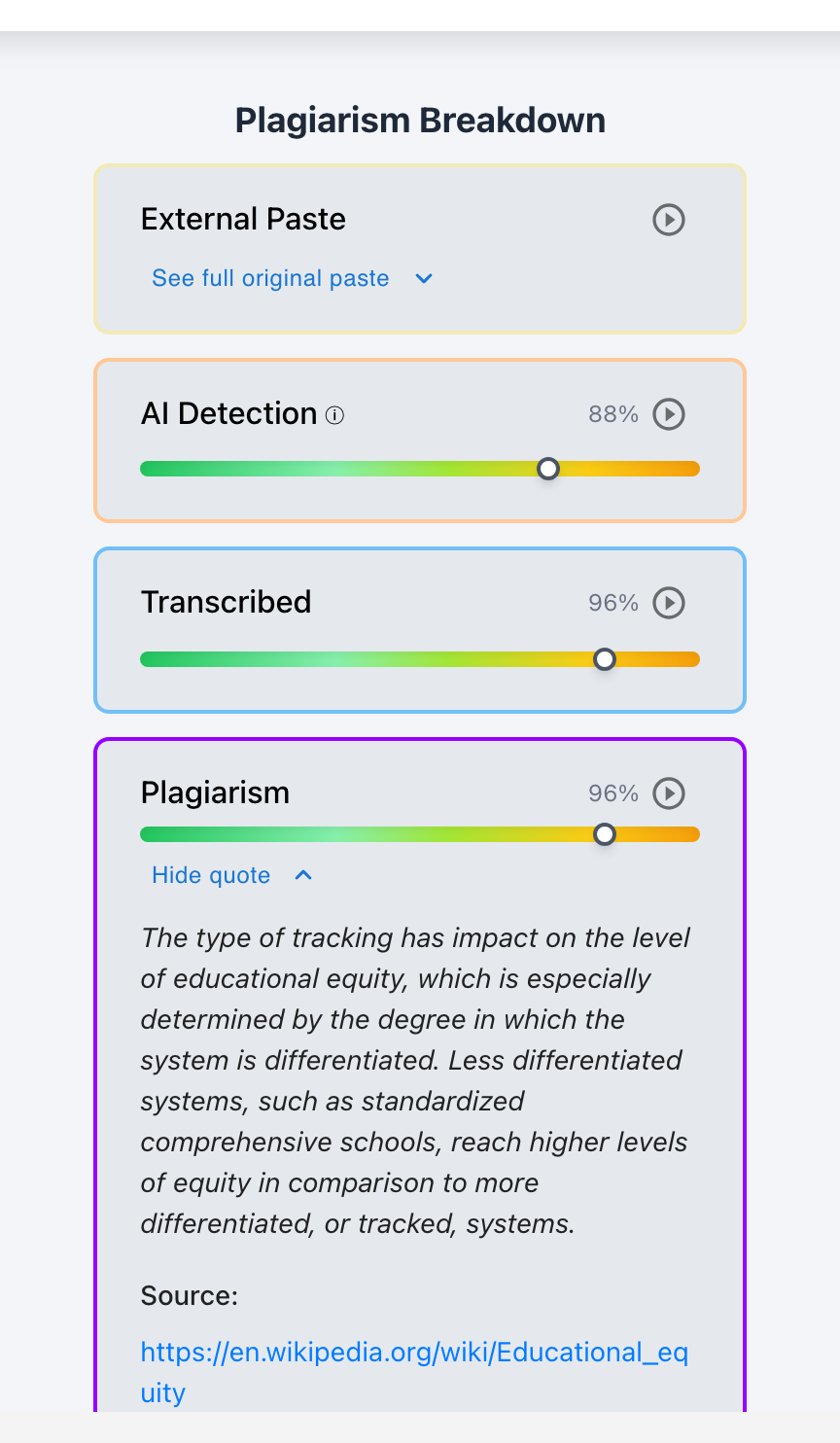
The Generic Detector Failure: Opaque AI detectors flag this record as 88% AI-Generated because standardized clinical acronyms (SI, ASI, SPM-2, PRN, WNL, ROM, MMT, ADLs) exhibit ultra-low lexical perplexity.
The Generic Detector Failure: Flowery paraphrasing easily passes traditional AI checkers with a 0% AI score, yet contains a dangerous clinical contraindication that could induce severe autonomic trauma.
- Rampant False Positives on Medical Shorthand: Generic AI detectors evaluate text predictability (perplexity) and structural variation (burstiness). Clinical documentation is intentionally formulaic, concise, and dense with standardized terminology (
SI,ASI,WNL,ADLs,IADLs,SPM-2,ROM,WFL,PRN,FIM,COPM,AOTA,OTR/L,COTA). When an honest student writes a compliant SOAP note, generic detectors flag it as "machine-generated." - Blindness to Clinical Fabrications: An LLM can generate a completely fabricated case history using varied, flowery vocabulary that passes generic AI detectors with a "0% AI" score, despite containing lethal vestibular intervention errors.
- FERPA and HIPAA Violations: Submitting student clinical logs containing patient health information into public, unvetted AI detection sites breaches federal privacy laws and university institutional agreements.
4. The Occupational Therapy Clinical Evidentiary Matrix
To evaluate student case writeups defensibly, OT faculty require a multi-dimensional evidentiary approach that replaces black-box guessing with transparent, objective writing process telemetry:
| Evaluation Dimension | Traditional Paper / Doc Logs | Generic AI Text Detectors | Checkmark Clinical Telemetry & Essay Playback™ |
|---|---|---|---|
| Clinical Reasoning Verification | Inferred indirectly from final static prose; cannot observe synthesis process. | None. Evaluates only surface text predictability; blind to clinical validity. | Direct observation of cognitive drafting pauses between raw assessment data and narrative. |
| Psychometric & Raw Data Concordance | Manual spot-check of score sheets; time-consuming. | None. Cannot cross-reference raw data forms. | Side-by-side verification of assessment scores & narratives. |
| Drafting Velocity & Keystroke Dynamics | Completely invisible; unknown whether typed or generated. | Completely invisible; treats pasted AI text as human text. | Millisecond-level keystroke replay (1x–8x) reveals pacing, deletions, and revisions. |
| External Paste Text Preservation | Undetectable if submitted as a finalized PDF or Word doc. | Flags pasted text only if statistical perplexity aligns. | Full timestamped capture of all external text pasted into doc, preserving original clipboard. |
| Protection for Honest Students & Non-Native Writers | Weak. Students cannot prove independent composition if accused by faculty. | Zero protection. Punishes neurodivergent writers and non-native English speakers. | Absolute proof. Complete replay exonerates students falsely accused by generic detectors. |
| Privacy, FERPA, and HIPAA Compliance | Varies; paper is private but unsearchable. | High risk: Data often ingested into public LLM training sets. | Enterprise HIPAA & FERPA compliance; zero model training. |
5. The 5-Phase Restorative & Defensible OT Clinical Audit Protocol
When evaluating sensory integration case writeups, MOT/OTD faculty, Academic Fieldwork Coordinators, and preceptors should follow an objective, 5-phase audit protocol that prioritizes student growth, clinical reasoning development, and patient safety:
Audit SPM-2 and Sensory Profile-2 raw data against standardized T-score cutoffs. Check mathematical consistency of quadrant classifications (+2 SD) and cross-check parent/teacher anecdotal notes against student clinical summaries.
Screen treatment plan for contraindicated rotary vestibular input in children with gravitational insecurity or autonomic reactivity. Verify that alerting inputs are followed by organizing proprioceptive heavy work and tied to functional ADLs.
Replay student drafting at 1x to 8x speed with Checkmark Essay Playback™. Look for the authentic 15–45 second “Data-to-Narrative Synthesis Pause” where students calculate scores and formulate hypotheses, versus steady unpaused mechanical typing.
Inspect timestamped clipboard captures to differentiate legitimate pasting of standardized clinical SOAP templates from unauthorized external AI-generated narrative summaries.
Conduct a supportive, evidence-based conference reviewing the Essay Playback™ timeline together. Differentiate clinical reasoning confusion from documentation burnout, and assign targeted lab re-evaluations under faculty observation.
Drafting Telemetry Comparison: Authentic Synthesis vs. Synthetic AI Transcription
6. How Checkmark Empowers Graduate OT Programs and Fieldwork Educators
Checkmark Plagiarism is engineered specifically to meet the high-stakes evidentiary demands of health sciences education, graduate clinical programs, and professional accreditation:
Watch how a student constructed their clinical evaluation, observing the exact moments they formulated diagnostic impressions, revised treatment ideas, and finalized SMART goals.
Preserves the exact text of every paste event with permanent historical timestamps, even if the student subsequently edited or paraphrased every single word.
Underlines specific suspect paragraphs directly in the text and displays sidebar evidence cards with calibrated confidence sliders, distinguishing clinic templates from synthetic text.
Generates draft rubric scores, per-criterion point breakdowns, and quote-anchored feedback tied directly to student text, with 1-click sync into Canvas LMS and Buzz LMS.
Student clinical notes and pediatric case reflections are never stored in public databases or used to train commercial AI models. Full HIPAA and FERPA compliance guarantees.
Embeds directly into Canvas SpeedGrader, Agilix Buzz, and Google Docs, allowing AFWCs and preceptors to review writing telemetry without changing their existing grading workflows.
7. Frequently Asked Questions (FAQ)
1. How do OT faculty differentiate between authorized AI grammar assistance and unauthorized clinical fabrication?
Authorized AI assistance includes using tools like Grammarly or spellcheck to correct typos, refine sentence flow, or clarify passive phrasing in clinical notes. In contrast, unauthorized clinical fabrication occurs when a student uses generative AI to invent pediatric behavioral observations, fabricate standardized test scores (e.g., SPM-2, Sensory Profile-2), synthesize clinical impressions, or generate complete sensory diets without having evaluated an actual client. Checkmark Essay Playback™ makes this distinction immediately clear: grammar corrections appear as brief, localized edits within student-drafted prose, whereas AI fabrication appears as large, uncomposed external paste events or monotonous, uninterrupted typing sequences.
2. Why do generic AI detectors trigger false positives on standardized OT clinical shorthand?
Generic AI detectors measure statistical perplexity (word choice unpredictability) and burstiness (sentence length diversity). In occupational therapy, clinical documentation relies heavily on standardized, formulaic phrasing and medical acronyms (SI, ASI, WNL, ADLs, IADLs, SPM-2, ROM, WFL, PRN, FIM, COPM, AOTA, OTR/L, COTA) to ensure precision and billing compliance. Because these professional abbreviations and standard phrasing are highly predictable, generic detectors mistakenly flag authentic student writing as machine-generated. Checkmark overcomes this flaw by combining passage-level linguistic analysis with keystroke telemetry, evaluating how the document was constructed rather than penalizing necessary medical terminology.
3. How does Essay Playback™ protect neurodivergent OT students who draft non-linearly?
Many neurodivergent graduate students (including individuals with ADHD, dyslexia, or autism) compose clinical notes in unconventional patterns—jumping between sections, brainstorming in fragmented bullet points, deleting large blocks of text, or experiencing extended pauses while processing complex diagnostic information. Traditional AI detectors often misinterpret these idiosyncratic writing patterns as anomalous or artificial. Checkmark Essay Playback™ captures the authentic, organic human drafting process keystroke-by-keystroke, providing undeniable visual proof of genuine creative effort and protecting neurodivergent students from unfounded accusations.
4. Can Checkmark detect students manually retyping AI-generated treatment plans from a phone or second monitor?
Yes. When a student composes an authentic clinical evaluation, their typing velocity is dynamic: fast bursts during familiar terminology, interspersed with frequent pauses (15–45 seconds) to consult raw score sheets, review reference norms, and formulate clinical hypotheses. When a student mechanically transcribes text from an external device (such as an iPhone or secondary laptop), the typing telemetry exhibits an unnatural, steady, unbroken cadence without cognitive synthesis pauses, and with near-zero conceptual revisions or structural deletions. Checkmark’s typing velocity analytics easily expose this transcription pattern.
5. How does Checkmark maintain HIPAA and FERPA compliance when evaluating student clinical case writeups?
Checkmark is built on an enterprise zero-retention security architecture. Student submissions, clinical evaluations, and fieldwork reflection journals are encrypted in transit (TLS 1.3) and at rest (AES-256). Crucially, student text is never cached, shared, sold, or used to train public Large Language Models. Furthermore, Checkmark integrates directly with university-managed Single Sign-On (Google SSO, Microsoft SSO) and LMS platforms (Canvas, Buzz, Google Classroom), ensuring that Protected Health Information (PHI) and student educational records remain strictly within institutional control.
6. How can Academic Fieldwork Coordinators (AFWCs) use Checkmark to support clinical preceptors at remote pediatric fieldwork sites?
Level II Fieldwork preceptors (OTR/L) are busy clinicians balancing heavy patient caseloads with student supervision. They often lack the time to investigate suspected AI usage in student clinical logs and SOAP notes. AFWCs can use Checkmark to centrally review student documentation submitted through Canvas or Buzz LMS. By reviewing Essay Playback™ timelines and paste reports before site visits or midterm FWPE evaluations, AFWCs can quickly identify students who are struggling with independent clinical reasoning and implement targeted academic remediation before clinical competency is compromised.
7. What restorative remediation steps should faculty take when an OT student submits an AI-generated sensory integration plan?
Rather than immediately referring the student to a punitive disciplinary committee, faculty should implement a restorative clinical learning protocol:
1. Review the Playback Together: Open the Checkmark Essay Playback™ with the student to establish an objective, transparent factual baseline.
2. Explore Cognitive Roadblocks: Discuss what led to the incident (e.g., anxiety over clinical performance, heavy caseload, confusion regarding sensory processing constructs).
3. Supervised Clinical Re-Evaluation: Require the student to re-administer the assessment (e.g., SPM-2 or structured clinical observations) under direct faculty observation in the pediatric lab.
4. Live Clinical Reasoning Defense: Have the student verbally defend their intervention choices, safety contraindications, and SMART goals before resubmitting the written documentation.
Conclusion: Restoring Trust in Graduate Occupational Therapy Clinical Education
The practice of sensory integration occupational therapy demands deep empathetic engagement, neurobiological acumen, and reflexive clinical problem-solving that cannot be replicated by artificial intelligence. While generative tools offer valuable administrative assistance, synthetic clinical documentation poses a serious threat to pediatric client safety and professional accreditation under ACOTE standards.
By implementing Checkmark Plagiarism's multi-dimensional telemetry suite—combining patent-pending Essay Playback™, External Paste Inspection, and teacher-in-the-loop autograding—graduate OT programs, Academic Fieldwork Coordinators, and clinical preceptors can eliminate adversarial guesswork, protect neurodivergent students, verify authentic clinical reasoning, and graduate competent, compassionate occupational therapists ready to transform children's lives.
Ready to Elevate Clinical Integrity in Your MOT or OTD Program?
Discover how Checkmark Plagiarism protects graduate clinical education, provides patent-pending keystroke replays, and syncs seamlessly with Canvas LMS, Agilix Buzz, and Google Classroom.