
Knowing whether a student authored their assignment independently or generated it with ChatGPT is one of the most pressing questions facing educators today.
Because modern language models generate grammatically flawless, articulate prose without traditional copy-paste plagiarism matches, teachers cannot rely on simple web searches or intuition alone. Furthermore, statistical AI detectors produce probabilistic scores that can create false positives on formal human writing.
To truly know whether a student used ChatGPT, educators must look beyond static text and evaluate a constellation of corroborating evidence: stylistic ChatGPT markers, document writing playback timelines, citation authentication in academic databases, and oral conceptual comprehension.
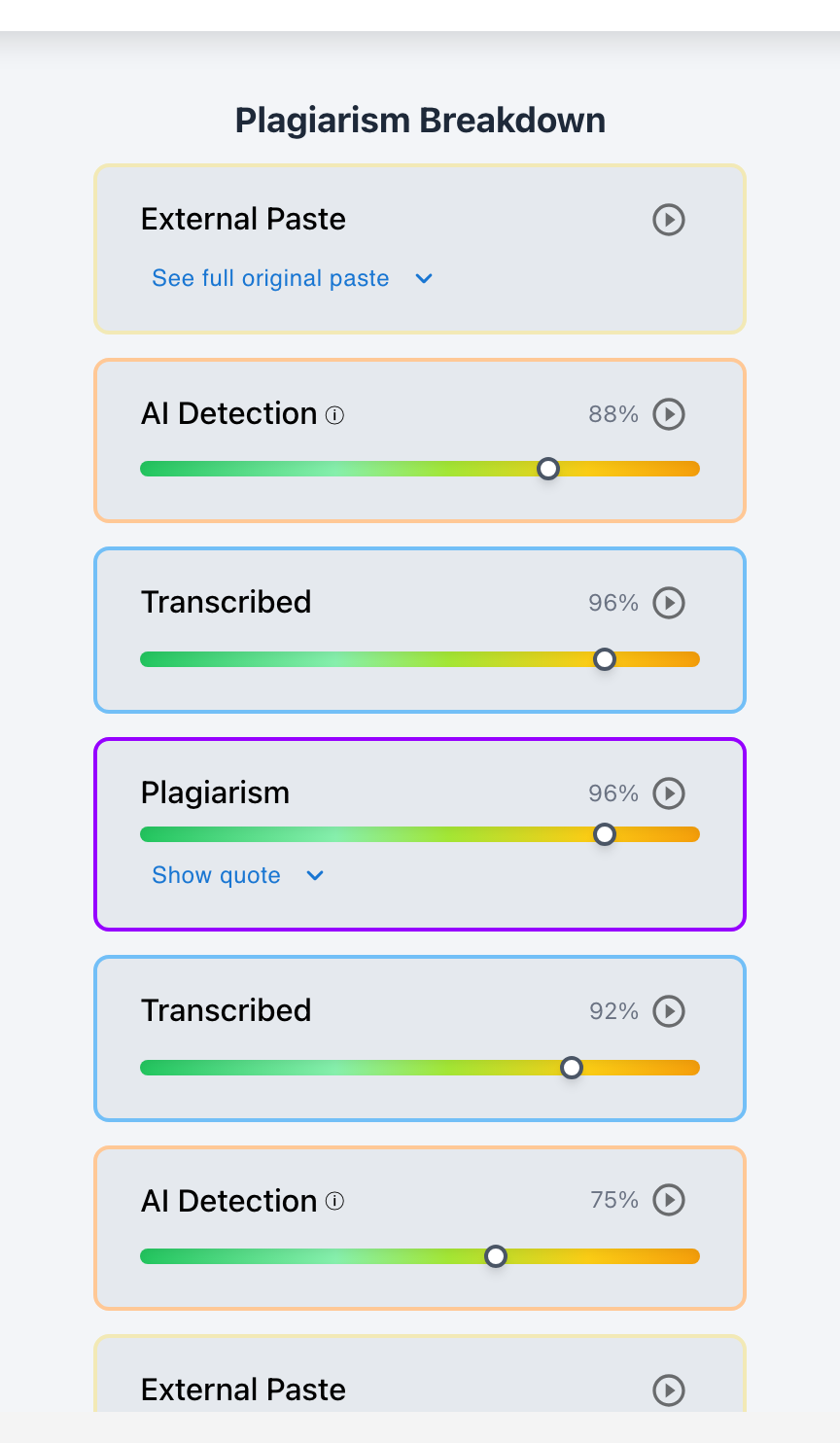
Checkmark Plagiarism provides this multi-signal visibility by combining AI detection with essay writing playback, static AI detection, plagiarism detection, autograding, and integrations with Canvas and Google Classroom.
The 4 Primary Indicators of ChatGPT Involvement
1. Stylistic & Structural Fingerprints
Formulaic 5-paragraph structures, characteristic transitional phrases ("delve into," "testament to"), neutral tone, and surface-level depth.
2. Document Creation Timeline Anomalies
Instant wholesale text insertions in writing playback, minimal active drafting duration, and zero substantive revision cycles.
3. Citation Hallucinations
Fabricated journal articles, non-existent book titles, fake DOIs, or direct quotations attributed to real authors that cannot be verified.
4. Oral Comprehension Disconnect
The student is unable to define advanced vocabulary used in the paper, summarize core arguments, or explain the thesis in plain words.
1. Identifying ChatGPT's Linguistic Habits
While ChatGPT writing continues to evolve, default outputs frequently exhibit recognizable stylistic tendencies:
- Overused Transitional Cliches: Heavy reliance on words and phrases like "delve," "tapestry," "testament," "crucial," "moreover," "furthermore," and "in conclusion."
- Aggressively Balanced Tone: Presenting opposing viewpoints with uniform symmetry, avoiding definitive stance-taking or personal voice.
- Prompt Generalization: Answering a broad, generic version of the prompt while omitting class-specific lectures, textbook examples, or teacher constraints.
Read more in what are the signs that a student used ChatGPT?
2. How Essay Writing Playback Provides Physical Proof
Linguistic habits justify curiosity, but document creation playback provides physical verification. Utilizing Checkmark Plagiarism's essay writing playback, instructors can observe the exact timeline of document assembly:
- Active Drafting Time: A human-written 1,500-word essay requires hours of active typing. If playback logs record only 9 minutes of total active drafting time, the essay was not typed keystroke-by-keystroke.
- Wholesale Paste Events: Playback highlights the exact timestamp and character count when 800–1,500 polished words appear simultaneously in the document.
- Revision Depth: Genuine human drafting shows typing, backspacing, sentence restructuring, and multi-session edits. Pasted ChatGPT output typically displays zero post-insertion revisions.
Read more in how Checkmark writing process analysis works.
3. Auditing Citations for Generative Hallucinations
One of the most concrete ways to confirm ChatGPT generation is checking the bibliography. Large language models predict next tokens rather than querying static databases, often fabricating plausible-sounding references:
- Search academic indices (JSTOR, Google Scholar, WorldCat) for cited article titles and DOIs.
- Confirm whether author pairings, journal volume numbers, and publication dates match real academic records.
When an essay contains multiple non-existent sources, it provides objective physical evidence of generative AI involvement.
4. The Student Writing Conference: Testing Conceptual Mastery
Hold a brief, supportive conversation with the student to evaluate conceptual ownership:
- "Can you summarize your core thesis and main points in a few sentences?"
- "What does this technical term mean in paragraph 3?"
- "How did you find this specific source, and what was the author's primary finding?"
A student who spent days drafting an authentic paper will comfortably discuss their research and ideas. An inability to explain basic arguments indicates disconnected authorship.
A 6-Step Verification Protocol for Teachers
Educator Protocol to Verify ChatGPT Use:
- 1. Inspect the essay for formulaic structure, overused transitions, and prompt generalization.
- 2. Review essay writing playback to evaluate active typing time, keystroke cadence, and paste events.
- 3. Run dual AI detection and plagiarism scans to identify statistical predictability maps.
- 4. Audit cited sources in academic databases to confirm whether publications and DOIs exist.
- 5. Compare the submission against 2–3 verified historical baseline writing samples.
- 6. Conduct an open-ended student conference to test oral conceptual understanding.
How Checkmark Plagiarism Eliminates Guesswork
Checkmark Plagiarism combines **AI detection, essay writing playback, static AI detection, plagiarism detection, autograding, and Canvas/Google Classroom integrations** to give educators complete, objective evidence for every assignment.
Frequently Asked Questions
How can a teacher know for sure if a student used ChatGPT?
By compiling multi-signal evidence: combining essay writing playback (paste events and typing duration) with citation validation (catching fake sources), baseline comparisons, and student interviews.
Can ChatGPT essays bypass standard plagiarism checkers?
Yes. Because ChatGPT generates novel word combinations rather than copying existing text, traditional plagiarism checkers report 0% similarity, making AI detection and writing playback essential.
What does a large paste in document history mean?
It indicates that text was drafted outside the document. It could be ChatGPT, but it could also be an authentic draft from Microsoft Word. Ask the student to provide the external draft file.
Why does ChatGPT invent fake sources?
Language models generate text by predicting statistically probable token sequences. They do not look up real library databases, frequently generating fictitious author names and titles that sound plausible.
How should I ask a student about suspected ChatGPT use?
Use open-ended, supportive questions: "Can you walk me through how you wrote this paper and explain the thesis in Section 2?" Avoid immediate accusations.
Can an AI detector percentage alone prove ChatGPT use?
No. Detector percentages are statistical estimates that must be corroborated by writing playback, citation audits, and student conferences.
What if the student claims they used ChatGPT only for grammar?
Inspect the document: basic grammar editing preserves the student's authentic vocabulary and structure, while full generation introduces formulaic phrasing and sudden stylistic shifts.
How does comparing previous student writing help?
It reveals whether the submission reflects natural growth in the student's recognizable voice or an uncharacteristic leap in syntax and vocabulary.
What if a student with a flagged essay can explain everything fluently?
If the student demonstrates thorough conceptual mastery and sources are verified, it strongly indicates authentic student ownership, resolving the concern.
How does Checkmark Plagiarism help teachers detect ChatGPT?
Checkmark Plagiarism captures writing playback timelines, runs dual AI/plagiarism scans, audits sources, and integrates seamlessly with Canvas and Google Classroom.
Definitive Proof Comes from Multi-Signal Evidence
Knowing whether a student used ChatGPT requires looking beyond single detector scores. By combining writing playback, citation audits, baseline comparisons, and student dialogue, educators protect academic standards with fairness, clarity, and confidence.
Checkmark Plagiarism supports this comprehensive approach with AI detection, essay writing playback, static AI detection, plagiarism detection, autograding, and integrations with Canvas and Google Classroom.
See how Checkmark pairs essay writing playback with multi-signal detection to give teachers definitive proof of student authorship. View a sample report or request a demonstration.