
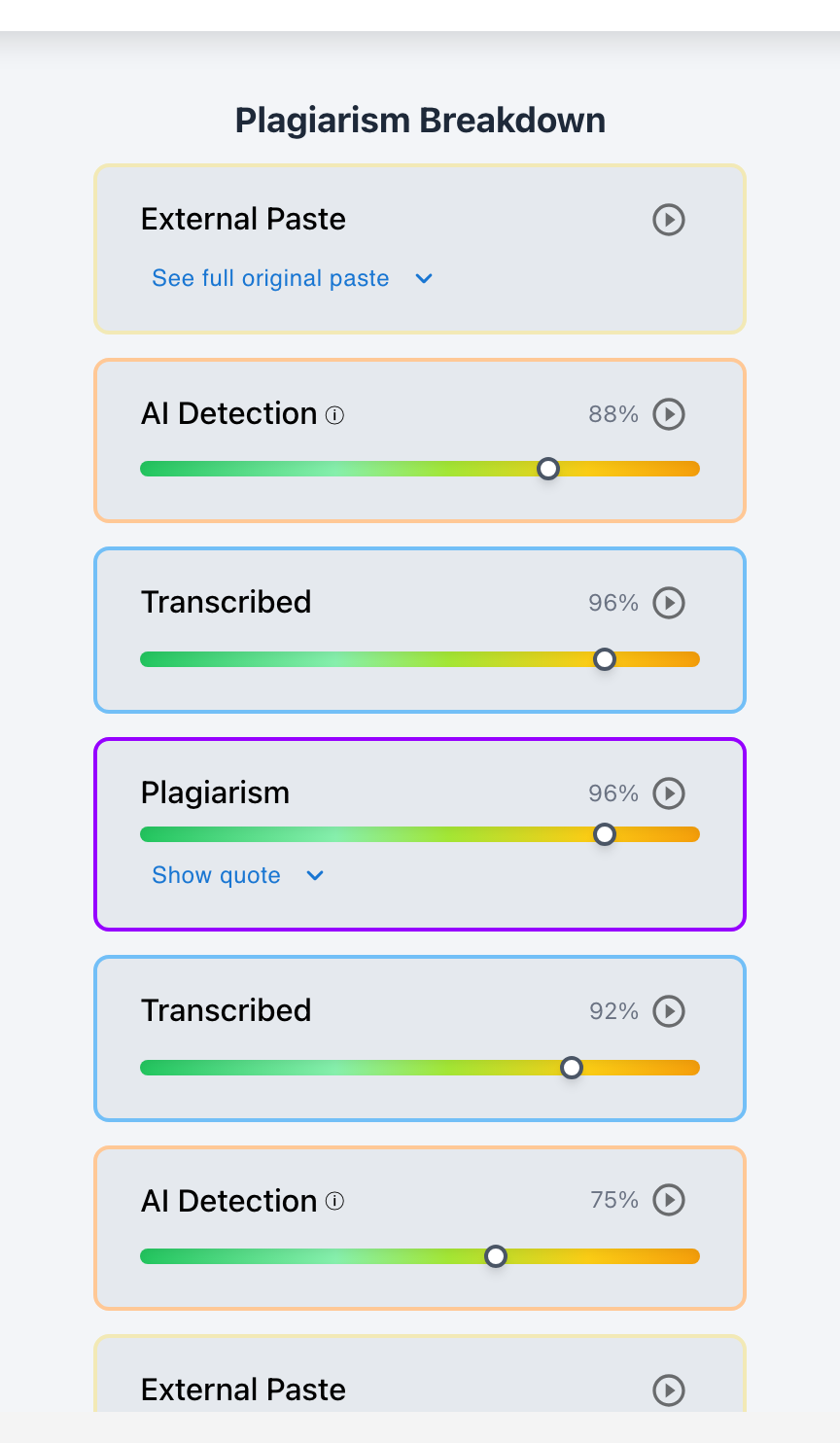
Teachers can investigate suspected AI use without relying on an AI detector by executing Checkmark Plagiarism's 4 Non-Detector Forensic Methods: 1) Keystroke Writing Playback Telemetry (watching a 15-second video replay to verify whether the essay was actively typed over hours or pasted in 0.05 seconds); 2) Citation & DOI Database Audits (verifying whether cited scholarly sources exist in Crossref); 3) In-Class Writing Baseline Comparisons (contrasting vocabulary against unassisted diagnostic samples); and 4) A 2-Minute Diagnostic Oral Conference.
Many educators and school districts are rightfully hesitant to rely on statistical AI detectors due to concerns about false positives, algorithmic opacity, and legal challenges. However, avoiding statistical detectors does not mean teachers must surrender academic integrity and accept ChatGPT essays without recourse. Process telemetry and factual research verification provide a 100% detector-free investigation pathway that delivers incontrovertible empirical proof without guessing at word probabilities.
Below is a comprehensive guide on investigating AI use using pure process telemetry and pedagogical verification.
Checkmark Plagiarism powers detector-free investigations by pairing essay writing playback with plagiarism detection, AI detection, autograding, and integrations with Canvas and Google Classroom.
The 4 Non-Detector Forensic Investigation Methods
1. Biometric Writing Playback
Checkmark Playback records the physical act of writing: active drafting minutes, pause-and-burst cycles, backspaces (15–25%), and paste event timestamps.
2. Factual Citation & DOI Auditing
Cross-references every cited academic article and DOI against international registries. Non-existent sources provide binary proof of generative hallucination.
3. In-Class Stylistic Baseline Matching
Compares readability metrics, vocabulary sophistication, and sentence structures with the student's verified, in-person diagnostic writing samples.
4. The 2-Minute Diagnostic Oral Conference
A supportive, 3-question check-in evaluating whether the student can define specialized terms, explain their research journey, and summarize their core thesis.
Why Detector-Free Investigations Are Superior
Understanding the legal, pedagogical, and ethical advantages:
- Zero False Positive Risk: You are not evaluating statistical word probabilities; you are inspecting physical drafting timestamps, database records, and oral student fluency.
- Total Legal & Parental Defensibility: Showing a parent a 0.05-second paste payload and a dead DOI is factual and indisputable, eliminating arguments over algorithm accuracy.
- Preserving Teacher-Student Trust: Grounding discussions in writing process telemetry transforms disciplinary confrontations into supportive pedagogical conferences.
Read more in how Checkmark writing process analysis works.
Comparison: Probabilistic AI Detectors vs. Pure Process Telemetry
Checkmark Process Telemetry (Empirical & Defensible)
- Watches 15-second time-lapse replay of drafting.
- Checks active drafting hours and 0.05s paste logs.
- Verifies cited academic DOIs against Crossref.
- Zero false positive vulnerability for honest writers.
Probabilistic AI Detectors (Speculative & Fragile)
- Outputs an arbitrary percentage score (e.g., 84% AI).
- Prone to false alarms on advanced and multilingual writers.
- Easily bypassed by free paraphrasing tools (QuillBot).
- Sparks heated debates over software reliability.
A 5-Step Educator Protocol for Detector-Free Inquiries
Detector-Free Investigation Checklist:
- 1. Open the student's submission in Canvas SpeedGrader with Checkmark enabled.
- 2. Watch the 15-Second Writing Playback Video: check if text was actively typed or pasted in bulk.
- 3. Inspect the Source Verification Card: check if cited journal articles and DOIs exist in Crossref.
- 4. Compare vocabulary and syntax against the student's in-class diagnostic baseline sample.
- 5. Hold a 2-minute diagnostic oral check-in: ask the student to explain their research and define key terms.
How Checkmark Plagiarism Powers Detector-Free Inquiries
Checkmark Plagiarism combines **AI detection, essay writing playback, static AI detection, plagiarism detection, autograding, and Canvas/Google Classroom integrations** to give educators complete empirical visibility into writing telemetry without ever needing to rely on a statistical detector.
Frequently Asked Questions
Can I prove a student used AI without an AI detector score?
Yes. Pairing a 0.05-second paste payload of 1,500 words with fabricated academic citations provides conclusive, incontrovertible proof of AI generation.
What if a student typed the essay instead of pasting it?
Checkmark Playback records the flat, robotic cadence, lack of cognitive thinking pauses, and <3% backspaces characteristic of manual transcription.
How does Crossref DOI auditing work?
Checkmark queries scholarly databases in real time, validating whether every cited article title, author, and DOI exists in published reality.
How does Checkmark Plagiarism integrate with Canvas LMS?
Checkmark embeds writing playback videos and citation status cards directly inside Canvas SpeedGrader, allowing detector-free audits in seconds.
What if a student drafted offline in Microsoft Word?
Ask the student to email the original Word file to verify its internal creation dates and save timestamps.
Why are oral check-ins so decisive?
Because authentic human writers understand what they wrote; students who used AI or external shortcuts are unable to explain their own text spontaneously.
How does Checkmark Autograder assist during detector-free investigations?
Autograder benchmarks the essay's claims against rubric criteria, highlighting unsupported assertions and citation anomalies for teacher review.
Can parents understand process telemetry evidence?
Yes. Parents immediately understand a 15-second video showing an essay appearing in a single paste, making parent meetings constructive and objective.
Does this approach comply with school district policies that ban AI detectors?
Yes. Process telemetry and citation verification inspect physical actions and factual accuracy, fully complying with detector-free district guidelines.
Why is process telemetry the future of academic integrity?
Because it shifts the focus from policing words to honoring the authentic, human journey of writing and intellectual growth.
Empirical Truth Beyond Algorithm Scores
Academic integrity does not require black-box algorithms. By utilizing Checkmark Plagiarism's writing playback telemetry, citation verification, and diagnostic conference frameworks, educators investigate suspected AI use with complete empirical certainty, total fairness, and deep educational care.
Checkmark Plagiarism supports this comprehensive approach with AI detection, essay writing playback, static AI detection, plagiarism detection, autograding, and integrations with Canvas and Google Classroom.
See how Checkmark powers detector-free writing process investigations in Canvas SpeedGrader. View a sample report or request a demonstration.