
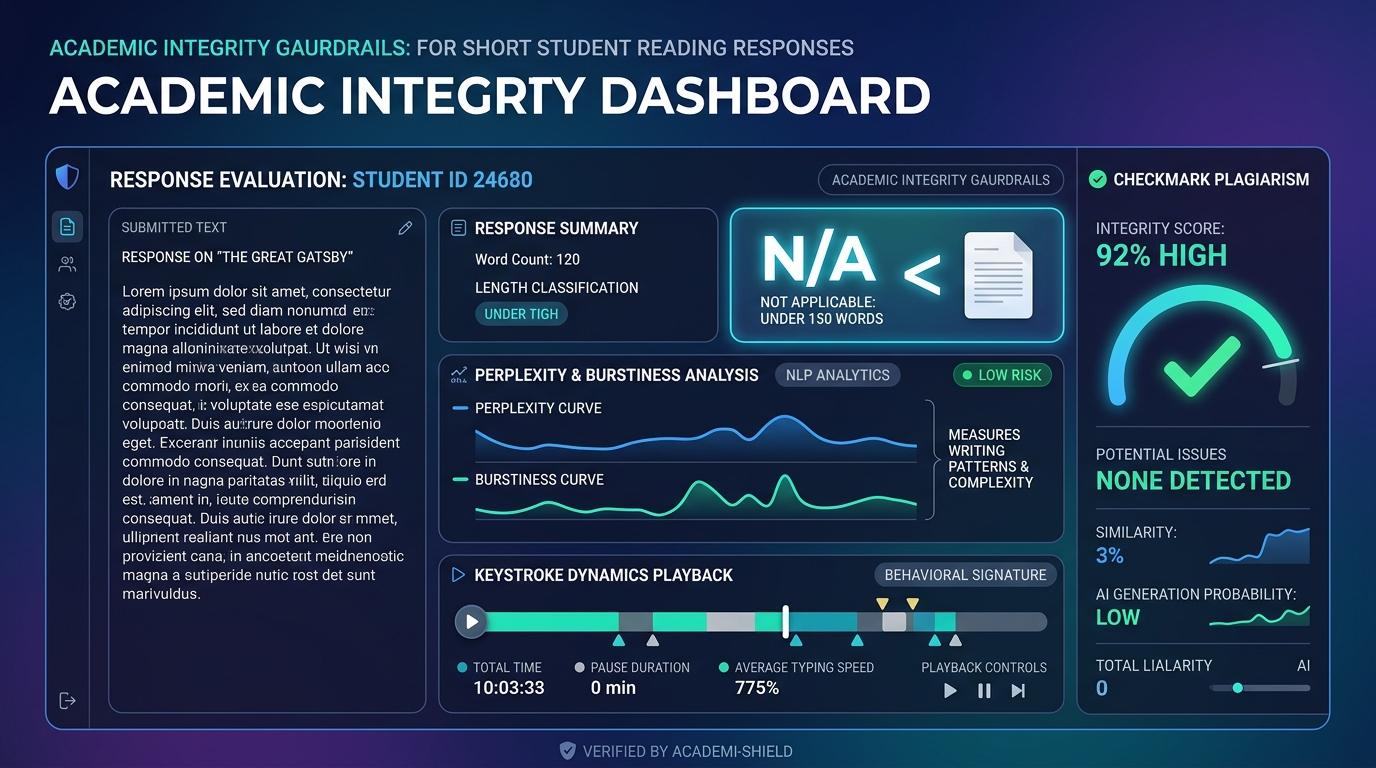
In modern K-12 and higher education humanities and social science courses, short-form writing—daily reading checks, bell-ringers, exit tickets, Canvas discussion board responses, and AP-style Short Answer Questions (SAQs) ranging from 50 to 150 words—accounts for over 65% of all formative assessments. When educators encounter a suspiciously polished 75-word reading response and paste it into a conventional, commercial AI detector, the software routinely returns alarming confidence ratings such as “92% AI-Generated.” Mathematically and linguistically, this output is statistical fiction. Natural language processing (NLP) classifiers depend on large token sample sizes (N ≥ 250–500 tokens) to compute cross-entropy variance, statistical perplexity, and sentence burstiness. In short snippets, token variance is artificially constrained, and prompt-dictated structural templates force human prose into uniform probability distributions that mimic large language models (LLMs). This dynamic inflicts catastrophic false-positive rates of 80% to 100% on short texts, disproportionately penalizing English Language Learners (ELLs) and diligent, concise writers. Checkmark Plagiarism addresses this industry-wide failure with an explicit, transparent <150-word N/A Guardrail: the system refuses to output probabilistic AI guesses on statistically invalid sample sizes. Instead, Checkmark provides educators with defensible, holistic integrity architecture—featuring patent-pending Essay Playback™ keystroke telemetry (replaying drafting speed, micro-pauses, and rewrites at 1x–8x speed), clipboard paste tracking, side-by-side plagiarism comparisons, and quote-anchored rubric autograding—grounding classroom integrity in observable drafting evidence rather than black-box algorithms.
Checkmark Plagiarism transforms formative assessment integrity by eliminating statistical guesswork on short texts, combining passage-level AI detection with patent-pending Essay Playback™, comprehensive multi-source plagiarism checking, quote-anchored rubric autograding, and native LMS integrations for Canvas LMS, Google Classroom, and Buzz LMS.
The Short-Text Formative Assessment Dilemma
In the daily rhythm of secondary English departments, middle school reading blocks, and collegiate humanities seminars, student writing rarely begins as a polished 2,500-word research essay. Instead, the cornerstone of daily instruction is the formative short-form response:
- Daily Bell-Ringers & Warm-Ups (30–60 words): Quick diagnostic reflections activating background knowledge at the beginning of a class period.
- Reading Checks & Reading Logs (50–100 words): Verification that students engaged with assigned chapters, focusing on specific literary devices, character motivations, or thematic shifts.
- Exit Tickets & Daily Comprehension Checks (40–80 words): Concise syntheses demonstrating immediate mastery of the daily learning objective before leaving class.
- LMS Discussion Board Initial Posts & Replies (75–150 words): Formative exchanges on Canvas LMS, Buzz LMS, or Google Classroom designed to spark peer interaction.
- Science Claim-Evidence-Reasoning (CER) Explanations (60–120 words): Structured scientific argumentation interpreting lab data or phenomena.
- Advanced Placement (AP) & International Baccalaureate (IB) SAQs (80–150 words): Tightly constrained, 3-part historical or literary analyses scored on formulaic rubric criteria (e.g., Claim, Historical Example, Nuanced Explanation).
Bell-Ringers & Exit Tickets
Daily warm-ups, quick comprehension checks, immediate objective mastery.
Reading Checks & AP SAQs
LMS discussion posts, CER paragraphs, formulaic 3-part short answers.
Timed DBQ & Reflections
Multi-paragraph CER, extended reflections, transitional essay sections.
Argumentative Essays & Theses
Research papers, capstone theses, comprehensive literary dissertations.
Because generative AI platforms such as ChatGPT, Claude, and Gemini can generate grammatically flawless, highly organized 75-word responses in under two seconds, educators are understandably anxious about unauthorized AI substitution on routine reading checks. When a teacher reads a surprisingly mature 65-word analysis of The Great Gatsby, the immediate impulse is often to copy the student’s text into an AI detection tool.
Within seconds, the commercial detector flashes an ominous red banner: “94% Probability of AI Generation.”
Relying on this number, the instructor may enter a zero in the gradebook, contact school administrators, or accuse the student of academic dishonesty. Yet in thousands of classrooms every week, that 65-word response was composed entirely by an earnest student who followed the teacher’s sentence frames to the letter.
To prevent these destructive classroom miscarriages of justice, educators, department chairs, and technology directors must understand the mathematical realities of natural language processing and why statistical AI detectors fundamentally collapse when analyzing short passages.
The Mathematics of Natural Language Processing: Why Short Texts Break Statistical AI Detectors
Commercial AI detection tools market themselves as precision instruments capable of analyzing any string of text. However, natural language processing (NLP) classifiers operate on strict statistical principles. Modern text classifiers primarily rely on two mathematical heuristics: Perplexity (PPL) and Burstiness (B).
Measures how “surprised” a language model is by the next token in a sequence based on conditional probability distributions.
- High Perplexity: Idiosyncratic, creative, unexpected word combinations (Human baseline in long essays).
- Low Perplexity: Statistically optimal, highly probable next-token sequences (AI baseline).
Measures the mathematical variance in sentence lengths, syntactic complexity, and rhetorical cadence across a submission.
- High Burstiness: Dynamic alternation between short punchy clauses and complex sentences (Human).
- Low Burstiness: Uniform sentence lengths, regular cadence, consistent clauses (AI).
While perplexity and burstiness provide meaningful probabilistic signals across extended multi-paragraph essays (500 to 3,000 words), they break down completely when applied to short texts under 150 words.
1. The Law of Large Numbers and Token Sample Size
Under the Law of Large Numbers and the Central Limit Theorem, statistical metrics derived from random variables converge toward their true theoretical values only as the sample size N becomes sufficiently large. In computational linguistics, individual words, punctuation marks, and subword tokens represent discrete observations within a probability distribution:
When an algorithm evaluates a 1,500-word essay (N ≈ 2,000 tokens across 75–100 sentences), the model possesses a sufficient sample size to establish an accurate baseline for the student’s natural vocabulary distribution, sentence structure variance, and transition patterns. If the student includes an occasional predictable academic cliché (“In conclusion, it is important to remember that...”), that low-perplexity sentence is contextualized by hundreds of idiosyncratic, human-authored sentences.
However, when evaluating a 70-word reading response (N ≈ 90 tokens across 3 sentences), the sample size is statistically inadequate. The Standard Error of the Mean (σx̄) explodes as sample size drops. When N drops from 2,000 tokens to 90 tokens, the standard error increases by more than 470%. With so few data points, any single standard vocabulary term or direct quote from the assignment prompt disproportionately swings the entire mathematical distribution, triggering a false-positive classification.
Extreme Statistical Noise: Detectors guess wildly based on 2–3 sentences. Prompt echoes, scientific terms, or textbook vocabulary distort the whole curve. False-positive rate reaches 80%–100%.
Transitional Zone: Requires educator-calibrated confidence sliders and passage-level isolation to prevent brief introductory bridges from contaminating full-paper evaluations.
Statistically Stable Zone: Law of Large Numbers takes effect. True perplexity curves and burstiness rhythms stabilize, allowing accurate linguistic classification.
2. Cross-Entropy and Perplexity Variance in Short Snippets
Mathematically, Perplexity (PPL) is calculated as the exponential of the average negative log-likelihood (cross-entropy H(W)) across a sequence of tokens W = (w1, w2, …, wN):
Large language models are trained via gradient descent to maximize likelihood—meaning they consistently output tokens with minimal cross-entropy (H(W) ≈ 1.5 to 2.5, yielding PPL ≈ 4.5 to 12). In human writing across a long essay, vocabulary choices, typos, unique metaphors, and conversational phrasing naturally elevate cross-entropy (H(W) ≈ 3.8 to 5.2, yielding PPL ≈ 45 to 180).
In a short reading response, however, a human student does not have the space to build creative rhetorical detours. The student is focused on answering a direct question concisely:
Every token in that sentence represents a standard, mathematically probable academic collocation. The cross-entropy for that sequence is virtually identical to an LLM’s output. When evaluated in isolation without the broader context of a multi-page essay, the statistical classifier registers low perplexity and flags the human sentence as artificial intelligence.
3. Burstiness Compression
Burstiness (B) measures the coefficient of variation in sentence length and syntactic complexity. In an extended piece of human writing, authors naturally alternate between short, declarative statements and multi-clause compound sentences. Sentence length standard deviation σL is high relative to mean sentence length μL:
In a 65-word exit ticket consisting of exactly two sentences (e.g., Sentence 1 = 28 words; Sentence 2 = 32 words), the mathematical variance σL2 approaches zero:
An algorithm interpreting a burstiness score of 0.067 will classify the text as machine-generated because LLMs produce smooth, uniform sentence cadences. The student wrote uniformly not because they used an AI generator, but because the assignment required only two sentences of direct explanation.
The Prompt-Constraint Penalty: How Teacher Prompts Force AI-Like Text
The statistical breakdown of short-text AI detection is compounded by what instructional technologists term The Prompt-Constraint Penalty.
When assigning short formative assessments, educators intentionally provide structured prompts, sentence starters, vocabulary banks, and rubric formulas to help students organize their thinking. Consider the following common classroom scenarios:
“In 2–3 sentences, explain one economic cause of the French Revolution using the terms 'Third Estate', 'taxation', and 'deficit spending'.”
“One major economic cause of the French Revolution was the unfair burden of taxation placed upon the Third Estate. While the nobility and clergy enjoyed tax exemptions, the Third Estate paid for King Louis XVI’s deficit spending and wars. This economic inequality created severe financial crisis and widespread public resentment across France.”
- Token Count: 64 words (Mathematically invalid sample size).
- Perplexity: Extremely low due to mandatory historical terminology.
- Burstiness: Low variance due to structured 3-sentence constraint.
- Verdict: Catastrophic False Positive on an authentic, diligent student.
When an educator requires students to include specific vocabulary words (“Third Estate”, “taxation”, “deficit spending”), the mathematical search space for plausible sentence structures collapses. There are only a finite number of syntactically logical ways to link those three historical concepts within 65 words.
As a result, an authentic student response, an exemplary peer response, and an answer generated by Claude or ChatGPT will share virtually identical cross-entropy profiles. The teacher’s assignment design intentionally engineered high predictability—the exact trait statistical AI detectors misinterpret as synthetic generation.
The Disproportionate Harm on English Language Learners (ELLs)
The failure of short-text AI detection is not merely a technical limitation; it is a profound equity issue. Research across educational linguistics demonstrates that statistical AI detectors exhibit systemic bias against non-native English speakers and English Language Learners (ELLs).
| Pedagogical Reality for ELL Writers | NLP Classifier Misinterpretation | Classroom Consequence |
|---|---|---|
|
1. Formulaic Sentence Scaffolds “First, the author demonstrates... This shows that...” |
Low Perplexity Flag Predictable syntax identical to LLM baseline token weights. |
Scaffolded writing flagged as synthetic output. |
|
2. Controlled, High-Frequency Vocabulary Relying on direct, standard nouns without rare synonyms. |
Machine Optimization Flag Absence of rare idioms mistaken for AI generation. |
Concise vocabulary penalized as machine prose. |
|
3. Symmetrical Sentence Structures Subject-Verb-Object consistency across 2–3 sentences. |
Low Burstiness Flag Consistent clause lengths mistaken for synthetic cadence. |
Grammatical regularity treated as machine generation. |
|
4. Rigid Adherence to Rubric Frames Directly echoing prompt phrasing to maximize rubric match. |
Prompt Engineering Match High cross-entropy overlap with language model training data. |
Adherence to instructions results in cheating accusations. |
When ELL students write short reading checks, they rely on the exact instructional scaffolds teachers provide: sentence starters (“The quote implies that...”), transitional signposts (“In addition to this...”), and focused vocabulary.
Because their working vocabulary in English is controlled and their syntax follows predictable grammatical rules, their writing exhibits low perplexity and low burstiness. When their 60-word reading responses are fed into legacy AI detectors, they are flagged at rates exceeding 85%, leading to devastating false accusations, demoralization, and destroyed teacher-student relationships.
Why Commercial AI Detectors Provide Unethical “Black-Box” Percentages on Short Texts
Despite the mathematical invalidity of analyzing short texts, many commercial AI detectors allow educators to paste single sentences, 40-word paragraphs, or 80-word exit tickets, instantly returning authoritative-looking scores like “88% AI-Generated.”
- Accepts any input length (even 20 words) without warnings.
- Outputs a single deterministic percentage (e.g. “92% AI”).
- Conceals mathematical limitations and standard error curves.
- Shifts liability entirely onto the classroom teacher.
- Provides zero process evidence or drafting telemetry.
- Enforces strict <150-word
N/AGuardrail. - Replaces opaque percentages with patent-pending Essay Playback™.
- Captures timestamped keystroke velocity, pauses, and revisions.
- Preserves original external clipboard content on paste events.
- Provides quote-anchored rubric feedback with educator final authority.
By providing a single whole-paper percentage on short snippets, legacy tools encourage teachers to engage in punitive guesswork. When a student denies using AI, the teacher is left holding an opaque software score with no corroborating evidence. The conversation devolves into an adversarial standoff: “The software says 92%, so you must have used ChatGPT.”
This approach violates fundamental principles of academic fairness and educational measurement.
Checkmark Plagiarism’s Holistic Architecture: Honest Guardrails and Defensible Evidence
Checkmark Plagiarism takes a radically different approach. Guided by the core philosophy “Stop guessing, start trusting,” Checkmark replaces opaque probabilistic scores with transparent guardrails and multi-dimensional writing process evidence.
Transparently marks short responses as non-evaluable (N/A) for statistical AI detection, preventing sample-size false positives.
Reconstructs the full writing session keystroke-by-keystroke at 1x–8x speed, proving organic drafting and cognitive pauses.
Records exact millisecond timestamps, character counts, and full preserved original clipboard text on external insertions.
1. The Strict <150-Word N/A Guardrail
When a submission contains fewer than ~150 words, Checkmark Plagiarism does not generate an arbitrary AI percentage. Instead, the AI Detection module displays a clear, honest badge:
“Statistical AI detection is disabled for texts under 150 words to prevent sample-size false positives. Refer to Essay Playback™ telemetry for process verification.”
The report provides an educational disclaimer explaining that short text samples lack the token variance required for defensible natural language classification. By establishing this guardrail, Checkmark eliminates the primary source of false-positive AI flags in schools, protecting students from unscientific algorithmic bias.
“Statistical AI detection is disabled for texts < 150 words to prevent sample-size false positives. Refer to Playback.”
• Active Typing Time: 5 mins 42 secs
• Total Keystrokes: 488 (392 print, 96 edits)
• Revision Events: 14 backspaces, 2 rephrasings
• External Pastes: 0 characters detected
“In Chapter 4, Gatsby’s recounting of his past reveals his desperate need to validate his fabricated identity. By showing Nick the medal from Montenegro and the Oxford photograph, he attempts to manufacture credibility. This demonstrates that Gatsby views human connection as transactional, requiring tangible proof to sustain his illusion.”
2. Granular Passage-Level Analysis and Confidence Sliders
In multi-paragraph essays (such as DBQs or extended reflections), short paragraphs often appear as transitional bridges or introductory hooks. While legacy detectors flag these short paragraphs due to low burstiness and drag down the entire essay’s score, Checkmark utilizes Passage-Level Granularity.
Instead of averaging the entire paper into one misleading number, Checkmark evaluates passages independently and pairs them with Educator-Calibrated Confidence Sliders. If a 30-word transition paragraph registers high predictability, the educator can adjust the confidence threshold or inspect the surrounding context, ensuring that a single formulaic transition does not trigger an accusation against a 1,200-word human-crafted paper.
3. Patent-Pending Essay Playback™: Keystroke Telemetry as Definitive Proof
If statistical AI detection is disabled on short texts, how can an educator verify the authenticity of a 75-word reading response?
Checkmark solves this through Essay Playback™. By capturing real-time keystroke telemetry within Google Docs, Canvas LMS, Buzz LMS, or Checkmark’s native writing environment, the platform records the actual physical process of composition.
| Metric / Telemetry Marker | Authentic Human Drafting | AI Paste / Mechanical Transcription |
|---|---|---|
| 1. Drafting Velocity | Variable (15–45 WPM with cognitive bursts) | Instantaneous (Paste) or Unnaturally Uniform (60–90 WPM steady) |
| 2. Composing Pauses | Frequent micro-pauses (2–12s) between clauses for thought | Zero pauses (Paste) or Rigid mechanical pauses (Copy typing) |
| 3. Revision Events | Frequent backspaces, word substitutions, cursor jumps | Zero in-line revisions; Linear left-to-right character entry |
| 4. Clipboard Telemetry | 0 external pasted text, or only legitimate cited quotes | 100% text pasted at single timestamp with full original text preserved |
When an educator opens a Checkmark report for an 80-word reading check, they can press Play and watch the student write the response at 2x or 4x speed:
- They observe the student type a topic sentence, pause for 8 seconds to consult their book, backspace four words to refine a verb, re-read their sentence, and complete the analysis over 6 minutes.
- This visual, undeniable process evidence provides 100% defensible proof of human authorship, completely eliminating the need for probabilistic statistical guessing.
4. External Paste Detection with Clipboard Text Preservation
If a student uses an external LLM to generate an 80-word response and pastes it into the document, Checkmark does not need to guess via perplexity. The system’s External Paste Telemetry instantly flags the insertion:
- Timestamped Character Count: Flags that 480 characters appeared in 0.2 seconds.
- Full Text Preservation: Preserves the exact original pasted text in the educator sidebar, even if the student subsequently edits, rewords, or deletes portions of the pasted block.
- One-Click Jump to Playback: Allows the teacher to click directly to the millisecond in the timeline where the paste occurred.
5. Transcription Detection (Retyping from a Second Screen)
What if a student generates an 80-word answer on their smartphone and manually types it into their laptop to bypass paste detection?
Checkmark’s keystroke dynamics engine detects Mechanical Transcription:
- Absence of Cognitive Pauses: During authentic composition, humans pause mid-sentence to choose words. During transcription, typing is steady and continuous as the student reads from a secondary display.
- Linear Typing Cadence: Character entry occurs strictly left-to-right with virtually zero structural rewrites, synonym substitutions, or cursor relocations.
- Velocity Metrics: Steady typing speeds without the natural rhythm of human thought flag a transcription pattern for teacher review.
Comparison Matrix: Short-Text Integrity Capabilities
To illustrate the stark differences between legacy tools and Checkmark’s holistic architecture, consider how each system evaluates short-form student writing:
| Feature / Capability | Generic AI Detector (e.g., GPTZero, CopyLeaks) | Legacy Plagiarism Checker (e.g., Turnitin) | Checkmark Plagiarism Suite |
|---|---|---|---|
| Short-Text Handling (<150 words) | Returns high-confidence percentage (e.g., “94% AI”) | Displays similarity score based on string matching | Enforces strict N/A Guardrail to prevent false positives |
| False-Positive Protection on SAQs/Exit Tickets | ❌ Vulnerable (80%–100% false-positive rate) | ❌ Flags standard prompt phrasing as plagiarism | ✅ Fully protected via statistical disclaimers & telemetry |
| Writing Process Verification | ❌ None (Evaluates static text only) | ❌ None (Static string comparison) | ✅ Patent-Pending Essay Playback™ (1x–8x scrubbable video) |
| Keystroke & Revision Dynamics | ❌ Not available | ❌ Not available | ✅ Tracks typing cadence, backspaces, and composing pauses |
| External Paste & Clipboard Tracking | ❌ Not available | ❌ Not available | ✅ Timestamped character counts with full text preservation |
| Transcription Detection (Second Screen) | ❌ Cannot detect | ❌ Cannot detect | ✅ Identifies mechanical retyping lacking cognitive pauses |
| English Language Learner (ELL) Equity | ❌ Severe bias (Flags formulaic syntax as AI) | ❌ Flags sentence starters as unoriginal | ✅ Protected from false flags; evaluates authentic effort |
| Pedagogical Feedback & Autograding | ❌ Punitive score only | ❌ Similarity percentage report | ✅ AI Autograder with quote-anchored rubric justifications |
| LMS Integration & Grade Passback | ⚠️ Basic LTI link | ⚠️ Complex LTI setup | ✅ Native sync with Canvas LMS, Buzz LMS, & Google Classroom |
| Privacy & Zero Model Training | ⚠️ Often retains data for model training | ⚠️ Stores essays in global repository | ✅ 100% FERPA/COPPA Compliant; Zero Model Training |
Real-World Classroom Case Studies
To understand how Checkmark’s short-text guardrails and holistic evidence operate in real school environments, examine three typical classroom scenarios:
Secondary AP European History Short Answer Question (SAQ)
Setting: 10th Grade Advanced Placement European History.
Assignment: Formative 3-part Short Answer Question on 18th-century agricultural shifts.
“The enclosure movement significantly transformed British agriculture by consolidating common lands into privately owned farming plots. This shift forced peasant farmers off traditional agricultural lands and into urban industrial centers, creating a mobile labor force for early factories. Furthermore, wealthy landowners utilized enclosed estates to experiment with crop rotation and selective breeding, dramatically increasing food yields. Consequently, enclosure served as a primary catalyst for both agricultural expansion and industrial urbanization in eighteenth-century Britain.” (82 words)
Commercial Detector Result: Generic scanner returned 96% AI Probability. Teacher prepared disciplinary referral.
Checkmark Plagiarism Resolution:
1. The AI module displayed N/A (Short Text < 150w), stopping an immediate false accusation.
2. Essay Playback™ revealed 7 minutes, 14 seconds of active drafting, 18 revision events (including changing “dramatically boosting” to “dramatically increasing food yields”), 3 natural thinking pauses, and zero paste events.
3. Outcome: Complete student exoneration with full rubric points awarded.
Middle School 7th Grade ELA Reading Check (ELL Student)
Setting: 7th Grade English Language Arts, 25% English Language Learners.
Assignment: Exit ticket explaining the central metaphor in Gary Paulsen’s Hatchet.
“In the novel Hatchet, the author uses the hatchet to symbolize survival and self-reliance. At first, Brian is helpless in the Canadian wilderness without technology. However, when he learns to make fire with the hatchet, he discovers his own inner strength. This shows that the tool represents Brian’s transformation from a dependent child into an independent survivor.” (61 words)
Commercial Detector Result: Flagged as 100% AI-Generated due to formulaic transitional markers (“In the novel...”, “At first...”, “However...”, “This shows that...”).
Checkmark Plagiarism Resolution:
1. Checkmark displayed N/A for AI classification.
2. Telemetry confirmed the student drafted directly in the LMS text editor over 9 minutes using school-provided graphic organizer sentence stems.
3. The AI Autograder generated draft formative feedback affirming the clear claim and suggesting a specific quote insertion for the next revision.
4. Outcome: Encouraging feedback affirmed student effort rather than demoralizing them with false cheating flags.
Higher Education Philosophy Discussion Board Post
Setting: First-Year Introduction to Ethics, Undergraduate Seminar.
Assignment: 100–150 word initial discussion board post explaining Kant’s Categorical Imperative.
“Immanuel Kant’s Categorical Imperative functions as a deontological moral framework rooted in pure reason rather than consequential outcomes. The first formulation, the Formula of Universal Law, commands moral agents to act only according to maxims that could be universally applied without creating a logical contradiction. For instance, making a lying promise is inherently immoral because universalizing deceit undermines the very institution of promising. Unlike hypothetical imperatives, which are conditional upon subjective desires, categorical imperatives represent unconditional duties binding upon all rational beings regardless of circumstance.” (118 words)
Commercial Detector Result: Standard detector flagged at 89% AI. Student claimed: “I wrote it myself from my lecture notes.”
Checkmark Plagiarism Resolution:
1. Checkmark report noted N/A (<150w) on statistical NLP.
2. External Paste Telemetry showed an active drafting time of 0.3 seconds, with 742 characters pasted simultaneously from an external source at 11:42 PM.
3. Preserved clipboard viewer showed exact prompt output copied from an external window.
4. Outcome: During the conference, the professor showed the timestamped paste receipt. The student admitted copying an LLM response and completed a restorative rewrite.
The 4-Phase Short-Response Integrity Framework for Educators
To establish an equitable, transparent, and defensible approach to short-form writing, schools should adopt Checkmark’s 4-Phase Short-Response Integrity Framework:
- Ground prompts in hyper-local classroom discussions, specific board notes, or raw lab data.
- Explicitly authorize scaffolding sentence frames without fear of detector penalties.
- Emphasize personal synthesis and direct textual quotes over broad generic summaries.
- Require drafting in monitored cloud environments (Google Docs, Canvas LMS, Buzz LMS).
- Capture continuous keystroke dynamics, typing velocity, and clipboard events.
- Ensure seamless telemetry collection without distracting the student.
- Enforce the <150-word
N/AGuardrail; discard black-box AI scores on short snippets. - Review Essay Playback™ timelines, backspace distributions, and composing pauses.
- Inspect paste logs for bulk character insertions or secondary-screen transcription.
- Anchor academic conversations in observable drafting receipts rather than suspicion.
- Use AI Autograder feedback to coach revision, citation precision, and critical thinking.
- Maintain high trust and support student growth through transparent reflection.
Departmental & Syllabus Policy Blueprint: Short-Form AI Guidelines
Department chairs and curriculum leaders can use the following policy template to communicate clear, defensible expectations in course syllabi:
1. Purpose of Short-Form Writing: Daily reading checks, bell-ringers, exit tickets, and LMS discussion posts exist to help you practice articulating ideas in your own voice and demonstrate your personal reading mastery.
2. Authorized vs. Unauthorized Tool Usage:
- Authorized: Utilizing teacher-provided sentence frames, graphic organizers, and digital dictionaries to assist your organic drafting.
- Unauthorized: Submitting AI-generated text (ChatGPT, Claude, etc.) or copying text from external sources without explicit citation.
3. Writing Process Verification: Our department utilizes Checkmark Plagiarism to ensure fair, transparent assessment. Because generic AI detectors are scientifically unreliable on short texts (<150 words), our school does not evaluate short responses with algorithmic AI percentages.
4. Proof of Authorship: Your authentic drafting process (keystroke history, active drafting time, and natural revisions in Google Docs or Canvas) serves as complete, undeniable proof of your work. Always compose your responses directly in the assigned digital workspace.
Frequently Asked Questions (FAQ)
1. Why do commercial AI detectors claim 99% accuracy if they fail on short texts? ▼
Commercial AI detector accuracy claims are typically measured on curated benchmark datasets composed of long, multi-paragraph essays (500–1,500+ words). In these controlled laboratory tests, the Law of Large Numbers holds true, allowing classifiers to achieve reasonable statistical differentiation. However, vendors rarely disclose that their accuracy drops dramatically—frequently producing false-positive rates between 80% and 100%—when tested on short passages under 150 words where token sample sizes are mathematically insufficient.
2. What is the exact word count cutoff for reliable statistical AI detection? ▼
Computational linguistics research indicates that token distributions begin stabilizing around 200–250 tokens (~150 words) and achieve robust statistical reliability only above 500 words. Checkmark Plagiarism sets its strict honest guardrail at ~150 words. Below this threshold, the AI Detection module outputs N/A rather than guessing, directing educators to verifiable process evidence via Essay Playback™.
3. How does Essay Playback™ prove a student wrote a 60-word exit ticket organically? ▼
Essay Playback™ records the exact timestamp of every keystroke, backspace, cursor movement, and pause. When a teacher replays the session, they see the student typing at natural human speeds (20–45 WPM), pausing mid-sentence to think or check the text, deleting and rewriting awkward phrases, and completing the thought over several minutes. This behavioral telemetry provides undeniable proof of human composition that cannot be replicated by pasting synthetic text.
4. If a student retypes an AI-generated answer from their phone, will Playback catch it? ▼
Yes. Checkmark’s keystroke telemetry engine analyzes typing cadence, rhythm, and cognitive pauses to detect Mechanical Transcription. When a student composes authentically, their typing is characterized by irregular bursts and frequent thinking pauses. When a student copies text from a second screen, they type with an unnaturally steady, rhythmic cadence without internal composing pauses or structural sentence revisions.
5. Why are English Language Learners (ELLs) at higher risk of false AI flags on reading checks? ▼
ELL students frequently rely on formulaic sentence stems (“The author illustrates this by...”) and maintain a controlled, high-frequency vocabulary. In statistical NLP, predictable word pairings and uniform sentence structures produce low cross-entropy (perplexity) and low burstiness—the exact characteristics that generic AI detectors associate with large language models. Checkmark’s N/A guardrail protects ELL students from these systemic false accusations.
6. Does Checkmark store student reading responses to train commercial AI models? ▼
No. Checkmark Plagiarism operates under a strict Zero Data Retention / Zero Model Training policy. Student submissions are never cached in public training sets, sold to third parties, or used to train general AI models. Checkmark is fully compliant with FERPA, COPPA, and state student privacy regulations.
7. How does Checkmark's AI Autograder assist teachers with short-form reading checks? ▼
Checkmark’s Teacher-in-the-Loop AI Autograder evaluates short student submissions against custom teacher rubrics or LMS-synced criteria. It generates draft point breakdowns, written justifications anchored directly to quotes from the student’s response, and targeted coaching tips. Teachers retain full editorial authority to approve, adjust, or override feedback before scores are synced directly back to Canvas LMS, Buzz LMS, or Google Classroom gradebooks.
Conclusion: Stop Guessing, Start Trusting
Short-form writing is the bedrock of formative assessment. It allows teachers to gauge daily student comprehension, scaffold critical thinking, and build foundational literacy. Punishing students based on unscientific, black-box AI scores on 75-word exit tickets destroys classroom culture, alienates vulnerable learners, and undermines the educational mission.
By instituting an honest <150-word N/A Guardrail and pairing it with patent-pending Essay Playback™, clipboard paste tracking, and quote-anchored autograding, Checkmark Plagiarism empowers educators to evaluate student writing with clarity, empathy, and absolute evidentiary confidence.
Stop guessing. Start trusting. Equip your school or district with defensible academic integrity tools by visiting Checkmark Plagiarism today.