
For Writing Program Administrators (WPAs), College Composition Directors, English Department Chairs, and Curriculum Committees, generative artificial intelligence has dissolved the historical boundary between automated mechanical assistance and unauthorized text generation. Modern writing assistants no longer merely fix comma splices—they rewrite entire paragraphs, synthesize arguments, alter syntactic tone, and generate novel sentences on command. When academic institutions respond with blanket “zero-AI” prohibitions or rely on commercial, binary “AI vs. Human” classifiers, they trigger an administrative and ethical catastrophe: students who merely accept localized Grammarly style suggestions are flagged as “100% AI Generated,” sparking contentious disciplinary disputes, alienating non-native English writers, and eroding faculty-student trust.
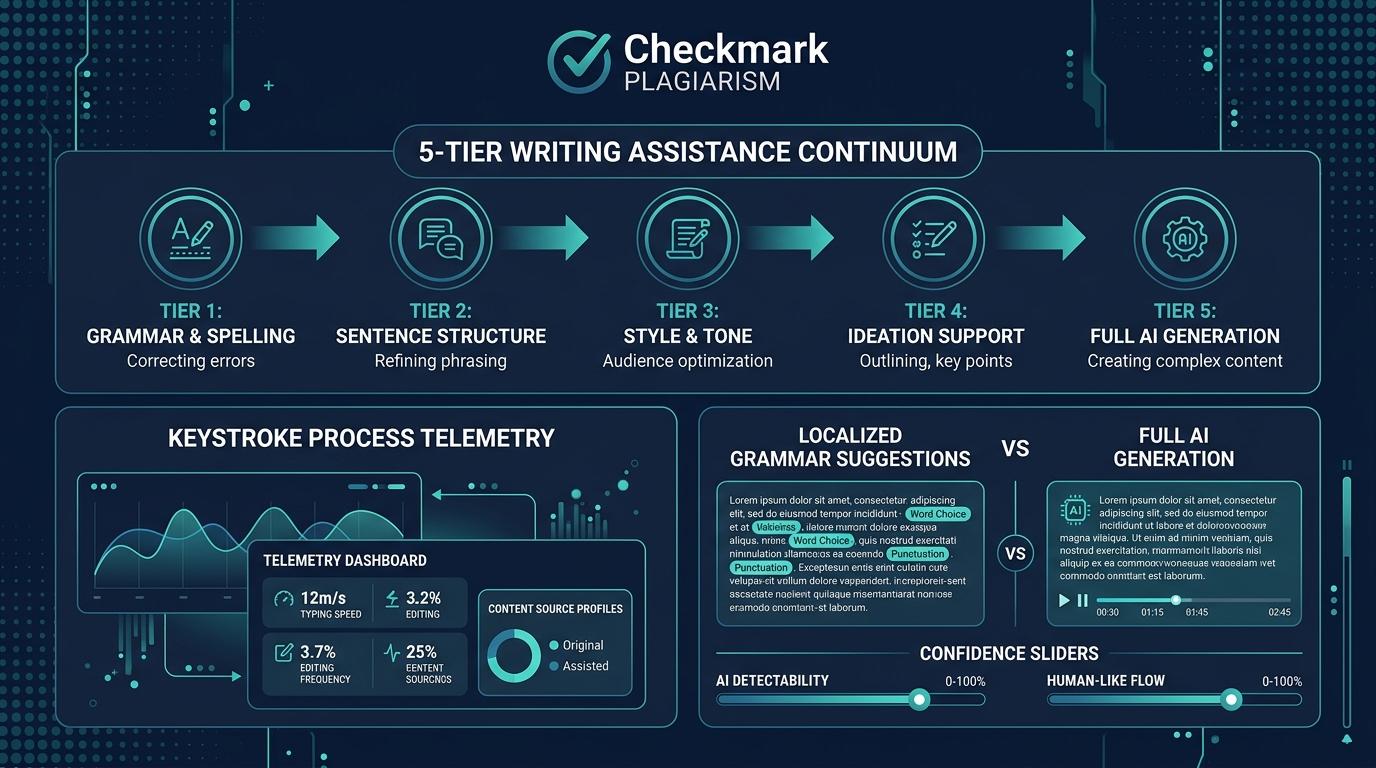
Checkmark Plagiarism resolves this crisis by pairing a 5-Tier Writing Assistance Continuum with multi-dimensional writing telemetry. By combining patent-pending Essay Playback™ keystroke dynamics, immutable external paste buffers, passage-level linguistic distributions with short-text guardrails, side-by-side plagiarism matching, and teacher-in-the-loop rubric grading, Checkmark equips WPAs to establish transparent, defensible, and pedagogically sound policy boundaries that protect honest student revision while definitively identifying unauthorized machine generation.
Checkmark Plagiarism equips Writing Program Administrators, college composition directors, department chairs, and classroom instructors with forensic writing telemetry and enterprise LMS integrations across Canvas LMS, Agilix Buzz, and Google Classroom.
1. The WPA Integrity Crisis: The Collapsing Boundary Between Assistance and Authorship
Across higher education writing programs, two-year college composition departments, and secondary English language arts divisions, Writing Program Administrators (WPAs) face a pedagogical and operational dilemma unprecedented in the history of composition studies.
For more than three decades, writing programs operated under a tacit, manageable consensus regarding digital writing technologies. Word processor spell-checkers, computerized dictionaries, and basic grammar checkers (such as Microsoft Word’s legacy wavy blue and red lines) were understood as assistive orthographic tools. They functioned at the level of surface mechanics—correcting typos, highlighting subject-verb disagreement, and flagging duplicate words—while leaving the cognitive burden of invention, arrangement, sentence architecture, and argumentative synthesis entirely with the student writer.
- Spell-Check & Punctuation Correction
- Basic Grammar & Passive Voice Alerts
- Deterministic, Rule-Based Algorithms
- Human Retains 100% of Ideational & Syntactic Burden
- Deep Structural Sentence Rewriting
- One-Click Paragraph & Clause Generation
- Prompt-Driven Tone, Cadence & Register Modulation
- Deep Native Integration into OS, Word Processors & Browsers
That historical consensus has fundamentally disintegrated.
The integration of Large Language Models (LLMs) and transformer neural architectures into consumer writing assistants—such as Grammarly (incorporating GrammarlyGO generative prompts), Microsoft Copilot embedded directly within Word 365, Google Gemini inside Google Docs Workspace, Apple Intelligence at the operating-system level, QuillBot, and Wordtune—has erased the technical boundary between mechanical correction and generative text production.
Today, a student who clicks a single floating widget inside their browser or desktop editor can effortlessly transform a fragmented, three-word bullet point into a polished, four-sentence academic paragraph with sophisticated subordinating conjunctions and elevated vocabulary.
The Failure of Blanket “Zero-AI” Bans
When generative AI entered mainstream educational discourse, many institutional leaders and departmental committees reacted by issuing categorical, blanket bans: “The use of Artificial Intelligence or automated writing tools of any kind is strictly prohibited and constitutes an honor code violation.”
In practice, categorical bans are not only pedagogically counterproductive—they are technically unenforceable and legally perilous:
- Ubiquitous Operating System and Platform Integration: Generative and assistive AI features are now native components of modern operating systems (macOS Tahoe, Windows 11), web browsers (Google Chrome, Microsoft Edge), and word processors (Google Docs, Microsoft Word). Requiring a student to guarantee that “zero AI” interacted with their document requires them to disable core operating system utilities, grammar checkers, and accessibility accommodations.
- The Disproportionate Penalization of International and ESL/ELL Students: Non-native English speakers, multilingual writers, and first-generation college students frequently rely on grammar assistants to navigate unfamiliar academic idiom, verify prepositional usage, and refine syntactic cadence. Categorical bans strip these students of legitimate scaffolding, forcing them into constant anxiety regarding disciplinary repercussions.
- The Subjectivity of Faculty Enforcement: In a writing program comprising 50 to 200 full-time professors, contingent lecturers, graduate teaching assistants (GTAs), and adjunct instructors, a vague policy leads to radical grading variance. While one instructor permits Grammarly for final proofreading, an adjacent instructor in the same course flags any student who uses sentence rephrasing as an academic integrity violator, subjecting students to capricious grading standards across sections.
Files academic misconduct charge, assigns punitive zero score, demands student confess to prompting ChatGPT.
Vehemently denies cheating but lacks verifiable telemetry to prove hours of kitchen-table drafting.
The Inadequacy of Commercial “AI vs. Human” Percentage Scores
The crisis is exacerbated by commercial plagiarism and AI detection platforms that market opaque, monolithic percentage scores (e.g., “This paper is 78% AI”).
As computational linguistics research has demonstrated, traditional statistical AI detectors calculate probability based on perplexity (lexical predictability) and burstiness (sentence length variation). When a student writes an authentic, original essay but accepts 10 or 15 stylistic recommendations from an automated grammar tool—substituting simpler synonyms for complex ones, active voice for passive constructions, or removing filler clauses—the resulting text exhibits uniformly low perplexity and flattened burstiness.
The monolithic detector flags the entire document as machine-generated. The instructor, lacking granular telemetry, assumes the student prompted ChatGPT to ghostwrite the assignment.
To escape this destructive cycle, Writing Program Administrators must lead their departments away from binary black-box verdicts and toward a multi-tiered, evidence-based policy framework underpinned by writing process telemetry.
2. The 5-Tier Writing Assistance Continuum: The WPA Pedagogical Taxonomy
To establish clear, enforceable, and transparent policy boundaries, Writing Program Administrators must replace binary terminology (“Cheating vs. Not Cheating”) with a nuanced, developmental classification of digital writing assistance.
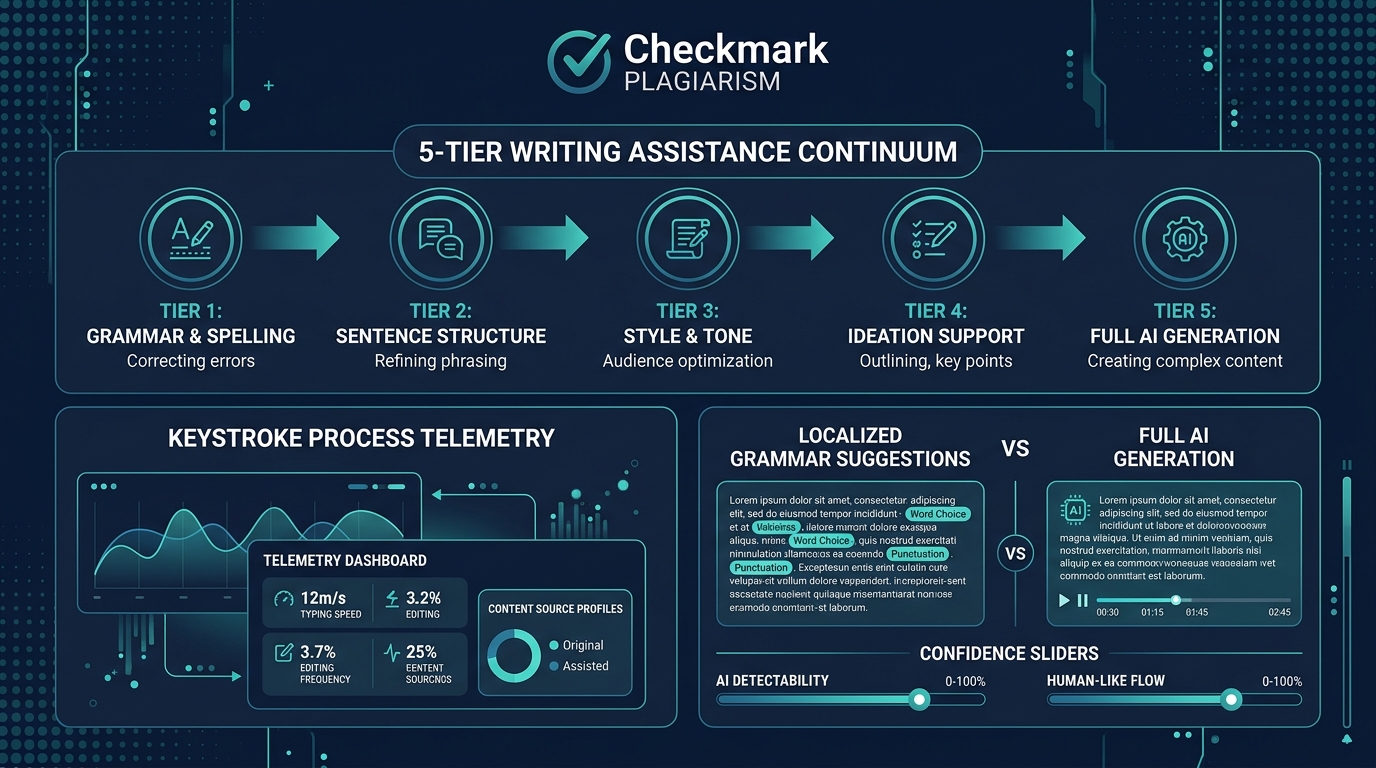
Checkmark Plagiarism has developed the 5-Tier Writing Assistance Continuum, a comprehensive pedagogical taxonomy designed specifically for college composition directors, department chairs, and curriculum coordinators:
Spell-check, typo correction, punctuation, capitalization, and character edit-distance matching.
Passive-to-active voice, wordiness alerts, synonym lookups, split infinitive flags (e.g., Grammarly Basic, MS Word Editor).
One-click sentence regeneration, clause restructuring, automated paraphrasing (QuillBot, GrammarlyGO rewrite, Apple Writing Tools).
Brainstorming topic angles, reverse-outlining, discovering counterarguments, and research synthesis matrices (ChatGPT, Claude, Gemini).
Full-clause, paragraph, or entire essay generation from user prompts; pasting LLM output directly into LMS.
The table below details the technical mechanisms, cognitive origin, integrity classification, and typical course permissions for each tier across the continuum:
| Assistance Tier | Representative Software | Technical Mechanism | Cognitive Ownership | Recommended WPA Policy Baseline |
|---|---|---|---|---|
| Tier 1: Surface Orthography & Mechanics | macOS/Windows Spell-Check, Google Docs Autocorrect, MS Word Editor (Spelling/Punctuation) | Deterministic dictionary lookups, character edit-distance matching, rule-based syntax checking. | Student Author (100%): Ideation, thesis, argument structure, syntax, and sentence arrangement belong entirely to the student. | Universally Allowed in all writing courses and timed exams. |
| Tier 2: Sentence-Level Style & Tone Polish | Grammarly Free/Basic, Hemingway Editor, MS Word Editor (Clarity/Conciseness), ProWritingAid (Grammar only) | Static n-gram models and localized classification transformers that highlight passive voice, split infinitives, and wordy phrases. | Student Author (85–95%): Student crafts the initial thought; tool suggests localized lexical substitutions that the student manually accepts or rejects. | Permitted by Default in First-Year Writing (FYW), research papers, and humanities. |
| Tier 3: Structural Rewriting & Paraphrasing | GrammarlyGO (“Rewrite” / “Improve Tone”), QuillBot Paraphraser, Wordtune, Apple Writing Tools (“Friendly / Professional”) | Masked sequence-to-sequence transformers that reconstruct complete clauses, alter syntactic hierarchy, and replace idiom. | Hybrid / Compromised (50–75%): The core seed idea originated with the student, but the syntactic architecture and voice are algorithmically generated. | Conditional / Scaffolding Only: Prohibited in FYW sentence crafting; permitted in advanced writing with formal citation. |
| Tier 4: Prompt-Driven Ideation & Outlining | ChatGPT (GPT-4o), Anthropic Claude, Microsoft Copilot, Google Gemini (Conversational Brainstorming Mode) | Autoregressive generative transformers responding to natural language prompts with structured outlines and ideas. | Algorithmically Seeded (25–50%): Topic exploration and scaffolding are machine-generated; prose drafting is student-authored. | Restricted Scaffolding: Permitted only during pre-writing with mandatory prompt disclosure appendices. |
| Tier 5: End-to-End Generative Text | ChatGPT, Claude, Gemini, DeepSeek, Jasper AI, Undetectable AI, StealthGPT, Automated Essay Generators | Large-scale autoregressive token generation producing full body paragraphs, complete transitions, and synthesized research essays. | Machine Generated (0–10%): Student acts solely as prompt engineer or clipboard copyist; cognitive synthesis is absent. | Strictly Prohibited: Constitutes severe academic integrity violation / authorship fraud. |
Deconstructing the Continuum Tiers in the Composition Classroom
To make these policy tiers actionable for faculty and students, WPAs must establish explicit operational boundaries for each level.
Tier 1: Surface Orthography & Mechanics
Tier 1 represents the foundational baseline of modern digital literacy. These tools operate strictly as digital proofreaders. They identify misspelled words (e.g., changing “occured” to “occurred”), flag missed punctuation (e.g., inserting a missing apostrophe in a contraction), and correct capitalization errors.
From an academic integrity perspective, Tier 1 tools do not alter the student’s cognitive voice, syntactic rhythm, or rhetorical intent. Banning Tier 1 tools is counterproductive, disproportionately harms neurodivergent students with dysgraphia or dyslexia, and ignores standard professional writing environments.
Tier 2: Sentence-Level Style, Tone & Clarity Suggestions
Tier 2 tools evaluate existing, student-authored sentences to enhance readability and conciseness. A Tier 2 tool might underline a 38-word run-on sentence and suggest: “Consider splitting this into two sentences,” or highlight “due to the fact that” and suggest replacing it with “because.”
Crucially, in Tier 2:
- The student has already written the full sentence.
- The assistive algorithm offers localized, discrete token replacements.
- The student retains full rhetorical agency to review the suggestion, accept the replacement, or reject it to preserve their unique voice.
Writing Program Administrators should explicitly protect Tier 2 usage in their foundational policies. Penalizing students for accepting clarity suggestions undermines the pedagogy of revision and creates unnecessary institutional friction.
Tier 3: Structural Rewriting, Expansion & Paraphrasing
Tier 3 represents the critical fault line where educational integrity is most frequently compromised. Unlike Tier 2, which suggests discrete word swaps, Tier 3 tools take a poorly formed or fragmented clause and completely regenerate it using advanced sequence-to-sequence neural models.
When a student highlights a sentence and clicks “Make this sound academic” in Grammarly Premium, QuillBot, or Apple Intelligence, the software does not simply fix grammar—it replaces the student’s authentic syntactic struggle with synthetic, pre-packaged academic cadence.
“The author shows how war is bad because the soldiers feel sad and they lose their minds.”
“The author shows how war is harmful because soldiers experience psychological trauma.”
→ Keystroke telemetry shows student reviewing suggestions and making individual word choices.
“Through poignant psychological characterization, the narrative elucidates the profound cognitive devastation and existential disillusionment endured by frontline combatants.”
→ Software replaces 100% of clause structure; student cognitive labor is completely bypassed.
In First-Year Writing and secondary English courses where instructors are actively assessing a student’s ability to construct complex sentences, employ subordinating conjunctions, and develop an individual voice, Tier 3 tools bypass the fundamental learning objectives of the course. WPAs must explicitly designate Tier 3 tools as restricted or requiring mandatory disclosure.
Tier 4: Prompt-Driven Ideation, Brainstorming & Outlining
Tier 4 encompasses the deliberate, collaborative use of conversational LLMs (e.g., ChatGPT, Claude) during the invention and planning stages of writing. A student might prompt an LLM: “I am writing an argumentative essay on renewable energy grid stability in rural municipalities. What are three common economic counterarguments, and what primary sources should I investigate?”
When utilized transparently under structured instructor guidance, Tier 4 usage can accelerate critical thinking and help students explore diverse perspectives. However, if conducted covertly, Tier 4 ideation frequently leads directly into Tier 5 generative text dumping.
WPAs should position Tier 4 as a pedagogical scaffold requiring formal attribution, instructing students to include an AI Attribution Appendix detailing their prompt history, model version, and how they critically evaluated and modified the machine’s suggestions.
Tier 5: End-to-End Generative Text Synthesis
Tier 5 is unequivocal authorship fraud. It occurs when a student inputs an assignment prompt into an LLM, copies the generated essay or paragraph block, and pastes it into their submission document (or into an LMS editor) as if it were their own original intellectual creation.
Tier 5 usage violates the core ethical standards of academic scholarship, circumvents all cognitive learning goals, and warrants formal academic integrity adjudication.
3. Forensic & Computational Distinctions: Token Replacement vs. Drafting Process Telemetry
Why do commercial, static text classifiers fail so miserably to distinguish between a student who legitimately accepted Tier 2 grammar corrections and a student who engaged in Tier 5 generative plagiarism?
To understand this administrative failure, WPAs and academic committees must examine the underlying computational mechanics of static text analysis versus temporal writing process telemetry.
- Evaluates only the finished, static text file after submission.
- Calculates Perplexity (predictability) and Burstiness (sentence variation).
- Structural Flaw: Human draft polished with Tier 2 Grammarly has the exact same low-perplexity mathematical signature as Tier 5 raw ChatGPT output.
- Captures the millisecond-by-millisecond physical creation of the document.
- Analyzes Inter-Key Intervals (IKI), cognitive pausing, and revision bursts.
- Definitive Fact: Tier 2 grammar user exhibits thousands of organic keystrokes and hours of typing before clicking localized suggestions.
The Physics of Human Writing: Keystroke Dynamics and Cognitive Hesitations
Authentic human writing is an inherently messy, non-linear, and cognitively demanding process. When a human sits down to compose an essay, their keystroke stream exhibits distinct physiological and cognitive markers:
- Inter-Key Interval (IKI) Variance: The time between individual keystrokes is not uniform. When typing familiar words (e.g., “the”, “because”), a student’s IKI might average 120–180 milliseconds. However, when navigating complex transitions or selecting precise terminology, the IKI spikes to 800–2,500 milliseconds.
- Cognitive Boundary Pauses: Human writers pause significantly at clause and sentence boundaries. Cognitive science research demonstrates that human writers pause for 2 to 15 seconds at the end of sentences to formulate the next proposition.
- Macro-Revision and Text Churn: Authentic drafting is characterized by high text churn—students type a sentence, delete half of it, retype it with different phrasing, move paragraphs, backspace over typos, and pause to review their progress. A typical 1,000-word authentic essay requires between 2,500 and 6,000 total keystroke events.
The Telemetric Signature of Tier 2 Grammar Tool Acceptance
When a student writes an authentic essay and subsequently uses a Tier 2 grammar assistant (like Grammarly Basic or MS Word Editor) to polish their prose, their telemetric profile remains overwhelmingly human:
- Extensive Pre-Existing Drafting History: The telemetric timeline reveals hours of authentic drafting, typing bursts, deletions, and structural reorganizations preceding any grammar tool interaction.
- Localized Insertion Indices: When the student accepts a grammar suggestion, the telemetry records a localized cursor jump to a specific character offset, a brief replacement of 1 to 4 words (e.g., replacing “effect” with “affect”), and an immediate return to reading or revising.
- Persistent Low-Level IKI Cadence: The surrounding text retains its original, human-generated temporal fingerprint.
The Telemetric Signature of Tier 5 Generative Infiltration
In contrast, when a student relies on Tier 5 generative AI, the telemetric profile exhibits one of two unmistakable forensic anomalies:
Anomaly 1: The Zero-Latency External Clipboard Dump
The student inputs their prompt into ChatGPT on an external browser tab, copies the resulting 600-word section, and pastes it into their document editor.
- The document word count jumps from 40 words to 640 words in exactly 0.00 seconds.
- The Inter-Key Interval is non-existent.
- Checkmark’s External Paste Buffer Inspector immediately captures the raw clipboard payload, stores the timestamped text string, and records the external injection point.
Anomaly 2: The Mechanical Transcription / Retyping Pattern
Some students, aware that instructors look for sudden paste dumps, attempt to evade detection by keeping ChatGPT open on a second monitor, smartphone, or split-screen window and manually retyping the text character-by-character.
While this creates individual keystrokes, it produces an unnatural mechanical transcription signature:
- Fixed, Isochronous IKI: Keystrokes occur at a steady, rhythmic cadence (e.g., 190ms–220ms per character) across hundreds of words without the natural variance of spontaneous composition.
- Absence of Cognitive Pauses: There are zero multi-second pauses at clause or sentence boundaries because the student is not cognitively generating thoughts; they are merely transcribing pre-existing text.
- Near-Zero Revision Churn: The student types with a backspace/deletion rate of less than 2%, producing flawless, complex syntactical structures on their first mechanical pass.
| Telemetry Metric | Tier 2 Grammar Polished Draft | Tier 5 Transcribed AI Essay | Diagnostic Significance |
|---|---|---|---|
| Total Active Composition Time | 3 Hours 45 Minutes | 22 Minutes | Reflects true cognitive formulation vs. copy-typing speed. |
| Total Keystroke Events | 4,820 keystrokes (850 words net) | 1,210 keystrokes (850 words net) | Authentic drafting requires 3x–6x keystrokes for trials and fixes. |
| Revision Churn Rate (Rdel) | 28.4% (backspaces & rewrites) | 1.2% (occasional typo correction) | Human thought involves high structural modification and backspacing. |
| Mean Inter-Key Interval (IKI) | 215ms (High σ > 480ms) | 195ms (Low σ < 90ms) | Organic log-normal distribution vs. metronomic motor rate. |
| Cognitive Pauses (>5.0s) | 64 natural ideation pauses | 2 pauses (phone notification check) | Syntactic boundary formulation vs. continuous optical reading. |
| External Paste Buffer Events | 2 quoted citations (documented) | 1 massive prompt template | Captured in 100% raw tamper-evident clipboard audit log. |
| Forensic Integrity Verdict | AUTHENTIC HUMAN WRITING | MECHANICAL TRANSCRIPTION (FRAUD) | Provides irrefutable physical proof (“receipts”) in appeal hearings. |
4. Checkmark Plagiarism: The Policy Governance & Multi-Evidence Telemetry Suite
To empower Writing Program Administrators, department chairs, and classroom instructors to uphold academic standards while eliminating false accusations, Checkmark Plagiarism provides a comprehensive, multi-dimensional policy governance and writing telemetry platform.
Checkmark’s design philosophy is rooted in the educator-first principle: “Stop guessing, start trusting.” By replacing arbitrary black-box percentage scores with five synchronized forensic pillars, Checkmark provides educators and students with unassailable factual evidence (“receipts”).
Millisecond-level reconstruction of entire writing journey across Google Docs, Word 365, Canvas LMS, and Buzz LMS embedded editors.
100% preservation of all clipboard text insertions with exact millisecond timestamps and character lengths.
- Encrypted raw text logs
- One-click jump-to-playback sync
- Distinguishes quotes vs. raw AI
Sentence-by-sentence perplexity & burstiness distributions with calibrated confidence sliders.
- Color-coded in-line underlines
- Calibrated confidence cards
- <150w guardrail (Displays N/A)
Synchronized two-pane comparison viewer with live resolved URLs scanning billions of web and academic sources.
- Dual-pane aligned view
- Live clickable DOI/web URLs
- Dedicated uncited source flags
Formative and summative criterion scoring customized to departmental writing rubrics with quote-anchored justifications and direct gradebook sync to Canvas LMS, Buzz LMS, and Google Classroom.
5. Real-World Institutional Case Studies
The following real-world case studies illustrate how diverse academic institutions implemented Checkmark’s policy framework and telemetry suite to resolve policy crises, eliminate false accusations, and scale consistent standards across complex writing programs.
3,000-Student First-Year Writing Overhaul
Blanket “Zero AI” syllabus ban triggered 240+ academic integrity flags in Canvas. 78% of appeals were from ESL students who merely used Grammarly Basic for proofreading. GTAs suffered severe grading anxiety.
WPA adopted 5-Tier Continuum (Tiers 1–2 Permitted, Tier 3 Conditional). Deployed Checkmark Canvas LTI 1.3 across 140 course sections and conducted 90-minute GTA calibration workshops on Essay Playback™.
- 86% drop in formal integrity appeals.
- 100% of contested drafts resolved in <15 min via Playback.
- International student satisfaction increased by 42%.
Resolving a 60-Student Grammarly False-Flag Crisis
School-managed Chromebooks pre-installed Grammarly. AP English teacher flagged 62 of 90 Junior Research Papers as “AI Plagiarized” using an online detector, sparking parent outrage and school board appeals.
Department Chair audited flagged papers in Checkmark. Essay Playback™ revealed 59 students spent 4–8 hours typing authentically, while Paste Buffer Inspector isolated 3 genuine full-essay ChatGPT dumps.
- 59 falsely accused students immediately cleared.
- 3 genuine cheaters completed restorative contracts.
- District established telemetry-mandated review policy.
Aligning 85 Adjunct Instructors Across 4 Campuses
Extreme grading inconsistency among 85 adjuncts teaching 6,500 composition students. Adult learners transferred out of sections with punitive zero-tolerance AI policies, creating administrative imbalances.
Standardized 5-Tier Continuum across all Buzz LMS master course blueprints. Activated AI Rubric Autograder with direct grade passback and enforced <150-word discussion board guardrails.
- 38% increase in inter-rater grading reliability.
- Grading turnaround dropped from 14 days to 4 days.
- Introductory course retention increased by 14%.
6. The 4-Phase WPA Implementation & Policy Rollout Framework
Writing Program Administrators seeking to establish clear, sustainable, and transparent policy boundaries should execute a structured 4-phase rollout across their writing programs:
- Survey faculty and student digital tool ecosystems (Grammarly, Copilot, Word, OS AI).
- Audit LMS assignment configurations in Canvas SpeedGrader, Buzz LMS, and Classroom.
- Establish baseline departmental learning objectives and core writing competencies.
- Adapt the 5-Tier Continuum to institutional degree pathways and course levels.
- Draft standardized syllabus blueprints and course permission matrices.
- Create mandatory student AI Attribution & Disclosure Appendix templates.
- Deploy Checkmark LTI 1.3 across all writing course shells in Canvas, Buzz, or Classroom.
- Conduct hands-on faculty workshops on interpreting Essay Playback™ and Paste Logs.
- Standardize formative rubric autograding workflows and LMS grade passback protocols.
- Deliver Week 1 student orientations on ethical tool boundaries and telemetry transparency.
- Implement student self-advocacy protocols (using Playback to prove original authorship).
- Establish restorative integrity conference workflows to replace punitive automatic zeroes.
7. Institutional Syllabus Policy Blueprints
Writing Program Administrators can copy, adapt, and distribute the following institutional syllabus policy blueprints across their departments:
| Course Level | Recommended Policy Blueprint | Permitted Continuum Tiers |
|---|---|---|
| Introductory / First-Year Composition | Blueprint B: Standard Academic | Tier 1 (Mechanics) & Tier 2 (Style/Clarity Polish) |
| Advanced / Technical / Digital Writing | Blueprint A: Exploratory & Professional | Tiers 1, 2, 3, 4 (With Mandatory AI Disclosure Appendix) |
| Timed Exams / In-Class Assessments | Blueprint C: Strictly Monitored | Tier 1 Only (Spell-check only; no external extensions) |
Blueprint A: Exploratory / Advanced Digital Writing Course (Tiers 1–4 Permitted with Disclosure)
Advanced CompPolicy on Artificial Intelligence & Assistive Writing Technologies:
In this course, we recognize that modern professional communicators collaborate with advanced digital tools. You are permitted and encouraged to utilize digital assistants across Tiers 1, 2, 3, and 4 of the Departmental Writing Assistance Continuum:
- Tier 1 (Mechanics & Spelling): Fully permitted without restriction.
- Tier 2 (Style, Tone & Grammar Polish): Permitted (e.g., Grammarly Basic, Word Editor).
- Tier 3 (Structural Rewriting & Paraphrasing): Permitted with attribution in your submission notes.
- Tier 4 (Ideation & Prompt-Driven Brainstorming): Permitted during designated invention stages.
Mandatory Disclosure Requirement: Whenever you utilize Tier 3 (Structural Rewrites) or Tier 4 (Conversational LLM Brainstorming like ChatGPT or Claude), you must attach an AI Attribution Appendix at the end of your submission detailing: (a) the tool and model version used, (b) the specific prompts entered, and (c) a 2–3 sentence reflection on how you critically evaluated and revised the generated output.
Prohibited Usage (Tier 5): Generating unedited body paragraphs, full sections, or complete essays via generative AI and submitting them as your own work constitutes severe academic dishonesty (authorship fraud) and will result in formal disciplinary review.
Our course utilizes Checkmark Plagiarism and Essay Playback™ to verify authentic writing processes and support formative revision.
Blueprint B: Standard First-Year Composition / Academic Writing (Tiers 1–2 Permitted, Tiers 3–5 Prohibited)
First-Year WritingPolicy on Writing Tools and Artificial Intelligence (First-Year Composition):
The primary learning objective of this course is to develop your authentic voice, critical thinking, sentence construction skills, and argumentative synthesis. To support your learning while maintaining academic integrity, our course enforces the following policy boundaries:
- PERMITTED (Tiers 1 & 2): You are fully permitted to use automated spell-checkers, punctuation tools, and sentence-level clarity assistants (such as Google Docs autocorrect, MS Word Editor, and Grammarly Free/Basic for proofreading). These tools help you polish your authentic prose.
- PROHIBITED (Tiers 3, 4, & 5): You may NOT use automated structural rewriting tools (e.g., QuillBot paraphrasing, GrammarlyGO “rewrite” features), prompt-driven outline generators, or generative AI models (e.g., ChatGPT, Claude, Gemini, Copilot) to generate ideas, outlines, clauses, or essay text. All sentence architecture, transitions, and argumentative synthesis must be your original intellectual work.
Writing Process Verification: All formal essays must be composed in Google Docs or Microsoft Word connected to our course LMS via Checkmark Plagiarism. Checkmark records your authentic keystroke drafting journey via Essay Playback™. In the event of an integrity inquiry, your Essay Playback™ timeline serves as your primary evidence of authentic drafting.
AI & Digital Assistance Attribution Statement Appendix Template
## Appendix: AI & Digital Assistance Attribution Statement
Include this completed appendix at the end of your essay if you utilized Tier 3 or Tier 4 tools.
1. Software Tools & Models Utilized:
[e.g., Anthropic Claude 3.5 Sonnet / Grammarly Premium Sentence Rewriter / ChatGPT-4o]
2. Phase of Writing Process Where Tool Was Applied:
[e.g., Brainstorming counterarguments during Outline Phase / Refining topic sentence transitions in Draft 2]
3. Specific Prompts Entered (if applicable):
- Prompt 1: “[Insert exact text of prompt]”
- Prompt 2: “[Insert exact text of prompt]”
4. Author’s Critical Evaluation & Revision Statement:
[2–4 sentences explaining what the AI generated, what inaccuracies or stylistic issues you identified, and how you altered the text in your own words.]
8. Restorative Student Conference Guidelines: Moving from Interrogation to Coaching
When writing telemetry indicates a potential policy boundary violation, instructors should never initiate an adversarial, accusatory confrontation. Instead, WPAs should train faculty to conduct Restorative Academic Integrity Conferences designed to foster reflection, metacognition, and skill development.
Educator Dialogue Scripts: Navigating Common Conference Scenarios
Scenario 1: Student Falsely Flagged by Generic Detector (Exoneration via Playback)
- Educator Opening: “Hi Alex, thanks for meeting with me. Our LMS flagged a potential AI pattern on your research draft, but I wanted to look at your actual drafting journey in Checkmark before making any assumptions. Let’s look at your Essay Playback™ together.”
- Reviewing Telemetry: (Teacher scrubs playback at 4x speed, observing Alex typing over 3.5 hours, pausing, and accepting a few Grammarly punctuation edits).
- Educator Resolution: “Looking at your timeline, it’s completely clear that you spent over three hours composing and revising this essay yourself. The automated scanner was thrown off because you accepted a few stylistic suggestions, but your keystroke telemetry proves this is 100% your original work. Thank you for your hard work—your draft is fully cleared.”
Scenario 2: Student Over-Relied on Tier 3 Structural Paraphrasers (QuillBot/GrammarlyGO)
- Educator Opening: “Hi Jordan. I was reading your fourth paragraph on economic policy, and the sentence structure feels noticeably different from the voice in your first two paragraphs. Let’s look at Checkmark’s Playback together.”
- Reviewing Telemetry: (Teacher opens the External Paste Buffer, showing where Jordan pasted an entire reconstructed paragraph from QuillBot).
- Educator Coaching: “I can see here that you pasted this paragraph from an external rewriter. In our course, our goal is for you to develop your own sentence-combining skills. When you have an AI rewrite your whole clause, you miss out on that practice. Let’s look at your original sentence before the rewrite, and work together right now on how you can improve its clarity in your own words.”
- Restorative Resolution: Jordan agrees to redraft the paragraph during office hours, submit a brief reflection on syntactic revision, and receive full credit upon completion.
9. Frequently Asked Questions (FAQ)
Q1: How do we handle students whose laptops have Grammarly or Apple Intelligence enabled by default at the OS level?
Writing Program Administrators should adopt policies that focus on functional impact rather than binary software bans. Operating-system level tools (such as Apple Intelligence or Windows Copilot) and browser extensions (Grammarly) provide both Tier 1/2 proofreading and Tier 3/5 generative features. WPAs should communicate to students that utilizing OS tools for spelling, punctuation, and word choice suggestions (Tier 1 & Tier 2) is fully authorized. However, clicking generative features (such as “Rewrite Paragraph”, “Summarize”, or “Generate Text”) cross into Tier 3 and Tier 5. Checkmark’s Essay Playback™ and Paste Buffer Inspector clearly distinguish between discrete word corrections and wholesale text injections, ensuring students are never penalized for having background OS utilities active.
Q2: Why do traditional AI detectors flag essays where students only used Grammarly for basic punctuation and clarity?
Traditional, commercial AI detectors (like Turnitin, GPTZero, and CopyLeaks) operate strictly on static text statistics—namely perplexity (lexical predictability) and burstiness (sentence length variation). When a student writes an authentic essay and accepts 10 or 15 standard grammar suggestions, the software replaces idiosyncratic human phrasing with conventional academic syntax. This flattens the document’s perplexity and burstiness, causing statistical classifiers to misinterpret the polished text as large language model output. Checkmark solves this problem by bypassing static statistical guesswork and analyzing the temporal keystroke telemetry of how the text was physically composed.
Q3: Can a student fake their Essay Playback™ telemetry by slowly retyping an AI-generated essay from a phone or second screen?
No. Retyping text from an external source (transcription) produces a completely different telemetric fingerprint than authentic human composition. When a student transcribes text, their Inter-Key Interval (IKI) is remarkably uniform (isochronous), their cognitive pauses at clause boundaries disappear, and their revision/backspace churn rate drops to nearly zero (<2%). Checkmark’s Essay Playback™ telemetry engine easily detects this mechanical transcription pattern, flagging the absence of natural human ideation hesitations and extensive text churn.
Q4: What is the difference between Tier 3 structural rewriting and legitimate peer editing or Writing Center tutoring?
The critical distinction lies in metacognitive agency and dialogue. When a student works with a peer tutor or Writing Center consultant, the tutor asks guiding questions: “What point are you trying to make here? How might you connect these two ideas?” The student must articulate their thoughts and manually compose the revised sentence, deepening their rhetorical awareness. In contrast, Tier 3 automated rewriters (e.g., QuillBot, GrammarlyGO) execute instantaneous syntactic replacement without requiring the student to understand the grammatical or rhetorical mechanics of the change, bypassing the cognitive learning process.
Q5: How should WPAs train adjunct and contingent faculty to maintain consistent policy enforcement without burning out?
WPAs should provide adjunct instructors with pre-configured Canvas LMS / Buzz LMS course shells equipped with Checkmark’s automated workflows. By utilizing Checkmark’s AI-Powered Rubric Autograder, adjuncts receive pre-scored rubric criteria with quote-anchored justifications, dramatically reducing grading fatigue. Furthermore, WPAs should establish a clear departmental protocol: instructors are never required to spend hours investigating disputed drafts. If an integrity question arises, the instructor simply opens Checkmark’s Essay Playback™ video timeline—resolving the inquiry in under 3 minutes.
Q6: Does Checkmark Plagiarism store student essays to train future AI models or share with third parties?
Absolutely not. Checkmark operates under a strict Zero-Data Training Policy. Student submissions, keystroke telemetry, and grading histories are strictly protected under FERPA and COPPA guidelines. Student data is encrypted in transit and at rest, is never indexed into public LLM training datasets, and is never sold or shared with third-party vendors. The institution retains 100% ownership and control of all student intellectual property.
Q7: How does Checkmark pass rubric grades and telemetry links directly back into Canvas SpeedGrader and Buzz LMS?
Checkmark utilizes advanced LTI 1.3 Advantage Protocols and REST API integrations. When an instructor reviews and approves an essay’s rubric scores in Checkmark, the platform automatically pushes the finalized criterion scores, overall point totals, quote-anchored written feedback, and a secure direct link to the Essay Playback™ report directly into Canvas SpeedGrader, Buzz LMS, or Google Classroom gradebooks with a single click. Instructors never have to manually re-enter grades across multiple windows.