
In undergraduate business programs and graduate MBA curricula, the case study method—central to Harvard Business School (HBS) teaching since the 1920s and now widely taught through Ivey Publishing, INSEAD, Darden, and others—serves as the gold standard for developing strategic acumen, financial modeling competency, and executive decision-making. However, the rise of advanced generative artificial intelligence models (such as GPT-4o, Claude 3.5 Sonnet, and Gemini Pro) alongside widespread illicit case-repository websites has created a profound evaluative crisis: The Quantitative-to-Strategic Decoupling Discrepancy.
Generative AI tools can instantly generate polished, highly articulate executive memos dense with elite management consulting jargon (synergistic value creation, Porterian moats, operating leverage optimization). Yet, when language models attempt to parse complex financial exhibits, 10-K disclosures, or multi-tab Discounted Cash Flow (DCF) spreadsheets, they routinely hallucinate financial metrics—inventing phantom balance sheet line items, reversing working capital requirements, positing mathematically impossible EBITDA margins, or detachedly applying generic SWOT and Porter’s Five Forces frameworks that ignore the idiosyncratic constraints of the assigned case. Legacy plagiarism checkers fail because synthetic prose yields 0% similarity scores, while brittle whole-document AI detectors trigger rampant false positives on legitimate student writing due to the standardized syntax of professional corporate communications.
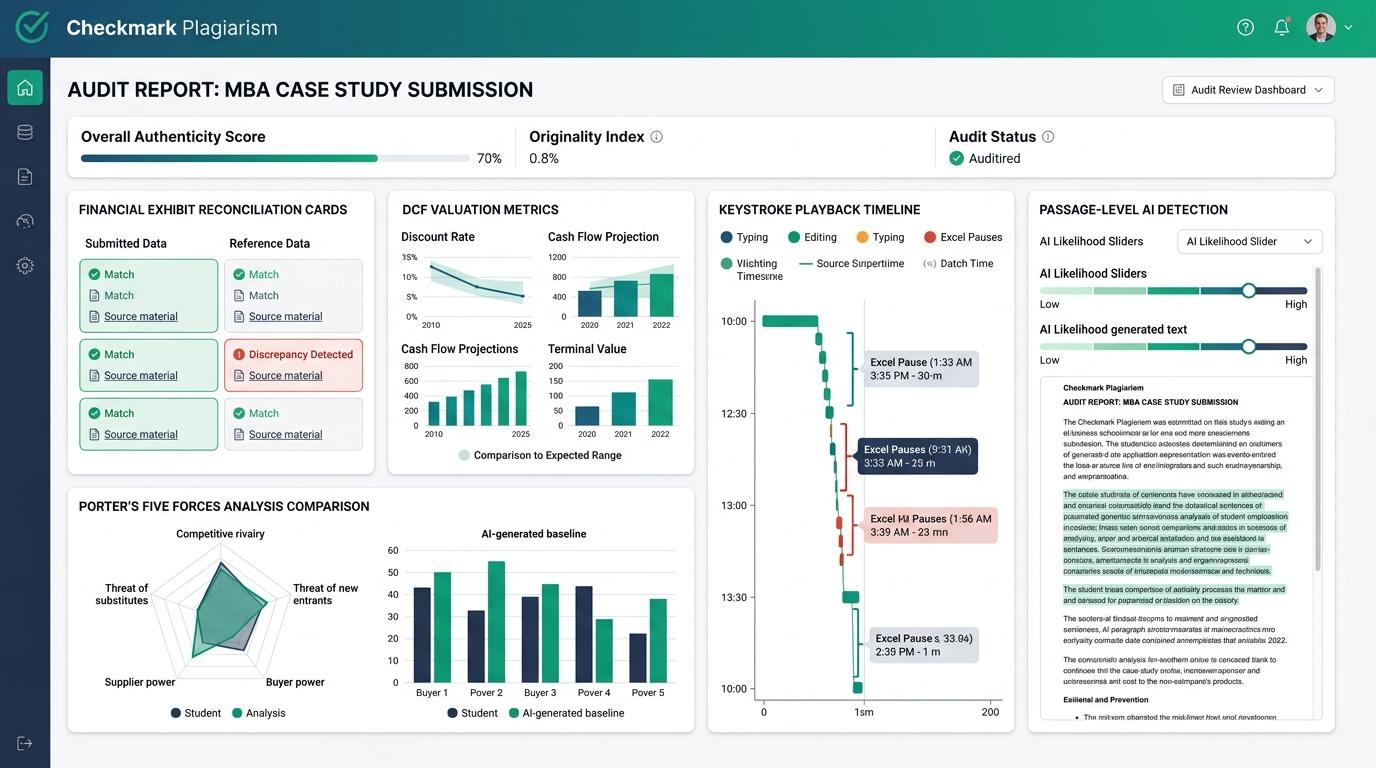
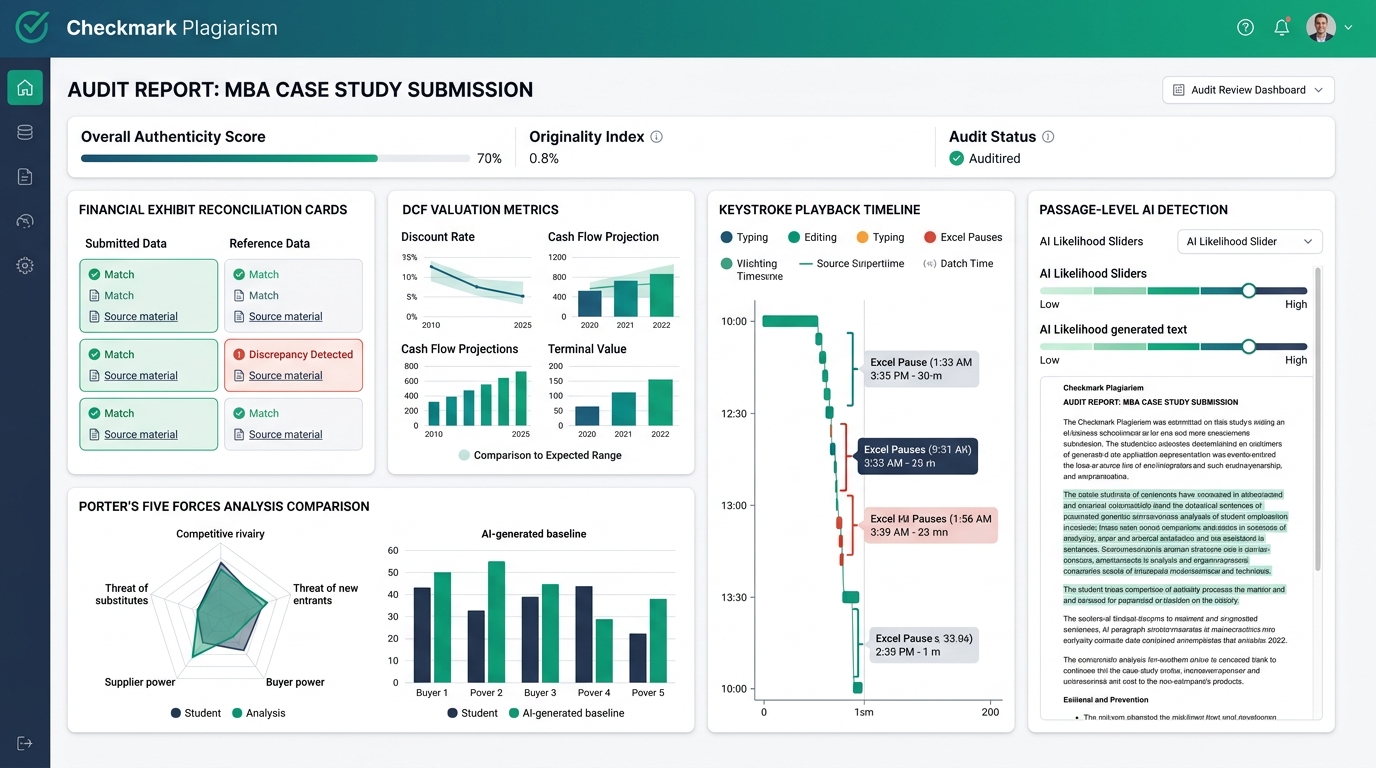
Checkmark Plagiarism resolves this crisis through a Multidimensional Business Case Integrity Framework. By uniting Financial Exhibit Reconciliation with patent-pending Essay Playback™ (1x–8x scrubbable keystroke video replay), an External Paste Buffer Inspector, Passage-Level AI Confidence Sliders with honest short-text guardrails (<150w N/A), and Teacher-in-the-Loop Rubric Autograding with Canvas, Buzz, and Google Classroom Passback, business faculty can distinguish authentic, spreadsheet-grounded financial reasoning from outsourced AI confabulations—transforming integrity checkpoints into restorative executive coaching dialogues.
Checkmark Plagiarism equips MBA Program Directors, Finance Department Chairs, Case Competition Judges, and Academic Honor Committees with verifiable writing process telemetry and LMS integrations across Canvas LMS, Agilix Buzz, and Google Classroom.
• Quantitative Exhibit Data: HBS/Ivey Financial Statements, DCF Models, WACC, EBITDA Multiples
• Qualitative Executive Memo: Strategic Rationale, SWOT / Porter’s Five Forces, Implementation Plan
- Balance Sheet & Cash Flow line checks
- DCF & WACC formula audits
- EBITDA & multiple logic verification
- Framework ground-truth audit
- Essay Playback™ (1x–8x scrubbable replay)
- Excel-to-Memo cognitive pause tracking
- External Paste Buffer Inspector
- Passage-level AI confidence sliders
- In-person or Zoom memo defense
- Defend WACC & margin assumptions
- Explain strategic risk trade-offs
- Restores pedagogical trust & coaching
1. The Disciplinary Dilemma: Generative AI in the Business Case Classroom
For more than a century, collegiate business schools and MBA programs have relied on the case study method to simulate real-world executive dilemmas. Students are placed in the seat of a Chief Executive Officer, Private Equity Principal, Chief Financial Officer, or Management Consultant tasked with evaluating incomplete information, reconciling conflicting financial statements, projecting future cash flows under severe uncertainty, and articulating a defensible strategic plan.
The efficacy of this pedagogy relies on an unbroken chain of reasoning connecting three distinct artifacts:
- Raw Quantitative Exhibit Data: Historical financial statements (Income Statements, Balance Sheets, Cash Flow Statements), 10-K regulatory disclosures, debt covenants, and capital expenditure schedules provided in the case text.
- Mathematical Modeling: Excel-based DCF valuations, Weighted Average Cost of Capital (WACC) calculations, Capital Asset Pricing Model (CAPM) beta unlevering/relevering, Comparable Company Analysis (Trading Multiples), and Precedent Transaction benchmarks.
- Strategic Narrative Synthesis: An executive memorandum justifying capital allocation, M&A bidding strategies, market entry, operational turnaround, or organizational restructuring based on rigorous qualitative frameworks (SWOT, Porter’s Five Forces, PESTEL, BCG Growth-Share Matrix).
Student uploads 20-page Harvard Business Publishing case PDF into an LLM and prompts: “Act as a McKinsey consultant and write a 5-page decision memo recommending whether to acquire Target Corp, including DCF valuation and Porter’s Five Forces.”
- Actual Case Exhibit 2: The company operates in grocery distribution with a 14.8% gross margin; 42.6% is an impossible margin structure for this sector.
- Actual Balance Sheet: Cash is restricted at $2.1M; the $18.4M figure was completely fabricated by the LLM.
- Debt Covenant Restriction: Case specifically forbids senior leverage exceeding 3.0x EBITDA; the proposed 8.5x LBO violates binding legal covenants.
The introduction of multimodal Large Language Models (LLMs) has fractured this evaluative model. Today, a student can upload a 20-page Harvard Business Publishing case PDF into an LLM and request a complete 5-page decision memo with financial recommendations in under 60 seconds.
The resulting output presents an alarming pedagogical challenge for business faculty: The Illusion of Executive Articulacy.
Because LLMs are trained on billions of tokens of corporate annual reports, management consulting decks (McKinsey, Boston Consulting Group, Bain), Wall Street equity research reports, and academic business journals, their prose reads with flawless executive polish. However, because LLMs generate text through statistical token prediction rather than deterministic mathematical computation, they routinely generate fabricated financial metrics, apply impossible margin assumptions, cite non-existent balance sheet reserves, and produce detached strategic recommendations that directly contradict the binding operational constraints described in the case exhibits.
2. The Dual Integrity Threat: Illicit Solution Manuals vs. Synthetic AI Hallucinations
Business faculty face a dual-pronged integrity landscape. While traditional copy-paste plagiarism from commercial paper mills and unauthorized online solution repositories remains prevalent, generative AI introduces an entirely new category of academic misconduct: quantitative fabrication and synthetic strategic confabulation.
(Course Hero, Chegg, Reddit, Student File Drives)
- Exact numerical matching from past teaching notes and instructor slides
- Historical solutions reflecting older case editions or outdated interest rates
- Verbatim lifting of instructor Excel spreadsheet models
- High similarity flags on legacy plagiarism engines, but bypassed by AI humanizers
(GPT-4o, Claude 3.5 Sonnet, Gemini 1.5 Pro)
- Plausible-sounding but completely fabricated dollar figures and multiples
- Mathematically impossible margin structures (e.g., SaaS margins on steel mills)
- Detached, boilerplate strategic buzzwords ignoring case constraints
- 0% similarity flags on legacy checkers; defeats surface detectors
Threat Vector A: Uncredited Case Solutions and Instructor Teaching Notes
For decades, classic business cases (such as Ben & Jerry’s Homemade, Blaine Kitchenware, or Midland Energy) have been widely taught, and unauthorized student solutions, Excel valuation models, and instructor teaching notes for cases like these circulate online. Students accessing these files bypass the cognitive struggle of building financial projections from scratch, pasting pre-calculated WACC rates (e.g., 8.42%) or valuation conclusions directly into their papers.
Legacy text-matching plagiarism engines can often detect these submissions if the text is copied verbatim. However, modern students routinely use AI paraphrasers (e.g., QuillBot or Undetectable AI) to rewrite the leaked solution manual text, evading traditional keyword and phrase-matching filters entirely.
Threat Vector B: AI-Synthesized Hallucinations and Fabricated Metrics
When students prompt an LLM to generate a business case analysis from scratch or provide it with raw case excerpts, the AI frequently confabulates data to satisfy the prompt’s logical structure. These hallucinations fall into four distinct categories:
- Phantom Financial Metrics: The AI cites specific dollar amounts, percentages, or ratios that do not appear anywhere in the case text, balance sheets, or accompanying exhibits. For example, an AI generating an analysis of an airline turnaround case may state: “Exhibit 3 demonstrates that fuel hedging contracts locked in 68% of crude requirements at $72/barrel,” when Exhibit 3 actually details fleet maintenance depreciation schedules and makes no mention of fuel hedging.
- Sector-Incongruent Margin Structures: LLMs frequently blend financial knowledge across unrelated corporate datasets. An essay analyzing an asset-heavy manufacturing firm or brick-and-mortar retailer might project an 88% Gross Margin and a 45% Free Cash Flow conversion rate—metrics typical of enterprise SaaS software companies but economically absurd for industrial fabrication.
- Violated Debt Covenants and Capital Constraints: An AI memo will confidently recommend issuing $150M in high-yield mezzanine debt to fund an immediate dividend recapitalization, completely oblivious to a prominent contractual clause in the case stating that existing senior debt covenants prohibit total debt-to-EBITDA leverage from exceeding 2.5x or cash dividends from being distributed prior to fiscal year 2028.
- Hollow, Universal Strategic Frameworks: When asked to provide a Porter’s Five Forces or SWOT analysis, the AI generates generic industry commentary (“Supplier power is moderate due to multiple global vendors; threat of substitutes is high due to rapid technological evolution”) without tying a single point to the unique corporate leadership, patented technologies, union negotiations, or regulatory investigations detailed in the assigned case.
3. The Pedagogical Trap: Why Business Faculty Get Misled by AI Submissions
Business school faculty, corporate finance professors, and case competition judges are uniquely susceptible to being deceived by AI-generated submissions due to three core structural features of business writing.
Reason: Low perplexity, predictable corporate idioms, structured syntax. (False positive on honest MBA student).
Reason: Humanizer broke syntax rhythm. Reality: Exhibit 4 has no cash flow data (Total hallucination).
The Corporate Jargon Paradox
Business communication is intentionally formal, concise, and structured around standardized executive vocabulary. Phrases such as:
- “Weighted Average Cost of Capital (WACC)”
- “Earnings Before Interest, Taxes, Depreciation, and Amortization (EBITDA)”
- “Sustainable competitive advantage”
- “First-mover advantage in fragmented markets”
- “Synergistic cost rationalization across redundant business units”
- “Working capital optimization through Days Sales Outstanding (DSO) compression”
These phrases possess inherently low perplexity (high statistical predictability) and uniform burstiness (standardized sentence lengths). When a diligent human student crafts an executive memo adhering strictly to the Minto Pyramid Principle or standard management consulting memo guidelines, generic AI percentage detectors frequently flag the paper as highly likely to be AI-generated.
This creates severe institutional risk: business school honor committees are inundated with false accusations against top-performing students who merely mastered professional business writing conventions.
Rewarding Style Over Exhibit Grounding
In large undergraduate or MBA cohorts (where a single professor or teaching assistant may evaluate 60 to 150 case memos per week), graders are easily charmed by articulate prose, crisp executive formatting, and bold subheadings. An AI submission that presents a beautifully structured 4-step strategic roadmap with flawless grammar often receives higher initial marks than a messy, authentic student draft that struggled through complex spreadsheet calculations but ultimately grounded its conclusions in real exhibit data.
Without tools to audit the connection between the writing process and the underlying spreadsheet exhibits, business faculty risk inadvertently penalizing honest, hard-working students while rewarding superficial AI-generated corporate fluff.
4. The Business School Evidentiary Matrix: Comparing Integrity Technologies
To establish an institutional integrity policy that withstands student appeals and protects academic rigor, business school deans and department chairs must understand the technical capabilities and limitations of available verification methods.
| Evaluation Dimension | Static PDF / Word Submissions | Legacy Plagiarism Engines | Generic Whole-Document AI Detectors | Checkmark Multidimensional Suite |
|---|---|---|---|---|
| Detection of Online Solution Manuals | ❌ Manual grading burden; relies on instructor memory. | ⚠️ Flags exact matches; fails if student paraphrases or humanizes. | ❌ Blind to source plagiarism; only assesses statistical syntax. | ✅ Comprehensive Web & Archive Matching: Side-by-side quote links to Chegg, Course Hero, and repositories. |
| Detection of Hallucinated Metrics | ❌ Requires line-by-line manual reconciliation of all numbers. | ❌ Cannot evaluate mathematical validity or exhibit truth. | ❌ Cannot evaluate numerical truth; passes plausible fake data. | ✅ Exhibit Reconciliation Auditing: Flags disconnected metrics and verifies claims against case data. |
| Handling Corporate Finance Jargon | ❌ Subjective instructor interpretation. | ⚠️ High false matches on common business headers. | ❌ Severe False Positives: Penalizes students for standard corporate vocabulary. | ✅ Calibrated Passage-Level Sliders: Contextual analysis distinguishes corporate syntax from synthetic AI generation. |
| Spreadsheet-to-Memo Drafting Telemetry | ❌ Zero visibility into whether student built an Excel model. | ❌ Zero process visibility. | ❌ Zero process visibility. | ✅ Patent-Pending Essay Playback™: 1x–8x scrubbable video replay reveals natural pauses between Excel modeling and writing. |
| External Paste & Clipboard Forensics | ❌ Cannot see what was pasted from external LLMs. | ❌ Only sees final submitted text string. | ❌ Only sees final submitted text string. | ✅ External Paste Inspector: Captures and preserves original raw clipboard text even if heavily edited afterward. |
| Short Discussion Prompts (<150w) | ❌ Difficult to assess authenticity. | ⚠️ Ineffective on short paragraph responses. | ❌ Highly erratic; unreliable on small sample sizes. | ✅ Honest Guardrails: Displays N/A under ~150 words rather than generating reckless probabilistic guesses. |
| Teacher-Controlled Rubric Autograding | ❌ 100% manual grading; high grading fatigue across MBA cohorts. | ❌ No autograding capability. | ❌ No rubric-anchored autograding capability. | ✅ AI Autograder with Human-in-the-Loop: Quote-anchored rubric feedback with Canvas, Buzz, and Google Classroom passback. |
| Proprietary Case Protection & FERPA | ⚠️ Varies; student files may be stored in unvetted databases. | ❌ Many vendors retain student submissions to build commercial databases. | ❌ Many consumer AI tools train models on uploaded proprietary case texts. | ✅ Zero Model Training & FERPA Compliant: Submissions are never used to train general AI models; full enterprise encryption. |
5. Step-by-Step Business Faculty Case Audit Protocol
To ensure fair, objective, and defensible evaluations, business school faculty should implement a standardized Four-Phase Case Audit Protocol. This workflow combines quantitative data verification, arithmetic spot-checks, keystroke writing process analysis, and restorative executive debriefs.
Cross-check all cited dollar amounts, margins, and ratios against case exhibits. Flag phantom line items and hallucinated cash balances.
Audit DCF mechanics (WACC, terminal growth rate vs. GDP). Verify multiple denominators (EV/EBITDA vs. P/E) and qualitative framework grounding.
Scrub through 1x–8x replay. Inspect Excel-to-memo pause dynamics and audit paste inspector for uncredited prompts or solutions.
Conduct supportive 10-minute office hours walk-through. Ask student to defend assumptions and turn integrity checkpoints into coaching.
Phase 1: Case Exhibit Reconciliation & Source Data Grounding
Before analyzing writing style, conduct a rapid Ground-Truth Data Audit by comparing the quantitative figures in the student’s submission against the official case exhibits:
- Balance Sheet & Cash Flow Reconciliation: Check whether the cited cash balances, accounts receivable, debt obligations, and capital expenditures match the case tables. If the student cites a “$45M liquidity reserve” but the case balance sheet shows only $4.5M in unrestricted cash, this is a prime indicator of an ungrounded LLM hallucination.
- Margin Consistency: Calculate the actual gross, operating, and net margins from the case income statement:
Gross Margin = (Revenue − COGS) / Revenue | EBIT Margin = Operating Income / RevenueCompare this against the student’s prose. If the case depicts a low-margin commodity distributor (6%–9% EBIT margin) but the student’s memo discusses “sustaining superior 35% operating margins,” the analysis is disconnected from the case reality.
- Footnote & Exhibit Title Verification: LLMs frequently invent exhibit names (e.g., citing “Exhibit 7: Competitor Market Share Breakdown” when the assigned case only contains Exhibits 1 through 5).
Phase 2: Financial Formula & Arithmetic Spot-Checks
Conduct targeted spot-checks on core financial modeling calculations:
1. Discounted Cash Flow (DCF) and WACC Mechanics
Verify that the student’s discount rate is mathematically coherent:
WACC = (E / V × Re) + [D / V × Rd × (1 − t)]
Common AI Hallucinations in DCF Models:
- Perpetual Hyper-Growth: Using a terminal growth rate (g) of 8%–12%, which is mathematically absurd (no company can permanently outgrow the long-term growth rate of the overall economy).
- CAPM Addition Flaw: Miscalculating the Cost of Equity (Re) via CAPM by adding the equity risk premium to beta rather than multiplying (
Re = Rf + Beta(ERP)vs. hallucinatedRf + Beta + ERP). - Denominator Confusion: Mixing Enterprise Value (EV) multiples with Equity Value line items (e.g., applying an EV/EBITDA multiple directly to Net Income).
2. Strategic Framework Ground-Truth Audit
When evaluating qualitative frameworks (SWOT, Porter’s Five Forces, PESTEL, BCG Matrix), check for case-specific grounding:
- Generic AI Generation: “Threat of Substitutes is High because customers can choose alternative digital service providers.” (Could apply to any tech company in the world).
- Authentic Case Synthesis: “Threat of Substitutes is High because, as detailed in Section 3 of the case, Apex Corp’s Tier-2 automotive clients can switch to DynoTech’s newly patented brushless motor without incurring contractual retooling penalties.” (Tied directly to unique case constraints).
Phase 3: Writing Process & Telemetry Audit with Essay Playback™
When an essay contains suspicious metrics or ungrounded strategic prose, open Checkmark Plagiarism to inspect the authentic writing process telemetry.
- Scrub Through the Drafting Session (1x–8x Speed): Use Essay Playback™ to observe how the student built the document. An authentic business student writing a case analysis exhibits a characteristic “burst-and-pause” pattern: they type a paragraph of qualitative analysis, pause for 10–20 minutes while running numbers in Excel or consulting case exhibits, and return to type their financial findings, frequently backspacing to correct numerical typos.
- Detect Mechanical Retyping (Second-Screen Transcription): If a student attempts to evade paste detection by placing an AI chat window or illegal solution PDF on a second monitor or smartphone and manually retyping the text, Essay Playback™ flags the anomaly: steady, mechanical typing at high velocity with near-zero backspaces, no pauses at complex mathematical junctures, and linear paragraph-by-paragraph generation without structural restructuring.
- Inspect the External Paste Buffer: Checkmark’s External Paste Inspector captures and preserves the full text of any content pasted into the document. If a student pasted a pre-written ChatGPT summary, an uncredited Chegg answer, or a peer’s spreadsheet table—even if they subsequently spent 45 minutes editing every sentence—the original clipboard string is preserved with full timestamping and a direct “jump-to-playback” button.
Phase 4: Restorative Executive Defense Debriefs (“The Boardroom Walk-Through”)
The philosophy of Checkmark is “Stop guessing, start trusting.” Academic integrity inquiries in business schools should mirror professional executive accountability rather than adversarial criminal proceedings.
“Walk me through your investment thesis for this case. How did you arrive at your 9.2% WACC and 8.5x exit multiple?”
“Open your Excel model and show me how Exhibit 3’s debt schedule links into this cash flow projection in Year 3.”
“Let’s look at Checkmark’s Essay Playback together. I notice this entire valuation section was pasted in at 2:14 AM without calculation pauses. Help me understand where these numbers were originally modeled.”
Differentiate between computational errors and integrity violations. Allow the student to rebuild the financial model under supervision, reinforcing ethical corporate stewardship.
- Conduct a 10-Minute Executive Debrief: Schedule a brief meeting during office hours or via Zoom. Treat the conference like a corporate board meeting or investment committee presentation.
- Ask the Student to Walk Through the Model: Ask open-ended, technical questions:
- “Walk me through the steps you took to calculate this terminal enterprise value.”
- “How did you reconcile the company’s negative working capital in Exhibit 2 with your positive Free Cash Flow projection in Year 3?”
- “Which specific case exhibits led you to conclude that supplier bargaining power was weak?”
- Review Telemetry Collaboratively: If the student cannot explain their numbers or claims they built the model in their head, open the Checkmark report together. Reviewing the Essay Playback timeline and paste inspector alongside the student removes ambiguity, eliminates subjective arguments, and opens the door for honest, developmental reflection.
6. Checkmark's Purpose-Built Features for Business & Management Education
Checkmark Plagiarism delivers an enterprise-grade academic integrity and feedback suite designed specifically for the rigorous demands of business schools, economics departments, and MBA programs.
- Underlines specific paragraphs with calibrated confidence indicators rather than whole-paper %s.
- Distinguishes standard corporate finance jargon from true synthetic text generation.
- Displays honest ‘N/A’ guardrails for short case discussion forum posts (<150 words).
- 1x–8x scrubbable video replay of the complete drafting process.
- Tracks natural pauses between Excel spreadsheet modeling and executive memo synthesis.
- External Paste Inspector preserves original clipboard text even after extensive student rewrites.
- Scans billions of live web pages, corporate filings, and online case-solution databases.
- Detects cross-section student copying and unauthorized cohort sharing without public exposure.
- Two-way linked evidence cards connect highlighted memo prose directly to original web sources.
- Evaluates case submissions against custom business school rubrics (DCF, Strategy, Implementation).
- Generates quote-anchored justifications tied directly to student prose and exhibit citations.
- One-click direct grade passback to Canvas LMS, Buzz LMS, and Google Classroom gradebooks.
- 100% FERPA and COPPA compliant.
- Strict Zero-Retention guarantee: student financial models and proprietary HBS/Ivey case materials are never used to train public or commercial AI models.
1. Calibrated Passage-Level AI Confidence Sliders
Rather than delivering a single, unhelpful whole-document percentage (e.g., “64% AI”), Checkmark provides passage-level granularity. Each paragraph is evaluated independently and accompanied by an interactive confidence slider in the sidebar. Faculty can immediately see whether a flag is driven by generic corporate transitional phrases or extensive, ungrounded synthetic text generation.
2. Patent-Pending Essay Playback™
Essay Playback™ reconstructs the entire writing session keystroke-by-keystroke. Faculty can scrub through the timeline like a video at 1x, 2x, 4x, or 8x speed. This allows professors to verify that students experienced authentic cognitive struggle—pausing to calculate values in financial spreadsheets, restructuring strategic arguments, and refining executive prose.
3. External Paste Buffer Inspector
When text is pasted from external sources (such as an LLM, an uncredited solution PDF, or a classmate’s document), Checkmark captures the exact pasted string, logs the timestamp, and stores the original content even if the student subsequently edits, rewords, or deletes portions of the pasted block.
4. Teacher-in-the-Loop AI Rubric Autograding
Grading 100 in-depth business case memos is notoriously time-consuming. Checkmark’s AI Autograder allows professors to upload their custom business school rubrics (or sync them directly from Canvas LMS or Buzz LMS). The system generates draft scores with quote-anchored written justifications tied to specific paragraphs in the student’s memo. Faculty maintain 100% editorial authority to adjust scores before publishing grades directly back into the LMS gradebook.
5. Enterprise Privacy and Proprietary Case Protection
Business schools frequently utilize proprietary, copyrighted case studies from Harvard Business Publishing, Ivey, or custom faculty-authored materials. Checkmark enforces a strict Zero-Training Architecture: student submissions, uploaded case texts, and proprietary financial spreadsheets are encrypted in transit and at rest and are never used to train public or private commercial AI models.
7. Concrete Case Walkthrough: Auditing a Disputed Corporate Valuation Memo
To illustrate how these tools operate in practice, consider a realistic scenario from an advanced MBA Corporate Finance course.
Evaluate a €450M cross-border acquisition of a German precision tooling manufacturer. Required: 5-page Executive Memo + DCF Valuation Exhibit.
- Case Exhibit 2 lists unrestricted cash as €6.2M. The €32.4M figure was hallucinated by an LLM.
- Case Exhibit 4 lists the German 10-year Bund at 3.4%; the student cited 2.1%.
- Total document drafting time: 4 minutes, 12 seconds.
- At timestamp 01:14, the student pasted a 1,850-word text block from the external clipboard.
- External Paste Inspector reveals original clipboard prompt: “Act as an investment banker and write an acquisition memo for the German tooling case.”
Professor holds a 10-minute boardroom debrief; student acknowledges using Claude to generate the memo after running out of time before the deadline. Instead of punitive expulsion, the student is assigned a supervised 3-hour lab session to rebuild the DCF model from raw exhibits, mastering real financial modeling mechanics.
In this scenario, a legacy plagiarism checker returned a 0% similarity score because the LLM generated unique text. A generic AI detector gave an ambiguous 52% probability score due to the heavy corporate jargon.
However, by combining Case Exhibit Reconciliation (catching the hallucinated €32.4M cash balance and wrong Bund yield) with Essay Playback™ and Paste Inspector telemetry (revealing the 4-minute drafting time and pasted LLM prompt), the professor possessed clear, irrefutable, and objective documentation to conduct a constructive, restorative conference.
8. Institutional Policy Recommendations for Business School Leadership
To establish long-term academic integrity across undergraduate business programs and graduate MBA curricula, deans, department chairs, and honor committees should implement the following policy guidelines:
Explicitly delineate authorized vs. prohibited AI use for each course tier. Authorize AI for preliminary market research while strictly banning AI generation of valuation models and core executive arguments.
Require all case memos to be submitted alongside live, formula-driven Excel workbooks (.xlsx). Explicitly penalize hardcoded numerical values that do not link back to raw exhibit inputs.
Prohibit honor code disciplinary actions based solely on black-box whole-document AI percentage scores. Require multidimensional proof: exhibit discrepancies + keystroke playback + paste logs.
Provide developmental re-examination opportunities that build genuine financial modeling skills rather than defaulting to immediate punitive failure, reinforcing professional business ethics.
- Adopt Transparent Syllabus Policies: Clearly delineate permitted vs. prohibited AI use for each course tier. For example, introductory business communication courses may prohibit all generative drafting, while advanced analytics courses may permit AI for coding assistance while strictly banning AI generation of core strategic arguments.
- Require Formula-Driven Spreadsheet Models: Mandate that all qualitative case memos be submitted alongside live, formula-active Excel workbooks (
.xlsx). Penalize hardcoded numerical values that do not link back to raw exhibit inputs. - Establish Clear Evidentiary Standards for Honor Boards: Update business school honor code bylaws to explicitly state that probabilistic AI percentage scores do not constitute sufficient sole evidence of academic dishonesty. Honor boards should require a complete evidentiary dossier comprising:
- Specific financial exhibit reconciliation discrepancies.
- Keystroke drafting telemetry and pause duration analysis via Essay Playback™.
- External paste buffer logs demonstrating unauthorized external text transfers.
- Implement Executive-Style Restorative Conferences: Train business faculty to utilize “boardroom-style” memo debriefs to evaluate student competency directly, turning potential disciplinary confrontations into powerful educational opportunities.
Frequently Asked Questions (FAQ)
1. Why do generic AI detectors frequently flag authentic MBA student case studies as AI-written?
Authentic business school writing relies heavily on standardized corporate jargon, executive acronyms (WACC, EBITDA, ROI, NPV), and concise, formulaic sentence structures (e.g., the Minto Pyramid Principle). Generic, whole-document AI detectors rely heavily on perplexity (word predictability). Because executive business prose is intentionally predictable and structured, generic detectors frequently assign high AI probability scores to completely authentic human writing. Checkmark eliminates this flaw through passage-level calibrated confidence sliders and writing process telemetry (Essay Playback™), which verifies the authentic human drafting history regardless of vocabulary.
2. Can students bypass Checkmark’s detection by manually typing text while looking at an AI screen?
No. When a student transcribes text from a secondary monitor, smartphone, or tablet, their typing behavior differs dramatically from an authentic author composing an original financial analysis. Essay Playback™ reveals a distinct mechanical transcription signature: continuous typing at steady, elevated words-per-minute with almost zero backspaces, no revision of sentence structures, and an absence of natural composing pauses when navigating complex quantitative data.
3. How does Checkmark handle short case discussion board posts under 150 words?
Unlike brittle AI detectors that generate reckless, high-confidence guesses on tiny text samples, Checkmark incorporates honest short-text guardrails. When analyzing text submissions under approximately 150 words, the AI detection module displays N/A rather than guessing. This protects students from unwarranted accusations on brief discussion responses where statistical token distributions are naturally insufficient.
4. What is the difference between a student pasting an Excel table they built versus pasting text from ChatGPT?
Checkmark’s External Paste Inspector and Essay Playback™ distinguish between legitimate workflow pasting and unauthorized text generation. When a student builds an Excel model and pastes their own financial table into the memo, the keystroke timeline reflects an extended preceding pause (e.g., 25 minutes of inactive drafting while working in Excel), followed by the pasting of structured numerical tabular data, followed by active iterative typing analyzing those numbers. In contrast, an AI paste typically dumps complete narrative paragraphs, bulleted strategic recommendations, and synthetic conclusions in a single event with zero subsequent quantitative reconciliation.
5. How does Checkmark protect proprietary Harvard Business School (HBS) or Ivey case studies uploaded by faculty?
Checkmark is built on a strict Zero-Training, FERPA-compliant enterprise architecture. Student submissions, proprietary case studies, instructor teaching notes, and custom rubrics are encrypted in transit and at rest and are never cached, shared, or used to train commercial AI models. Faculty and institutions maintain full ownership and confidentiality over all uploaded pedagogical materials.
6. How does Checkmark’s AI Autograder assist faculty in grading large MBA case cohorts?
Checkmark’s AI Autograder allows business faculty to upload custom rubrics (or import them directly via Canvas LMS, Buzz LMS, or Google Classroom). The system analyzes student submissions against specific rubric criteria (such as DCF Model Rigor, Strategic Coherence, Exhibit Grounding, and Executive Communication), generating draft scores and quote-anchored written justifications. Faculty maintain 100% final authority to review, modify, and approve all grades before executing a one-click passback to their LMS gradebook.
7. What should an instructor do if an AI-generated memo produces mathematically correct answers by sheer coincidence?
Even if an LLM happens to guess a plausible valuation multiple or correct final recommendation, it almost invariably fails Exhibit Reconciliation. When faculty conduct a 5-minute boardroom walk-through and ask the student to explain the intermediary mechanics—such as how working capital adjustments impacted free cash flow in Year 2—an outsourced submission will immediately unravel. Pairing exhibit reconciliation with Essay Playback™ provides faculty with unambiguous proof of whether the student mastered the underlying business concepts.
To learn how Checkmark Plagiarism can help your business school, department, or university establish transparent, defensible, and restorative academic integrity workflows, visit checkmarkplagiarism.com.