
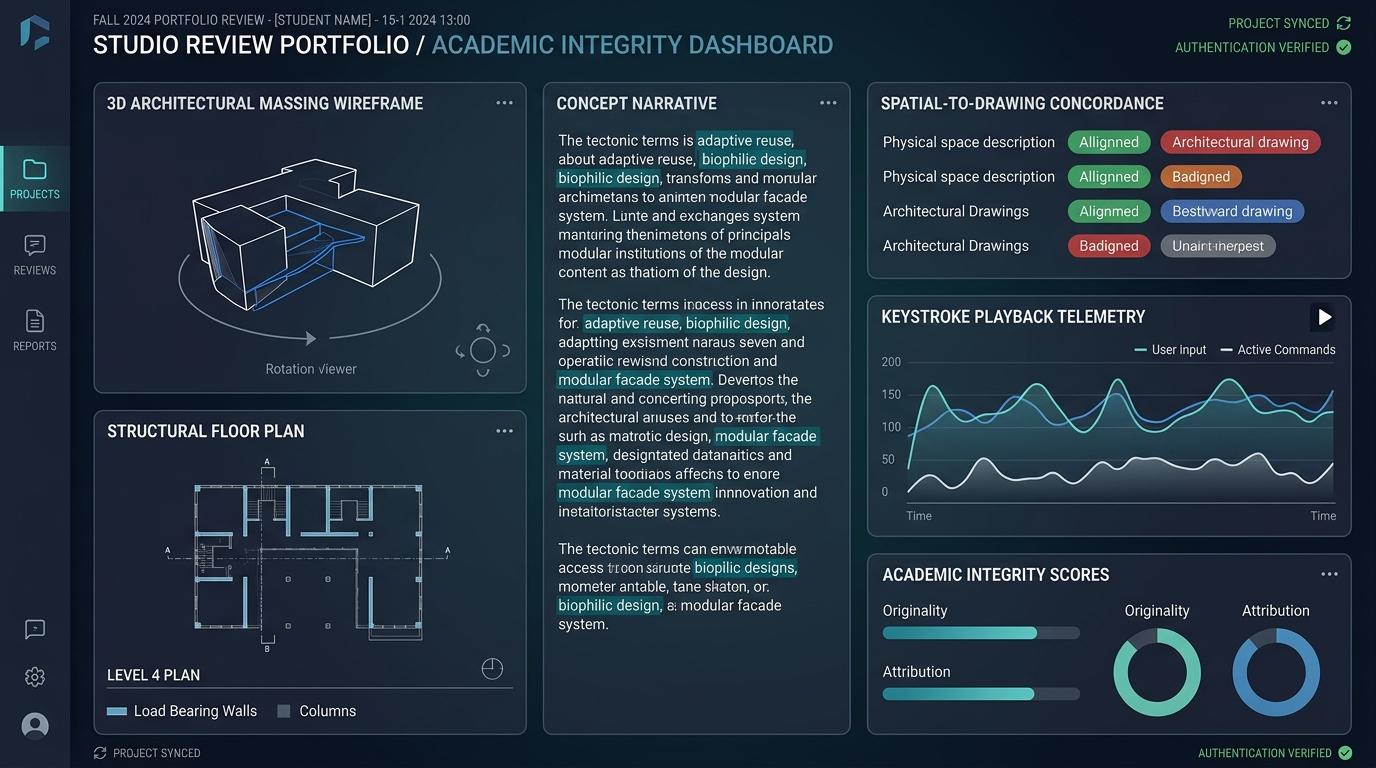
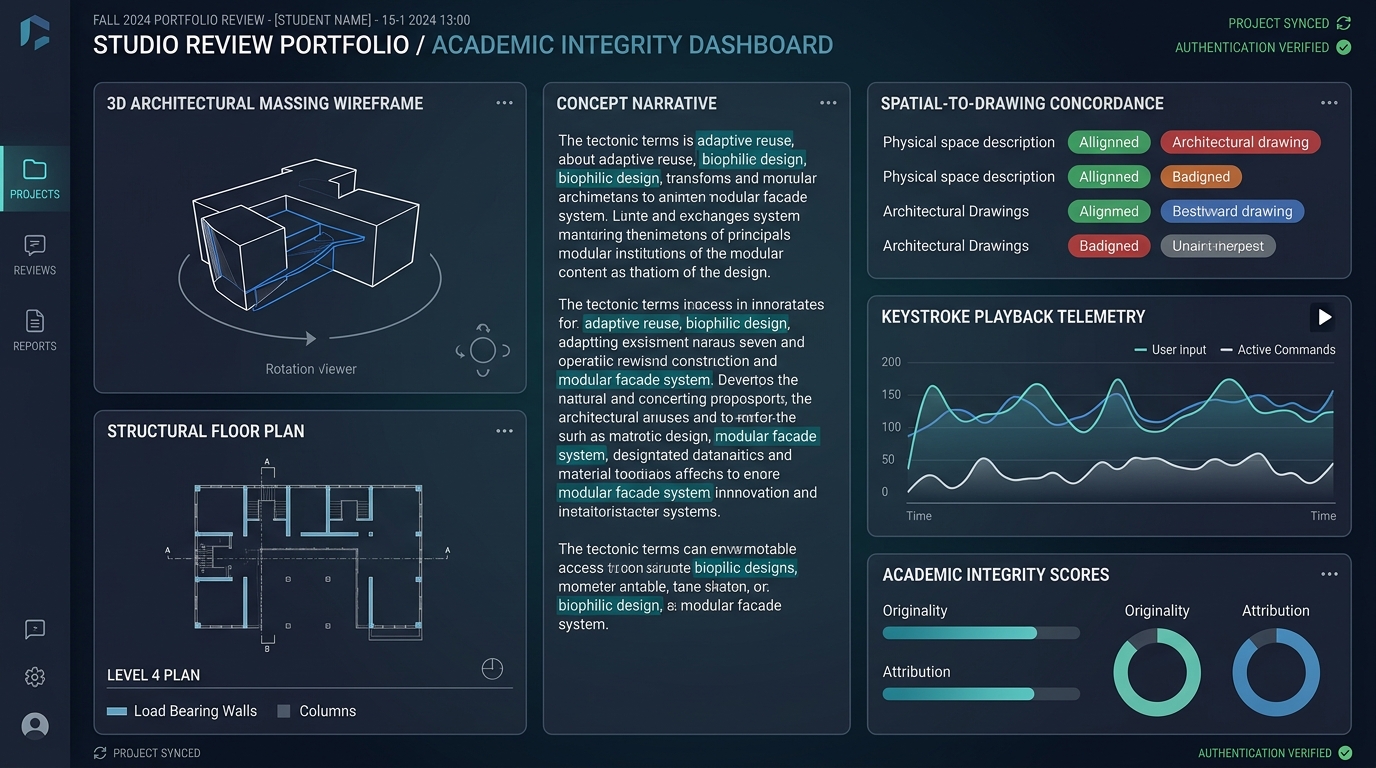
Executive Summary & Architecture Studio Mandate
In undergraduate and graduate architecture programs (B.Arch, M.Arch), the design studio portfolio is the definitive record of a student’s intellectual rigor, spatial reasoning, and professional competency. Alongside orthographic drawings, Rhino/Revit models, and physical mockups, studio portfolios rely heavily on written design concept statements, site analysis reports, structural tectonic rationales, and urban context manifestos. However, the rise of advanced Large Language Models (LLMs) has introduced a critical vulnerability: students can now synthesize hyper-sophisticated, jargon-laden architectural theory narratives—dense with terms like phenomenology, spatial syntax, biophilic thresholds, tectonic articulation, and liminal porosity—that are completely decoupled from their actual physical models, structural grids, and 14-week studio desk-critique evolutions.
Generic AI text detectors and legacy plagiarism checkers fail in architecture education. Plagiarism tools cannot identify original AI-generated text, while black-box AI detectors generate catastrophic false positives on dense architectural theory terminology while missing wholesale generative injections. To satisfy National Architectural Accrediting Board (NAAB) Student Performance Criteria (e.g., Design Synthesis, Building Integration) and maintain authentic studio culture, faculty need an empirical, non-punitive audit protocol. Checkmark Plagiarism’s patent-pending Essay Playback™ bridges this gap through Writing Process Telemetry. By pairing scrubbable 1x–8x keystroke video replay and immutable external paste tracking with passage-level confidence sliders and teacher-controlled rubric autograding, architecture faculty can verify authentic design thinking, confirm spatial-to-textual concordance, and conduct restorative studio jury debriefs that celebrate genuine student growth.
Layer 1: Spatial & Tectonic Concordance
- Drawing-to-narrative cross-audit
- Structural assembly & bay grid check
- Environmental microclimate alignment
- Spatial syntax & egress validation
Layer 2: Process Telemetry (Checkmark)
- Patent-pending Essay Playback™ (1x–8x replay)
- Design-thinking modeling pauses (45–180s)
- Immutable External Paste Inspector
- Passage-level calibrated AI sliders
Layer 3: Studio Jury & NAAB Defense
- 14-week desk critique correlation
- Oral spatial defense at the pin-up board
- NAAB SC.5 & SC.6 evidence dossiers
- Supportive restorative rewrite workflows
1. The Studio Portfolio Integrity Crisis: Generative AI and Architectural Theory
Architectural education is built upon a dual pedagogy: visual/spatial generation and theoretical/conceptual framing. In collegiate design studios, an architectural scheme is never evaluated solely as an isolated geometric object. Instead, students must articulate the parti pris (the organizing concept), justify structural and material assemblies, synthesize complex environmental and urban site parameters, and situate their formal moves within recognized architectural theory.
Authentic Studio Design Process
- 14 weeks of iterative desk crits & trace overlays
- Hard-fought structural and programmatic fixes
- Genuine struggle with site constraints and microclimate
- Direct correspondence: Concept Prose ↔ Orthographic Drawings
Synthetic LLM Narrative Injection
- Single high-level architectural theory prompt
- Seductive, buzzword-heavy phenomenological prose
- Zero concordance with structural sections or CAD drawings
- Fabricated environmental and urban site rationales
A dazzling portfolio narrative generated in seconds that papers over shallow, uncoordinated drawings—threatening NAAB accreditation and subverting authentic studio critique culture.
The Anatomy of Written Discourse in Architecture Studio
Writing in architecture is not an auxiliary academic exercise; it is an active design medium. Across undergraduate (B.Arch) and graduate (M.Arch) studios, capstone design theses, and urban design workshops, students produce multiple distinct genres of written discourse:
The core philosophical thesis guiding the building proposal, explaining how formal decisions respond to cultural, political, or spatial inquiries.
Comprehensive microclimate evaluations, solar path calculations, wind funnel dynamics, pedestrian circulation patterns, and urban morphology studies.
Written justifications for structural bay spacing, lateral load resistance, material selection (e.g., mass timber vs. post-tensioned concrete), and building envelope assemblies.
Descriptions of the experiential user journey, interstitial threshold transitions, compression/release spatial hierarchies, and the interplay of natural light and shadow.
Detailed spatial syntax breakdowns explaining how room adjacencies satisfy building codes, egress requirements, and Universal Design / ADA accessibility standards.
The Rise of “Theoretical Decoupling”
Large Language Models (such as Claude 3.5 Sonnet, GPT-4o, and Gemini 1.5 Pro) have mastered the specialized, often opaque vocabulary of 20th and 21st-century architectural theory. When prompted with basic parameters (e.g., “Write a 500-word design concept narrative for a community arts center in an industrial waterfront zone using phenomenological theory and biophilic principles”), an LLM instantly generates prose resembling an essay by Juhani Pallasmaa, Kenneth Frampton, or Rem Koolhaas:
“The proposed cultural infrastructure negotiates the liminal dialectic between industrial post-maritime memory and contemporary community activation. Through a stereotomic massing strategy punctuated by tectonic timber interventions, the building establishes an interstitial threshold that recalibrates the user’s phenomenological encounter with the tidal edge. Biophilic light wells pierce the monolithic basalt plinth, orchestrating a spatial syntax of compression and release that reflects the diurnal rhythms of the surrounding estuarine ecology.”
To an external portfolio reviewer or an exhausted studio jury member scanning dozens of 40-page portfolios at 2:00 AM, this narrative sounds intellectual, sophisticated, and publication-ready.
The critical flaw is Theoretical Decoupling: When studio faculty cross-reference this dazzling text against the student’s actual orthographic drawings, Rhino/Revit models, and physical mockups, they discover a profound void:
- The “stereotomic basalt plinth” is drawn as a standard 6-inch concrete slab with no thermal insulation or foundation detailing.
- The “interstitial threshold negotiating maritime memory” corresponds to an unprogrammed 80-foot hallway with no daylight access.
- The “biophilic light wells” clash directly with the main rooftop HVAC mechanical unit in the structural section.
- The studio development record: The student spent 14 weeks struggling to resolve basic stair egress and plumbing cores, never mentioning phenomenology in a single desk critique, only to paste an elaborate theoretical manifesto into the portfolio 30 minutes before the digital submission portal closed.
This disconnect undermines the foundational premise of studio education: that architectural form, technical execution, and conceptual reasoning must exist in rigorous, reciprocal alignment.
2. The Pedagogical & NAAB Accreditation Dilemma
The integrity of studio concept narratives is not merely a matter of classroom ethics; it is directly tied to professional licensure standards, degree accreditation, and the evaluation frameworks mandated by the National Architectural Accrediting Board (NAAB).
Ability to make design decisions within complex architectural projects while synthesizing theoretical, programmatic, environmental, and technical factors.
Ability to develop an integrated design that reconciles site, program, structural, environmental systems, life safety, and building envelope assemblies.
How the program instills pedagogical frameworks that synthesize visual, verbal, and written communication into clear architectural arguments supported by historical traditions.
Why Legacy Plagiarism Checkers and Generic AI Detectors Fail Architecture Faculty
Architecture faculty who attempt to police studio writing with conventional educational technology tools face two catastrophic failure modes:
1. Plagiarism Checkers Detect Matching, Not Generation
Traditional plagiarism software (e.g., Turnitin Similarity, Copyleaks standard matching) indexes published web pages, scholarly journal databases, and past student submissions. When a student prompts an LLM to generate an original site analysis or tectonic manifesto, the resulting text is statistically novel. The plagiarism checker returns a 0% similarity score, giving faculty and capstone juries a dangerous false sense of validation.
2. Generic AI Detectors Suffer Massive False Positive Rates on Architecture Jargon
Generic AI text detectors (e.g., GPTZero, Turnitin AI score, Writer) operate by calculating global linguistic perplexity (word predictability) and burstiness (sentence length variation).
Architectural theory writing is inherently specialized, dense, and polysyllabic. When an authentic, honest student writes about:
- “Non-orthogonal stereotomic concrete shear walls resisting seismic overturning moments”
- “Brise-soleil fenestrations calibrated to low-angle winter azimuths”
- “Spatial syntax graphs illustrating integration and choice values across the urban fabric”
Generic detectors flag these passages with 85%–100% “AI Probability” because technical architectural nomenclature mimics the formal, elevated cadence of LLM pre-training data. This disproportionately harms:
- International & ESL Architecture Students: Non-native English speakers who rely on precise, formal vocabulary acquired in theory seminars are routinely falsely accused.
- Dedicated High-Achieving Students: Students who read extensively in architectural history and theory and adopt theoretical frameworks are punished for sophisticated writing.
Generic Detector Calculation: [ "Liminal porosity of the tectonic facade" ] → Low Perplexity → Flagged as 94% Synthetic!
The Reality: The student spent 6 hours hand-drafting wall sections in AutoCAD and searching for the exact architectural term in Frampton’s Studies in Tectonic Culture. A black-box 94% score creates an adversarial jury confrontation, destroying student trust with ZERO defensible proof.
3. The Architectural Evidentiary Matrix
To evaluate student design narratives accurately, design educators require a multi-dimensional evidentiary model that bridges physical studio culture, digital design workflows, and written process telemetry.
Architecture Studio Evidentiary Comparison Matrix
| Evaluation Dimension | Traditional Studio Desk Critiques & Pin-Up Logs | Generic Whole-Document AI Text Detectors | Checkmark Writing Process Telemetry & Essay Playback™ |
|---|---|---|---|
| Primary Data Source | Weekly verbal conversations, physical tracing paper overlays, sketchbook pin-ups. | Static, submitted final text string processed through probabilistic language models. | Keystroke-by-keystroke temporal telemetry, 100% raw clipboard capture, active composing vs. pause logs. |
| Spatial Concordance Verification | High (Direct Visual): Faculty physically inspect drawings during 1-on-1 desk critiques. | Zero: Cannot read or correlate text claims with Rhino, Revit, AutoCAD, or physical models. | High (Empirically Anchored): Correlates text evolution timestamps with CAD modeling sessions and drawing revisions. |
| False Positive Risk on Architectural Jargon | None: Faculty evaluate the student’s verbal reasoning directly during desk critiques. | Extreme (Catastrophic): High false-positive flags on theory vocabulary, tectonic terms, and ESL prose. | Near Zero: Calibrated passage-level confidence sliders paired with immutable drafting video replays. |
| Detection of Copied / Pasted LLM Narratives | Low: Faculty cannot observe what a student types alone in the digital studio at 3:00 AM before a pin-up. | Moderate (Probabilistic): Returns a single opaque percentage without showing how or where text entered the file. | 100% Deterministic: Captures the exact millisecond an external paste occurs and preserves the raw clipboard content. |
| Second-Screen Retyping & Transcription Detection | None: Undetectable in final portfolio PDFs. | Zero: Retyped LLM text appears identical to native student prose to a whole-document scanner. | High: Flags continuous, robotic typing velocities with zero natural revision pauses or spatial cross-checks. |
| NAAB Accreditation & Honor Board Defensibility | Moderate: Relies on faculty memory and subjective notes from mid-term reviews. | Inadmissible / Unusable: Black-box statistical guesses rejected by academic integrity boards and legal counsel. | 100% Defensible: Provides scrubbable video receipts showing the complete evolution of the student’s manuscript. |
| Pedagogical & Restorative Value | High: Traditional studio mentoring and formative coaching. | Negative / Adversarial: Accuses students without explanation, shutting down dialogue. | Transformative: Empowers faculty to replay the writing process with the student during portfolio conferences. |
4. Step-by-Step Architecture Faculty Audit Protocol: From Drawing to Playback
To ensure fairness, rigor, and alignment with NAAB performance criteria, architecture departments should implement a standardized, four-phase audit workflow for studio portfolios, capstone design reports, and thesis manifestos.
The Four-Phase Architecture Studio Audit Protocol
Phase 1: Spatial & Tectonic Concordance Verification (Text-to-Drawing Cross-Check)
Compare narrative claims against submitted sheets: verify whether “ventilated atriums” have operable louvers in section, “glulam timber diagrids” are structurally detailed, and “galleria circulation” meets egress widths.
Phase 2: Studio Iteration Milestone Correlation
Cross-reference the 14-week desk critique logbook. Confirm whether theoretical concepts evolved organically from sketchbook trace overlays or appeared spontaneously 30 minutes before submission.
Phase 3: Writing Process Telemetry Audit via Checkmark Essay Playback™
Scrub the 1x–8x keystroke video replay. Inspect natural 45–180s CAD-cross-check pauses, net typing speed (15–35 WPM), active revisions, and timestamped clipboard paste events.
Phase 4: Restorative Studio Jury & Portfolio Defense Protocol
Conduct a private, supportive screen-sharing conference. Review the timeline together, conduct an oral spatial defense, and assign a formative supervised studio rewrite if needed.
“The tectonic articulation of the interstitial threshold negotiates the liminal dialectic...”
Deep Dive: The Four Telemetry Indicators in Essay Playback™
Authentic architectural writing exhibits Design-Thinking Pauses (45–180 seconds) where students switch windows to check dimensions in Rhino, consult building codes, or sketch details before continuing. Net typing speed typically averages 15–35 WPM with high revision rates.
Checkmark timestamps external clipboard dumps to the millisecond, archiving the exact text pasted even if the student subsequently runs it through an AI humanizer or manually edits individual words.
When students retype an LLM response from an iPad or phone, Checkmark flags the unnaturally uniform velocity (e.g., constant 65–75 WPM for 20 minutes) with a near-zero backspace rate (<1%), indicating mechanical transcription rather than genuine cognitive composition.
Individual Evidence Cards evaluate discrete sentences rather than generating litigious whole-paper scores, distinguishing authentic model reflections from ungrounded theoretical jargon.
“Let’s look at your portfolio drafting timeline together in Checkmark. I noticed that at 2:30 AM last Thursday, a 900-word design manifesto was pasted into your concept section in four seconds. Can you walk me through your writing and research process for this section?”
“In this paragraph, you discuss ‘stereotomic basalt plinths and biophilic light wells.’ Can you show me on your 1/4” section model how this basalt assembly is constructed, and where the light wells penetrate the roof membrane?”
“Our goal in studio is to develop your genuine spatial reasoning and critical voice. Let’s do a supervised 1-hour writing session in studio where you write an authentic 300-word concept statement directly reflecting your real drawings before certifying the portfolio for NAAB records.”
5. Checkmark Plagiarism Suite: Tailored Capabilities for Architecture Studios
Checkmark Plagiarism was engineered specifically to address the complex evidentiary needs of professional degree programs. Its feature architecture provides design educators with unmatched clarity, defensibility, and pedagogical control.
Patent-Pending Essay Playback™
Full 1x–8x keystroke video replay capturing CAD cross-check pauses, drafting cadence, revisions, and deletions.
External Paste Inspector
Captures 100% of raw clipboard text from external browser/LLM interfaces before subsequent student edits or humanizing.
Passage Confidence Sliders
Granular sentence-level evidence cards that evaluate contextual variety rather than punishing architectural theory vocabulary.
Honest Short-Text Guardrails
Enforces an honest ~150-word minimum threshold, displaying N/A on drawing sheet callouts and axonometric captions.
Studio Rubric Autograding
NAAB-aligned rubric scoring with quote-anchored justifications and one-click passback to Canvas, Buzz, and Google Classroom.
Zero-Model-Training Guarantee
Guarantees student design proposals and intellectual property are never stored, indexed, or used to train commercial AI models.
6. Real-World Architecture Studio Case Scenarios
The following three case studies demonstrate how Checkmark’s multi-dimensional telemetry resolves common integrity challenges in undergraduate and graduate architecture studios.
The Decoupled High-Theory Manifesto
Student Profile & Submission Extract:
1,800-word Urban Waterfront Thesis Statement & 6 Drawing Plates. Dazzling phenomenological text; drawings show generic rectangular parking structure.
Checkmark Audit Findings:
- Active Drafting Time: 8 minutes, 22 seconds for 1,800 words (Net Velocity: 214 WPM).
- Paste Inspector: Flagged two bulk paste operations (1,100 words and 700 words) from external browser at 03:14 AM on the morning of the pin-up.
- Spatial Concordance: Zero drawing callouts matched the text’s “biophilic kinetic facade” claims.
The Falsely Flagged International M.Arch Scholar
Student Profile & Submission Extract:
1,200-word Tectonic Analysis of Mass Timber Post-Tensioned Framing. Legacy detector flagged submission as “88% AI” due to dense structural engineering terminology.
Checkmark Telemetry Findings:
- Active Drafting Time: 4 hours, 48 minutes across 5 distinct drafting sessions.
- Keystroke Telemetry: Over 420 natural “design pauses” (avg. 65 seconds) where the student checked timber span tables and AutoCAD structural detail drawings.
- Revision Activity: 1,140 backspaces and extensive sentence restructuring as the student translated complex structural concepts into English. 0 external pastes.
The Second-Screen Transcription Attempt
Student Profile & Submission Extract:
1,500-word Comparative Essay on Rossi’s Architecture of the City vs. Rowe’s Collage City. Student claimed: “I typed every word by hand in Google Docs—no pasting!”
Checkmark Keystroke Dynamics Findings:
- Active Drafting Time: 22 minutes continuous typing (Steady 68 WPM velocity).
- Keystroke Dynamics: Zero cognitive brainstorming pauses exceeding 3 seconds. Zero paragraph-level reorganizations. Backspace rate was <0.4% (only minor mechanical typo corrections).
- Passage Confidence Sliders: Flagged uniform syntactical predictability characteristic of LLM text.
7. Frequently Asked Questions (FAQ)
1. How does Checkmark differentiate between authorized digital research (e.g., looking up building codes) and unauthorized AI generation?
Checkmark’s telemetry analyzes the temporal pattern of text production. When a student conducts legitimate research (consulting the International Building Code, checking structural span tables, or browsing architectural journals), their writing timeline shows extended research pauses followed by active, bursty composition, frequent backspaces, and natural sentence restructuring. In contrast, unauthorized AI generation manifests either as an instant bulk paste (captured with complete text preservation by the Paste Inspector) or continuous, unpaused transcription at a fixed velocity with zero structural revision.
2. Can architecture students draft their narratives in external programs like Microsoft Word or Google Docs?
Yes. Checkmark offers seamless integrations with Google Docs, Microsoft Word (via OneDrive and desktop add-ins), and LMS-embedded text editors in Canvas and Buzz. Regardless of where the student drafts, Checkmark’s ecosystem captures keystroke telemetry, active drafting duration, and clipboard events. If a student chooses to draft offline in a plain text editor, faculty can mandate that final portfolio synthesis occur within the monitored LMS editor or Google Docs environment to ensure verified process telemetry.
3. Why are generic AI detectors particularly unreliable for architectural theory essays?
Generic AI detectors rely heavily on perplexity and burstiness algorithms calibrated on standard colloquial English. Architectural theory, environmental design, and structural engineering utilize a highly specialized, polysyllabic lexicon (stereotomic, tectonic, phenomenology, brise-soleil, interstitial, liminal, solar azimuth). When honest students employ this formal vocabulary, generic detectors misinterpret the low lexical perplexity as artificial, triggering false-positive AI scores as high as 80%–100%. Checkmark avoids this by combining passage-level confidence sliders with empirical keystroke replay.
4. How does Essay Playback™ protect student intellectual property and architectural copyright?
Architecture students frequently develop novel structural systems, parametric algorithms, and proprietary design concepts that represent valuable intellectual property. Checkmark enforces a strict Zero-Model-Training Guarantee: student submissions, project descriptions, and portfolio texts are never indexed into public databases or used to train commercial AI models. All data is protected by enterprise-grade encryption in transit and at rest, ensuring full compliance with FERPA regulations.
5. How can NAAB accreditation teams use Checkmark reports during site visits?
During accreditation reviews, NAAB visiting teams must evaluate student work against Student Criteria (e.g., SC.5 Design Synthesis, SC.6 Building Integration). Studio coordinators can export Checkmark Multi-Evidence Dossiers for sample High-Pass and Low-Pass student portfolios. These dossiers include rubric-anchored autograding evaluations, verified drafting timelines, and spatial concordance logs, providing visiting team members with irrefutable, empirical proof of student learning outcomes.
6. What happens if a student claims their 800-word paste was merely their own pre-written notes?
When a student pastes text, Checkmark’s Paste Inspector captures the complete original clipboard string and marks the timestamp on the timeline. If the student claims the pasted text was their own draft from an unmonitored local application, the instructor conducts an oral portfolio debrief: the student is invited to open their earlier timestamped draft files, show the evolution of those ideas in their studio sketchbook, and verbally defend the technical logic of the text. Genuine student authors can effortlessly explain their own design logic; students who used an LLM quickly struggle to articulate the theoretical terminology.
7. Does Checkmark flag short drawing captions and sheet callouts as AI?
No. Checkmark features Honest Short-Text Guardrails. When analyzing text blocks under ~150 words (such as drawing callouts, material legends, or schematic captions), Checkmark displays N/A rather than generating an unreliable statistical guess. This prevents false alarms on technical annotations and allows faculty to focus integrity reviews on major narrative essays, site analyses, and thesis manifestos.
8. Conclusion: Restoring Trust and Intellectual Rigor to the Architecture Studio
The architecture design studio has always been a sanctuary of iterative learning—a dynamic environment where ideas are tested on tracing paper, modeled in chipboard, refined through intense critique, and defended before expert juries. Written narratives are the intellectual scaffolding that binds these spatial experiments into a coherent architectural argument.
When generative AI decouples written theory from physical form, it threatens the core mission of architectural education. However, the response cannot be punitive paranoia or reliance on flawed black-box AI detectors that alienate honest students.
By deploying Checkmark Plagiarism’s patent-pending Essay Playback™, external paste inspection, and passage-level telemetry, architecture faculties gain an objective, transparent, and restorative toolset. Instructors can eliminate guesswork, protect dedicated students, verify NAAB accreditation competencies, and ensure that every portfolio narrative represents an authentic, hard-fought journey of spatial design thinking.
Bring Process Transparency to Your Architecture Studios
Empower studio critics and NAAB review juries with verifiable writing process playback, clipboard telemetry, and quote-anchored rubric autograding.