
When a four-person collaborative research paper or group essay returns an aggregate “62% AI Detected” flag from a legacy detection tool, educators face an excruciating pedagogical and ethical dilemma: penalize the entire group and inflict unfair collective punishment on honest students, or dismiss the flag entirely and allow unearned AI authorship to compromise academic standards. Standard document version histories (such as Google Docs revision history) cannot solve this crisis because they only record which account inserted text, failing to distinguish between authentic offline drafting, legitimate research notes, and unapproved large language model (LLM) paste events.
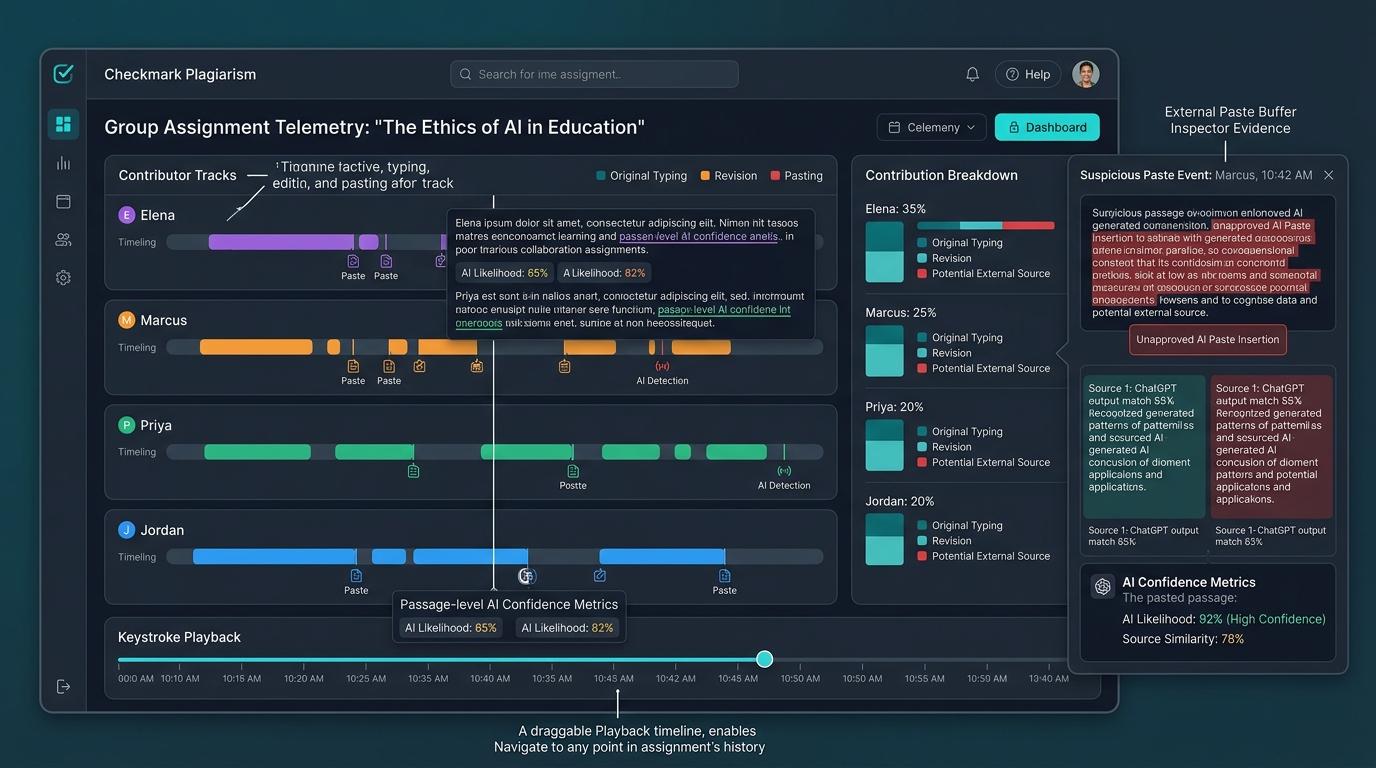
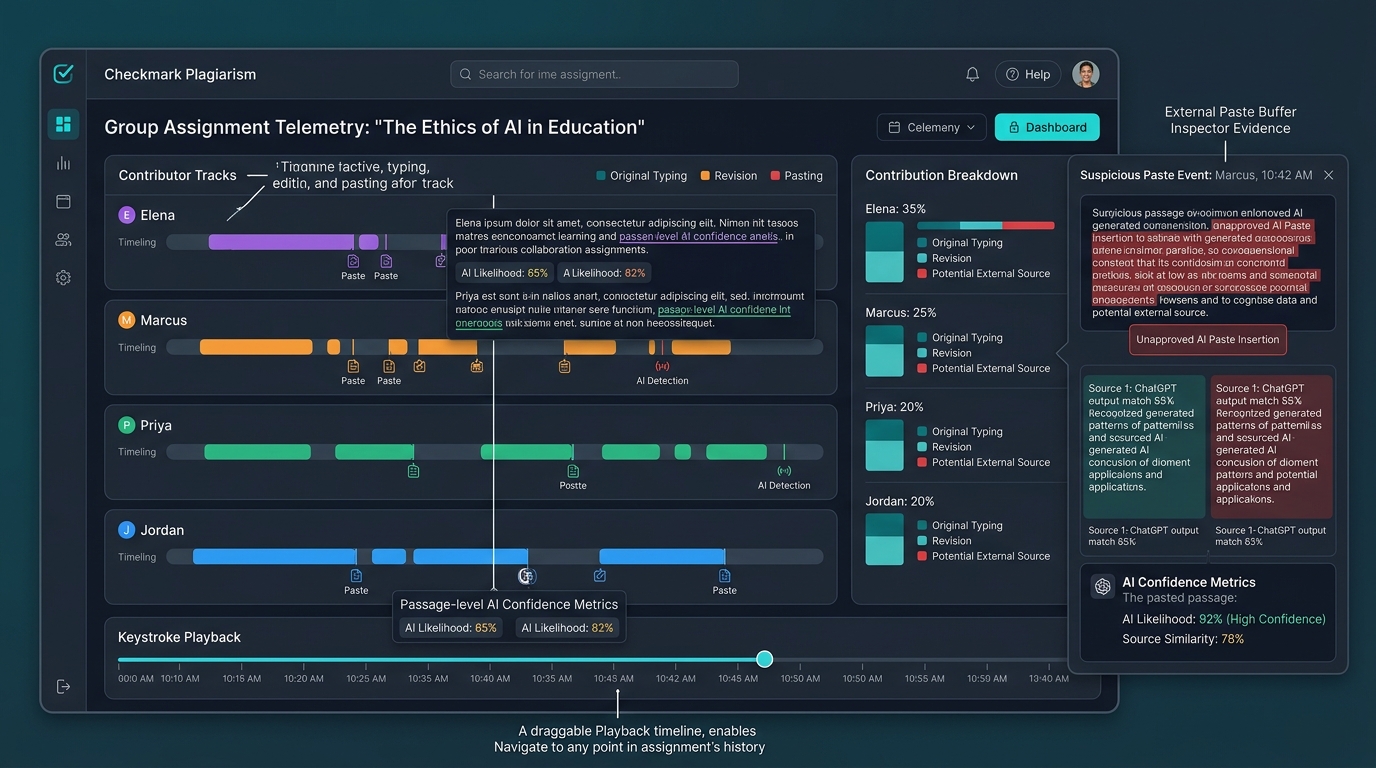
Checkmark Plagiarism resolves the group writing dilemma through its Multi-Author Writing Telemetry Suite. By combining patent-pending Multi-Contributor Essay Playback™ (with author-isolated 1x–8x scrubbable video replay), the External Paste Buffer Inspector (preserving 100% of clipboard insertions tied to authenticated user IDs), and Author-Mapped Passage-Level AI Confidence Sliders, Checkmark empowers teachers to pinpoint exact individual contributions with indisputable forensic evidence. This guide breaks down the legal and pedagogical mandates against collective punishment, provides forensic frameworks for multi-contributor analysis, explores three detailed classroom case studies, and outlines an end-to-end 4-Phase Collaborative Attribution Protocol.
Checkmark Plagiarism provides secondary teachers, university faculty, and department heads with the complete toolkit for collaborative writing integrity—uniting writing process replay, passage-level AI detection, multidimensional plagiarism checking, and split-rubric autograding with seamless integrations for Canvas LMS, Agilix Buzz, and Google Classroom.
1. The Collaborative Integrity Dilemma: The Trap of Collective Punishment vs. Total Impunity
Collaborative group assignments are among the most pedagogically valuable formats in modern secondary and postsecondary education. When structured effectively, group projects cultivate essential 21st-century competencies: peer discourse, synthesis of divergent perspectives, project management, and collaborative problem-solving. In humanities seminars, social studies cohorts, and advanced STEM capstones, group writing challenges students to harmonize individual voices into a cohesive argumentative document.
However, the rapid democratization of generative artificial intelligence—powered by frontier models like ChatGPT, Claude, and Gemini—has plunged collaborative writing into an acute evaluation crisis.
- Teacher issues group-wide zero or grade reduction.
- Destroys academic trust and psychological safety.
- Inflicts trauma and distress on honest, hardworking students.
- Violates constitutional Due Process (Goss v. Lopez).
- Teacher dismisses flag because individual culpability is unproven.
- Rewards dishonest shortcuts and free-riding behavior.
- Demoralizes diligent peers who suspect unearned credit.
- Erodes department-wide standards and academic rigor.
The 60% Aggregate AI Flag Nightmare
Consider a standard classroom scenario: An AP Environmental Science teacher assigns a 3,000-word group policy brief analyzing municipal watershed management. Four students—Elena, Marcus, Priya, and Jordan—collaborate on a shared Google Doc over three weeks. Upon final submission to the learning management system (LMS), the school’s legacy AI detection filter flags the entire document with a monolithic “64% AI Generated” warning.
The software offers no further breakdown. It does not indicate whether all four students collaborated with an AI chatbot, whether two students used an LLM to generate their respective sections, or whether a single student panicked at 11:30 PM on the night before the deadline and pasted five generated paragraphs into the policy recommendation section.
Faced with this opaque percentage, educators typically find themselves trapped between two equally destructive choices:
Failure Mode A: Collective Punishment
The instructor applies a blanket sanction—such as rejecting the submission, issuing an automatic zero across all four team members, or forcing the entire group into a disciplinary hearing.
- The Pedagogical Cost: Honest students who spent dozens of hours conducting primary research, drafting authentic arguments, and revising prose are subjected to severe distress, anger, and disillusionment. Academic trust is obliterated.
- The Legal Cost: In public school districts and state universities, collective disciplinary action violates students’ constitutional rights to procedural due process under the Fourteenth Amendment. Under the landmark U.S. Supreme Court ruling in Goss v. Lopez (419 U.S. 565), educational institutions cannot deprive an individual student of academic standing or property interests based on group guilt without establishing individual culpability through defensible evidence.
Failure Mode B: Total Impunity
Recognizing that they cannot prove who used AI, and unwilling to punish innocent students, the instructor ignores the flag, writes a generic comment about “maintaining academic voice,” and assigns full credit.
- The Pedagogical Cost: The student who committed authorship fraud learns that collaborative documents provide perfect camouflage for unapproved AI generation. Meanwhile, the honest group members—who frequently suspect or know that their peer took an unauthorized shortcut—realize that integrity is unrewarded and that free-riding goes unchecked.
- The Systemic Cost: Academic rigor degrades, and peer dynamics turn toxic as honest students refuse to participate in future group assignments.
Summary Comparison: Adjudication Approaches in Collaborative Assignments
| Evaluation Approach | Evidentiary Basis | Impact on Honest Students | Impact on Flagged Student | Legal & Due Process Standing |
|---|---|---|---|---|
| Blanket Collective Penalty | Monolithic document AI % | Severe distress, false accusation trauma, destroyed teacher trust | Evades individual accountability; hides behind group friction | Vulnerable to formal appeals, FERPA disputes, & Goss v. Lopez challenges |
| Complete Dismissal (Impunity) | Ignored detection warnings | Deep resentment, perceived unfairness, devaluation of honest work | Reinforced reliance on AI shortcuts; zero skill development | Compliant on paper, but fails institutional academic integrity standards |
| Standard Google Docs History Review | High-level edit timestamps & character counts | High ambiguity; unable to prove if pasted text was authentic notes or LLM prose | Exploits “shared account” or “offline drafting” excuses | Insufficient forensic proof to withstand parental or administrative scrutiny |
| Checkmark Multi-Author Telemetry Suite | Per-author keystroke playback, paste buffer preservation, passage-level AI mapping | Complete exoneration and validation of authentic drafting effort | Pinpointed, non-punitive intervention with clear forensic “receipts” | 100% defensible, FERPA-compliant, legally sound procedural fairness |
2. The Deconstruction of Multi-Contributor Collaborative Forensics
To accurately isolate individual contributions in shared digital documents, educators and technology administrators must understand why traditional tools fail and how multi-contributor drafting telemetry operates at a forensic level.
Why Google Docs Version History Fails as an Integrity Audit
When faced with a disputed collaborative essay, many instructors attempt to inspect the native Google Docs Version History or Microsoft Word Track Changes. While these tools are excellent for high-level editorial tracking, they possess critical forensic blind spots when investigating AI generation:
Text appears highlighted in Marcus’s assigned color (Purple).
Ctrl+V paste?
- The “Paste Attribution” Flaw: When a user pastes a block of text into a shared document, Google Docs attributes that block to the account currently logged in and pressing
Ctrl+V. However, Google Docs does not capture where the text originated or whether the user drafted it elsewhere. A student can claim, “I wrote that section in Apple Notes on my phone while on the bus and pasted it in,” and standard version history cannot disprove the claim. - The “Shared Device / Single Account” Exploit: In middle school and high school classrooms, students frequently huddle around a single Chromebook in the library or computer lab. If Student A steps away and Student B uses Student A’s active session to paste AI-generated text, standard version history permanently attaches Student A’s name to the infraction.
- The “Group Document Blame Game”: When confronted with an aggregate AI flag, group members often fracture. One student will claim, “I wrote the outline and Jordan said he would ‘polish’ the grammar—he must have run it through ChatGPT!” Another will claim, “Marcus put that paragraph in under my name when we were working together.” Without granular keystroke telemetry, the teacher cannot establish the objective sequence of events.
Multi-Author Drafting Telemetry: The 4 Core Forensic Dimensions
Authentic human writing leaves distinct behavioral and temporal fingerprints. When multiple students contribute to a single document, their individual drafting patterns can be separated into four forensic dimensions:
- Inter-Key Intervals (IKI): Millisecond duration between consecutive keystrokes.
- Authentic Cadence: Fluctuates naturally between 120ms and 350ms with jitter across syllables and punctuation.
- Mechanical Cadence: Metronomic, flat IKI curve characteristic of second-screen transcription.
- Micro-pauses (100ms–500ms): Motor-execution transitions between keys.
- Meso-pauses (500ms–2,000ms): Cognitive lexical retrieval & clause formulation.
- Macro-pauses (2,000ms–30,000ms+): Structural planning and reading preceding sentences.
- Authentic Ratio (1.3x–2.2x): Drafting 500 words (3,000 chars) requires 4,500–6,500 gross keystrokes due to backspaces and edits.
- AI Ingestion Ratio (1.00x–1.05x): Near-zero deletions or corrections relative to final character volume.
- Collaborative Interaction: Honest peers highlight sentences, leave comments, and reorder paragraphs across sections.
- Static Ingestion: Unauthorized AI text appears as monolithic static blocks with zero integration or lexical revision.
3. Checkmark Plagiarism’s Multi-Author Writing Telemetry & Forensic Suite
To eliminate guesswork and protect innocent students, Checkmark Plagiarism provides an integrated forensic architecture designed specifically for multi-contributor collaborative assignments across Google Docs, Canvas LMS SpeedGrader, Buzz LMS, and Microsoft 365.
Author-isolated 1x to 8x scrubbable video timeline. Filter by Student A, B, C, or D to view active drafting duration, typing velocity (WPM), and pause heatmaps per contributor.
Captures 100% of clipboard text tied to verified SSO logins. Preserves pre-edit states, timestamps, insertion volumes, and provides a 1-click “Jump to Playback” button.
Sentence-by-sentence perplexity and burstiness mapping tied to verified author IDs. Includes honest short-text guardrails (<150w) and educator-only privacy flags.
Differentiates shared group criteria (thesis, flow) from individual contributor criteria (evidence, analysis). Synchronizes scores directly into Canvas SpeedGrader & Buzz LMS.
1. Multi-Contributor Essay Playback™ (1x–8x Scrubbable Multi-Track Replay)
Checkmark’s patent-pending Essay Playback™ captures native writing telemetry and reconstructs the entire collaborative drafting session keystroke-by-keystroke.
12m 14s
720 words (29.4%)
142 total (0.04x)
2 Major Pastes (680w)
01:18:10: Marcus cursor navigates to Line 112 → Injected 268 words in 0.00s.
01:26:36: Marcus logs out. Total active drafting time: 12 minutes with 0 macro-revisions.
- Author Isolation Filtering: With a single click, educators can toggle between the combined team view and individual contributor tracks. Isolating an author filters out all peer contributions, allowing the teacher to watch exactly how and when that specific student built their assigned sections.
- Scrubbable Multi-Speed Playback: Teachers can scrub forward and backward through hours of collaborative drafting at 1x, 2x, 4x, or 8x speed. Composing pauses, outline structuring, sentence deletions, and peer comment responses unfold visually in real time.
- Concurrent Editing & Collision Telemetry: When multiple group members edit simultaneously, Checkmark displays color-coded cursor tracks, showing whether students were actively co-authoring or working in isolated silos.
2. External Paste Buffer Inspector with Contributor-ID Tagging
The single most decisive piece of evidence in academic integrity adjudication is the External Paste Buffer Inspector. When a student pastes text into a collaborative document, Checkmark does not merely record a timestamp; it captures and permanently stores 100% of the raw clipboard text attached to that student’s authenticated LMS login.

- Pre-Edit State Preservation: Even if a student pastes an LLM-generated paragraph and immediately edits, rephrases, or deletes the telltale conversational introductory markers (e.g., “Certainly! Here is a detailed analysis...”), Checkmark’s paste buffer retains the original unedited clipboard text as it existed at the exact millisecond of injection.
- Contextual Provenance Verification: If a student claims they pasted authentic primary research notes, the teacher can inspect the paste buffer to verify the claim. If the pasted buffer contains raw interview transcripts or bibliographic data, the student is instantly exonerated. If the buffer contains structured, syntactically polished LLM prose with AI formatting artifacts, the provenance is definitively established.
3. Granular Passage-Level AI Detection Mapped to Author Spans
Rather than generating an aggregate document percentage that paints the entire group with a broad brush, Checkmark applies Passage-Level Granularity mapped directly to verified contributor user IDs.
- Author-Span Alignment: Every sentence in the collaborative document is cross-referenced against the author ID verified by Essay Playback. AI confidence scores are calculated exclusively on localized spans, preventing cross-contamination between group members.
- Calibrated Confidence Sliders: Rather than a binary “AI vs. Human” verdict, each flagged passage features an evidence card displaying calibrated sliders that illustrate linguistic perplexity and burstiness distributions.
- Honest Short-Text Guardrails (<150 Words): If an individual student contributes a short subsection of under 150 words, Checkmark displays
N/Arather than guessing on an insufficient sample size, preventing false-positive flags on brief introductory transitions. - Educator-Only Flag Privacy: Flag statuses remain strictly visible to teachers only. This prevents students from seeing automated flags before the educator conducts an audit, eliminating premature peer accusations within the group.
4. Teacher-in-the-Loop Rubric Autograding with Individual Weighting
Checkmark’s AI Autograder integrates directly with Canvas LMS SpeedGrader, Buzz LMS, and Google Classroom, enabling teachers to grade collaborative projects with differentiated accountability.

4. Real-World Classroom Case Studies
The following real-world case studies illustrate how Checkmark’s Multi-Author Forensic Suite resolves high-stakes collaborative writing disputes across different grade levels and disciplines.
The 4-Student AP Environmental Science Policy Brief
The Tragedy Comparison Essay (Resolving Peer Accusations)
The Civil War Exhibit Script (Second-Screen Transcription)
5. The 4-Phase Collaborative Integrity & Attribution Protocol
To systematically prevent authorship disputes and establish transparent accountability, educators should implement the 4-Phase Collaborative Integrity & Attribution Protocol.
Establish clear section assignments, enforce single-user SSO document logins (no shared accounts), define allowed brainstorming vs. prohibited generation, and collect signed Attribution Contracts.
Filter Essay Playback™ by individual author tracks to verify active writing durations, audit the External Paste Buffer Inspector for raw clipboard text, and cross-reference passage-level AI confidence scores.
Privately affirm and exonerate compliant group members first. Hold a private, 1-on-1 evidence review with the identified student, presenting objective playback and paste receipts in a supportive coaching frame.
Apply split-rubric scoring (group criteria vs. individual criteria), provide a structured formative redrafting window for the non-compliant student, and synchronize grades directly into Canvas SpeedGrader or Buzz LMS.
Post-Submission Forensic Audit Checklist
6. Ready-to-Use Group Project Syllabus Policy & Contribution Contract
Educators can copy, adapt, and distribute the following policy contract to establish transparent collaborative integrity standards.
Course: ___________________________ • Instructor: ___________________________
Project Title: __________________________________________________________________
Group Members: 1. ___________________ 2. ___________________ 3. ___________________ 4. ___________________
1. Individual Accountability & Digital Telemetry
We understand that this collaborative project evaluates both our collective synthesis and our individual contributions. To ensure fairness and procedural due process:
- Every team member must access and edit the shared document exclusively through their individual school-issued SSO account.
- Writing process telemetry (including keystroke dynamics, typing cadence, and revision history) is logged via Checkmark Plagiarism to verify authentic human authorship.
- Text generated by an unapproved AI model and pasted into the document will be isolated to the individual user account responsible; honest team members will NOT be subject to collective punishment.
2. Authorized vs. Prohibited AI Assistance
- ALLOWED: Using AI for preliminary brainstorming of search queries, outlining potential research angles, or checking mechanical grammar on pre-written student sentences.
- PROHIBITED: Using AI to generate sentences, paragraphs, source summaries, or conclusions; using AI humanizer tools or paraphrasers to disguise external text; sharing logins to disguise paste events.
3. Section Attribution Matrix
Each member agrees to lead and draft the following specific sections:
7. Restorative Team & Individual Conferencing Scripts
When an integrity issue is detected in a group project, using precise, supportive language de-escalates anxiety and ensures productive resolution.
“Thank you all for meeting with me. Your policy brief covers a crucial topic, and I appreciate the hard work you put into organizing your research. In our course, we evaluate collaborative assignments using multi-author process analysis so that each person’s individual writing and research effort is recognized independently. I am currently reviewing everyone’s individual drafting tracks and rubric milestones in Checkmark. You will each see your individualized feedback and criterion scores in Canvas SpeedGrader by tomorrow afternoon. If I need to meet with anyone individually to talk through revision strategies for their specific section, I will reach out privately. Excellent job collaborating on the overall project structure.”
“Hi Jordan, thanks for coming in. I wanted to look together at Section 4 of the watershed brief. When I opened Checkmark’s Essay Playback, I noticed that while Elena, Marcus, and Priya spent several hours actively drafting their sections, your track shows an active drafting time of about seven minutes, with a 485-word external paste at 11:34 PM on Sunday night.
When we look at the Paste Buffer Inspector right here on screen, it shows the unedited clipboard text from that moment, which includes the opening prompt response from an AI assistant.
Our goal today isn’t to lecture you or impose an arbitrary zero—it’s to talk about what happened on Sunday night. Were you feeling overwhelmed by the deadline, or did you get stuck on how to formulate the policy recommendations? Let’s look at how we can get you back on track so you can master this material and write this section in your authentic voice.”
“Hi Elena, Marcus, and Priya. I have completed the individual writing process audit for Sections 1, 2, and 3 of your group project. Your drafting telemetry, research synthesis, and revision histories were exceptional and have been awarded full credit (94/100) in the gradebook. Thank you for your rigorous, authentic scholarship. I am working with Jordan on an independent revision for Section 4, which will not impact your project grades or timeline in any way. Keep up the outstanding work!”
8. Frequently Asked Questions (FAQ)
1. What if all group members worked on a single student’s laptop in the library using one Google account?
Drafting an entire collaborative project on a single account eliminates individual login telemetry and makes per-author isolation impossible. To prevent this, educators must establish a strict Single-User SSO Requirement in the project syllabus. If students collaborate in person, they should each bring their own district-issued device or take turns logging into their respective school accounts on the shared device. If an integrity dispute arises on a single-account document, the teacher must rely on oral defense conferences and physical draft notes to establish individual authorship.
2. Can a student claim they drafted their section offline in Microsoft Word or Apple Notes and pasted it in?
Yes, this is the most common student defense when confronted with a paste flag. Checkmark resolves this claim through the External Paste Buffer Inspector and Linguistic Passage Analysis. If the student genuinely drafted offline, the pasted text will exhibit natural human syntactical variation, occasional typos, and authentic informal notes. Furthermore, teachers can request that the student produce the original offline .docx file or Apple Notes version history. If the pasted buffer contains characteristic LLM phrasing, conversational preambles, and low perplexity scores, the offline drafting claim is forensically disproven.
3. How does Checkmark handle collaborative editing where one student rephrases another student’s sentences?
Checkmark’s multi-track telemetry precisely differentiates between primary author generation and peer editorial revision. In Essay Playback™, peer edits appear as secondary overlay events tagged to the editor’s user ID. The original author retains credit for the underlying drafting volume, while the editor’s contributions are logged as editorial macro-revisions. This gives teachers complete visibility into peer review quality and collaborative editing dynamics.
4. Is collective grading legal if our school district student code of conduct doesn’t explicitly mention group projects?
While assigning a shared group grade for general academic quality is standard practice, imposing collective disciplinary penalties or academic dishonesty sanctions for suspected cheating violates constitutional procedural due process under Goss v. Lopez (419 U.S. 565) in public institutions. Disciplinary sanctions require individualized evidence of wrongdoing. Utilizing Checkmark ensures that institutions uphold due process by establishing individual culpability before any penalty is applied.
5. What should a teacher do if an entire group admits they used AI together during a brainstorming session?
Collaborative AI brainstorming is a legitimate pedagogical activity when authorized by the instructor. If students used an LLM to generate initial topic ideas or outline structures, but subsequently drafted the body prose in their authentic human voices, Checkmark’s Essay Playback™ will show extensive active keystroke histories, formulation pauses, and macro-revisions. The teacher should evaluate whether the students adhered to course attribution guidelines and award credit based on authentic prose composition.
6. How does individual rubric weighting work in Canvas SpeedGrader and Buzz LMS when using Checkmark?
Checkmark synchronizes with LMS rubrics via LTI 1.3 Advantage integration. Teachers can configure custom rubric weighting that separates shared group criteria (e.g., Thesis Cohesion, Formatting) from individual contributor criteria (e.g., Evidence Analysis, Keystroke Authenticity). When the teacher approves the autograded drafts, Checkmark calculates the differentiated final scores and pushes both the points and quote-anchored written feedback directly into Canvas SpeedGrader or Buzz LMS with a single click.
7. How does Checkmark protect student privacy when auditing collaborative documents under FERPA and COPPA?
Checkmark Plagiarism operates under a strict Zero Data Retention and Zero Model Training Policy. Student collaborative documents, keystroke logs, and clipboard buffers are processed in secure, encrypted cloud environments (AES-256 at rest, TLS 1.3 in transit) and are never used to train public or commercial artificial intelligence models. Checkmark fully complies with the Family Educational Rights and Privacy Act (FERPA) and the Children’s Online Privacy Protection Act (COPPA), ensuring that student educational records remain confidential and protected.
9. Conclusion: Moving from Guesswork to Trust in Collaborative Learning
Collaborative writing remains one of the most powerful pedagogical vehicles for preparing students for the intellectual and professional demands of the modern world. However, its continued viability in the generative AI era depends entirely on the fairness, precision, and transparency of evaluation.
Educators can no longer afford to rely on opaque, monolithic AI percentages that force a false choice between punishing innocent students and ignoring academic dishonesty. By implementing Checkmark Plagiarism’s Multi-Author Writing Telemetry Suite—leveraging author-isolated Essay Playback™, external paste buffer preservation, and author-mapped passage-level analysis—schools can uphold rigorous academic integrity, protect student due process, and foster a classroom culture grounded in authentic scholarship.
Stop guessing. Start trusting. Equip your department with the multi-author forensic evidence needed to support every writer.