
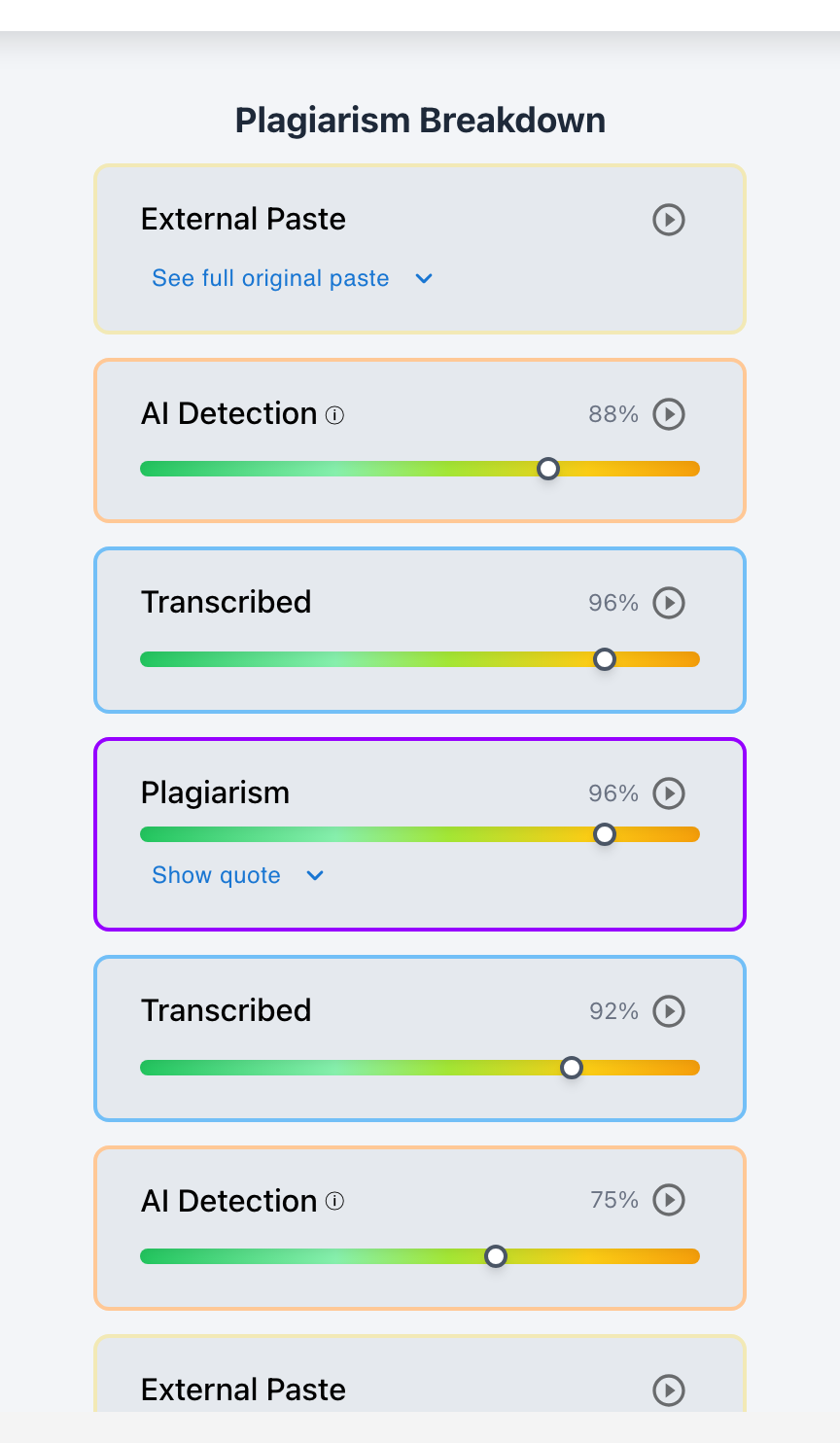
When an essay looks suspiciously artificial but passes a statistical AI detector with a low score, educators can investigate and verify AI use through a 4-step multi-signal audit combining essay writing playback, citation verification, in-class baseline comparisons, and oral check-ins.
Static AI detectors evaluate vocabulary predictability. When students use advanced prompt engineering, third-party AI humanizers, or paraphrasing tools, they can sometimes manipulate mathematical perplexity enough to generate a "green" or low AI percentage. However, passing a text detector does not mean the paper was written by a human. The physical process of creation, the authenticity of cited sources, and the student's conceptual mastery cannot be manipulated by AI cloaking tools.
Below is a structured educator protocol for investigating AI writing that passes an AI detector.
Checkmark Plagiarism powers multi-signal investigations by pairing essay writing playback with AI detection, plagiarism detection, autograding, and integrations with Canvas and Google Classroom.
The 4-Pillar Investigation Protocol for Stealth AI
1. Keystroke Writing Playback Replay
Open Checkmark Playback: verify if the paper was typed over 3+ hours with 15–30% backspaces or appeared in a single 1-second clipboard paste.
2. Academic Citation & DOI Audit
Search 2–3 cited articles in Google Scholar enclosed in quotes. ChatGPT frequently invents fake authors, non-existent journals, and dead DOIs.
3. In-Class Baseline Comparison
Compare the submission's rhetorical style, syntax complexity, and grammatical quirks side-by-side with proctored in-class diagnostic writing samples.
4. Focused 2-Minute Oral Check-In
Ask the student to define advanced vocabulary used in the paper, summarize their main counterargument, and explain how they located their sources.
What Stealth AI Submissions Look Like in Playback
Even when AI text passes an algorithmic text scanner, its document creation timeline reveals the truth:
- The Instant Paste Flag: The 1,500-word essay was inserted via clipboard paste in 0.05 seconds with under 3 minutes of active typing time.
- The Linear Transcription Cadence: If hand-typed from an external screen, keystrokes flow in an unbroken line with <2% backspaces and zero paragraph reorganization.
- The Original Preserved Paste: Checkmark's Original Paste Preservation captures the unedited text payload at the moment of insertion, exposing the raw AI text before student edits.
Read more in how Checkmark writing process analysis works.
Comparison: Passing AI Detector vs. Multi-Signal Ground Truth
Static AI Detector Output (Circumstantial)
- Outputs a 12% AI score (bypassed via humanizer).
- Evaluates only vocabulary predictability.
- Blind to active drafting hours and paste events.
- Leaves teachers with unresolved suspicions.
Checkmark Multi-Signal Audit (Conclusive)
- Playback shows 1,500 words pasted in 1 second.
- Active typing duration: 2.8 minutes total.
- Citations contain 2 hallucinated studies with fake DOIs.
- Conclusively proves unauthorized AI generation.
A 5-Step Educator Protocol for Investigating Stealth AI
Educator Stealth AI Audit Checklist:
- 1. Open the Checkmark Playback replay in Canvas SpeedGrader or Google Classroom.
- 2. Review the Active Typing Duration: flag submissions under 15 minutes.
- 3. Inspect the document timeline for wholesale paste blocks or linear transcription.
- 4. Audit 2 cited sources in Google Scholar or JSTOR to check for hallucinations.
- 5. Hold a 2-minute oral check-in asking the student to explain their drafting choices.
How Checkmark Plagiarism Powers Stealth AI Investigations
Checkmark Plagiarism combines **AI detection, essay writing playback, static AI detection, plagiarism detection, autograding, and Canvas/Google Classroom integrations** to give educators complete multi-signal evidence, ensuring no AI shortcut goes undetected.
Frequently Asked Questions
Can an essay be written by AI and still score 0% on an AI detector?
Yes. By using humanizers, heavy prompt engineering, or paraphrasing tools, students can sometimes lower static AI scores to near-zero.
How can a teacher prove AI use if the detector score is low?
By reviewing Checkmark Playback (showing a 1-second paste event and zero typing time) and auditing citations for fake AI hallucinations.
What is a hallucinated citation?
A fabricated reference generated by ChatGPT that appears real (with realistic authors and journal titles) but does not actually exist in academic databases.
How does writing playback catch AI that beat detectors?
Playback captures the physical creation process—proving whether a paper was typed over hours with revisions or inserted in an instant clipboard paste.
What is a normal student backspace rate?
Authentic student writing typically exhibits a 15% to 30% backspace/edit rate as thoughts are refined. AI copy-pastes show 0% edits.
How does Checkmark Plagiarism integrate with Canvas LMS?
Checkmark Plagiarism displays visual writing playback timelines, session breakdowns, and dual AI/plagiarism reports directly inside Canvas SpeedGrader.
What questions should I ask in an oral check-in?
Ask: "Can you define [complex term]?", "What was the main finding of your cited source?", and "Walk me through how your thesis evolved."
Can students fake authentic multi-session writing history?
Simulating hours of realistic typos, backspaces, and natural thinking pauses takes longer than actually writing the essay honestly.
Does baseline comparison help in stealth AI cases?
Yes. Comparing the submission to in-class writing samples easily highlights sudden jumps in vocabulary tier, syntax complexity, and style.
Why is multi-signal investigation essential for modern schools?
Because static AI detectors are imperfect; combining linguistic analysis with writing playback and citation audits guarantees complete accuracy and fairness.
Beyond the Detector: Complete Multi-Signal Proof
When software scores fail to tell the whole story, physical creation history and academic verification provide the ground truth. With Checkmark Plagiarism, educators investigate stealth AI submissions with speed, fairness, and absolute forensic certainty.
Checkmark Plagiarism supports this comprehensive approach with AI detection, essay writing playback, static AI detection, plagiarism detection, autograding, and integrations with Canvas and Google Classroom.
See how Checkmark pairs essay writing playback with multi-signal detection to investigate stealth AI writing inside your LMS. View a sample report or request a demonstration.