
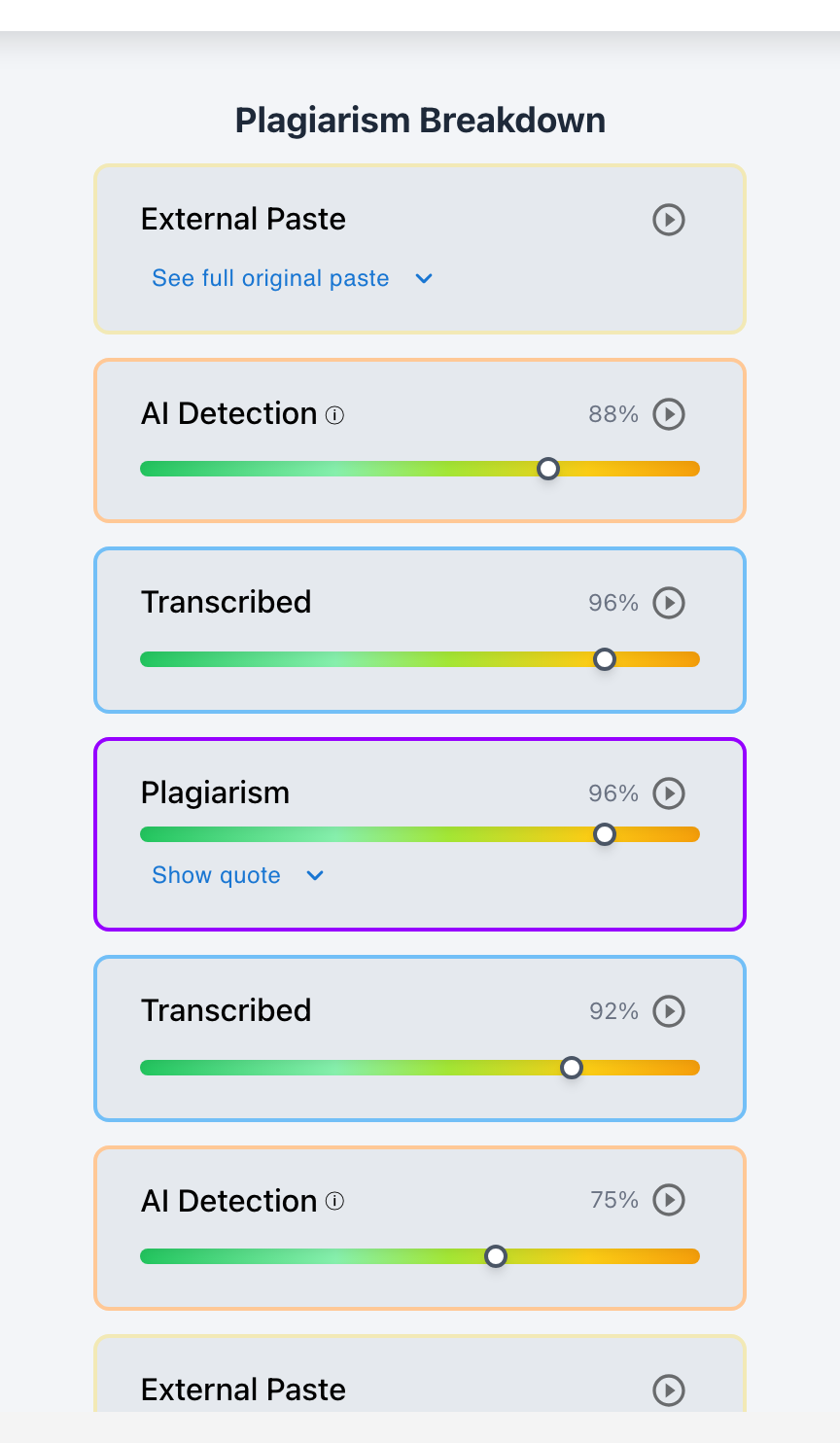
Teachers can document an academic integrity investigation by compiling a 4-part evidence dossier: first, export the Checkmark Process Telemetry Snapshot (recording active typing duration, deletion rates, paste timestamps, and a link to the 15-second writing playback video); second, include the Textual Forensics Record (sentence-level AI heatmaps and Crossref DOI verification checks); third, log contemporaneous conference notes (documenting the student's responses to conceptual oral questions); and fourth, cite the exact syllabus policy and restorative resolution applied.
When an academic integrity case reaches school administrators, honor councils, or parent appeals, the strength of the teacher's documentation determines the outcome. Vague accusations ("the essay felt too advanced") or isolated screenshots of third-party detector percentages are routinely dismissed for lack of verifiable proof. By maintaining a standardized, multi-signal audit dossier, educators protect student due process, eliminate bias, and provide transparent, undeniable records that satisfy FERPA regulations. Checkmark Plagiarism enables one-click PDF dossier exports directly from Canvas SpeedGrader.
Below is a comprehensive guide on building airtight, professional academic integrity investigation dossiers.
Checkmark Plagiarism streamlines investigation documentation by pairing AI detection with essay writing playback, plagiarism detection, autograding, and integrations with Canvas and Google Classroom.
The 4 Components of an Airtight Investigation Dossier
1. Process Telemetry & Video Snapshot
The physical keystroke log showing active drafting hours, session counts, backspaces, paste event payloads, and an embedded link to the 15-second Playback replay.
2. Textual Forensics & Citation Card
The sentence-level neural AI heatmap alongside automated Crossref DOI verification logs proving the existence or hallucination of cited sources.
3. Contemporaneous Conference Record
A factual, written summary of the private 2-minute student check-in, including the specific questions asked, the student's verbal explanations, and demeanor.
4. Policy Alignment & Educational Remedy
A clear citation of the course syllabus integrity policy, the rubric criteria affected, and the restorative educational remedy assigned (e.g., supervised rewrite).
Why Contemporaneous Notes Matter in Formal Inquiries
Understanding the legal and administrative power of structured documentation:
- FERPA-Compliant Privacy: Checkmark dossiers contain only the student's verifiable submission telemetry, ensuring zero privacy violations when shared with administrators.
- Shield Against Arbitrary Claims: Detailed keystroke timestamps and conference notes prove that the educator followed a fair, objective procedure without personal bias.
- Instant Administrative Resolution: Deans and department chairs can review the 1-page PDF summary and approve resolutions in minutes without lengthy hearings.
Read more in how Checkmark writing process analysis works.
Comparison: Informal Teacher Notes vs. Checkmark Audit Dossier
Checkmark Audit Dossier (Standardized & Airtight)
- Automated keystroke telemetry and paste logs.
- Sentence-by-sentence neural probability heatmap.
- Verified citation and DOI existence cards.
- One-click exportable PDF for administration.
Informal Notes (Vague & Vulnerable)
- Handwritten notes or vague email summaries.
- Relying solely on a third-party AI percentage score.
- No physical drafting logs to disprove student claims.
- Easily overturned during formal parent appeals.
A 5-Step Educator Protocol for Documenting Inquiries
Investigation Documentation Checklist:
- 1. Open the student's submission in Checkmark Plagiarism inside Canvas SpeedGrader.
- 2. Click "Generate Case Dossier" to compile telemetry, paste logs, and citation cards.
- 3. Conduct the 2-minute student conference and type brief contemporaneous summary notes directly into the dossier.
- 4. Select the appropriate pedagogical resolution (e.g., supervised rewrite with 10% policy deduction).
- 5. Export the signed PDF record and attach it to the student's institutional file in Canvas.
How Checkmark Plagiarism Powers Automated Documentation
Checkmark Plagiarism combines **AI detection, essay writing playback, static AI detection, plagiarism detection, autograding, and Canvas/Google Classroom integrations** to automatically generate comprehensive, standardized audit dossiers in seconds.
Frequently Asked Questions
What is the most important element of an integrity dossier?
Writing playback telemetry—it provides physical, empirical proof of active drafting duration, deletion rates, and clipboard paste payloads.
How does Checkmark export investigation dossiers?
With a single click in Canvas SpeedGrader, Checkmark generates a secure, FERPA-compliant PDF report containing all telemetry, heatmaps, and notes.
What are 'contemporaneous notes'?
Notes written immediately during or after the student conference, documenting the exact questions asked and answers provided while memory is fresh.
Can students request a copy of their investigation dossier?
Yes. Under FERPA, students and parents have the right to inspect educational records, making professional, objective documentation essential.
How does Checkmark Plagiarism integrate with Canvas LMS?
Checkmark provides certified LTI 1.3 integration, SpeedGrader sidebar embeds, two-way grade passback, and single sign-on (SSO).
What if an administrator asks for evidence of AI generation?
Provide the Checkmark PDF dossier: it displays the zero typing hours, the instant paste logs, the fake DOIs, and the sentence heatmap in one document.
How long should schools retain investigation dossiers?
Most institutional policies recommend retaining academic integrity audit records for 3 to 7 years in accordance with district record retention schedules.
Does Checkmark store student essays publicly?
No. Checkmark adheres to strict zero-retention and non-training data privacy policies, ensuring student submissions are never used to train public AI models.
How does standardized documentation prevent educator burnout?
By automating telemetry capture and report generation, teachers spend minutes documenting cases instead of losing hours to manual investigations.
Why is documentation critical for equity?
Because standardized documentation ensures that every student is evaluated against identical objective criteria, preventing bias and protecting fairness.
Defending Academic Standards with Professional Excellence
Fair, transparent documentation is the backbone of institutional integrity. By utilizing Checkmark Plagiarism to automate comprehensive, evidence-first audit dossiers, educators uphold rigorous academic standards while providing compassionate, legally defensible due process for every student.
Checkmark Plagiarism supports this comprehensive approach with AI detection, essay writing playback, static AI detection, plagiarism detection, autograding, and integrations with Canvas and Google Classroom.
See how Checkmark automates academic integrity dossiers with writing playback and multi-signal detection. View a sample report or request a demonstration.