
Teachers can detect fake citations created by AI through a structured 4-step verification audit: check if digital object identifiers (DOIs) resolve to active papers on doi.org, search Google Scholar or Crossref for the exact article title, check for "Frankenstein citations" (real scholars paired with fabricated article titles), and verify that journal issue page numbers physically exist.
When students prompt ChatGPT or Claude to "write a research paper with five peer-reviewed sources in APA format," the AI model does not query real academic databases. Instead, it generates citations probabilistically—predicting plausible combinations of academic buzzwords, real journal names, and famous scholars. The resulting bibliography looks impeccably formatted but is completely fabricated. Knowing how to uncover AI citation hallucinations gives teachers undeniable, objective proof of AI generation. Checkmark Plagiarism automates DOI resolution and citation verification directly inside Canvas SpeedGrader.
Below is a comprehensive guide on identifying and proving fake AI citations in student writing.
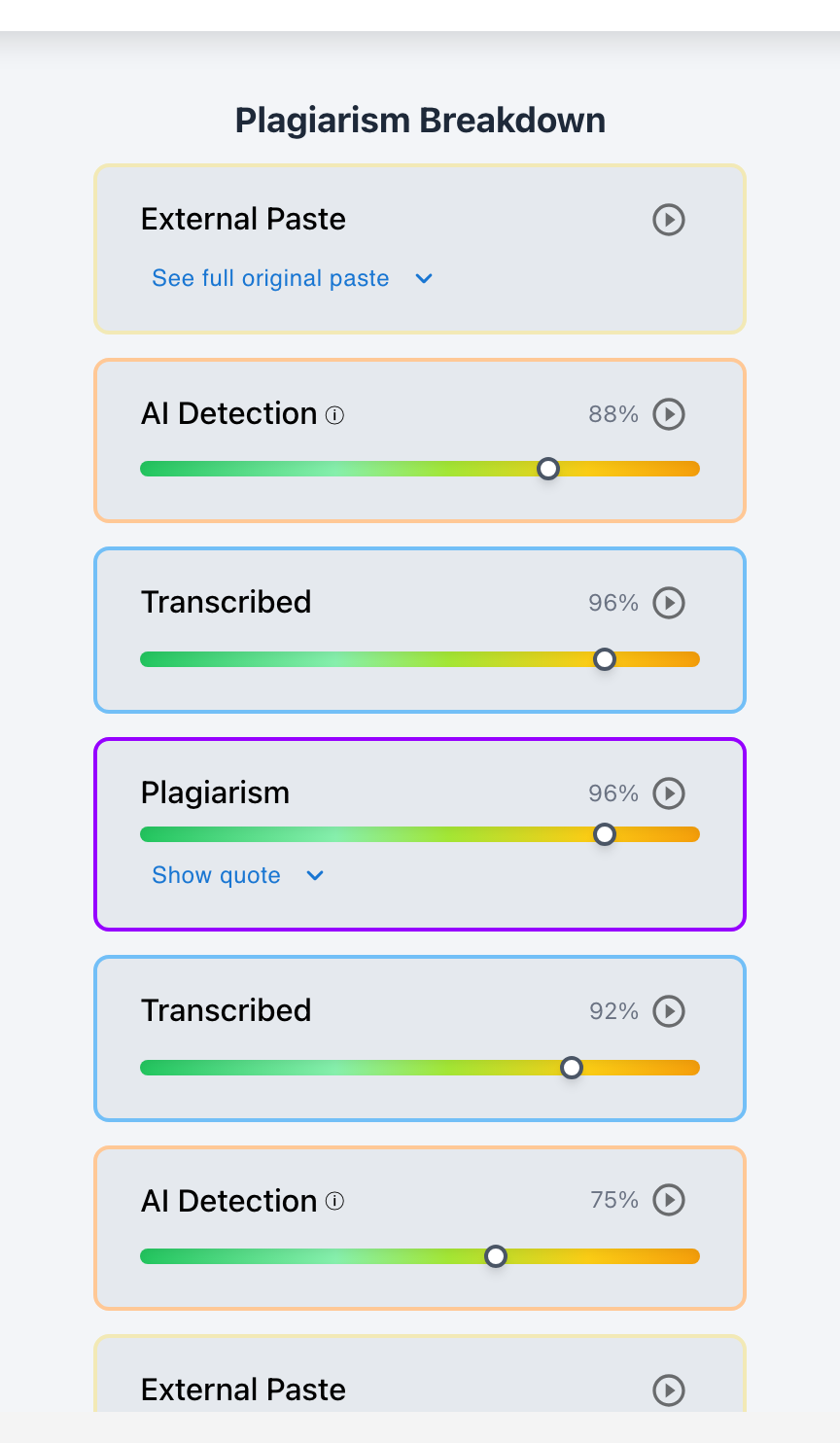
Checkmark Plagiarism detects fake citations by pairing plagiarism detection with AI detection, essay writing playback, autograding, and integrations with Canvas and Google Classroom.
The 4 Types of Fake Citations Generated by AI
1. The "Ghost DOI" Anomaly
The citation contains a realistic-looking alphanumeric string in the standard 10.xxxx/... DOI format, but clicking it on doi.org yields a "DOI Not Found" 404 error.
2. "Frankenstein" Author Combinations
The AI pairs real famous scholars who work in the field with a completely fabricated article title that has never been written or published.
3. Impossible Journal Page Numbering
The citation references pages 412–430 in a specific journal volume and issue that only published 150 total pages in reality.
4. Phantom Book Titles
The citation lists a plausible academic monograph published by Harvard University Press or Routledge that does not exist in WorldCat or library catalogs.
Why Fake Citations Provide Undeniable Proof of AI Use
Unlike abstract statistical AI percentages, fake citations provide concrete physical evidence:
- Mathematical Proof of Fabrication: A human student who researched a paper cannot accidentally invent a non-existent journal article with a fake DOI.
- Unassailable in Parent & Honor Code Reviews: Presenting an official library search showing that a cited book or paper does not exist eliminates all student defense arguments.
- Corroborating Telemetry: In Checkmark Playback, fake citations appear within instant paste blocks or rapid unedited transcription sessions with zero source lookup pauses.
Read more in how Checkmark writing process analysis works.
Comparison: Real Scholarly Citations vs. AI Hallucinations
Real Scholarly Citation (Human Research)
- DOI resolves instantly to publisher landing page.
- Article title matches Crossref and Google Scholar.
- Student can produce full-text PDF upon request.
- Quotes exist on the exact page numbers cited.
AI Hallucinated Citation (ChatGPT Invention)
- DOI returns 404 "DOI Not Found" error.
- Zero results in Google Scholar and WorldCat.
- Student cannot produce the source or explain it.
- Quotes are synthetic inventions that never existed.
A 5-Step Educator Protocol for Fake Citation Audits
Fake Citation Audit Checklist:
- 1. Open the student's submission in Checkmark Plagiarism inside Canvas SpeedGrader.
- 2. Review the automated Citation Verification report: red flags highlight unresolvable DOIs and missing titles.
- 3. Copy a suspicious title into Google Scholar in quotation marks: verify if 0 results are returned.
- 4. Check the DOI link on doi.org to verify active registration.
- 5. Hold a 2-minute conference: "I tried to access this article for grading, but could not find it. Can you email me the PDF of this study?"
How Checkmark Plagiarism Powers Automated Citation Audits
Checkmark Plagiarism combines **AI detection, essay writing playback, static AI detection, plagiarism detection, autograding, and Canvas/Google Classroom integrations** to automatically query academic databases and flag hallucinated sources in seconds.
Frequently Asked Questions
Why does ChatGPT invent fake citations?
Because Large Language Models generate text based on statistical word associations rather than querying live academic databases, creating realistic-sounding but fictitious references.
What is a 'Ghost DOI'?
It is a synthetic digital object identifier string generated by AI that follows standard syntax but has never been registered on doi.org.
How does Checkmark verify citations automatically?
Checkmark queries Crossref, PubMed, Google Scholar, and OpenAlex APIs in the background upon submission, flagging any unresolvable citations.
Can a student accidentally write a fake citation?
A student might make a minor formatting typo in a URL or page number, but inventing an entire fictitious article title and fake author pairing only happens through generative AI.
What if a student copied a fake citation from a blog?
Checkmark Plagiarism's web search engine will identify the exact blog source where the citation originated.
How does Checkmark Plagiarism integrate with Canvas LMS?
Checkmark provides certified LTI 1.3 integration, SpeedGrader sidebar embeds, two-way grade passback, and single sign-on (SSO).
What should a teacher do when a fake citation is proven?
Document the failed DOI search, export the Checkmark citation report, and follow standard institutional academic integrity procedures.
Can students fake library search results?
No. Academic registries like Crossref and WorldCat are centralized databases that cannot be manipulated by students.
Does writing playback show citation creation?
Yes. Playback reveals whether citations entered via a single wholesale paste or were assembled with research pauses and manual typing.
Why are fake citations the strongest proof of AI use?
Because non-existent academic papers are impossible for a human to write by mistake, providing definitive proof of machine generation.
Conclusive Ground Truth Through Citation Verification
In the age of AI, fake citations provide unambiguous, undeniable proof of unauthorized assistance. By automating citation verification and process telemetry with Checkmark Plagiarism, educators protect the integrity of academic research and ensure that grades reflect real scholarship.
Checkmark Plagiarism supports this comprehensive approach with AI detection, essay writing playback, static AI detection, plagiarism detection, autograding, and integrations with Canvas and Google Classroom.
See how Checkmark pairs automated citation verification with multi-signal detection to catch fake AI sources. View a sample report or request a demonstration.