
In scholastic newsrooms, student reporters face intense deadline pressures, complex beats, and uncooperative sources. When high school journalists struggle to secure or transcribe real-world interviews, the temptation to prompt Large Language Models (LLMs) like ChatGPT or Claude to synthesize plausible quotes—from school principals, athletic directors, student leaders, or community experts—creates an existential integrity crisis.
Fabricated quotes violate the Society of Professional Journalists (SPJ) Code of Ethics, undermine scholastic press credibility, trigger severe administrative backlash, and expose student publications to legal liabilities such as defamation and libel. However, generic AI detectors fail student newsrooms: their whole-document probability scores routinely generate false positives on standardized, formulaic Associated Press (AP) Style lead paragraphs while completely missing isolated, synthetically polished quotes embedded inside genuine reporting.
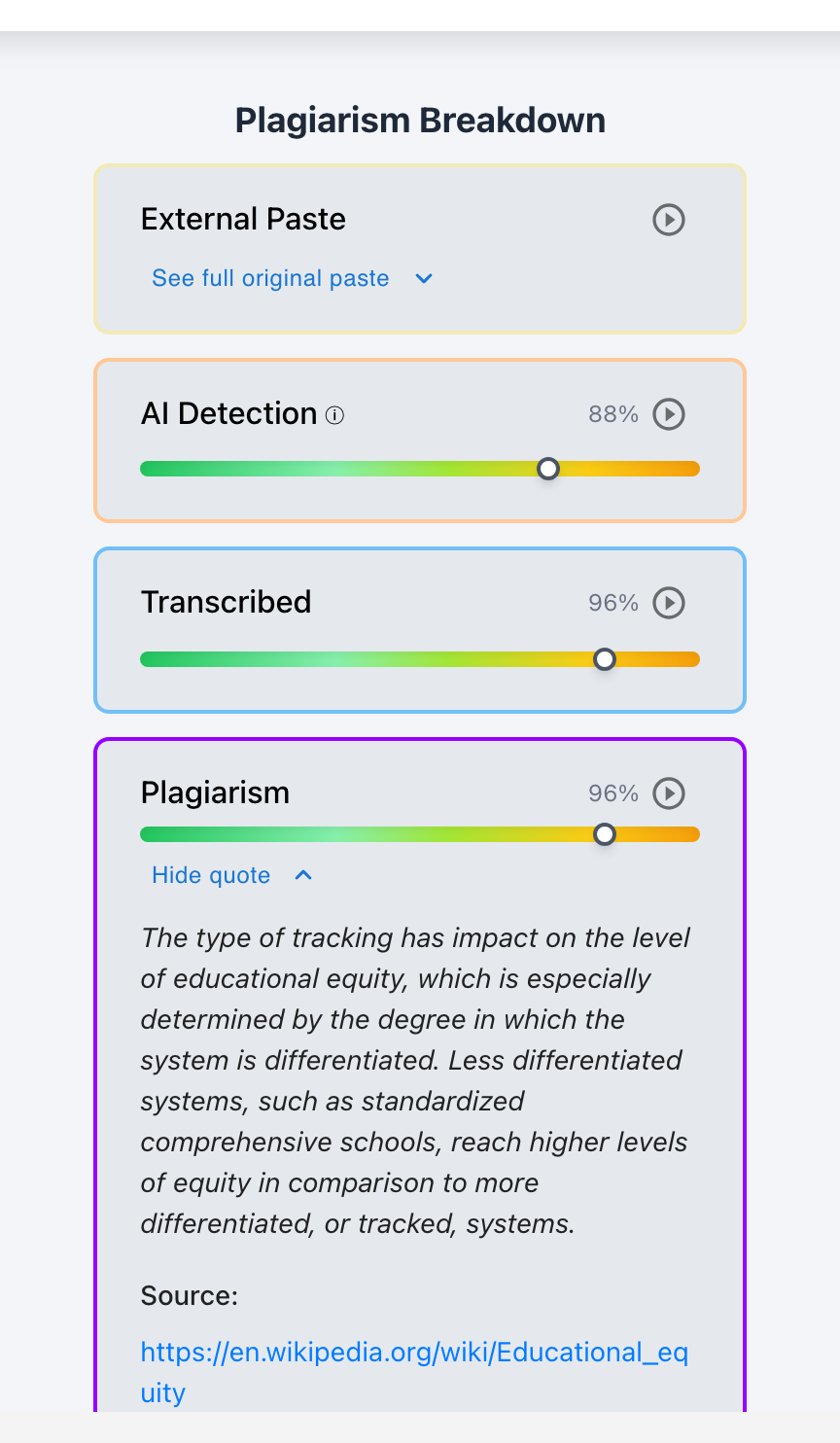
This authoritative guide provides journalism advisers, Journalism Education Association (JEA) and National Scholastic Press Association (NSPA) media educators, and student editors with an actionable verification framework. By combining primary asset verification (raw audio files and automated Otter.ai/Descript transcripts), forensic linguistic analysis (contrasting spontaneous oral dysfluency against polished synthetic diction), and Checkmark Plagiarism’s patent-pending Essay Playback™ (1x–8x keystroke replay, audio transcription pause analysis, and external paste buffer inspection), advisers can conclusively verify quote provenance, protect honest reporters, and foster a transparent, restorative culture of newsroom integrity.
Checkmark Plagiarism provides student media advisers, yearbook instructors, and scholastic journalism programs with an integrated newsroom integrity workbench, combining keystroke process playback with side-by-side source verification, passage-level AI writing detection, quote-anchored rubric autograding, and direct LTI 1.3 integrations for Canvas LMS and Google Classroom.

1. The Scholastic Newsroom Crisis: Synthetic Sourcing and Fabricated Quotes
Scholastic journalism operates under conditions that mirror professional newsrooms—high stakes, tight deadlines, complex ethical constraints, and public accountability—yet it is executed by adolescents who are still developing emotional maturity, social confidence, and foundational reporting skills. High school newspaper advisers, yearbook instructors, digital broadcast teachers, and collegiate student media directors (often affiliated with the Journalism Education Association [JEA], the National Scholastic Press Association [NSPA], and Quill and Scroll) oversee publications that serve as the historical record and primary watchdog for their school communities.
With the proliferation of generative Large Language Models (LLMs), student newsrooms face a novel and deceptive threat: the synthetic interview. Unlike traditional student plagiarism—where a writer copies text directly from an existing website or encyclopedia—synthetic quote generation involves prompting an AI model to generate entirely new, plausible-sounding statements attributed to real or fictitious individuals.
How deadline pressures convert uncooperative sources into synthetic fabrication risks
- Administrator ignores email for 5 days
- Reluctant peer refuses controversial interview
- Publication cycle closes in 3 hours
“Act as high school AD explaining why the turf field is delayed...”
- Pasted into Google Docs or Canvas LMS
- Camouflaged in AP-style inverted pyramid
- Zero raw audio file generated
- False attribution & defamation
- Administrative prior review trigger
- SPJ Code of Ethics breach
1.1 The Anatomy of a Scholastic Deadline Panic
To understand why high school reporters resort to AI quote generation, advisers must examine the intense psychological and logistical pressures that converge during production week:
- The Ghosting Phenomenon (Uncooperative Official Sources): High school reporters frequently cover serious administrative issues—such as budget allocations, facility renovations, scheduling changes, and disciplinary policies. When school principals, district superintendents, or athletic directors fail to respond to interview requests before the editorial cutoff, student journalists feel trapped between missing their deadline or publishing an “unbalanced” story.
- Social Anxiety and Peer Reluctance: Novice reporters often experience intense apprehension when interviewing older peers, authority figures, or students involved in sensitive campus controversies (e.g., student walkouts, grading equity debates, or club defundings). When peers give curt one-word answers or decline to speak on the record, students lack the interviewing experience to probe deeper.
- The Illusions of Plausibility in Modern LLMs: Generative AI tools excel at simulating institutional rhetoric, official apologies, and balanced civic discourse. A student who prompts an AI with, “Write a formal, diplomatic statement from a high school principal explaining why the homecoming dance venue was changed,” receives a paragraph that sounds identical to real district communications. The student convinces themselves that because the quote “sounds like what the principal would have said anyway,” inserting it into the article is harmless.
- The Friction of Audio Transcription: Even when students successfully record a 30-minute interview on their smartphone or voice memo app, the tedious process of listening, scrubbing, and transcribing spoken audio into text creates a severe bottleneck. Novice writers frequently turn to AI not just for transcription, but to “clean up and summarize what the speaker meant,” leading to synthetic paraphrasing that crosses the line into full quote fabrication.
1.2 Prompting LLMs for Synthetic Voices
Student journalists do not typically use AI to write entire 2,000-word feature stories from scratch; rather, they use LLMs surgically to fill reporting voids. Advisers must recognize the distinct prompting patterns students employ:
Yields sanitized bureaucratic jargon that mimics district press releases with zero real administrative accountability.
Produces an awkward mix of forced slang tokens and overly formal grammar—the classic AI Teenager paradox.
Generates dense medical textbook prose detached from specific clinical observations or local community health context.
1.3 Hallucinated Interviewees vs. Fabricated Attributions
In scholastic journalism ethics, synthetic quoting manifests in two distinct, equally damaging categories:
Comparing invented personas against false attribution to real community members
- Mechanism: Student invents a fictitious persona (e.g., “Junior Alex Rivera”, “Community member Sarah Jenkins”) to supply quick quotes.
- Newsroom Impact: Used to manufacture artificial balance or vox-pop consensus on controversial campus issues.
- Forensic Footprint: Zero digital record in school Student Information System (SIS), roster, or yearbook.
- Ethical Breach: Violates the truth-seeking foundation of journalism by fabricating community sentiment out of thin air.
- Mechanism: Student quotes a REAL living person (e.g., the actual principal, athletic director, or ASB president) who never granted an interview.
- Newsroom Impact: Real individual discovers their name attached to synthetic words upon publication.
- Forensic Footprint: Real source confirms zero contact was made; no audio file or email trail exists.
- Legal Liability: Triggers immediate defamation, libel risks, administrative censorship, mandatory retractions, and loss of adviser trust.
1.4 Linguistic Realities: Spoken Dysfluency vs. Polished Synthetic Diction
The most reliable linguistic marker separating genuine spoken interviews from AI-generated quotes lies in the fundamental difference between oral speech production and synthetic text generation.
Human beings do not speak in polished, grammatically balanced compound-complex sentences. When speaking spontaneously—even in formal interviews—human subjects exhibit natural oral dysfluency:
- Conversational Pauses & Fillers: Marked by cognitive processing markers (“well,” “I mean,” “you know,” “honestly”).
- False Starts & Syntactic Repairs: Speakers abandon sentence structures midway and restart (“We looked at the—well, what happened was...”).
- Colloquial Contractions: Spoken verbal forms like “couldn’t,” “they’d,” “gonna” and conversational transitions.
- Hyper-Local Spatial Grounding: Specific references to room numbers, dates, local landmarks, or staff members (“Ever since the pipe burst in room 204 back in October...”).
- Over-Polished Grammatical Symmetry: Perfectly balanced parallel clauses without a single fragmented thought or repair.
- Predictable Rhetorical Triads: Ideas grouped in neat sets of three (“to foster academic excellence, promote student safety, and enhance community engagement”).
- Sterile Institutional Vocabulary: High density of PR buzzwords (“holistic approach,” “pivotal milestone,” “mitigate disruptions”).
- Thematic Hyper-Relevance: Lacks natural conversational meandering; answers the exact journalistic prompt with sterile precision.
2. The Journalistic Credibility, Ethical, and Legal Dilemma
When student publications print fabricated or AI-synthesized quotes, the repercussions reverberate far beyond a single classroom assignment grade. Student media operates under public scrutiny, and ethical failures carry legal, educational, and institutional consequences.
2.1 The SPJ Code of Ethics in Scholastic Publications
The Society of Professional Journalists (SPJ) Code of Ethics, adopted universally across scholastic media associations including the JEA and NSPA, establishes absolute boundaries regarding source authenticity:
- Test the accuracy of information from all sources and exercise care to avoid inadvertent error.
- Identify sources clearly. The public is entitled to as much information as possible to judge reliability.
- Never fabricate quotes, manipulate audio, or invent fictitious sources.
- Diligently seek subjects of news coverage to give them reasonable opportunity to respond.
- Recognize that private individuals (especially minors) have a greater right to control information about themselves.
- Avoid misattributing false or inflammatory statements that could harm student or faculty reputations.
- Balance the community’s need for information against potential personal damage.
- Resist internal and external pressure to alter direct quotes or synthesize artificial consensus.
- Maintain clear distinctions between reporting, editorial commentary, and administrative PR.
- Refuse gifts, special treatment, or administrative intimidation that compromises editorial integrity.
- Explain ethical choices and journalistic processes openly to the student body and faculty.
- Acknowledge mistakes and publish corrections promptly and prominently.
- Maintain accessible audio recordings and transcript archives for all published direct quotes.
2.2 Legal and Administrative Ramifications
Scholastic media operates within a complex legal framework defined by landmark Supreme Court precedents (Tinker v. Des Moines, Hazelwood School District v. Kuhlmeier) and state-level New Voices legislation. Fabricated quotes directly imperil student press freedoms:
- Defamation and Libel Liabilities: Attributing false statements to a real teacher, administrator, coach, or student can form the basis of a defamation or false-light lawsuit if the fabricated words harm their professional reputation or subject them to public ridicule.
- Loss of Administrative Goodwill and Censorship Triggers: High school journalism programs rely on trust with building administrators. In non-New Voices states operating under Hazelwood, a principal who discovers a fabricated quote possesses clear pedagogical justification to institute mandatory prior review or shut down the print edition entirely.
- Compromising New Voices Protections: In states with robust New Voices laws protecting student journalists from administrative censorship, those legal shields explicitly exclude libel, slander, obscenity, or material incitement. Fabricated quotes undermine the legislative defense that student editors are responsible, ethical stewards of free expression.
- Community Backlash and Source Non-Cooperation: Once a school community learns that the student newspaper publishes unverified or AI-generated quotes, faculty and students refuse future interviews, rendering authentic news coverage impossible.
2.3 Why Generic AI Detectors Fail in Newsrooms
Many school districts have attempted to solve AI cheating by purchasing generic, whole-document AI detection software. In scholastic journalism classrooms, these tools fail catastrophically for two fundamental reasons:
How legacy whole-document probability scores create false positives on honest news leads while missing fabricated quotes
Why it fails: Journalistic conciseness, standardized syntax, and factual density mimic the low perplexity patterns of AI models.
Why it fails: Whole-document averaging dilutes the isolated fabricated quote, letting journalistic fraud enter print unnoticed.
3. The Scholastic Journalism Verification Matrix
To establish a defensible, objective standard for evaluating source authenticity, advisers need a multi-layered evaluation framework that separates superficial formatting checks from deep process telemetry.
| Evaluation Dimension | Traditional Fact-Checking | Legacy Plagiarism Scanners | Standalone AI Detectors | Checkmark Integrated Telemetry |
|---|---|---|---|---|
| Quote Provenance Verification | High (Direct editor callbacks) | None (Checks web text matches) | None (Guesses probability) | High (Links raw transcript & keystroke playback) |
| Granularity of Analysis | Manual source by source | Line-by-line web similarity | Whole-document probability % | Passage-level calibrated confidence sliders |
| Auditing Spoken vs. Written Dynamics | Requires listening to 45m audio | Incapable | Incapable | Reconstructs audio listen pauses vs typing bursts |
| External Paste Buffer Preservation | None | None | None | Captures full original clipboard buffer & timestamp |
| AP Style Lead Protection | High (Teacher recognizes news) | Low (Flags official press words) | Extremely Low (High false positives) | Protected by honest <150w guardrails (N/A) |
| Side-by-Side Source Viewer | Manual paper notes comparison | Highlights web text matches | None | Two-way clickable synchronized cards |
| Restorative Coaching Value | High time burden on adviser | Adversarial (Accusatory red ink) | Punitive (Black-box percentage) | Objective, visual “receipts” for 1-on-1 growth |
4. Forensic Linguistic Case Studies: Spoken Transcripts vs. AI Quotes
To train student editors and advisers to spot the subtle markers of AI quote synthesis, consider three realistic scholastic reporting scenarios.
“Look, nobody wants to cut ceramics. My own daughter took ceramics here two years ago. But when we walked the stadium bleachers with the state safety inspector back in August—I mean, section C is literally rusted through the sub-framing. If we don’t remediate code 4-B by November, the county condemns the grandstand. We had to move the line-item from account 302. It’s painful, but spectator life safety has to come first.”
“Our administration remains deeply committed to fostering artistic expression while balancing the indispensable safety imperatives of our athletic infrastructure. The reallocation of funds represents a comprehensive, strategic response to state compliance guidelines, ensuring our facilities promote both educational excellence and physical well-being.”
“Honestly? In third period chemistry it’s super annoying because Mr. Henderson used to let us use the timer on our phones for titration labs. Now we’re fighting over three broken digital stopwatches from like 2008. Like, nobody’s texting during a lab anyway, so locking them up just slows the whole class down.”
“This phone pouch rule is honestly so ridiculous and completely ruins our daily vibe. It literally restricts our collaborative workflow during group assignments and makes high school feel like a maximum security prison. We definitely deserve more mutual respect from the administration.”
“When teenagers hit puberty, their melatonin secretion window shifts back about two full hours. So waking up a 15-year-old at 5:45 in the morning to catch the yellow bus is the biological equivalent of waking an adult up at 3:30 AM. In my clinic, I’m seeing chronic migraine spikes every single October once cross-country and first-period AP classes kick into high gear.”
“Adolescent neurological development necessitates sufficient rapid eye movement sleep cycles to facilitate cognitive consolidation. Early secondary school schedules disrupt circadian rhythms, precipitating academic fatigue, diminished attention spans, and elevated psychological stress among developing teenagers.”
5. The Step-by-Step Journalism Adviser Editorial Audit Protocol
To safeguard school publications without burdening advisers with unsustainable manual fact-checking, student newsrooms should implement a structured, five-stage Editorial Audit Protocol before any story enters layout or digital publishing.
From primary audio intake to restorative post-draft conference
Stage 1: Primary Asset Submission (The “Proof of Reporting” Dossier)
No article draft should be accepted for editorial review without its accompanying Proof of Reporting Dossier. Every student reporter must submit:
- Raw Audio Asset: The unedited audio file recorded via voice memo app, smartphone, Zoom, or handheld recorder.
- Timestamped Transcript: The automated transcript generated by Otter.ai, Descript, or Google Recorder.
- Source Verification Card: Full legal name, official title, school email address, phone extension, and physical room/office location.
- Context Notes: Date, time, and location where the interview occurred (e.g., “Conducted in Room 114 during 5th period lunch on Tuesday, Sept 12”).
Stage 2: Transcript-to-Story Contextual Cross-Referencing
The student section editor or copy editor performs a spot-check cross-referencing direct quotes in the draft against the transcript:
- Timestamp Match: Does the quote appear word-for-word in the transcript at the specified timestamp?
- Context Preservation: Was the quote trimmed in a way that distorts the speaker’s original meaning? (e.g., omitting the word “if” or “unless” to make an administrator sound absolute).
- Question Alignment: Is the quote answering the question the reporter claims they asked, or did the student stitch together disparate sentences from different parts of the interview?
Stage 3: Telemetry & Keystroke Drafting Analysis with Essay Playback™
When an adviser suspects a quote may be fabricated or copied from an unauthorized secondary source, they open Checkmark Plagiarism’s Essay Playback™ viewer. Writing telemetry provides irrefutable, objective insight into the student’s cognitive drafting process:
How keystroke rhythm and external paste capture differentiate real synthesis from fraud
Reporter listens to earphone audio, types phrase, pauses playback, rewinds, and corrects spelling. Keystroke dynamics show realistic, uneven velocity and frequent micro-revisions.
External Paste Inspector flags full clipboard content. One-click “Jump to Playback” confirms no prior typing, brainstorming, or drafting of that quote occurred.
Reporter mechanically retypes text displayed on a phone or secondary ChatGPT window. Complete absence of audio listening delays or sentence restructuring confirms copying of pre-generated prose.

Stage 4: Passage-Level AI Writing Calibration
Rather than relying on generic black-box percentages, the adviser inspects Checkmark’s Passage-Level AI Detection Sidebar:
- Passage-Level Granularity: Checkmark underlines the specific suspected quote in orange or purple without condemning the rest of the student’s 1,200-word investigative article.
- Calibrated Confidence Sliders: Clicking the quote opens an evidence card displaying the probabilistic distribution (typical human speech variance vs. regular synthetic token prediction).
- Honest Guardrails (<150 Words): If an adviser analyzes a single 30-word quote in isolation, Checkmark displays
N/A, preventing false accusations on statistically insufficient sample sizes.
Stage 5: Supportive Restorative Newsroom Coaching
The ultimate goal of scholastic journalism advising is education, not punishment. When telemetry confirms an unauthorized AI quote or unverified attribution, the adviser facilitates a restorative integrity conference:
- Open the Telemetry Together: The adviser and student sit side-by-side and review the Essay Playback™ replay and Paste Inspector logs together.
- Remove the Confrontation: Because the evidence is visual and objective, the conversation avoids defensive denial and focuses on root causes: “I see you encountered a paste event here at 11:30 PM. What happened with the interview deadline?”
- Teach Reporting Problem-Solving: Guide the student through professional alternatives: how to file a public records request, how to politely escalate an unanswered media inquiry, or how to write an ethical attribution of non-response (“Principal Marcus Davis did not respond to three email requests for comment prior to publication deadline”).
- Restorative Remediation: Require the student to conduct a genuine in-person follow-up interview, submit the complete audio dossier, and complete a reflective rewrite before publication.
6. How Checkmark Plagiarism Empowers Scholastic Journalism Programs
Checkmark Plagiarism provides a purpose-built, educator-first integrity architecture designed to meet the rigorous pedagogical and ethical demands of modern scholastic media programs.
Six core pillars engineered for newsroom integrity, source verification, and formative coaching
Keystroke-by-keystroke timeline reconstruction at 1x–8x speed. Differentiates organic audio transcription pauses from external text injections.
Captures 100% of clipboard text, timestamping injections and preserving original strings even after extensive student rewrites.
Multi-factor perplexity and burstiness sliders on individual sentences. Prevents whole-document false positives on AP Style leads.
Categorizes text into Direct Quotes, Uncited Sources, Patchwriting, and Wire References. Replaces red blobs with actionable coaching flags.
Quote-anchored feedback aligned with JEA standards for leads, quote attribution, and AP style. Advisers retain 100% editing authority.
Student investigative notes and drafts are NEVER used to train AI models. Full compliance with FERPA, COPPA, and state student privacy laws.
7. Practical Newsroom Policy Framework: Model Staff Manual Guidelines
Journalism advisers can adopt the following model policy language for their student media staff handbooks and newsroom operating manuals.
1. Direct quotes enclosed in quotation marks must represent the exact spoken or written words of the identified speaker, edited only for minor vocal dysfluencies (“um,” “like”) without altering grammatical context, intent, or factual meaning.
2. Paraphrased statements must accurately reflect the source’s verified views and contain clear attribution tags (e.g., “according to district financial reports”).
3. Anonymous sources are strictly prohibited unless approved in writing by the Adviser and Editor-in-Chief to protect the source from physical, legal, or administrative retaliation.
Permissible Uses: Automated speech-to-text transcription software (Otter.ai, Descript) with raw audio; headline brainstorming; interview question generation; copy editing for grammar.
Prohibited Uses: Prompting AI models to generate, synthesize, or “clean up” quotes attributed to real or fictitious individuals; using generative AI to write whole narrative sections, leads, or editorial arguments.
1. Reporters must maintain raw audio files and automated transcripts in the staff Google Drive for a minimum of two academic semesters following publication.
2. Section editors will conduct random audit cross-references of direct quotes against audio recordings using Checkmark Essay Playback™ prior to final layout sign-off.
First-time ethical violations involving unverified quotes or synthetic AI text result in immediate retraction from the publishing cycle, mandatory restorative reporting conference with the Adviser, and completion of a re-interview portfolio.
8. Frequently Asked Questions (FAQs)
Q1: How can an adviser tell if a student cleaned up a real quote versus having AI synthesize it?
Cleaning up a real quote involves removing verbal fillers (“um,” “you know”) while retaining the speaker’s distinct vocabulary, regional phrasing, and specific local details. AI synthesis replaces human vocabulary with generic, corporate, or sociological abstractions and creates unnaturally balanced parallel syntax. By reviewing the raw audio transcript in the Proof of Reporting Dossier and checking Essay Playback™, advisers can see whether the student lightly trimmed an authentic sentence or replaced it with an external paste.
Q2: Why do generic AI detectors flag student news leads written in standard AP Style?
Associated Press Style teaches students to write concise, formulaic leads that answer Who, What, Where, When, and Why in 25 to 35 words using active voice and standard subject-verb-object order. Because LLMs are trained to produce highly efficient, statistically predictable prose, authentic AP Style leads naturally register low perplexity scores on generic AI detectors. Checkmark prevents these false accusations through passage-level analysis and honest <150-word guardrails.
Q3: What if a student claims they interviewed a source in person and did not record audio?
While in-person reporting without audio occasionally happens, professional standards (SPJ, JEA, NSPA) require journalists to maintain detailed handwritten notes in a physical reporter’s notebook with exact timestamps and source contact information. Advisers should verify the source’s email and require the student to send a brief fact-checking confirmation email before publication. In Essay Playback™, authentic note-transcription shows uneven typing bursts as the student reads from their notebook.
Q4: Can a student use AI transcription tools like Otter.ai or Descript without violating ethics?
Yes. Using automated speech-to-text software to transcribe an authentic recorded interview is an authorized, industry-standard efficiency practice. The ethical boundary is clear: the audio must be real, and the transcript must reflect what the speaker actually said. The violation occurs when a student uses an LLM to generate synthetic text from scratch or prompts an AI to rewrite a source’s words into a completely fabricated statement.
Q5: How does Essay Playback™ protect honest student reporters falsely accused of using AI?
When an administrator, parent, or teacher suspects an exceptionally well-written article was produced by ChatGPT, Essay Playback™ provides complete forensic proof of authentic human authorship. Advisers can replay the drafting session to show every composing pause, structural reorganization, draft revision, and backspace, conclusively exonerating the student.
Q6: What legal risks do school publications face if an AI-fabricated quote is published?
Publishing fabricated quotes attributed to a real person constitutes false attribution and can trigger defamation or libel lawsuits if the statement harms their professional standing. In non-New Voices jurisdictions, it provides school administrators with legal grounds under Hazelwood to impose prior review or censor the publication. It also permanently damages community trust.
Q7: Does Checkmark Plagiarism train AI models on student journalism submissions?
No. Checkmark adheres to strict enterprise data privacy standards and is fully compliant with FERPA and COPPA. Student articles, reporter notes, and interview drafts are never used to train public or proprietary AI models, ensuring complete confidentiality for student investigative reporting.
Conclusion: Stop Guessing, Start Trusting
Scholastic journalism is one of the most powerful civics and writing laboratories in modern education. It teaches students how to listen actively, investigate rigorously, synthesize complex information, and hold power accountable. However, maintaining the integrity of student media in the age of generative AI requires moving away from punitive, black-box suspicion and embracing transparent, defensible evidence.
By establishing clear staff policies, requiring primary audio dossiers, and utilizing Checkmark Plagiarism’s integrated suite—including Essay Playback™, the External Paste Inspector, passage-level calibrated AI confidence sliders, and quote-anchored rubric autograding—journalism advisers and student editors can protect honest reporting, prevent quote fabrication, and uphold the highest standards of journalistic excellence.
Transform Your Student Newsroom with Checkmark Plagiarism
Empower your journalism staff with patent-pending Essay Playback™, raw paste buffer forensics, and JEA-aligned rubric autograding.