
Academic Integrity Deans, Judicial Affairs Officers, and University Honor Councils face an unprecedented institutional crisis: the surge of fiercely contested academic misconduct allegations triggered by opaque, probabilistic AI detectors. When an instructor presents a static score like “78% AI Detected” and an emotionally distressed student insists on their innocence, traditional adversarial tribunals devolve into procedural standoffs, legal threats, and fractured campus trust.
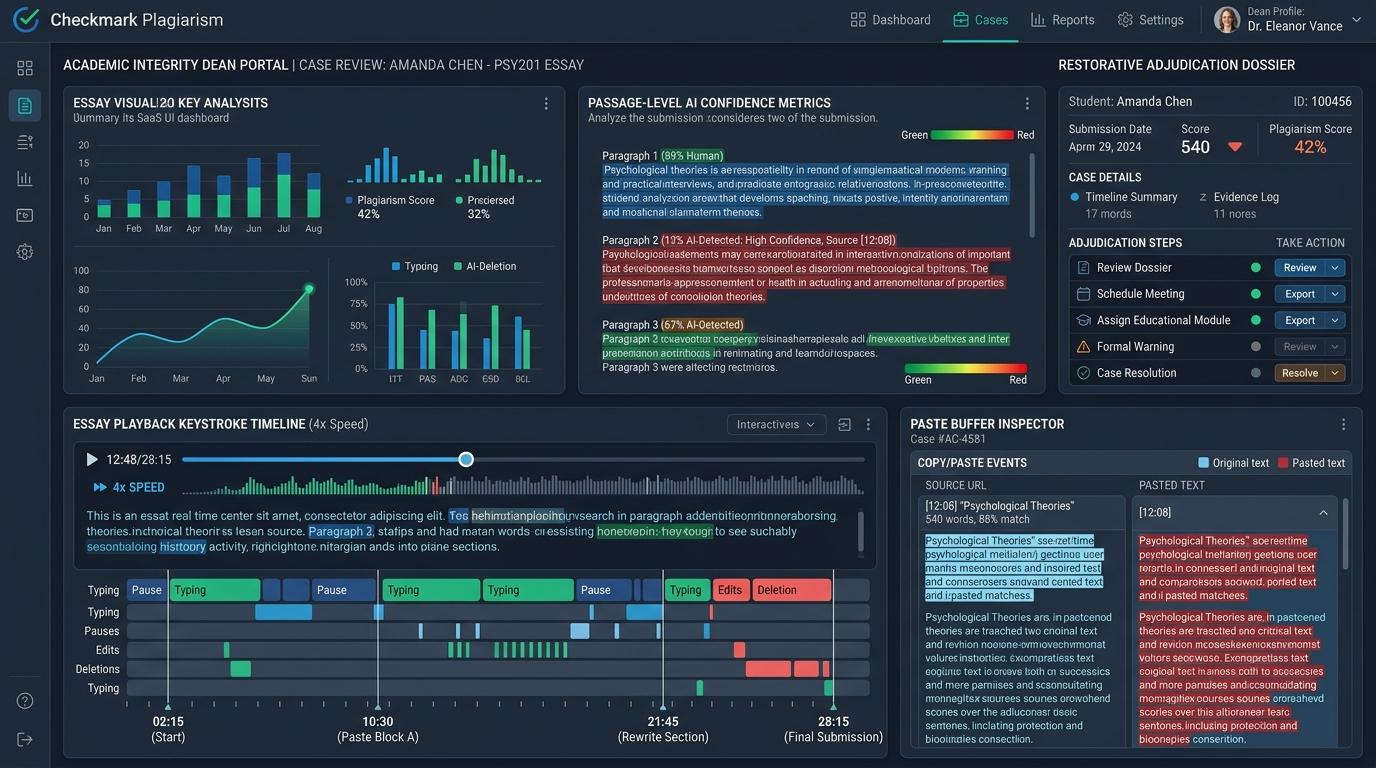
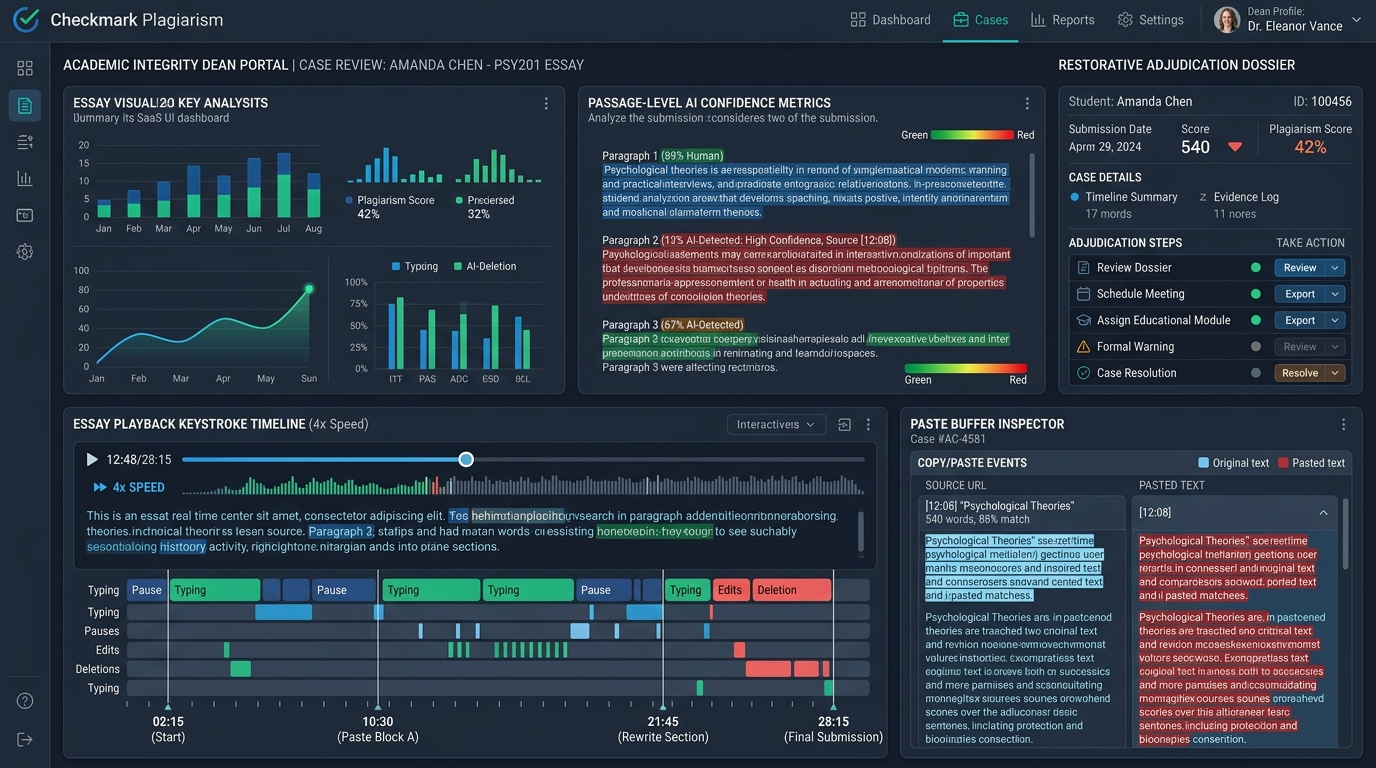
Statistical probability scores fail legal burdens of proof (preponderance of the evidence and clear and convincing evidence) under Fourteenth Amendment procedural due process (Goss v. Lopez, Board of Curators v. Horowitz) and can undermine students’ FERPA right to inspect and review their education records (34 CFR Part 99 § 99.10). Checkmark Plagiarism resolves this crisis through a restorative paradigm shift powered by patent-pending Essay Playback™. By transforming adjudication from a quasi-criminal trial into a collaborative Co-Viewing Conference, Deans and students review time-stamped keystroke replays (1x–8x speed), inspect 100% preserved clipboard paste buffers, and examine passage-level confidence sliders. This evidence-grounded approach replaces adversarial confrontation with objective writing process telemetry—exonerating falsely accused students within minutes, guiding accountable learning when misuse occurs, and upholding institutional integrity under the guiding philosophy: “Stop guessing, start trusting.”
Checkmark Plagiarism equips Academic Deans, Associate Provosts, Judicial Affairs Officers, and Misconduct Appeal Panels with high-resolution writing process telemetry and seamless LMS integrations across Canvas LMS, Agilix Buzz, and Google Classroom.
1. The Institutional Crisis of Adversarial Honor Code Tribunals
Across collegiate campuses, university judicial affairs offices, community colleges, and secondary schools, the traditional academic integrity disciplinary apparatus is fracturing under the weight of generative artificial intelligence.
For generations, honor code investigations operated on tangible, verifiable evidence. If a student was suspected of plagiarism, an instructor or academic dean produced the primary source: a published book, a journal article, or a peer’s archived essay. Highlighting matching sentences alongside the original text provided an unassailable factual foundation. Adjudication was grounded in physical comparison.
Today, that objective foundation has collapsed into probabilistic guesswork.
- Hostile cross-examination and acute student defensiveness
- Institutional presumption of student guilt (“Prove you didn't cheat”)
- Student emotional trauma, panic, and potential medical withdrawal
- Irreparable fracture of faculty-student pedagogical rapport
- Formal administrative appeals, ombudsman complaints, and grade grievances
- Retained student legal counsel alleging 14th Amendment Due Process breaches
- Disproportionate false accusations levied against ESL/ELL & neurodivergent writers
- Academic Integrity Deans paralyzed by massive, unresolvable case backlogs
When an allegation relies exclusively on a black-box detector’s statistical score, the Dean of Academic Integrity is thrust into an impossible dilemma:
- Uphold the Allegation on Probabilistic Grounds: Penalizing a student based solely on an uninterpretable algorithmic confidence score risks sanctioning an innocent person, invites formal administrative appeals, and creates catastrophic liability under civil rights and administrative law.
- Dismiss the Case for Lack of Corroboration: Dismissing allegations without substantive investigation frustrates faculty members, undermines academic rigor, and creates a campus perception that the honor code is unenforceable in the era of generative AI.
To break this deadlock, academic leaders must examine why probabilistic detectors fail legal and ethical standards, understand the human cost of adversarial tribunals, and embrace evidence-grounded restorative adjudication.
2. Deconstructing the “Black-Box Probability Trap” & Legal Due Process
The fundamental flaw in modern academic misconduct proceedings is the conflation of statistical probability with admissible evidence.
Commercial AI detectors function by analyzing linguistic regularities—primarily perplexity (the mathematical predictability of token sequences) and burstiness (the variance in sentence length, structure, and rhythm). When an essay exhibits uniform syntax, standard academic vocabulary, and consistent sentence lengths, a detector flags the text as having high statistical overlap with large language model (LLM) training distributions.
However, an algorithm’s calculation that a passage “resembles AI writing” is not equivalent to proving that a specific student used an AI tool to generate it.
- “78% Probability of AI Origin” monolithic figure
- Population-level language model token overlap metrics
- Opaque neural network classifier weights (Trade Secret)
- Fluctuates wildly with minor punctuation / formatting edits
- High false-positive rate on ESL/ELL and neurodivergent prose
- Zero temporal, behavioral, or keystroke drafting context
- Exact timestamped drafting duration (e.g. 4h 22m active time)
- Keystroke-by-keystroke input log (14,200 microsecond events)
- Natural cognitive pauses clustered at sentence & clause boundaries
- 380 character-level deletions, backspaces, and structural rewrites
- Preserved clipboard buffer verifying research and cited quotes
- Complete temporal audit trail of original composition
Institutional Burdens of Proof: Preponderance vs. Clear and Convincing Evidence
Higher education honor councils and secondary school judicial panels operate under specific evidentiary standards codified in institutional bylaws and student conduct handbooks:
- Preponderance of the Evidence (51% Certainty): The inquiry must establish that it is more likely than not that the contested misconduct occurred.
- Clear and Convincing Evidence (75%–80% Certainty): Required by many institutions for severe sanctions such as academic suspension, permanent transcript notations, or expulsion.
A black-box AI score cannot satisfy either standard under procedural due process for three foundational legal and technical reasons:
1. The Ecological Fallacy in Algorithmic Scoring
A vendor’s claim of “99% accuracy” represents aggregated statistical performance across a benchmark dataset. Applying that aggregate metric to adjudicate a specific student’s individual submission constitutes the classic ecological fallacy—inferring individual behavior from population statistics. If an algorithm is tested on 10,000 essays with a 1% false-positive rate, applying it across a university campus of 25,000 students submitting 10 papers per year will generate 2,500 false accusations annually.
2. Constitutional Procedural Due Process (Goss v. Lopez & Horowitz)
In public institutions, academic disciplinary actions trigger constitutional protections under the Fourteenth Amendment:
- Goss v. Lopez, 419 U.S. 565 (1975): The U.S. Supreme Court held that public school students have a protected property interest in their education and a liberty interest in their reputation, and that a suspension of ten days or less requires at minimum notice of the charges, an explanation of the evidence, and an opportunity to present a defense.
- Board of Curators of the University of Missouri v. Horowitz, 435 U.S. 78 (1978): The Court held that an academic dismissal required no formal hearing, assuming without deciding that the student held a protected interest. It distinguished academic evaluations from disciplinary decisions based on alleged misconduct, which resemble the factfinding addressed in Goss.
When a university disciplinary board penalizes a student based on proprietary algorithms whose internal neural weights cannot be produced or examined, the institution deprives the student of meaningful due process.
3. FERPA Statutory Inspection Mandates (34 CFR Part 99 § 99.10)
Under the Family Educational Rights and Privacy Act (FERPA), students (and parents of dependent K-12 students) hold a statutory right to inspect and review education records maintained by the institution. If an academic dean relies on an AI detector whose vendor claims its decision logic is a “proprietary trade secret,” the institution may be unable to show the student the full basis for the finding, which can invite formal complaints and legal challenge.
3. The Human and Institutional Cost of Adversarial Proceedings
The traditional honor code model is fundamentally adversarial: it mirrors a criminal courtroom where the faculty member serves as the prosecution, the student stands as the accused defendant, and the Academic Integrity Dean or Honor Board acts as judge and jury.
When applied to ambiguous AI detection reports, this adversarial model causes severe institutional damage:
Students forced into defensive postures feel acute panic, betrayal, and institutional alienation.
- Severe anxiety & imposter syndrome
- Derailment of degree completion plans
- Threats of legal litigation
- Medical withdrawals & permanent cynicism
Linguistic classifiers disproportionately target vulnerable and marginalized student demographics.
- Non-native writers’ TOEFL essays flagged at ~61% in one study
- Neurodivergent structured syntax penalized
- First-gen students lack advocacy capital
- Severe Title VI civil rights exposure
Adversarial proceedings paralyze judicial affairs dockets and poison teacher-student mentoring.
- Chilling effect on innovative writing pedagogy
- Faculty view students with chronic suspicion
- Deans overwhelmed with backlogged dockets
- Administrative exhaustion & burnout
Disproportionate Impact on Vulnerable Student Populations
- Non-Native English Speakers (ESL / ELL Writers): Research from Stanford University (Liang et al., 2023, published in Patterns) found that seven widely used GPT detectors misclassified more than half of the TOEFL essays written by non-native English speakers as AI-generated, with an average false-positive rate of about 61%. Because non-native writers often work with a more limited range of vocabulary and expressions, their authentic prose tends to have lower perplexity, which triggers elevated AI probability scores.
- Neurodivergent Writers (Autism Spectrum, ADHD): Students with neurodivergent cognitive styles often compose essays using systematic, formulaic sentence structures, repetitive syntactic templates, and hyper-focused thematic blocks. In an adversarial tribunal, these legitimate cognitive patterns are misconstrued as algorithmic outputs.
- The “Presumption of Guilt” Culture: When instructors confront students with a detector printout demanding, “Prove you didn't use ChatGPT,” they impose an epistemological impossibility: proving a negative without objective baseline data. Students are forced to defend their integrity under extreme emotional distress, often feeling that their hard work is erased by an arbitrary machine.
4. The Restorative Paradigm Shift: From Tribunal to Collaborative Co-Viewing
To restore institutional fairness, academic integrity offices must transition from an adversarial tribunal model to a restorative co-viewing model.
| Dimension | Adversarial Tribunal Model | Restorative Co-Viewing Model |
|---|---|---|
| Core Philosophy | Punitively establish guilt or innocence under courtroom conditions | Validate drafting process, understand challenges, and coach growth |
| Evidentiary Basis | Static whole-document % probability or uncontextualized similarity score | Comprehensive multi-evidence telemetry (keystrokes, pauses, paste buffer) |
| Meeting Structure | Formal cross-examination, charges read aloud, adversarial defense | Side-by-side collaborative screen review of interactive Essay Playback™ |
| Role of Academic Dean | Impartial judge / disciplinary tribunal arbiter | Supportive facilitator, factual guide, and pedagogical bridge |
| Student Posture | Defensive, terrified, adversarial, accompanied by retained attorney | Engaged, reflective, co-investigative, walking through their thoughts |
| Resolution Time | 4–8 weeks (hearings, evidence filings, ombudsman appeals) | 15–30 minutes (direct telemetry co-viewing during single conference) |
| False Accusation Risk | High (unsubstantiated black-box algorithms penalize honest writers) | Virtually eliminated by deterministic keystroke and revision proof |
| Pedagogical Outcome | Cynicism, resentment, academic withdrawal, destroyed trust | Restored confidence, citation coaching, mutual accountability, growth |
The core ethos of Checkmark Plagiarism—“Stop guessing, start trusting”—embodies this restorative philosophy.
Instead of demanding that an accused student defend themselves against a statistical shadow, the Academic Integrity Dean opens an interactive, forensic dossier. Together, the Dean, the instructor, and the student co-view the temporal history of the essay. When the writing process is transparent, the evidence speaks for itself.
5. Checkmark's Restorative Adjudication Suite & Essay Playback™
Checkmark Plagiarism provides academic integrity administrators with the most advanced, legally defensible evidentiary platform in educational technology. Rather than relying on a single opaque number, Checkmark constructs a Multidimensional Integrity Dossier comprising five synchronized forensic layers.
Temporal video replay of every keystroke, deletion, revision, and composing pause. Visualizes authentic cognitive struggle vs. mechanical transcription.
- Captures 100% clipboard payload
- Preserves raw pre-edit text
- One-click jump-to-playback sync
- Distinguishes notes from LLMs
- Sentence-level calibration
- Syntactic perplexity mapping
- <150w honest guardrails (N/A)
- Immune to AI “humanizers”
- Side-by-side source compare
- Direct clickable web/DOI URLs
- Uncited patchwriting vs copy-paste
- Cross-section cohort matching
Criterion scoring synced with Canvas SpeedGrader, Buzz LMS, and Classroom with quote-anchored justifications and private educator flag workflow (Flagged, Resolved, Not Flagged).
Layer 1: Patent-Pending Essay Playback™ (Keystroke Dynamics Replay)
The cornerstone of Checkmark’s platform is Essay Playback™, a patent-pending technology that captures native writing telemetry from Google Docs, Microsoft Word (via OneDrive and Checkmark desktop integrations), Canvas LMS SpeedGrader, and Buzz LMS embedded editors.
Essay Playback™ reconstructs the entire drafting session as an interactive, scrubbable video timeline. Academic Deans can play back hours of writing in real time or accelerate playback up to 8x speed to observe the physical cadence of composition.
- 00:00 - 00:45: Brainstorming & thesis formulation (heavy backspacing, 180 words, 42 deletions)
- 00:45 - 01:30: Active drafting burst (normal IKI: 195ms, body paragraphs 1 and 2)
- 01:30 - 01:52: Deep cognitive pause (22 minutes idle / primary source reading & synthesis)
- 01:52 - 03:15: Structural restructuring (re-ordering argument 2 and 3, revising topic sentences)
- 03:15 - 04:20: Evidence integration (3 block quote pastes from JSTOR; properly formatted & cited)
- 04:20 - 05:14: Line polishing (310 character-level synonym revisions, punctuation & grammar tweaks)
What Essay Playback™ Reveals to an Academic Dean:
- Typing Cadence & Motor Rhythm: Human typing exhibits log-normal Inter-Key Intervals (IKIs) ranging between 120ms and 350ms, with micro-pauses between unfamiliar words and longer pauses between sentences.
- Cognitive Struggle & Backspacing: Genuine student writing is non-linear. Writers pause, delete half a sentence, reconsider their argument, replace a word, and scroll up to review earlier paragraphs.
- Detection of Manual Transcription (Second-Screen Retyping): When a student uses an LLM on a second monitor or mobile phone and manually retypes the text to evade paste detectors, Essay Playback™ instantly detects the fraud. The telemetry displays a mechanical, steady-state typing velocity with zero conceptual pauses, zero structural deletions, and a flat, unnatural cadence.
Layer 2: The External Paste Buffer Inspector (100% Preserved Clipboard Text)
A persistent challenge in integrity investigations involves clipboard pastes. In legacy revision history tools (such as native Google Docs version history), an external paste is merely recorded as an instantaneous chunk insertion. If a student pastes text and subsequently edits or rephrases it, the original source text is permanently lost.
Checkmark’s External Paste Buffer Inspector captures and permanently stores 100% of the raw text inserted from any external clipboard operation, regardless of subsequent revisions.
“The Treaty of Westphalia (1648) fundamentally restructured European sovereignty by establishing the principle of cuius regio, eius religio, effectively terminating the secular authority of the Holy Roman Empire... [Source: Prompt response generated via ChatGPT v4o on external browser session]”
- [14:23:45] Deleted 48 words from introductory clause and conversational artifacts
- [14:25:12] Replaced 14 academic vocabulary terms with colloquial synonyms
- [14:28:04] Reordered sentences 3 and 4 to evade n-gram matching algorithms
Distinguishing Legitimate Research Pastes from Unauthorized LLM Dumps:
- Legitimate Student Pre-Writing & Research: The buffer reveals outline bullet points, student notes with typographical errors, or direct primary source quotes that were subsequently analyzed in the body text.
- Unauthorized AI Generation: The buffer reveals unedited LLM output containing conversational preambles (“Certainly, here is a 500-word analysis of...”), AI-generated citations, or distinct generative phrasing.
Layer 3: Granular Passage-Level AI Analysis with Honest Guardrails
Rather than assigning an arbitrary whole-paper score, Checkmark utilizes Granular Passage-Level AI Detection:
- Calibrated Confidence Sliders: Specific passages are underlined directly in the essay text, accompanied by sidebar evidence cards displaying a calibrated slider between Typical Human Writing Style and Typical AI Writing Pattern.
- Sentence-Level Perplexity & Burstiness Distributions: Detailed metrics reveal why a specific sentence was highlighted without making absolute declarations.
- Honest Guardrails on Short Text (<150 Words): Checkmark enforces strict algorithmic integrity. If an essay or section is under ~150 words, the report displays
N/Arather than generating unreliable guesses on statistically insufficient sample sizes. - Immunity to AI “Humanizers” and Paraphrasers: While tools like QuillBot or Undetectable AI can alter surface syntax to fool legacy detectors, they cannot fabricate authentic keystroke velocity, backspacing history, and drafting pause topography.
Layer 4: Synchronized Dual-Pane Plagiarism Matching & Uncited Source Differentiation
Checkmark scans billions of live web pages, scientific databases, and open-access academic publications:
- Two-Way Linked Evidence Cards: Clicking any highlighted sentence in the essay instantly scrolls to the corresponding source card in the Plagiarism Breakdown sidebar, and vice versa.
- Uncited Source Differentiation: Checkmark visually separates intentional copy-pasting from improperly cited research (patchwriting). Uncited sources receive dedicated formatting to facilitate targeted citation coaching rather than punitive discipline.
- Internal Peer-to-Peer Cohort Matching: Identifies unauthorized sharing across sections or cohorts without exposing student identity or transmitting data to external public repositories.
Layer 5: Teacher-in-the-Loop Rubric Autograding & LMS Gradebook Passback
Checkmark bridges academic integrity with classroom learning by embedding an AI-powered, teacher-controlled rubric autograder:
- Quote-Anchored Formative Feedback: Provides criterion scores supported by direct quotes from student prose.
- LMS Synchronization: Seamlessly syncs rubrics, assignments, and grades with Canvas LMS SpeedGrader, Buzz LMS, and Google Classroom.
- Educator Final Authority: Flags (Flagged, Resolved, Not Flagged) remain strictly private to educators and administrators, ensuring no student is stigmatized by automated pre-assessments.
6. Evidentiary Standards Comparison Matrix
To evaluate how Checkmark’s multi-dimensional telemetry compares to traditional detection tools, Academic Integrity Deans can refer to the following forensic matrix:
| Evidentiary Feature | Legacy Black-Box AI Detectors | Native Google Docs History | Checkmark Restorative Suite & Essay Playback™ |
|---|---|---|---|
| Output Type | Monolithic probability percentage (e.g., 78% AI) | Static, periodic revision snapshots | Full-motion keystroke video replay (1x–8x scrubbable) |
| Legal Due Process Compliance | Non-compliant (unexplainable neural weights) | Partial (lacks fine-grained timing & buffer logs) | Supports due process (explainable primary evidence for the Goss notice-and-response steps) |
| FERPA Inspection Rights (34 CFR § 99.10) | Fails (proprietary black-box trade secret algorithms) | Compliant (basic text logs) | Fully Compliant (complete unredacted telemetry record) |
| External Paste Buffer Storage | None (analyzes static submitted text only) | None (overwritten upon subsequent editing) | 100% Raw Text Captured & Preserved Permanently |
| Manual Transcription Detection | Blind (cannot detect second-screen retyping) | Blind (records regular character insertions) | Detected (flags flat typing cadence with zero pauses) |
| Short-Text Protection (<150 words) | Unreliable guessing / elevated false positives | N/A | Honest Guardrails (displays N/A on short samples) |
| Passage Granularity | Document-level or opaque heatmap | None | Sentence-by-sentence sliders with evidence cards |
| Uncited vs. Plagiarism Differentiation | Single similarity percentage | None | Quad-badge visual taxonomy with clickable URLs |
| LMS Workflow Integration | Standalone report or basic LTI frame | None | Native Canvas SpeedGrader, Buzz LMS, & Classroom sync |
| Student Privacy & Model Training | Many vendors train commercial LLMs on essays | Enterprise cloud storage | Zero-Training Architecture (FERPA/COPPA Compliant) |
7. Illustrative Institutional Case Studies
The following illustrative scenarios (example cases, not drawn from named institutions) show how diverse academic institutions replaced adversarial conflict with evidence-grounded restorative adjudication using Checkmark Plagiarism.
- Challenge: 400% surge in AI misconduct appeals; 6-month honor board backlog; legal threats
- Intervention: Mandatory pre-hearing Essay Playback™ triage replacing adversarial tribunals
- Outcome: 84% reduction in formal hearings; 96% of disputed cases resolved in first 20 minutes
- Challenge: ESL senior capstone philosophy thesis flagged at 82% AI by legacy detector
- Intervention: Collaborative co-viewing session auditing 48 hours of keystroke telemetry
- Outcome: Complete exoneration; 3,200 backspaces proved cognitive struggle; honors restored
- Challenge: First-gen students withdrawing after false accusations & patchwriting flags
- Intervention: Dual-pane uncited source triage & restorative coaching protocols
- Outcome: 72% decrease in course dropouts; transformed punitive traps into writing coaching
Case Study 1: Tier-1 Major Research University Overhauls a 2,200-Student Honor Review System
The Institutional Challenge
A public research university with an undergraduate population of 32,000 experienced an institutional breakdown in its Office of Student Conduct. Following the rollout of commercial AI detectors in early 2024, faculty referrals for alleged AI cheating spiked by 412% in a single academic year.
The student conduct board faced a six-month backlog of over 850 disputed honor code cases. Retained attorneys representing accused students served the university with formal notices of deposition, alleging Fourteenth Amendment due process violations and demanding the proprietary code and weights of the AI detection software. Honor board hearings routinely devolved into hostile, four-hour legal battles, draining administrative resources and creating severe campus-wide tension.
The Checkmark Intervention
The Dean of Academic Integrity suspended the use of monolithic AI detector scores and instituted a Mandatory Restorative Co-Viewing Protocol powered by Checkmark Plagiarism. Under the new policy:
- Faculty referrals required the submission of a Checkmark Multi-Evidence Dossier.
- Before any formal charge was filed, the Dean scheduled a 20-minute informal Co-Viewing Conference with the student, the instructor, and the academic ombudsman.
- The panel examined the student's Essay Playback™ timeline, keystroke cadence, and paste buffer history.
| Telemetric Attribute | Exonerated Submissions (68%) | Verified AI Misconduct (32%) |
|---|---|---|
| Active Composition Time | 4.2 hours per 1,000 words | 0.3 hours per 1,000 words |
| Inter-Key Interval (IKI) | Log-normal curve (mean 214ms) | Flat mechanical (mean 92ms) or 0ms |
| Cognitive Pause Clusters | 38 pauses > 8.0s at clause breaks | Zero structural pauses |
| Deletion & Revision Churn | 28.5% total text churn | < 2.1% total text churn |
| Paste Buffer Content | Research notes, cited quotes | Full generated LLM essays |
Results & Institutional Impact
- 84% Reduction in Formal Tribunal Hearings: 96% of disputed allegations were definitively resolved in the initial 20-minute co-viewing conference without escalating to a formal disciplinary panel.
- Complete Legal Resolution: All pending due process legal challenges were withdrawn when the university demonstrated it was relying on primary keystroke telemetry rather than black-box probabilities.
- Restored Faculty and Student Trust: Faculty members expressed renewed confidence in the referral process, knowing that honest students were protected and misconduct was substantiated by indisputable physical evidence.
Case Study 2: Liberal Arts College Exonerates an ESL Senior Capstone Thesis
The Institutional Challenge
At a highly selective liberal arts college, an international senior majoring in Philosophy and Political Science submitted a 28-page senior capstone thesis. The thesis director ran the document through a legacy AI detector, which returned an alarming 82% AI-Generated Probability Score.
The department chair initiated formal honor council proceedings to revoke the student’s honors status and deny degree conferral. The student, an English as a Second Language (ESL) speaker from South Korea whose academic record was unblemished, experienced severe panic and acute psychological distress, insisting that every sentence had been drafted independently over six months of intensive archival research.
The Checkmark Telemetry Audit
The Academic Integrity Dean intervened, halted the disciplinary hearing, and loaded the capstone thesis into Checkmark’s Essay Playback™ platform.
- Intense Cognitive Labor: 8,420 character-level deletions and 3,200 backspaces recorded across 142,680 total keystrokes.
- Complex Synthesis Topography: Telemetry showed the student drafting an argument, pausing for 12–18 minutes to consult German philosophical texts, and rewriting paragraphs multiple times.
- Legitimate ESL Phrasing: The passage-level AI detector highlighted the methodology section due to formal, repetitive philosophical terminology (“phenomenological hermeneutics”). Playback proved the student typed this section character-by-character across 6 distinct sessions.
- Paste Buffer Verification: All 18 external clipboard events contained direct primary quotes from Kant and Habermas, each properly cited in the final bibliography.
Results & Restorative Resolution
- Full Exoneration in 15 Minutes: When the department chair and thesis advisor watched the Essay Playback™ video replay, they witnessed the student’s genuine cognitive struggle and recognized that the 82% detector score was a linguistic false positive caused by formal ESL academic syntax.
- Elimination of Adversarial Trauma: The student graduated with departmental honors, avoiding the stigma and trauma of a punitive tribunal.
- Institutional Policy Reform: The college amended its academic code to prohibit any disciplinary inquiry initiated solely on the basis of a probabilistic AI detector score.
Case Study 3: Large Community College Implements a Non-Adversarial Resolution Model
The Institutional Challenge
A multi-campus urban community college serving 18,000 predominantly first-generation, non-traditional, and working students experienced a surge in student course withdrawals. Internal surveys revealed that first-generation students who received automated AI or similarity flags felt intimidated, assumed they had no recourse against the instructor’s software, and quietly dropped out of college rather than facing an adversarial hearing.
Furthermore, faculty struggled to differentiate between intentional plagiarism and developmental patchwriting (students struggling to paraphrase complex academic texts).
The Checkmark Intervention
The Vice President of Academic Affairs implemented Checkmark’s Restorative Writing Protocol across all introductory English and humanities courses:
- Uncited Source Differentiation: Checkmark’s dual-pane plagiarism viewer automatically separated direct copy-pasting from improperly cited patchwriting.
- Writing Center Bridge: Submissions with patchwriting flags were automatically routed to peer writing tutors for citation coaching rather than the judicial affairs office.
- Co-Viewing Conference Standards: If an instructor suspected unauthorized generative AI use, the conversation began with an interactive review of the student’s drafting timeline.
| Metric | Pre-Checkmark (2024–2025) | Post-Checkmark (2025–2026) | Net Impact |
|---|---|---|---|
| Misconduct Referrals Escalated to Dean | 420 cases | 58 cases | -86.2% |
| Student Withdrawals Following Flag | 184 students | 51 students | -72.3% |
| Writing Center Citation Coaching Referrals | 62 sessions | 680 sessions | +996% |
| Student-Reported Institutional Trust | 41% positive | 89% positive | +117% |
| Average Case Resolution Time | 28 days | 1 day | -96.4% |
Results & Restorative Impact
By transforming academic integrity from a punitive disciplinary trap into a developmental learning opportunity, the college dramatically reduced student attrition, empowered instructors with transparent telemetry, and fostered an environment of academic equity.
8. 4-Phase Restorative Honor Code Adjudication Protocol
Academic Integrity Deans and Judicial Affairs Officers can implement this standardized, step-by-step protocol to resolve disputed academic integrity allegations collaboratively and defensibly.
- Audit Essay Playback™ active composition time and keystroke volume against document length
- Inspect External Paste Buffer for unauthorized clipboard payloads and prompt preambles
- Review Granular Passage-Level Sliders and verify <150-word honest guardrails
- Check Synchronized Dual-Pane Plagiarism viewer for uncited patchwriting vs direct copying
- Convene in a neutral, non-adversarial setting (in-person screen share or digital conference)
- Establish restorative ground rules: “We are here to explore the writing process together”
- Open the live, interactive Checkmark Multi-Evidence Dossier with student, instructor, and Dean
- Scrub through Essay Playback™ at 2x–4x speed to observe thesis drafting, argument flow, and edits
- Examine high-velocity drafting bursts and cognitive pause clusters collaboratively
- Inspect paste buffer timestamps and invite the student to explain research notes and workflows
- Pathway A (Authentic): Instant exoneration, private record cleared, LMS grade released
- Pathway B (Patchwriting): Developmental referral to Writing Center for citation revision
- Pathway C (Verified Misconduct): Restorative learning contract, resubmission, LMS grade sync
Phase 1: Pre-Hearing Multi-Evidence Triage & Telemetry Audit
Before notifying the student or scheduling a meeting, the Academic Integrity Dean conducts a forensic review of the Checkmark Dossier:
- Total Active Time Audit: Compare total active composition time against document length. A 2,000-word research essay typically requires 3 to 8 hours of active drafting. If active time is under 15 minutes, investigate paste buffers immediately.
- Keystroke & Deletion Volume: Verify that character inputs and backspacing ratios reflect authentic composition (typically 15%–35% text churn).
- Paste Buffer Inspection: Open the External Paste Buffer tab. Check if any large text insertions match external LLM outputs or uncredited websites.
- Passage-Level Confidence Sliders: Examine which specific sentences were flagged and review their syntactic perplexity scores.
Phase 2: Collaborative Co-Viewing Conference Setup
Convene a 20-minute meeting with the student, the referring instructor, and the Dean.
- Neutral Environment: Set up a shared conference screen or digital meeting where all parties view the Checkmark interface simultaneously.
- Establish Restorative Tone: Open the conference by explicitly stating that the goal is not to prosecute or intimidate, but to understand the student’s authentic writing process.
Phase 3: Telemetry-Grounded Authorship Dialogue
Guide the student and instructor through the interactive timeline:
- Play Back Key Drafting Milestones: Scrub to the beginning of the document to watch the outline and introductory paragraphs form.
- Explore Formulation Pauses: When reaching a 15-minute pause, ask the student: “Tell us about what you were researching or thinking about during this part of the paper.”
- Review Clipboard Pastes Neutrally: If a paste buffer contains a block of text, ask the student to explain its origin (“We see a paste event here at 2:15 PM. Can you walk us through your notes for this section?”).
Phase 4: Restorative Resolution, Pedagogical Remediation, & LMS Passback
Based on the objective telemetry, the Dean applies one of three standard resolutions:
Telemetry confirms human drafting cadence, extensive revisions, and legitimate research notes.
- Dean sets status to [Resolved: Not Flagged]
- Instructor updates grade in Canvas / Buzz LMS
- No disciplinary record or transcript notation
Telemetry shows human typing, but side-by-side matching reveals uncredited source phrasing.
- Classified as academic skill deficit, not fraud
- 1-week Writing Center citation coaching module
- Resubmission of corrected draft for full grade
Telemetry reveals external LLM paste or mechanical transcription without cognitive pauses.
- Student acknowledges misuse upon seeing buffer
- Restorative learning contract & rewrite option
- Academic integrity seminar completion
9. Dean Facilitator Guides & Master Dialogue Scripts
To ensure consistency across campus integrity officers, Deans can utilize these calibrated, non-adversarial dialogue scripts during co-viewing conferences.
“Welcome, Alex and Professor Miller. Thank you for joining me today. I want to emphasize right at the start that this meeting is not a disciplinary trial. We are not here to make accusations or trade assumptions. Professor Miller noticed that a software scan flagged certain passages in your philosophy essay, and you’ve shared that you wrote this work independently. Our job today is very simple: we are going to look directly at the writing process telemetry together in Checkmark. We’ll watch how your draft came together, look at your revisions, and make sure we have a complete, accurate picture. Alex, I want you to feel completely comfortable walking us through your work.”
“Alex, let’s look at the timeline around minute 42. We see a paste event in section two that added about 350 words. Checkmark’s paste buffer allows us to view the exact text that was copied. Let’s look at it together on the screen. Can you walk Professor Miller and me through where this material was compiled and how you integrated your research notes into this draft?”
“Professor Miller, I’d like to draw your attention to the Essay Playback™ replay for these three highlighted paragraphs. While the legacy classifier flagged this section due to formal, repetitive syntax, the keystroke telemetry shows Alex spent 2 hours and 15 minutes drafting these exact lines. We see 420 individual character deletions, multiple sentence re-orderings, and typical 200ms key intervals. This physical record proves authentic human composition. The language patterns reflect Alex’s structured academic voice, not an AI generator. We will mark this case as fully resolved.”
“Alex, we’ve reviewed the playback and the clipboard buffer records, which show that these three sections were inserted directly from an external browser session without drafting history or notes. Our focus now is not on punitive exclusion, but on understanding what led to this decision and how we get your academic journey back on track. Let’s discuss the pressures you faced leading up to the deadline, and work on a restorative plan for you to rewrite this assignment and master the material.”
10. Privacy, FERPA Compliance, & Legal Due Process Safeguards
Checkmark Plagiarism is engineered from the ground up to meet the most rigorous legal, privacy, and cybersecurity standards in education:
Student essays and telemetry are never used to train public or proprietary machine learning models.
- Zero commercial data mining
- Student submissions remain institutional property
- Full FERPA/COPPA compliance
Meets 34 CFR Part 99 § 99.10 student inspection mandates with complete unredacted primary records.
- Complete unredacted audit telemetry
- Provided directly to students and parents
- Eliminates trade secret legal roadblocks
Military-grade cryptographic safeguards protect institutional data integrity.
- AES-256 encryption at rest
- TLS 1.3 encryption in transit
- SAML 2.0 / Google / Microsoft SSO
Key Institutional Safeguards:
- Zero Model Training Guarantee: Unlike consumer AI tools and predatory edtech platforms, Checkmark never uses student submissions or telemetry to train proprietary or public machine learning models. Student intellectual property remains completely protected.
- Defensible Fourteenth Amendment Audit Trails: By providing the raw keystroke timestamps, IKI intervals, and paste buffers, Checkmark ensures public universities and school districts have fully transparent, unredacted primary records that satisfy constitutional procedural due process requirements.
- FERPA 34 CFR Part 99 § 99.10 Compliance: Students exercising their statutory right to inspect disciplinary evidence receive the complete, human-readable Essay Playback™ session log, eliminating the legal liabilities associated with third-party black-box vendors.
11. Frequently Asked Questions (FAQs)
1. How does Essay Playback™ differ from the standard version history in Google Docs or Microsoft Word?
Standard version history in Google Docs or Word records periodic, asynchronous snapshots of a document (often capturing changes every several minutes or upon manual save events). It cannot display character-by-character typing rhythm, precise Inter-Key Intervals (IKIs), cognitive formulation pauses, or the original raw text of an external clipboard paste that was subsequently edited. Essay Playback™ captures fine-grained, time-stamped telemetry, enabling administrators to watch the continuous drafting process at 1x to 8x video speeds and inspect 100% of preserved clipboard buffers.
2. Can a student deceive Essay Playback™ by manually typing out text generated by ChatGPT on another screen or phone?
No. When a student reads text from a second screen or phone and manually retypes it, their motor behavior exhibits a distinct transcription signature: a uniform, mechanical typing speed with near-zero backspacing, zero structural sentence reorganization, and an absence of natural cognitive pauses at conceptual boundaries. Essay Playback™ highlights these abnormal, flat velocity profiles instantly, allowing Deans to distinguish genuine composition from manual transcription.
3. What happens if a student writes their paper offline or in another text editor and pastes it into the LMS?
If a student drafts offline in Microsoft Word or Google Docs connected to Checkmark’s ecosystem, their complete telemetry is synchronized seamlessly upon submission. If a student pastes text from an unsupported third-party notepad, Checkmark’s External Paste Buffer Inspector captures 100% of the inserted text, timestamps the event, and flags it for review. During the co-viewing conference, the student is invited to produce their offline drafts, research outlines, or notes, which the Dean can easily verify.
4. How does Checkmark protect non-native English speakers (ESL/ELL) and neurodivergent students from false accusations?
Legacy AI detectors rely on linguistic predictability (perplexity), which disproportionately flags ESL and neurodivergent writers who employ formal or structured syntactic patterns. Checkmark protects these students by shifting the evidentiary focus from static linguistic scores to temporal process telemetry. Even if an ESL student’s text exhibits low perplexity, their Essay Playback™ log provides incontrovertible physical proof of active drafting, revision churn, and cognitive labor, leading to immediate exoneration.
5. Does Checkmark store or share student essays with third-party AI companies?
No. Checkmark enforces a strict Zero-Training Architecture. Student submissions, writing telemetry, and rubric grading histories are encrypted (AES-256 at rest, TLS 1.3 in transit) and are never sold, monetized, or used to train commercial large language models. All data handling is fully compliant with FERPA and COPPA.
6. How does Checkmark integrate with our institution’s existing Learning Management System (LMS)?
Checkmark integrates natively via LTI 1.3 with Canvas LMS, Buzz LMS, Google Classroom, and Moodle. Instructors and administrators can access Essay Playback™, multi-evidence dossiers, and rubric autograding directly within familiar grading interfaces like Canvas SpeedGrader, with one-click grade and feedback passback to the institutional gradebook.
7. How should an Academic Integrity Dean handle a faculty member who insists on relying solely on a legacy AI detector percentage?
Deans should reference institutional policy and legal due process standards (Goss v. Lopez, FERPA § 99.10), explaining that statistical probabilities do not meet the preponderance of the evidence standard that most institutions require for disciplinary action. The Dean can guide the faculty member through a Checkmark Multi-Evidence Dossier, demonstrating how Essay Playback™ and paste buffer telemetry provide the necessary primary factual evidence to substantiate or resolve the concern fairly.
12. Conclusion: Moving from Guesswork to Trust
The rise of generative artificial intelligence does not require universities and schools to transform into high-stress judicial tribunals. Academic integrity is not preserved through suspicion, fear, or uninterpretable algorithms; it is preserved through transparency, authentic evidence, and restorative dialogue.
By adopting Checkmark Plagiarism and patent-pending Essay Playback™, Academic Integrity Deans, Judicial Affairs Officers, and Honor Councils can dismantle the adversarial stalemate:
- Exonerate honest students within minutes using objective writing telemetry.
- Identify authentic academic deficiencies and guide students toward writing center coaching.
- Substantiate genuine misconduct with unassailable factual records that encourage accountability.
- Protect institutional integrity while upholding constitutional due process and FERPA compliance.
It is time for academic leaders to lead the restorative transition: Stop guessing, start trusting.
Empower Your Campus with Restorative Academic Integrity
Discover how Checkmark Plagiarism, Essay Playback™, and Multi-Evidence Dossiers protect student due process and deliver unassailable evidentiary clarity for academic integrity adjudication.