
In scholastic journalism, an unverified source, a fabricated quotation, or uncredited press-release patchwriting carries severe real-world consequences—including community fallout, administrative censorship, and legal defamation liability. Under strict print deadlines and digital publishing pressures, novice high school student reporters increasingly face the temptation to prompt Large Language Models (LLMs) to synthesize complex beats, manufacture on-the-record quotes from real school administrators, confabulate fictitious student personas, polish raw conversational interview notes into synthetic corporate PR diction, or rephrase local commercial newspaper reporting without attribution.
Legacy whole-document AI percentage scanners fail catastrophically in scholastic newsrooms: they routinely flag formulaic Associated Press (AP) Style inverted pyramid ledes as synthetic text while completely missing 100% fabricated primary interviews. Grounded in the Journalism Education Association (JEA) standards, the National Scholastic Press Association (NSPA) Model Code of Ethics, and scholastic press law (Tinker v. Des Moines and Hazelwood v. Kuhlmeier), this definitive guide details how journalism advisers, publication directors, and communications department chairs can audit In-Depth Student Reporting Packets. By combining structured primary source documentation with Checkmark Plagiarism’s newsroom forensics suite—featuring patent-pending Essay Playback™ (1x–8x keystroke replay), the External Paste Buffer Inspector, discrete side-by-side plagiarism matching, and quote-anchored rubric autograding—advisers can authenticate reporting trails, coach novice journalists through ethical attribution, protect student press freedoms, and restore trust in the scholastic newsroom.
Checkmark Plagiarism delivers secondary journalism programs and publication departments an integrated evidentiary workbench, pairing keystroke process playback with side-by-side source verification, passage-level AI writing detection, quote-anchored rubric autograding, and direct integrations for Canvas LMS, Google Classroom, and Schoology.

1. The Scholastic Newsroom Imperative: Why Final Copy Is Never Enough
High school student publications—whether print newspapers, digital news sites, newsmagazines, or broadcast programs—occupy a singular place in secondary education. Unlike traditional English Language Arts (ELA) essays or history research papers submitted privately to a teacher for a grade, scholastic journalism is public-facing civic discourse.
When a student staff reporter for the campus newspaper publishes an investigative piece on school cafeteria food safety violations, athletic department concussion protocol compliance, or district budget reallocations, their words are read by:
- The Entire Student Body: Fellow peers whose perspectives and campus climate are directly shaped by coverage.
- Faculty and Staff: Teachers and building administrators named in or affected by investigative claims.
- Parents and Community Members: Taxpayers and voters who evaluate the school board and district leadership based on reporting.
- Local Commercial Media: Regional newspapers and broadcast outlets that frequently pick up, amplify, or investigate stories broken by student journalists.
How unverified quotes and synthetic sourcing cascade across the educational institution
Unfair professional reputational harm, contested personnel records, hostile workplace friction, and formal administrative grievances when quotes are synthetic or taken out of context.
Breach of peer trust, social retaliation, misrepresentation of vulnerable youth voices, and severe reluctance of student stakeholders to speak to the student press in the future.
Destruction of newsroom credibility, severe staff demoralization, community backlash, loss of local business advertising, and retracted state/national press awards (CSPA Crowns, NSPA Pacemakers).
Administrative prior review demands under Hazelwood, district public relations crises, adviser job vulnerability, and permanent erosion of student editorial autonomy.
The Inherent Vulnerability of High School Reporting
High school reporters (typically ages 14 to 18) are novices learning the craft of investigative journalism in real time. They face structural pressures unique to secondary scholastic newsrooms:
- Tight Publication Cycles: Staff members must balance a full schedule of 6–7 academic classes, sports, clubs, and family commitments while meeting rigid bi-weekly or monthly print deadlines and daily web publishing schedules.
- Access and Power Asymmetries: A 16-year-old sophomore attempting to interview a veteran high school principal, athletic director, or district superintendent often experiences severe intimidation, leading to skipped follow-up questions, unrecorded interviews, or reliance on informal hearsay.
- Cognitive Synthesis Demands: Transforming a 45-minute audio recording containing disorganized spoken digressions, vocal filler, and complex bureaucratic jargon into tight, 700-word Associated Press (AP) Style inverted pyramid copy is one of the most demanding writing tasks in secondary education.
- The Friction of Sourcing: Sourcing requires real-world legwork—tracking down phone numbers, scheduling in-person meetings during free periods, obtaining signed media release permissions, and transcribing recordings.
When deadlines loom and source access falls through, the temptation to take shortcuts escalates exponentially. For decades, journalism advisers watched for cut corners in the form of rushed quotes or uncredited quotes copied from local newspapers. Today, generative artificial intelligence has altered the risk landscape.
With a single prompt, a student can generate a fully structured investigative news story complete with convincing quotes from real school personnel, realistic student reactions, and synthetic statistical data.
For high school journalism advisers, auditing final copy alone is no longer pedagogically or legally sufficient. Advisers must inspect the entire reporting trail—the underlying evidence architecture that proves where every fact, quote, and figure originated.
2. Deconstructing the In-Depth High School Reporting Packet
To teach ethical journalism and protect the integrity of the school newspaper, high-performing scholastic media programs require student journalists to submit a comprehensive In-Depth Reporting Packet alongside their final draft.
This packet serves as the evidentiary foundation for the story. If a claim cannot be verified within the packet, it cannot appear in print or online.
The 5 essential evidentiary components required before publication clearance
Core newsworthy inquiry, audience public interest justification, and pre-reporting background research links.
Diverse stakeholder tiers: Institutional Authority, Affected Students, Outside Subject Expert, and Counter-Perspective.
Timestamped audio files (.m4a/.mp3) with recorded oral consent and unedited conversational transcripts (Otter.ai / Voice Memos).
Line-by-line concordance table linking every draft quote to an exact audio timestamp and cited public document pages.
Inverted pyramid lead, contextual nut graf, balanced direct quotes, standard neutral attribution tags, and data graphics.
Detailed Breakdown of Packet Components
Component 1: Pitch Brief & Angle Hypothesis
Before conducting interviews, the reporter submits a pitch brief defining:
- The core journalistic question (e.g., “Why has the high school guidance department student-to-counselor ratio climbed to 450:1 this semester, and how is it impacting college application deadlines?”).
- The news angle and relevance to the student body.
- Initial background research gathered from public school board minutes, state education department databases, or previous campus coverage.
Component 2: Contact Log & Source Directory (The 3–5 Source Rule)
A credible scholastic investigative piece cannot rely on a single interview or a handful of friends in the cafeteria. Advisers mandate a minimum of 3 to 5 diverse, on-the-record sources across distinct stakeholder tiers:
- The Institutional Decision-Maker: The administrator, director, or faculty member responsible for the policy (e.g., Head of Guidance, Assistant Principal of Curriculum).
- Directly Affected Students: At least two students from differing grade levels, academic tracks, or student demographics directly experiencing the issue.
- Certified Subject-Matter Expert / Outside Context: A school psychologist, state counseling association representative, or college admissions officer providing objective context.
- Counter-Perspective / Dissenting View: A voice representing alternative budgetary priorities or explaining administrative constraints.
The contact log must record full names, official titles, contact information (school email/phone), interview dates, and location/modality (in-person, phone call, Zoom).
Component 3: Raw Audio Recordings & Verbatim Transcripts
To ensure quotes are not fabricated, misremembered, or taken out of context:
- Students record all on-the-record interviews using smartphone voice memos, school recording equipment, or digital recording apps, following state consent laws (with explicit oral recording consent captured at the start of the audio).
- Students generate full conversational transcripts using approved scholastic speech-to-text tools (e.g., Otter.ai, Apple Voice Memos, Google Recorder).
- The transcript must preserve the entire unedited dialogue—including the reporter’s questions and the source’s natural verbal pauses, digressions, and false starts.
Component 4: Source Verification Document & Fact-Checking Ledger
The core audit instrument: a structured spreadsheet or table where the student copies every direct quotation and discrete factual assertion from their article draft and links it directly to:
- The exact audio timestamp (e.g.,
Audio File #2 (Principal_Interview.m4a) @ 14:22–14:48). - The exact page and paragraph of any cited public document, budget spreadsheet, or press release.
- The contact info of the source for editorial verification.
Component 5: AP Style Investigative Article
The finalized article written in strict accordance with the Associated Press (AP) Stylebook:
- Hard News Lede: Concise (25–35 words), active voice, capturing the most compelling new development.
- Nut Graf: Establishing the broader significance, scope, and stakes of the investigation.
- Balanced Quote Distribution: Alternating direct quotes with objective narrative transitions, avoiding back-to-back quotes from different speakers without transition copy.
- Standard Journalistic Attribution: Neutral, objective verbs of attribution (e.g.,
“, principal Elena Rostova said.”rather than subjective editorializing like“, claimed an angry Rostova.”).
3. The Acute Newsroom Dilemma: When LLMs Synthesize High School Reporting
Generative AI has introduced sophisticated failure modes into student journalism. When student reporters encounter a reporting roadblock—such as an administrator declining to comment, a missed interview deadline, or messy voice notes—they can turn to LLMs to solve their problem in seconds.
Advisers must understand the four distinct modalities of AI contamination in student reporting:
How AI shortcuts bypass legitimate reporting and introduce legal/ethical liability
Prompt: “Write a quote from Vice Principal Miller explaining why senior parking passes doubled.”
Prompt: “Give me three quotes from high school juniors complaining about the AP Biology exam.”
Prompt: “Clean up this messy 15-year-old interview transcript and make it sound professional.”
Prompt: “Rewrite this article from the County Daily Gazette so it sounds like student news.”
1. Fabricated On-The-Record Quotes from Real School Administrators
A student reporter forgets to interview the Assistant Principal of Facilities before the 5:00 PM deadline. Instead of requesting an extension or admitting the oversight, the student prompts ChatGPT:
“I’m writing a high school newspaper article about the cafeteria renovations being delayed. Write a formal 2-sentence quote from Vice Principal David Miller explaining that supply chain issues with commercial ovens pushed the reopening back to November.”
The LLM produces an articulate, realistic quotation:
“‘While we understand the student body’s frustration with temporary lunch lines, global supply chain bottlenecks on commercial refrigeration equipment forced our contractors to adjust the completion timeline to mid-November,’ Miller said.”
The quote sounds authentic, aligns with the facts of the construction delay, and matches professional administrative phrasing. However, Vice Principal Miller never uttered those words.
If published, this constitutes journalistic fraud and potential defamation. When the administrator sees their name attached to fabricated statements in the school paper, they may demand retractions, disciplinary action, or administrative pre-publication censorship of the entire newspaper staff.
2. Confabulating Fictitious Student Personas with Manufactured Backstories
When a student needs diverse student reactions to meet the 3–5 source quota, they prompt an AI model to generate student quotes. The AI invents names, grade levels, and opinions:
“‘It’s really difficult to focus on third-period chemistry when you haven’t eaten since 7:00 AM because the grab-and-go lines wrap around the main concourse,’ said senior Jordan Ramirez, a member of the varsity track team.”
Upon newsroom audit, the adviser checks the school’s Student Information System (SIS) and discovers there is no student named Jordan Ramirez in the entire district. The persona is a complete AI hallucination.
3. AI Polishing of Rough Audio into Corporate PR Diction
A student conducts an authentic, recorded 10-minute interview with an ESL classmate. The transcript contains broken phrasing, natural slang, and conversational repetitions:
Raw Transcript: “Yeah, like, I was super stressed because, you know, my bus was late every single day last week, and then Mr. Henderson gave me a tardy slip, and I was like, that’s not even my fault.”
Insecure about how to format the quote or wanting the article to sound “more sophisticated,” the student pastes the transcript into an LLM with the instruction: “Make this quote sound more formal and academic for a news article.”
AI Output in Draft: “‘The chronic transit schedule discrepancies experienced during morning bus routes severely disrupted my academic attendance, culminating in unjustified disciplinary infractions that failed to account for municipal logistical failures,’ senior Kevin Torres said.”
This violates a fundamental tenet of journalistic integrity: Quote Fidelity. High school journalists must never sanitize or rewrite a source’s direct words into synthetic corporate jargon. If a quote is awkward, the reporter must paraphrase the background or select a cleaner excerpt—not manufacture an artificial voice.
4. Unattributed Local Commercial News Patchwriting
When breaking news happens in the community (e.g., a teacher contract negotiation, a school board redistricting vote, a city environmental fine), student reporters sometimes copy text from the regional daily newspaper (e.g., The Chicago Tribune, The Seattle Times, or local online news sites) and prompt an AI paraphraser (e.g., QuillBot, ChatGPT) to “rewrite this so it isn’t plagiarized.”
The student submits an article that appears original to basic copy-paste searches, but the student never attended the school board meeting, never requested public records, and never interviewed a single primary source. They stole the intellectual property and primary reporting labor of professional commercial journalists.
4. The Editorial Ethics & Scholastic Press Law Dilemma
Auditing student reporting packets is not merely a grading exercise; it is the frontline defense of scholastic press freedoms and ethical newsroom governance.
The guiding legal precedents and ethical codes governing high school reporting audits
- Absolute Verification: Duty to verify all facts and quotes before printing.
- Zero Fabrication: Inventing quotes or sources is an egregious ethical breach.
- Distinct Labeling: Clear demarcation between news, analysis, and opinion.
- Transparent Corrections: Immediate public retractions when errors occur.
- Human Byline Accountability: AI can never be listed as an author or source.
- No AI Interviews: AI cannot conduct interviews or assess emotional nuance.
- Human Drafting: Primary synthesis and quote selection must be student-executed.
- Reporting Evidence: Primary audio and contact logs must be verifiable.
- First Amendment at School: Protects student speech at the schoolhouse gate.
- Substantial Disruption Bar: Censorship prohibited unless material disruption proven.
- Unprotected Speech: Fabricated quotes & defamation do NOT receive Tinker protection.
- Prior Review Standard: Permits censorship for “legitimate pedagogical concerns.”
- Pedagogical Grounds: Unverified facts, libel, poor research, and unvetted sources.
- Defensive Shield: Verifiable reporting packets eliminate administrative grounds.
Scholastic Press Law: Tinker, Hazelwood, and Defamation Liability
Understanding the legal landscape is essential for high school journalism advisers navigating source audits:
Tinker v. Des Moines Independent Community School District (1969)
Under Tinker, student journalists retain First Amendment rights at the schoolhouse gate. Administrators cannot censor student expression unless they can demonstrate that the publication will cause a “material and substantial disruption” to the school environment or invade the rights of others.
However, publishing a fabricated quotation or unverified defamatory allegation regarding a teacher or peer is not protected speech—it immediately creates a substantial disruption and invites legal claims.
Hazelwood School District v. Kuhlmeier (1988)
In non-forum or school-sponsored publications (where state “New Voices” student press freedom laws have not superseded Hazelwood), the Supreme Court ruled that school administrators can exercise prior review and censorship if their actions are reasonably related to “legitimate pedagogical concerns.”
The Supreme Court explicitly defined legitimate pedagogical concerns to include:
- Articles that are poorly researched or biased.
- Material that contains unverified, libelous, or defamatory statements.
- Content that fails to provide proper attribution or relies on unvetted sources.
When student journalists fail to maintain rigorous reporting packets, they hand building administrators the exact legal justification needed under Hazelwood to impose strict prior review, censor controversial investigative articles, or shut down hard-hitting student coverage. A verifiable reporting packet is a student newsroom’s strongest legal shield.
The Fatal Blindspot of Generic Whole-Document AI Percentage Detectors
When journalism advisers attempt to police AI generation using generic whole-document AI detection tools (which output a single score like “82% AI Probability”), the results are disastrous for scholastic newsrooms:
How statistical probability algorithms generate catastrophic false alarms and blindspots
Associated Press Style mandates:
- Short, direct sentences (15–25 words)
- Subject-Verb-Object inverted pyramid syntax
- Neutral, objective, unemotional tone
- Standardized attribution tags (
“, Davis said.”)
A student prompts ChatGPT for a fake principal quote, then manually types it into their document:
- The quote contains natural spoken dialogue cadences
- Surrounding copy was typed by the student
- Overall statistical perplexity appears mixed/human
- AP Style Ledes Naturally Mimic AI Predictability: Inverted pyramid news leads are designed to be concise, formulaic, and predictable. When an honest student writes a textbook lead (“The Oakridge High School Board of Education voted 5-2 Tuesday night to approve a $3.4 million bond measure for auditorium renovations.”), generic AI detectors flag it as synthetic because the perplexity is low and the structure is standardized.
- Generic Detectors Cannot Verify Real-World Truth: An AI detector does not check the school district directory. It does not listen to the interview voice memo. It cannot determine if a source named “Marcus Vance” actually exists or if Principal Miller ever said those words.
Journalism advisers cannot rely on black-box percentage scores. They need multi-dimensional process evidence that proves the authentic chronological development of the reporting.
5. The High School Journalism Evidentiary Matrix
To evaluate student reporting integrity, advisers must understand how different verification methods perform across real newsroom criteria:
| Evaluation Criterion | Paper Notebooks | Generic AI Scanners | Google Docs Version Hist. | Checkmark Forensics & Essay Playback™ |
|---|---|---|---|---|
| Audio & Transcript Concordance Linking | Manual / Tedious | None | None | Automated Side-by-Side Quote & Evidence Cards |
| Fabricated Source / Quote Detection | Adviser must call source | Zero capability | Zero visibility | Replay reveals paste vs. live audio typing bursts |
| Keystroke & Typing Cadence Analysis | None | None | Coarse (15–30 min snapshots) | Millisecond Telemetry: Natural Pauses vs Script Retyping |
| External Clipboard Ingestion Inspection | None | None | Shows text magically in doc | Preserves original raw clipboard buffer payload permanently |
| False Positive Defense for AP News Ledes | High (Subjective) | Catastrophic False Flags | Moderate (Ambiguous) | 100% Defensible via Visual Keystroke Replay |
| Local News Wire Plagiarism Matching | Requires manual search | Keyword-only (Misses rewrites) | None | Billion-page multi-match with side-by-side viewer |
| Student Privacy & FERPA Standards | High (Paper) | Poor (Public cloud caching) | High (Enterprise) | FERPA/COPPA Compliant: Zero Model Training Guarantee |
Why Google Docs Version History Falls Short in Newsrooms
While Google Docs is standard across 1:1 Chromebook high schools, its native version history is insufficient for high-stakes newsroom audits:
- Batch Snapshots: Google Docs bundles keystrokes into coarse 15-to-30-minute revision clusters. If a student spent 20 minutes copying and paraphrasing an AI response off a secondary smartphone screen, Google Docs shows a continuous block of green typed text, making transcription look like authentic brainstorming.
- Lost Clipboard Buffer: If a student pastes a full Otter.ai transcript, extracts two sentences, and deletes the rest, Google Docs does not preserve the original external payload. Advisers cannot verify whether the pasted text was a raw audio transcript or an LLM completion.
6. Step-by-Step Journalism Adviser Editorial Audit Protocol
To standardize verification across all student beats and publication cycles, journalism advisers and editorial boards should execute this 5-Step Editorial Audit Protocol before sending any investigative draft to the layout desk or content management system (CMS).
A systematic pre-publication verification workflow for student investigative drafts
Primary Transcript & Audio Recording Concordance Check
Select 3 random quotes from the draft; jump to timestamp in submitted .m4a audio file; confirm exact words, emotional context, and verify student names against the school SIS database.
Administrator & Source Attribution Confirmation
Send standardized verification emails for complex administrative/financial statements to lock down on-the-record quotes and neutralize post-publication misattribution disputes.
Keystroke Drafting & Transcription Analysis via Essay Playback™
Scrub through composition at 2x–4x speed; identify authentic headphone transcription rhythms (listen-pause-type bursts) versus mechanical uninterrupted second-screen retyping.
External Clipboard Paste Buffer Payload Inspection
Click paste markers in Checkmark to view original raw clipboard payloads; verify that external text came from raw Otter transcripts or district press releases, not LLM prompt completions.
Restorative Newsroom Editorial Conference & Archival
Review objective telemetry side-by-side with student; guide developmental revision and quote fidelity; archive verified reporting packet as permanent pre-publication legal defense.
Step 1: Primary Transcript & Audio Recording Concordance Check
Before reading the prose for flow, the adviser or student copy editor opens the Source Verification Document and performs spot concordance checks:
- Select three direct quotes at random from the draft (including at least one administrative quote and one student quote).
- Open the corresponding
.m4aor.mp3audio file submitted in the reporting packet. - Jump to the listed timestamp (e.g.,
08:45). - Listen to 30 seconds of audio before and after the quote to verify:
- Exact Words: Did the source actually say this?
- Contextual Accuracy: Did the student omit a crucial qualifying clause (e.g., source said “I support the policy only if funding is doubled,” but student quoted “I support the policy”).
- Identity Verification: Cross-check the student’s name against the school’s SIS database to ensure they are an enrolled student.
Step 2: Administrator & Source Quote Attribution Confirmation
When reporting touches on controversial topics (e.g., school safety, budget cuts, staff turnover), high school administrators often panic when a story is published, claiming they were “misquoted” or “taken out of context.”
To protect student journalists and the publication:
- The adviser trains section editors to send a Quote Verification Check for complex technical or statistical statements:
“Dear Vice Principal Miller, Our staff is finalizing an article on the cafeteria equipment timelines. We have you on the record for the following statement: ‘[Insert Quote]’. Please confirm that this accurately reflects your statement by 3:00 PM today.”
- This does not grant the administrator prior review of the article narrative or veto power over the story angle; it simply locks down factual attribution on the record, neutralizing post-publication claims of misattribution.
Step 3: Keystroke Drafting & Transcription Analysis via Essay Playback™
The adviser opens the student’s submission in Checkmark Plagiarism and launches Essay Playback™. Scrubbing through the timeline at 2x to 4x speed, the adviser observes the authentic behavioral rhythms of journalistic writing:
How writing telemetry visualizes cognitive synthesis versus mechanical copying
- Distinct temporal bursts matching auditory processing and speech playback.
- Frequent pauses where student rewinds audio recording to catch exact wording.
- Punctuation adjustments and backspacing as quote attribution is shaped.
- Mechanical, uninterrupted typing stream without auditory rewind cycles.
- Zero pauses for semantic restructuring or quote selection.
- Complex, multi-syllabic sentences typed without a single structural edit.
- Entire inverted pyramid article appears in 1 millisecond.
- Paste buffer payload contains pre-formatted LLM response headers and synthetic quotes.
Authentic Audio Transcription Cadence: A student transcribing from headphones types in short bursts (6–12 words), followed by 5–15 second pauses as they listen, pause the audio, rewind 3 seconds, and resume typing. Essay Playback™ clearly displays this rhythmic, stop-and-start pattern.
Second-Screen AI Retyping: If a student is reading a synthetic article off their smartphone or a second monitor, they type continuously at 60–80 WPM without the auditory rewind cycles or the natural syntactic wrestling that characterizes novice quote integration.
Step 4: Inspecting External Clipboard Paste Buffer Payloads
When large blocks of text are pasted into a document, Checkmark’s External Paste Buffer Inspector allows the adviser to click directly on the paste event to inspect the original raw payload:
Adviser-facing forensic view distinguishing raw audio transcripts from generative AI completions
Speaker 2 (04:28): Exactly, and the district didn’t give us the supplementary grant...”
Legitimate Paste: The student pasted a raw block from their Otter.ai transcription session, then used their keyboard to highlight and delete the filler, extracting the exact quote. Checkmark’s playback proves the student actively curated raw reporting.
Prohibited AI Paste: The paste payload contains conversational LLM prompt artifacts (“Certainly, here is an AP Style draft...”), proving the article was generated externally.

Step 5: Conducting Supportive Restorative Newsroom Editorial Conferences
When an audit identifies unverified sourcing, patchwriting, or AI contamination, the goal in a high school educational newsroom is growth, ethical mastery, and restorative accountability—not punitive humiliation.
Advisers should follow the 4-Step Restorative Editorial Protocol:
Transforming integrity audits into transformative journalistic learning moments
Sit side-by-side with the student reporter; open Checkmark Essay Playback™ and their Reporting Packet. Anchor the conversation in the NSPA Code of Ethics and publication credibility rather than personal accusation.
“Let’s look at the playback around paragraph 4 where this administrative quote appears. Can you pull up the audio file and show me where this exact phrasing was discussed?” Let objective facts guide the inquiry.
Identify the underlying root cause: Did the student struggle with AP Style synthesis under deadline pressure and panic? Did a primary source cancel at the last minute? Address the educational gap.
Pull the unverified draft from the current print cycle; require the student to conduct the authentic primary interview on the record; have them write a 300-word newsroom reflection on quote fidelity.
7. How Checkmark Empowers High School Journalism Advisers
Checkmark Plagiarism provides an integrated, educator-controlled software suite engineered specifically for the evidentiary demands of scholastic writing and journalism instruction.
Five specialized capabilities engineered for scholastic journalism verification
Millisecond keystroke reconstruction visualizes audio transcription bursts, drafting pauses, quote revisions, and typing cadence.
Captures and permanently preserves original clipboard text; distinguishes Otter.ai transcripts from generated LLM prompt completions.
Evaluates discrete transitions and nut grafs individually; zero whole-paper black boxes. Honest N/A guardrail protects short ledes.
Scans billions of live web pages, regional newspapers, and school board agendas with interactive side-by-side text comparisons.
Evaluates drafts against JEA/NSPA journalistic rubrics (Attribution, Inverted Pyramid, Source Diversity); generates sentence-level formative feedback with 100% teacher editing authority and 1-click grade passback to Canvas, Google Classroom, and Schoology.
1. Patent-Pending Essay Playback™ (1x–8x Speed)
Advisers can scrub through the entire writing session just like a video. By watching a student reporter compose their article, advisers can verify whether the student spent 90 minutes wrestling with audio notes, structuring transitions, and typing quotes—or whether the draft materialized in a single unedited burst.
2. External Paste Buffer Inspector
Checkmark preserves the exact text that entered the clipboard. Even if a student reporter subsequently edits every word of a pasted paragraph, Checkmark stores the original payload with a direct “Jump to Playback” button, allowing advisers to prove whether external text originated from a district press release, an interview transcript, or an AI generator.
3. Calibrated Passage-Level AI Confidence Sliders
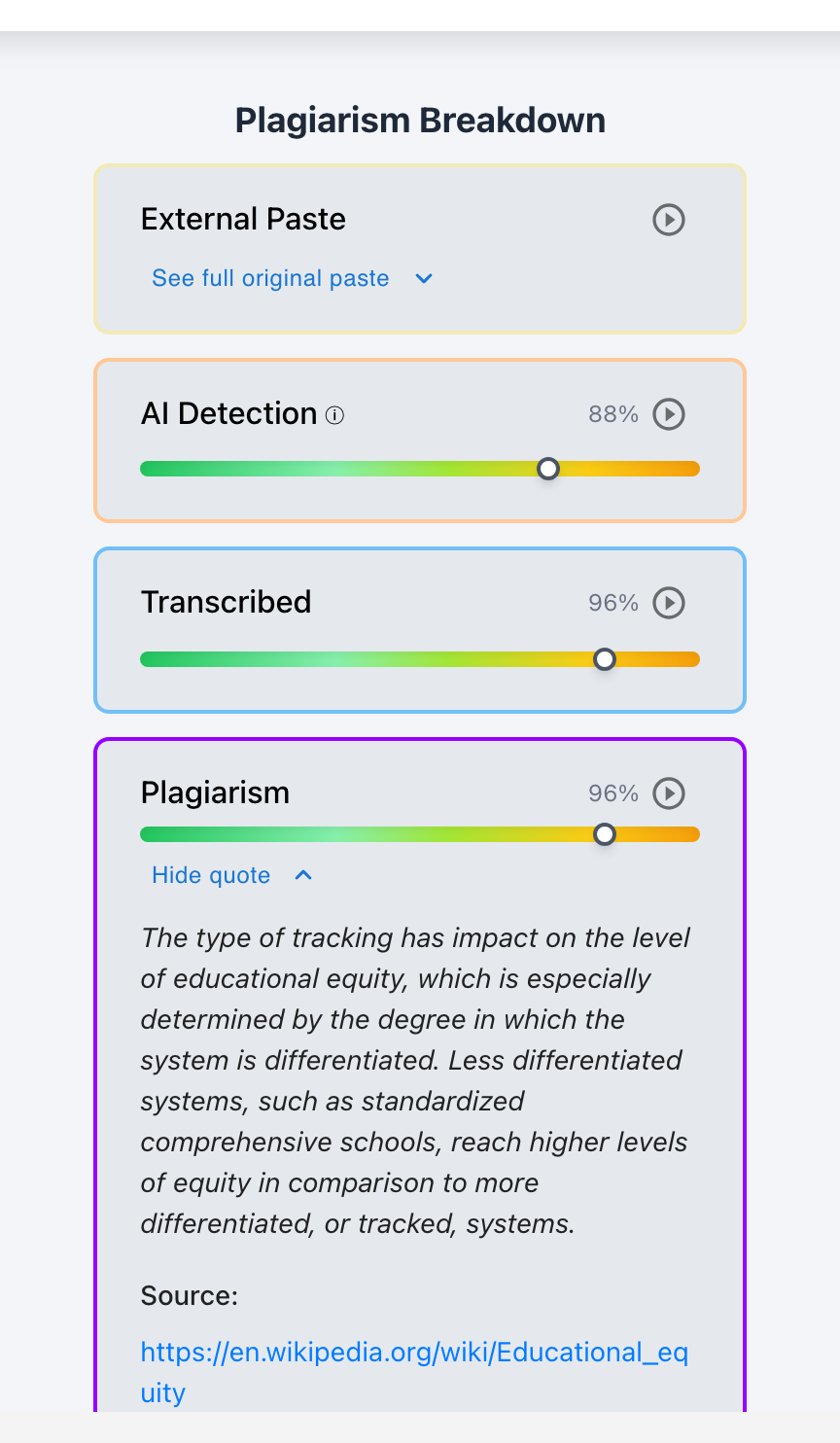
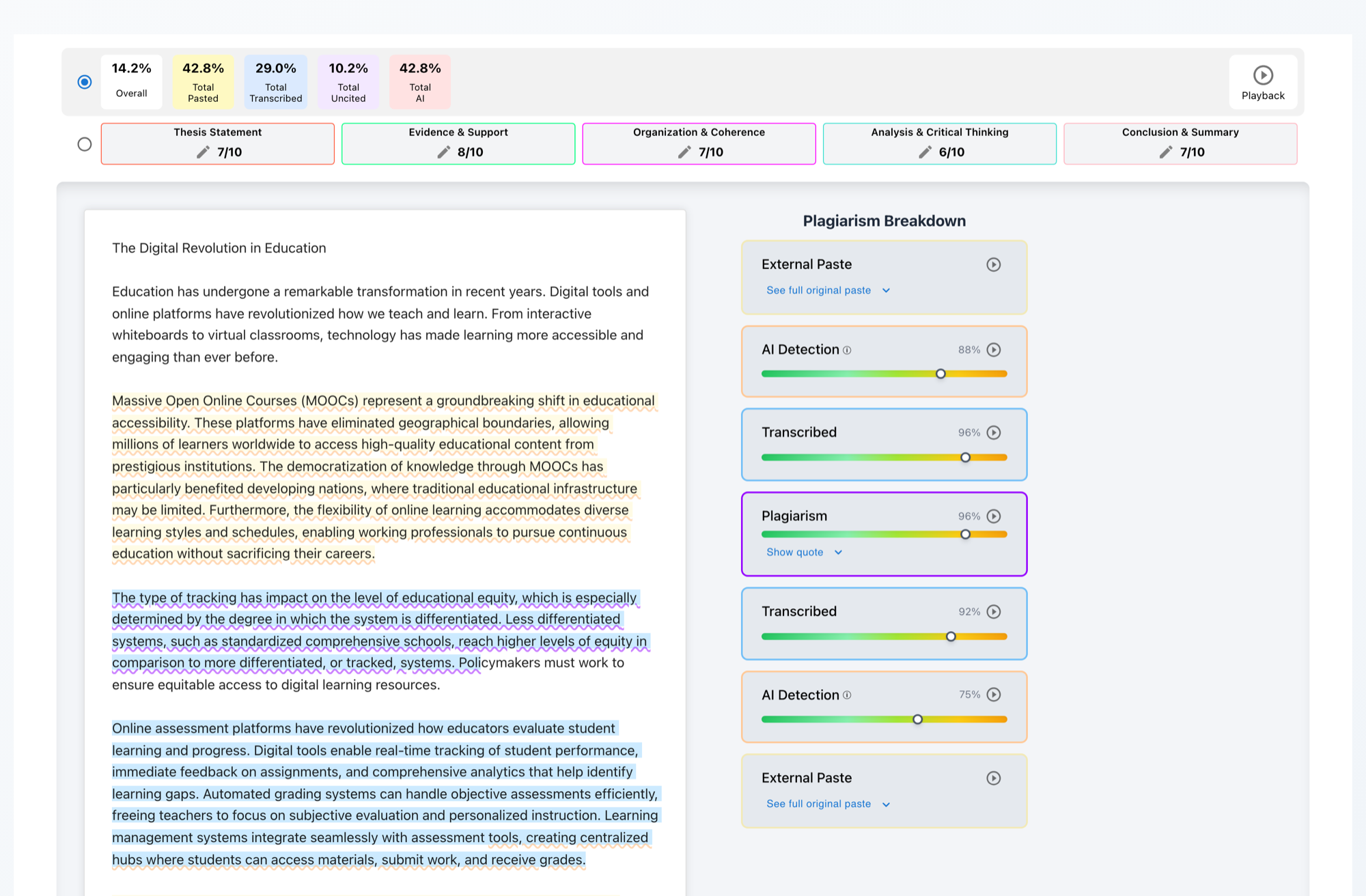
Rather than delivering a terrifying, unhelpful “75% AI” score that poisons student-teacher relationships, Checkmark underlines specific sentences and provides calibrated confidence cards in the sidebar. Advisers can see whether an isolated transition sentence triggered an AI pattern while the surrounding quotes and reporting remain authentic.
4. Side-by-Side Wire & Local News Plagiarism Matching
Checkmark matches text against live regional publications, press release repositories, and student peer databases. When a student copies reporting from a local commercial outlet, Checkmark displays the student’s copy side-by-side with the original newspaper article, highlighting exact quote matches and patchwritten phrases.
5. Quote-Anchored Rubric Autograding with LMS Grade Passback
High school journalism teachers managing 30–60 newspaper and yearbook staffers across multiple sections can leverage Checkmark’s AI Rubric Assistant to generate first-draft evaluations aligned with JEA Write-off rubrics.
- The autograder identifies missing attributions, weak inverted pyramid transitions, and unsupported claims, anchoring each comment to specific student sentences.
- The adviser maintains 100% final authority to edit comments and adjust points before syncing scores directly back to Canvas LMS, Google Classroom, Schoology, or Buzz LMS.
8. Real-World Newsroom Case Scenarios
To illustrate the audit protocol in action, consider three common scholastic reporting scenarios:
Cafeteria Contract Investigation
11th-grade investigative piece on district cafeteria vendor switch. Legacy scanner flagged draft at 74% similarity due to public health inspection quotes and vendor contracts.
Fabricated Quote in Feature Profile
10th-grade feature on student burnout with emotional quotes from a junior track athlete. Student claimed phone died during interview.
False Positive on AP Style Lede
Senior editor’s in-depth news analysis on state testing reform. Principal ran text through online scanner which flagged it as 88% AI.
Scenario A: The High-Similarity Cafeteria Contract Investigation
An 11th-grade staff reporter wrote a hard-hitting exposé on why the school district switched food service providers, citing financial data and health inspection infractions. A legacy plagiarism checker flagged the article with an alarming 74% similarity score.
The Audit:
- The journalism adviser opened Checkmark’s side-by-side source viewer and observed that 100% of the matched text originated from the official County Health Department PDF and the public school board RFP.
- Checkmark’s 4-badge taxonomy correctly classified the matched text as properly attributed public records citations.
- Essay Playback™ showed the student actively copying public financial figures from the PDF, switching tabs, and typing original explanatory transitions around the data.
- Outcome: The article was cleared, published on the front page, and won a state scholastic press award.
Scenario B: The Fabricated Quote in the Varsity Feature
A 10th-grade reporter submitted a feature on high school student burnout, featuring deep quotes from an anonymous sophomore and a junior track star.
The Audit:
- During the Step 1 concordance check, the adviser requested the audio file for the junior athlete. The student claimed their phone battery died during the interview and they only took handwritten notes.
- The adviser opened Checkmark’s External Paste Buffer Inspector and discovered that the entire interview section was pasted from an external window containing the prompt: “Give me 3 emotional quotes from a high school athlete suffering from sleep deprivation.”
- Outcome: The story was pulled from the issue. In a restorative conference, the student admitted to panicking when the athlete canceled their interview. The adviser guided the student to conduct a genuine interview with a new subject for the subsequent issue.
Scenario C: The False Positive AI Allegation on an AP Style Lede
A senior editor submitted an in-depth news analysis on state standardized testing reform. The school principal, reviewing the draft before publication, ran the text through a free online AI detector, which flagged it as 88% AI-Generated, and demanded the article be killed.
The Audit:
- The adviser opened Checkmark Plagiarism and launched Essay Playback™.
- The adviser and principal watched the complete 140-minute writing session replay: the student outlining arguments, pausing for minutes at a time to consult state legislative bills, revising sentences, and fixing typos.
- Checkmark’s passage-level sliders demonstrated that the high formal tone was an authentic product of the student’s advanced vocabulary and rigorous AP Lang training.
- Outcome: The principal withdrew their objection. The student was protected from a career-damaging false accusation, and the story ran without censorship.
9. Frequently Asked Questions (FAQ)
1. Can student reporters use AI tools like Otter.ai or Descript for audio transcription without violating academic integrity?
Yes, absolutely. Automated speech-to-text transcription tools (e.g., Otter.ai, Apple Voice Memos, Descript, Google Recorder) are industry-standard journalistic utilities. They do not generate text; they simply convert human spoken audio into a written transcript. Under JEA and NSPA standards, using transcription software is fully permitted, provided the student submits the raw audio file in their reporting packet and verifies quote fidelity against the recording.
2. What is the difference between cleaning up conversational verbal filler and unethical quote alteration?
Journalistic convention permits the removal of minor vocal filler (e.g., “um,” “uh,” “like,” “you know”) and false starts, provided the omission does not alter the speaker’s meaning, tone, or grammatical intent. However, students may never substitute words, add new ideas, or use generative AI to rewrite a source’s conversational phrasing into sophisticated corporate PR jargon. If an interviewee’s direct words are too confusing or ungrammatical, the reporter must paraphrase the statement with proper attribution rather than rewriting the quote.
3. How should an adviser handle an interview conducted via Snapchat, Instagram DMs, or text message?
While in-person or recorded phone interviews are strongly preferred, high school sources sometimes communicate via digital messaging. In these cases:
- The student must submit unaltered, full-screen captures of the entire digital conversation in their reporting packet (including usernames, profile headers, and timestamps).
- The student must verify the identity of the account holder through the school directory to ensure the account is not an unverified impersonator.
- The article copy must transparently disclose the interview medium (e.g.,
“, senior Maya Lin said in a direct message.”).
4. How does Essay Playback™ differentiate between transcribing audio from headphones vs. retyping text from an AI screen?
Audio transcription from headphones exhibits a distinct auditory burst-and-rewind pattern: the student types 6–10 words, pauses for 4–12 seconds while listening, occasionally rewinds, and backspaces to correct misunderstood words. Retyping text from an AI generator on a phone or second monitor exhibits steady visual transcription: the student types at a continuous, steady pace (50–80 WPM) with minimal structural pauses, zero auditory rewind cycles, and no semantic reorganization.
5. If a student uses ChatGPT to brainstorm interview questions, is that a violation?
Under standard scholastic media policies, using AI as a pre-reporting brainstorming assistant (e.g., generating preliminary interview questions or researching background history on a complex topic) is acceptable, provided it is disclosed in the pitch brief. However, the AI cannot conduct the interview, select which quotes to use, or write the article copy. All final questions, reporting, and prose must be executed independently by the student journalist.
6. How does a verified reporting packet protect student journalists from administrative censorship under Hazelwood?
Under Hazelwood v. Kuhlmeier, school administrators can only censor school-sponsored publications for “legitimate pedagogical concerns,” such as unverified assertions, biased reporting, libel, or factual inaccuracy. When a student newsroom maintains a comprehensive Reporting Packet containing timestamped audio, verified contact logs, and Checkmark keystroke replay proof, they eliminate every legitimate pedagogical ground for censorship, providing an airtight legal and ethical defense for hard-hitting investigative journalism.
7. What should an adviser do if a published article is found to contain a fabricated quote?
If an unverified or fabricated quote slips through to publication:
- Immediately retract the quote online and publish a prominent, transparent Correction and Clarification Notice in accordance with NSPA ethical guidelines.
- If in print, run a formal correction on page 2 of the subsequent issue explaining the attribution error.
- Conduct a private, restorative newsroom review with the student reporter and section editor.
- Execute an editorial audit of the student’s beat to ensure no other articles contain fabricated sourcing before clearing them for future assignments.
10. Conclusion: Building a Newsroom Culture of Trust and Defensible Proof
In an era of ubiquitous generative AI, scholastic journalism faces a defining fork in the road. Advisers can either succumb to cynicism and fear—relying on punitive, inaccurate black-box scanners that alienate honest student writers—or they can lead the way by establishing transparent, evidence-based newsroom workflows.
“Stop Guessing, Start Trusting.”
Require complete In-Depth Reporting Packets for every piece.
Verify primary voice recordings and confirm source identities.
Use keystroke telemetry to celebrate and protect authentic writing.
Guide novice writers through developmental quote attribution.
Protect student press freedom with unassailable reporting proof.
By mandating comprehensive In-Depth Reporting Packets and leveraging Checkmark Plagiarism’s revolutionary suite of newsroom forensics—featuring patent-pending Essay Playback™, the External Paste Buffer Inspector, side-by-side plagiarism matching, and quote-anchored rubric autograding—high school journalism teachers can protect their publications, empower student reporters, and uphold the highest standards of scholastic press integrity.
Elevate Your Scholastic Newsroom Integrity with Checkmark
Equip your student publication staff with patent-pending Essay Playback™, raw clipboard paste inspection, and JEA-aligned journalistic integrity forensics.
Published by The Checkmark Plagiarism Editorial Team. Checkmark Plagiarism provides FERPA-compliant, patent-pending writing process playback, side-by-side plagiarism forensics, and teacher-in-the-loop rubric autograding for secondary schools and school districts.