
Novice student journalists face immense cognitive and ethical hurdles when transforming messy, multi-source raw materials—including 45-minute audio interview recordings, automated voice transcripts (e.g., Otter.ai), district press releases, and complex school board spreadsheets—into balanced, hard-hitting news reporting. When high school reporters struggle with synthesis, they frequently fall into the trap of patchwriting, superficial synonym substitution, or clumsy quote attribution.
Unfortunately, legacy plagiarism scanners flatten these developmental missteps into alarming, punitive similarity scores (often 60%–80%), misdiagnosing legitimate press-release reporting as academic theft and poisoning the student-adviser instructional alliance. Grounded in the Society of Professional Journalists (SPJ) Code of Ethics and standards from the Journalism Education Association (JEA) and National Scholastic Press Association (NSPA), this guide details how journalism advisers can leverage Checkmark Plagiarism’s newsroom coaching suite—featuring patent-pending Essay Playback™ (1x–8x scrubbable keystroke replay), the External Paste Buffer Inspector, discrete 4-badge plagiarism taxonomy, and quote-anchored rubric autograding—to inspect reporting telemetry, authenticate primary sources, protect honest reporters, and foster a transparent culture of newsroom integrity.
Checkmark Plagiarism provides student media advisers, yearbook instructors, and scholastic journalism programs with an integrated newsroom integrity workbench, combining keystroke process playback with side-by-side source verification, passage-level AI writing detection, quote-anchored rubric autograding, and direct LTI 1.3 integrations for Canvas LMS and Google Classroom.

1. The High-Stakes Scholastic Newsroom Challenge
Scholastic journalism operates at the precarious intersection of rigorous professional ethics, First Amendment civic responsibility, and novice developmental writing. Unlike standard English essays—where students synthesize static secondary literary criticism or general web research—student journalists must navigate fast-paced, unstructured, and high-stakes information ecosystems.
High school newspaper advisers, yearbook instructors, digital media teachers, and broadcast advisers (affiliated with organizations like the Journalism Education Association (JEA), the National Scholastic Press Association (NSPA), and Quill and Scroll) oversee student newsrooms that publish directly to the school and local community. In this environment, an unverified quote, an altered statement, or uncited patchwriting does not simply result in a lowered grade; it risks community backlash, administrative censorship, libel, and the permanent destruction of public trust.
How competing cognitive inputs create synthesis bottlenecks for high school reporters
45 minutes of spoken audio, conversational disfluencies, non-linear thoughts
Official administrative spin, dense bureaucratic terminology, legal framing
Multi-page PDF spreadsheets, state funding formulas, line-item codes
Cognitive Overload Hub
- Tight publication deadlines
- AP Style attribution mechanics
- Fear of misquoting authority figures
- Inverted pyramid structuring
- Balancing multiple stakeholders
Crucial who, what, where, when, and why framed in active journalistic voice
Contextual lead-ins with exact audio fidelity and AP Style attribution tags
Clear distinction between official PR background, opinion, and investigative fact
The Cognitive Overload of Novice Reporting
Novice student reporters—frequently 14 to 18 years old—are asked to master several advanced cognitive tasks simultaneously:
- Active Listening and Note Triangulation: Sorting through pages of raw audio transcripts to identify the newsworthy “nut graph” and compelling pull-quotes.
- Synthesizing Institutional Jargon: Translating bureaucratic school district policy announcements into clear, accessible prose for the student body.
- Verbatim Quote Fidelity: Preserving an interviewee’s precise words and contextual intent while editing out distracting vocal tics (“um,” “like”) without altering meaning.
- Structural Composition: Organizing facts according to the inverted pyramid or narrative feature structures under tight publication deadlines.
- Associated Press (AP) Style & Attribution: Formatting attribution tags accurately (e.g.,
“, principal Marcus Davis said.”vs.“, claimed Marcus Davis.”).
When cognitive working memory is overloaded by these competing demands, novice writers instinctively grasp for shortcuts. Rather than independently synthesizing dense public documents or press releases, they copy and paste large blocks of official text and perform light word substitutions (patchwriting). When handling interview audio, they may struggle to construct seamless narrative transitions between direct quotes, resulting in disjointed “quote dumps” or distorted summaries that misrepresent the speaker’s nuance.
The Fatal Failure of Legacy Plagiarism Detection in Journalism
When journalism advisers run student articles through legacy plagiarism checkers or one-dimensional AI detectors, the software routinely fails to understand newsroom workflows:
When an administration sends out a 400-word press release regarding school start times, student reporters must incorporate those official facts. A legacy similarity scanner flags an 85% match to the district website and tags the student as a plagiarist, ignoring that the reporter properly attributed the announcement in their lead paragraph.
When a student pastes a verified, verbatim 80-word quote from their own recorded interview with a school board member, legacy checkers flag the quote as “unoriginal” or “copied” if similar transcripts or summaries appear across other local media outlets.
Generic AI detectors flag student news writing because journalistic prose—characterized by short sentences, formal tone, high factual density, and standardized AP Style attribution—naturally exhibits the low perplexity and regular cadence typical of synthetic text.
How multi-dimensional process forensics replaces hostile accusations with pedagogical clarity
Potential Academic Dishonesty Flagged
- Flattens press releases, direct quotes, and patchwriting into one red blob
- Fails to inspect student interview recordings or Otter.ai transcript notes
- Triggers adversarial confrontations between student editors and advisers
- Leaves adviser guessing whether the writer copied or synthesized
- Essay Playback™: Visualizes how the student typed transitions around quotes
- Paste Buffer Inspector: Matches pasted clipboard text to raw audio transcript
- 4-Badge Taxonomy: Distinguishes Direct Quotes from Wire References
- Formative Coaching: Empowers constructive 10-minute editorial conferences
Journalism advisers do not need punitive scanners that flag all matched text with red ink. They need formative, forensic coaching tools that visualize the student’s reporting process, verify the provenance of interview clips, separate authorized press release background from uncredited copying, and support meaningful editorial conferences.
2. Pedagogy: Ethical Journalistic Synthesis vs. Plagiarism
To teach scholastic journalism effectively, advisers must anchor their curriculum in recognized professional frameworks while establishing clear distinctions between legitimate newsroom synthesis, developmental patchwriting, and deliberate journalistic fraud.
The SPJ Code of Ethics in Scholastic Media
The Society of Professional Journalists (SPJ) Code of Ethics provides four foundational pillars that directly inform scholastic writing integrity:
- Test accuracy from all primary sources and cross-check multiple stakeholders.
- Never plagiarize text, data, photographs, or graphics.
- Identify sources clearly; direct quotes must be verbatim and placed in authentic context.
- Never distort facts, audio meaning, or context through selective quotation.
- Show compassion and heightened sensitivity for vulnerable student sources and peers.
- Balance public interest and community transparency against privacy rights of minors.
- Recognize that reporting on sensitive campus issues requires nuanced, empathetic synthesis.
- Avoid conflicts of interest and disclose unavoidable personal connections.
- Refuse gifts, favors, or administrative pressure to alter critical investigative facts.
- Distinguish clearly between factual news reporting, opinion columns, and administrative PR.
- Explain news coverage decisions and reporting processes openly to the school community.
- Promptly acknowledge and publicly correct factual errors in print and online editions.
- Expose unethical reporting practices in the newsroom and engage in restorative coaching.
The 3 Levels of Source Processing in News Writing
Teaching novice reporters how to process information requires breaking down source utilization into three explicit pedagogical tiers:
From verbatim quotes to multi-source investigative synthesis
Definition: Exact words spoken by source, encapsulated in quotation marks with explicit AP-style attribution.
Example: “The budget deficit forces us to freeze all elective department hires,” Principal Davis said.
Definition: Transforming official documents, budget spreadsheets, or secondary explanations into concise news prose.
Example: According to the district’s annual financial audit, the deficit reached $1.2 million following state aid cuts.
Definition: Triangulating multiple recorded interviews, public records, and historical context into an original investigative narrative and balanced analysis.
Example: While district administrators attribute the funding freeze to state revenue shortfalls, union representatives argue the cuts disproportionately impact visual arts programs.
The Press Release & Wire Trap: Patchwriting vs. News Attribution
The most common ethical mistake among novice student journalists is the Press Release Trap. When a high school principal, athletic director, or district superintendent sends out a press release, novice reporters often copy-paste the entire announcement into their draft document and execute superficial word replacements—a practice composition scholar Rebecca Moore Howard identified as patchwriting.
Comparing raw PR copy, uncredited patchwriting, and ethical journalistic synthesis
“Due to unforeseen HVAC mechanical failures during scheduled summer maintenance, Oakridge High School will temporarily transition to asynchronous remote instruction for three days.”
“Because of unexpected HVAC machinery breakdowns throughout planned summer repairs, Oakridge High will briefly switch to independent online learning for three days.”
“Oakridge students will spend the first three days of the school year learning from home after air conditioning systems failed during summer repairs, Principal Sarah Jenkins announced in an official memorandum Tuesday morning.”
Why Novice Reporters Fall Into the Trap
Novice reporters do not patchwrite out of malice. They patchwrite because:
- Fear of Misrepresenting Official Facts: Students worry that altering the phrasing of an authority figure might introduce factual errors.
- Ignorance of Journalistic Conventions: Novice writers do not understand that in journalism, taking facts from a press release requires attributing the document (e.g.,
“, according to a district press release.”), not merely rephrasing its sentences. - Time Pressure: Balancing five academic classes while trying to publish a 12-page print edition or daily web post creates immense deadline panic.
3. Checkmark Plagiarism: The Newsroom Coaching & Telemetry Suite
Checkmark Plagiarism provides a purpose-built, multi-dimensional integrity platform designed to give journalism advisers and student editors transparent, defensible evidence (“receipts”) that foster growth, protect honest students, and streamline editorial review.
Integrated forensic modules designed specifically for scholastic media workflows
- 1x–8x scrubbable replay
- Visualizes synthesis pauses
- Identifies typing bursts
- Exonerates honest reporters
- 100% clipboard capture
- Verifies raw audio logs
- Jump-to-playback sync
- Catches uncredited PR lifts
- 🟢 Direct Quote Badge
- 🟠 Uncited Source Badge
- 🟣 Patchwriting Badge
- 🔵 Wire Reference Badge
Passage-level calibrated confidence sliders • Honest short-text guardrail (<150w = N/A) • Quote-anchored rubric feedback aligned with JEA standards (Lede, Attribution, Nut Graph) • Teacher-in-the-loop: All marks remain editable drafts until approved.
1. Patent-Pending Essay Playback™: Keystroke Telemetry in the Newsroom
The flagship innovation of Checkmark is Essay Playback™, an interactive forensic tool that records and reconstructs the complete writing session keystroke-by-keystroke. Advisers can scrub through the reporting timeline at 1x, 2x, 4x, or 8x speed like a video playback.
What Essay Playback™ Visualizes for Advisers:
- The Synthesis Pause: When a student reporter is synthesizing audio notes, their keystroke timeline exhibits distinct patterns: long reading/listening pauses (2–5 minutes) followed by bursts of active typing as they translate audio concepts into written prose.
- Drafting Around Quotes: Advisers can watch the student paste an interview quote, pause, type a lead-in sentence, delete it, rewrite the transition to provide context, and attach an AP-style attribution tag.
- Exonerating Authentic Reporting: If a generic AI detector flags a student’s polished news article, Essay Playback™ provides indisputable visual proof that the student drafted every sentence by hand over hours, actively deleting, restructuring, and refining the copy.
2. External Paste Buffer Inspector: Primary Source Provenance
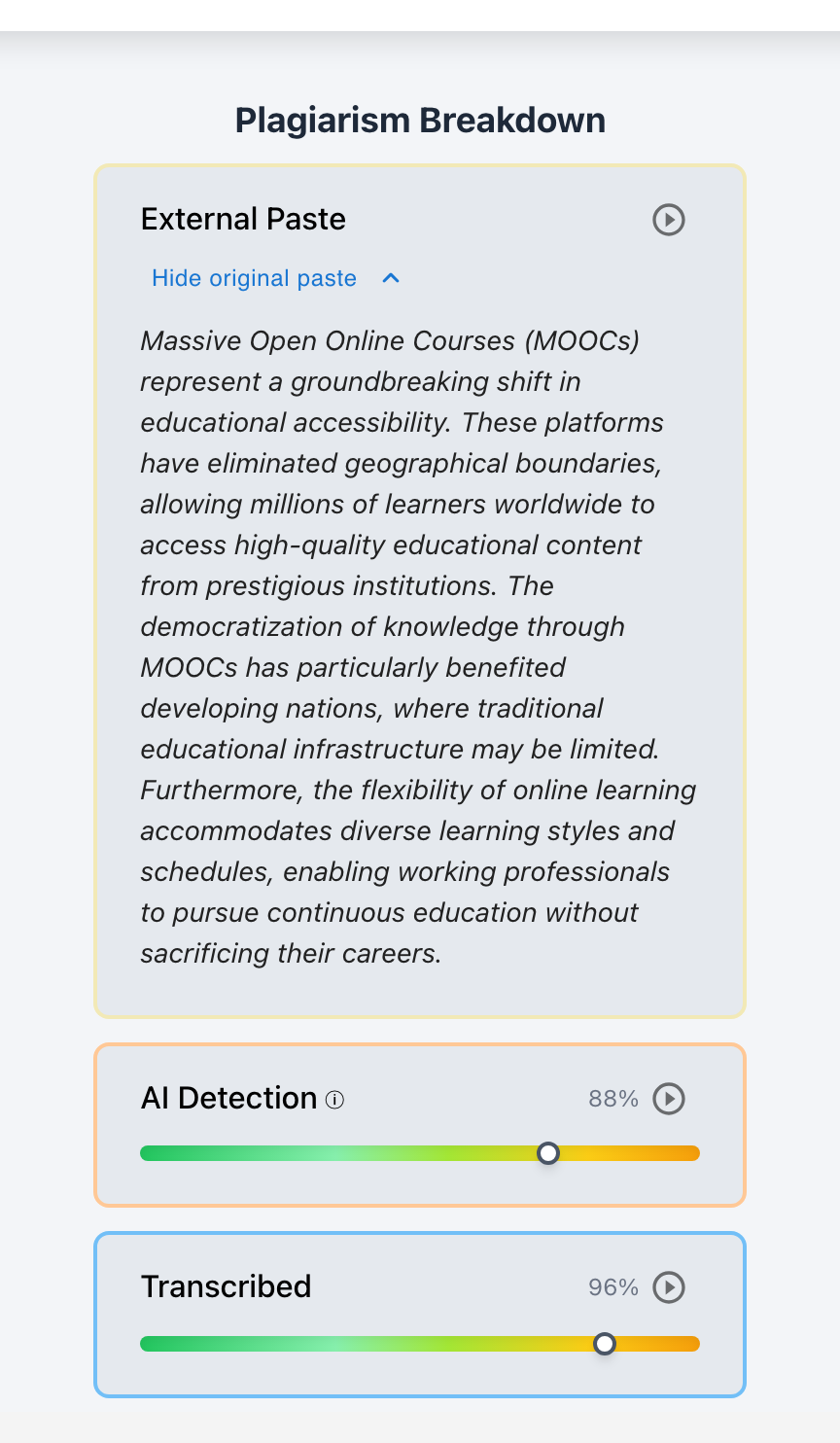
When student reporters paste text into their articles, advisers need to know where that text originated. Checkmark’s External Paste Buffer Inspector captures 100% of clipboard text, records exact timestamps and character counts, and preserves the original raw text even if the student subsequently edits every word.
3. Defensible Side-by-Side Matching with 4-Badge Taxonomy
Legacy plagiarism tools present advisers with a chaotic wall of overlapping colors and an unhelpful percentage. Checkmark replaces this with a Two-Pane Synchronized Verification Workbench featuring a discrete 4-Badge Taxonomy:
Properly attributed quotation with verified speaker tags. Advisers validate quote fidelity against audio logs without false plagiarism penalties.
Factual material matched to a public source without journalistic credit. Triggers a formative prompt to add in-text attribution tags.
Syntactic structure borrowed from press release or wire copy with superficial synonym substitutions. Used to scaffold synthesis skills in 1-on-1 conferences.
Standard boilerplate, school district press release facts, or public data tables. Differentiates official releases from student investigative text.

4. Granular AI Writing Detection & JEA-Aligned Rubric Autograding
Checkmark combines passage-level linguistic analysis with AI-powered, rubric-based feedback designed specifically for journalism curricula:
Calibrated passage sliders and quote-anchored rubric scoring
“The board voted 5-2 to approve the bond measure following three hours of public testimony.”
N/A rather than guessing on insufficient sample lengths.
Justification: “The reporter includes 3 primary source quotes with accurate AP Style tags (Lines 14, 22, 38). However, the lead-in to Principal Jenkins’ quote on Line 22 lacks narrative context and reads as a quote-dump. Recommend adding a transitional background sentence.”

4. Comprehensive Comparison: Traditional Methods vs. Checkmark Telemetry
The following matrix highlights the operational differences between legacy integrity software and Checkmark’s newsroom telemetry suite:
| Evaluation Dimension | Legacy Plagiarism Checkers (e.g. Turnitin) | Generic AI Detectors (e.g. GPTZero) | Checkmark Plagiarism Newsroom Suite |
|---|---|---|---|
| Analysis Granularity | Document-level similarity percentage. | Whole-paper probabilistic percentage. | Passage-level cards + calibrated confidence sliders. |
| Writing Process Telemetry | None. Treats final submission as static snapshot. | None. Evaluates only text output. | Patent-Pending Essay Playback™ (1x–8x scrubbable replay). |
| Clipboard / Paste Tracking | None. Large pastes flagged Users indiscriminately as overlap. | None. Treats pasted AI and pasted audio notes identically. | External Paste Buffer Inspector (100% clipboard text + timestamps). |
| Source Classification | Generic color-coded matches without functional taxonomy. | Binary (AI vs Human) without source context. | 4-Badge Taxonomy (Direct Quote, Uncited Source, Patchwriting, Wire Reference). |
| Press Release Handling | Triggers high false-positive similarity flags (60%–90%). | May flag formal PR prose as AI-generated text. | Differentiates legitimate PR attribution from uncredited patchwriting. |
| Short-Text Protection | Flags common phrases in short snippets. | Guesses wildly on short texts, producing false positives. | Honest Guardrails: Automatically outputs N/A for samples <150 words. |
| Pedagogical Focus | Punitive surveillance (“catching cheaters”). | Punitive suspicion (“detecting bots”). | Formative coaching: “Stop guessing, start trusting” with verifiable receipts. |
| Rubric & LMS Integration | Basic comment boxes without automated quote anchoring. | Disconnected from curriculum and grading rubrics. | Teacher-in-the-Loop Autograding syncing to Canvas, Google Classroom, and Buzz LMS. |
| Data Privacy (FERPA/COPPA) | Retains student papers in global commercial repositories. | Often trains commercial AI models on student work. | Zero Model Training: Submissions are encrypted and never used for LLM training. |
5. Real-World Newsroom Case Studies
The following real-world scenarios demonstrate how high school journalism advisers use Checkmark’s telemetry suite to resolve editorial challenges, coach novice reporters, and protect student press freedom.
Investigative Reporting on School Board Budget Cuts
Junior reporter Jordan submitted a 1,400-word investigative piece on a projected $1.2M district budget deficit. The school’s legacy plagiarism scanner returned a 64% Similarity Index, flagging paragraphs containing exact equalization funding formulas and line-item tables from the district’s 84-page budget PDF. The assistant principal suggested withholding the article from print.
Adviser Ms. Alvarez opened Checkmark: Paste Inspector verified Jordan pasted data lines directly from the public board agenda at 00:14:22. Essay Playback™ proved Jordan spent 90 minutes typing narrative transitions around the figures and integrating on-the-record interview quotes from the CFO. The 4-Badge Taxonomy classified the data as Wire / Public Document References, exonerating the reporter.
Feature Profile Synthesizing 45 Minutes of Audio Notes
Staff reporter Sophia wrote a 900-word feature profiling a beloved 30-year head custodian retiring at semester’s end, synthesizing a 45-minute audio recording transcribed via Otter.ai. A generic AI detector flagged the story with an 82% AI Probability Flag due to Sophia’s clean, polished sentence structure and balanced transitions. The editor-in-chief hesitated to publish.
Adviser reviewed Sophia’s Essay Playback™ session (2h 18m). Playback revealed Sophia pausing for 4–6 minutes to listen to audio segments, pasting raw quote snippets from her Otter transcript, and actively re-drafting narrative lead-ins. She deleted and rewrote the opening lead 4 times. This organic revision velocity conclusively disproved synthetic AI generation.
Breaking News Coverage of Athletic Department Restructuring
Thirty minutes before deadline, the district released a 500-word memo consolidating varsity gymnastics and wrestling facilities. First-year sports reporter Liam copied the release, pasted it into his document, and swapped 10 adjectives with synonyms (patchwriting). Liam submitted the piece without secondary interviews or attribution.
Checkmark workbench flagged four paragraphs with the purple Patchwriting Badge. Instead of assigning a zero, the adviser and sports editor held a 10-minute conference. They scrubbed Essay Playback™ to show Liam his synonym replacements and coached him to write an original inverted pyramid lead with explicit attribution.
6. The 4-Phase Scholastic Newsroom Verification Protocol
To institutionalize ethical source attribution, scholastic journalism programs should implement a standardized 4-Phase Verification Protocol across their editorial workflow:
Standardized editorial checks from reporting dossier to publication clearance
Reporter uploads raw audio recording link, Otter transcript, and primary source documents (press releases, PDF budgets) alongside draft.
Section editor runs Checkmark: audits Essay Playback™ for natural drafting velocity, inspects Paste Buffer provenance, and checks 4-Badge matches.
If patchwriting or missing attribution is found, adviser and editor conduct a 10-minute restorative conference using side-by-side evidence cards.
Fact-check verified; quotes corroborated against audio; teacher-in-the-loop rubric marks synced to LMS gradebook; article cleared for layout.
7. Newsroom Policy Handbook Templates & Ethics Guidelines
Scholastic journalism publications should incorporate clear, transparent integrity policies into their annual staff handbooks. Below are customizable policy templates aligned with JEA and SPJ standards.
Staff Handbook Policy Template 1: Generative Artificial Intelligence (AI)
JEA-Aligned1. CORE PHILOSOPHY: Scholastic journalism is a human discipline centered on authentic reporting, interpersonal interviewing, and original writing. The publication’s credibility rests on our community’s trust that student journalists gathered every fact, conducted every interview, and wrote every sentence.
2. AUTHORIZED USE OF AI TOOLS: Student journalists may use AI tools ONLY for: (a) Brainstorming general topic angles or interview question ideas; (b) Automated transcription of student-recorded audio files (e.g. Otter.ai), provided the reporter verifies the transcript against the original recording; (c) Spellchecking and preliminary copy editing assistance, provided human editors make all final decisions.
3. STRICTLY PROHIBITED USE: Student journalists are STRICTLY PROHIBITED from: (a) Using AI to generate article text, ledes, nut graphs, transitions, or headlines for publication; (b) Fabricating interview subjects, quotes, or statistics using synthetic text generators; (c) Using “AI Humanizers” or paraphrasing software (e.g., QuillBot) to disguise copied text.
4. TRANSPARENCY & VERIFICATION: All staff submissions are subject to writing process verification via Checkmark Plagiarism’s Essay Playback™ and Paste Buffer Inspector. If drafting telemetry indicates unverified paste events or lack of original drafting, raw audio logs must be provided prior to publication.
Staff Handbook Policy Template 2: Source Attribution & Press Releases
SPJ-Aligned1. DIRECT QUOTATIONS: Quotations must represent the exact words spoken by the source. Minor vocal fillers (“um,” “like”) may be removed only if doing so does not alter the speaker’s meaning. Never alter a quote to improve grammar without explicit editorial board approval.
2. PRESS RELEASE & INSTITUTIONAL MEMOS: Facts, dates, and statements obtained from press releases, emails, or police blotters must be explicitly attributed in the text (e.g., “, according to a district press release issued Monday.”). Copying sentences from a press release and swapping words (patchwriting) violates publication ethics. All press release stories must include at least ONE independent, student-conducted interview.
8. Editorial Board Conference Scripts: Restorative Coaching
When a section editor or journalism adviser detects patchwriting or missing attribution tags in Checkmark Plagiarism, the goal is not punitive discipline, but formative coaching. The following dialogue script illustrates a supportive, evidence-based editorial conference:
How advisers and student editors use Checkmark’s workbench during a 10-minute conference
‘, according to head librarian Mrs. Vance.’”
9. Frequently Asked Questions (FAQs)
Q1: How does Checkmark differentiate between a student pasting their own interview transcript versus pasting an AI-generated article?
Checkmark’s External Paste Buffer Inspector captures the complete text, character volume, and exact timestamp of every clipboard paste event. In legitimate journalistic reporting, a student pastes a raw quote (often containing conversational disfluencies or speaker names from an Otter.ai voice transcript), pauses, and then actively types narrative lead-in sentences and AP-style attribution tags around the quote. In contrast, when a student pastes generative AI output, they typically paste a multi-paragraph article in a single instant, followed by zero substantive revisions.
Q2: Why do legacy plagiarism checkers fail when analyzing student journalism that uses press releases?
Legacy similarity scanners rely on rigid lexical n-gram matching. When a school district issues an official press release, that exact phrasing is indexed across websites and news portals. When a student reporter incorporates factual background from that release, legacy tools flag an 80%+ match, categorizing the entire section as “plagiarism” even if the student properly credited the district in their opening lead. Checkmark solves this with its 4-Badge Taxonomy that differentiates Wire / Public Document References and Direct Quotes from true uncredited copying.
Q3: Can Essay Playback™ verify if a student fabricated interview quotes?
While Essay Playback™ cannot physically listen to a live conversation, it provides critical behavioral telemetry: it records whether quotes were pasted from a digital transcript document or typed out manually while listening to audio. When students retype quotes while listening to audio recordings, their keystrokes exhibit distinct rhythmic pause patterns (pauses every 4–8 words as they listen, replay, and transcribe audio segments). Fabricated quotes are often typed in rapid, continuous bursts as creative fiction or generated via external AI prompts.
Q4: How does passage-level AI detection protect student journalists from false positives when reporting on technical or administrative topics?
Journalistic writing naturally exhibits lower perplexity and higher uniformity than creative fiction because news copy follows standardized Associated Press (AP) style rules: short declarative sentences, inverted pyramid structure, high factual density, and formulaic attribution tags. Generic AI detectors misinterpret this clean, professional style as synthetic AI text. Checkmark protects students by providing passage-level confidence sliders with transparent linguistic metrics and enforcing an honest short-text guardrail that automatically displays N/A for samples under ~150 words rather than guessing.
Q5: How can advisers use Checkmark to teach Associated Press (AP) style and news attribution rubrics efficiently?
Checkmark features a Teacher-in-the-Loop Autograding Engine populated with standard Journalism Education Association (JEA) rubrics. The autograder analyzes student submissions against specific criteria—such as Lead Effectiveness, Nut Graph Clarity, Source Diversity, Quote Attribution, and AP Style Mechanics—and generates quote-anchored formative feedback cards tied directly to the student’s prose. Advisers maintain complete editorial authority to edit, adjust, or override suggestions before publishing grades back to the LMS.
Q6: Is student reporting data secure, and are student articles protected from being used to train commercial AI models?
Yes. Checkmark enforces a strict Zero Model Training Policy. Student drafts, audio transcripts, and investigative notes submitted to Checkmark are never used to train commercial large language models (LLMs) or shared with third-party data brokers. Checkmark is fully compliant with FERPA and COPPA, utilizing end-to-end encryption in transit and at rest to protect scholastic press freedom and student investigative privacy.
Q7: How does Checkmark integrate with school learning management systems like Canvas LMS, Google Classroom, and Buzz LMS?
Checkmark offers seamless LTI 1.3 Enterprise Integrations across major educational platforms:
- Canvas LMS & SpeedGrader: Embeds directly within SpeedGrader, allowing advisers to scrub Essay Playback™ replays and inspect evidence cards without leaving Canvas.
- Google Classroom & Google Docs: Integrates natively with Google Workspace, capturing rich revision telemetry while syncing assignment scores directly.
- Buzz LMS & Moodle: Provides bidirectional grade passback, pushing finalized rubric scores and written feedback straight into district gradebooks with one click.
10. Conclusion: Stop Guessing, Start Trusting in Scholastic Media
High school journalism is one of the most transformative educational experiences available to young writers. It teaches critical thinking, civic responsibility, investigative tenacity, and ethical communication. However, when school newsrooms rely on opaque, black-box plagiarism scanners or blunt AI detection scores, the educational alliance between student reporters and journalism advisers breaks down into mutual suspicion and anxiety.
By adopting Checkmark Plagiarism’s comprehensive newsroom coaching suite, journalism advisers replace punitive guesswork with transparent, defensible evidence. Through patent-pending Essay Playback™, the External Paste Buffer Inspector, discrete 4-badge plagiarism taxonomy, and quote-anchored rubric autograding, educators can:
- Authenticate primary source reporting and verify interview quote fidelity.
- Coach novice writers through the Press Release Trap, transforming developmental patchwriting into powerful, original news synthesis.
- Exonerate honest student reporters from unfair false-positive AI flags.
- Protect student press freedom with secure, FERPA-compliant integrity telemetry.
In scholastic journalism, the objective is never merely to detect errors—it is to teach young journalists how to seek truth, minimize harm, and report with fearless integrity. With Checkmark Plagiarism, advisers have the tools to stop guessing and start trusting the next generation of journalists.
Transform Your Student Newsroom with Checkmark Plagiarism
Empower your journalism staff with patent-pending Essay Playback™, raw paste buffer forensics, and JEA-aligned rubric autograding.