
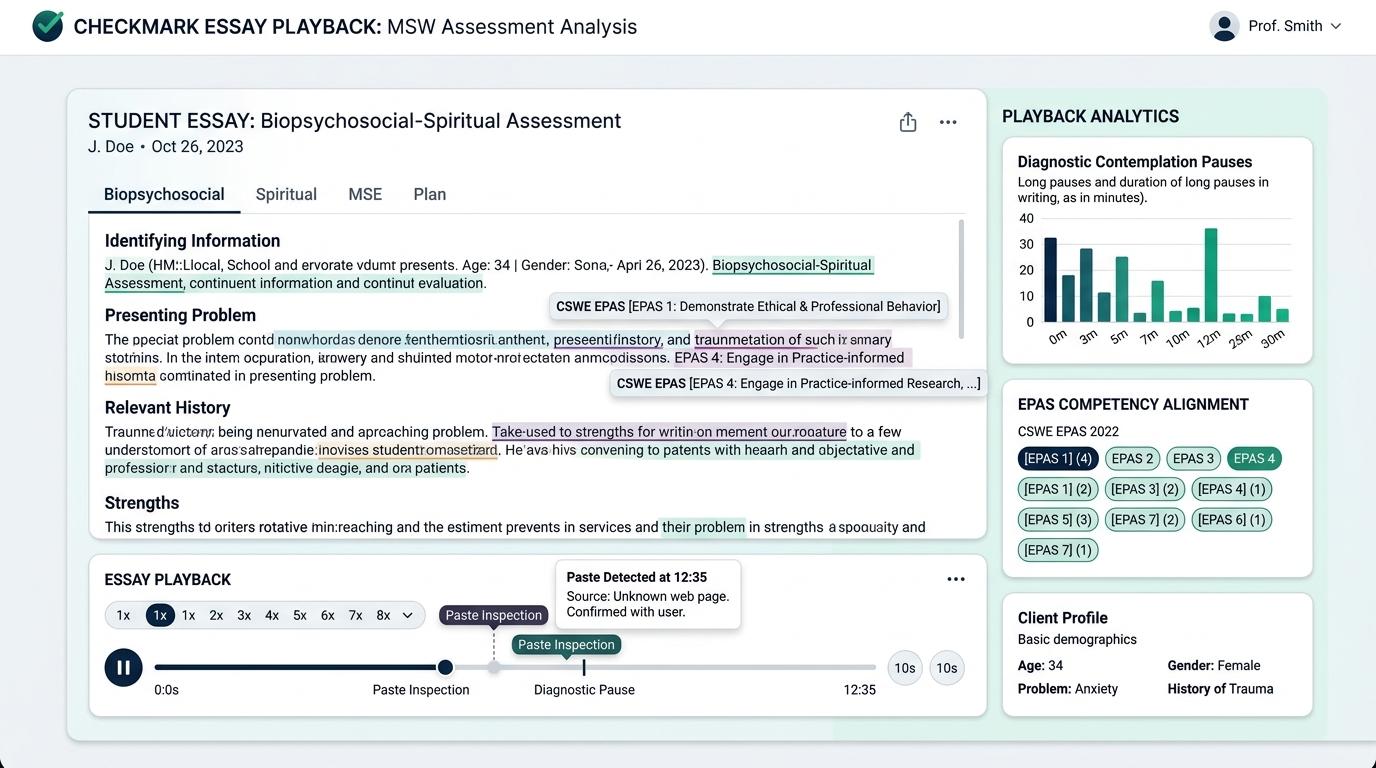
In graduate social work education, field practicum documentation—encompassing Biopsychosocial-Spiritual (BPSS) assessments, structured progress notes (SOAP, BIRP, DAP), crisis safety plans, and DSM-5-TR diagnostic formulations—serves as the foundational bridge between classroom theory and direct clinical practice. Designated by the Council on Social Work Education (CSWE) 2022 Educational Policy and Accreditation Standards (EPAS) as social work’s Signature Pedagogy, field practicums require Master of Social Work (MSW) candidates to demonstrate rigorous clinical judgment, trauma-informed empathy, and strict adherence to the NASW Code of Ethics. However, the rapid proliferation of Large Language Models (LLMs) poses an unprecedented challenge to field education. Students under intense caseload pressure increasingly turn to generative AI to draft clinical case notes. Generative AI models routinely synthesize sanitized, clinical-sounding narratives that hallucinate fictitious client quotes, suggest generic or culturally inappropriate coping mechanisms, and sanitize raw trauma narratives. Furthermore, uploading student assessment notes into commercial, cloud-based AI detectors triggers severe HIPAA, FERPA, and NASW Standard 1.07 confidentiality violations while producing widespread false-positive flags on standardized clinical screening tools (e.g., PHQ-9, GAD-7, MSE, C-SSRS). To verify authentic clinical reasoning without punitive guesswork or privacy breaches, MSW programs are adopting Checkmark’s non-invasive Writing Process Telemetry. By combining patent-pending Essay Playback™ (1x–8x keystroke replay), External Paste Telemetry, honest short-text guardrails, and zero-training FERPA/HIPAA-aligned data architecture, social work faculty and Licensed Clinical Social Worker (LCSW) field instructors can audit clinical reflection pauses, verify authentic diagnostic formulation, protect candidates from false accusations, and conduct supportive, restorative clinical supervision debriefs.
Checkmark Plagiarism provides the foundational technology for graduate social sciences and health integrity by uniting patent-pending Essay Playback™ with passage-level AI confidence scoring, source-linked plagiarism detection, quote-anchored clinical rubric autograding, and enterprise LMS integrations for Canvas LMS, Blackboard, and D2L Brightspace.
1. The Crucible of MSW Field Education: Signature Pedagogy and Clinical Authorship
Field education is universally recognized across accredited graduate schools of social work as the Signature Pedagogy of the profession. Unlike purely didactic lecture courses where students analyze historical policies or theoretical frameworks in the abstract, the Master of Social Work (MSW) field practicum places candidates in direct, real-time engagement with vulnerable individuals, families, groups, and communities.
In community mental health clinics, hospital trauma centers, child welfare agencies, substance use treatment facilities, school-based counseling departments, and correctional settings, MSW interns must translate classroom models into actionable, legally defensible, and therapeutically sound clinical documentation.
- Verbal & somatic nonverbal cue tracking
- Affective resonance & baseline rapport
- Active crisis & suicide risk screening
- Environmental & immediate safety triage
- Biological & medical history triangulation
- Social determinants & systemic oppression
- Protective cultural & spiritual factors
- Intergenerational family systems mapping
- DSM-5-TR diagnostic criteria correlation
- Medical & substance rule-out synthesis
- Trauma-informed diagnostic formulation
- Functional impairment baseline scoring
- Stanley-Brown Safety Planning Intervention
- Columbia-Suicide Severity (C-SSRS) tracking
- Lethal means restriction counseling
- Community emergency contact mobilization
- SOAP / BIRP / DAP / GIRP formatting
- Target symptom & behavioral tracking
- Interventional modality & client response
- Continuity of care treatment objectives
- LCSW clinical supervision verification
- Telemetry & Essay Playback™ coaching
- Countertransference & bias exploration
- CSWE EPAS Competency 1-9 progression
The Spectrum of High-Stakes MSW Clinical Documentation
Within field practicum seminars and agency placement assignments, MSW candidates produce an extensive portfolio of specialized clinical documentation:
Multi-page foundational documents synthesizing biological predispositions, medical histories, psychiatric symptoms, developmental milestones, systemic socioeconomic barriers, cultural identities, and personal spiritual coping mechanisms.
- SOAP: Subjective client statements, Objective clinical observations (Mental Status Exam), Assessment of clinical progress/dynamics, and Plan for future therapeutic interventions.
- BIRP: Behavior presented by client, Interventions deployed by clinician, Response observed, and Plan.
- DAP: Description of session dynamics, Assessment of clinical progress, and Plan.
- GIRP: Goal addressed, Intervention utilized, Response of client, and Plan.
Immediate risk assessments utilizing standardized screening tools such as the Columbia-Suicide Severity Rating Scale (C-SSRS) and the Stanley-Brown Safety Planning Intervention, documenting specific internal coping strategies, social distractors, emergency contacts, environmental lethal means restriction, and professional emergency resources.
Detailed narratives explaining how observed clinical symptoms meet specific diagnostic criteria while ruling out differential diagnoses, secondary substance-induced conditions, or underlying medical etiologies.
Three-generation family systems mapping and community ecological assessments paired with deep reflective commentary on intergenerational trauma patterns, social network density, and community resources.
Why Documentation IS Clinical Practice
In professional social work, clinical documentation is not an administrative afterthought; it is an intrinsic component of direct client care:
Clinical notes serve as formal legal documents in civil commitments, child custody disputes, disability adjudications, and criminal justice proceedings.
In multidisciplinary teams (psychiatrists, nurses, case managers, social workers), inaccurate or fabricated notes directly compromise patient treatment safety.
The cognitive act of drafting a note forces the intern to examine countertransference, test clinical hypotheses, and internalize trauma-informed principles.
When an MSW student bypasses this cognitive drafting process by outsourcing case notes to generative AI, they bypass the vital professional socialization and clinical judgment development required for autonomous licensure.
2. The AI Disruption in Social Work: The Anatomy of Fabricated Casework
As generative AI tools (ChatGPT, Claude, Microsoft Copilot, and specialized clinical prompt templates) become ubiquitous, MSW field directors and faculty liaisons are encountering an alarming trend: clinical case writeups that are grammatically flawless, highly articulated, and structurally impeccable, yet fundamentally detached from authentic client realities.
- Suggests generic “deep breathing” or journaling during active physical domestic abuse.
- Erases visceral somatic cues (hypervigilance, tremor, dissociation, flinching).
- Ignores immediate material survival needs (food security, emergency shelter, legal orders).
- Hallucinates scripted, textbook dialogue matching psychological tropes.
- Artificially linear, coherent verbal cadence without real-world vernacular dialects.
- Erases authentic defense mechanisms, guarded silence, and emotional ambivalence.
- Superficial cultural platitudes about “traditional collectivist family harmony.”
- Total absence of intersectional humility and localized community ties.
- Fails to account for unique immigration legal precarity and linguistic barriers.
- Forces complex trauma-based suffering into rigid, unverified diagnostic checklists.
- Invents phantom insomnia, appetite shifts, and psychomotor signs never reported by client.
- Inability to account for medical rule-outs or substance-induced psychiatric symptoms.
Concrete Case Study: Authentic Trauma-Informed Assessment vs. AI-Fabricated Assessment
To illustrate the stark divergence between genuine clinical reasoning and AI-generated casework, consider the following comparative analysis of a field practicum intake writeup for a 34-year-old unhoused military veteran presenting at a community mental health outreach clinic.
| Assessment Domain | Authentic Student-Authored Clinical Note | AI-Generated / Fabricated Note |
|---|---|---|
| Mental Status Exam (MSE) & Affect | “Marcus appeared disheveled in multiple layers of soiled clothing, hypervigilant, constantly scanning the office exit and window. Sits on the edge of the chair with clenched fists. Eye contact fleeting and suspicious. Speech was rapid, low volume, and guarded. When siren passed outside, Marcus flinched, stood up abruptly, and placed back against wall before re-engaging.” | “Client presented as a 34-year-old male in casual attire with good hygiene. Mood was anxious and affect was congruent with depressed mood. Eye contact was appropriate. Speech was normal in rate and volume.” |
| Biopsychosocial-Spiritual Synthesis | “Marcus reports sleeping under the I-95 overpass for 4 months since eviction. Refuses city shelters due to feeling ‘caged in with unpredictable crowds’ triggering combat memories (Fallujah, 2011). Endorses nightly intrusive nightmares, waking in cold sweats. Uses alcohol (3-4 tallboys daily) ‘to stop the tape in my head.’ Denies SI/HI intent, but endorses passive ideation: ‘If I don’t wake up, I’m good with that.’ Protective factor: strong bond with his service dog ‘Buster’, whom he feeds before himself. Alienated from church community since discharge.” | “Client has a history of combat-related PTSD and major depressive disorder. He is currently unhoused due to economic hardship. He has poor social support but is motivated to improve his life circumstances through therapy and housing support. He is open to exploring healthy coping strategies.” |
| Formulation & Intervention Plan | “Primary Focus: Stabilize immediate physical safety and trauma reactivity without forcing shelter placement that separates him from dog. Completed C-SSRS (Score: Low Acute, Chronic Passive). Plan: 1) Coordinate with Veteran Outreach for dog-friendly temp motel voucher; 2) Harm reduction counseling on alcohol taper to prevent withdrawal seizures; 3) Low-demand walk-in follow-up on Thursday at 10 AM; 4) Staff case with LCSW supervisor re: trauma triggers before initiating formal PTSD exposure protocols.” | “Primary Focus: Cognitive Behavioral Therapy (CBT) for PTSD and depression. Plan: 1) Teach 5-4-3-2-1 grounding and mindfulness journaling; 2) Refer to local homeless shelter; 3) Schedule weekly CBT sessions for cognitive restructuring.” |
| Forensic & Clinical Impact | Critical Life-Safety Discrepancies: The authentic note captures somatic hypervigilance (window scanning, siren startle), housing reality (dog barrier), and acute passive suicidality. In contrast, the AI draft suggests a standard homeless shelter (which Marcus would reject due to dog separation), suggests journaling (unfeasible on street), and critically overlooks the dangerous alcohol withdrawal seizure risk during sudden cessation. | |
3. The Regulatory, Ethical, and Accreditation Mandates: CSWE, NASW, HIPAA & FERPA
Collegiate social work educators cannot treat AI documentation integrity as an isolated academic cheating issue. In social work education, clinical authenticity is bound by statutory privacy laws, professional codes of ethics, and national accreditation standards.
Competency 1 (Ethical & Professional Behavior): Candidates understand technology standards, maintain boundaries, apply the NASW Code of Ethics, and uphold documentation integrity.
Competency 2 (Advance Human Rights and Social, Racial, Economic, and Environmental Justice): Requires students to advocate for client dignity. Synthetic, stereotypical client narratives strip away the client’s authentic lived voice.
Competency 4 (Engage in Practice-Informed Research and Research-Informed Practice): Candidates must accurately synthesize quantitative and qualitative clinical data without fabrication.
Competencies 6-9 (Engagement, Assessment, Intervention, Evaluation): Mandate authentic data collection and collaborative goal-setting based on continuous clinical evaluation.
- Standard 1.07(a, m, u) – Privacy and Confidentiality: Social workers respect clients’ right to privacy, take reasonable steps to protect the confidentiality of electronic communications, and should not disclose identifying information when discussing clients for teaching or training purposes unless the client has consented.
- Standard 3.01 – Supervision and Consultation: Field instructors and faculty liaisons who supervise should have the necessary knowledge and skill to do so and should evaluate supervisees’ performance in a manner that is fair and respectful.
- Standard 3.04 – Client Records: Social workers should take reasonable steps to ensure that documentation in electronic and paper records is accurate and reflects the services provided.
- Standard 4.04 – Dishonesty, Fraud, and Deception: Prohibits participation in or condonation of dishonesty, including the submission of fabricated clinical encounter records.
The Dual Privacy Trap: HIPAA vs. FERPA Intersection
In MSW field education, student documentation exists at the complex intersection of the Health Insurance Portability and Accountability Act (HIPAA) and the Family Educational Rights and Privacy Act (FERPA):
- Client encounter documentation in agency EHR.
- Strict Protected Health Information (PHI) safeguards.
- Requires formal Business Associate Agreements (BAA).
- De-identified student case formulation submitted to LMS.
- Graded educational record protected by FERPA.
- Prohibits unapproved third-party model training on student work.
The False Positive Trap: Standardized Clinical Acronyms and Screening Tools
Generic AI text detectors (which rely on whole-document statistical perplexity and burstiness metrics) fail catastrophically when evaluating clinical social work documentation. Clinical notes are intentionally structured around standardized clinical nomenclature, diagnostic phrasing, and standardized screening instruments:
- Standard Acronyms:
MSE,PHQ-9,GAD-7,C-SSRS,SI/HI,ADLs/IADLs,CPS/APS,AUDIT-C,ACEs. - Formulaic Phrasing: Mandated clinical shorthand (e.g., “Client denied active suicidal ideation, intent, or plan; contracted for safety; oriented x4; speech clear and goal-directed; thought process coherent and linear”).
Because these standardized clinical strings are highly predictable, generic AI classifiers can flag authentic, high-quality clinical notes as likely “AI-Generated.”
Generic AI detector false positives disproportionately penalize English-as-a-Second-Language (ESL) candidates, international social work scholars, and neurodivergent students who adhere strictly to standardized clinical templates. Accusing an MSW candidate of clinical fraud based on an opaque AI score destroys supervisory trust and violates social work principles of fairness and restorative justice.
4. The Social Work Evidentiary Matrix: Comparative Analysis of Verification Approaches
To establish defensible, ethical integrity in MSW field documentation, programs must evaluate available verification methodologies across clinical, legal, and pedagogical dimensions.
| Evaluation Dimension | Traditional Paper Logs | Generic AI Detectors | Invasive Screen Spyware | Checkmark Non-Invasive Telemetry |
|---|---|---|---|---|
| Evidentiary Basis | Self-reported logs; subjective recall. | Opaque probability % (black-box guess). | Webcam video, eye-tracking flags. | Deterministic keystrokes, velocity, pause metrics. |
| Clinical Reflection Verification | Cannot verify real-time diagnostic reasoning. | Cannot evaluate reasoning; flags medical jargon. | High anxiety; does not evaluate drafting. | Tracks authentic diagnostic reflection pauses. |
| HIPAA & FERPA Compliance | Compliant if locked locally; non-scalable. | High Risk: Caches text; PHI leak hazard. | Severe Privacy Violation: Captures home/agency. | 100% Compliant: Zero-retention cloud architecture. |
| False-Positive Risk on Clinical Terms | Low (evaluated qualitatively). | Extremely High on MSE/PHQ-9 terminology. | Low on text (high on innocent eye shifts). | Near Zero: Evaluates temporal keystroke dynamics. |
| Paste & Clipboard Inspection | Cannot detect pasting or digital copies. | Flags only if text matches LLM patterns. | Flags clipboard events without context. | External Paste Inspector captures full text. |
| Pedagogical & Restorative Utility | Moderate; depends on supervisor recall. | Adversarial & Punitive: Accusatory scores. | Hostile & Distrustful in social work. | Supportive & Restorative: Collaborative coaching. |
5. The 5-Phase Social Work Faculty Telemetry Audit Protocol
To verify authentic client assessment notes while upholding ethical standards and CSWE competencies, MSW programs should deploy a structured 5-Phase Telemetry Audit Protocol.
Cross-reference documentation against agency EHR time-logs, client caseload, and intake dates. Verify population alignment (e.g., medical oncology, youth justice, geriatrics).
Inspect for genuine affective details, non-linear client quotes, and complete scrubbing of all 18 HIPAA identifiers with standardized clinical pseudonyms.
Review 1x–8x keystroke replay: verify natural typing velocity (30–60 WPM), diagnostic reflection pauses (>45s), self-correction edits, and paste logs.
Conduct a supportive, trauma-informed supervisory conference using playback evidence to coach clinical reasoning rather than issuing punitive misconduct notices.
Formulate a targeted field learning contract addressing caseload time management, ethics refresher on NASW 1.07, and supervised co-documentation hours.
Phase 3 Deep Dive: Writing Telemetry & Keystroke Playback Analysis
• 00:04:12 [PASTE DETECTED]: Pasted agency-standard MSE template outline (48 words).
• 00:14:35 [ORGANIC DRAFTING]: Typed MSE findings with frequent backspaces refining affect terms.
• 01:02:18 [EXTENDED PAUSE - 3m 42s]: Cursor stationary at DSM-5-TR Differential Diagnosis section.
• 01:06:00 [ORGANIC DRAFTING]: Authored differential analysis comparing PTSD vs. Adjustment Disorder.
• 02:15:10 [ORGANIC REVISION]: Re-read safety plan, deleted generic coping bullet, added specific dog care contingency based on client interview notes.
Key Telemetry Indicators of Authentic Clinical Drafting:
- Reflective Diagnostic Pauses: Authentic clinical writing is characterized by significant pauses (ranging from 45 seconds to several minutes) before complex clinical formulations—such as weighing differential diagnoses, synthesizing trauma histories, or articulating safety plans.
- Self-Correction and Clinical Refinement: High rates of backspaces, deletions, and vocabulary adjustments (e.g., changing “client appeared uncooperative” to “client exhibited guarded demeanor and hypervigilance secondary to trauma history”).
- Template Pasting vs. Narrative Injection: When a student legitimately pastes an agency-approved SOAP outline, the paste is isolated to blank template headers. In contrast, if a student pastes an entire completed 2,000-word intake narrative in a single 2-second clipboard insertion, Checkmark’s External Paste Inspector captures the entire pasted payload and flags the anomaly.
Detecting “Second-Screen Transcription”:
If a student prompts ChatGPT on their smartphone or secondary monitor and manually types the AI text into the essay editor to evade paste detection, Essay Playback™ immediately exposes the anomaly:
- Transcription Velocity Signature: Steady, mechanical typing at 55–80 WPM without natural composing pauses.
- Absence of Diagnostic Reflection: Zero extended pauses at critical diagnostic junctures.
- Near-Zero Structural Revisions: The student types forward continuously without restructuring paragraphs or refining clinical nuance.
Phase 4: Restorative Clinical Supervision Debrief Script
Supervisor: “Maya, thank you for meeting today. I reviewed your clinical intake assessment for Marcus and noticed some unusual patterns in the documentation telemetry that I want to explore with you.”
Student: “Did I fail the assignment? Was something wrong with my diagnosis?”
Supervisor: “Your diagnostic formulation is technically sophisticated, but when we review the drafting timeline in Essay Playback™, the entire 1,800-word assessment was entered in a single 4-minute block with zero revision history. In social work, our documentation reflects our real-time clinical thinking and ethical duty to the client. Can you walk me through how this assessment was drafted?”
Student (Relieved/Anxious): “I had three intakes on Thursday, two crisis calls, and my child was sick. I felt completely overwhelmed and terrified of falling behind, so I gave my rough scratch notes to an AI tool and asked it to write up a professional SOAP note. I didn’t think it mattered as long as the general facts were right.”
Supervisor (Trauma-Informed Coaching): “I understand the intense time pressure you are under—practicum burnout is very real. But let’s look at what the AI produced: it recommended a homeless shelter that Marcus would have refused because of his service dog, and it completely missed his alcohol withdrawal seizure risk. If this note were in his medical chart, another clinician could have made a dangerous clinical error. Let’s use this session to rewrite the intervention plan together, and then we’ll adjust your weekly caseload pacing so you have dedicated documentation time.”
6. Inside Checkmark’s Clinical Verification Suite for MSW Programs
Checkmark provides a purpose-built academic integrity and clinical reasoning verification platform designed specifically for the ethical, regulatory, and pedagogical demands of graduate health and social sciences education.
Patent-Pending Essay Playback™ (1x–8x)
Reconstructs the complete writing session keystroke-by-keystroke. MSW faculty can scrub through drafting, diagnostic contemplation pauses, deletions, and structural revisions in real time.
- Exonerating Honest Candidates: Objective keystroke logs prove independent authorship beyond dispute.
- Cognitive Reflection Audits: Tracks essential thinking pauses at differential diagnosis points.
External Paste Inspector
Timestamped logging of all clipboard insertions. Distinguishes between legitimate blank screening templates (PHQ-9, MSE) and unverified third-party AI text injections.
- Preserves Full Original Payload: Retains complete pasted text even after extensive student rewrites.
- Jump-to-Playback Sync: One-click navigation to the precise moment of paste in the timeline.
Passage-Level AI Confidence & Guardrails
Highlights specific passages with calibrated human vs. AI confidence sliders. Below 150 words, automatically displays honest N/A guardrails to prevent false alarms on brief clinical notes.
- No Black-Box Guessing: Eliminates deceptive whole-paper percentage scores.
- Protects ESL & Neurodivergent Writers: Evaluates process dynamics over vocabulary conformity.
Zero-Training FERPA & HIPAA Cloud
Student submissions and clinical case writeups are NEVER cached, sold, or used to train general AI models. Enterprise cloud security with complete encryption in transit and at rest.
- Strict Data Sovereignty: Institutions maintain absolute control over academic logs.
- NASW Standard 1.07 Aligned: Guarantees electronic confidentiality for clinical teaching records.
Teacher-in-the-Loop CSWE Rubric Autograding & LMS Integration
Autogrades clinical writeups against customizable CSWE EPAS 2022 Rubrics, generating draft feedback cards anchored directly to quotes in the student’s prose. Faculty maintain 100% editorial control before one-click grade passback to Canvas LMS, Buzz LMS, Moodle, and Google Classroom.
7. Frequently Asked Questions (FAQ) for MSW Field Directors and Faculty
How does writing telemetry differentiate between an agency-provided SOAP note template and an AI-generated progress note?
When a student uses an agency-provided clinical template, Checkmark’s External Paste Inspector records a single initial paste event containing only blank section headers (e.g., S:, O:, A:, P:, Mental Status Exam:). Subsequent writing telemetry shows organic, keystroke-by-keystroke composition with natural typing speeds, backspace corrections, and diagnostic reflection pauses as the student populates each section. In contrast, when a student prompts an LLM to generate an entire completed note, telemetry reveals a single massive paste event containing fully articulated prose, or a continuous, unpaused transcription pattern with zero clinical contemplation pauses.
Is student writing telemetry compliant with HIPAA and client confidentiality rules in MSW field placements?
Yes. Checkmark is engineered with a Zero-Training, Zero-Retention Architecture. Unlike commercial AI detection sites that cache submitted text on third-party servers to train future models, Checkmark processes text within a secure, encrypted sandbox. Furthermore, MSW students must follow standard clinical de-identification protocols (removing all 18 HIPAA identifiers) before submitting case studies to university portals. Because Checkmark does not store, index, or expose submissions externally, it fully complies with FERPA, HIPAA Business Associate principles, and NASW Standard 1.07.
Why shouldn’t MSW faculty simply run student clinical writeups through free online AI detectors?
Uploading student clinical writeups to free online AI detectors represents a severe ethical, legal, and regulatory violation. Free online tools frequently retain submitted data in public server caches, potentially exposing confidential client health details in violation of HIPAA and NASW Code of Ethics Standard 1.07. Furthermore, free detectors rely on crude perplexity algorithms that generate high false-positive rates on standardized clinical terminology (MSE, PHQ-9, GAD-7, DSM-5 criteria), unfairly penalizing honest students—especially bilingual and international MSW candidates—while providing zero defensible evidentiary receipts.
What does an authentic clinical reflection pause pattern look like in Essay Playback™ compared to AI transcription?
In an authentic clinical drafting session, Essay Playback™ reveals a dynamic, non-linear pause distribution. Students typically pause for 45 seconds to several minutes before writing complex sections—such as formulating a DSM-5-TR differential diagnosis, articulating a suicide safety plan, or reflecting on countertransference. These pauses are followed by variable typing bursts (30–60 WPM) and frequent backspaces as the student refines clinical terminology. In contrast, when a student transcribes text generated by an LLM on a second screen, Essay Playback™ reveals a rigid, metronomic typing cadence (constant 50–75 WPM) with virtually zero extended cognitive pauses and near-zero structural revisions.
How can field liaisons use telemetry evidence during restorative supervision when a student denies using AI?
Rather than initiating an adversarial accusation, the field liaison opens Checkmark Essay Playback™ alongside the student in a private supervision conference. The liaison frames the review around clinical skill development: “Let’s look at your drafting process together to see how you developed this intervention plan.” When the student observes the objective telemetry—such as a 2,000-word clinical assessment appearing in 3 seconds or a steady, pause-free transcription pattern—the objective evidence eliminates deniability without shame. The supervisor can then pivot directly to the root cause: “I see that this note was pasted from an outside source. Let’s talk about the clinical time pressure or diagnostic confusion that led to this, and how we can support you in mastering this skill authentically.”
Does Checkmark integrate with clinical learning management systems and field tracking software?
Yes. Checkmark offers robust LTI 1.3 Advantage integration with leading academic Learning Management Systems, including Canvas LMS, Blackboard, Brightspace by D2L, Moodle, Google Classroom, and Buzz LMS. Faculty can launch Essay Playback™ directly within Canvas SpeedGrader, view passage-level integrity cards side-by-side with student text, and push finalized CSWE rubric scores and qualitative feedback straight into the institutional gradebook with a single click.
How does this approach protect bilingual, international, or neurodivergent MSW candidates from false accusations?
Generic AI detectors disproportionately flag non-native English writers and neurodivergent students because their prose often exhibits lower linguistic perplexity and strict adherence to formulaic sentence structures. Checkmark solves this systemic bias by shifting the evidentiary standard from linguistic surface predictability to temporal writing process telemetry. A bilingual or neurodivergent student who drafts an assessment authentically will produce an undeniable keystroke audit trail—complete with drafting sessions, contemplation pauses, vocabulary lookups, and revision cycles. This objective process proof completely exonerates honest candidates from false positive AI flags.
8. Summary Protocol: Action Checklist for Social Work Faculty & Field Directors
To ensure consistent, ethical, and defensible clinical documentation standards across your MSW program, implement the following operational checklist:
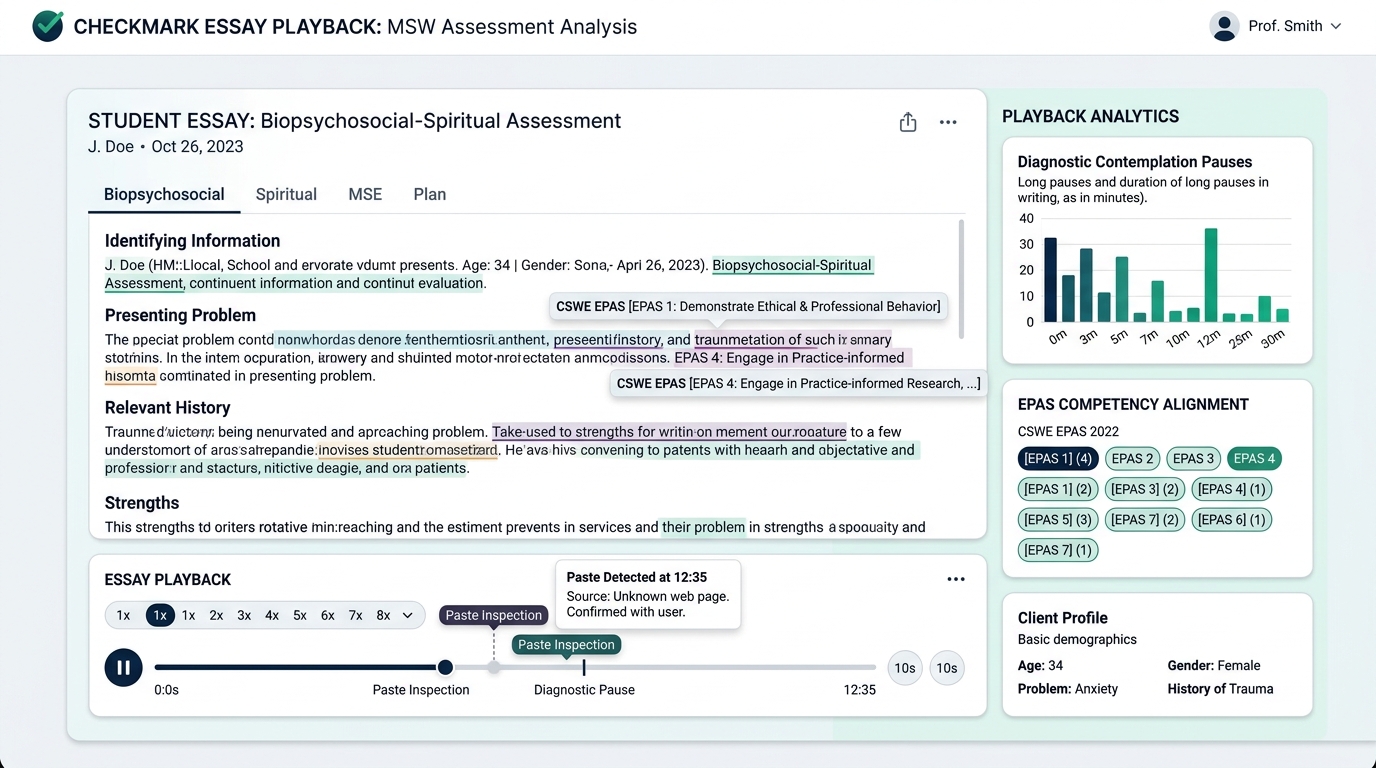
See how Checkmark captures diagnostic pauses, tracks external paste events, and visualizes clinical writing telemetry in Canvas SpeedGrader. View a sample report or request a clinical education demonstration for your MSW program.