
The rapid proliferation of Large Language Models (LLMs) has introduced a sophisticated, insidious form of academic dishonesty into secondary and collegiate historical research: hallucinated archival citations and phantom primary sources. Because generative AI models predict text based on statistical token probabilities rather than factual repository lookups, they regularly synthesize structurally flawless Chicago-style footnotes referencing non-existent Record Groups at the National Archives (NARA), fabricated manuscript boxes in the Library of Congress, non-existent dispatches at the UK National Archives (Kew), and confabulated historical quotations attributed to real historical figures.
Traditional similarity-based plagiarism checkers fail catastrophically in these cases because synthetic citations and quotes produce 0% web text overlap. Meanwhile, standalone black-box AI detectors risk falsely accusing honest students who quote authentic archaic prose. Rooted in Checkmark Plagiarism’s foundational philosophy of “Stop guessing, start trusting,” this guide provides Social Studies Department Chairs, AP/IB History teachers, and National History Day (NHD) mentors with an authoritative, four-phase archival citation audit protocol. By combining rapid digital repository triangulation, semantic anachronism analysis, patent-pending Essay Playback™ writing process telemetry, and restorative inquiry conferences, educators can protect historical truth, exonerate honest student researchers, and guide students toward rigorous historical scholarship.
Checkmark Plagiarism provides secondary and collegiate history departments with comprehensive authorship verification infrastructure, uniting synchronized side-by-side source comparison with keystroke process playback, passage-level AI writing detection, quote-anchored rubric autograding, and direct LTI 1.3 integrations for Canvas LMS and Agilix Buzz LMS.

1. The New Frontier of Historical Fabrication: The Synthetic Archival Citation
For generations of history educators, evaluating student research papers followed a well-established verification rhythm. When a student submitted an Advanced Placement (AP) U.S. History research paper, an International Baccalaureate (IB) History Extended Essay, an IB Historical Investigation (Internal Assessment), or a National History Day (NHD) project, academic integrity violations typically manifested as recognizable cut-and-paste plagiarism from Wikipedia, digital encyclopedias, or uncredited secondary monographs.
The widespread adoption of generative AI has inverted this paradigm. Students no longer merely copy existing historical text; instead, generative models synthesize entirely fabricated historical evidence wrapped in the structural conventions of professional historiography.
How historical research integrity shifted from copy-paste plagiarism to probabilistic synthetic confabulation
- Verbatim copying from published websites, books, or peer essays.
- Uncited quotes lifted directly from monographs or journal articles.
- Patchwriting and direct cut-and-paste student text blocks.
- Easily caught by traditional similarity engines and n-gram web crawlers.
- 100% synthetically generated prose crafted token-by-token.
- Fabricated archival Record Groups, box numbers, and folder titles.
- Confabulated primary source quotes attributed to real historical actors.
- Invented peer-reviewed journal titles and non-existent, broken DOIs.
When an LLM is prompted to “Write an AP European History paper on British naval diplomacy during the 1898 Fashoda Incident with five archival primary sources,” it does not search the digital catalog of The National Archives in Kew. Instead, it generates plausible-sounding historical syntax, inventing diplomatic dispatches, telegram numbers, and Foreign Office call numbers (such as an invented FO 27/3999) that look indistinguishable from real archival records to an overburdened educator grading dozens of papers.
To social studies department chairs and history faculty, this creates an urgent pedagogical crisis: How do we distinguish between an exceptionally dedicated student who spent hours searching digital archives and an AI-generated draft containing fabricated historical records?
2. The Anatomy of Archival Hallucinations: How LLMs Fabricate Historical Evidence
To effectively detect and address hallucinated citations, department chairs and history educators must first understand the technical mechanisms of generative language models and why historical archives are particularly susceptible to hallucination.
1. Probabilistic Next-Token Prediction vs. Deterministic Retrieval
Large Language Models (such as GPT-4o, Claude 3.5 Sonnet, or open-source LLMs) do not possess a structured, relational database of historical facts, nor do they query live repository indices during standard generation. They operate via probabilistic token prediction, selecting the next most statistically probable word or symbol based on patterns observed across massive training datasets.
Because academic history papers follow rigid bibliographic conventions (such as the Chicago Manual of Style, 17th and 18th Editions), the model understands the structural rhythm of a footnote far better than its empirical truth:
When the model needs an archival citation to support an analytical claim, it samples high-probability archival tokens—such as “National Archives and Records Administration,” “Record Group 59,” “Box 142,” or “Folder 12”—synthesizing a citation that is syntactically flawless but physically non-existent.
| CITATION COMPONENT | HISTORICAL REALITY AUDIT |
|---|---|
| Historical Figures & Roles | REAL: Sir Edmund Monson was Ambassador to France in 1898. |
| Target Repository | REAL: The National Archives (TNA) in Kew holds Foreign Office files. |
| Series Code (FO 27) | REAL: FO 27 represents Foreign Office: Correspondence, France (General Correspondence before 1906). |
| Piece Number (/3441) | MISMATCHED: FO 27/3441 exists, but the catalogue lists it as “Various. Africa. Vol. 6,” covering 17 June to 8 August 1898, so it cannot hold a document dated 12 October 1898. |
| Dispatch Number (#84) | IMPLAUSIBLE: Monson’s Africa despatches numbered 203-258 already run from 8 June to 31 July 1898 (FO 27/3414), so a No. 84 is out of sequence for October. |
| Quoted Archival Prose | SYNTHETIC: The quoted text was generated token-by-token by the LLM in Victorian diplomatic style. |
2. The Four Tiers of Fabricated Historical Evidence
Hallucinated historical evidence manifests in student papers across four distinct tiers of sophistication:
Invented quotes attributed to real historical figures (Lincoln, Churchill, Susan B. Anthony, Calhoun, Bismarck) containing plausible period vocabulary and cadence, but zero empirical existence in published transcripts or diaries.
Fictitious Record Groups (RG), Box numbers, Folder titles, and Manuscript Collection names at major repositories (NARA, Library of Congress, UK National Archives, Archives Nationales).
Fabricated journal articles in JSTOR, Project MUSE, or Oxford Academic, complete with fake volume/issue numbers, confabulated titles attributed to famous scholars (e.g. Eric Foner), and dead DOIs returning HTTP 404 errors.
10.1086/ahr/104.3.9892 that fail DOI resolver lookup.
Subtle synthetic errors where historical figures reference treaties, modern sociological concepts, or terms that were not coined until decades or centuries after the document’s purported creation date.
3. The Pedagogical Dilemma: Surface Elegance vs. Synthetic Historical Truth
The emergence of hallucinated archival citations strikes at the very heart of historical education. Social studies educators and department chairs are confronted with several profound challenges:
1. The Catastrophic Failure of Traditional Plagiarism Checkers
Traditional plagiarism detection tools were engineered exclusively for text-matching. They compare submitted student text against static web pages, student repositories, and published journals.
How an entirely fabricated primary source receives a false “Original Work” certificate
100% Synthetic Fabrication. In this illustration, the quoted dispatch is invented and the box and folder citation does not lead to any such document.
Because an AI-generated quote is synthesized uniquely on the fly, it exists nowhere in published literature or online databases. Consequently, traditional similarity checkers return a 0% similarity score, giving teachers a false sense of security while rewarding fabricated scholarship with top marks for “original archival work.”
2. The Danger of Opaque, Standalone AI Percentages
In response to generative AI, many institutions adopted standalone AI percentage detectors. However, in advanced history classrooms, these tools introduce a severe risk of false positive accusations:
- Archaic Prose Triggers: When honest students transcribe authentic 17th-, 18th-, or 19th-century primary sources (such as colonial charters, parliamentary debates, or Federalist essays), the archaic grammar, low perplexity, and predictable formal phrasing frequently trigger elevated AI probability scores in crude whole-document detectors.
- Punitive Friction: Department chairs are placed in an unworkable position: accusing an earnest AP/IB student of cheating based solely on an unexplained “82% AI” score, only for the student to produce their authentic library notes.
- The Checkmark Philosophy: At Checkmark Plagiarism, we reject opaque whole-paper percentages. Academic integrity requires transparent, defensible receipts—distinguishing between authentic student writing history, verified web sources, and ungrounded synthetic text.
4. The Archival Evidentiary Matrix
To understand how modern academic integrity infrastructure evaluates historical research, consider the comparative capabilities of traditional similarity checkers, standalone AI percentage detectors, and Checkmark Plagiarism’s multi-dimensional integrity suite:
| Integrity Dimension | Traditional Similarity Checkers | Standalone AI Percentage Detectors | Checkmark Plagiarism Suite |
|---|---|---|---|
| Detection of Phantom Primary Quotes | ❌ Fails completely (0% text overlap detected) | ⚠️ Unreliable (Generates whole-paper percentage with no source context) | ✅ Detects synthetic patterns at passage level; flags ungrounded quotes |
| Archival Metadata Verification | ❌ None (Ignores footnote factual validity) | ❌ None (Cannot cross-reference archival records) | ✅ Dual-pane viewer facilitates instant repository cross-referencing |
| Secondary Literature / DOI Audit | ❌ Only catches verbatim copied citations | ❌ No link analysis | ✅ Clickable live links reveal dead DOIs and non-existent citations |
| False Positive Risk on Archaic Text | 🟢 Low (Identifies legitimate quotes if published) | 🔴 High Risk (Archaic prose triggers false AI flags) | 🟢 Zero False Accusations via Essay Playback™ revision telemetry |
| AI Humanizers & Paraphrasers | ❌ Fails (QuillBot/Undetectable AI pass easily) | ❌ Fails (Humanized text bypasses classifiers) | ✅ Immune (Evaluates temporal keystroke history & paste events) |
| Process & Drafting Telemetry | ❌ Zero telemetry (Evaluates only final text) | ❌ Zero telemetry (Opaque black-box score) | ✅ Patent-Pending Essay Playback™ (Scrubbable 1x–8x typing timeline) |
| External Paste Provenance | ❌ None (Cannot see where text originated) | ❌ None | ✅ Captures original clipboard payload with instant jump-to-playback |
| Pedagogical Alignment | 🔴 Punitive (Arbitrary similarity cutoff) | 🔴 Punitive (Black-box accusation numbers) | 🟢 Supportive & Restorative (“Stop guessing, start trusting”) |
5. The Four-Phase Archival Citation Audit Protocol for History Educators
Social Studies Department Chairs and history faculty require an actionable, systematic protocol to verify archival citations and evaluate student research papers fairly and rigorously.
A standardized, evidence-grounded workflow for secondary and collegiate social studies faculty
Phase 1: Digital Repository Triangulation
When reviewing citations to archival collections or obscure primary sources, educators do not need to physically travel to Washington D.C. or London. Modern archives offer comprehensive, publicly accessible digital finding aids and catalog search engines.
Search Record Group (e.g. “Record Group 59”) + Series Title.
Search collection name (e.g. “Alexander Hamilton Papers”).
Enter exact series code (e.g. “FO 371/12345” or “CAB 128/10”).
Directly resolve DOI strings in JSTOR, Project MUSE, or Google Scholar.
Step-by-Step Triangulation Techniques:
- Exact-Phrase Quotation Search: Copy the quoted primary text into Google Books, HathiTrust Digital Library, or the Internet Archive enclosed in quotation marks (
“...”). If a multi-sentence quote from a famous figure returns zero hits across millions of digitized historical books and government records, it is almost certainly synthetic. - Archival Finding Aid Validation: Check the collection container list. If a student cites “NARA RG 242, Box 892, Folder 14,” open the NARA finding aid for RG 242. If Box 892 contains microfilm reels rather than folders, or if the series ends at Box 650, the citation is hallucinated.
- DOI and Volume/Issue Verification: Enter the cited DOI into
https://doi.org/. If the DOI fails to resolve or leads to an article on marine biology rather than a 1984 paper on the Cold War, the citation was generated by an LLM hallucinating scholarly metadata.
Phase 2: Textual, Semantic, and Chronological Anachronism Forensics
LLMs trained on massive internet corpora frequently exhibit distinct linguistic fingerprints when generating historical prose:
- Rhetorical Uniformity: In genuine historical research, there is a stark stylistic contrast between the student’s modern 21st-century analytical prose and the complex, archaic cadence of a 19th-century letter. In AI-generated papers, the student’s analysis and the “quoted” primary source often share identical sentence burstiness, vocabulary distributions, and syntactic rhythms.
- Conceptual Anachronisms: Watch for conceptual frameworks that did not exist during the historical era. Examples include:
- An 1848 French revolutionary manifesto discussing “systemic marginalization” or “socioeconomic infrastructure.”
- A 1787 Constitutional Convention letter referencing “human rights violations” (a mid-20th-century legal concept) rather than “natural rights” or “liberties.”
- A 1920 League of Nations memo referencing “non-governmental organizations (NGOs)” before the term was formalized by the UN Charter in 1945.
- Suspiciously Convenient Quotations: AI-generated primary quotes often state the paper’s thesis with unnatural, on-the-nose clarity. Real historical actors rarely summarize complex historiographical debates in a single tidy sentence.
Phase 3: Telemetry & Keystroke Dynamics via Checkmark Essay Playback™
The most definitive evidence of academic authenticity does not lie in static text analysis—it lies in the temporal process of composition.
When a student conducts authentic historical research, their writing process leaves distinct, human cognitive footprints. When using Checkmark Plagiarism, educators can review the entire writing session using patent-pending Essay Playback™:

How microsecond-level writing telemetry exposes synthetic quotes while validating genuine student research
- High variance in typing speed, natural composing pauses (10–90s).
- Iterative backspacing and authentic transcription rhythms.
- Zero composing pauses, zero backspaces, 0 WPM velocity.
- Permanent clipboard capture stores full external payload.
What Essay Playback™ Reveals:
- Paste Provenance & Text Preservation: Checkmark captures the exact text pasted from the clipboard, preserving the original payload even if the student subsequently edits words or tweaks footnote numbers.
- Transcription vs. Generation: If a student retyped text from a second screen or phone (transcription behavior), Essay Playback™ detects the steady, mechanical typing rate devoid of natural cognitive composing pauses, thesis re-evaluations, or organic drafting corrections.
- Footnote Construction History: Authentic researchers construct footnotes iteratively—pasting a URL, formatting a title, correcting a date. In contrast, synthetic essays introduce multi-part archival citations instantaneously or via robotic, pre-composed blocks.
Phase 4: The Restorative Historical Inquiry Conference (Viva Voce)
When an educator discovers a hallucinated citation or an instantaneous paste anomaly, the response must never be an uncalibrated, hostile accusation. Generative AI tools are often used by students who were overwhelmed by complex research expectations or who mistakenly believed that AI was an advanced search engine capable of finding real archival documents.
Guided by Checkmark’s philosophy of “Stop guessing, start trusting,” the goal of an inquiry conference is to verify authentic authorship, understand the student’s research methodology, and transform the incident into a powerful learning experience.
- “Can you walk me through the steps you took to access this Foreign Office file (FO 27/3441)?”
- “What search queries did you use in the UK National Archives catalog to find this dispatch?”
- “Do you have your working research notes, bookmarks, or browser history from this session?”
Open Checkmark Plagiarism side-by-side with the student:
- Show the live catalog search demonstrating that Piece 3441 covers June to August 1898 and cannot hold a dispatch dated 12 October 1898.
- Review Essay Playback™ showing the instantaneous insertion of the entire footnoted section.
- Clarify how LLMs fabricate citations when asked to find sources.
- Assign a guided redraft requiring verified primary sources with permalinks or digital scans.
6. Detailed Classroom Case Scenarios
To illustrate how these dynamics could play out, examine three illustrative scenarios from secondary and collegiate history classrooms.
NARA RG 60 (Department of Justice), Year Files 1894, Box 114, Folder 3 with dramatic quotes from Attorney General Richard Olney ordering marshals to “suppress the insurrectionary labor cabal by all executive prerogatives.”
The National Archives (UK), Kew, CAB 128/30, Cabinet Conclusions CM(56) 74th Meeting, 31 October 1956 regarding Suez Crisis coordination.
CM(56) 76th Conclusions (CAB 128/30/76). The 74th Conclusions (CAB 128/30/74) are dated 25 October 1956.
7. How Checkmark Plagiarism Empowers Social Studies Departments
Checkmark Plagiarism is engineered specifically to address the complex integrity and pedagogical challenges of modern humanities education. Rather than relying on simplistic, punitive scores, Checkmark provides a comprehensive, educator-first toolset:
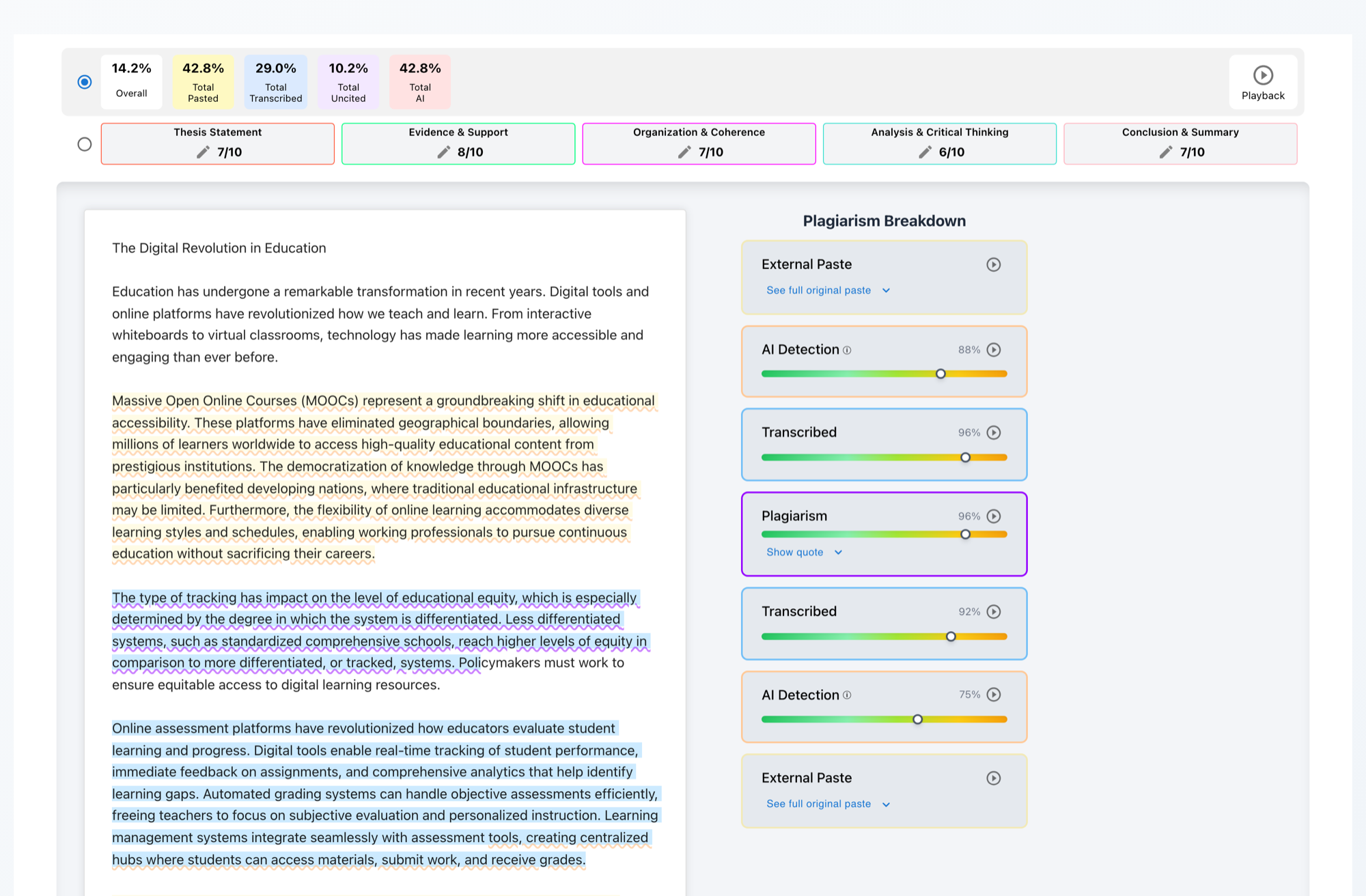
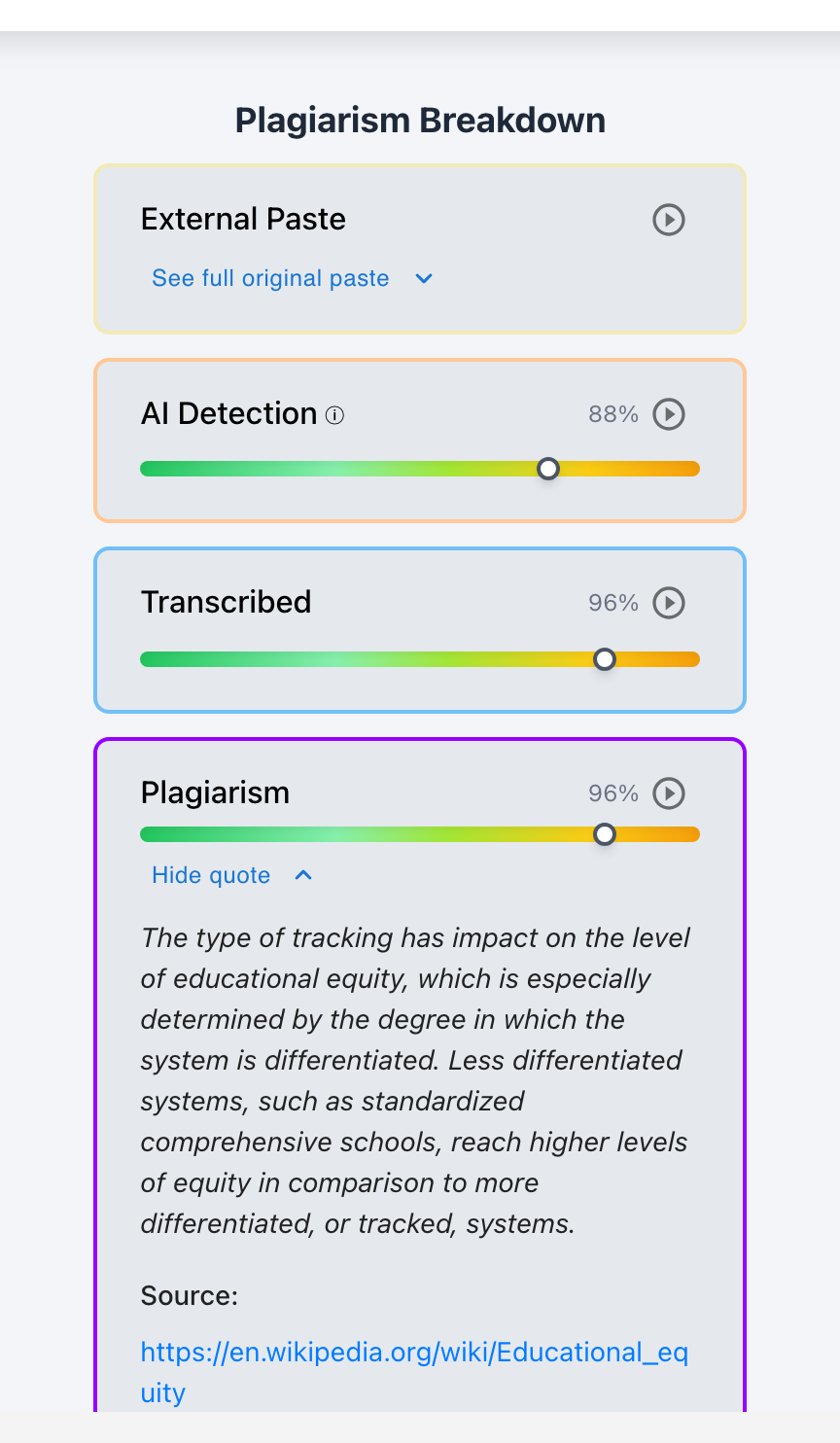
Underlines specific synthetic passages directly within the essay. Evidence cards show calibrated confidence sliders (typical human vs. typical AI) with honest guardrails (‘N/A’ on samples <150 words).
Scans billions of live web pages, open-access archives, and academic encyclopedias. Side-by-side quote comparison with clickable live links to verify citation authenticity instantly.
Full 1x–8x scrubbable video timeline of the entire writing and revision history. Permanent external paste capture preserves original clipboard text and timestamps.
Autogrades history essays against AP DBQ/LEQ, IB History, and NHD rubrics with quote-anchored justifications while teachers retain 100% final grading authority.
Student history papers are NEVER used to train commercial AI models. Full FERPA and COPPA compliance with enterprise-grade encryption.
8. Social Studies Department AI Policy Framework
To prevent archival hallucinations and establish a culture of academic integrity, Social Studies Department Chairs should establish clear, transparent department-wide policies governing AI usage in historical research.
Transparent boundaries between productive research assistance and prohibited synthetic fabrication
- Brainstorming broad historical research topics and angles.
- Developing keyword search strings for archival catalogs (e.g. NARA, LOC).
- Formatting bibliographic entries from verified, student-supplied sources.
- Proofreading student-drafted prose for grammatical clarity.
- Generating primary or secondary source quotations.
- Using AI as a search engine for historical evidence or citations.
- Generating analytical paragraphs, DBQ arguments, or thesis statements.
- Pasting AI-generated text into LMS submissions.
Departmental Policy Best Practices:
- Require a “Primary Source Provenance Log”: Alongside final research papers, require students to submit a simple research log documenting where and how each primary source was accessed (URL, library database name, finding aid PDF, or catalog accession number).
- Incorporate Checkmark Essay Playback™ into Draft Milestones: Require students to compose their drafts within approved environments (Canvas LMS, Buzz LMS, Google Docs, or Microsoft Word integrated with Checkmark) so their writing process telemetry is automatically preserved.
- Teach LLM Hallucination Mechanics Explicitly: Dedicate one class period at the start of major research units to demonstrate how ChatGPT hallucinates citations. Show students a real prompt generating fake NARA records to demystify the technology and warn them of its academic risks.
9. Frequently Asked Questions (FAQ)
1. Why do AI models hallucinate archival citations instead of simply saying “I don’t know”?
Large Language Models are probabilistic text completion systems, not relational databases. They are optimized to produce coherent, contextually appropriate text that matches the user’s prompt. When a student asks for archival citations supporting a specific historical thesis, the model predicts the exact grammatical and lexical structure of an archival footnote, drawing upon common repository names, series codes, and numbering conventions from its training data to construct a syntactically convincing, but completely fabricated, citation.
2. Can traditional similarity checkers like Turnitin detect hallucinated historical citations?
No. Traditional plagiarism detectors rely on text matching against existing web pages, digitized books, and student repositories. Because an AI model generates synthetic quotes and citations token-by-token on demand, the text has 0% overlap with existing published sources. Traditional checkers will report 0% similarity, treating a completely fabricated primary source as 100% original student work.
3. How does Checkmark Plagiarism prevent false AI accusations on authentic archaic historical quotes?
Checkmark Plagiarism rejects blunt, whole-paper AI percentage scores in favor of passage-level linguistic analysis combined with patent-pending Essay Playback™. Even if a 17th-century colonial legal document has archaic phrasing that registers high predictability on linguistic models, Essay Playback™ provides indisputable visual proof of the student’s authentic typing, note-taking pauses, and iterative editing timeline—completely exonerating the student.
4. What is the fastest way for a history teacher to verify a suspicious NARA or Library of Congress citation?
Search the quoted text in quotation marks (“...”) on Google Books or HathiTrust. If no published record exists, search the Record Group or Collection Name directly in the National Archives Catalog or Library of Congress Finding Aids. If the container, box, or folder number exceeds the physical range of the collection (e.g., Box 800 in a 400-box series), the citation is hallucinated.
5. What is the difference between authentic student transcription and AI generation in Essay Playback™?
Authentic transcription of a primary source involves natural, human writing telemetry: intermittent typing bursts, pauses between sentences as the student reads off their source material, typographical error corrections, and manual footnote formatting. In contrast, AI-generated submissions typically appear as monolithic paste events where hundreds or thousands of words with pre-formatted citations are inserted into the document in under two seconds.
6. Does Checkmark Plagiarism train AI models on student history papers?
No. Checkmark Plagiarism enforces a strict zero-retention data privacy policy. Student submissions are never used to train, fine-tune, or develop artificial intelligence models. Checkmark is fully compliant with FERPA, COPPA, and enterprise educational privacy standards.
7. How should history teachers handle a student who claims they found a hallucinated source in a book they lost?
Schedule a supportive viva voce inquiry conference. Open Checkmark Plagiarism and demonstrate that the citation metadata (box number, series code, or DOI) does not exist in official repository catalogs. Guide the conversation around research methodology rather than moral condemnation, and provide an opportunity for the student to redraft the section using verified primary sources supported by Checkmark’s Essay Playback™ writing telemetry.
10. Conclusion: Fostering Genuine Historical Inquiry
The emergence of generative AI does not spell the end of the high school or undergraduate history research paper. Rather, it challenges social studies educators to elevate their pedagogical standards from passive text evaluation to active, evidence-based verification of the historical research process.
By moving away from opaque, punitive black-box detectors and embracing Checkmark Plagiarism’s transparent suite—featuring passage-level AI detection, side-by-side archival source verification, and patent-pending Essay Playback™—department chairs and history teachers can uphold the highest standards of historiographical integrity.
Stop guessing, start trusting. Empower your history faculty with transparent receipts, protect your honest student scholars, and cultivate a classroom culture where authentic historical inquiry thrives.
Equip Your Social Studies Department with Checkmark
Discover how synchronized side-by-side archival verification, keystroke process telemetry, and teacher-in-the-loop rubric grading safeguard historical inquiry across your school or district.
Schedule a Department Consultation