
The rapid adoption of generative artificial intelligence (ChatGPT, Claude, Perplexity) among secondary students has precipitated an unprecedented archival integrity crisis across Advanced Placement (AP U.S. History, AP European History, AP World History), National History Day (NHD) competitions, and high school research seminars. Large language models (LLMs) routinely generate “plausible hallucinations”—convincing, period-accurate quotes, fabricated archival letters, and non-existent scholarly citations (e.g., citing fictitious volumes of The Papers of Thomas Jefferson or imaginary Senate hearing transcripts). Because these quotes are newly synthesized rather than copied from existing web documents, legacy string-matching plagiarism detectors award them a misleading “0% Plagiarism” clean score.
Checkmark Plagiarism’s Side-by-Side Source Verification Workbench directly resolves this crisis. By coupling a synchronized dual-pane viewer—which resolves live digital repositories (Library of Congress, National Archives, Founders Online, JSTOR, The Avalon Project)—with a 4-Badge Source Taxonomy (🟢 Quoted & Verified, 🟡 Paraphrased with Source, 🔴 Uncited External Match, 🟣 Unverified/Hallucinated Citation Alert), patent-pending Essay Playback™ writing process telemetry, passage-level AI detection, and teacher-in-the-loop rubric grading, Checkmark equips history educators with transparent, defensible evidence. Rather than relying on punitive black-box percentages, social studies teachers can differentiate intentional fraud from novice naivete, protect historical thinking skills, and conduct restorative student conferences rooted in authentic disciplinary literacy.
Checkmark Plagiarism empowers secondary social studies teachers, AP history educators, and department chairs with comprehensive authorship verification, uniting side-by-side source comparison with keystroke process playback, passage-level AI writing detection, quote-anchored rubric autograding, and direct LTI 1.3 integrations for Canvas LMS and Agilix Buzz LMS.

1. The Archival Crisis in Secondary History Education
For generations, the central challenge of teaching secondary historical research was plagiarism of discovery: students copying verbatim text from Wikipedia, digital encyclopedias, or uncredited secondary articles without quotation marks or attribution. High school social studies teachers and AP readers developed sharp eyes for sudden vocabulary shifts, and automated string-matching tools provided simple similarity percentages to flag copied text.
Today, secondary social studies faces a fundamentally different, far more insidious challenge: the fabrication of historical reality.
How the nature of academic misconduct in history classrooms has evolved from copied prose to synthetic reality
- Copy-pasting authentic published text from online websites or encyclopedias
- Directly verifiable against existing URLs and digital book repositories
- Reliably flagged by legacy character string-matching scanners
- Student copies a genuine historical artifact or secondary source
- Core Issue: Failure of ethical attribution and citation mechanics
- Generating newly synthesized primary and secondary archival text on the fly
- Convincing, period-accurate historical syntax, cadence, and vocabulary
- Completely invisible to legacy checkers (produces a misleading 0% similarity score)
- LLM invents non-existent archival citations, collection boxes, and page numbers
- Core Issue: Historical disinformation, factual counterfeit, and research collapse
In advanced courses—such as AP U.S. History (APUSH), AP European History, AP World History: Modern, IB History, and capstone research programs like National History Day (NHD)—students are evaluated on their ability to locate, analyze, contextualize, and corroborate primary and secondary sources. Historical literacy rests upon the foundational premise that primary sources are authentic artifacts of human history.
When a student submits an essay featuring an eloquent quote from an 1862 Civil War soldier or a 1933 New Deal relief worker that never existed in human history, the entire architecture of historical argumentation collapses. If left unchecked, this dynamic erodes core disciplinary skills:
- Historiographical Sourcing (HIPP/POVA): Students cannot meaningfully analyze historical situation, intended audience, purpose, or point of view on an artifact created by a predictive neural network in 2026.
- Corroboration: Fabricated quotes short-circuit the historical habit of cross-referencing multiple archival accounts.
- Academic Trust: Evaluators spend dozens of hours chasing phantom citations in university archives and digital repositories, creating deep teacher burnout and administrative friction.
2. Anatomy of the “Plausible Quote” Trap: How LLMs Fabricate Historical Evidence
To effectively address AI-generated source fabrication, secondary educators must understand the underlying computational mechanics that make large language models so adept at generating persuasive historical counterfeit.
The algorithmic sequence from student prompt to non-existent archival counterfeit
1. The Mechanics of Autoregressive Token Generation
Large Language Models (LLMs) do not operate like searchable archival databases (such as the National Archives or the Library of Congress). They are autoregressive statistical engines trained to predict the most probable sequence of tokens (words and subwords).
When an LLM is prompted to provide a quote from a historical figure, it does not query an internal library of verified transcripts. Instead, it generates words that statistically align with the linguistic cadence, syntactic structure, and ideological worldview of the historical figure:
- For Thomas Jefferson, the model generates balanced Enlightenment prose featuring vocabulary like “unalienable,” “usurpations,” and “civic virtue.”
- For Abraham Lincoln, it crafts rhythmic, biblically inflected mid-19th-century phrasing featuring terms like “scourge,” “providence,” and “malice toward none.”
- For a 1930s labor organizer, it produces colloquial, gritty vernacular reflecting industrial unionism.
Furthermore, because academic citations frequently follow rigid formatting conventions (Author, Title, Volume, Page, Publisher, Year), the model effortlessly predicts and constructs a fully formed, mathematically plausible citation that mimics authentic scholarship.
2. The Total Failure of Legacy String-Matching Plagiarism Scanners
For two decades, school districts relied on similarity detection tools. These legacy engines operate by dividing student submissions into overlapping n-grams (strings of 5 to 10 consecutive words) and querying a database of indexed websites, published journal articles, and previously submitted student papers.
Comparing legacy string matchers against Checkmark’s Synchronized Dual-Pane Archive Matcher
↓
[Scan 90B Public Webpages]
↓
[No Verbatim Matching String Found]
↓
[Synchronized Dual-Pane Archive Matcher]
↓
[4-Badge Sourcing Taxonomy Cross-Check]
When an LLM fabricates a primary source quote, that exact string of words has never been published on any website or in any digitized book. Consequently, when the legacy plagiarism checker scans the document:
- It finds zero verbatim string matches across its billions of indexed pages.
- It returns a pristine “0% Similarity / Original Content” report.
- The classroom teacher, reassured by the green report, assumes the student conducted diligent archival research in primary source databases.
This creates a dangerous pedagogical false sense of security: the papers containing the most severe integrity breaches (pure factual fabrication) receive the highest originality ratings from legacy tools.
3. Dissecting Student Intent: Malicious Fraud vs. Novice Naivete
When addressing fabricated historical quotes, educators must not treat every student as a malicious counterfeiter. In secondary classrooms, student use of AI falls along a wide spectrum of digital literacy and intent:
Differentiating student cognitive mindsets to guide appropriate pedagogical responses
- Student asks AI: “Find me a quote from Elizabeth Cady Stanton supporting the 1848 Seneca Falls Declaration.”
- Assumes AI functions as a search engine like Google or JSTOR.
- Genuinely believes the generated quote is real and cites it in good faith.
- Student is working at 1:00 AM before the APUSH deadline.
- Asks AI to generate an essay with footnotes to satisfy the 5-source rubric quota.
- Copies the output without checking archive validity due to time stress.
- Student uses AI humanizers or retypes text to bypass basic detectors.
- Fabricates elaborate archive box and folder numbers to deceive competition judges (e.g., NHD finals).
A supportive, pedagogical integrity system must provide clear, undeniable forensic evidence (“receipts”) that enable teachers to distinguish between a confused 10th grader who needs a lesson on search indexers vs. an intentional bypass of academic honesty policies.
3. Checkmark Plagiarism’s Side-by-Side Source Verification Workbench
To restore transparency to historical research, Checkmark Plagiarism provides an integrated Side-by-Side Source Verification Workbench engineered specifically for the analytical needs of secondary and higher education humanities teachers.
...Throughout the critical winter of 1862, Abraham Lincoln balanced pressure from Radical Republicans against the vital strategic necessity of retaining the loyalty of Kentucky and Missouri.
In an unrecorded 1862 letter to Salmon P. Chase, Lincoln cautioned: “The border states will wither if we strike the institution prematurely; we must hold the border before we can redeem the Union.”¹
This correspondence demonstrates how Lincoln’s administrative calculations were governed by pragmatic constitutional timing rather than immediate moral abolitionism...
Typing Velocity: 0 WPM (Instantaneous clipboard drop)
Cached Prompt: “Give me an unknown Lincoln quote to Chase on border states...”
1. Synchronized Dual-Pane Archival Engine
Checkmark’s interface pairs the student’s submitted essay directly alongside live digital repositories and open-access archives. Rather than forcing teachers to manually open five browser tabs and search disparate databases, Checkmark automatically cross-references cited passages against major historical archives:
- The Library of Congress (LOC): Digitized manuscripts, Chronicling America historical newspapers, and congressional debate transcripts.
- National Archives and Records Administration (NARA): Founders Online, presidential papers, and legislative committee records.
- The Avalon Project at Yale Law School: Treaties, international legal conventions, and diplomatic history documents.
- Fordham Internet Medieval Sourcebook: Pre-modern European, Islamic, and global primary sources.
- JSTOR & CrossRef: Peer-reviewed secondary literature and historical academic monographs.
When a student embeds a direct quotation or bibliographic citation, Checkmark queries these open-access scholarly databases and displays the verified original document in the synchronized right pane. If the text matches, the exact sentence is highlighted in the archive with side-by-side textual alignment.
2. The 4-Badge Source Taxonomy
Checkmark replaces confusing, aggregate “originality percentages” with an intuitive, 4-badge disciplinary taxonomy visible on two-way linked evidence cards:
The quoted text matches a verified document in an authoritative archive (LOC, NARA, Avalon) and is properly enclosed in quotation marks with complete bibliographic attribution.
Substantive semantic overlap with an external source accompanied by a citation. Indicates the student located a genuine source but may have struggled to synthesize it without mimicry.
Verbatim text matches an indexed online webpage, published article, or peer document without any citation, footnote, or quotation marks.
The quoted passage and citation do NOT exist in any verified repository or live web index. Accompanied by LLM linguistic signatures or single-paste telemetry.
When a purple badge is triggered, the system flags the citation for immediate teacher review. Clicking the purple badge opens an evidence card detailing:
- Archive Search Status: Confirmation that comprehensive queries across verified corpora yielded no matches.
- Linguistic Confidence Score: The probability that the passage syntax was synthesized by an LLM rather than extracted from historical literature.
- Drafting Telemetry: Keystroke timeline data showing how the passage was entered into the document.
3. Patent-Pending Essay Playback™: Keystroke Telemetry & Clipboard Forensics
The ultimate defense against AI-fabricated history is not surface-level text scanning; it is process evidence. While generative AI can produce synthetic text that mimics 19th-century prose, it cannot fake authentic, messy human drafting behavior.

How microsecond-level writing telemetry exposes synthetic quotes while validating genuine student research
- Natural cognitive pauses (45–180s) while reading
- Keystroke burstiness with backspaces and edits
- Manual typing velocity: 25–45 WPM
- Single clipboard drop event (0 WPM velocity)
- Full unredacted prompt cached in paste snapshot
- Complete absence of organic cognitive friction
Essay Playback™ reconstructs the student’s complete writing session keystroke-by-keystroke. Educators can scrub through the timeline like a video at 1x to 8x speed:
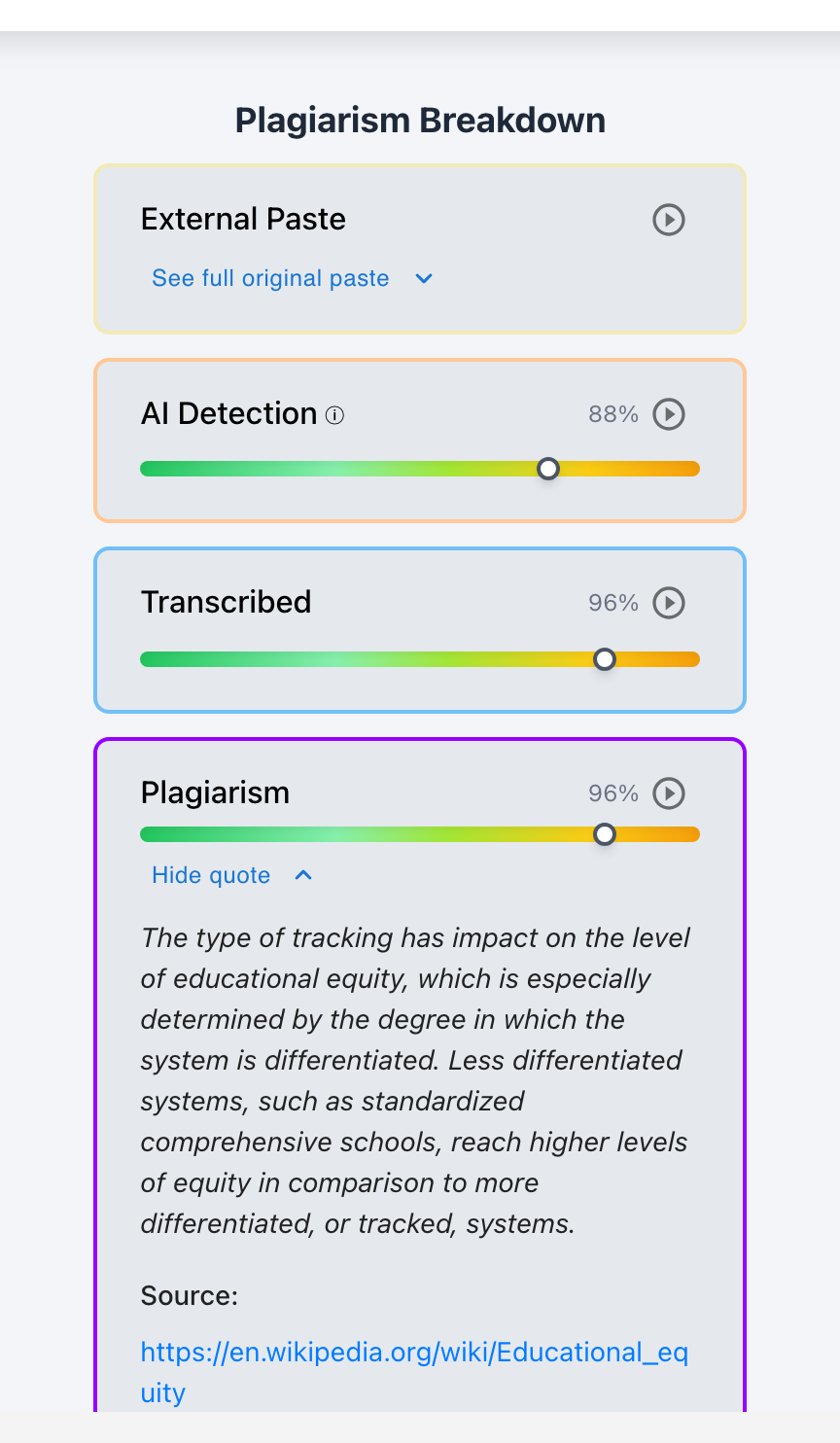
- External Paste Tracking with Complete Text Preservation: When a student pastes text from an external source (e.g., ChatGPT or Claude), Checkmark captures an immutable, timestamped snapshot of the exact clipboard content. Even if the student subsequently edits every word or changes vocabulary to disguise the paste, the teacher can click “Jump to Playback” and view the original pasted block in full.
- Transcription & Mechanical Retyping Detection: Some students attempt to circumvent paste detectors by placing an AI chat window on a second monitor or mobile phone and manually retyping the generated text. Essay Playback™ detects this immediately by analyzing typing velocity and pause distribution: a student retyping fabricated text types with steady, mechanical speed across complex sentences without the natural cognitive pauses, word deletions, and syntactic restructuring characteristic of authentic human historical writing.
- Exoneration of Honest Students: For students who quote rare, obscure local historical archives not indexed in commercial databases, Essay Playback™ serves as undeniable proof of innocence. The teacher can watch the student compose the analysis, pause to consult their notes, type the citation, and revise their argument—instantly clearing them of false AI accusations.
4. Passage-Level AI Linguistic Pattern Analysis & Honest Short-Text Guardrails
Unlike generic AI detectors that assign an arbitrary whole-paper score (e.g., “78% AI”), Checkmark provides passage-level granularity:
- Underlines specific sentences within the essay accompanied by individual sidebar evidence cards.
- Calibrated confidence sliders visually display whether sentence construction reflects typical human writing diversity or typical AI statistical predictability (low perplexity, uniform burstiness).
- Honest Short-Text Guardrails (<150 words): Checkmark explicitly displays
N/Afor short text selections under ~150 words rather than guessing on statistically insufficient sample sizes, preventing unwarranted flags on brief thesis statements or short historical definitions. - Educator-Only Flag Statuses: All flags (
Flagged,Resolved,Not Flagged) remain strictly private to educators to ensure objective evaluation and prevent student panic.
5. Teacher-in-the-Loop Rubric Autograding with Direct LMS Passback
Checkmark integrates directly with Canvas LMS SpeedGrader, Agilix Buzz LMS, and Google Classroom via LTI 1.3 Advantage. Teachers can evaluate Document-Based Questions (DBQs) and historical research papers against custom analytical rubrics:
- AI autograding generates first-draft rubric suggestions with quote-anchored justifications tied directly to student prose.
- Teachers retain 100% final authority to modify scores, refine feedback, or override suggestions.
- Finalized scores and detailed feedback sync back to the LMS gradebook in a single click, eliminating manual data entry.
4. Deep-Dive Case Studies: Archival Forensics in the History Classroom
To illustrate how Checkmark’s Side-by-Side Source Verification Workbench operates in practice, consider three realistic secondary social studies scenarios.
| Course & Level | Assignment & Historical Era | Sourcing Integrity Challenge | Checkmark Resolution |
|---|---|---|---|
| 1. APUSH (11th Grade) | Civil War Emancipation Policy & Border States (1862) | Hallucinated Lincoln-Chase letter; fictitious Basler Vol. V page. | Dual-pane archive check fails; single-paste prompt snapshot revealed; restorative rewrite. |
| 2. National History Day (10th) | 1930s Labor Movement & New Deal Industrial Unionism | Fabricated 1936 Senate committee testimony from fake organizer. | National Archives check fails; 78 WPM retyping velocity; coached on Reuther Library. |
| 3. World History (9th Grade) | Cold War Crises: Cuban Missile Crisis & Bay of Pigs | Invented 1961 Khrushchev-Castro cable with fake Russian fond numbers. | Wilson Center CWIHP query fails; formative lesson on search engines vs. LLM token synthesis. |
“Lincoln remained deeply hesitant to alienate Kentucky. In a private May 1862 letter to Treasury Secretary Salmon P. Chase, Lincoln confided: ‘To lose Kentucky is nearly the same as to lose the whole game, but to lose our constitutional footing in the process would make victory indistinguishable from defeat.’ (Lincoln to Chase, May 14, 1862, in Basler, Collected Works of Abraham Lincoln, Vol. V, p. 219).”
Returned 0% Plagiarism. The quote was newly minted by an LLM and did not match any indexed webpage.
🟣 Purple Alert. Library of Congress cross-reference confirms Basler Vol. V, p. 219 contains routine Treasury warrants, not Lincoln-Chase letters.
The teacher scrubbed to timestamp 00:08:41. The timeline showed the entire paragraph pasted in one action. The cached clipboard snapshot preserved the student’s prompt: “Write an APUSH-level paragraph about Lincoln balancing Chase and border states, cite a primary source quote from Basler.” During a restorative conference, the student learned how LLMs hallucinate citations and resubmitted the paper using Lincoln’s verified letter to Orville Browning (Sept 22, 1861) on Founders Online for full credit.
“During the 1936 Flint Sit-Down Strike, rank-and-file organizers faced immense intimidation. Arthur MacIntyre, a local GM assemblyman, testified before the Senate La Follette Civil Liberties Committee: ‘We did not strike for comfort; we struck for the right to stand upright on the shop floor without asking permission from private detectives.’ (U.S. Senate, Hearings on S. Res. 266, Part 4, p. 1432, 1936).”
Query against National Archives Record Group 46 confirmed that no individual named “Arthur MacIntyre” ever testified before the committee.
Text was not pasted. The student typed at an unbroken 78 WPM with 0 backspaces across 45 words—proving transcription from a secondary phone screen.
The NHD adviser demonstrated that submitting fabricated testimony would result in immediate regional disqualification. The adviser connected the student with digitized oral histories at Wayne State University’s Walter P. Reuther Library, where the student incorporated authentic testimonies from real organizers like Genora Dollinger and Bob Travis.
“Following the Bay of Pigs invasion in April 1961, Premier Nikita Khrushchev sent a classified telegram to Fidel Castro stating: ‘Imperialist aggression in the Caribbean will be met not with diplomatic protests, but with the full defensive shield of the Soviet motherland.’ (Soviet Foreign Ministry Archives, F. 059, Op. 43, D. 12, L. 4).”
Query to Woodrow Wilson Center Cold War International History Project (CWIHP) declassified records yielded 0 matches for the quoted text.
90% of the essay was drafted authentically over 3 days with hundreds of organic edits. Only the 15-word quote block had been pasted from an AI chatbot.
The teacher recognized novice search confusion: “I typed ‘Find me a declassified Soviet telegram from 1961 about Cuba’ into ChatGPT. It gave me the quote and the Russian archive number, so I thought it was real.” The teacher used this as a high-impact classroom lesson on LLM hallucinations vs. real archival indices, and the student received full formative credit after incorporating authentic cables from the Wilson Center Digital Archive.
5. The 4-Phase Historical Research Verification Protocol
To implement a consistent, department-wide standard for evaluating primary source integrity, secondary social studies departments can adopt Checkmark’s 4-Phase Verification Protocol:
- Submissions sync automatically via Canvas, Buzz LMS, or Google Classroom.
- Checkmark cross-references quotes against LOC, Founders Online, Avalon, & JSTOR.
- Teacher filters submissions by badge status (prioritizing 🟣 Purple Alerts).
- For any purple badge, open Essay Playback™ timeline at 2x–4x speed.
- Review external clipboard captures to inspect original pasted prompts.
- Check velocity curves for mechanical typing patterns (retyping from external screens).
- Examine passage-level confidence sliders (perplexity & burstiness metrics).
- Verify that short citations under 150 words display honest N/A guardrail tags.
- Corroborate whether surrounding analytical prose matches student’s natural voice.
- Use AI Rubric Assistant to generate first-draft DBQ/Research rubric scores.
- Teacher reviews, adjusts points, and embeds quote-anchored disciplinary feedback.
- Push finalized scores directly to LMS Gradebook via LTI 1.3 Advantage passback.
6. Institutional Implementation: Syllabus Policies & Restorative Conference Scripts
Clear institutional policies and transparent teacher-student communication are essential to ensure academic integrity tools support student growth rather than creating an adversarial classroom dynamic.
Model Syllabus Language for Secondary Social Studies
Departments can adapt this syllabus policy to establish unambiguous expectations regarding AI and primary source research:
Historical thinking requires engaging with authentic, verifiable primary and secondary sources. Every quotation, archival letter, statistical data point, and scholarly citation in your research papers must originate from a real, verifiable historical artifact.
• Permissible AI Assistance (Formative Support): You may use approved AI tools to brainstorm research questions, generate search keywords for archival databases (e.g., “What terms should I use to search the Library of Congress for the Pullman Strike?”), or check grammar and mechanics on your own original drafting.
• Prohibited AI Fabrication (Authorship Fraud): You may NOT use generative AI to draft essay paragraphs, synthesize primary source quotes, or generate bibliographic citations. Generating or citing non-existent quotes or citations constitutes academic fabrication under district policy.
All research papers will be evaluated using Checkmark Plagiarism’s Side-by-Side Source Verification Workbench and Essay Playback™. Writing process history—including authentic composing pauses, revisions, and verified archival links—protects honest students and confirms authentic authorship.
Restorative Sourcing Conference Script
When a 🟣 Unverified/Hallucinated Citation Alert is detected, teachers should conduct a non-punitive, evidence-based restorative dialogue using this proven script:
7. Frequently Asked Questions (FAQ)
1. How does Checkmark detect hallucinated historical quotes if they aren’t on the internet?
Traditional plagiarism tools search only for matching strings on indexed websites. Checkmark connects directly to comprehensive, structured historical corpora (Library of Congress, Founders Online, National Archives, JSTOR, Avalon Project) through its Dual-Pane Source Engine. When an essay cites an archival source, Checkmark verifies whether that specific text exists within the cited volume, manuscript collection, or author corpus. If no archival record exists and the passage displays characteristic LLM linguistic predictability, the system generates a 🟣 Unverified/Hallucinated Citation Alert.
2. Can a student fool Essay Playback™ by manually retyping an AI-generated quote?
No. Essay Playback™ analyzes continuous keystroke dynamics, typing velocity curves, and cognitive pause distributions. Authentic historical composing involves natural hesitation (e.g., pausing for 30–90 seconds while reading an archive on another screen, deleting words, fixing typos, rephrasing sentences). Manual transcription from a phone or second screen produces a uniform, unbroken typing velocity with zero natural compositional pauses—a distinct mechanical signature flagged by Checkmark’s writing telemetry.
3. What happens if a student cites a legitimate but obscure physical archive from a local historical society?
Honest students citing non-digitized, local primary sources are fully protected by Essay Playback™. The teacher can replay the student’s drafting session to observe authentic note synthesis, composing pauses, and manual citation entry. Furthermore, teachers can use the one-click “Mark as Verified” button to convert the badge to 🟢 Quoted & Verified, preserving the teacher as the ultimate authority.
4. Does Checkmark store or train AI models on student essays?
Never. Checkmark strictly enforces zero model training on student submissions. Student essays and research papers are never cached in public LLM repositories, never sold to third parties, and never used to train machine learning models. Checkmark is fully compliant with FERPA, COPPA, and state-level student data privacy mandates.
5. How does Checkmark differentiate between bad citation formatting and intentional fabrication?
Checkmark’s 4-Badge Source Taxonomy explicitly separates formatting errors from fraud. An uncredited or poorly formatted match triggers an amber 🟡 Paraphrased with Source or red 🔴 Uncited External Match badge, allowing teachers to provide targeted citation coaching. A 🟣 Purple Alert is reserved exclusively for unverified citations where neither the text nor the source can be corroborated in archival indices.
6. How does Checkmark integrate with Canvas SpeedGrader, Agilix Buzz, and Google Classroom?
Checkmark utilizes 1EdTech LTI 1.3 Advantage (Assignment and Grade Services AGS 2.0 & Names and Role Provisioning Services NRPS 2.0). Within Canvas SpeedGrader or Buzz LMS, teachers access the synchronized source viewer, Essay Playback™ timeline, and AI rubric draft suggestions directly inside the native grading pane. One click synchronizes final scores and written justifications directly back to the LMS gradebook.
7. Why does Checkmark display “N/A” on short text selections under 150 words?
Short passages (such as a single thesis sentence or brief factual definition) do not provide a large enough statistical sample for reliable linguistic pattern analysis (perplexity and burstiness). Rather than guessing and generating false-positive flags, Checkmark enforces Honest Short-Text Guardrails displaying N/A, preventing unwarranted accusations against concise student writing.
8. Summary Comparison Matrix: Integrity Tools in the Social Studies Classroom
| Feature / Capability | Legacy Plagiarism Scanners | Checkmark Plagiarism |
|---|---|---|
| Primary Source Archive Verification | ❌ No (Web scrape only) | 🟢 Dual-Pane Archive Matcher |
| Detection of AI Hallucinated Quotes | ❌ Failed (Flags 0% Plagiarism) | 🟢 🟣 Purple Badge Alerts |
| Keystroke & Video Essay Playback™ | ❌ None (Static text only) | 🟢 1x–8x Scrubbable Replay |
| External Clipboard Text Capture | ❌ Not preserved | 🟢 Full original text saved |
| Mechanical Retyping Detection | ❌ Invisible | 🟢 Keystroke velocity curves |
| Granular Passage-Level AI Sliders | ❌ Whole-paper % score | 🟢 Passage-level confidence |
| Honest Short-Text Guardrails (<150w) | ❌ Hallucinates flags | 🟢 Transparent N/A display |
| Teacher-in-the-Loop Rubric Grading | ❌ No autograding | 🟢 DBQ Rubric Assistant |
| Student Data Privacy (Zero Training) | ⚠️ Varies / Vendor Caching | 🟢 Guaranteed Zero Training |
Conclusion: Stop Guessing, Start Trusting in Historical Research
The rise of generative AI does not signify the end of the high school research paper or the National History Day project. Instead, it challenges social studies educators to elevate historical thinking skills and replace outdated string-matching scanners with transparent, multi-dimensional verification tools.
By deploying Checkmark Plagiarism’s Side-by-Side Source Verification Workbench, secondary history departments gain the defensible process evidence needed to detect AI-hallucinated primary sources, protect honest students, and transform potential academic integrity breaches into powerful, restorative lessons in authentic historiography.
Ready to Transform Sourcing Integrity in Your Social Studies Department?
Equip your history educators with synchronized dual-pane archival verification, 1x–8x Essay Playback™, and certified Canvas SpeedGrader integration.
Schedule a Department Demo