
One-on-one formative writing conferences represent the gold standard of secondary English Language Arts (ELA) instruction. Decades of writing research—from Donald Murray and Lucy Calkins to Nancy Sommers—demonstrate that dialogic, in-process coaching produces transformative leaps in student writing autonomy. Yet across American secondary education, English teachers facing 120 to 150 students across five daily sections encounter an insurmountable bottleneck: conducting meaningful 5-minute conferences requires 15 to 20 minutes of diagnostic pre-reading and rubric markup per essay—demanding 35 to 50 hours of non-instructional preparation per writing cycle. Teachers are forced into an impossible compromise: enter conferences unprepared and waste precious face-to-face minutes reading silently, or abandon formative conferencing entirely in favor of terminal summative grading.
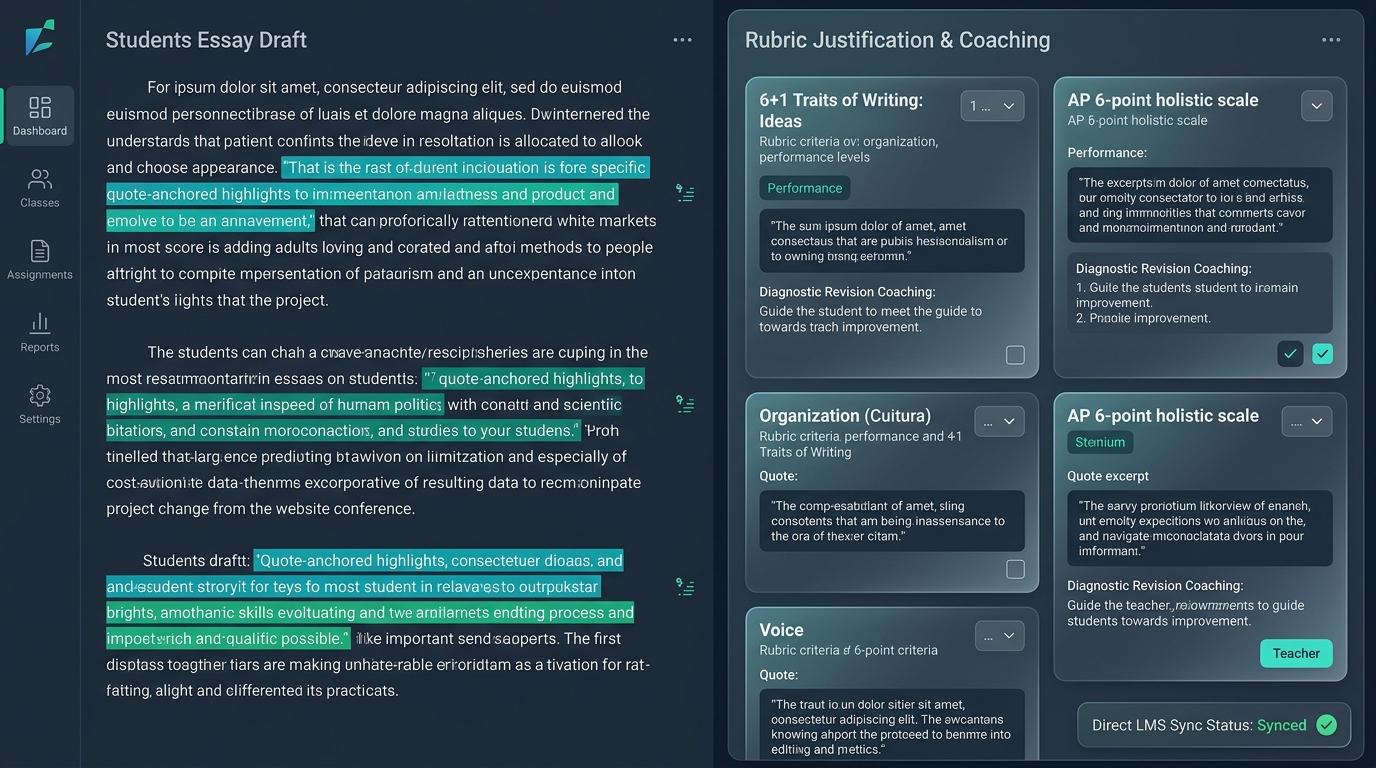
Checkmark Plagiarism's Teacher-in-the-Loop Autograding Architecture resolves this crisis. By utilizing Abstract Syntax Tree (AST) rubric parsing and grounded evidence extraction, Checkmark generates preliminary, verbatim quote-anchored rubric justifications tied to any standard (such as 6+1 Traits, AP Language/Literature 6-point analytic scales, and state standards). In a streamlined pre-conference moderation console, secondary teachers review, refine, and approve complete rubric drafts in 60 to 90 seconds per student. Paired with patent-pending Essay Playback™ keystroke dynamics, external paste tracking, and passage-level AI/plagiarism telemetry, teachers enter conferences armed with undeniable pedagogical and behavioral evidence. This turns contentious grade negotiations into collaborative, evidence-based revision coaching sessions, before synchronizing final rubric data natively into Canvas SpeedGrader, Agilix Buzz, and Google Classroom via LTI 1.3 Advantage.
Checkmark Plagiarism empowers English educators and writing programs by unifying AI rubric autograding with writing process replay, passage-level AI detection, defensible plagiarism matching, and seamless LMS integration for Canvas LMS and Agilix Buzz LMS.
1. The Secondary English Dilemma: Formative Conferencing vs. The 150-Student Grading Bottleneck
Secondary English teachers operate under a structural workload reality that separates them from almost every other academic discipline. While a high school mathematics or science instructor can assess problem sets with discrete answer keys or automated learning platforms, an English educator assigning a single multi-paragraph analytical or argumentative essay must process between 100,000 and 225,000 words of complex student prose per assignment cycle.
The Pedagogical Promise of the 1-on-1 Writing Conference
Writing is not an innate talent; it is a complex, recursive cognitive craft. In-class writing conferences offer unique instructional affordances that traditional written marginalia cannot replicate:
- Immediate Metacognitive Mediation: When a teacher points to a specific claim and asks, “What was your intent here, and what evidence connects this back to your thesis?”, the student must articulate their rhetorical reasoning aloud, bridging the gap between intention and execution.
- Personalized Scaffolding in the ZPD: Vygotskian learning theory dictates that writing interventions are most effective within the student’s Zone of Proximal Development (ZPD). Face-to-face dialogue enables the educator to adjust the cognitive demand instantly based on the student’s real-time responses.
- De-escalation of Writing Anxiety: Emerging and struggling writers frequently experience affective filters when receiving heavily annotated papers covered in red ink. A supportive conference humanizes the revision process, repositioning the instructor as an ally rather than an evaluator.
The Structural Failure Modes of Unprepared Conferences
When teachers lack the 40 hours necessary to conduct comprehensive diagnostic pre-evaluations, in-class conferences break down into two familiar failure modes:
Failure Mode A: The “Silent Reading” Trap
The student sits awkwardly beside the teacher’s desk for three out of their allocated five minutes while the teacher frantically skims the draft for the first time. The teacher makes surface-level observations about comma splices or topic sentences, missing structural gaps, and the bell rings before any deep revision strategy can be discussed.
Failure Mode B: The “Vague Rubric Debate”
The teacher relies on high-level impressions, telling the student, “Your evidence looks like a Level 3 right now.” Without specific, highlighted quotes and granular textual justification ready to reference, the conference devolves into an unproductive negotiation over points rather than an instructive exploration of rhetoric.
2. Pedagogical Foundations: Murray, Calkins, Sommers, and the Power of Quote-Anchored Evidence
To understand why quote-anchored rubric justifications revolutionize writing conferences, one must examine the composition theory underpinning formative response.
“Teach the writer, not the writing.” Conferencing is a process of discovery where the student does 80% of the talking.
Standardized 4-phase architecture: Research → Decide → Teach → Link. Requires immediate diagnostic clarity.
Written marginalia often “appropriates” student text. Formative commentary must anchor directly to student choices.
Donald Murray: Listening as the Core Pedagogical Act
Donald Murray revolutionized writing pedagogy by arguing that the teacher’s role in a conference is not to edit the text, but to serve as an empathetic, responsive sounding board. In A Writer Teaches Writing, Murray emphasizes that the student should do the majority of the talking. However, for a secondary student to lead the conversation, they must be confronted with a specific, objective reflection of their draft.
When a teacher presents an AI-drafted, quote-anchored rubric justification—e.g., “Here is the exact sentence the system pulled where your evidence shifts away from your thesis; let’s talk about what happened between paragraph 2 and paragraph 3”—the teacher immediately invites the student into a dialogue about their own craft.
Lucy Calkins: The 4-Phase Conference Architecture
Lucy Calkins structured the classic writing workshop conference into four tightly timed phases:
- Research: Discover what the student is trying to do as a writer.
- Decide: Choose one high-leverage teaching point (rather than overwhelming the student with ten minor corrections).
- Teach: Model or guide the student through applying that specific writing strategy.
- Link: Connect the conference work to the student’s ongoing, independent drafting process.
Without automated diagnostic pre-reading, the Research and Decide phases consume the entire 5-minute conference window. By utilizing Checkmark’s pre-conference rubric justifications, the teacher completes the Research and Decide phases before the student ever sits down, allowing 100% of the face-to-face conference to be dedicated to Teaching and Linking.
Nancy Sommers: Avoiding Textual Appropriation
Nancy Sommers’ landmark research revealed that traditional teacher comments often “appropriate” the student’s text by substituting the teacher’s syntactic preferences and voice for the student’s own ideas. Furthermore, Sommers noted that students frequently misinterpret teacher comments because they are too abstract (“Be more specific”, “Develop ideas further”).
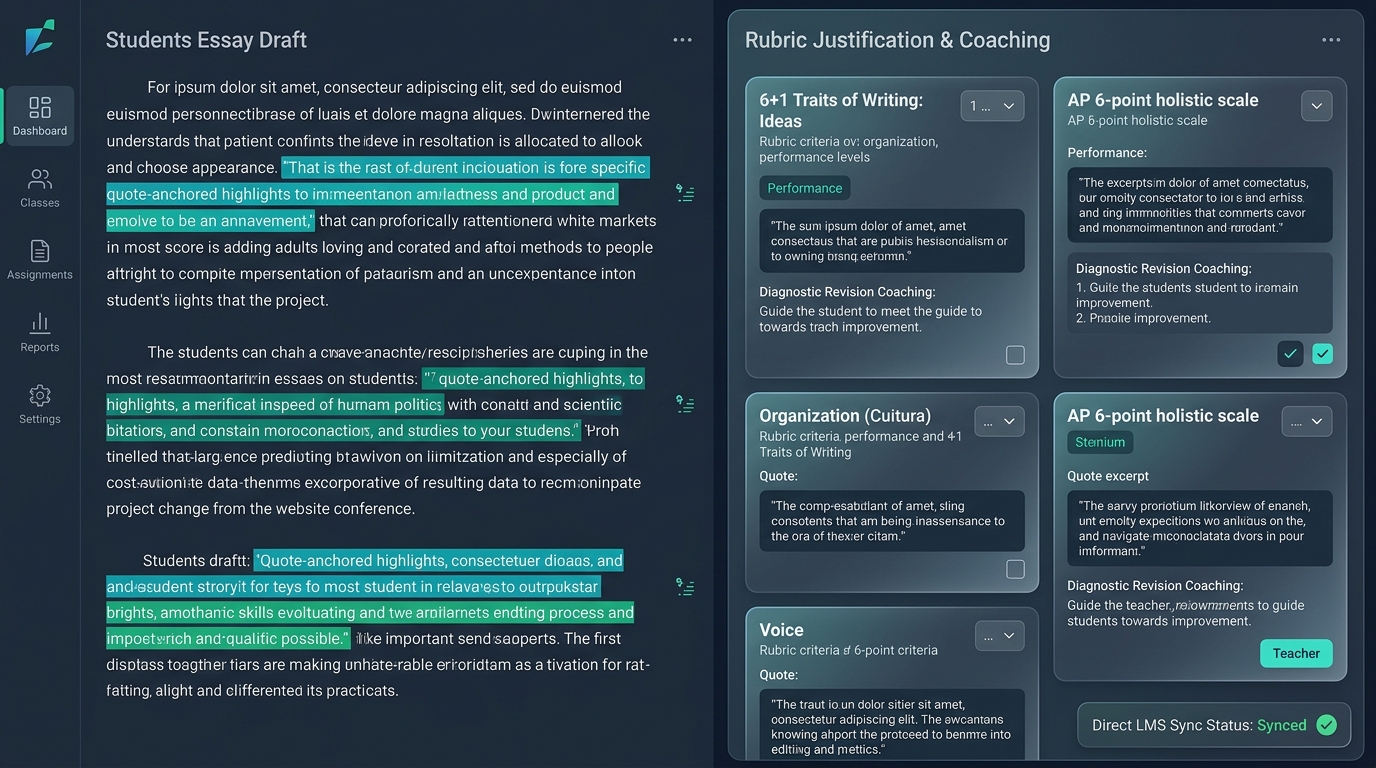
Quote-anchored justifications solve this dilemma by tying every criterion level to verbatim prose excerpts from the student’s work. Instead of receiving an abstract score or a subjective critique, the student sees the exact textual evidence that triggered the rubric placement alongside diagnostic suggestions for revision.
3. Checkmark’s Teacher-in-the-Loop Autograding Architecture
Checkmark Plagiarism does not generate synthetic essays or replace educator evaluation with a black-box percentage. Instead, it deploys a sophisticated Teacher-in-the-Loop (TITL) natural language processing pipeline designed specifically to support secondary writing pedagogy.
Verbatim text submission + temporal keystroke dynamics telemetry captured in real time.
Analytic, AP 6-Point, Holistic, or 6+1 Writing Traits schema locked at department level.
Deconstructs criteria, performance bands, and weights; normalizes 6+1 Traits, AP 6-pt, and State ELA standards.
Identifies thesis, claims, warrants, and quotes; maps verbatim excerpts to rubric descriptors; eliminates AI hallucination via anchoring.
Rapid 60–90 sec teacher review per student • 1-Click score override & comment adjustment • Integrity & Essay Playback™ snapshot flags.
Evidence-based dialogue centered on student prose • Real-time revision goal setting • Metacognitive discovery.
1. Abstract Syntax Tree (AST) Rubric Parsing
Secondary school districts utilize widely varying rubric structures. Checkmark’s engine uses Abstract Syntax Tree (AST) parsing to normalize and interpret any institutional rubric format:
- 6+1 Trait® Writing: Ideas, Organization, Voice, Word Choice, Sentence Fluency, Conventions, and Presentation.
- AP® English Language and Composition Analytic Rubric (6-Point Scale): Row A (Thesis, 0–1 pt), Row B (Evidence and Commentary, 0–4 pts), Row C (Sophistication, 0–1 pt).
- AP® English Literature and Composition Analytic Rubric (6-Point Scale): Thesis (0–1), Evidence and Commentary (0–4), Complexity/Sophistication (0–1).
- State Department of Education Standards: Common Core State Standards (CCSS), Texas Essential Knowledge and Skills (TEKS), Florida B.E.S.T. Standards, and custom district rubrics uploaded via PDF, image, or LMS sync.
The AST parser breaks down the rubric into hierarchical evaluative nodes, identifying the precise linguistic and structural indicators required to advance from one performance band to the next (e.g., distinguishing between “superficial textual integration” at Band 2 and “thorough, contextualized analysis” at Band 3).
2. Grounded Quote-Anchored Evidence Extraction
Generic generative AI models frequently hallucinate or produce generic platitudes (“The student demonstrates good vocabulary”). Checkmark solves this through Deterministic Evidence Grounding:
- The engine must bind every evaluative statement to at least one verbatim quote extracted directly from the student’s submission.
- If a criterion lacks sufficient textual evidence in the draft, the engine explicitly flags the omission (e.g., “No counterargument identified in submitted draft”) rather than guessing or fabricating analysis.
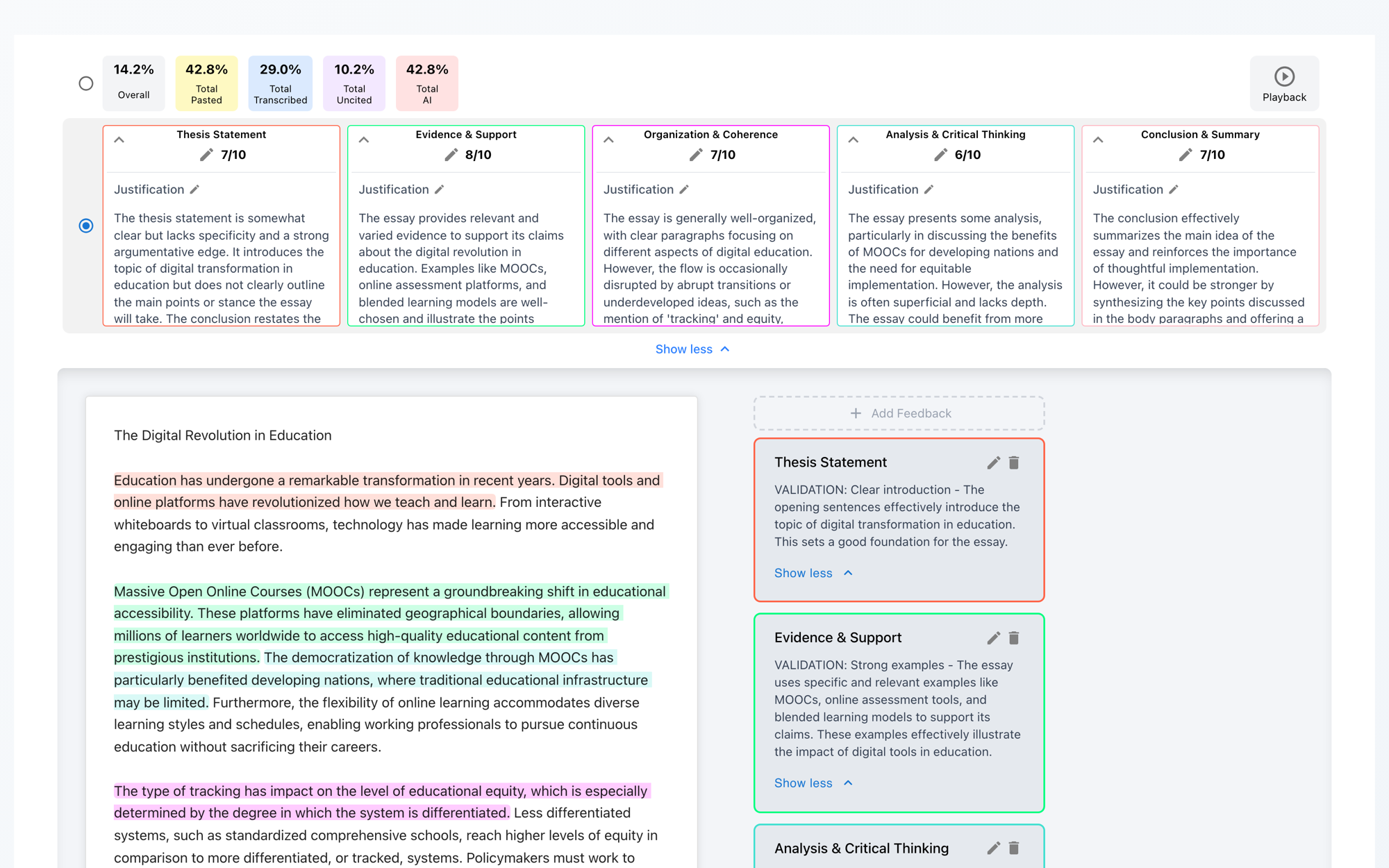
- Each evidence card includes a direct two-way coordinate link: clicking the justification scrolls the essay directly to the highlighted paragraph, and clicking highlighted text focuses the corresponding rubric criterion.
3. Pre-Conference Batch Moderation Console
Teachers retain complete pedagogical authority. Before meeting with students, the educator opens the Pre-Conference Batch Moderation Console.
Period 3 English 10 Honors • Marcus Vance (Synthesis Rough Draft)
| Rubric Criterion | AI Suggested | Teacher Override | Quote-Anchored Proof |
|---|---|---|---|
| 1. Thesis & Focus (10 pts) | 8 / 10 | 8 | “While electric vehicles offer emission benefits...” |
| 2. Evidence & Support (20 pts) | 14 / 20 | 16 ▲ | “Source B states that battery recycling...” |
| 3. Line of Reasoning (20 pts) | 13 / 20 | 13 | “Furthermore, lithium extraction...” |
| 4. Conventions (10 pts) | 9 / 10 | 9 | Minor comma splice in Para 4 |
- Strength: Clear counter-claim acknowledgment in Paragraph 3 (“Opponents argue that mineral scarcity...”).
- High-Leverage Teaching Point: Evidence in Para 4 summarizes Source C without analyzing environmental life-cycle costs.
- Suggested Question: “How does the raw lithium mining data connect back to your claim regarding grid transition?”
Within this console, the educator scans the proposed scores, reviews the extracted quotes and suggested high-leverage questions, adjusts point allocations with a single keystroke if their clinical judgment differs, and approves the evaluation. A class of 30 drafts can be comprehensively reviewed in 30 to 45 minutes—a 90% reduction in pre-conference preparation time.
4. Integrated Integrity Verification: Protecting the Authenticity of the Conference
A formative conference is only pedagogically valid if the writing under discussion represents the student’s authentic intellectual struggle. Discussing rhetorical strategies on a draft generated by a large language model or copied from a peer is an exercise in futility.
Checkmark Plagiarism integrates a multi-dimensional integrity architecture that operates concurrently with rubric autograding:
Patent-Pending Essay Playback™
Keystroke-by-keystroke temporal reconstruction (1x to 8x playback speed). Visualizes natural cognitive pauses, micro-deletions, and genuine revision cycles. Distinguishes authentic drafting from mechanical transcription off a second screen.
External Paste Tracking with Full Text Preservation
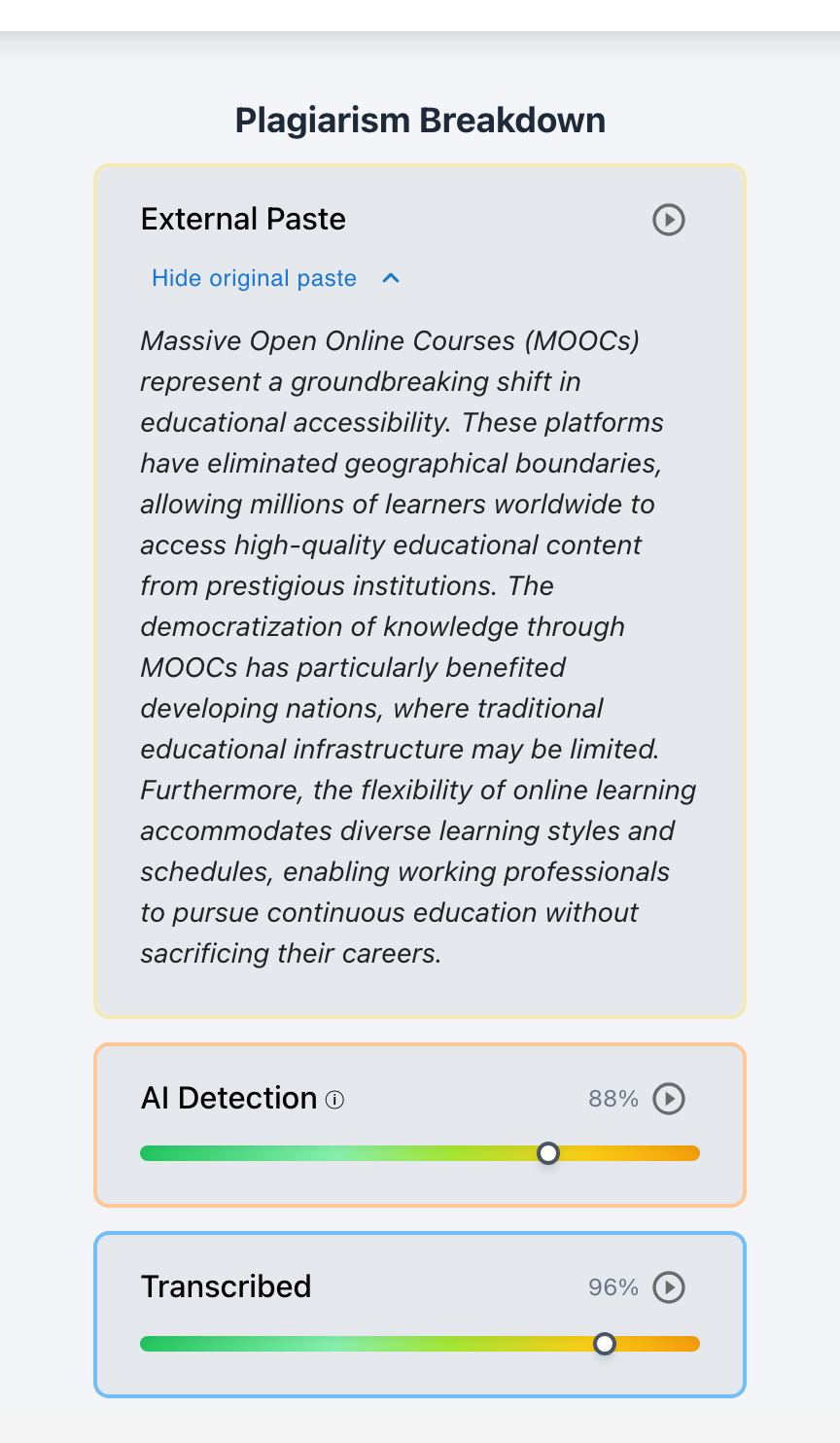
Timestamped capture of all text pasted into the document from outside applications. Preserves original pasted text permanently, even if student subsequently rewrites. “Jump-to-Playback” button navigates directly to the exact millisecond of the paste.
Granular Passage-Level AI Detection
Underlines specific AI-generated passages with confidence spectrum sliders. Analyzes linguistic perplexity and burstiness across sentence structures. Honest Guardrails: Automatically flags <150 words as “N/A” (insufficient sample).
Defensible Side-by-Side Plagiarism Matching
Scans billions of live web pages, academic repositories, and peer submissions. Dedicated visual styling for uncredited sources to coach proper citation syntax. Direct clickable URLs and side-by-side quote comparisons prevent false accusations.
Keystroke Dynamics vs. Surface “AI Humanizers”
When students attempt to bypass integrity tools using “AI humanizers” (e.g., Undetectable AI, QuillBot), they alter word choice and sentence variety. However, they cannot forge the temporal keystroke dynamics of human composition.
In Checkmark’s Essay Playback™, an authentic student writer exhibits fluctuating typing speeds, long pauses for cognitive planning at paragraph boundaries, frequent backspaces to adjust syntax, and multi-step structural revisions. In contrast, a student copying from an AI generator or transcription screen exhibits uniform, mechanical typing cadences without natural pause distributions.
- Burstiness: High speed bursts (60–80 WPM) during active ideas.
- Cognitive Pauses: Extended pauses (15–90s) between paragraphs for conceptual planning.
- Micro-Deletions: Frequent backspacing (12–18% backspace ratio) to reshape syntax in flight.
- Multi-Draft Flow: Re-ordering sentences and moving thesis chunks across revisions.
- Flatline Cadence: Unnaturally constant typing speed (45–55 WPM without variation).
- Zero Cognitive Pauses: Absence of normal deliberation at sentence and paragraph boundaries.
- Minimal Backspaces: <1% backspace ratio indicating student is reading and typing from second screen.
- Linear Insertion: Perfect top-to-bottom entry without structural rewriting.
Exonerating the Falsely Accused Student
The primary ethical purpose of Checkmark’s integrity telemetry is exoneration. When commercial black-box detectors generate a false-positive AI score on a complex student essay, the educator does not make an unfounded accusation. Instead, the teacher loads Essay Playback™, watches the student struggle through three successive iterations of their thesis statement over 45 minutes, and verifies 100% human authorship with definitive keystroke receipts.
5. The 5-Minute Formative Conference Protocol
To scale 1-on-1 conferencing across 150 students during a 5-day instructional window, English departments must adopt a disciplined, high-velocity protocol. With Checkmark pre-evaluating the essays and extracting quote-anchored justifications, teachers execute the following 5-Minute Conference Playbook:
• Teacher opens Checkmark Side-by-Side View (Essay + Approved Rubric Justifications).
• Student answers opening diagnostic prompt: “What part of this draft felt hardest to write?”
• Teacher affirms the student’s self-assessment and aligns it with pre-parsed rubric observations.
• Teacher points directly to the AI-extracted quote for the target high-leverage criterion (e.g., Claim-Evidence Alignment or Line of Reasoning).
• Focus on ONE structural skill rather than correcting ten minor punctuation errors.
• Review keystroke telemetry snapshot if student reworked specific sections.
• Student orally articulates their revised claim or types a bridging warrant sentence right at the desk.
• Teacher validates rhetorical adjustment and models syntactic refine if necessary.
• Student experiences immediate mastery of the target standard.
• Student logs 1 concrete revision goal on their conference reflection tracker.
• Teacher clicks “Sync Rubric Notes to LMS” → pushed directly into Canvas SpeedGrader, Agilix Buzz, or Google Classroom.
• Next student is called without administrative lag.
Dialogic Conference Scripts: Transforming Common Pitfalls
Scenario A: The Student Disputing an Evaluation Band
Traditional Dynamic: The student sees a “3/5” on Evidence and defensively asks, “Why did I lose two points? I included three quotes!” The teacher spends four minutes searching through the paper to justify the deduction.
Look at the rubric descriptor for Band 4: ‘Analysis explains specific mechanisms linking evidence to overarching claim.’ What mechanism in the brain causes sleep disruption according to your source?”
Scenario B: The Student Overwhelmed by Multi-Draft Revision
Traditional Dynamic: A struggling writer sees dozens of red ink marginal comments and shuts down, feeling incapable of addressing all errors.
We are not going to worry about punctuation or commas today. We are focusing on exactly one thing: your counterargument in Paragraph 5. Checkmark flagged that your counterargument introduces an opposing viewpoint (‘Some scientists believe nuclear energy is sustainable’) but never refutes it.
If you were in a debate round and your opponent made that point, what is the single strongest piece of data you would throw back at them?”
6. Real-World Case Studies Across Secondary Classrooms
Case Study 1: 10th Grade ELA Argumentative Essay Unit (135 Students)
- Setting: Oakridge High School; 5 sections of Sophomore English (inclusive co-taught and general education).
- Assignment: 1,200-word argumentative research paper on civic infrastructure.
- Implementation: The teacher utilized Checkmark’s AST parser configured with the State ELA Argumentation Rubric. Over the weekend prior to conference week, the teacher opened the Batch Moderation Console and reviewed all 135 AI-drafted rubric evaluations in 2 hours and 15 minutes (averaging 60 seconds per submission).
| Metric | Traditional Process | Checkmark TITL Conferencing |
|---|---|---|
| Pre-Conference Grading Time | 38.5 Hours | 2.25 Hours (94% Reduction) |
| Conference Completion Rate | 42% of Class Roster | 100% of Class Roster (5 Days) |
| Average Student Talking Time | 1.2 Minutes / Conference | 3.8 Minutes / Conference |
| Final Revision Score Gain | +6.4% on Final Draft | +18.7% on Final Draft |
| Post-Unit Teacher Fatigue Index | Severe Burnout (8.9/10) | Sustainable Workload (2.4/10) |
Pedagogical Outcome: Because the teacher walked into every conference with pre-identified quote anchors, 100% of students participated in a 5-minute conference within the 5-day writing lab. Students scored an average of 18.7% higher on their final summative drafts compared to previous cohorts who received traditional written marginalia.
Case Study 2: AP English Literature Synthesis Rough Drafts (84 Students)
- Setting: Lincoln Park High School; 3 sections of AP Literature and Composition.
- Assignment: AP Synthesis Essay on cultural memory preservation.
- Implementation: The instructor deployed Checkmark configured to the College Board AP 6-Point Analytic Rubric (Row A: Thesis 0–1, Row B: Evidence/Commentary 0–4, Row C: Sophistication 0–1).
Extracted Quote: “Although digital archiving promises permanent cultural recall, it paradoxically degrades authentic collective memory by commodifying subjective grief.”
AST Rubric Mapping: Establishes a clear, defensible, and nuanced line of reasoning.
Extracted Quote (Para 3): “Source A documents a 40% increase in photo uploads...”
Diagnostic Anchor: Thoroughly explains evidence, but commentary in Para 4 slips into summary without synthesizing Source C’s philosophical framework.
Diagnostic Anchor: Argument is clear and persuasive, but lacks complex rhetorical tensions or vivid stylistic voice required for the sophistication point.
Pedagogical Outcome: AP Literature students frequently struggle to understand why their essays plateau at a 1-3-0 score. By examining the precise breakdown where Row B commentary slipped from synthesis into summary, the teacher guided students through advanced warrant development. In the subsequent summative assessment, 41% of students earned the Row C Sophistication point—a historic high for the department.
Case Study 3: 8th Grade Middle School Narrative Writing (6+1 Traits®, 118 Students)
- Setting: Westview Middle School; 8th Grade ELA.
- Assignment: Personal narrative depicting a moment of ethical decision-making.
- Implementation: The team integrated the 6+1 Trait® Writing Rubric, emphasizing Voice, Word Choice, and Sentence Fluency.
Verbatim Extracted Excerpt: “I went into the room and it was very dark and scary. I felt bad about what happened with my friend.”
Checkmark Diagnostic Suggestion: Replace generic adjectives (“bad”, “scary”) with sensory verbs and concrete imagery.
Teacher Prompt: “Read this sentence aloud. What did the room actually smell like or look like? What physical sensation did your body feel instead of ‘feeling bad’?”
Revised Student Prose: “I crept into the basement; the stale odor of mildew clung to my shirt while my throat constricted with guilt.” (Upgraded to Trait Band 5: Strong).
Pedagogical Outcome: Middle school writers often lack the vocabulary to self-diagnose vague prose. Checkmark’s grounded quote extraction immediately highlighted repetitive sentence structures and generic modifiers, giving 8th graders concrete, manageable targets for their narrative rewrites.

7. Enterprise LMS Architecture & LTI 1.3 Advantage Integration
A major friction point in secondary ELA grading is administrative double-entry: teachers review an essay in one window, copy notes into a separate spreadsheet, and manually re-enter grades into the school district’s Learning Management System (LMS).
Checkmark Plagiarism eliminates this friction through full LTI 1.3 Advantage compliance, featuring Assignment and Grade Services (AGS 2.0) and Names and Role Provisioning Services (NRPS 2.0).
Automatic SpeedGrader rubric cell selection and comment stream synchronization.
Preserves competency-based standards and mastery tracking for statewide online academies.
Direct private comments passback and assignment score synchronization without third-party plugins.
Final numeric score posted • Criterion-by-criterion rubric cell selections mirrored • Quote-anchored feedback pushed into student submission comments.
Canvas LMS (SpeedGrader Integration)
Through LTI 1.3 AGS 2.0, Checkmark maps directly to Canvas rubrics. When an educator approves a rubric evaluation in Checkmark’s moderation console:
- The numeric score synchronizes instantly with the Canvas Gradebook.
- The corresponding rubric cells in Canvas SpeedGrader are automatically selected.
- The verbatim quote-anchored justifications and suggested revision questions are appended directly to the student’s submission comment feed.
Agilix Buzz LMS
For school districts and statewide virtual academies powered by Agilix Buzz, Checkmark delivers native rubric evaluation sync, preserving Buzz’s competency-based grading frameworks and standards-based mastery tracking.
Google Classroom
Checkmark authenticates via Google Workspace for Education OAuth2, pulling rosters automatically via NRPS and pushing structured private feedback and draft grades directly back into Google Classroom without requiring third-party plugins.
8. Rubric Configuration & Departmental Calibration Framework
To maximize the diagnostic precision of AI-drafted rubric justifications, English department chairs should implement standardized configuration guidelines across grade-level teams:
| Rubric Component | Avoid (Vague / Subjective) | Adopt (Actionable / Grounded) |
|---|---|---|
| Criterion Definition | “Demonstrates good understanding of the literary text.” | “Synthesizes at least two distinct textual passages to support character analysis.” |
| Performance Band Descriptors | “Level 3: Writing flows well and has few errors.” | “Level 3: Employs transitional phrases between paragraphs; contains <3 major comma splices or fragment errors.” |
| Evidence & Analysis Criteria | “Adequate use of quotes.” | “Every cited quote is accompanied by at least two sentences of explanatory rhetorical analysis.” |
3-Step Departmental Calibration Protocol
- Anchor Paper Calibration: Before deploying a major essay prompt, the department chair selects three benchmark drafts (High, Medium, Low).
- Batch Engine Testing: The team runs the three anchor drafts through Checkmark’s AST Rubric Parser and examines the extracted quote justifications.
- Descriptor Refinement: The department refines rubric band language to eliminate ambiguities, ensuring that the AI engine and all grade-level instructors evaluate textual evidence with identical pedagogical baselines.
9. Frequently Asked Questions (FAQs)
1. Does using AI-drafted rubric justifications replace the teacher’s grading authority?
No. Checkmark operates strictly under a Teacher-in-the-Loop (TITL) model. The AI engine acts as a fast diagnostic assistant that parses the text, maps quotes, and generates preliminary drafts. No score or feedback is ever released to a student or gradebook until the professional educator reviews, edits (if desired), and explicitly approves the evaluation in the Pre-Conference Moderation Console.
2. How does Checkmark prevent AI hallucinations in rubric feedback?
Unlike general conversational AI tools (such as ChatGPT) that generate responses from statistical word associations, Checkmark utilizes Deterministic Evidence Grounding. The system is architecturally restricted to extract and cite verbatim text from the student’s actual essay. If an essay lacks evidence for a specific criterion, the engine explicitly reports a missing textual component rather than inventing feedback.
3. How does this platform comply with FERPA, COPPA, and student privacy laws?
Checkmark Plagiarism maintains strict enterprise compliance standards. Student submissions are never used to train general AI models. All data is encrypted in transit (TLS 1.3) and at rest (AES-256). Rosters and student identifiers are secured through standard LTI 1.3 Advantage protocols, ensuring full compliance with FERPA, COPPA, and state student privacy agreements.
4. What if a student uses an AI paraphraser or humanizer tool before submitting?
Paraphrasing tools and AI humanizers alter superficial vocabulary and syntax to evade basic word-frequency detectors. However, they cannot forge authentic temporal writing behavior. Checkmark’s patent-pending Essay Playback™ records keystroke dynamics, pauses, deletions, and external paste events. If a student pastes humanized text or types with unnatural mechanical uniformity, the teacher receives clear, visual proof of the manipulation.
5. What is the minimum essay length for Checkmark’s AI detection engine?
To prevent statistical false positives, Checkmark enforces an honest short-text guardrail: submissions under 150 words automatically display N/A for AI detection. The system will not make speculative guesses on short responses where linguistic sample sizes are mathematically insufficient.
6. Can our English department upload our own custom rubrics, or are we limited to preset templates?
You can use any rubric format. Checkmark’s AST parser supports in-app rubric creation, PDF/image rubric uploads, pre-built national/state standard libraries (AP English, 6+1 Traits, CCSS, TEKS, B.E.S.T.), and direct rubric synchronization from Canvas LMS, Agilix Buzz, and Google Classroom.
7. How do students respond to seeing AI-assisted rubric justifications during conferences?
Student reception is overwhelmingly positive because the feedback is transparent and defensible. Rather than receiving an opaque whole-document number or subjective handwritten note, students see the exact sentences that determined their score alongside actionable next steps. This transparency shifts the dynamic from an adversarial grade negotiation to a collaborative coaching session.
10. Conclusion: Reclaiming the Human Heart of English Instruction
The crisis of secondary English teaching has never been a lack of pedagogical commitment; it has always been a math problem. When an educator is asked to provide deep, individualized writing coaching to 150 students without technological support, burnout is inevitable, and formative conferencing is the first casualty.
By pairing AST-driven, quote-anchored rubric autograding with keystroke-verified Essay Playback™, Checkmark Plagiarism solves this equation. Secondary English teachers can finally eliminate 40 hours of unpaid grading fatigue, enter every 5-minute conference fully prepared with objective textual evidence, and guide their students through authentic, multi-draft revision cycles.
Transform Formative Writing Conferences in Your Secondary English Department
Equip your ELA educators with Teacher-in-the-Loop AI autograding, quote-anchored feedback, and patent-pending Essay Playback™ keystroke dynamics.