
In secondary English Language Arts (ELA) instruction across Grades 6 through 8, formative feedback is the primary engine of student writing development. However, middle school teachers managing rosters of 125 to 160 students face an impossible logistical bottleneck: delivering individualized, criterion-referenced formative comments across multi-draft writing cycles requires 20 to 30 hours of manual evaluation per assignment. When districts attempt to automate this workload using generic artificial intelligence (AI) grading tools, they encounter severe pedagogical and technical risks—most notably, autonomous grade overwriting in Google Classroom that strips teachers of instructional authority, publishes unvetted numerical scores prematurely, and damages student trust.
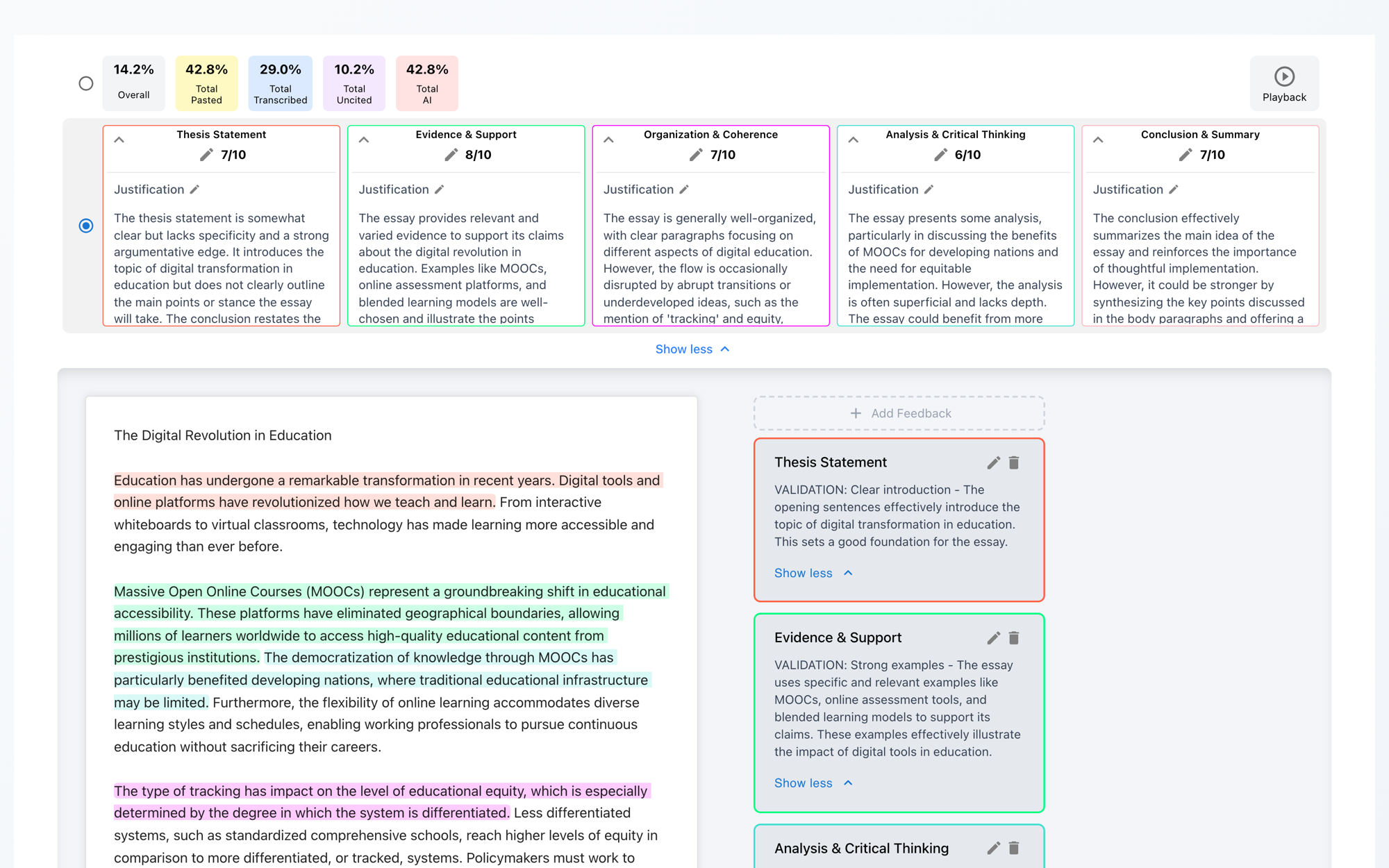
Checkmark Plagiarism resolves this tension through a Teacher-in-the-Loop Google Classroom Integration Engine. By leveraging the Google Classroom REST API (courses.courseWork.studentSubmissions.patch) and Google Docs batch comment infrastructure, Checkmark allows middle school ELA leads and classroom teachers to generate granular, quote-anchored formative rubric justifications, calibrate feedback in a rapid 10-second-per-student review console, and selectively sync qualitative comments into Google Classroom Private Comments and Google Doc margins—while keeping numerical marks in draftGrade staging or completely suppressed during formative revision phases.
Explore how Checkmark's AI Autograder, patent-pending Essay Playback™ technology, passage-level AI writing detection, and Google Classroom integration establish a safe, high-velocity feedback loop for secondary writing departments.

1. The Secondary ELA Workload Crisis: Formative Feedback vs. "Grading Stack Paralysis"
Middle school English Language Arts instruction occupies a unique and demanding developmental space. Between sixth and eighth grade, emerging adolescent writers transition from elementary paragraph construction to complex, evidence-based discourse. They must learn to formulate defensible claims, embed textual evidence smoothly, analyze rhetorical devices, construct counterarguments, and navigate the structural requirements of informative, argumentative, and narrative genres.
To build these competencies, literacy research has consistently demonstrated that frequent, low-stakes formative feedback during the drafting process produces significantly greater skill acquisition than summative grading after submission. When students receive actionable, descriptive guidance while their ideas are still malleable, they engage in meaningful substantive revision.
The Middle School ELA Formative Writing Ecosystem (Grades 6–8)
| Writing Framework | Typical Length | Key Formative Diagnostic Focus | Primary Feedback Need |
|---|---|---|---|
| RACES Response | 100–200 words | Restating prompt, citing text, deep explanation | Quote punctuation & analytical depth |
| CER Argument Paragraph | 120–250 words | Claim validity, quote integration, reasoning | Distinguishing evidence from reasoning |
| Multi-Paragraph Essay | 400–800 words | Thesis control, paragraph transitions, evidence | Structural flow & topic sentence alignment |
| Literary Analysis Draft | 500–1,000 words | Textual synthesis, thematic nuance, MLA citation | Thematic reasoning & textual attribution |
The 150-Student Reality: The Arithmetic of Teacher Burnout
Despite the clear pedagogical necessity of formative feedback, secondary educators are constrained by structural workload realities. In typical public, charter, and independent middle schools, a full-time ELA teacher instructs five class periods per day, with class sizes ranging from 25 to 32 students. This creates an active caseload of 125 to 160 students.
When an ELA department implements a standard multi-draft writing cycle—such as a three-draft unit consisting of an initial thesis/outline checkpoint, a rough draft with peer/teacher feedback, and a final revised submission—the sheer volume of writing artifacts is staggering:
Secondary ELA Grading Workload Breakdown (150-Student Caseload)
| Unit Stage | Student Submissions | Manual Review Time | Total Teacher Hours |
|---|---|---|---|
| Draft 1 (Formative Checkpoint) | 150 rough drafts | 3.0 minutes / paper | 7.5 Hours |
| Draft 2 (Revision & Expansion) | 150 revised drafts | 3.5 minutes / paper | 8.75 Hours |
| Draft 3 (Summative Final Essay) | 150 final essays | 5.0 minutes / paper | 12.5 Hours |
| TOTAL PER WRITING UNIT | 450 submissions | ~11.5 min total / student | 28.75 Hours |
With contractually allocated preparation time often limited to 45 minutes daily—much of which is consumed by Individualized Education Program (IEP) meetings, Section 504 plan reviews, department planning, and parent communications—middle school ELA teachers must absorb this 28-hour workload during evening hours and weekends.
The "Grade Fixation Effect": Why Early Numbers Kill Formative Growth
A second, deeper pedagogical dilemma compounds this workload crisis: the premature assignment of summative grades.
Foundational educational research (notably by Ruth Butler and Dylan Wiliam) establishes that when students receive both a numerical score and qualitative comments on a formative draft, they look almost exclusively at the score and ignore the comments. The presence of a grade triggers an ego-involved cognitive response rather than a task-involved learning state. Students who receive high marks believe no further work is required; students who receive low marks experience demotivation and disengage from revision.
Student Cognitive Response to Draft Feedback (Butler & Wiliam Research)
| Feedback Modality | Primary Student Behavior | Impact on Revision Yield |
|---|---|---|
| Grade Only | Compares score with peers; immediately stops reading or analyzing text | Zero revision gain |
| Grade + Comments | Fixates on grade; skims or ignores detailed feedback and marginal comments | Minimal cosmetic edits |
| Descriptive Feedback (No Score) | Engages with targeted prompts and quotes to resolve specific textual gaps | Substantive structural revision & high skill growth |
To maximize writing growth, middle school ELA leads must establish classroom workflows where Draft 1 and Draft 2 receive purely descriptive, rubric-anchored formative feedback, reserving numerical scores exclusively for the final summative evaluation.
2. The Teacher Authority & Data Sovereignty Mandate: Why Autonomous AI Overwrites Are Catastrophic
In response to grading volume, many schools and districts have experimented with generic AI grading platforms. However, fully autonomous AI scoring creates severe pedagogical, ethical, and political hazards within secondary schools.
The Dangers of Unmoderated, Autonomous "Black-Box" AI Grading
Pedagogical Erosion
Generic, robotic comments fail to address individual student learning trajectories, IEP accommodations, or specific classroom mini-lessons.
Gradebook Pollution
AI directly writes unvetted scores into the LMS gradebook, triggering immediate grade alerts to parents via student information system (SIS) sync.
Cultural & ELL Bias
Generic LLMs frequently penalize emergent bilingual syntax, regional dialects (e.g., AAVE), or neurodivergent sentence structures.
Teacher Disempowerment
Teachers become administrative bystanders forced to defend AI decisions they did not make, fracturing student-teacher rapport and classroom trust.
The Non-Negotiable "Teacher-in-the-Loop" Standard
Educators are the ultimate instructional authority in the classroom. An AI algorithm cannot know that an eighth-grader with an active 504 plan for dysgraphia drafted their essay using voice-to-text dictation, nor can it recognize that a seventh-grade English Language Learner (ELL) made a breakthrough by successfully integrating their first textual quotation, even if the punctuation is non-standard.
Checkmark Plagiarism enforces a strict Teacher-in-the-Loop Architecture:
- AI Never Finalizes Grades Autonomously: Every rubric score, justification, and suggested comment is treated as a provisional draft awaiting human verification.
- Rapid Multi-Passage Calibration: Teachers can accept, modify, or completely rewrite AI-generated comments in a single click within a high-velocity evaluation console.
- Data Sovereignty: Student submissions and teacher modifications are retained exclusively within the district's secure environment and are never used to train public commercial AI models.
- Sync Private Comments
- Inject Google Doc Margins
- Suppress Numerical Grade
- Sync Final Numeric Score
- Publish to Gradebook
- Return Work to Student
3. Technical Architecture of Google Classroom API Sync: Decoupling Feedback from Grade Overwrites
To understand how middle school ELA leads can safely sync AI-assisted rubric feedback into Google Classroom without prematurely publishing scores or overriding teacher authority, one must examine the underlying Google Classroom REST API infrastructure.
The Anatomy of Google Classroom Submissions
In the Google Classroom API, student assignments are managed under the courses.courseWork.studentSubmissions resource collection. Every student assignment object maintains several distinct state and scoring fields:
{
  "courseId": "84729103948",
  "courseWorkId": "91823740192",
  "id": "CgkJ39xZ0KLS",
  "userId": "104928374920194827104",
  "state": "TURNED_IN",
  "draftGrade": 88.0,
  "assignedGrade": null,
  "alternateLink": "https://classroom.google.com/c/ODQ3MjkxMDM5NDg=/a/OTE4MjM3NDAxOTI=/submissions/by-status/and-sort-name/all/CgkJ39xZ0KLS",
  "submissionHistory": [
    {
      "stateHistory": {
        "state": "TURNED_IN",
        "stateTimestamp": "2026-08-19T14:22:10.450Z",
        "actorUserId": "104928374920194827104"
      }
    }
  ],
  "assignmentSubmission": {
    "attachments": [
      {
        "driveFile": {
          "id": "1A2B3C4D5E6F7G8H9I0J",
          "title": "Maya_Lin_Civil_Rights_Argument_Draft1.gdoc",
          "alternateLink": "https://docs.google.com/document/d/1A2B3C4D5E6F7G8H9I0J/edit"
        }
      }
    ]
  }
}
The Critical Distinction: draftGrade vs. assignedGrade
The Google Classroom API maintains an intentional separation between internal grading staging and student-facing score publication:
draftGrade(Internal Teacher Staging): A floating-point value visible only to the teacher and co-teachers within the Google Classroom web grading interface. ModifyingdraftGradedoes not notify the student, does not update the student's visible Classroom grade, and does not trigger SIS gradebook sync engines.assignedGrade(Public Published Grade): The official grade visible to the student and their guardians. This field is populated only when an assignment is formally returned via the Classroom UI or through an explicit API execution of thecourses.courseWork.studentSubmissions.returnendpoint.
Google Classroom API Scoring Lifecycle & Visibility Matrix
| API Field / Action | Visibility Scope | Student Notified? | SIS Sync Triggered? |
|---|---|---|---|
| draftGrade Update | Teacher Console Only | NO | NO |
| Private Comment Create | Teacher & Student | YES (Email/App) | NO |
| Google Doc Comment Patch | Document Collaborators | YES (In Doc) | NO |
| assignedGrade (Return) | Teacher, Student & Parents | YES | YES (SIS Bridge) |
How Checkmark Interfaces with the Google Classroom API
Checkmark Plagiarism utilizes OAuth 2.0 authenticated Google Workspace scopes (https://www.googleapis.com/auth/classroom.coursework.students, https://www.googleapis.com/auth/classroom.profile.emails, and https://www.googleapis.com/auth/documents) to execute fine-grained, decoupled updates.
During formative drafting cycles, Checkmark creates structured Google Classroom Private Comments containing criterion-by-criterion justifications without altering the gradebook:
{
  "comment": "📝 Checkmark Formative Writing Feedback (Draft 1):

🔹 Criterion 1: Claim / Thesis (Proficient)
Your central argument in paragraph 1 is clear. To strengthen it, explicitly mention the historical context of the Voting Rights Act.

🔹 Criterion 2: Text Evidence & Citation (Developing)
Quote in paragraph 2 lacks MLA attribution. Remember to introduce your source: 'According to Congressman Lewis...'

🔹 Criterion 3: Reasoning / Explanation (Proficient)
Strong analysis connecting the primary source quote to modern civic engagement.

💡 Next Step: Revise paragraph 2 citations before submitting Draft 2 on Friday!"
}
Checkmark leverages the Google Docs API (documents.batchUpdate) to insert quote-anchored inline comments directly at the exact character index in the student's live Google Doc:
{
  "requests": [
    {
      "createNamedRange": {
        "name": "Checkmark_Feedback_Node_104",
        "range": {
          "startIndex": 248,
          "endIndex": 312
        }
      }
    }
  ]
}
4. Comparative Matrix: Formative Grading Workflows in Secondary ELA
To highlight why Checkmark's Teacher-in-the-Loop integration represents the gold standard for secondary literacy departments, consider how it compares to traditional manual grading and generic autonomous AI tools across key pedagogical and technical dimensions:
Secondary ELA Formative Evaluation Workflow Comparison
| Feature / Capability | Manual Classroom Grading | Generic Autonomous AI | Checkmark Teacher-in-the-Loop |
|---|---|---|---|
| Grading Velocity (150 Students) | 7.5 to 12.0 hours | Instant (<1 minute) | 25 to 45 min (12s / paper) |
| Feedback Granularity | High early on, drops with fatigue | Generic, repetitive comments | Deep, quote-anchored rubric feedback |
| Quote-Anchored Evidence Extract | Manual copy/paste | Rare; hallucinated citations | Automatic verbatim extraction |
| Gradebook Overwrite Risk | None (human manual entry) | HIGH: Overwrites without review | ZERO: Teacher-gated staging |
| Teacher Authority & Control | 100% Complete | Stripped / Non-existent | Full Sovereign Control (100%) |
| Formative Score Suppression | High manual effort | Difficult to configure | 1-Click "Comments Only" Mode |
| Google Doc Marginal Sync | Manual typing in doc | None (external portal only) | Direct API batch comment insert |
| Keystroke & Authorship Audit | None (static text only) | None | Essay Playback™ (1x–8x scrub) |
| External Paste Tracking | None / Coarse version history | None | 100% paste buffer preservation |
| Short-Text AI Guardrails | N/A | >40% false positives on <150w | Honest N/A guardrail (<150w) |
| Student Data Privacy (FERPA) | Fully compliant | High risk (trains public LLMs) | Zero data retention for LLM training |
5. Step-by-Step ELA Lead Implementation Protocol: Standardizing Formative Feedback Across Grade-Level Teams
For middle school ELA department leads, literacy coaches, and curriculum directors, scaling a high-impact formative writing protocol requires clear operational stages. Below is a structured, classroom-tested implementation protocol for 6th, 7th, and 8th-grade literacy teams.
Phase 1: Rubric Harmonization & Google Classroom Setup
Before deploying autograding tools, the department lead must standardize rubric architecture across grade-level sections (e.g., all 7th-grade ELA teachers using the same argumentative writing rubric).
- Standardize Criterion Descriptors: Define 3 to 5 core criteria aligned to state writing standards (e.g., Claim/Thesis, Evidence Integration, Reasoning & Elaboration, Conventions & Organization).
- Assign Performance Level Weights: Establish clear 4-point or 5-point performance bands (Exemplary [4], Proficient [3], Developing [2], Emerging [1]).
- Import into Checkmark: In the Checkmark Rubric Library, create or import the department rubric. Checkmark automatically converts standard rubric criteria into structured parsing logic.
- Link to Google Classroom: Connect the Checkmark assignment to the corresponding Google Classroom assignment via Google Workspace SSO.
Sample Middle School 7th Grade RACES / Argument Rubric
| Criterion | Exemplary (4) | Proficient (3) | Developing (2) |
|---|---|---|---|
| Claim (C) | Clear, defensible, and nuanced argument. | Clear claim addressing the prompt directly. | Vague claim or merely restates the prompt. |
| Evidence (E) | Two or more relevant, cited textual quotes. | At least one relevant cited textual quote. | Evidence is weak, misquoted, or uncited. |
| Reasoning (R) | Insightful explanation connecting quote to claim. | Logical explanation of how quote supports claim. | Summary of plot rather than analytical reasoning. |
| Conventions | Sophisticated sentence variety; zero run-ons. | Minor errors that do not impede meaning. | Frequent errors that impede comprehension. |
Phase 2: First-Draft AI Batch Processing & Evidence Extraction
Once students submit their rough drafts (Draft 1) via Google Classroom, the teacher initiates batch processing in Checkmark:
- Synchronous Submission Ingestion: Checkmark pulls all student Google Docs directly from Google Classroom with a single click.
- Verbatim Quote Extraction: Checkmark's AI parsing engine scans each document, extracting verbatim text passages that correspond to each rubric criterion.
- Draft Justification Generation: The engine drafts concise, constructive formative justifications anchored to the extracted quotations.
- Parallel Integrity Scans: In the background, Checkmark executes passage-level AI detection and multi-source plagiarism checks, flagging uncited text or abnormal keystroke patterns without interrupting the grading workflow.
Checkmark Quote-Anchored Evidence Extraction in Action
“In the novel The Giver, Jonas discovers that the community has sacrificed human emotion for safety. The author states, ‘The worst part of holding the memories is not the pain. It's the loneliness of it. Memories need to be shared’ (Lowry 154). This shows that without shared feelings, people cannot truly understand each other or feel real love.”
📌 Anchored Quote: “'The worst part of holding the memories is not the pain...' (Lowry 154)”
💬 AI-Drafted Feedback: “Excellent MLA citation and smooth signal phrase introduction.”
📌 Anchored Quote: “This shows that without shared feelings, people cannot truly understand...”
💬 AI-Drafted Feedback: “Strong explanation connecting loneliness to community control. To reach Exemplary, expand on how this realization motivates Jonas's final decision to escape.”
Phase 3: The Rapid Calibration & Teacher Review Console
The teacher opens the Checkmark Rapid Batch Review Console. Rather than spending three to four minutes manually writing repetitive comments, the teacher evaluates each submission in 10 to 15 seconds:
“Marcus, great growth on quote integration! Focus your revision on your reasoning in paragraph 3 as noted.”
- One-Click Acceptance: Pressing the Spacebar accepts all suggested feedback cards and advances instantly to the next student.
- Instant Text Editing: Clicking on any feedback card allows the teacher to modify phrasing, add a personalized encouragement, or adjust a performance level.
- Integrity Telemetry at a Glance: The console displays real-time integrity badges (🟢 Authentic Keystroke History, 🟡 Uncited Source Patchwork, 🔴 Suspicious External Paste), allowing the teacher to immediately identify submissions requiring a writing conference.
Phase 4: Selective Google Classroom Sync & Feedback Release
With the batch review complete, the ELA lead or classroom teacher selects the Google Classroom Sync Options:
Checkmark Google Classroom Sync Configuration Modal
Course: 7th Grade ELA Period 3draftGradeWhen the teacher clicks Execute Selective Sync Now, Checkmark fires concurrent background requests to the Google Classroom API:
- Every student receives a structured private comment detailing their strengths and next revision steps.
- In-text quote-anchored comments appear in the margins of their Google Docs.
- The Google Classroom gradebook remains completely clean, without premature numbers or parent grade-change notifications.
Phase 5: Student Revision Tracking with Essay Playback™
Following feedback release, students enter a 48-hour revision window. When Draft 2 is submitted, Checkmark's Essay Playback™ visually highlights whether the student engaged with the formative feedback:

6. The Full Checkmark Suite: Unifying Autograding, Integrity, and Process Telemetry
Unlike standalone AI grading tools or legacy plagiarism checkers that operate in disconnected silos, Checkmark Plagiarism provides a unified academic integrity and writing assessment ecosystem designed specifically for secondary and post-secondary educational institutions.
Quote-Anchored Autograder
Eliminates ambiguous grading. Every criterion score suggestion is accompanied by verbatim quotes extracted directly from the student's prose, demonstrating exactly where the claim was established, where evidence was cited, and where reasoning fell short.
Patent-Pending Essay Playback™
Reconstructs the entire drafting session keystroke-by-keystroke. Educators can observe natural drafting, pauses for cognitive formulation, real-time revisions, and external paste events with 100% clipboard text retention.
Passage-Level AI Detection
Replaces opaque percentages with passage-level granularity and confidence sliders. Includes an honest short-text disclaimer (<150 words) outputting N/A rather than guessing on small sample sizes.
Side-by-Side Defensible Plagiarism Matching
When students copy web sources or peer submissions, Checkmark generates two-way linked evidence cards with side-by-side textual alignment, distinguishing accidental citation errors from deliberate source misappropriation.
FERPA / COPPA Zero Retention
Districts deploy Checkmark with total confidence. Student submissions are processed within secure, encrypted cloud infrastructure and are strictly never retained, sold, or used to train commercial generative AI foundation models.

7. Classroom Case Scenarios: 6th, 7th, and 8th Grade Implementations
To illustrate how middle school ELA leads and teachers utilize Checkmark's decoupled Google Classroom sync in practice, consider three authentic secondary classroom scenarios:
Case Scenario 1: 6th Grade Narrative Writing Checkpoint (Formative Feedback Only)
Grade 6- Context: Ms. Albright's 6th-grade ELA class is writing personal narrative memoirs. Students submit Draft 1 (a 250-word scene establishing dialogue and sensory imagery).
- The Challenge: Ms. Albright has 135 students. She needs to provide immediate feedback on sensory details before students draft their climactic scenes, but assigning grades now will discourage students who struggle with initial descriptive drafting.
- The Checkmark Workflow: Ingests all 135 docs • AI extracts sensory language and dialogue punctuation • Ms. Albright completes batch review in 20 minutes • Initiates Formative Sync (Comments Only) to Google Classroom.
- The Result: Every 6th-grader receives targeted Private Comments and marginal suggestions praising their dialogue and prompting for more sensory descriptions. The Google Classroom gradebook shows no numerical score, maintaining 100% focus on revision for Draft 2.
Case Scenario 2: 7th Grade Argumentative Essay (Teacher Override & Calibration)
Grade 7- Context: Mr. Chen's 7th-grade students submit their first full five-paragraph argumentative essay on renewable energy.
- The Challenge: Julian, an English Language Learner who recently arrived from Brazil, submits an essay with profound analytical insight regarding solar subsidies, but with numerous syntactic and verb-tense errors.
- The Checkmark Workflow: Checkmark Autograder suggests 2/4 on Conventions but 4/4 on Evidence and Reasoning. In the Batch Review Console, Mr. Chen overrides Conventions to 3/4, noting Julian's massive growth, and customizes feedback to focus on three specific subject-verb pairs. He stages the score in
draftGradeand syncs comments to Classroom. - The Result: Julian receives validating, instructionally calibrated feedback that honors his cognitive analysis while providing manageable syntax targets. Mr. Chen's professional discretion remains completely sovereign.
Case Scenario 3: 8th Grade Research Paper (Resolving an Integrity Discrepancy)
Grade 8- Context: An 8th-grade student submits a research paper on digital privacy exhibiting adult-level vocabulary and periodic sentence structures.
- The Challenge: A generic AI detector would flag the paper as 90% AI, prompting an adversarial integrity confrontation.
- The Checkmark Workflow: Checkmark flags high syntactic predictability in paragraph 3, but the teacher immediately opens Essay Playback™. The timeline reveals the student spent 45 minutes actively drafting the paragraph, consulting an outline in Google Docs, pausing for 15 to 30 seconds between clauses, and repeatedly revising word choices with backspaces. The paste buffer shows zero copied text.
- The Result: The teacher confirms that the sophisticated vocabulary represents authentic student effort supported by dictionary tools. The teacher dismisses the integrity flag and syncs advanced stylistic feedback to Google Classroom, completely protecting the student from a false accusation.
8. Frequently Asked Questions (FAQ)
1. Does syncing Checkmark comments into Google Classroom alter or overwrite any grades previously entered by the teacher?
No. Checkmark's integration is explicitly engineered to preserve teacher grading sovereignty. When utilizing the Formative Feedback Sync Mode, Checkmark updates only the Private Comments field and inserts marginal notes in the student's Google Doc via API; it completely omits the assignedGrade field and leaves existing gradebook values untouched. In Summative Mode, scores are pushed exclusively to Google Classroom's internal draftGrade staging, requiring an explicit teacher confirmation before grades are published to students or synchronized with district Student Information Systems (SIS).
2. How does Checkmark extract quote-anchored evidence from student essays?
Checkmark utilizes structured natural language processing models calibrated against standardized writing rubrics. When an essay is processed, the system parses the document into syntactic segments, categorizes text blocks according to rubric criteria (e.g., Claim, Evidence, Analysis, Transitions), and extracts the exact string indices of textual evidence. These verbatim quotes are embedded directly into the feedback cards, ensuring that every score suggestion is explicitly justified by the student's own writing.
3. Can middle school ELA leads customize rubrics to match specific district frameworks like RACES or CER?
Yes. Checkmark includes a flexible, comprehensive Rubric Builder. Department leads can build custom rubrics from scratch, upload existing district PDF or Word rubrics for automatic parsing, import rubrics directly from Google Classroom or Canvas LMS, or select from pre-calibrated state-standard rubrics (e.g., Common Core, SBAC, STAAR, NYS Next Generation). Any custom criterion names, scoring scales (e.g., 4-point, 5-point, 100-point), and qualitative descriptors are fully supported.
4. What happens if a student essay is shorter than 150 words?
Generic AI detectors frequently suffer from catastrophic false-positive rates on short texts because small word counts lack sufficient statistical variation for perplexity and burstiness calculations. Checkmark solves this through an Honest Short-Text Guardrail: on submissions under ~150 words (such as brief reading exit tickets or single-sentence answers), Checkmark automatically marks the AI detection metric as N/A rather than guessing, while still providing full rubric autograding and plagiarism matching.
5. How does Essay Playback™ differ from Google Docs native Version History?
Google Docs native Version History only captures periodic, low-resolution document snapshots (often separated by 5 to 20 minutes of work). It collapses complex typing sessions into single static chunks, making it impossible to distinguish between a student typing authentic prose and a student retyping text while reading off a smartphone or secondary screen. Checkmark's patent-pending Essay Playback™ logs raw temporal keystroke telemetry, enabling educators to scrub through the entire writing session at 1x to 8x speed to observe real-time pauses, fluid typing bursts, backspaces, and exact timestamped external clipboard paste events with 100% text retention.
6. Is student data shared with third-party LLMs or used for AI model training?
Never. Checkmark operates under strict FERPA, COPPA, and CSPC compliance standards. Student submissions are processed through dedicated, private enterprise API pipelines with end-to-end encryption both in transit and at rest. Student text is never indexed into public repositories, never sold to data brokers, and never used to train or fine-tune public foundation models.
7. How does Checkmark handle multi-teacher co-taught classrooms or inclusion sections?
Because Checkmark synchronizes directly with the Google Classroom API, all co-teachers and special education case managers attached to a Google Classroom section maintain shared access to the Checkmark evaluation console. Special education teachers can view Essay Playback timelines to verify IEP assistive technology accommodations (such as speech-to-text dictation) and collaborate with general education leads on calibrated rubric comments.
8. Can teachers use Checkmark autograding on handwritten student essays?
Checkmark's primary Google Classroom integration is designed for digital submissions in Google Docs, Word, and LMS text editors. However, for schools utilizing handwritten on-demand writing assessments, Checkmark provides an OCR scanning intake module that digitizes student handwriting into text, enabling quote-anchored rubric autograding while noting that keystroke playback is unavailable for physical paper submissions.
9. Conclusion: Empowering Teachers to "Stop Guessing, Start Trusting"
The ultimate purpose of academic integrity and writing assessment technology is not to replace the human educator, but to remove the crushing administrative bottlenecks that prevent meaningful teacher-student connection.
By eliminating the 20-hour manual grading burden through quote-anchored AI autograding, safeguarding teacher authority through decoupled Google Classroom API sync, and verifying authentic student effort through Essay Playback™, Checkmark Plagiarism transforms secondary writing instruction. Middle school ELA leads can finally deliver the high-frequency, descriptive formative coaching that young writers need to flourish—turning the writing process from an exhausting grading marathon into an empowering, collaborative journey of growth.
Ready to Transform Secondary ELA Formative Writing in Your District?
Equip your middle school literacy team with quote-anchored autograding, keystroke playback telemetry, and sovereign Google Classroom sync.