
Executive Summary
Evaluating historical sourcing—specifically Point-of-View (POV), Purpose, Historical Situation, and Intended Audience (HIPP/SOAPS)—in Advanced Placement (AP) European History Document-Based Questions (DBQs) is widely recognized by high school history educators and College Board AP readers as the single most cognitively demanding and contentious scoring node on the 7-point rubric. Generic commercial AI chatbots and basic LLM wrappers routinely fail this task: they suffer from semantic gullibility, awarding unearned points to superficial biographical “name-dropping” (“Martin Luther was a monk, so he had a Catholic POV”), hallucinating analytical credit where no causal reasoning exists, and inflating essay scores across entire class sections. Checkmark Plagiarism’s Teacher-Controlled AI Rubric Autograding Suite solves this disciplinary challenge through deterministic Abstract Syntax Tree (AST) parsing and quote-anchored evidence extraction. Rather than generating ungrounded probabilistic scores, Checkmark requires verbatim student prose justification, verifies the explicit causal link between an author’s socio-political position and their rhetoric, provides interactive teacher-in-the-loop override consoles, and cross-references drafting authenticity using patent-pending Essay Playback™. Integrated seamlessly into Canvas SpeedGrader, Agilix Buzz, and Google Classroom via LTI 1.3 Advantage, Checkmark enables secondary social studies departments to cut 30+ hours of weekend grading per DBQ cycle while elevating inter-rater reliability (κ > 0.88) and providing actionable historical writing interventions.
Checkmark Plagiarism elevates secondary humanities education by integrating AI rubric autograding with Essay Playback™ process telemetry, AI writing detection, side-by-side plagiarism verification, and certified LMS extensions for Canvas LMS and Agilix Buzz LMS.
1. The Disciplinary Anatomy of Historical Sourcing in AP European History DBQs
In high school Advanced Placement humanities curricula—including AP European History (AP Euro), AP United States History (APUSH), and AP World History: Modern—the Document-Based Question (DBQ) serves as the gold-standard assessment of collegiate-level historiographical synthesis. Unlike standard thematic essays, a DBQ requires students to read, analyze, and synthesize six to seven primary and secondary source documents under intense time constraints (typically a 45-minute timed in-class write or a structured multi-day Chromebook drafting unit), contextualize the era, weave unprompted outside historical evidence, and construct a nuanced historical argument.
| Node | Rubric Criterion | Pts | Key Disciplinary Evaluation Rule (College Board Standard) |
|---|---|---|---|
| SEC 1 | Thesis / Claim | 0–1 | Responds with a defensible historical thesis that establishes a clear line of reasoning in 1–2 consecutive sentences. |
| SEC 2 | Contextualization | 0–1 | Situates argument within broader historical processes prior to, during, or continuing after the prompt era (> single phrase). |
| SEC 3A | Evidence: Doc Description | 0–1 | Accurately describes content from at least 3 documents to address the prompt topic. |
| SEC 3B | Evidence: Doc Argumentation | 0–1 | Uses content from at least 4 documents to actively support a defensible argument in response to the prompt (total 2 pts). |
| SEC 4 | Evidence Beyond Documents | 0–1 | Supplies at least 1 discrete, accurate historical piece of outside evidence not found in the documents. |
| SEC 5 | Historical Sourcing (HIPP) | 0–1 | Explains HOW or WHY Historical Situation, Intended Audience, Purpose, or Point of View is relevant for ≥ 2–3 documents. |
| SEC 6 | Complex Understanding | 0–1 | Demonstrates nuance, corroboration, qualification, or multi-thematic synthesis across the entire essay. |
The Cognitive Bottleneck: Grading 120–150 Student DBQs
A secondary history educator teaching 4 to 5 sections of AP European History or APUSH manages 120 to 160 students. Scoring a single student DBQ across seven distinct analytical dimensions takes between 12 and 15 minutes of intensive reading, cross-referencing document prompts, checking historical accuracy, and writing margin comments.
| Audit Metric | Measurement | Pedagogical Consequence |
|---|---|---|
| Total Student Submissions | 140 essays | Standard cohort across 5 AP history periods |
| Average Reading & Annotation Time | 11.5 minutes per essay | Analyzing 4–6 handwritten or typed pages |
| Rubric Calculation & Sourcing Tally | 3.5 minutes per essay | Verifying HIPP relevance rules and counting documents |
| Total Teacher Grading Hours per DBQ Set | 35.0 Hours | Equivalent to 4.5 full workdays beyond contracted school hours |
| Expected Turnaround Time | 18–24 Calendar Days | Feedback arrives long after the unit has concluded |
This staggering 35-hour workload creates three severe instructional consequences:
Intra-Rater Drift (Fatigue)
When reading essay #12 on Saturday morning, a teacher meticulously evaluates whether a student’s sourcing on King Louis XIV qualifies. By essay #118 on Sunday evening, mental exhaustion causes the teacher to either skim and miss valid sourcing or subconsciously reward superficial text.
The 3-Week Feedback Void
When essays take three weeks to return, the class has already progressed from the Protestant Reformation and Wars of Religion to the Enlightenment and French Revolution. The formative window for students to correct historical reasoning is lost.
The Sourcing Point Plateau
On the national AP European History exam, the Sourcing (HIPP) point is historically the lowest-scoring node on the entire rubric, with national earning rates frequently hovering below 25–30%. Students plateau at basic summary because teachers lack the time to coach POV mechanics.
Deconstructing Point-of-View (POV) vs. Mere Attribution
Under the College Board AP History rubric, students must explain how or why the document’s Historical Situation, Intended Audience, Purpose, or Point of View (HIPP / SOAPS) is relevant to the argument for at least three documents (or two under certain rubric revisions).
Among these four sourcing pathways, Point-of-View (POV) is the most sophisticated and the most frequently botched by high school writers:
| Tier | Student Performance Level | Earns Pt? | Disciplinary Characteristic |
|---|---|---|---|
| Tier 0 | Document Summary / Quote Dropping | NO | Merely summarizes text without author awareness or analytical connection to the thesis. |
| Tier 1 | Biographical Attribution (“Name-Dropping”) | NO | Identifies author’s job, title, social class, or race without explaining how it shapes bias or rhetoric. |
| Tier 2 | Circular Purpose Tagging | NO | States obvious generic intent (“he wants power”) without connecting to reliability, tone, or specific historical crisis. |
| Tier 3 | Authentic Disciplinary POV Sourcing | YES | Establishes a direct causal bridge linking the author’s socio-political position to their rhetorical strategy, selective framing, and document bias. |
- Who is the author in terms of their social, political, religious, economic, or gender position?
- How does that specific position explain why they expressed their ideas in this particular way, or why their account is biased, selective, or uniquely motivated?
The Three Student Writing Archetypes in AP European History
To illustrate why automated evaluation is so difficult, consider how high school students handle a primary source document from an AP Euro DBQ on the French Revolution (1789–1799):
“Document 4 was written by Maximilien Robespierre, who was the leader of the Committee of Public Safety and a Jacobin during the French Revolution. He believed that terror was necessary to protect the Republic from enemies.”
“Robespierre’s point of view is biased because he is the ruler of France and wants to keep his power, so of course he is going to say that terror is good.”
“Robespierre’s passionate defense of state terror in Document 4 must be understood through his point of view as a radical Jacobin ideological leader who was facing both internal counter-revolutionary revolts in the Vendée and foreign invasion. Because his political survival and the survival of the radical republic depended on ruthlessly suppressing moderate dissent, his speech intentionally equates republican virtue with terror to intimidate the National Convention into maintaining wartime emergency dictatorship.”
2. The Grading Dilemma: Why Generic Chatbot Rubric Graders Fail at POV
As school districts experiment with generative AI tools, many history teachers have attempted to paste student DBQs into consumer chatbots (such as ChatGPT, Claude, or generic LMS chatbot wrappers) with prompts like: “Grade this AP Euro DBQ using the 7-point rubric and evaluate the sourcing point.”
The results in the social studies classroom are universally problematic. Generic Large Language Models (LLMs) suffer from severe structural limitations when assessing complex historical argumentation:
The model sees words like “point of view,” “biased,” or “because he was a Catholic” and immediately awards the point, confusing empty keywords with deep disciplinary analysis.
Chatbots generate glowing feedback (“Excellent analysis of Doc 2’s Protestant bias!”) even when the student never mentioned Document 2 in their body paragraphs.
Generic chatbots average 5.8 / 7.0 across high school sections where national AP benchmarks average 3.1 / 7.0, setting students up for shock on AP exam day.
Chatbot wrappers cannot verify whether a sophisticated POV paragraph was written organically over 40 minutes or pasted in 2 seconds from external AI tools.
When high school teachers distribute hallucinated AI feedback to students and parents, trust in the department’s grading integrity evaporates.
3. The High School DBQ Assessment & Sourcing Matrix
To understand how modern educational technology can accurately evaluate complex historical sourcing, departments must compare manual red-pen workflows, consumer LLM chatbot prompts, and purpose-built educational autograders.
| Evaluation Dimension | Traditional Manual Grading | Generic Chatbot / LLM Wrappers | Checkmark Teacher-Controlled Suite |
|---|---|---|---|
| Evaluation Granularity | Holistic margin notes + manual tally | Whole-paper probabilistic text summary | Deterministic AST node extraction |
| POV / Sourcing Precision | High (when fresh); Degrades after 15+ essays | Very Low (Keyword rubber-stamping & false credit) | Calibrated (Verifies causal link; flags name-dropping) |
| Feedback Evidence Base | Hand-written margin citations (often rushed) | Hallucinated or generalized text summaries | Verbatim quote-anchored evidence cards linked to prose |
| Grading Turnaround Time (140 Essays) | 25–35 hours (18–24 calendar days) | 5–10 min (unverified text; copy-paste risk) | 1–2 hours for cohort (Teacher reviews pre-scored cards) |
| Inter-Rater Reliability (Across Sections) | Low to Moderate (κ = 0.52 – 0.64) | Unstable & Inconsistent (κ = 0.40 – 0.55) | High (κ > 0.88 across course sections & teachers) |
| LMS Integration | Manual gradebook entry | None (manual browser window copy-pasting) | Seamless LTI 1.3 Advantage sync (Canvas / Buzz) |
| Process Authenticity Telemetry | Timed writes or blind trust on take-homes | None (cannot verify if essay was generated by AI) | Patent-pending Essay Playback™ scrubs typing at 1x–8x |
| Student Data Privacy | Secure (local paper) | Major Risk (Student essays train commercial models) | FERPA & COPPA compliant; Zero model training |
4. Concrete AP European History Case Studies: Sourcing in Action
To demonstrate how Checkmark’s deterministic rubric engine differentiates between empty biographical attribution and authentic Point-of-View analysis, let us examine real-world AP European History DBQ prompts.
Case Study 1: The Protestant Reformation & German Peasants’ Revolt (1525)
Prompt: “Evaluate whether the German Peasants’ War of 1524–1525 was primarily motivated by religious ideals of the Protestant Reformation or long-standing economic grievances.”
“Let everyone who can, smite, slay, and stab, secretly or openly, remembering that nothing can be more poisonous, hurtful, or devilish than a rebel... Baptism does not make men free in body and property, but in soul.”
“In Document 2, Martin Luther angrily tells the German princes to kill the rebelling peasants because baptism only frees the soul, not property. Luther’s point of view is that he was a religious leader and a former Augustinian monk who translated the Bible into German, so he cared deeply about religion.”
“Luther’s vehement condemnation of the peasants in Document 2 directly reflects his precarious point of view as a religious reformer entirely dependent upon the military and political protection of the German territorial princes. Because the Catholic Holy Roman Emperor Charles V had declared him an outlaw at the Diet of Worms, Luther recognized that if the Protestant movement became associated with violent social anarchy and peasant attacks on aristocratic property, the princes would abandon him. Consequently, his rhetoric deliberately draws a rigid line between spiritual freedom and secular obedience to preserve noble sponsorship for the Lutheran church.”
Case Study 2: Industrial Manchester & Child Labor (1830s)
Prompt: “Analyze the social and political effects of rapid industrialization on the English working class between 1800 and 1850.”
“I have visited many factories... and I never saw a single instance of corporal punishment inflicted on a child, nor indeed, did I ever see children in ill-humor. They seemed to be always cheerful and alert, taking pleasure in the light play of their muscles... As to exhaustion by the day’s work, they manifested no traces of it on emerging from the mill in the evening.”
“Dr. Andrew Ure argues in Document 4 that factory children are happy and well-treated, not exhausted at all. His purpose was to write a book about factories for the public, and as a doctor his point of view was observing children’s health.”

5. Technical Architecture: How Checkmark Evaluates Sourcing with Quote-Anchored Precision
Checkmark Plagiarism does not treat student essays as an unstructured block of text passed to a black-box model. Instead, Checkmark employs a multi-tiered Deterministic Abstract Syntax Tree (AST) Parsing and Evidence Extraction Engine specifically tuned to College Board DBQ rubrics.
Canvas LMS / Agilix Buzz / Google Classroom LTI 1.3 Sync + Essay Playback™ Writing Telemetry & Keystroke Verification.
Thesis node scan (intro/conclusion boundary) • Contextualization window detection • Document reference extraction (Docs 1–7 regex & entity mapping) • Outside evidence fact-checking engine.
Multi-tier classification (Summary vs. Attribution vs. Sourcing) • Author position & bias causal link verification • Mandatory 2/3 document threshold tallying • Verbatim quote extraction.
Calibrated sourcing sliders & 1-click score adjustments • Editable formative feedback justifications • Batch pre-moderation & inter-rater alignment.
The Three Technical Pillars of Checkmark's Sourcing Evaluator
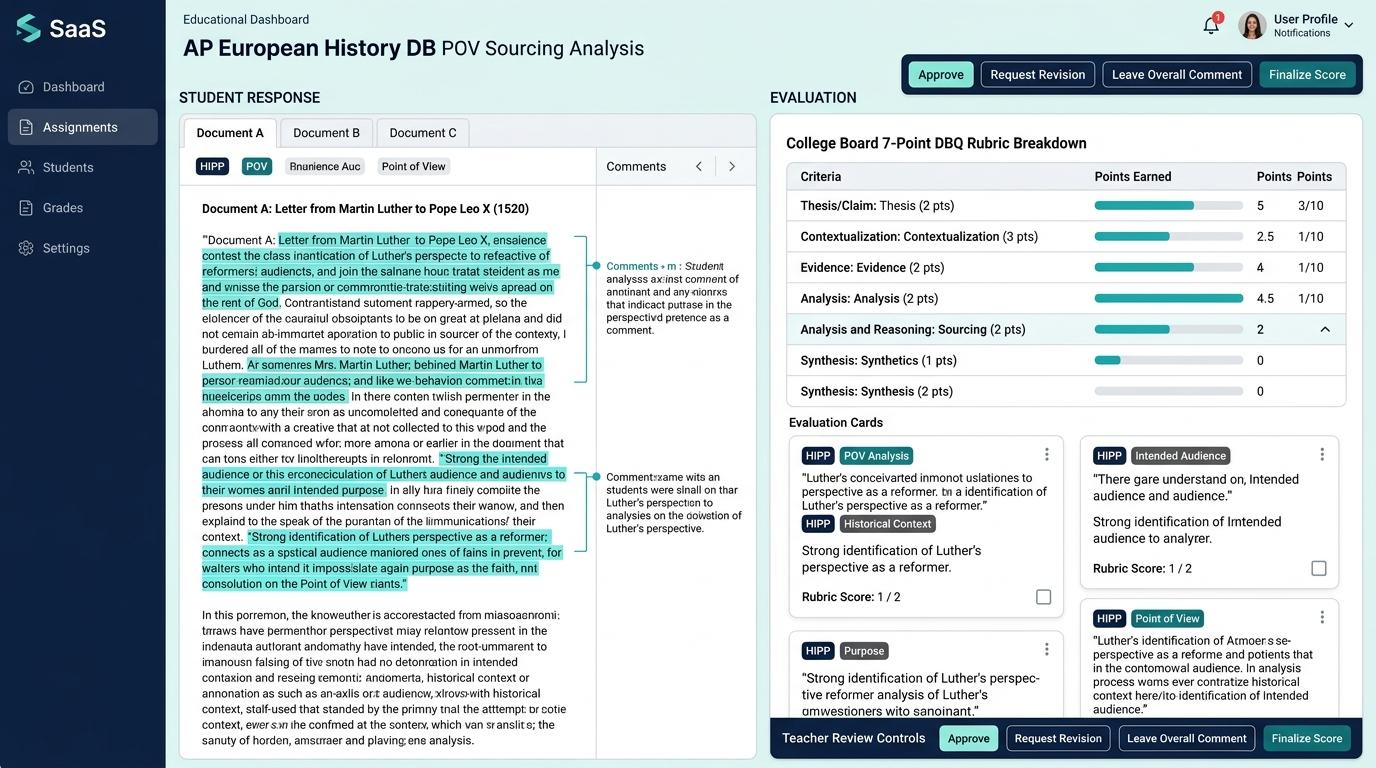
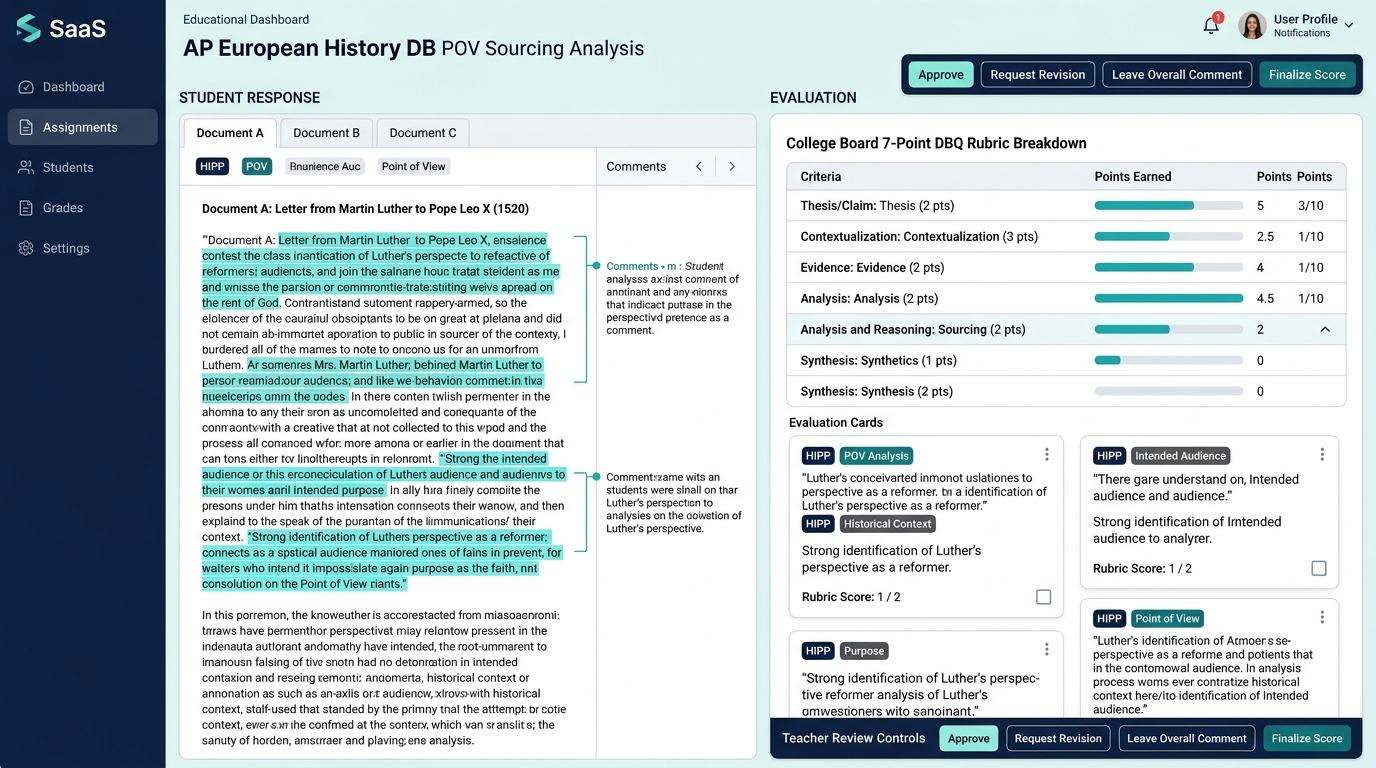
Every single point assigned or withheld on the 7-point rubric is anchored to the student’s exact prose. Checkmark highlights the specific sentence in the essay viewer and generates a corresponding Evidence Card in the sidebar.
Clicking any highlighted sourcing passage in the essay immediately scrolls to and expands its evaluation card in the sidebar. Conversely, clicking “Doc 3 Sourcing” in the rubric breakdown highlights the student paragraph in yellow.
If an essay is under 250 words or fails to cite at least three documents, Checkmark marks the criterion as Insufficient Evidence rather than hallucinating speculative scores. Borderline analysis surfaces a Calibrated Confidence Slider for teacher review.

6. Step-by-Step History Teacher Rubric Calibration Protocol
To achieve high inter-rater consistency and maximize the instructional power of AI rubric autograding, high school social studies departments should implement the following five-step protocol:
| Stage | Responsible Stakeholder | Concrete Action Required |
|---|---|---|
| Step 1 | Department Chair / PLC Lead | Ingest & configure 7-point DBQ rubric weights and HIPP sourcing constraints in Checkmark. |
| Step 2 | AP History Teaching Team | Conduct batch pre-moderation on 5 sample essays to calibrate department scoring thresholds. |
| Step 3 | Classroom Teacher | Run autograder and review draft cards in Canvas SpeedGrader / Agilix Buzz console (90s per paper). |
| Step 4 | Classroom Teacher | Adjust borderline scores via 1-click override sliders and approve finalized grades. |
| Step 5 | Whole Department / Students | Conduct restorative post-DBQ sourcing workshop using aggregated AST analytics the next day. |
Teacher-in-the-Loop SpeedGrader Review Console
With pre-moderation complete, the classroom teacher opens the Checkmark Review Console embedded directly inside Canvas SpeedGrader or Buzz LMS. Reviewing an essay that previously took 15 minutes now takes 90 to 120 seconds:
Student: Marcus Vance | AP European History Section 3 | DBQ: French Revolution Terror
Class-Wide Sourcing Diagnostic Dashboard
Because Checkmark aggregates rubric data at the AST level, the department chair and classroom teachers have immediate access to a Class-Wide Sourcing Diagnostic Dashboard:
| Diagnostic Metric | Measurement (142 AP Euro Students) | Departmental Intervention Action |
|---|---|---|
| Sourcing Point Earning Rate | 38.7% (55 / 142 students) | Target: Elevate to > 65% before midterm exam |
| Most Common Sourcing Failure Mode | Tier 1: Biographical Attribution (58.6%) | Conduct mini-lesson on causal connectors (“because of his role as...”) |
| Historical Situation (H) Share | 44.2% of all attempts | Most common pathway used by students |
| Point of View (POV) Share & Failure | 18.4% of attempts (71% failure rate) | Highest failure rate across all 4 HIPP pathways |
| Most Botched Document | Document 4 (Robespierre Speech — 71% failed) | Project anonymized student samples for whole-class revision workshop |
7. Integrity & Pedagogy: Combining Essay Playback™ with Sourcing Verification
In the modern 1:1 Chromebook high school environment, DBQ evaluation is complicated by the proliferation of generative AI tools. Students struggling to synthesize seven primary sources often resort to pasting document text into chatbots with prompts like: “Write a paragraph explaining the point of view of Martin Luther in Document 2.”
Generic AI detectors that output a single probabilistic percentage (“84% AI”) are notoriously unreliable for DBQs because historical documents contain archaic syntax, formal language, and repetitive historical terminology that trigger false-positive AI flags.
Checkmark solves this through patent-pending Essay Playback™ writing process telemetry:

Zero-Training Student Data Privacy
Under federal (FERPA, COPPA) and state student privacy regulations (e.g., California SOPIPA, New York Ed Law 2-D), public school districts cannot submit student essays to public AI platforms that use student writing to train commercial models.
Checkmark operates on private, encrypted runtime memory buffers. Student essays submitted for DBQ autograding and plagiarism checks are never stored in public LLM repositories or used to train general artificial intelligence models.
8. Frequently Asked Questions (FAQ)
How does Checkmark differentiate between simple document summary and true Point-of-View (POV) sourcing?
Checkmark’s deterministic Abstract Syntax Tree (AST) engine evaluates both semantic content and grammatical dependency structures. To award the Sourcing point for Point of View, the engine checks for two required analytical components: (1) an identification of the author’s specific socio-economic, political, religious, or ideological identity beyond basic prompt metadata, and (2) an explicit causal conjunction or explanatory clause explaining how that identity motivated their rhetoric, produced bias, or affected document reliability. If an essay merely restates what the author said or mentions their job title without explaining its analytical impact, Checkmark flags the passage as “Biographical Attribution” and withholds the point.
What happens if an AP European History student uses a non-standard acronym or informal sourcing structure?
AP students are taught various sourcing frameworks across different school districts, including HIPP (Historical Context, Intended Audience, Purpose, Point of View), SOAPS (Speaker, Occasion, Audience, Purpose, Subject), HAPPY, or integrated narrative sourcing. Checkmark’s engine does not require specific acronym headings or formulaic sentence starters. It parses natural English prose across the entire document, identifying valid sourcing regardless of whether it appears in the topic sentence, the middle of an evidence block, or a concluding analytical synthesis.
Can teachers override the AI’s sourcing score if they disagree with the evaluation?
Yes. Checkmark is built entirely on the principle of Teacher Final Authority (Teacher-in-the-Loop). All automated rubric evaluations are presented to the educator as editable first drafts. In the review console, teachers have 1-click override sliders for every individual rubric node. If an educator determines that a student’s subtle literary allusion or nuanced historical phrasing meets the threshold for Point-of-View analysis, clicking the override slider instantly updates the point total and re-anchors the feedback card.
How does Checkmark handle DBQs that use images, political cartoons, or maps instead of text documents?
AP European History DBQs routinely include visual primary sources, such as British political cartoons (e.g., James Gillray), Catholic Reformation artwork, or Industrial Revolution urbanization maps. In the Assignment Setup portal, teachers provide the source metadata and intended historical context for each visual document. Checkmark’s engine checks whether the student’s text accurately analyzes the artist’s point of view, satirical purpose, intended audience, or artistic symbolism in relation to the thesis.
Does using AI rubric assistance prevent students from learning how to write historical arguments?
No. When properly implemented, quote-anchored autograding dramatically accelerates student writing growth. In traditional classrooms, students wait 2 to 3 weeks for DBQ feedback, by which time the historical unit has ended. With Checkmark, teachers can return detailed, sentence-level feedback within 24 to 48 hours while the content is fresh. Furthermore, because Checkmark generates specific formative revision prompts tied to student errors (e.g., explaining how to convert biographical name-dropping into authentic POV), students receive actionable coaching on every draft.
How does Checkmark integrate with Canvas SpeedGrader, Agilix Buzz, and Google Classroom?
Checkmark is certified under the 1EdTech LTI 1.3 Advantage standard, including Assignment and Grade Services (AGS 2.0) and Names and Role Provisioning Services (NRPS 2.0). Educators launch Checkmark directly inside Canvas SpeedGrader or Buzz LMS. Student submissions synchronize automatically, and once the teacher approves the rubric scores in Checkmark’s review console, the points, criteria breakdowns, and feedback comments push directly back into the official LMS gradebook with zero manual data entry.
How does Checkmark protect high school history departments during parent grade disputes?
In AP courses where GPA weighting and college admissions stakes are high, grading disputes often center on subjective rubric points like Sourcing and Complexity. Checkmark provides history teachers with an airtight, objective evidentiary dossier. Instead of arguing over subjective impressions, the teacher can display the verbatim Quote-Anchored Sourcing Card showing exactly which disciplinary criteria were missing, alongside the Essay Playback™ timeline proving the student wrote the essay organically. This transparency transforms adversarial parent conferences into productive, student-centered learning conversations.
How does Checkmark ensure student essay data is never used to train commercial AI models?
Under Checkmark’s strict zero-training enterprise data privacy policy and standard Student Data Privacy Agreements (SDPAs), all student writing submitted through LMS integrations is processed ephemerally in isolated, encrypted runtime memory. Data is never cached in public LLM pools, sold to third parties, or used for model training, ensuring full compliance with FERPA, COPPA, and state-level student privacy statutes.