
For Secondary ELA Department Chairs, High School English Teachers, Instructional Coaches, and Canvas LMS Administrators, transitioning writing instruction to Standards-Based Grading (SBG) represents both an essential pedagogical evolution and an overwhelming operational bottleneck. Under the Common Core State Standards (CCSS.ELA-LITERACY.W.9-10.1–5 and W.11-12.1–5) and contemporary state writing frameworks, educators are charged with isolating and scoring discrete learning targets—including Thesis/Claim Formulation (W.1.A), Evidence & Sourcing (W.1.B), Reasoning & Synthesis (W.1.B/W.9), Structural Cohesion (W.1.C), and Domain Register & Style (W.1.D)—across 4-level mastery scales.
However, with secondary educator caseloads averaging 130 to 160 students across five class periods, evaluating 5 to 7 discrete standards per essay generates 650 to 1,120 individual rubric assessments per assignment, creating an unsustainable 30-to-40-hour grading backlog. This crushing volume introduces feedback latencies of 14 to 21 days, stalls formative revision, and exacerbates inter-rater scoring variance across departmental sections. Generic, black-box AI graders fail this paradigm entirely—generating hallucinated justifications, penalizing non-linear developmental writers, and alienating faculty.
Checkmark Plagiarism resolves this systemic crisis through an enterprise Quote-Anchored Standards-Based Autograding and Writing Integrity Suite. By parsing ELA rubrics via Abstract Syntax Trees (ASTs), grounding every mastery rating in verbatim extracted student prose, providing a rapid Pre-Flight Educator Review Console, synchronizing discrete criterion scores directly into Canvas SpeedGrader via 1EdTech LTI 1.3 Advantage AGS 2.0 LineItem APIs, and validating authentic authorship through patent-pending Essay Playback™ keystroke telemetry, Checkmark cuts secondary ELA grading time by 80% while elevating departmental scoring consistency and student trust.
Checkmark Plagiarism empowers secondary writing programs by uniting AI-assisted rubric autograding with writing process replay, passage-level AI detection, multi-source plagiarism matching, and seamless bidirectional integration with Canvas LMS.
1. The Secondary ELA Standards-Based Grading Crisis: The 750-Rubric Grading Crunch and Departmental Inconsistency
Across secondary school districts nationwide, English Language Arts (ELA) departments are navigating a profound pedagogical transformation: dismantling traditional, points-based holistic grading systems in favor of Standards-Based Grading (SBG).
Under legacy holistic grading models, a high school junior submitting a literary analysis of The Great Gatsby or an argumentative synthesis paper on algorithmic bias received a single composite score—such as an "84/100 (B)"—accompanied by generic margin notes like "Good flow" or "Expand on this analysis." This holistic paradigm failed both students and teachers:
- Masked Skill Deficits: A student with exceptional rhetorical voice and expressive vocabulary could receive a high grade despite possessing severe deficits in textual citation synthesis or analytical warrants.
- Obscured Mastery Progress: A struggling writer who mastered claim formulation and paragraph organization but continued to battle mechanical punctuation errors received a low grade that concealed genuine conceptual growth.
- Incentivized Grade Haggling Over Revision: Points-based holistic grading encouraged students to negotiate for partial credit rather than engage in substantive, iterative revision of specific writing skills.
To establish authentic diagnostic transparency, secondary curriculum leaders and department chairs have aligned high school writing programs with Common Core State Standards (CCSS), state-specific writing frameworks (e.g., Texas TEKS, California CCSS, Florida B.E.S.T., Massachusetts Curriculum Frameworks), and 4-level developmental mastery scales (Exceeds Standard / 4, Meets Standard / 3, Approaching Standard / 2, Beginning Standard / 1).
The Secondary Caseload Burden
- Teaching Load: 5 class periods per school day
- Class Size: 28–32 students per section
- Total Caseload: 130–160 students per educator
- Writing Volume: 4–6 major multi-draft essays per term
- Department Scale: 10–14 faculty members per high school
The Multi-Standard Rubric Matrix
- Claim / Thesis: CCSS.W.9-10.1.A / W.11-12.1.A
- Evidence & Sourcing: CCSS.W.9-10.1.B / W.11-12.1.B
- Reasoning & Warrants: CCSS.W.9-10.1.B / W.11-12.9
- Organization & Cohesion: CCSS.W.9-10.1.C / W.11-12.1.C
- Tone, Style & Register: CCSS.W.9-10.1.D / W.11-12.1.D
150 Essays × 5 Discrete Standards = 750 Individual Diagnostic Evaluations
150 Essays × 14 minutes per paper = 2,100 minutes (35 hours of cognitive overtime) per essay cycle
• Teacher A: 35% Mastery rate (Strict AP standard)
• Teacher B: 80% Mastery rate (Lenient standard)
• Double-data entry in Canvas SpeedGrader
• Instructional unit concludes; revision momentum is lost
• Identical structural writing errors repeat on next essay
• Vague margin notes fail to guide concrete line edits
The Mathematics of the 750-Rubric Grading Crunch
While Standards-Based Grading is pedagogically superior, its operational execution imposes an astronomical cognitive burden upon secondary English educators. Consider the empirical workload of a standard secondary ELA teacher:
- Caseload Realities: A high school English teacher typically manages 5 class sections averaging 30 students, yielding a caseload of 150 students.
- Discrete Learning Targets per Assignment: When evaluating a Common Core-aligned argumentative or informational essay, the educator must evaluate a minimum of 5 to 7 discrete standards:
- CCSS.ELA-LITERACY.W.9-10.1.A / W.11-12.1.A (Claim/Thesis): Introducing precise, knowledgeable claims, establishing significance, distinguishing from counterclaims, and creating an organized sequence.
- CCSS.ELA-LITERACY.W.9-10.1.B / W.11-12.1.B (Evidence & Sourcing): Supplying sufficient textual evidence from credible sources while pointing out strengths and limitations.
- CCSS.ELA-LITERACY.W.9-10.1.B / W.11-12.9 (Reasoning & Warrant Analysis): Providing analytical justification that explains how and why quoted text proves the claim, rather than merely summarizing narrative plot points.
- CCSS.ELA-LITERACY.W.9-10.1.C / W.11-12.1.C (Cohesion & Structural Transitions): Using complex transitions, topic sentences, and paragraph sequencing to link claims, counterclaims, and evidence.
- CCSS.ELA-LITERACY.W.9-10.1.D / W.11-12.1.D (Academic Register & Style): Establishing and maintaining formal academic style, objective tone, domain-specific vocabulary, and syntactic variety.
- CCSS.ELA-LITERACY.W.9-10.1.E / W.11-12.1.E (Concluding Synthesis): Crafting a concluding statement that articulates thematic significance and extends beyond mechanical paragraph restatement.
When an educator scores an assignment using a 4-level mastery rubric across these 5 standards, the math is unyielding:
To thoroughly read an 800-to-1,200-word high school essay, identify where the student fulfilled or missed each standard, select the appropriate rubric cell (Exceeds, Meets, Approaching, Beginning), write formative commentary explaining the rating, and manually input the scores into Canvas SpeedGrader requires 12 to 15 minutes per paper.
When an ELA department assigns 4 major writing units per semester, each teacher incurs 140 hours of grading outside contractual instruction hours—equivalent to nearly four full work weeks of uncompensated overtime.
The Feedback Latency Crisis and the Broken Revision Cycle
The most damaging consequence of this grading volume is feedback latency. Because grading 150 essays takes 30 to 40 hours, teachers typically require 14 to 21 days to return graded papers.
By the time students receive their rubric scores and margin comments:
- The class has already concluded the writing unit and transitioned to a new literary text or thematic module.
- The formative window for iterative drafting has completely evaporated.
- Students glance at their mastery ratings, experience frustration or apathy, and file the paper away without reading the teacher's painstaking comments.
- When the next essay assignment begins four weeks later, the exact same structural errors—unanchored evidence, plot summary masquerading as analysis, weak transitions—recur across the cohort.
The Departmental "Grading Lottery" and Inter-Rater Inconsistency
When multiple teachers within a secondary ELA department grade identical standards without unified, objective calibration technology, high schools suffer from the departmental grading lottery:
- In Section A, Teacher 1 (a 15-year veteran) enforces rigorous AP-level standards: an essay without explicit textual warrants connecting quotes to the thesis receives an "Approaching Standard (2)".
- In Section B, Teacher 2 (a second-year teacher under severe grading fatigue) awards a "Meets Standard (3)" to any essay that embeds direct quotations, regardless of whether analytical commentary is present.
- In Section C, Teacher 3 converts the 4-level rubric into traditional percentages using an idiosyncratic curve (4=100%, 3=85%, 2=70%, 1=55%), while Teacher 4 enters raw mastery scores into Canvas Learning Mastery Gradebook.
This inter-rater divergence generates severe parent grievances, skews district benchmark tracking, and deprives department chairs of reliable longitudinal data regarding student writing growth.
| Feature / Dimension | Traditional 100-Point Holistic Grading | Secondary Standards-Based Grading (SBG) |
|---|---|---|
| Scoring Output | Single composite score (e.g., 84/100, B) | Discrete scores across 4-level mastery scales per learning target |
| Diagnostic Specificity | Low; conceals specific writing deficits behind a letter grade | High; isolates Claim (W.1.A), Evidence (W.1.B), and Analysis (W.1.B/W.9) |
| Cognitive Grading Burden | 6–8 minutes per essay (superficial impressionistic scoring) | 12–16 minutes per essay (750 discrete diagnostic judgments per 150 papers) |
| Grading Turnaround Time | 7–10 days | 14–21 days (creates severe formative feedback latency) |
| Actionability for Revision | Low; students focus on points rather than specific skill improvement | High; students see exact criteria requiring targeted line edits |
| Inter-Rater Reliability | Very Low; highly subjective and prone to teacher mood and halo effect | Moderate without automation; High with AST quote-anchored calibration |
| Canvas LMS Integration | Single gradebook column (Points) | Native Canvas Rubrics, Outcome Mastery Gradebook, SpeedGrader comment stream |
2. The Fallacy and Hazards of Autonomous "Black-Box" AI Grading in Secondary ELA
In an attempt to alleviate teacher grading burnout, some educational technology vendors have marketed fully autonomous "AI autograders" that promise to evaluate secondary student writing instantaneously. Secondary Department Chairs, High School Principals, and District Curriculum Directors must recognize the severe pedagogical, technical, and ethical hazards inherent in ungrounded, autonomous generative AI grading tools.
Autonomous Black-Box AI Grading
- Autonomous, opaque score assignment without human review
- Hallucinated justifications & vague, flattering feedback
- Susceptible to prompt injection & "vocabulary stuffing"
- Algorithmic bias against ELL, MLL & neurodivergent writers
- Strips teacher professional authority & damages student trust
- Opaque whole-paper percentage scores disconnected from standards
Checkmark Teacher-in-the-Loop Suite
- Teacher-in-the-loop Pre-Flight Review Console (2-3 min per paper)
- Grounded quote-anchored citations linked to verbatim student prose
- AST syntactic validation of structural Common Core essay criteria
- Calibrated mastery rubrics anchored in empirical standards
- Teacher retains 100% final editing, scoring, & approval control
- Direct 1EdTech LTI 1.3 Advantage passback to Canvas SpeedGrader
1. Hallucinated Justifications and Ungrounded Feedback
Generic Large Language Models (LLMs) operate through probabilistic token prediction rather than deterministic textual auditing. When tasked with scoring an essay against a rubric, autonomous black-box AI tools routinely invent fictional citations, reference historical or literary details not present in the student's text, or praise non-existent rhetorical moves ("Your analysis of Gatsby's green light in Chapter 4 is excellent", when the student never mentioned the green light). When high school students or parents detect these hallucinations, institutional trust in the grading process collapses.
2. Algorithmic Bias Against Developing and Multilingual Writers
Autonomous AI models are trained predominantly on standard, polished digital prose. Consequently, when evaluating emerging bilingual writers (English Language Learners / Multilingual Learners) or neurodivergent students who compose with non-standard syntax, ungrounded AI models conflate surface-level grammatical variations with cognitive or analytical deficits. A multilingual student who formulates a brilliant, highly nuanced literary argument in unconventional phrasing is penalized with a "Beginning" rating, while a superficial essay filled with hollow, high-register vocabulary is awarded an "Exceeds" score.
3. Vulnerability to "Vocabulary Stuffing" and Sycophancy
Secondary students quickly learn how to game autonomous black-box grading algorithms. By peppering essays with advanced transitional phrases ("Furthermore," "Inextricably bound," "Paradigmatic juxtaposition") and increasing word count, students can trick generic AI scoring engines into awarding high marks even when the essay lacks textual evidence, warrants, or logical cohesion.
4. Disenfranchisement of Teacher Professional Judgment
Handing final grading authority over to an autonomous AI model violates the foundational pedagogical relationship between teacher and student. Secondary writing instruction requires an educator who understands a student's developmental trajectory, IEP accommodations, personal voice, and classroom context. Automated grading must empower teachers by preparing high-fidelity draft diagnostics, not replace teacher judgment with an unexplainable algorithm.
| Evaluation Dimension | Autonomous "Black-Box" AI Grader | Checkmark Grounded SBG Architecture |
|---|---|---|
| Evidence Grounding | None; generates probabilistic summary feedback without line citations | 100% Quote-Anchored; highlights exact sentences fulfilling each standard |
| Rubric Parsing | Generic prompt injection into an LLM | Abstract Syntax Tree (AST); maps criteria to discrete syntactic nodes |
| Scoring Control | Algorithm publishes scores automatically | Teacher-in-the-Loop; requires educator validation in Pre-Flight Console |
| Citation Verification | Cannot verify source veracity; vulnerable to hallucination | Side-by-Side Sourcing; matches evidence against web & school repositories |
| Writing Process Telemetry | Blind to composition history; evaluates final text snapshot only | Essay Playback™; records keystroke dynamics, pauses, & paste buffers |
| LMS Data Flow | Generic CSV exports or proprietary closed portals | 1EdTech LTI 1.3 Advantage AGS 2.0; direct sync into Canvas SpeedGrader |
| FERPA & IP Rights | Ingests student prose to train commercial LLM foundation models | Zero-Training Guarantee; student data is never retained or trained upon |
3. Checkmark's Grounded Standards-Based Architecture: AST Parsing and Quote-Anchored Evidence
Checkmark Plagiarism eliminates the secondary grading bottleneck while safeguarding pedagogical rigor through its proprietary Quote-Anchored Standards-Based Autograding Engine. Rather than treating student writing as an undifferentiated block of text, Checkmark deconstructs essays into functional rhetorical components using Abstract Syntax Tree (AST) Parsing aligned with Common Core and state ELA standards.
“F. Scott Fitzgerald utilizes the eyes of Dr. T.J. Eckleburg not merely as an optometrist billboard, but as an indictment of moral decay in the Valley of Ashes. When George Wilson gazes at the billboard and murmurs ‘God sees everything’ (Fitzgerald 160), the text exposes the replacement of spiritual faith with consumerist idolatry in 1920s America.”
• Maps nodes against Common Core ELA Standards (CCSS.ELA-LITERACY.W.9-10.1 & W.11-12.1)
The Six Dimensions of Grounded Quote-Anchored Evidence Extraction
When an ELA student submits an argumentative, literary, or informational essay, Checkmark's AST engine parses the prose and extracts verbatim evidence anchors across six discrete learning standards:
🔵 Claim / Thesis Formulation (CCSS.ELA-LITERACY.W.9-10.1.A & W.11-12.1.A)
What the AST Evaluates: Identifies whether the student establishes a clear, defensible, and arguable claim that introduces a distinct perspective, outlines an analytical line of reasoning, and establishes thematic significance.
Diagnostic Justification: "The thesis articulates a defensible literary claim establishing authorial purpose and thematic symbolism."
Formative Coaching Prompt: "To reach Exceeds Mastery, extend the thesis to preview your line of reasoning regarding how consumerism replaces spiritual faith."
🟢 Textual Evidence & Source Integration (CCSS.ELA-LITERACY.W.9-10.1.B & W.11-12.1.B)
What the AST Evaluates: Audits direct quotations, paraphrased evidence, parenthetical MLA/APA citations, and source credibility. Verifies whether evidence is properly framed rather than dropped as unintegrated "quote bombs."
Diagnostic Justification: "Textual evidence is accurately embedded with proper MLA parenthetical attribution and introductory signal framing."
🟣 Analytical Reasoning & Warrants (CCSS.ELA-LITERACY.W.9-10.1.B & W.11-12.9)
What the AST Evaluates: Identifies the student's original analytical commentary, evaluating whether the student explains how the quoted evidence proves the claim or merely summarizes plot events.
Diagnostic Justification: "Sophisticated warrant connecting textual symbolism directly to the overarching historical and thematic claim."
🟠 Structural Cohesion & Transitions (CCSS.ELA-LITERACY.W.9-10.1.C & W.11-12.1.C)
What the AST Evaluates: Maps topic sentences, paragraph sequencing, and inter-clause transitional connectives across paragraphs.
Diagnostic Justification: "Effective transitional contrast bridging geographical symbolism across body paragraphs."
🟡 Domain Register, Tone & Conventions (CCSS.ELA-LITERACY.W.9-10.1.D & W.11-12.1.D)
What the AST Evaluates: Audits academic voice, discipline-specific literary terminology (e.g., juxtaposition, motif, syntax), sentence variety, and grammatical conventions.
🔴 Concluding Synthesis & Extension (CCSS.ELA-LITERACY.W.9-10.1.E & W.11-12.1.E)
What the AST Evaluates: Verifies whether the concluding paragraph extends beyond mechanical thesis restatement to synthesize the argument's broader thematic implications.
The Calibrated 4-Level Mastery Engine
Checkmark maps AST diagnostics to a customizable 4-level mastery scale:
| Mastery Level | Numerical Value | Common Core Descriptors Definition |
|---|---|---|
| Level 4: Exceeds Mastery | 4.0 | Demonstrates advanced, nuanced command; insightful line of reasoning; seamless evidence synthesis; sophisticated academic voice. |
| Level 3: Meets Standard | 3.0 | Demonstrates proficient command; clear, defensible claim; properly integrated evidence; logical warrants; organized structure. |
| Level 2: Approaching Standard | 2.0 | Demonstrates emerging command; developing claim; unanchored or summarized evidence; plot summary instead of analysis; basic transitions. |
| Level 1: Beginning Standard | 1.0 | Demonstrates minimal command; missing or unclear claim; lack of textual support; fragmented organization; severe convention barriers. |
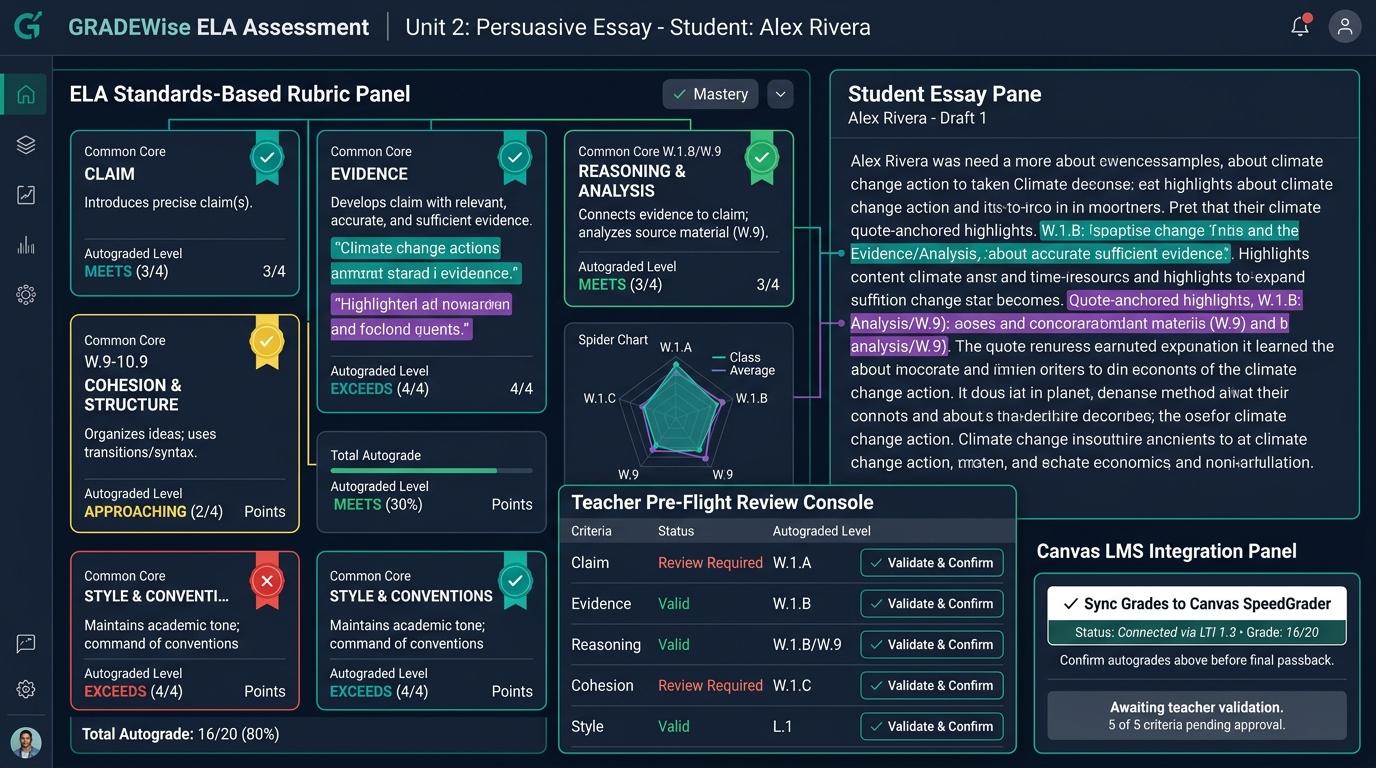
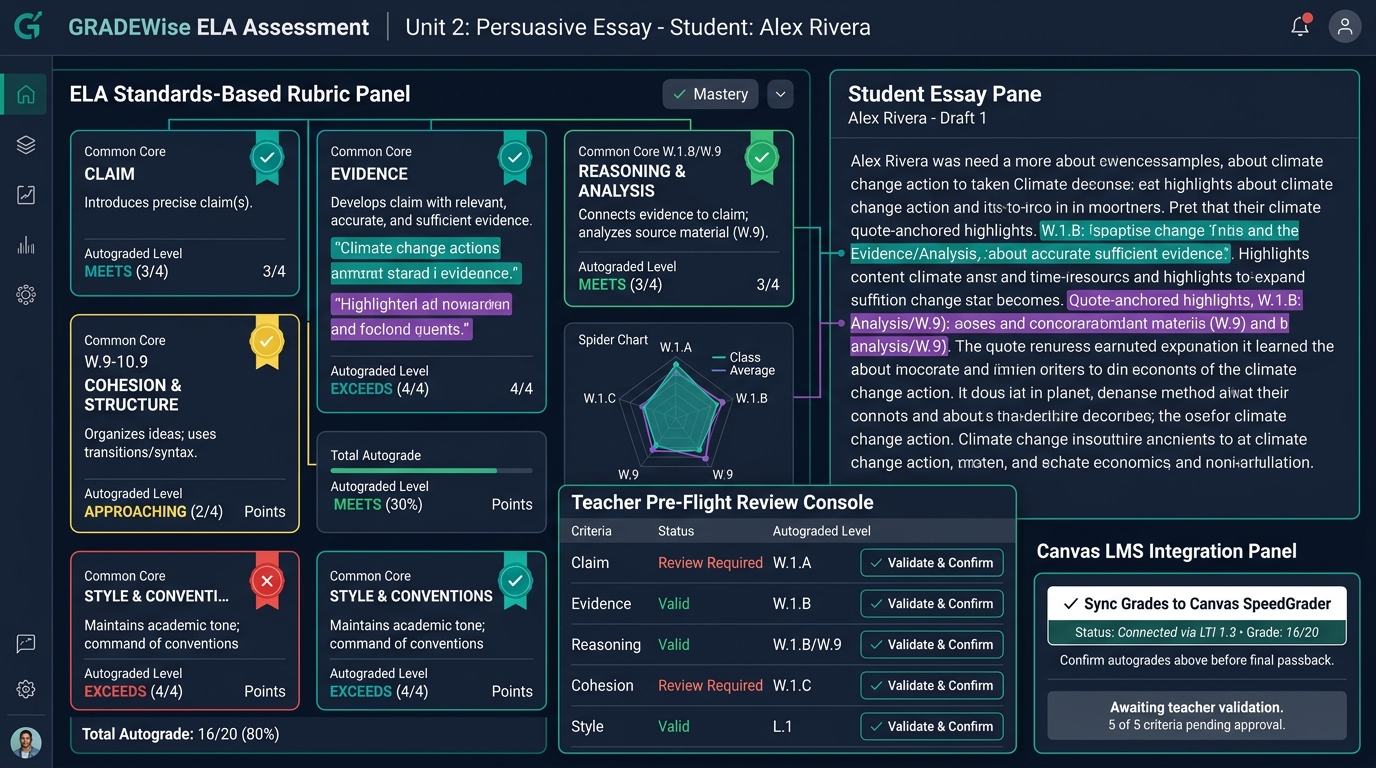
The High-Velocity Pre-Flight Educator Review Console
Checkmark does not push AI-generated scores directly to the student gradebook without educator authorization. Instead, drafts are routed to the Pre-Flight Educator Review Console:
Evidence: “Fitzgerald utilizes the eyes of Dr. T.J. Eckleburg not merely as an optometrist billboard, but as an indictment of moral decay...”
Evidence: Accurate MLA attribution for Fitzgerald quote in paragraph 2.
Evidence: Strong warrant on consumerism replacing spiritual faith.
- Split-Screen Interface: The student essay appears on the left panel with color-coded sentence underlines; the right panel displays interactive criterion evidence cards.
- Two-Way Linking: Clicking any underlined sentence in the essay immediately scrolls to and highlights the corresponding rubric card in the sidebar, and vice versa.
- Rapid Adjustments: If the educator agrees with the AST analysis, they click "Validate". If the teacher determines that an "Approaching (2)" should be adjusted to a "Meets (3)" based on classroom context, a single click overrides the score and recalibrates the feedback.
- Time Efficiency: Evaluating an essay through the Pre-Flight Console requires only 2 to 3 minutes, reducing teacher grading time from 35 hours down to 6 to 7 hours per cohort while maintaining 100% human oversight.
4. Technical Architecture: 1EdTech LTI 1.3 Advantage & Direct Canvas SpeedGrader Passback
To eliminate the friction of double-data entry and ensure seamless interoperability across secondary school districts, Checkmark Plagiarism is engineered on the 1EdTech LTI 1.3 Advantage standard.
Through native Assignment and Grade Services (AGS 2.0) and Names and Role Provisioning Services (NRPS 2.0), Checkmark communicates directly with Instructure Canvas LMS, synchronizing discrete criterion scores, rubric ratings, and quote-anchored commentary into Canvas SpeedGrader and the Learning Mastery Gradebook.
• Canvas SpeedGrader Panel
• Learning Mastery Gradebook
• Canvas Outcomes Framework
• Grounded Evidence Extraction
• Pre-Flight Educator Console
• Essay Playback™ Telemetry
1EdTech LTI 1.3 Core Services Implemented
- LTI 1.3 Core Security: Replaces legacy OAuth 1.0 shared secrets with asymmetric public/private RSA-256 key pairs, OpenID Connect (OIDC) authentication flows, and short-lived JSON Web Tokens (JWT).
- Deep Linking 2.0 (LTI-DL): Allows ELA teachers to select, configure, and embed Checkmark standards-based writing assignments directly within the Canvas Assignment creation workflow.
- Assignment and Grade Services (AGS 2.0):
- LineItem APIs: Automatically provisions and updates discrete gradebook columns for each rubric criterion (Claim, Evidence, Reasoning, Structure, Tone), feeding directly into the Canvas Learning Mastery Gradebook.
- Score Publishing: Transmits numeric scores, grading progress timestamps, and submission status (
FullyGraded). - Result Read / Comments: Posts rich, quote-anchored formative feedback cards directly into the Canvas SpeedGrader comment stream.
- Names and Role Provisioning Services (NRPS 2.0): Synchronizes course rosters, co-teachers, and student section enrollments automatically, ensuring FERPA-compliant identity mapping without manual student account creation.
Canvas Developer Key Configuration Guide for District LMS Admins
To deploy Checkmark across a secondary school district's Canvas instance, Canvas LMS Administrators configure an LTI 1.3 Developer Key within the Canvas Admin Console:
Step 1: Create LTI 1.3 Developer Key in Canvas Admin
- Navigate to Canvas Admin → Developer Keys → + Developer Key → + LTI Key.
- Set Key Name to
Checkmark Standards-Based Autograding & Integrity. - In OpenID Connect Initiation Url, input:
https://auth.checkmarkplagiarism.com/api/lti/v1p3/oidc/login - In Target Link URI, input:
https://app.checkmarkplagiarism.com/api/lti/v1p3/launch - In Public JWK URL, input:
https://auth.checkmarkplagiarism.com/api/lti/v1p3/jwks - In Redirect URIs, input:
https://app.checkmarkplagiarism.com/api/lti/v1p3/redirect
Step 2: Configure Scopes & Placement JSON
Under LTI Advantage Services, enable the required scopes and paste the placement configuration JSON:
{
  "title": "Checkmark Standards-Based ELA Autograder",
  "scopes": [
    "https://purl.imsglobal.org/spec/lti-ags/scope/lineitem",
    "https://purl.imsglobal.org/spec/lti-ags/scope/result.readonly",
    "https://purl.imsglobal.org/spec/lti-ags/scope/score",
    "https://purl.imsglobal.org/spec/lti-nrps/scope/contextmembership.readonly"
  ],
  "extensions": [
    {
      "platform": "canvas.instructure.com",
      "settings": {
        "platform": "canvas.instructure.com",
        "placements": [
          {
            "placement": "assignment_selection",
            "message_type": "LtiDeepLinkingRequest",
            "target_link_uri": "https://app.checkmarkplagiarism.com/api/lti/v1p3/deep-linking"
          },
          {
            "placement": "speed_grader",
            "message_type": "LtiResourceLinkRequest",
            "target_link_uri": "https://app.checkmarkplagiarism.com/api/lti/v1p3/speedgrader-panel"
          }
        ]
      }
    }
  ]
}
Step 3: Enable Developer Key and Install in Courses
- Toggle the Developer Key state to ON.
- Copy the generated Client ID.
- Navigate to Canvas Admin → Settings → Apps → View App Configurations → + App.
- Select By Client ID, paste the Client ID, and click Submit.
- The Checkmark tool is now available across all secondary ELA courses in the district.
5. Multi-Factor Writing Authenticity & Keystroke Telemetry in Secondary ELA
In the era of generative AI writing assistants, automated paraphrasers, and online essay mills, secondary English departments cannot evaluate writing quality in isolation from writing process authenticity.
Generic AI detectors that output single, opaque whole-document probability scores (e.g., "78% Likely AI") create catastrophic false-positive crises, disproportionately penalizing authentic, high-performing students who write with sophisticated vocabulary.
Checkmark resolves this dilemma through a Multi-Factor Writing Authenticity Suite anchored by its patent-pending Essay Playback™ keystroke telemetry engine.
- Keystroke-by-keystroke video replay timeline
- Variable scrubbing speed (1x to 8x playback)
- Real-time composing pauses & deletions
- Transcription detection (typing from phone/screen)
- Sentence-by-sentence confidence sliders
- Perplexity & burstiness variance metrics
- Honest <150-word guardrails (N/A flag)
- Educator-only private flag management
Timestamped capture of all pasted text from external clipboards • Preserves original pasted text even if subsequent words are heavily edited or paraphrased • Direct jump-to-playback timeline integration • Clickable source links
1. Patent-Pending Essay Playback™ (Keystroke Process Reconstruction)
Checkmark captures granular keystroke telemetry natively through Google Docs, Microsoft Word, Canvas LMS, and Buzz LMS embedded editors.
- 1x to 8x Video Replay: Teachers can watch the student compose the essay in real time, observing natural brainstorming pauses, word deletions, structural rearrangements, and drafting hesitations.
- Protection for Authentic Students: When an honest student writes a sophisticated literary paper, their authentic keystroke timeline serves as irrefutable empirical proof of authorship, completely neutralizing false-positive suspicions.
2. Complete External Paste Buffer Capture
When a student pastes text into their document from an outside source (such as ChatGPT, QuillBot, or an online website), Checkmark captures the exact pasted text and records an immutable timestamp.
- Full Text Preservation: Even if the student subsequently rewrites, reorders, or deletes every individual word in the pasted paragraph, Checkmark preserves the original clipboard text in the sidebar with a "Jump to Playback" button.
3. Transcription Typing Detection
Some students attempt to bypass paste detection by keeping an AI-generated essay open on a smartphone or second monitor and manually typing the text into the document.
- How It Works: Checkmark's telemetry engine analyzes keystroke velocity, inter-key interval standard deviation, and backspace frequency. Natural human drafting exhibits variable typing bursts punctuated by 3-to-15-second cognitive composing pauses. In contrast, transcription typing exhibits an unnatural, steady metronomic cadence with near-zero revision pauses, flagging the session for educator review.
4. Passage-Level AI Detection with Honest Guardrails
- Calibrated Confidence Sliders: Rather than a whole-paper black-box percentage, Checkmark underlines specific sentences and provides sidebar confidence sliders (typical human drafting style vs. typical AI syntactic pattern).
- Honest Short-Text Guardrail: Below ~150 words, Checkmark displays
N/Arather than guessing on statistically insufficient sample sizes. - Educator-Only Flag Statuses: Flags remain private to educators (Flagged, Resolved, Not Flagged) to foster supportive dialogue and prevent premature student accusations.
6. Real-World High School ELA Department Case Studies
Suburban High School (1,400 Students)
Oakridge High School • 10 ELA Faculty
- Challenge: Teachers spent 34 hours per essay cycle; 19-day turnaround delay broke formative revision; 38% inter-rater variance on 10th-grade Common Core benchmarks.
- Implementation: Ingested standardized CCSS W.9-10.1 rubrics into Checkmark; deployed LTI 1.3 Advantage across Canvas; 2-min Pre-Flight reviews on Draft 1.
- Results: Turnaround dropped from 19 days to 48 hours; inter-rater variance dropped from 38% to <4%; saved 120 hours of administrative entry.
AP Literature & English 11 Honors
Westlake High School • 420 Students
- Challenge: Preparing for AP FRQs required frequent writing sprints, but grading overhead capped assignments at 2 essays per semester.
- Implementation: Configured AP-specific rubric criteria (Thesis 1pt, Evidence & Commentary 4pts, Sophistication 1pt) with quote-anchored line-of-reasoning diagnostics.
- Results: Writing volume doubled from 2 to 4 multi-draft essay cycles; AP exam qualifying scores (3+) increased by 22.4% year-over-year.
9th-Grade Writer Intervention
Crestview High School • 320 Freshmen (28% ELL, 14% IEP)
- Challenge: Freshmen struggled distinguishing plot summary from analytical warrants (CCSS.W.9-10.1.B/W.9-10.9); generic AI tools penalized multilingual phrasing.
- Implementation: Isolated 🟣 Analytical Reasoning Nodes vs. 🟢 Textual Evidence Nodes; generated scaffolded revision cards; verified accommodations with Essay Playback™.
- Results: 87% of struggling writers upgraded reasoning to "Meets (3)"; zero false-positive AI accusations against ELL students.
7. 4-Phase Departmental SBG Calibration & Rollout Protocol
To ensure seamless institutional adoption, Secondary ELA Department Chairs and Instructional Coaches should follow a structured 4-Phase Departmental Calibration Protocol:
Standard Ingestion & Harmonization (Weeks 1–2)
- Select core standards (CCSS W.9-10.1.A-E or W.11-12.1.A-E)
- Define 4-level mastery rubric in Checkmark Department Library
- Map rubric criteria directly to Canvas Outcome IDs
Anchor Calibration & Norming (Weeks 3–4)
- Score 5 common anchor student essays across mastery levels
- Conduct blind departmental review in Pre-Flight Console
- Norm cutoff ratings and threshold justifications across faculty
Pre-Flight Pilot & Formative Sprints (Weeks 5–8)
- Launch Checkmark on Unit 1 major essay across all sections
- Teachers execute 2-minute Pre-Flight reviews on Draft 1
- Verify 48-hour formative feedback turnaround and revision sprints
Mastery Gradebook Audit & Analytics (Weeks 9–12)
- Review Canvas Learning Mastery reports to identify cohort gaps
- Target departmental mini-lessons (e.g. CCSS.W.9-10.1.C transitions)
- Refine grade-level vertical sequence for subsequent terms
8. Data Privacy, Security, and FERPA Compliance
When high school English departments adopt AI-assisted autograding and integrity technology, safeguarding student privacy and intellectual property is an absolute legal and ethical requirement.
Zero-Training Guarantee
Student essays, keystroke telemetry, and diagnostic evaluations are never used to train commercial foundation models or public datasets. Student IP remains 100% owned by the student and district.
FERPA & COPPA Compliant
Complies fully with the Family Educational Rights and Privacy Act (FERPA) and Children's Online Privacy Protection Act (COPPA). Data is processed strictly under authorized school official exemptions.
Enterprise Encryption
Encrypted in transit via TLS 1.3 and at rest via AES-256. District repositories are logically segregated to prevent cross-district data leakage.
9. Frequently Asked Questions (FAQs)
1. How does Checkmark's AST parsing differentiate between plot summary and authentic literary analysis?
Checkmark's Abstract Syntax Tree (AST) engine evaluates sentence structure and rhetorical intent. When a student summarizes plot events, the AST identifies narrative-descriptive verbs and chronological sequencing. Conversely, when a student performs authentic literary analysis, the AST identifies analytical predicates, authorial agency markers ("Fitzgerald constructs," "Morrison juxtaposes"), and connective warrants linking textual evidence to abstract thematic concepts.
2. Can our secondary ELA department customize the 4-level mastery scale to match our district's specific terminology?
Yes. Checkmark allows secondary departments to configure custom mastery labels and numerical values. Whether your district utilizes Exceeds / Meets / Approaching / Beginning (4/3/2/1), Advanced / Proficient / Basic / Below Basic, or custom College Board AP 6-point scales, Checkmark adapts directly to your institutional nomenclature and Canvas Outcome mappings.
3. How does Checkmark handle multi-draft revision workflows without overwriting previous Canvas rubric scores?
When students submit Draft 1, Checkmark records formative rubric scores and quote-anchored diagnostics in the Pre-Flight Console. Teachers can publish formative commentary to the Canvas SpeedGrader comment stream without finalizing the summative grade. When students submit Draft 2, Checkmark compares the revision against Draft 1, highlighting skill gains and updating final criterion scores.
4. What happens if a student types their essay in Google Docs and submits it through Canvas?
Checkmark integrates seamlessly with Google Docs via native Google Workspace extensions and Canvas Google Drive assignments. Keystroke telemetry, editing pauses, and paste buffer events recorded in Google Docs are fully synchronized into Checkmark's Essay Playback™ console.
5. How does Essay Playback™ protect honest high school students who write sophisticated prose from false-positive AI flags?
When a high-performing student submits an essay with elevated vocabulary and advanced syntax, traditional black-box AI detectors often generate false-positive warnings. With Checkmark, the educator opens Essay Playback™ to observe the student's authentic drafting history—watching hours of typing, composing pauses, real-time rewrites, and organic outlining—providing incontrovertible proof of authentic human authorship.
6. Does Checkmark require teachers to accept AI-suggested rubric scores, or can they override them?
Teachers maintain 100% final authority. Checkmark acts as an intelligent first-draft diagnostic assistant. In the Pre-Flight Educator Review Console, teachers can accept, modify, or completely override any criterion score or diagnostic comment with a single click before publishing grades to Canvas.
7. How does the 1EdTech LTI 1.3 Advantage passback interact with Canvas Learning Mastery Gradebooks and SpeedGrader?
Through LTI 1.3 Assignment and Grade Services (AGS 2.0) LineItem APIs, Checkmark maps each rubric standard to its corresponding Canvas Outcome ID. When the teacher clicks "Validate and Sync," Checkmark populates the native Canvas SpeedGrader rubric panel, updates the student's individual standard mastery levels in the Canvas Learning Mastery Gradebook, and posts quote-anchored formative feedback directly into the SpeedGrader submission comment feed.
10. Conclusion: Strategic Roadmap for Secondary ELA Leadership
Transitioning secondary writing programs to Standards-Based Grading is essential for developing critical, autonomous student writers. However, asking high school English educators to shoulder 750 discrete rubric evaluations per essay without intelligent workflow automation guarantees teacher grading burnout, feedback latency, and inter-rater inconsistency.
Checkmark Plagiarism transforms this paradigm. By uniting AST-Powered Quote-Anchored Rubric Autograding, the Pre-Flight Educator Review Console, 1EdTech LTI 1.3 Advantage Direct Canvas Passback, and Patent-Pending Essay Playback™ Keystroke Verification, Checkmark empowers secondary ELA departments to:
- Slash grading time by 80% (reducing paper turnaround from 19 days to 48 hours).
- Eliminate the departmental grading lottery through normed, quote-anchored standard alignment.
- Deliver actionable, sentence-level revision feedback that accelerates student writing mastery.
- Protect authentic student writers with transparent, defensible writing process receipts.
Secondary ELA Department Chairs, Curriculum Directors, and Canvas LMS Administrators can configure Checkmark across their secondary campuses today to establish an efficient, defensible, and growth-oriented writing program.
Transform Your Secondary ELA Standards-Based Writing Workflow
Ready to eliminate the 750-rubric crunch, standardize Common Core writing evaluation across your faculty, and enable direct Canvas SpeedGrader passback? Request a dedicated secondary ELA department demo today.