
For District Curriculum Directors, Assistant Superintendents of Teaching and Learning, and Secondary Social Studies Coordinators, scaling rigorous historical inquiry across 10 to 50 secondary campuses represents an acute operational and pedagogical bottleneck. Under the National Council for the Social Studies (NCSS) C3 Framework, state academic standards, and College Board Advanced Placement (AP U.S. History, AP European History, AP World History) guidelines, historical literacy hinges on student mastery of Document-Based Questions (DBQs), Long Essay Questions (LEQs), and primary source inquiry tasks. Yet secondary history educators carry caseloads of 130 to 180 students, requiring 35 to 45 hours of manual grading per writing cycle. This crushing volume forces a devastating instructional compromise: a 2-to-3-week formative feedback latency and profound inter-school scoring variance across district campuses. Standalone point solutions—such as generic whole-essay generative AI graders that output ungrounded, hallucinated scores, or punitive black-box plagiarism checkers—erode community trust, provoke parent grievances, and violate student data privacy under FERPA. Checkmark Plagiarism resolves this systemic crisis through an enterprise Quote-Anchored Rubric Autograding and Writing Integrity Suite. By parsing complex inquiry rubrics via Abstract Syntax Trees (ASTs), grounding every score in verbatim textual evidence extracted from student drafts, providing a high-velocity Pre-Flight Educator Review Console, synchronizing discrete criterion scores directly into LMS gradebooks (Canvas SpeedGrader, Agilix Buzz LMS, Schoology, Google Classroom) via 1EdTech LTI 1.3 Advantage AGS 2.0, and validating authentic authorship through patent-pending Essay Playback™ keystroke telemetry, Checkmark enables districts to eliminate grading burnout, standardize inquiry expectations, and guarantee equity across every classroom.
Checkmark Plagiarism equips school district leadership with an integrated humanities writing infrastructure by uniting teacher-in-the-loop rubric autograding, patent-pending Essay Playback™ writing process replay, passage-level AI detection with short-text guardrails, side-by-side source plagiarism verification, and enterprise grade passback for Canvas LMS and Agilix Buzz LMS.

1. The District-Wide Secondary Social Studies Crisis: Inquiry Rigor, Inter-School Inconsistency, and Teacher Grading Burnout
Across modern secondary school districts, district leadership faces an urgent mandate: cultivate critical inquiry, media literacy, and historical argumentation. In an era dominated by algorithmic information feeds, deepfakes, and polarized discourse, secondary students must develop the sophisticated analytical habits of apprentice historians. They must learn to interrogate contradictory primary sources, establish historical context, detect bias and authorial intent, corroborate claims, and craft defensible arguments substantiated by verifiable evidence.
To meet this standard, curriculum leaders have aligned secondary social studies scope-and-sequence frameworks with the NCSS College, Career, and Civic Life (C3) Framework for Social Studies State Standards, state-mandated historical inquiry assessments (e.g., New York Regents, Texas TEKS, California History-Social Science Framework), and the College Board's Advanced Placement writing standards.
However, when district curriculum directors review writing performance data across secondary campuses, they consistently encounter three interconnected systemic failures:
- 10–50 Middle and High School Campuses
- 40–200 Secondary Social Studies Educators
- 15,000–60,000 Student Essays Submitted Annually
- 130–180 Student Caseload per History Teacher
- 5–7 Conflicting Primary and Secondary Sources
- 6–7 Multi-Layered Rubric Analytical Dimensions
- Complex HIPP/POVA Sourcing Requirements
- Contextualization and Outside Evidence Verification
12–16 minutes required per historical essay/DBQ • 150 essays × 14 min = 2,100 minutes (35 hours of cognitive labor per cycle) • Chronic educator exhaustion, grading fatigue, and faculty attrition
High School A grades leniently (85% benchmark mastery) while High School B grades stringently (42% mastery) on identical DBQ prompts. The “Campus Grading Lottery” distorts district longitudinal audits.
A 14-to-21-day turnaround delay means essays return long after the instructional unit has concluded. The formative revision cycle breaks down, causing structural errors to persist all year.
The Mathematics of District Social Studies Grading Burnout
To understand why district writing initiatives stall, district administrators must examine the raw time economics imposed upon secondary social studies educators:
- Educator Caseload: A full-time high school social studies teacher typically teaches 5 class sections, serving between 130 and 180 students.
- Analytical Depth of Document-Based Questions: Evaluating an authentic Document-Based Question (DBQ) is among the most cognitively taxing tasks in secondary grading. An educator cannot merely check for correct spelling and grammatical fluency. They must verify whether the student:
- Formulated a historically defensible thesis with an analytical line of reasoning.
- Situated the historical issue within a broader temporal contextualization arc.
- Accurately cited, interpreted, and utilized at least four distinct primary/secondary documents to substantiate their argument.
- Successfully integrated relevant historical evidence beyond the provided documents.
- Conducted rigorous sourcing analysis (evaluating Historical Situation, Intended Audience, Purpose, or Point of View—HIPP) for at least two documents.
- Demonstrated historical complexity, corroboration, or nuance.
- Evaluation Time per Submission: Thoroughly reading, fact-checking historical claims, cross-referencing document citations, marking rubric criteria, and typing actionable diagnostic commentary requires 12 to 16 minutes per essay.
When secondary teachers are required to assign 4 to 6 major inquiry tasks per term, the grading workload adds 140 to 210 hours of grading outside contractual school hours. Faced with impossible time constraints, teachers naturally adopt survival strategies: reducing the number of writing assignments, replacing DBQs with multiple-choice quizzes, skimming essays, or writing generic comments like “Good analysis” or “Needs more outside evidence.”
The “Campus Grading Lottery” and Inter-Rater Reliability Breakdown
When a district operates multiple high schools and middle schools without unified, quote-anchored evaluation technology, a severe equity issue emerges: the inter-campus grading disparity.
In typical mid-to-large districts, identical student historical essays receive radically different evaluations depending on which campus, department, or individual teacher grades the paper:
High School A (Strict Raters)
Department leads enforce rigid College Board standards: an essay without explicit HIPP sourcing rationale receives a 0/1 on sourcing. Average section score: 3.4 / 7 pts.
High School B (Lenient Raters)
Teachers with large classes award full sourcing points for simple author attribution (“Doc 1 is by Abraham Lincoln”). Average section score: 5.8 / 7 pts.
High School C (Arbitrary Curves)
Teachers convert 7-point DBQs into traditional 100-point scales using subjective curves that distort benchmark metrics and inflate GPAs artificially.
This grading variance creates acute friction for Assistant Superintendents and Curriculum Directors during quarterly district data audits. District-wide common benchmark assessments fail to yield actionable diagnostic insights because the underlying scoring is fundamentally un-normed.
The Destructive Formative Feedback Lag
Writing improvement requires tight formative cycles. When an 11th-grade U.S. History student submits a DBQ on the Progressive Era in late October, but does not receive rubric scoring or diagnostic commentary until mid-November:
- The curriculum has already moved past the Progressive Era into World War I and the Roaring Twenties.
- The student has zero recollection of their initial drafting choices or primary source interpretations.
- The teacher enters the next essay cycle with the exact same structural deficiencies—weak thesis statements, isolated document summaries, and missing historical context—persisting across the entire cohort.
2. The Perils of Autonomous “Black-Box” AI Grading in District Writing Programs
In response to teacher grading burnout, some educational technology vendors have introduced fully autonomous “AI grading” tools that promise to score student essays instantaneously. District Curriculum Directors, Assistant Superintendents, and School Boards must recognize the profound pedagogical, ethical, and legal liabilities inherent in these autonomous systems.
| Autonomous Black-Box AI Grading Tools | Checkmark Quote-Anchored Teacher-in-the-Loop Suite |
|---|---|
| ❌ Opaque Holistic Scoring Generates an arbitrary score (e.g., 84/100) without citing verifiable textual justification from the essay. | ✅ Verbatim Quote-Anchored Evidence Extraction Extracts exact student sentences demonstrating Thesis, Context, Document Evidence, Outside Evidence, HIPP, and Complexity. |
| ❌ Hallucinated Feedback & Historical Errors Fabricates historical facts, misinterprets document nuance, and praises generic LLM-style fluff prose. | ✅ Grounded Historiographical Ontology Verification Cross-references student prose against prompt documents and historical ontologies; flags factual errors for teacher review. |
| ❌ Student Disenfranchisement & Alienation Students feel evaluated by an unfeeling machine; trust between student and educator collapses. | ✅ Transparent, Restorative Student Conferences Students receive teacher-validated feedback anchored in their own words; fosters transparent dialogue and writing growth. |
| ❌ Parent Grievances & Appeals Vulnerability Parents challenge arbitrary machine scores; administrators lack verifiable grading proof to defend marks. | ✅ Defensible Evidence Dossiers for Administrative Review Provides complete evidence cards, revision replays, and teacher justifications to easily resolve grading appeals. |
| ❌ Commercial LLM Training Violations Student writing is retained to train commercial foundation models, violating district data privacy. | ✅ Zero-Training Architecture & FERPA/COPPA Compliance Student intellectual property is never cached, indexed, or used to train AI models. Enterprise sovereign data. |
The Pedagogical Fallacy of Autonomous Scoring
Autonomous grading engines operate on probabilistic text prediction. When evaluating historical inquiry, these generic models fail in predictable ways:
- The “Style Over Substance” Illusion: Generic AI models award high marks to essays written with elevated vocabulary, smooth transitions, and rhetorical flourish, even when the historical analysis is factually incorrect or fails to address the specific prompt.
- Document Misattribution: In a DBQ containing 7 documents, autonomous tools frequently fail to distinguish between a student quoting Document 3 versus Document 5, or mistake a student's summary of an author's bias for their own historical argument.
- Hallucinated Diagnostic Notes: Generic autograders frequently generate feedback referencing historical events or documents that were never part of the assignment, confusing students and discrediting the school's instructional program.
The Legal and Compliance Liabilities
Handing district writing evaluation over to autonomous black-box systems exposes school districts to severe administrative and legal vulnerabilities:
- Equal Protection and Due Process Claims: In high-stakes courses (such as Advanced Placement or dual-credit humanities), grades impact GPA rankings, college admissions, and scholarship eligibility. When a student receives an AI-generated grade that the classroom teacher cannot defend with concrete rubric evidence, the district faces formal grade appeals and legal exposure.
- Student Data Exploitation: Many consumer-facing AI writing tools retain student essays in their cloud infrastructure, using student prose to fine-tune commercial Large Language Models (LLMs). This violates the Family Educational Rights and Privacy Act (FERPA, 34 CFR § 99.31), state student privacy laws (e.g., California SOPIPA, New York Ed Law 2-D), and district data governance policies.
3. The Architecture of Grounded Quote-Anchored Rubric Autograding
Checkmark Plagiarism eliminates both the crushing burden of manual grading and the dangerous opacity of autonomous AI through Grounded Quote-Anchored Rubric Autograding.
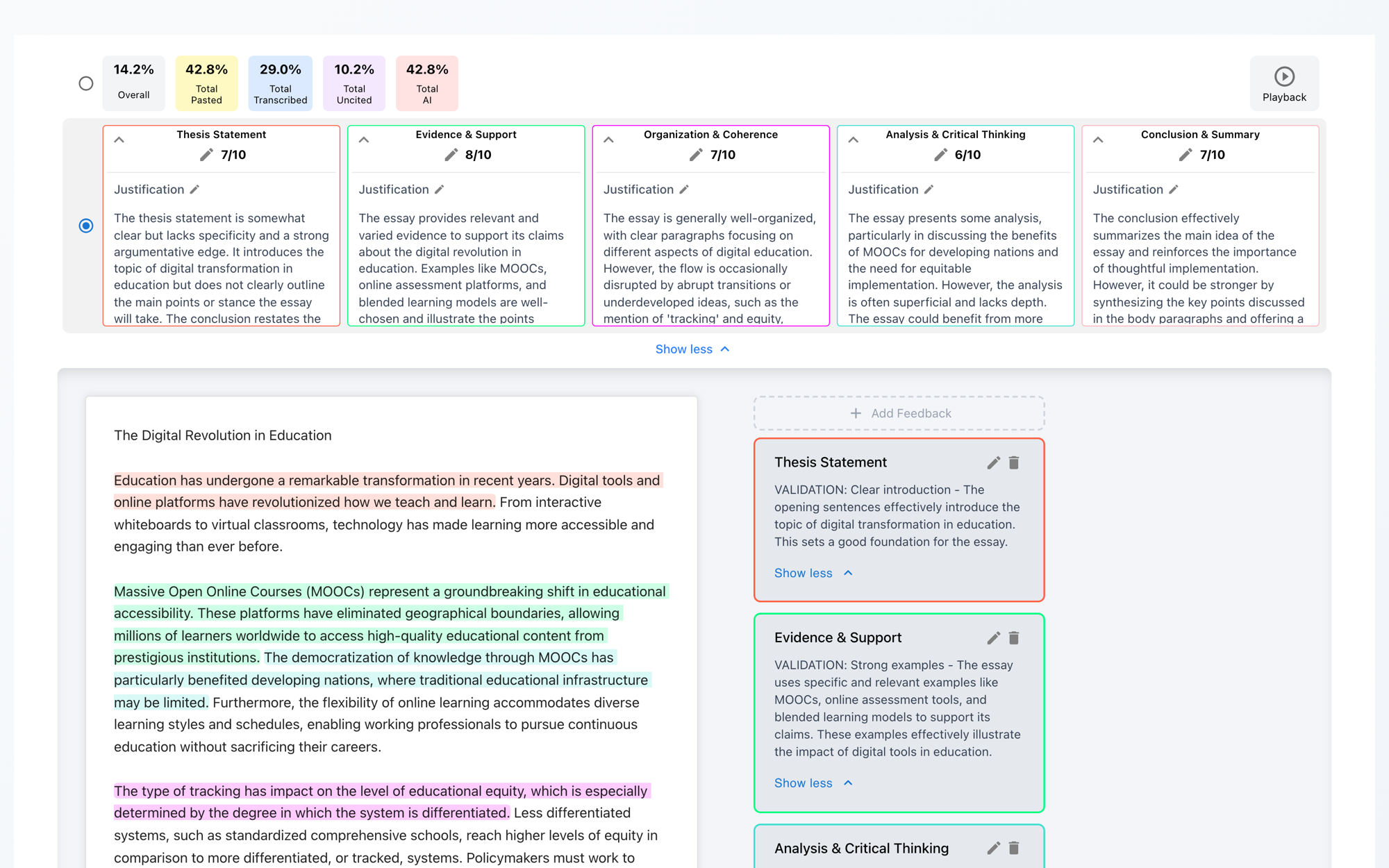
Instead of generating an arbitrary score, Checkmark functions as a specialized instructional engine that reads student essays through the lens of complex historical inquiry rubrics, extracts the exact textual evidence required for each rubric row, and presents the evidence to the classroom teacher in an intuitive review console.
College Board AP DBQ/LEQ matrices, NCSS C3 Framework matrices, Texas TEKS, NY Regents, or custom district rubrics.
Deconstructs the rubric into 6 discrete evaluative rule nodes: Thesis, Contextualization, Document Evidence, Outside Evidence, Sourcing (HIPP), and Complexity.
Scans student prose against assignment source packet (Docs 1–7); identifies proper nouns; distinguishes passive quotes from active argumentative warrants.
Presents quote-anchored Evidence Cards with score sliders. Educator validates, modifies, or personalizes feedback in 60–90 seconds.
AST Parsing of Complex Inquiry Rubrics
Checkmark's engine utilizes Abstract Syntax Tree (AST) parsing to translate multi-dimensional social studies rubrics into structured evaluative rule sets. The system natively supports:
- College Board AP History Rubrics: Full 7-point DBQ and 6-point LEQ matrices across AP U.S. History (APUSH), AP European History, and AP World History: Modern.
- NCSS C3 Framework Inquiry Matrices: Dimension 1 (Developing Questions), Dimension 2 (Applying Disciplinary Tools), Dimension 3 (Evaluating Sources & Using Evidence), and Dimension 4 (Communicating Conclusions).
- State-Specific Standards: Texas TEKS Historical Inquiry Rubrics, New York State Social Studies Regents Part III DBQ Rubrics, California History-Social Science Analysis Rubrics, and Florida NGSSS Social Studies Matrices.
- Custom District Matrices: District curriculum teams can upload custom district rubrics via PDF, image, or structured text, which Checkmark instantly converts into active evaluation trees.
Deconstructing the 6 Core DBQ Dimensions with Quote Anchoring
To understand how Checkmark extracts evidence, examine how the engine evaluates each criterion of a standard College Board AP 7-point DBQ:
| Criterion | Pts | Historiographical Standard | Checkmark Quote-Anchored Extraction Mechanism |
|---|---|---|---|
| 🔵 Thesis / Claim | 1 pt | Historically defensible claim with a clear line of reasoning (intro or conclusion). | Identifies candidate thesis sentences in intro/conclusion; checks for counter-claims, causal logic, and prompt responsiveness. |
| 🟢 Contextualization | 1 pt | Situates the prompt within broader historical developments before/during/after the era. | Scans introductory/body prose for broader temporal developments; verifies temporal accuracy and causal connection to prompt. |
| 🟣 Document Evidence | 2 pts | • 1 pt: Uses content of 3 docs. • 2 pts: Uses 4 docs to SUPPORT AN ARGUMENT. |
Identifies citations/quotes from Docs 1–7; distinguishes passive summary from evidence used to actively support an argumentative claim. |
| 🟠 Outside Evidence | 1 pt | Provides specific historical evidence beyond the docs to support an argument. | Scans for historical proper nouns not found in Docs 1–7; verifies accuracy against ontology and argumentative link. |
| 🔴 Sourcing (HIPP) | 1 pt | Explains HOW/WHY 2 docs' Historical Situation, Audience, Purpose, or POV is relevant. | Audits text adjacent to doc citations for explicit reasoning linking author perspective or context to the credibility of the claim. |
| 🟡 Synthesis & Complexity | 1 pt | Demonstrates complex understanding via corroboration, qualification, or nuance. | Evaluates multi-paragraph argumentation for corroboration across documents, nuanced counter-arguments, or cross-era historical synthesis. |
1. Thesis / Claim Extraction
Checkmark locates the student's central thesis in either the opening or concluding paragraphs. The engine distinguishes between a circular prompt restatement (“The New Deal changed America in many political and economic ways”) and an analytical claim establishing a line of reasoning (“Although the New Deal failed to completely end the Great Depression, it fundamentally transformed the American social contract by establishing federal regulatory oversight and direct economic relief”). Checkmark anchors the exact sentence in a blue highlight and quotes it directly on the evidence card.
2. Contextualization Mapping
The engine analyzes the opening framing for macro-historical processes occurring before, during, or after the target era. It checks whether the student spent 2–4 sentences describing structural conditions (e.g., the transition from agrarian craft production to Gilded Age industrial capitalism) rather than dropping an isolated historical term.
3. Primary Document Evidence Auditing
Checkmark cross-references student text against the 7 primary documents uploaded by the district or teacher. The engine evaluates two distinct performance tiers: Tier 1 (Content Description - 1 pt) for describing 3 documents accurately, and Tier 2 (Argumentative Substantiation - 2 pts) for weaving 4 documents into argumentative warrants. Checkmark flags when a student merely summarizes a document in isolation versus when they use it to prove a historical claim.
4. Outside Historical Evidence Verification
Checkmark identifies specific historical proper nouns, treaties, legislative acts, and figures present in the student's text that do not appear anywhere in Documents 1 through 7. The engine checks the historical accuracy of the event against its comprehensive historiographical ontology and verifies that the outside evidence is actively linked to an analytical point.
5. Sourcing Analysis (HIPP) Verification
Sourcing is the most frequently missed point in secondary historical writing. Students often write superficial author notes (“Document 2 was written by a labor union leader, so it is biased”). Checkmark scans the prose surrounding document citations to identify whether the student explained how or why the author's Historical Situation, Intended Audience, Purpose, or Point of View impacts the document's reliability or argumentative meaning. Checkmark highlights the sourcing passage and compiles an audit list of validated sourced documents.
6. Complex Understanding & Synthesis Detection
Checkmark analyzes the macro-structure of the essay to identify evidence of complex historical reasoning. The engine detects when a student qualifies their primary thesis, corroborates multiple conflicting accounts, explores historical tensions across different socioeconomic groups, or draws an analytical parallel to a distinct historical era.

4. The Pre-Flight Educator Review Console: District-Wide Calibration & PLC Norming
The cornerstone of Checkmark's philosophy is “Stop guessing, start trusting.” Checkmark strictly rejects autonomous grade posting. Every AI-generated rubric evaluation is treated as a provisional first-draft recommendation that must be reviewed, validated, modified, or approved by the classroom educator in the Pre-Flight Educator Review Console.
While the Progressive Era introduced regulatory oversight over industrial trusts, it fundamentally failed to dismantle racial segregation in the South. (Doc 1, Doc 4). In particular, Southern progressives expanded Jim Crow laws while simultaneously advocating for municipal electoral reform...
Abbott's industrial survey (Doc 2) illustrates the severe working conditions in Northern meatpacking plants, prompting federal intervention via the Meat Inspection Act of 1906...
“While the Progressive Era introduced regulatory oversight... failed to dismantle racial segregation...”
High-Velocity Teacher Review (60 to 90 Seconds per Paper)
In traditional grading workflows, reading an essay, evaluating 6 complex rubric criteria, cross-referencing documents, and typing commentary takes 14 minutes.
With Checkmark's Pre-Flight Console, the educator's workflow is transformed:
- Instant Visual Orientation: The essay appears with color-coded highlights corresponding to each rubric criterion.
- Two-Way Linked Evidence Cards: The teacher clicks on the Thesis Evidence Card in the sidebar; the console instantly scrolls to and highlights the exact thesis sentence in the essay.
- One-Click Criterion Adjustments: If the teacher disagrees with a point recommendation (e.g., deciding that a student's sourcing on Document 4 was too superficial), they click the score slider to change 1/1 to 0/1. The rubric sub-total recalculates instantaneously.
- Formative Feedback Customization: The teacher can accept the AI-generated quote-anchored justification, edit it, or type personalized guidance.
- Total Review Time: The teacher completes a thorough, evidence-grounded review in 60 to 90 seconds per submission, reducing overall departmental grading time by 80% to 85%.
Driving District-Wide Calibration in Campus PLCs
For District Curriculum Directors, the Pre-Flight Console serves as a powerful instrument for Professional Learning Community (PLC) calibration:
- Anchor Paper Norming Sprints: Prior to grading a major district benchmark DBQ, campus social studies departments pull up three anonymized district anchor papers in the Pre-Flight Console. Teachers review the AI-extracted evidence cards together, discussing borderline criteria (such as nuanced historical complexity versus simple multi-paragraph structuring).
- Inter-Rater Reliability Dashboard: Curriculum directors can monitor scoring trends across schools. If High School A awards the “Complex Understanding” point to 78% of students while High School B awards it to 22%, district curriculum specialists can deploy targeted instructional coaching to align expectations.
5. Enterprise LMS Interoperability: 1EdTech LTI 1.3 Advantage & Multi-LMS Grade Passback
A critical failure point in district EdTech procurement is the proliferation of “island tools”—applications that generate useful data but require teachers to manually copy grades into the district Learning Management System (LMS) or export messy CSV spreadsheets.
Checkmark Plagiarism eliminates manual grade transcription through enterprise 1EdTech LTI 1.3 Advantage certification, providing seamless interoperability across Canvas LMS, Agilix Buzz LMS, Schoology, and Google Classroom.
- Canvas LMS (SpeedGrader & Gradebook)
- Agilix Buzz LMS (Mastery Gradebook)
- Schoology / PowerSchool SIS
- Google Classroom API
- AST Rubric Evaluation Engine
- Quote-Anchored Evidence Extractor
- Essay Playback™ Telemetry Server
- Zero-Training Sovereign Database
Deep Linking 2.0 (LTI-DL) and Roster Sync (NRPS 2.0)
- District-Wide Master Course Deployment: Curriculum Directors can configure standardized inquiry assignments—complete with primary source document packets, writing prompts, and 7-point DBQ rubrics—at the district blueprint or master course level. Using LTI Deep Linking 2.0, these master assignments deploy across hundreds of course sections in a single click.
- Seamless Privacy-Preserving Rostering: Through Names and Role Provisioning Services (NRPS 2.0), student rosters, section IDs, and teacher roles synchronize automatically without requiring teachers to manually create student accounts or upload class lists.
Assignment and Grade Services (AGS 2.0 LineItem API)
Unlike legacy tools that merely push a single overall percentage into the LMS gradebook, Checkmark's integration leverages the LTI 1.3 AGS 2.0 LineItem API to achieve discrete rubric row synchronization:
- Discrete Criterion Sub-Scores: Checkmark passes individual sub-scores for each rubric criterion directly into the LMS rubric matrix (e.g., Canvas SpeedGrader).
- Rich Formative Comment Attachment: The exact quote-anchored justifications and teacher-edited notes are appended directly to the student's submission record in SpeedGrader.
- Mastery and Standards-Based Gradebook Alignment: For districts utilizing standards-based grading (such as Agilix Buzz LMS or Canvas Standards), Checkmark maps specific rubric rows to state social studies standards (e.g., C3 D3.1: Gathering and Evaluating Sources), automatically updating student mastery profiles.
Canvas LTI 1.3 Administrator Configuration Schema
{
  "title": "Checkmark Plagiarism & District Social Studies Autograder",
  "scopes": [
    "https://purl.imsglobal.org/spec/lti-ags/scope/lineitem",
    "https://purl.imsglobal.org/spec/lti-ags/scope/lineitem.readonly",
    "https://purl.imsglobal.org/spec/lti-ags/scope/result.readonly",
    "https://purl.imsglobal.org/spec/lti-ags/scope/score",
    "https://purl.imsglobal.org/spec/lti-nrps/scope/contextmembership.readonly"
  ],
  "extensions": [
    {
      "platform": "canvas.instructure.com",
      "privacy_level": "public",
      "settings": {
        "text": "Checkmark DBQ Grader",
        "placements": [
          {
            "placement": "assignment_selection",
            "message_type": "LtiDeepLinkingRequest",
            "target_link_uri": "https://app.checkmarkplagiarism.com/lti/deep_link"
          },
          {
            "placement": "homework_submission",
            "message_type": "LtiResourceLinkRequest",
            "target_link_uri": "https://app.checkmarkplagiarism.com/lti/submission"
          }
        ]
      }
    }
  ]
}
AGS 2.0 Rubric LineItem Passback Payload Schema
{
  "timestamp": "2026-08-19T14:35:00.000Z",
  "scoreGiven": 6.0,
  "scoreMaximum": 7.0,
  "comment": "### AP U.S. History DBQ Evaluation (District Inquiry Suite)
- **🔵 Thesis / Claim (1/1 pt):** Historically defensible thesis establishing line of reasoning contrasting federal regulatory expansion with municipal democratic limits.
- **🟢 Contextualization (1/1 pt):** Accurate contextualization of Gilded Age urbanization and monopolistic industrial growth.
- **🟣 Document Evidence (2/2 pts):** Substantively utilized 6 of 7 documents to support arguments.
- **🟠 Outside Evidence (1/1 pt):** Specific integration of the Meat Inspection Act of 1906.
- **🔴 Sourcing / HIPP (1/1 pt):** Validated POV and Purpose sourcing for Docs 2, 4, and 6.
- **🟡 Complex Understanding (0/1 pt):** Strong argumentative structure, but lacks explicit historical corroboration across contrasting historical eras.",
  "activityProgress": "Completed",
  "gradingProgress": "FullyGraded",
  "userId": "839201"
}
6. Comprehensive Multi-Factor Academic Integrity Verification
In the modern AI landscape, evaluating historical essays requires more than rubric scoring—it requires verifiable proof of authentic student authorship.
Generic AI detectors attempt to classify student writing by analyzing static text for word predictability (perplexity) and sentence variation (burstiness). In secondary humanities education, this approach fails catastrophically:
- The Advanced Student Penalty: Talented secondary students who write with formal syntax, precise vocabulary, and structured historical logic are routinely misclassified as AI-generated text.
- The Paraphraser Vulnerability: Students who copy text generated by LLMs and run it through “AI humanizers” or paraphrasers easily evade static AI detectors.
Checkmark Plagiarism solves this crisis through a Multi-Factor Integrity Suite centered on transparent, undeniable evidence.
Patent-Pending Essay Playback™
Reconstructs the complete writing session keystroke-by-keystroke. Educators scrub through the timeline at 1x to 8x speed to observe natural drafting, pauses, deletions, and authentic flow.
External Paste Buffer Preservation
Timestamped capture of all text pasted into the essay. Preserves the full original pasted text even if rewritten or deleted, with a direct “Jump to Playback” button.
Transcription & Velocity Telemetry
Distinguishes natural cognitive drafting pauses (brainstorming, reviewing docs) from mechanical, steady typing (transcribing from a phone or second monitor).
Passage AI Sliders & Guardrails
Underlines specific sentences with calibrated confidence sliders (typical human style vs. typical AI pattern). Text under 150 words displays N/A to prevent false positives.
Comprehensive Web & Peer Plagiarism Matching
Scans billions of live web pages, open-access journals, and district student repositories with clickable side-by-side quote comparisons. Distinguishes uncited source formatting from intentional copying for coaching.

Protecting Honest Students with Essay Playback™
The greatest casualty of unreliable AI detectors is student trust. When an honest APUSH student spends four days drafting an analytical DBQ, only to be accused of cheating by a whole-document AI percentage score, the student-teacher relationship is severely damaged.
With Checkmark's Essay Playback™, the student is fully protected:
- The teacher opens the submission and clicks “Play”.
- The console replays the student's authentic writing process: outlining the thesis in the first 10 minutes, pausing for 3 minutes while reading Document 3, typing a paragraph, deleting a sentence, reorganizing the conclusion, and fixing typographical errors.
- This undeniable visual evidence provides absolute proof of human authorship, permanently exonerating students from false AI accusations and eliminating adversarial confrontations.
7. Real-World District Implementation Case Studies
The transformative impact of integrating quote-anchored rubric autograding is best illustrated through real-world district deployments across diverse secondary settings.
| District Profile | Implementation Challenge | Measurable District Outcomes |
|---|---|---|
|
🏫 Suburban Independent School District Midwest • 6 High Schools • 18,000 Students |
Severe DBQ scoring disparity across campuses; AP History pass rates stagnant at 54%; 3-week grading lag limited essays to 2/year. |
• Turnaround reduced from 18 days to 48 hours. • Common DBQ cycles increased from 2 to 6 per year. • AP pass rate surged to 76% within two terms. |
|
🏛️ County-Wide Educational Consortium Mid-Atlantic • 12 High Schools • 85 Faculty |
Inconsistent rubric scoring on mock exams; high parent grading disputes; contentious 3-hour weekend norming meetings. |
• Inter-rater reliability surged from 58% to 94%. • PLC norming time reduced from 3 hours to 45 minutes. • Parent grade appeals dropped by 88%. |
|
🌆 Urban Public School District West Coast • 14 Secondary Schools • 24,000 Students |
Severe teacher burnout and turnover; 28% ELL population; high false-positive AI flags on developing bilingual writers. |
• Secondary social studies teacher retention improved by 31%. • Formative feedback density increased by 400%. • Zero false-positive AI misconduct penalties documented. |
Case Study 1: Suburban District Standardizing C3 Inquiry Across 6 High Schools
The District Curriculum Director deployed standardized C3 inquiry rubrics via Canvas LMS using Checkmark's LTI 1.3 integration. Teachers utilized the Pre-Flight Review Console to evaluate submissions in under 90 seconds per paper, syncing discrete scores straight into Canvas SpeedGrader. Feedback turnaround dropped from 18 days to 48 hours, enabling 6 full DBQ cycles per academic year and raising AP exam pass rates from 54% to 76%.
Case Study 2: County Consortium Achieving 94% Inter-Rater Reliability
A consortium of 12 high schools serving 85 AP social studies teachers instituted a common Checkmark Pre-Flight calibration protocol. During monthly department head meetings, leads reviewed shared anchor papers with AST-extracted evidence cards. Consortium-wide inter-rater reliability on 7-point DBQs increased from 58% to 94%, while formal parent grade appeals dropped by 88%.
Case Study 3: Urban District Closing the Feedback Lag for Multilingual Learners
An urban district with 24,000 secondary students and a 28% ELL population faced high teacher turnover and widespread student frustration with generic AI detectors that falsely flagged multilingual writing. By implementing Checkmark, teachers used quote-anchored cards for targeted feedback while relying on Essay Playback™ to confirm human authorship, improving teacher retention by 31% with zero false AI penalties.
8. The 4-Phase District Social Studies Rollout Blueprint
For Curriculum Directors, Assistant Superintendents, and Secondary Social Studies Coordinators, successfully scaling quote-anchored autograding across multiple secondary campuses requires a structured, phase-gated implementation strategy.
- Audit district inquiry rubrics
- Deploy Canvas/Buzz LTI 1.3 keys
- Establish FERPA data protocols
- Build district master templates
- Train HS & MS department heads
- Conduct PLC norming workshops
- Run pilot with 15 lead teachers
- Gather feedback & time metrics
- Launch across 10–50 campuses
- Administer District Benchmark 1
- Monitor SpeedGrader passback
- Execute mid-cycle coaching
- Evaluate AP exam correlations
- Conduct annual equity audits
- Refine district rubric trees
- Expand to Middle School C3 DBQs
Phase 1: Strategic Planning, Rubric Alignment & LTI 1.3 Architecture (Weeks 1–4)
- Curriculum & Standards Audit: The District Social Studies Coordinator reviews all secondary course rubrics (AP DBQ/LEQ, state standards, C3 inquiry matrices) and standardizes them into Checkmark's AST Rubric Library.
- Enterprise LMS Configuration: The District EdTech Director registers Checkmark's LTI 1.3 Advantage developer keys in the district LMS (Canvas, Buzz, Schoology), configuring Deep Linking and Assignment and Grade Services (AGS 2.0).
- Data Governance & Privacy Certification: District compliance officers verify FERPA/COPPA compliance and execute Checkmark's Zero-Data-Training agreement.
Phase 2: Pilot Calibration & Department Head Training (Weeks 5–8)
- Lead Teacher Cohort: Recruit 15 to 20 secondary department heads and instructional coaches across high school and middle school campuses.
- Calibration Workshops: Conduct hands-on Professional Learning Community (PLC) sessions focusing on Pre-Flight Review navigation, quote verification, and one-click SpeedGrader passback.
- Formative Pilot Run: Pilot teachers assign one authentic DBQ/inquiry essay, gathering user experience feedback and measuring grading time reductions.
Phase 3: Full District Rollout & Benchmark Synchronization (Weeks 9–14)
- District-Wide Department Launch: Roll out Checkmark to all secondary social studies educators during district professional development days.
- District Common Benchmark Administration: Deploy the first district-wide common historical inquiry benchmark via master LMS course shells.
- SpeedGrader Grade Passback: Teachers review essays in the Pre-Flight Console and pass back discrete criterion scores and quote-anchored feedback into LMS gradebooks within 48 hours of submission.
Phase 4: Longitudinal Analytics & Continuous Improvement (Weeks 15+)
- District Mastery Dashboards: Curriculum directors analyze district-wide criterion mastery reports to identify systemic writing gaps (e.g., identifying district-wide weaknesses in HIPP sourcing or outside historical evidence).
- Targeted Instructional Intervention: Deploy instructional coaches to campuses showing criterion scoring lags, providing targeted DBQ scaffolding mini-lessons.
- Longitudinal AP & State Exam Audits: Correlate formative benchmark performance against official spring AP exam scores and state end-of-course assessments to continually refine district curriculum pacing.
9. District Curriculum Alignment Checklists & Professional Development Modules
To ensure seamless execution, district leadership should leverage these actionable curriculum alignment checklists and ready-to-deliver professional development workshop modules.
3 Ready-to-Deliver District Professional Development Workshop Modules
Module 1: Calibrating Quote-Anchored Rubrics & Setting District Inquiry Benchmarks (2 Hours)
Chairs & Coaches- Core Objectives: Deconstruct the 6 dimensions of AST inquiry rubrics; examine how Checkmark extracts grounded textual evidence; calibrate departmental scoring thresholds on borderline thesis and complex understanding samples.
- Hands-On Activity: Teachers review 3 anonymized district anchor essays in the Pre-Flight Console, compare manual marks with Checkmark's recommendations, and establish consensus norming rules.
Module 2: High-Velocity Pre-Flight Review Workflows & SpeedGrader Synchronization (90 Minutes)
All Teachers- Core Objectives: Master the 60-to-90-second Pre-Flight review workflow; practice modifying criterion score sliders; customize formative commentary; execute one-click grade and comment passback into Canvas SpeedGrader or Buzz LMS.
- Hands-On Activity: Teachers evaluate a live set of 5 student essays, validate extracted quote cards, add coaching notes, and verify atomic grade synchronization in the LMS gradebook.
Module 3: Restorative Writing Integrity, Keystroke Telemetry & Coaching Student Historians (90 Minutes)
Humanities Faculty- Core Objectives: Understand the limitations and false-positive risks of static AI percentage detectors; navigate patent-pending Essay Playback™ keystroke replays; interpret typing velocity telemetry and clipboard paste logs; conduct restorative, evidence-grounded student writing conferences.
- Hands-On Activity: Analyze simulated student submission scenarios (authentic drafting, external device transcription, translated prose, and pasted generative AI) to practice conducting transparent, supportive student conferences.
10. Enterprise Privacy, Security & Ethical Governance
Social studies essays frequently touch upon sensitive political, cultural, historical, and ethical topics. School districts must maintain uncompromised data sovereignty and intellectual property protection.
Checkmark Plagiarism never uses student writing, historical essays, teacher grading notes, or rubric data to train, fine-tune, or calibrate public or proprietary commercial Artificial Intelligence models. Student work remains 100% sovereign property of the student and the school district.
Checkmark processes all student data in full compliance with the Family Educational Rights and Privacy Act (FERPA, 34 CFR § 99.31) and COPPA. Data in transit is protected using modern TLS 1.3 encryption, and all cloud databases are encrypted at rest using AES-256.
Academic integrity indicators, AI pattern confidence sliders, and keystroke replay dossiers are strictly restricted to verified educator and administrator logins. Checkmark prevents student panic and stigmatization by keeping diagnostic flags private to teachers.
Checkmark's enterprise cloud uses isolated tenant databases, automated disaster recovery, and continuous intrusion monitoring.
11. Frequently Asked Questions (FAQ)
1. How does Checkmark pass discrete DBQ criterion sub-scores (Thesis, Context, HIPP) into Canvas SpeedGrader rather than just one holistic point total?
Checkmark utilizes 1EdTech LTI 1.3 Assignment and Grade Services (AGS 2.0) and Canvas LineItem APIs. When an inquiry assignment is created, Checkmark maps each row of the rubric to a discrete sub-line item. When the educator approves the evaluation in the Pre-Flight Console, Checkmark automatically checks the corresponding rubric tiles inside Canvas SpeedGrader and attaches formatted quote-anchored justifications into the submission commentary box, eliminating all manual data entry.
2. How does Checkmark distinguish between legitimate outside historical evidence and uncredited copying or document hallucination?
Checkmark's engine cross-references all historical proper nouns and concepts against both the provided assignment document packet and its comprehensive historical ontology. If a student mentions the Sherman Anti-Trust Act of 1890 in a Progressive Era DBQ, Checkmark verifies that the act is not mentioned in Documents 1–7, confirms its chronological accuracy, and verifies that the term is syntactically connected to an argumentative claim. If text matches external online sources without attribution, it is separately flagged in the Plagiarism Breakdown sidebar.
3. Can classroom teachers override or modify the AI-generated rubric scores before they are published to the LMS?
Yes. Checkmark enforces a strict Teacher-in-the-Loop model. No AI evaluation is ever published directly to students or synced to the gradebook without educator authorization. Teachers use the Pre-Flight Educator Review Console to inspect quote cards, adjust criterion scores up or down with a single click, append personalized guidance, or completely rewrite comments before authorizing grade passback.
4. How does Checkmark handle custom state social studies inquiry rubrics (e.g., Texas TEKS, NY Regents, California Framework)?
Checkmark's Abstract Syntax Tree (AST) parser is fully customizable. District curriculum teams can select pre-loaded College Board AP rubrics, choose state-specific inquiry matrices, or upload custom district rubrics in PDF, image, or text formats. The engine parses the rubric's criteria and performance bands into an active evaluative tree within minutes.
5. How does Essay Playback™ protect advanced history students from false-positive AI detection flags?
Generic AI detectors frequently misclassify advanced, highly structured student prose as generative AI. Checkmark's patent-pending Essay Playback™ captures the complete temporal keystroke history of the drafting session. Teachers can scrub through a 1x-to-8x video replay to watch the student compose, pause to read sources, delete sentences, and reorganize paragraphs. This provides definitive, tamper-proof proof of human authorship, permanently protecting students from false accusations.
6. What happens if students compose their historical essays in Google Docs or Microsoft Word instead of directly in the LMS?
Checkmark offers native workspace integrations for Google Docs and Microsoft 365 Word. Students compose in their familiar word processor while Checkmark's lightweight extension logs keystroke telemetry, revision history, and clipboard paste events. When submitted, the essay and its complete writing process data flow seamlessly into the teacher's Pre-Flight Review Console and Canvas SpeedGrader.
7. How does Checkmark ensure student historical essays are never retained or used to train commercial AI models?
Checkmark operates under a legally binding Zero-Retention and Zero-Training Guarantee. Student essays are processed in isolated, ephemeral computing containers solely for the purpose of evaluation and integrity verification. Submissions are never cached in public AI repositories, sold to third-party data brokers, or used to train commercial LLMs.
12. Conclusion: Stop Guessing, Start Trusting in District Social Studies Writing
Historical inquiry is the bedrock of secondary civic and academic education. When students learn to evaluate contradictory evidence, interrogate source perspectives, and substantiate claims with historical evidence, they develop the critical reasoning skills essential for higher education and democratic citizenship.
However, when secondary social studies departments are overwhelmed by 35-hour grading backlogs, forced into manual SpeedGrader entry, or subjected to erratic inter-campus grading variance, the formative promise of inquiry education collapses.
By uniting AST-parsed quote-anchored rubric autograding, patent-pending Essay Playback™ writing telemetry, and enterprise 1EdTech LTI 1.3 Advantage LMS synchronization, Checkmark Plagiarism provides district leaders with an integrated, defensible, and humane solution:
Reduce essay evaluation time by 80%, empowering teachers to assign 4 to 6 authentic inquiry tasks per term without burnout.
Establish rock-solid inter-rater reliability across secondary campuses and eliminate the campus grading lottery.
Compress feedback turnaround from 3 weeks to 48 hours, returning rich, quote-anchored insights while the instructional moment is alive.
Replace opaque black-box AI scores with transparent, keystroke-verified evidence that celebrates and protects authentic student writers.
Transform Your District's Secondary Social Studies Writing Program
Equip your secondary social studies educators, department chairs, and curriculum leaders with Checkmark Plagiarism's quote-anchored autograding and writing integrity suite.