
Executive Summary
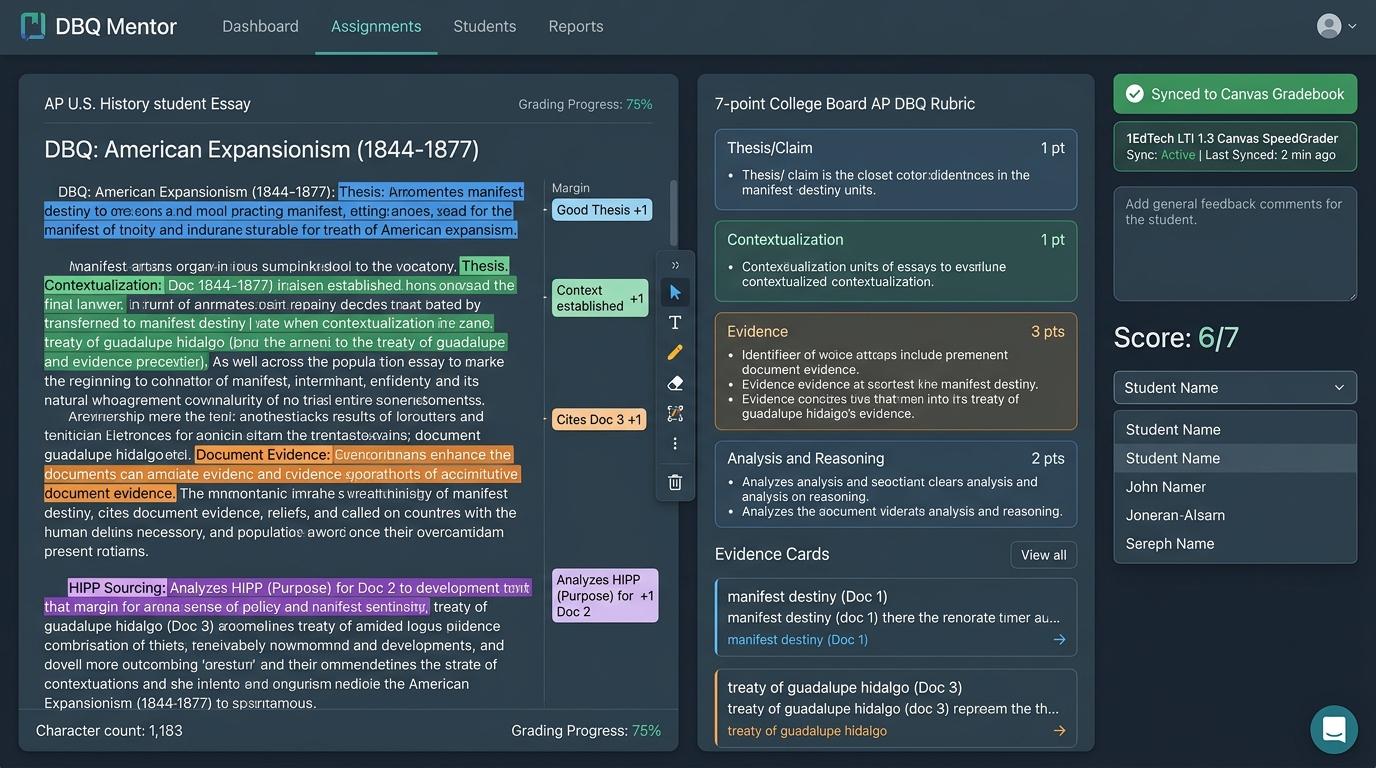
High school social studies departments face one of the most punishing grading bottlenecks in secondary education: evaluating complex Document-Based Questions (DBQs) and Long Essay Questions (LEQs) across 120 to 180 students per teacher. Under College Board AP standards (AP U.S. History, AP European History, AP World History) and state inquiry frameworks (such as the C3 Framework), scoring an authentic DBQ requires evaluating six multi-dimensional criteria totaling 7 points—auditing a defensible thesis with a line of reasoning, broad contextualization, two levels of document evidence, outside historical evidence, HIPP sourcing analysis (Historical Situation, Intended Audience, Purpose, Point of View), and complex historical synthesis. Manually reading, annotating, scoring, and typing individualized feedback across 150 essays consumes 35 to 45 hours per assessment, creating a 2-to-3-week grading lag that obliterates the formative learning cycle. Checkmark Plagiarism eliminates this bottleneck by uniting AI-assisted quote-anchored rubric evaluation, patent-pending Essay Playback™ writing telemetry, and 1EdTech LTI 1.3 Advantage Assignment and Grade Services (AGS 2.0). Checkmark parses complex 7-point AP rubrics via Abstract Syntax Trees (ASTs), extracts grounded textual evidence for each criterion, provides a 2-minute Pre-Flight Educator Review Console, and pushes discrete criterion sub-scores and rich quote-anchored feedback straight into Canvas LMS SpeedGrader rubrics without CSV exports or manual double-entry.
Checkmark Plagiarism empowers high school social studies departments and district humanities leaders by combining AI rubric autograding with Essay Playback™ keystroke replay, passage-level AI detection, side-by-side plagiarism verification, and native LTI 1.3 Advantage passback for Canvas LMS and Agilix Buzz LMS.
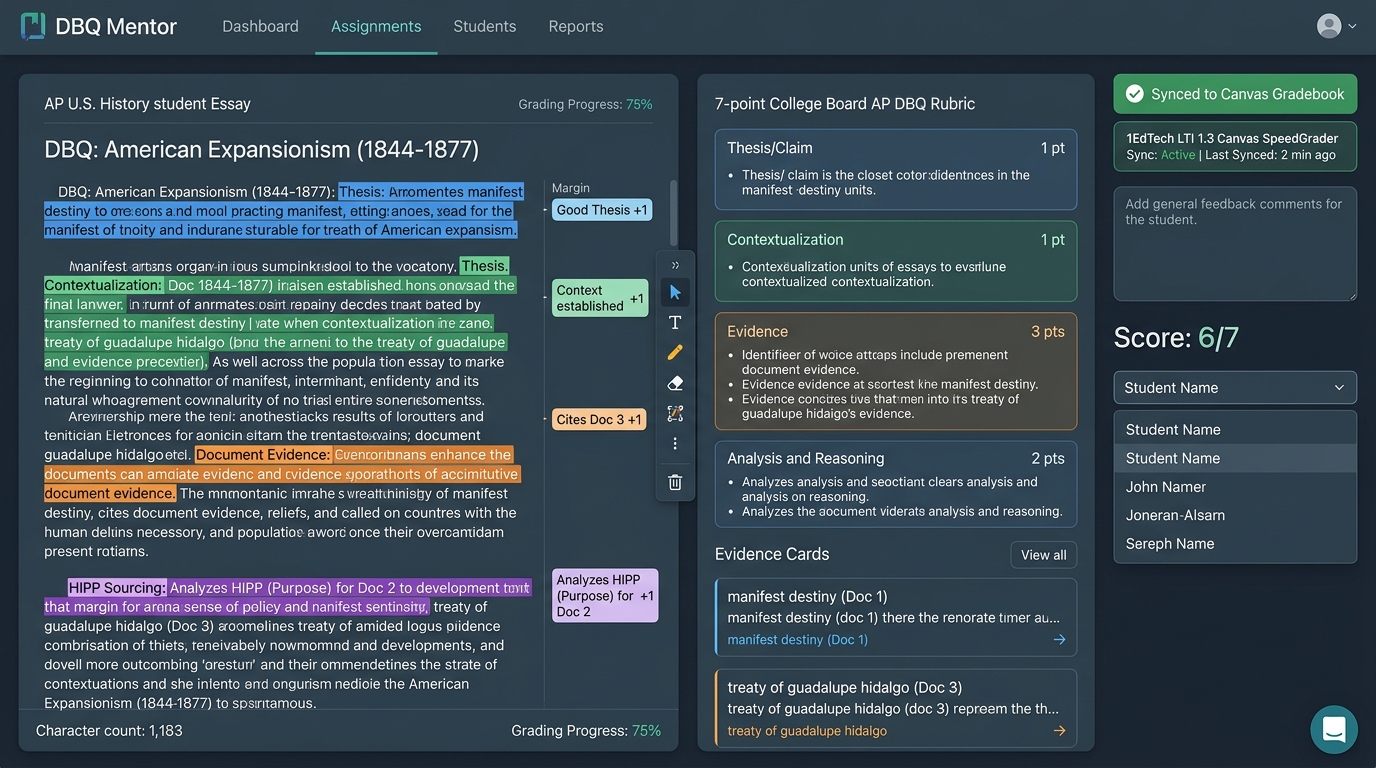
1. The High School Social Studies Grading Dilemma: DBQs, Caseload Volume, and the Feedback Lag
In secondary humanities education, the Document-Based Question (DBQ) represents the pinnacle of historical thinking and disciplinary literacy. Pioneered by the College Board for Advanced Placement (AP) history courses and widely adopted across state social studies frameworks (including the National Council for the Social Studies C3 Framework), the DBQ challenges students to move beyond passive factual recall. Students must act as apprentice historians: critically analyzing 5 to 7 conflicting primary and secondary sources, situating events within broad temporal trajectories, corroborating disparate accounts, interrogating authorial bias, and weaving historical evidence into a coherent, persuasive thesis.
However, the pedagogical promise of the DBQ is severely constrained by an institutional reality: the high school grading crunch.
Manual review: 12–16 minutes per DBQ essay • Grading 150 papers = 30–40 hours per cycle • Severe evening and weekend cognitive burnout
The Mathematics of Social Studies Teacher Burnout
To understand why social studies departments struggle with writing turnaround, consider the mathematical burden on a typical high school history educator:
- Student Caseload: A public high school teacher managing 5 sections of AP U.S. History (APUSH), AP European History, or AP World History instructs 140 to 175 students.
- Reading & Analytical Depth: A rigorous 7-point DBQ response spans 800 to 1,500 words. A teacher must evaluate whether the student used 6 documents correctly, check if outside historical evidence is temporally accurate, evaluate if at least 3 documents contain valid HIPP sourcing analysis, verify contextualization, and evaluate the thesis and complex understanding.
- Evaluation Time per Paper: Doing justice to this multi-dimensional assessment requires 12 to 16 minutes per student (including reading, marking rubric rows in SpeedGrader, and typing individualized diagnostic notes).
150 students × 14 minutes = 2,100 minutes = 35.0 Hours
When a teacher must invest 35 hours of intensive cognitive labor on top of daily lesson preparation, classroom instruction, and parent communications, grading inevitably bleeds across 2 to 3 weeks.
The Destructive Impact of Formative Latency
In writing pedagogy, feedback immediacy is directly correlated with skill acquisition. When a 10th-grade AP World History student writes a DBQ on the Columbian Exchange in late September but does not receive rubric scores or sourcing feedback until mid-October, the instructional moment has evaporated. By the time papers are returned:
- Curriculum Disconnect: The class has already transitioned into a subsequent historical unit (e.g., Gunpowder Empires or the Transatlantic Slave Trade).
- Stifled Revision Opportunities: The student cannot apply corrective guidance—such as distinguishing between passive document summary and analytical argument—to immediate drafting revisions.
- Error Replication: The teacher enters the next essay cycle with the exact same structural deficiencies persisting across the cohort.
The Canvas SpeedGrader Bottleneck
Learning Management Systems like Canvas LMS provide robust gradebooks and rubric tools, but standard manual workflows create severe friction:
- Manual SpeedGrader Clicking: Teachers must open SpeedGrader, click through 6 to 7 individual criterion rows for every single student, manually select performance point bands, and type explanatory comments into small text boxes.
- Rubric-to-Gradebook Disconnect: If teachers grade on external paper rubrics or local grading spreadsheets to speed up the process, they must spend hours transcribing numbers into Canvas, introducing data-entry errors.
- Generic Comment Fatigue: By paper 40, teachers run out of stamina to type detailed sourcing explanations, resorting to brief, unhelpful remarks like "More HIPP needed" or "Expand context."
2. Deconstructing the 7-Point AP DBQ Assessment Architecture
To design an automated rubric evaluation and synchronization system, we must examine the precise mechanics of the College Board 7-Point DBQ Rubric across APUSH, AP European History, and AP World History. Each point represents a distinct cognitive and historiographical competency.
| Criterion | Max Pts | Core Historiographical Function | Common Student Failure Modes |
|---|---|---|---|
| Thesis / Claim | 1 pt | Responds to prompt with a historically defensible claim establishing a line of reasoning (in intro or conclusion). | • Restates or paraphrases the prompt • Broad generalization with no roadmap • Split thesis with conflicting logic |
| Contextualization | 1 pt | Accurately describes broader historical events, developments, or processes relevant to prompt (before/during/after). | • Mere passing mention of a term • Temporal mismatch (wrong century) • Isolated facts with no link to topic |
| Document Evidence | 2 pts |
1 pt: Accurately uses content of ≥3 docs. 2 pts: Uses content of ≥6 docs to SUPPORT AN ARGUMENT. |
• "Quote dumping" without argument • Misinterprets document meaning • Uses only 4–5 documents instead of 6 • Summarizes docs in isolation |
| Outside Evidence | 1 pt | Provides specific, relevant historical evidence beyond the provided documents to support the argument. | • Mentions vague concept ("economy") • Fact already mentioned in documents • Historical hallucination / factual error |
| Sourcing (HIPP) | 1 pt | For at least 3 documents, explains HOW or WHY the document's Historical Situation, Audience, Purpose, or POV is relevant. | • "Laundry list" sourcing without reasoning • Identifies HIPP but ignores WHY/HOW • Only completes sourcing for 1–2 docs |
| Complex Understanding | 1 pt | Demonstrates complex understanding via corroboration, qualification, contradiction, or analyzing multiple perspectives. | • Simplistic "both sides" paragraph • Formulaic transition words only • Fails to weave nuance across essay |
Detailed Breakdown of the 6 DBQ Dimensions
3. The Interoperability Infrastructure: 1EdTech LTI 1.3 Advantage & Canvas AGS 2.0
To bridge the gap between AI-assisted DBQ analysis and the teacher's primary grading interface, social studies departments require enterprise-grade interoperability. Manually exporting CSV spreadsheets from third-party tools or copy-pasting feedback into Canvas is slow, prone to errors, and legally vulnerable.
Checkmark Plagiarism integrates directly with Canvas LMS via the 1EdTech Learning Tools Interoperability (LTI) 1.3 Advantage standard.
The Three Pillars of LTI 1.3 Advantage in Checkmark
AGS 2.0 (LineItem API)
Binds discrete LineItem containers for each criterion of the 7-point DBQ rubric. Executes atomic grade passbacks populating individual criterion rows in Canvas SpeedGrader and pushing quote-anchored commentary.
NRPS 2.0 (Roster Sync)
Automates roster synchronization across complex high school schedules, period transfers, semester adds, and dual-credit portals, eliminating orphaned submissions.
Deep Linking 2.0
Enables department chairs to configure standardized DBQ assignments upstream with pre-configured 7-point rubrics and document collections, distributing them across all Canvas sections with 1 click.
4. Comparison Matrix: Social Studies DBQ Evaluation Workflows
To evaluate the efficiency and pedagogical impact of automated LTI 1.3 rubric synchronization, examine how different grading workflows compare across key departmental dimensions:
| Architectural Dimension | Manual SpeedGrader Grading | Generic AI Chatbot / Extension | Checkmark LTI 1.3 Advantage Suite |
|---|---|---|---|
| Grading Overhead (150 essays) | 35–45 hours (14 min/essay) | 15–20 hours (manual copy-paste) | 4–5 hours (<2 min review) |
| Canvas SpeedGrader Sync | Manual click-through on 7 rows | None (manual re-entry required) | Instant Atomic AGS 2.0 Passback |
| Criterion Granularity | Full (if teacher has stamina) | Monolithic summary score only | Discrete sub-scores for all 6 criteria |
| Evidence Grounding | Manual margin notes | Hallucinated quotes & generic praise | Direct quote-anchored student citations |
| HIPP Sourcing Extraction | Manual line-by-line reading | Often confuses summary with sourcing | Automated detection of Author POV/Audience |
| Writing Process Telemetry | None (static text only) | None | Patent-Pending Essay Playback™ (1x–8x) |
| Paste Buffer Tracking | None | None | 100% external paste preservation |
| FERPA & Privacy Protection | Compliant (native Canvas) | High Risk (commercial LLM training) | Zero-Retention, Zero Model Training |
5. Checkmark's AI DBQ Autograding, Sourcing Engine & Quote-Anchored Feedback
Checkmark Plagiarism's DBQ evaluation engine is specifically tuned for historical argumentation and document analysis. Rather than evaluating text with generic generative heuristics, Checkmark employs Abstract Syntax Tree (AST) Rubric Parsing and Grounded Quote-Anchored Evidence Extraction.
“Although progressive reformers successfully expanded democratic participation through direct primaries and the 17th Amendment, their regulatory agenda fundamentally expanded federal executive power to stabilize corporate capitalism rather than dismantle it. As seen in Theodore Roosevelt's 1906 letter to Lincoln Steffens [Doc 2], the president argued that 'the man with the muckrake' threatened national stability by inciting radicalism without offering constructive governance. Roosevelt's purpose in this correspondence was to distance his administration from socialist critics while maintaining political leverage over moderate business leaders. Beyond these published critiques, the passage of the Meat Inspection Act and the Pure Food and Drug Act of 1906 institutionalized this regulatory balance by establishing federal oversight over meatpackers.”
Line of Reasoning: Contrasts democratic political reform with federal corporate stabilization in introductory paragraph.
Sourced Document: Document 2 (Roosevelt to Steffens, 1906). Uses critique of muckrakers to substantiate corporate stabilization argument.
Sourcing Dimension: Purpose & Political Context. Explains Roosevelt's intent to triangulate between radicalism and corporate elites.
Historical Entity: Meat Inspection Act & Pure Food and Drug Act (1906). Directly substantiates institutionalization of federal regulatory oversight.
The 4 Pillars of the Checkmark DBQ Engine
- Abstract Syntax Tree (AST) Rubric Parsing: Ingests the official College Board 7-point DBQ rubric (or custom state standards) and constructs an internal semantic AST with strict mathematical evidence thresholds.
- Grounded Quote-Anchored Evidence Extraction: Identifies thesis lines of reasoning, scans for direct and indirect document citations, validates HIPP sourcing justifications, and audits outside historical facts against prompt time boundaries.
- The Pre-Flight Educator Review Console: Enforces a strict Teacher-in-the-Loop workflow. Teachers view highlighted textual anchors side-by-side with rubric recommendations, accepting or overriding scores in under 90 to 120 seconds per paper.
- Instant Canvas SpeedGrader Sync: Triggers the LTI 1.3 AGS 2.0 passback pipeline, populating SpeedGrader rubric tiles and injecting rich diagnostic commentary into submission comments.

6. Multi-Factor Academic Integrity Verification in Historical Inquiry
In the era of ubiquitous generative AI, social studies departments face a dual integrity crisis:
- Unauthorized AI Generation: Students using LLMs to generate polished, superficial DBQ essays that synthesize documents without genuine student reading or cognitive struggle.
- False Accusations Against Honest Writers: High-achieving AP students who write with formal, sophisticated syntax frequently trigger high false-positive AI scores on generic probabilistic detectors.
Checkmark Plagiarism solves both problems by replacing black-box guessing with empirical writing process telemetry.
Side-by-side plagiarism matching across billions of web pages • Citation error differentiation • Definitively proves student authorship ("receipts") • Eliminates adversarial parent conferences
| Student Submission State | Typical Generic AI Detector | Checkmark Multi-Factor Evidence | Adjudication Outcome |
|---|---|---|---|
| Sophisticated Human Writing (APUSH Student) | 88% AI (False Positive) | 72 min active drafting, 14 backspaces on thesis, 0 pastes | Exonerated instantly with receipts |
| Transcribed AI Generation (Copied from Phone) | 14% AI (False Negative) | Transcription Alert: 0 composing pauses, 115 WPM robotic cadence | Flagged for educator review |
| Pasted Study Guide Document Commentary | 0% AI (Missed Plagiarism) | Paste buffer captured 450w injection; match to AP forum analysis | Uncited source match flagged |
Protecting Honest Students: The Case of the Sophisticated AP Historian
Consider a common scenario in an AP U.S. History class:
- The Incident: A student submits a 1,200-word DBQ on Reconstruction. The essay features mature phrasing: "The Radical Republican legislative agenda was systematically undermined by the resurgence of Redeemer Bourbon Democrats and the judicial emasculation of the 14th Amendment in the Slaughterhouse Cases."
- The False Flag: A generic commercial AI detector flags the paper as "88% Likely AI Generated" due to its low perplexity and elevated vocabulary.
- The Checkmark Resolution: The department chair opens Checkmark's Essay Playback™:
- The timeline reveals 72 minutes of active drafting on a district Chromebook.
- The teacher watches the student spend 8 minutes outlining thesis categories, pausing to consult primary sources, reordering topic sentences, and backspacing 14 times while refining the analysis of the Slaughterhouse Cases.
- The external paste buffer confirms zero external text injections.
- The student is instantly and definitively exonerated with undeniable empirical evidence.

7. Real-World History Department Case Studies
8. The 4-Phase Departmental DBQ Calibration and Synchronization Protocol
To implement seamless DBQ autograding and Canvas synchronization across a social studies department, follow this structured 4-Phase Protocol:
Phase 1: Pre-Assessment Rubric Ingestion & Canvas LineItem Binding
- Rubric Architecture Setup: In Checkmark, select the standardized College Board 7-point DBQ rubric (or upload your district's custom inquiry matrix).
- LTI 1.3 Canvas Assignment Binding: Create the assignment in Canvas using the Checkmark External Tool link. Deep Linking 2.0 automatically maps the 6 rubric criteria to Canvas LineItem IDs.
- Document Context Configuration: Upload or select the primary source document packet (Docs 1–7) so Checkmark's engine can cross-reference quotes and author attributions.
Phase 2: Formative Drafting & Real-Time Telemetry Capture
- In-Class Timed Write or Scaffolded Inquiry: Students compose their DBQ responses directly within the Checkmark-enabled Canvas editor, Google Docs, or Microsoft 365 Word.
- Writing Telemetry Capture: Essay Playback™ logs every keystroke, drafting pause, revision cycle, and clipboard paste event in real time.
Phase 3: AI-Assisted Quote Extraction & Pre-Flight Educator Calibration
- Automated Evidence Extraction: Checkmark's engine processes submissions within seconds, color-coding Thesis, Document Evidence, Outside Evidence, HIPP Sourcing, and Complexity.
- Departmental Calibration Sprint: In a 30-minute PLC (Professional Learning Community) meeting, teachers review 3 shared anchor papers in the Pre-Flight Console to norm expectations on borderline criteria (e.g., nuanced complexity vs. simple summary).
- Individual Pre-Flight Review: Teachers review their class roster, spending 60 to 90 seconds per essay validating quote anchors, adjusting scores, or adding custom comments.
Phase 4: Atomic Canvas AGS 2.0 Passback & Inquiry Reflection
- One-Click Batch Sync: The teacher clicks "Finalize & Passback All Scores".
- SpeedGrader Populated: Canvas SpeedGrader immediately displays criterion scores, total points, and rich diagnostic comments.
- Data-Driven Inquiry Debrief: The teacher opens Checkmark's Classroom Analytics Dashboard to identify cohort-wide trends (e.g., "65% of students missed Document 4 sourcing"), guiding immediate targeted mini-lessons the next day.
9. Step-by-Step Canvas LTI 1.3 Administrator Configuration Guide
For School District EdTech Directors, Canvas Administrators, and Curriculum Coordinators, setting up Checkmark's LTI 1.3 Advantage integration is straightforward.
Step 1: Register Developer Key in Canvas Admin Console
- Navigate to Canvas Admin → Developer Keys → + Developer Key → + LTI Key.
- Configure Key Settings:
- Key Name: Checkmark Plagiarism & DBQ Autograder
- Owner Email: admin@yourdistrict.k12.st.us
- Redirect URIs: https://api.checkmarkplagiarism.com/lti/v1p3/launch
- Target Link URI: https://app.checkmarkplagiarism.com/lti/launch
- OpenID Connect Initiation Url: https://api.checkmarkplagiarism.com/lti/v1p3/auth
Step 2: Configure LTI 1.3 JSON Configuration Schema
Paste the following standardized 1EdTech LTI 1.3 Advantage configuration into Canvas:
{
  "title": "Checkmark Plagiarism & DBQ Autograder",
  "scopes": [
    "https://purl.imsglobal.org/spec/lti-ags/scope/lineitem",
    "https://purl.imsglobal.org/spec/lti-ags/scope/lineitem.readonly",
    "https://purl.imsglobal.org/spec/lti-ags/scope/result.readonly",
    "https://purl.imsglobal.org/spec/lti-ags/scope/score",
    "https://purl.imsglobal.org/spec/lti-nrps/scope/contextmembership.readonly"
  ],
  "extensions": [
    {
      "platform": "canvas.instructure.com",
      "privacy_level": "public",
      "settings": {
        "text": "Checkmark DBQ Grader",
        "placements": [
          {
            "placement": "assignment_selection",
            "message_type": "LtiDeepLinkingRequest",
            "target_link_uri": "https://app.checkmarkplagiarism.com/lti/deep_link"
          },
          {
            "placement": "homework_submission",
            "message_type": "LtiResourceLinkRequest",
            "target_link_uri": "https://app.checkmarkplagiarism.com/lti/submission"
          }
        ]
      }
    }
  ]
}
Step 3: AGS 2.0 Rubric LineItem Passback Payload Example
When Checkmark passes back 7-point DBQ scores to the Canvas LineItem API, it transmits a structured payload formatted as follows:
{
  "timestamp": "2026-08-19T14:32:00.000Z",
  "scoreGiven": 6.0,
  "scoreMaximum": 7.0,
  "comment": "### APUSH DBQ Rubric Evaluation (Checkmark Formative Engine)
- **🔵 Thesis / Claim (1/1):** Historically defensible thesis establishing line of reasoning contrasting regulatory power with democratic reform.
- **🟢 Contextualization (1/1):** Accurate contextualization of Gilded Age corporate monopolies and political machines.
- **🟣 Document Evidence (2/2):** Accurately cited and supported argument using 6/6 documents.
- **🟠 Outside Evidence (1/1):** Specific discussion of the Meat Inspection Act (1906).
- **🔴 Sourcing / HIPP (1/1):** Accurate POV and Purpose analysis for Docs 2, 4, and 5.
- **🟡 Complex Understanding (0/1):** Essay presents a strong linear argument but lacks explicit corroboration across contrasting historical eras.",
  "activityProgress": "Completed",
  "gradingProgress": "FullyGraded",
  "userId": "948271"
}
10. Enterprise Data Privacy, FERPA Compliance & Historiographical Ethics
Social studies departments handle student essays exploring sensitive historical, political, and cultural topics. School districts must ensure that technology vendors uphold the highest standards of data security and intellectual property protection.
Zero Model Training
Checkmark Plagiarism never uses student writing, historical essays, or teacher feedback to train, fine-tune, or calibrate public or commercial AI models. Student intellectual property remains 100% sovereign.
FERPA & COPPA Compliant
All student records, rosters (via NRPS 2.0), and grades (via AGS 2.0) are encrypted in transit (TLS 1.3) and at rest (AES-256) in strict compliance with FERPA (34 CFR § 99.31) and state student privacy regulations.
Educator-Only Visibility
Integrity telemetry and AI confidence indicators are strictly visible to educators. Checkmark prevents unwarranted accusations by providing transparent evidence dossiers rather than punitive scores.
11. Frequently Asked Questions (FAQ)
1. How does Checkmark pass individual DBQ criterion points (Thesis, Context, Sourcing) into Canvas SpeedGrader rather than just one overall score?
Checkmark utilizes 1EdTech LTI 1.3 Assignment and Grade Services (AGS 2.0) and Canvas LineItem APIs. Rather than passing a single decimal score, Checkmark binds each row of the 7-point DBQ rubric to a discrete sub-line item. When the teacher approves the evaluation in the Pre-Flight Console, Checkmark populates the individual rubric tiles in SpeedGrader and pushes formatted criterion rationales into the submission comments.
2. How does Checkmark distinguish between legitimate outside historical evidence and uncredited copying or document hallucination?
Checkmark's engine cross-references historical proper nouns and concepts against both the provided document packet and its comprehensive historical knowledge ontology. If a student mentions the Compromise of 1877 in a Reconstruction DBQ, Checkmark verifies that this event is not mentioned in Documents 1–7, confirms its historical accuracy to the prompt's time frame, and evaluates whether it is syntactically connected to an argumentative warrant.
3. Can teachers modify, override, or add custom notes to the AI-generated DBQ rubric scores before syncing to Canvas?
Yes. Checkmark enforces a strict Teacher-in-the-Loop model. The Pre-Flight Review Console presents all AI evaluations as provisional suggestions. Teachers can adjust point values up or down with a single click, type personalized notes, or completely override any criterion before scores are transmitted to Canvas.
4. How does Checkmark handle revised College Board DBQ rubrics or custom state social studies inquiry standards (e.g., C3 Framework)?
Checkmark's AST Rubric Parser accepts any standard rubric matrix. Teachers can select pre-built College Board rubrics for APUSH, AP Euro, and AP World History, import state-specific matrices (such as Texas TEKS, New York Regents, or California History Frameworks), or build custom department rubrics directly in the application.
5. What happens if a student writes their DBQ in Google Docs or Microsoft Word instead of Canvas directly?
Checkmark provides native extensions and integrations for Google Docs and Microsoft 365 Word. Students can compose in their preferred word processor while Checkmark captures complete keystroke dynamics, revision history, and paste buffers, seamlessly passing the submission and telemetry into Canvas.
6. How does Essay Playback™ protect AP History students who write with formal, sophisticated prose from false AI accusations?
Generic AI detectors frequently misclassify sophisticated, elevated vocabulary and structured syntax as AI-generated text. Checkmark's patent-pending Essay Playback™ records the student's authentic temporal writing session. Teachers can replay the drafting process at 1x to 8x speed to observe natural composing pauses, sentence revisions, and outlining, providing definitive, tamper-proof proof of authorship.
7. How does Checkmark ensure student essay data is not used to train AI models or shared across commercial databases?
Checkmark operates under a strict Zero-Retention and Zero-Training Guarantee. Student essays are processed in isolated, encrypted memory containers solely for the purpose of evaluation and integrity verification. Submissions are never added to public LLM training corpuses or sold to third parties.
12. Conclusion: Stop Guessing, Start Trusting in Social Studies Writing
The Document-Based Question is one of the most powerful tools in modern education for cultivating critical thinking, evidence evaluation, and historical literacy. But when educators are crushed by 35-hour grading sprints and forced into manual SpeedGrader entry, the formative cycle breaks.
By uniting AI-assisted quote-anchored rubric evaluation, patent-pending Essay Playback™ writing telemetry, and 1EdTech LTI 1.3 Advantage Canvas synchronization, Checkmark Plagiarism restores the promise of social studies education:
- Eliminating the 35-Hour Grading Crunch: Reducing grading turnaround from 3 weeks to 48 hours while maintaining rigorous human oversight.
- Deepening Formative Feedback: Providing students with quote-anchored justifications for every thesis, document, and sourcing point.
- Protecting Academic Integrity with Empathy: Exonerating honest students through authentic keystroke replay and eliminating black-box guesswork.
Empower Your Social Studies Department with Checkmark Plagiarism
Ready to eliminate DBQ grading bottlenecks, standardize rubric calibration, and sync quote-anchored feedback straight into Canvas SpeedGrader?