
Executive Summary
High school science educators across Biology, Chemistry, Physics, and Environmental Science face an overwhelming assessment bottleneck: evaluating Claim-Evidence-Reasoning (CER) frameworks across 120 to 180 inquiry lab write-ups per week. Under Next Generation Science Standards (NGSS), scientific argumentation requires evaluating whether a student makes an explicit testable Claim (C), backs it with authentic quantitative Evidence (E) featuring correct units and control comparisons, and articulates mechanistic scientific Reasoning (R) grounded in underlying physical laws rather than circular restatements.
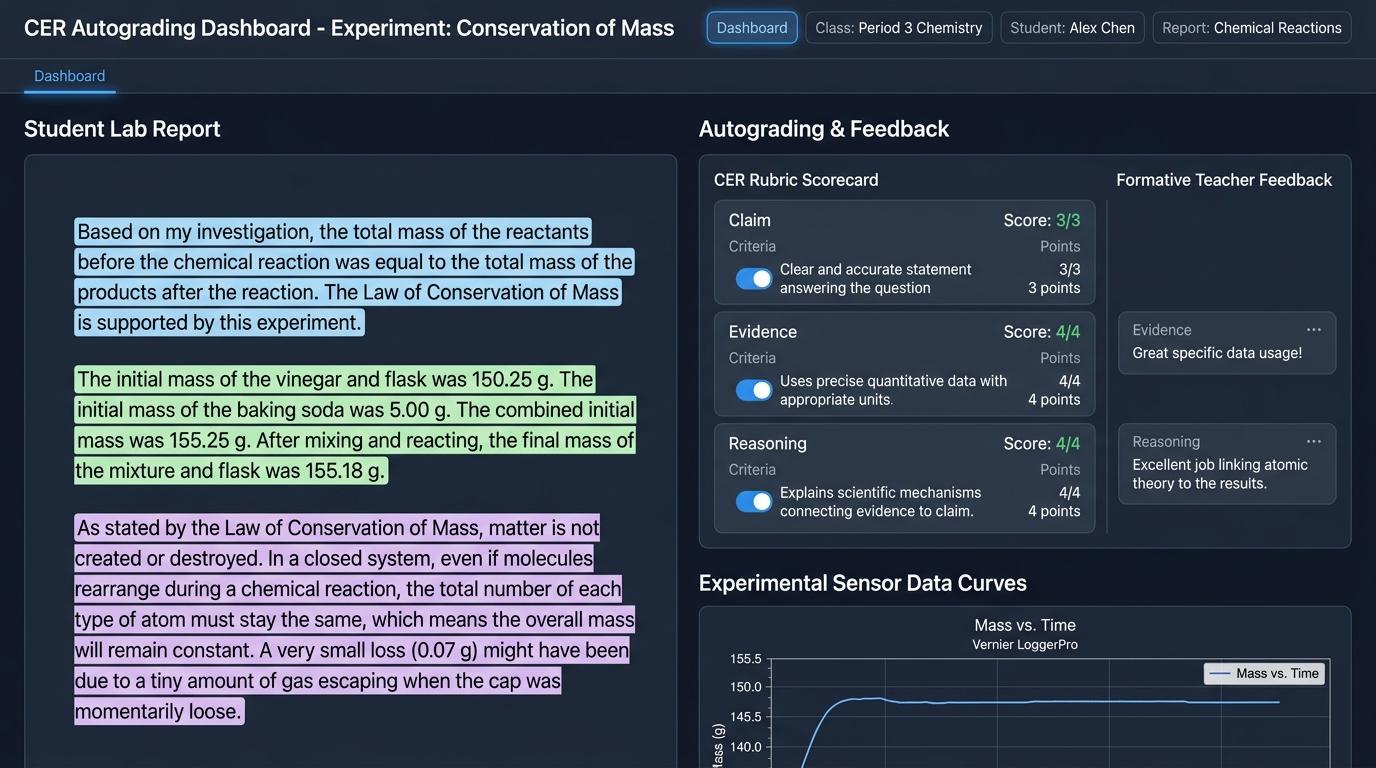
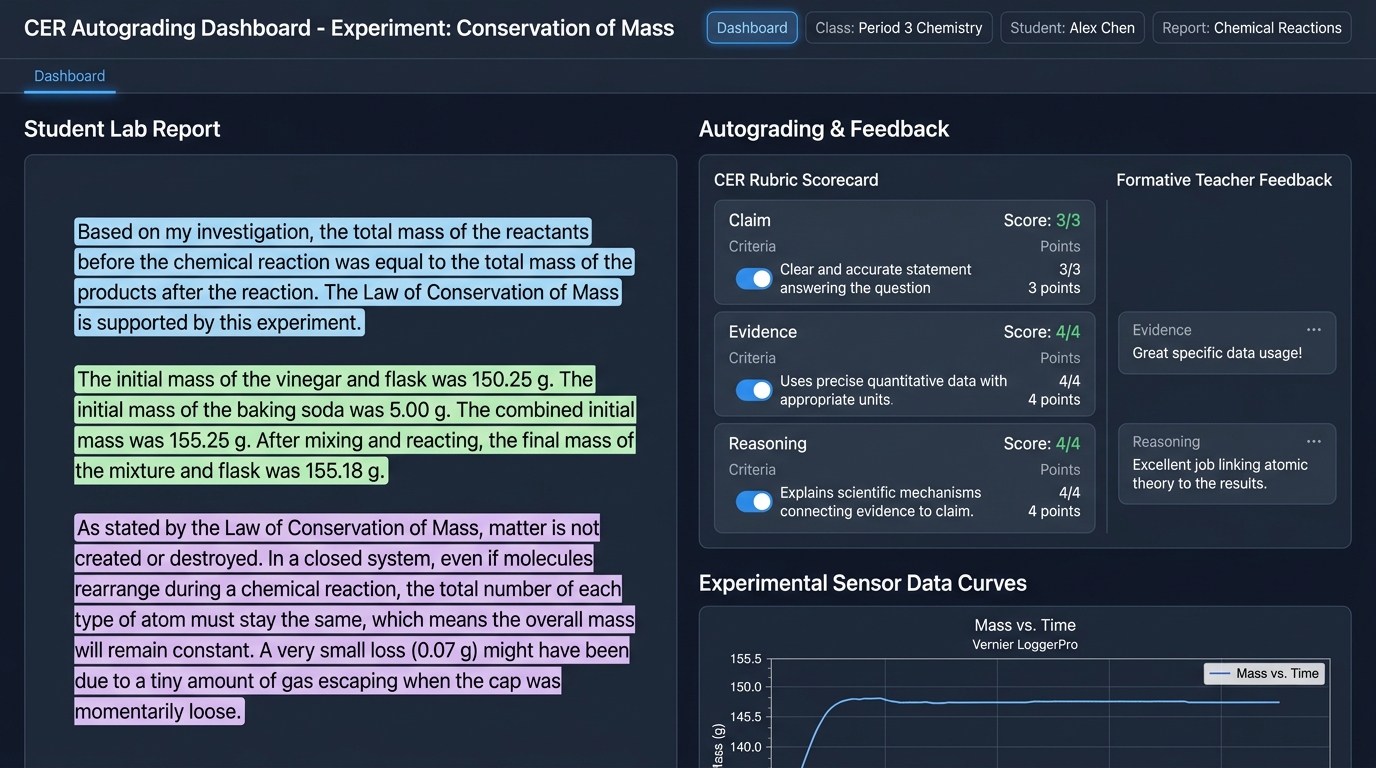
When grading fatigue peaks, teachers are forced into superficial scoring, while students increasingly rely on generative Large Language Models (LLMs) that hallucinate textbook-ideal curves disconnected from actual classroom bench data. Checkmark Plagiarism resolves this dilemma through AI-Assisted Quote-Anchored Rubric Autograding, Experimental Data Cross-Verification, and Writing Process Telemetry (Essay Playback™). By parsing multi-level NGSS rubrics via Abstract Syntax Trees (ASTs), visually color-tagging student claims (🔵 Blue), data-backed evidence (🟢 Green), and causal scientific principles (🟣 Purple), cross-verifying written text against raw sensor data imports (Vernier, LoggerPro, Excel), and providing a rapid 3-minute Pre-Flight Educator Review Console with native Canvas SpeedGrader and Buzz LMS grade passback, Checkmark cuts lab grading time by up to 75% while deepening formative feedback and protecting academic integrity.
In modern secondary science education, the laboratory report is no longer a passive confirmation of known textbook facts. Driven by the Next Generation Science Standards (NGSS) and state frameworks centered on Science and Engineering Practice #7 (Engaging in Argument from Evidence) and Practice #8 (Obtaining, Evaluating, and Communicating Information), students are required to construct structured scientific arguments using the Claim-Evidence-Reasoning (CER) framework developed by McNeill and Krajcik.
1. The High-Volume STEM Grading Bottleneck & The CER Assessment Crisis
Whether investigating enzyme kinetics in AP Biology, limiting reactants in Honors Chemistry, or cart acceleration on an inclined ramp in AP Physics 1, students must demonstrate rigorous empirical sensemaking—the cognitive ability to collect raw, noisy measurements, synthesize trends, and explain causal mechanisms.
- 4–5 daily class sections: Biology, Chemistry, Physics, or Environmental Science.
- Inquiry cadence: 1–2 formal laboratory investigations every 7 to 10 school days.
- 150–300 weekly lab write-ups: Continuous multi-page student submissions.
- High overhead: Chemical prep, safety compliance, and hazardous waste disposal.
- Multi-page formal write-ups: Claims, data tables, graphs, and reasoning narratives.
- Numerical & unit audits: Auditing rates, standard deviations, and percent errors.
- Deep causal verification: Distinguishing true mechanisms from circular logic.
- 10–15 min per lab report: Demanding 25–40+ hours of manual grading per cycle.
Grading fatigue leads to margin shorthand: “Good data”, “Expand reasoning”, “-2 pts missing units”.
Novices repeat circular logic traps because feedback lacks granular, actionable coaching.
Students prompt LLMs to write lab discussions, generating textbook-ideal curves disconnected from actual bench data.
“Dry labbing” masquerades as mastery while bypassing real empirical error analysis.
The Mathematics of Science Teacher Burnout
Consider the typical workload of a secondary science teacher or department chair:
- Caseload Volume: A standard public high school science educator teaches 5 class sections with an average of 28 to 32 students per section, totaling 140 to 160 students.
- Inquiry Frequency: Inquiry-based curricula require a laboratory investigation every 7 to 10 school days.
- Evaluation Time: A comprehensive evaluation of a 3-to-4-page CER write-up—auditing the testable claim, checking calculations against raw data tables, verifying percent errors, evaluating graphical slopes, and evaluating the scientific theory in the reasoning paragraph—demands 10 to 15 minutes per student.
For a single lab assignment, this represents 25 to 40 hours of continuous grading. Multiplied across 12 to 16 lab units per academic year, science teachers spend hundreds of hours grading in isolation outside school hours.
The Inevitable Degradation of Formative Feedback
Under this crushing evaluation volume, feedback quality rapidly erodes. By paper 45 on a Sunday evening, an exhausted educator inevitably resorts to margin shorthand:
- “Expand reasoning.”
- “Where is your evidence?”
- “Good discussion.”
- “-2 (units missing).”
While these marks assign a grade, they fail to teach scientific argumentation. A student who receives “Expand reasoning” on an AP Chemistry titration lab does not understand whether their error was failing to cite the Henderson-Hasselbalch equation, misunderstanding buffer capacity, or committing circular reasoning by simply repeating that the pH leveled off because a buffer was present.
2. Deconstructing the CER Framework: Mechanics & Failure Modes
To understand how automated rubric systems can evaluate scientific writing, we must first examine the pedagogical anatomy of the Claim-Evidence-Reasoning (McNeill & Krajcik) framework and identify the specific failure modes that trap developing science students.
The Pedagogical Anatomy of the CER Scientific Argument
A direct, testable assertion that resolves the guiding inquiry question.
- Directly answers the research question.
- Avoids vague qualifiers (“it changed a lot”).
- Identifies independent & dependent variables.
Empirical measurements, sensor data, and systematic observations from the bench.
- Quantitative: explicit numbers and SI metric units.
- Comparative: contrasts control vs. experimental groups.
- Sufficient: cites multiple trials, slopes, and ranges.
The scientific principle or law that explains WHY the evidence supports the claim.
- Articulates underlying mechanism (kinetics, stoichiometry, thermodynamics).
- Bridges raw empirical data to established scientific theory.
- Avoids tautological / circular restatements.
The Three Critical Failure Modes in Student CER Writing
In secondary and early undergraduate science writing, student errors in CER construction follow three distinct patterns:
The “Floating Data” Problem (Unanchored Evidence)
Structural Defect: Dumps isolated raw numbers without narrative context, rates of change, statistical comparisons, or standardized SI units. Real evidence requires synthesizing differences (“The reaction rate increased by 150% from 0.12 kPa/s to 0.30 kPa/s”).
The “Circular Reasoning” Trap (Tautological Reasoning)
Structural Defect: Restates the claim using synonyms instead of citing physical mechanisms (Newton’s Second Law: Fnet = m · a, unbalanced gravitational tension force driving the total system mass). Generic AI graders often miss this trap because sophisticated vocabulary masks circular logic.
The “AI Hallucination in Science” Risk (Synthetic Decoupling)
Structural Defect: The student’s actual physical bench data yielded only 1.62 g (66.1%) due to filter paper spillage. The AI prose describes a fictional, textbook-perfect experiment. The student bypasses the core lesson of scientific inquiry: troubleshooting error and reconciling messy physical reality with theory.
3. How Checkmark Plagiarism Evaluates CER Structure
Checkmark Plagiarism provides a specialized AI Rubric Autograding & Scientific Evidence Engine engineered specifically for high school and collegiate STEM curricula. Rather than generating opaque overall percentage scores, Checkmark breaks down lab reports through four technical pillars:
Abstract Syntax Tree (AST) Rubric Parsing
Translates complex NGSS 4-level scoring rubrics into deterministic evaluation trees. Weighs Claim clarity, Evidence sufficiency, and Mechanistic Reasoning independently, evaluating essays across Exemplary (4), Proficient (3), Developing (2), and Novice (1) criteria.
Multi-Span Scientific Quote Anchoring
Scans student prose and tags exact sentence-level structural spans: 🔵 Blue Spans for testable scientific claims, 🟢 Green Spans for empirical numerical evidence with metric units, and 🟣 Purple Spans for mechanistic scientific principles.
Experimental Data Cross-Verification
Ingests student raw data tables (Vernier, LoggerPro, Excel CSV, Google Sheets) and cross-checks written numerical values against recorded datasets. Automatically flags AI-generated textbook curves that contradict the student’s bench measurements.
Pre-Flight Review Console (<3 Min / Lab)
Displays side-by-side interactive evidence cards with pre-drafted, quote-anchored justifications. The educator maintains 100% editorial authority: one-click score approvals, custom notes, and direct bidirectional LMS grade passback via LTI 1.3 Advantage.
🔵 CLAIM [4.0/4.0 - Exemplary] An increase in temperature from 0°C to 40°C accelerates catalase activity, but exposure to 65°C results in immediate enzymatic inactivation.
🟢 EVIDENCE [4.0/4.0 - Exemplary] At 0°C, the rate of oxygen gas production was 0.08 kPa/s, which increased to 0.42 kPa/s at 22°C (room temperature) and peaked at 0.91 kPa/s at 40°C. However, at 65°C, gas pressure remained static at 0.01 kPa/s across all three 180-second trials, representing a 98.9% reduction in velocity.
🟣 REASONING [4.0/4.0 - Exemplary] According to collision theory, thermal energy increases molecular kinetic velocity, increasing the frequency of effective collisions between hydrogen peroxide substrate molecules and the catalase active site. However, at 65°C, excessive thermal vibrations disrupt the non-covalent hydrogen and ionic bonds stabilizing the enzyme’s tertiary structure, causing irreversible active site denaturation.
4. Multi-Factor Integrity: Protecting Honest Scientists & Catching Fraud
Evaluating science lab reports requires distinguishing between legitimate digital data handling and academic dishonesty. Science students frequently copy and paste large tables of sensor data from LoggerPro, Vernier Graphical Analysis, or Google Sheets into their lab reports.
Generic AI detectors and legacy plagiarism checkers regularly misidentify these legitimate data drops as copied text or generative AI. Checkmark utilizes a Multi-Factor Verification Suite to protect honest students while surfacing authentic misconduct.
Patent-Pending Essay Playback™
- 1x–8x keystroke video replay: Visualizes natural composing pauses and backspaces.
- Full clipboard preservation: Inspects exact paste payloads.
- Sensor data paste validation: Distinguishes Vernier CSV imports from illicit AI text dumps.
Passage-Level AI Confidence
- Paragraph-level precision: Evaluates discussion sections independently.
- Honest short-text guardrail (<150w): Returns
N/Aon equipment and reagent lists. - Eliminates false alarms: Ignores formulaic standardized lab protocol phrasing.
Side-by-Side Cohort Matching
- Student-to-student matching: Checks across sections and district cohorts.
- Lab partner discrimination: Allows shared raw numerical tables while flagging copied analysis prose.
- Live web indexing: Scans billions of online lab repositories.
5. Real-World High School STEM Case Studies
To illustrate how Checkmark transforms CER assessment, let’s examine three realistic high school STEM classroom scenarios across Biology, Chemistry, and Physics.
| Discipline | Investigation | Student Failure Mode / Issue | Checkmark Resolution |
|---|---|---|---|
| AP Biology (120 Students) | Catalase Enzyme Kinetics vs. Temp | LLM-generated conclusion with hallucinated ideal curves (0.95 kPa/s vs. 0.11 kPa/s bench leak) | Data cross-verification flags disconnect; prompt guides revision on real sensor leak |
| Honors Chemistry (95 Students) | Stoichiometry & Limiting Reactants | Circular reasoning in percent yield error justification (“yield was low because product didn’t form”) | AST engine identifies tautology; quote-anchored card coaches mechanical loss explanation |
| AP Physics 1 (80 Students) | Newton’s 2nd Law on Inclined Ramp | Large Vernier CSV data paste falsely flagged as 88% AI by legacy detector | Essay Playback proves valid sensor import + 24 min authentic cognitive drafting |
AP Biology: Catalase Enzyme Kinetics vs. Temperature
- 0°C Trial: 0.08 kPa/s
- 22°C Trial: 0.42 kPa/s
- 40°C Trial: 0.11 kPa/s (Anomalous: Stopper leaked air at bench)
- 65°C Trial: 0.01 kPa/s
“The data demonstrates that catalase operates at peak efficiency at 40°C, producing an optimal rate of 0.95 kPa/s. This aligns with standard biological kinetics where reaction velocity doubles every 10°C until thermal denaturation at 65°C.”
Checkmark flags an Experimental Data Mismatch (written prose reports 0.95 kPa/s while raw table shows 0.11 kPa/s) and logs a single 0.4-second paste event. Rather than issuing a punitive zero, the educator uses Checkmark’s quote-anchored coaching card:
“Your discussion cites an ideal textbook rate (0.95 kPa/s) rather than your group’s actual sensor reading (0.11 kPa/s). In science, unexpected results are valuable. Review your lab notes regarding the sensor leak at 40°C and rewrite your CER explaining how experimental error affected your rate calculation.”
Honors Chemistry: Stoichiometry & Limiting Reactant Lab
- Theoretical Yield: 2.50 g CaCO3
- Actual Experimental Yield: 1.62 g CaCO3
- Calculated Percent Yield: 64.8%
“The reason our yield was 64.8% is because not all of the product formed, which caused the mass to be lower than theoretical yield.”
The AST engine scores Claim at 4.0/4.0 and Evidence at 4.0/4.0, but identifies tautological syntax in Reasoning, scoring it at 1.5/4.0 (Developing). Checkmark populates a targeted prompt coaching the student to discuss precipitate filtration loss or incomplete solubility. The teacher approves the feedback in 15 seconds.
AP Physics 1: Newton’s Second Law on an Inclined Track
A legacy AI detector flagged an 800-character pasted data table as artificial text. Checkmark’s Essay Playback™ proved that at Minute 02:14, the student pasted a structured 6x5 CSV table from Vernier Graphical Analysis. Over the subsequent 24 minutes, keystroke telemetry recorded 42 backspaces, calculation pauses, and authentic formula formulation. The student received full credit (19.5/20.0) without unwarranted disciplinary stress.
6. The 4-Phase CER Calibration & Assessment Protocol for Science Departments
To maximize grading efficiency and ensure instructional consistency across multi-teacher science departments, school districts should implement Checkmark’s 4-Phase CER Calibration Protocol:
Phase 1: Department Rubric Standardization & AST Mapping
Course teams (Biology, Chemistry, Physics) establish unified 4-level CER scoring criteria aligned with NGSS Practices #7 and #8. Rubric templates are uploaded to Checkmark, which automatically constructs deterministic AST evaluation nodes.
Phase 2: In-Class Inquiry & Raw Data Logging
Students execute hands-on laboratory investigations and export raw data tables (Vernier, LoggerPro, Google Sheets CSV) directly into their LMS submission shell. Checkmark registers the numerical baseline to prepare for automated cross-verification.
Phase 3: Pre-Flight AI Autograding & Teacher Review (<3 Min / Lab)
Checkmark parses student lab drafts, generates multi-span highlights (🔵 Claims, 🟢 Evidence, 🟣 Reasoning), audits data points against sensor logs, and drafts score justifications. The educator reviews the suggestions in the side-by-side console, making one-click adjustments.
Phase 4: Formative Revision & Direct LMS Grade Passback
Finalized rubric scores and quote-anchored coaching comments sync directly into Canvas SpeedGrader, Agilix Buzz, or Google Classroom. Students receive clear, actionable feedback showing exactly where their mechanistic reasoning needs additional depth.
7. NGSS-Aligned 4-Level CER Scoring Rubric Model & Formative Coaching Bank
Below is a comprehensive, production-ready NGSS-aligned CER scoring rubric designed for high school Biology, Chemistry, Physics, and Environmental Science courses:
| Criterion | Novice (1 Pt) | Developing (2 Pts) | Proficient (3 Pts) | Exemplary (4 Pts) |
|---|---|---|---|---|
| 🔵 CLAIM Testable Assertion |
Claim is missing, incorrect, or merely restates the prompt without an answer. | Claim is incomplete, vague, or restates the lab question without a clear position. | Claim clearly answers inquiry question and identifies independent/dependent variables. | Claim makes a precise, nuanced assertion identifying independent, dependent, and controlled parameters. |
| 🟢 EVIDENCE Quantitative Data |
No data provided, or cites inaccurate/fabricated data not found in raw bench logs. | Cites isolated raw numbers without metric units or comparative control context. | Provides sufficient, accurate data with metric units; contrasts control vs. experimental trials. | Integrates comprehensive, accurate data; calculates rates of change, percent errors, or statistical distributions. |
| 🟣 REASONING Mechanistic Theory |
Reasoning is missing or scientifically incorrect. | Circular logic: repeats claim using synonyms without citing underlying theory/laws. | Explains how evidence supports claim using established scientific principles/theories. | Articulates sophisticated causal mechanism linking data to scientific laws and evaluates experimental uncertainties. |
Formative Coaching Prompt Bank for Science Educators
When guiding students through CER revisions, educators can utilize Checkmark’s pre-configured, quote-anchored coaching prompt templates:
“You listed raw data points from your table, but haven’t explained what they indicate. Rewrite this sentence to calculate the rate of change between Trial 1 and Trial 4, and be sure to include metric units (e.g., kPa/s, mL/min, m/s²).”
“Your reasoning states that the reaction slowed down because ‘it took longer to complete.’ This is circular. Explain the biochemical/physical cause: How did substrate depletion or active site denaturation reduce effective molecular collisions?”
“Your calculated percent error was 24.5%. Rather than calling this ‘human error,’ identify the specific procedural step (e.g., heat dissipation, incomplete drying, friction) that caused the discrepancy and explain its mathematical effect on your yield.”
“Your written discussion describes a perfect linear curve, but your raw sensor data shows a plateau at Trial 3. Real science requires analyzing the data you actually collected. Revise your claim to reflect your bench results.”
8. Enterprise Security, FERPA Zero-Training Compliance & LMS Integration
Secondary school districts and collegiate STEM departments handle protected student educational records subject to strict federal and state privacy statutes. Adopting AI-assisted assessment requires uncompromising security architecture:
Student laboratory reports, numerical data tables, and draft keystroke telemetry are never used to train public or proprietary AI models. Submissions remain 100% private to the school district.
AES-256 encryption at rest and TLS 1.3 in transit. Configurable zero-retention policies purge student identifiers immediately upon grading session completion.
Native SSO and assignment synchronization with Canvas LMS, Agilix Buzz, and Google Classroom. One-click bidirectional grade passback streams finalized rubric scores directly into LMS gradebooks.
9. Frequently Asked Questions (FAQ)
1. How does Checkmark distinguish between legitimate data table copy-pastes and AI-generated text dumps?
Checkmark’s patent-pending Essay Playback™ analyzes the underlying structure and telemetry of every clipboard event. When a student copies a numerical data table from Vernier Graphical Analysis, LoggerPro, or Google Sheets, the telemetry logs a structured CSV/table payload. Essay Playback shows normal analytical pauses and bursty typing as the student subsequently writes their interpretation. Conversely, when a student pastes an AI-generated discussion section, the telemetry captures an unformatted multi-paragraph prose dump in a fraction of a second, with zero authentic composing friction.
2. Can Checkmark autograde custom science lab rubrics from our school district?
Yes. Checkmark’s engine does not rely on rigid proprietary rubrics. Educators can upload existing district rubrics in PDF, Word, or image formats, or build them directly in the platform. Checkmark parses the criteria using Abstract Syntax Trees (ASTs) to map any 3-, 4-, or 5-level mastery scale (including state-specific NGSS frameworks and IB Group 4 Internal Assessment criteria).
3. How does the system prevent false AI flags on standardized “Materials and Methods” sections?
Standardized lab protocols, equipment lists, and chemical reagent descriptions have inherently low perplexity and predictable syntax. Checkmark features Honest Short-Text Guardrails (<150 words) that display N/A on brief procedural lists rather than guessing on insufficient sample sizes. Furthermore, Checkmark’s Passage-Level AI Confidence Sliders evaluate each section independently, preventing a formulaic materials list from skewing the integrity rating of an original CER discussion.
4. What happens if a student’s actual lab experiment failed or produced anomalous data?
Checkmark is designed to reward authentic scientific sensemaking rather than textbook perfection. Its Experimental Data Cross-Verification engine checks that the student’s written evidence matches their actual recorded data table—even if the data is messy or anomalous. If a student explains why their enzyme denatured unexpectedly or why their friction cart stalled, Checkmark’s AST engine awards full mastery for mechanistic reasoning and error analysis.
5. Does Checkmark automatically submit grades to the LMS without teacher approval?
No. Checkmark operates strictly on a Teacher-in-the-Loop model. All autograded rubric scores, color-coded CER anchors, and feedback notes are presented as draft suggestions in the Pre-Flight Educator Review Console. The teacher maintains complete authority to adjust point allocations, edit comments, or override scores before initiating direct grade passback to Canvas SpeedGrader, Buzz LMS, or Google Classroom.
6. Can students see the AI detection and integrity flags directly?
Integrity flag statuses (Flagged, Resolved, Not Flagged) and raw keystroke telemetry remain private to educators and administrators. This design prevents unwarranted accusations and allows science teachers to investigate discrepancies objectively before holding supportive, restorative student conferences.
7. How does Checkmark comply with student privacy laws like FERPA and COPPA?
Checkmark enforces a strict Zero Model Training Policy: student lab reports, numerical datasets, and keystroke logs are never used to train or refine public or proprietary AI models. The platform uses end-to-end AES-256 encryption, ensuring full compliance with FERPA, COPPA, and state-level student data privacy mandates.
Conclusion: Transform CER Lab Grading from a Bottleneck into Deep Scientific Inquiry
Scoring Claim-Evidence-Reasoning frameworks across hundreds of weekly lab reports should not drive dedicated science educators to exhaustion, nor should it push overwhelmed students toward synthetic AI shortcuts.
By combining AI-assisted quote-anchored rubric autograding, experimental data cross-verification, and patent-pending Essay Playback™ writing telemetry, Checkmark Plagiarism provides high school science departments with the defensible tools they need to evaluate scientific argumentation in minutes—restoring trust, protecting honest students, and keeping authentic scientific inquiry at the heart of STEM education.
Ready to Standardize CER Lab Autograding in Your Science Department?
Explore how Checkmark's quote-anchored rubric engine, experimental sensor data cross-verification, and Essay Playback™ cut lab grading time by up to 75% while deepening student scientific mastery.