
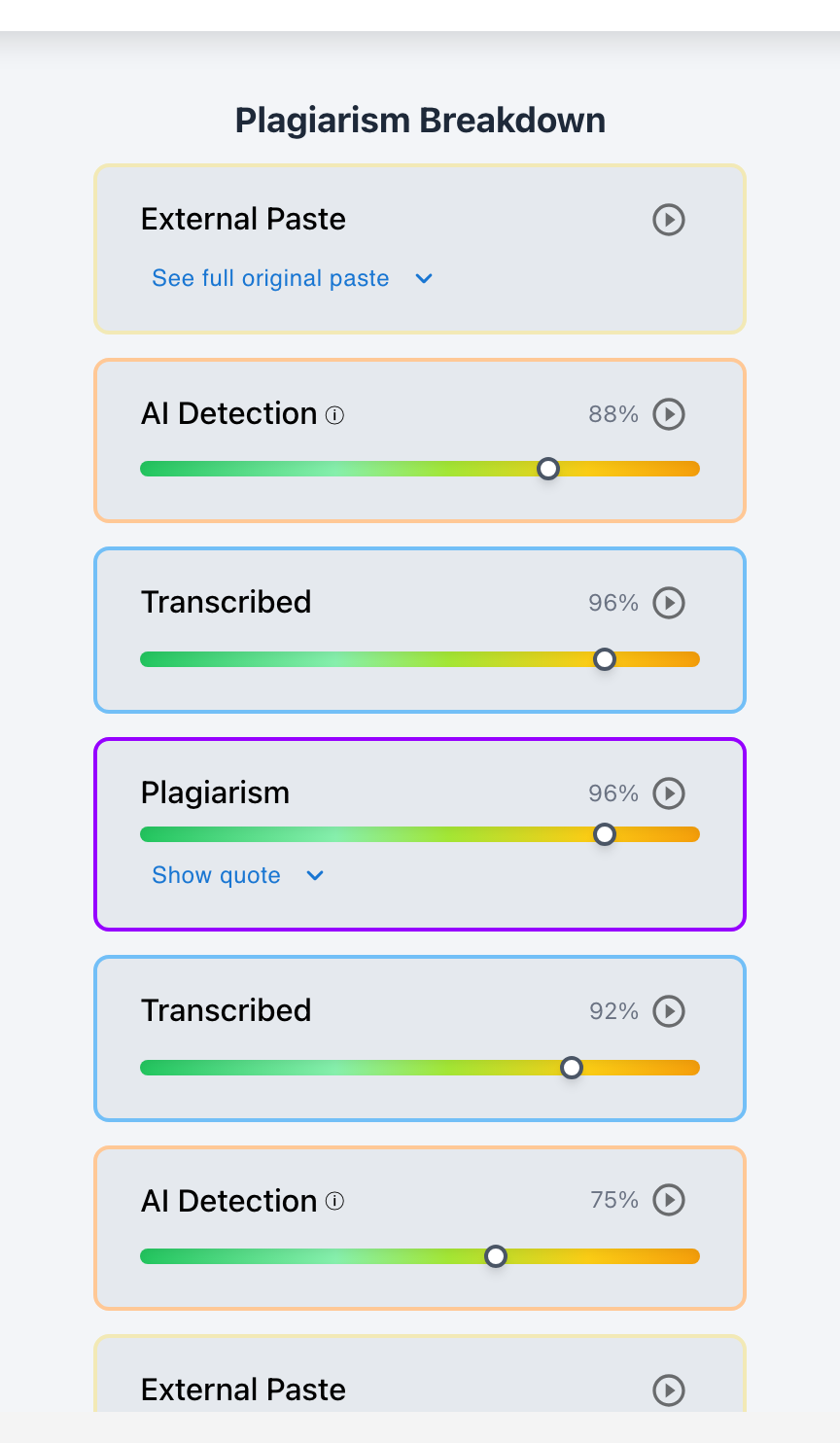
Schools can track repeat academic integrity violations across courses and semesters by deploying Checkmark Plagiarism's Centralized Recidivism Tracking Module: 1) Secure Student Integrity Profiles (consolidating multi-signal dossiers across English, History, and STEM); 2) Automated Multi-Course Recidivism Alerts (flagging when a student incurs a second verified incident in a different class); 3) Automated Tiered Sanction Progression (graduating from formative rewrites to formal Dean referrals); and 4) Restorative Resolution Audits.
One of the largest structural blind spots in secondary and higher education is the "Siloed First-Offense Loophole." A student might use ChatGPT to write a paper in English in October, copy a peer's essay in History in December, and paste an AI lab report in Biology in March. In each instance, the individual teacher assumes it is an isolated "first offense" and issues a lenient warning. The student never receives the comprehensive intervention required to break the habit. Centralized cross-course recidivism tracking closes this loophole, ensuring consistent accountability while supporting restorative learning.
Below is a comprehensive guide for academic deans, principals, and honor councils on managing longitudinal integrity tracking.
Checkmark Plagiarism powers recidivism tracking by pairing AI detection with essay writing playback, plagiarism detection, autograding, and integrations with Canvas and Google Classroom.
The 4 Pillars of Centralized Recidivism Tracking
1. Centralized Student Integrity Profiles
Consolidates verified incident dossiers, writing telemetry logs, and conference notes into a secure, FERPA-compliant profile accessible only to authorized administrators.
2. Automated Multi-Course Recidivism Alerts
When a teacher submits a verified incident dossier, Checkmark automatically alerts the Academic Dean if prior verified incidents exist in other courses.
3. Automated Tiered Sanction Routing
Automatically maps incidents to the school handbook's tiered discipline matrix (Tier 1: Formative; Tier 2: Dean Conference; Tier 3: Honor Board Hearing).
4. Restorative Resolution Tracking
Monitors when a student completes assigned writing integrity modules and verifies subsequent authentic drafting habits in writing playback.
How Restorative Tracking Helps Students Reform
Balancing firm institutional accountability with compassionate educational growth:
- Early Formative Intervention: Spotting a first-time shortcut early allows counselors and writing tutors to teach authentic research skills before habits become entrenched.
- Monitoring Post-Intervention Writing: After completing a restorative module, Checkmark Writing Playback tracks the student's next 3 assignments, visually confirming 3+ hours of active typing and healthy backspaces.
- Record Expungement Pathways: School policy can allow first-time restorative records to be sealed or expunged upon sustained demonstration of authentic scholarship over two semesters.
Read more in how Checkmark writing process analysis works.
Comparison: Siloed Teacher Notebooks vs. Checkmark Centralized Recidivism Tracking
Checkmark Centralized Tracking (Unified & Restorative)
- Cross-course visibility for academic deans and chairs.
- Automates tiered sanction escalation based on handbook.
- Tracks post-conference writing telemetry for recovery.
- Encrypted, FERPA-compliant administrative vault.
Siloed Teacher Notebooks (Fragmented & Blind)
- Incidents recorded only in personal teacher gradebooks.
- Students exploit the "perpetual first-offense" loophole.
- No longitudinal tracking of student writing recovery.
- Disciplinary decisions applied inconsistently across terms.
A 5-Step Leadership Protocol for Managing Repeat Violations
Recidivism Tracking & Intervention Checklist:
- 1. Require teachers to submit verified Stage 3 dossiers through the Checkmark Canvas integration.
- 2. The system queries the Centralized Integrity Registry: flags whether this is Incident 1, 2, or 3.
- 3. For Incident 1: assign the student a restorative writing module and require a supervised rewrite.
- 4. For Incident 2: convene a formal Dean-Parent-Student conference using the compiled multi-course dossier.
- 5. Monitor subsequent submissions in Checkmark Playback to verify healthy, multi-hour typing telemetry.
How Checkmark Plagiarism Powers Recidivism Oversight
Checkmark Plagiarism combines **AI detection, essay writing playback, static AI detection, plagiarism detection, autograding, and Canvas/Google Classroom integrations** to provide school leaders with secure, longitudinal integrity tracking that balances rigorous standards with student growth.
Frequently Asked Questions
Who has access to the Centralized Recidivism Registry?
Access is restricted strictly to authorized academic administrators, deans, and honor committee chairs to protect student FERPA privacy.
Can individual classroom teachers see a student's prior violations in other classes?
Standard policy maintains teacher confidentiality: classroom teachers see only their current course submissions, while the system alerts the Dean when repeat thresholds are reached.
What is the 'perpetual first-offense loophole'?
When different teachers handle cheating in isolation, a student can commit multiple violations across different subjects without facing escalating accountability.
How does Checkmark protect student records under FERPA?
Checkmark employs AES-256 encryption and role-based access control (RBAC) for all incident profiles.
How does Checkmark Plagiarism integrate with Canvas LMS?
Checkmark integrates via LTI 1.3, syncing incident dossiers directly with Canvas administrative reporting tools.
Can a student's record be expunged after reform?
Yes. Policies often allow first-offense records to be sealed after one academic year of verified authentic writing documented in Checkmark Playback.
What is a 'restorative academic integrity module'?
An interactive curriculum where students learn proper citation mechanics, ethical AI use, research synthesis, and time management skills.
How does writing playback prove student rehabilitation?
Playback visually confirms that the student is spending 3+ hours typing, drafting organically, and self-editing on subsequent essays.
How does Checkmark Autograder assist with repeat offenders?
Autograder benchmarks subsequent draft progressions, verifying genuine revision effort before releasing marks.
Why is centralized recidivism tracking essential for institutional integrity?
Because consistent, longitudinal oversight ensures fair accountability, eliminates favoritism, and provides students with the structured support needed for lifelong ethical scholarship.
Fostering Lifelong Ethical Growth
Academic discipline is not about punishment—it is about transformation. By utilizing Checkmark Plagiarism's centralized recidivism tracking, schools eliminate systemic loopholes, enforce clear tiered accountability, and guide students toward authentic, honorable scholarship that lasts a lifetime.
Checkmark Plagiarism supports this comprehensive approach with AI detection, essay writing playback, static AI detection, plagiarism detection, autograding, and integrations with Canvas and Google Classroom.
See how Checkmark tracks academic integrity recidivism and restorative interventions across Canvas courses. View a sample report or request a demonstration.