
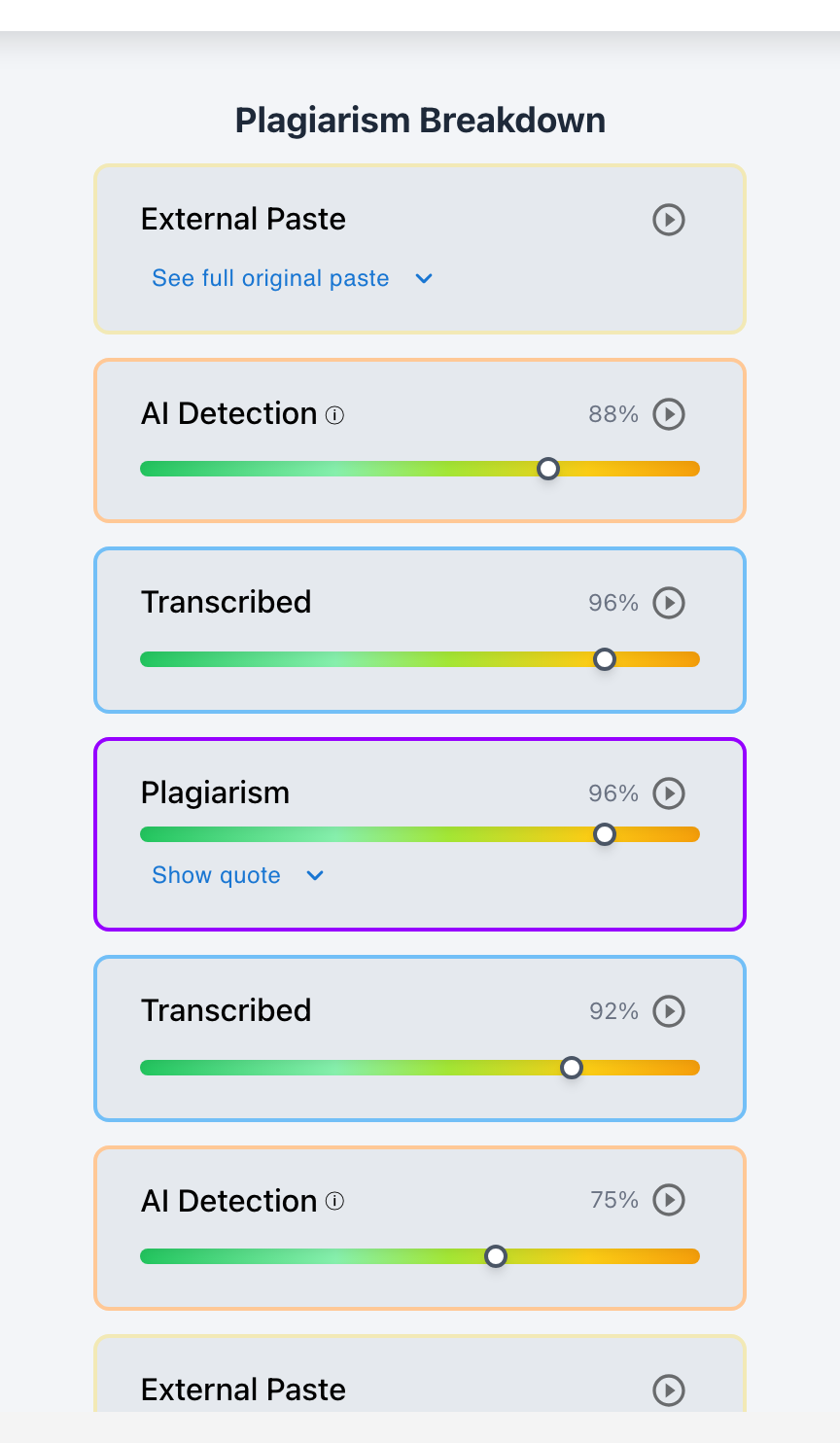
Schools can track AI writing trends across classes, departments, and grade levels by deploying an institutional analytics dashboard like Checkmark Analytics—which aggregates anonymized AI probability scores, clipboard paste volumes, active drafting hours, and revision rates across your entire LMS course catalog.
For school principals, curriculum directors, and district technology leaders, managing generative AI without systemic data is impossible. When teachers evaluate AI in isolation, administrators have no visibility into macro trends: Are 10th graders using ChatGPT more in English or History? Did the new AI disclosure policy lower unauthorized use? Are certain assignment types experiencing 60%+ paste rates? By consolidating integrity metrics into Checkmark's Academic Integrity Dashboard, school leaders gain actionable, macro-level insights to guide professional development and policy refinement.
Below is a comprehensive guide on tracking and analyzing school-wide AI writing trends.
Checkmark Plagiarism powers district-wide intelligence by pairing AI detection with essay writing playback, plagiarism detection, autograding, and integrations with Canvas and Google Classroom.
The 4 Macro Metrics Schools Must Track Across Classes
1. Departmental AI Probability Trends
Tracks average AI detection scores across subject areas (ELA, Social Studies, STEM), identifying which departments face the highest rates of synthetic text generation.
2. Grade-Level Clipboard Paste Volumes
Measures the percentage of total document words inserted via external clipboard pastes versus typed keystrokes across 9th through 12th grade cohorts.
3. Average Active Drafting Hours per Assignment
Monitors whether students are engaging in multi-hour drafting (3.5+ hrs) or completing major research essays in rapid 10-minute bursts.
4. Policy Compliance & Disclosure Rates
Tracks student self-reported AI disclosures against verified writing playback data to evaluate whether school AI policies are being followed.
How Institutional AI Tracking Informs Leadership Decisions
Tracking AI writing across classes allows administrators to move from reactive discipline to proactive instructional leadership:
- Targeted Professional Development: If 11th Grade US History shows a 45% AI rate while 11th Grade English shows 12%, curriculum leaders can help history teachers redesign prompts into AI-resistant, process-based assessments.
- Measuring Policy Effectiveness: Track longitudinal data before and after introducing a new AI code of conduct to measure its actual impact on student drafting behaviors.
- Ensuring Grading Equity: Ensure that strict and lenient teachers apply consistent, evidence-based standards across all sections of the same course.
Read more in how Checkmark writing process analysis works.
Comparison: Siloed Teacher Grading vs. School-Wide Analytics
Siloed Classroom Grading (Zero Visibility)
- Administrators have zero data on AI usage rates.
- Inconsistent disciplinary standards between teachers.
- No way to tell if school AI policies are working.
- Reactive handling of parent disputes and appeals.
Checkmark School-Wide Analytics (Actionable Data)
- Real-time dashboard tracking AI rates across all courses.
- Standardized multi-signal evidence for every department.
- Longitudinal metrics measuring policy effectiveness.
- Data-driven prompt design and teacher PD support.
A 5-Step Administrator Protocol for Tracking AI Across Classes
District AI Tracking Checklist:
- 1. Deploy Checkmark Plagiarism across all LMS courses via institutional LTI 1.3.
- 2. Open the Checkmark Administrative Dashboard to review department-level heatmaps.
- 3. Compare average active drafting time and backspace rates across course sections.
- 4. Identify assignment formats with high paste volumes to guide faculty prompt redesign.
- 5. Review quarterly integrity trends with department chairs to refine school AI guidelines.
How Checkmark Plagiarism Powers District-Wide Analytics
Checkmark Plagiarism combines **AI detection, essay writing playback, static AI detection, plagiarism detection, autograding, and Canvas/Google Classroom integrations** to provide school and district leaders with centralized, privacy-compliant intelligence.
Frequently Asked Questions
How can school principals see AI use trends across all classes?
Through the Checkmark Administrator Dashboard, which aggregates AI probability scores, paste percentages, and drafting hours across all LMS courses.
Is student data anonymized in administrative analytics?
Yes. Checkmark provides macro-level aggregated dashboards for department chairs and administrators while maintaining strict FERPA compliance and student privacy.
Can department chairs compare AI rates between different teachers?
Yes. Department heads can view course-level trends to ensure grading equity and identify courses that may need support in prompt redesign.
What is the most reliable metric for school-wide AI tracking?
Average active drafting hours combined with paste volume percentages provide the most reliable behavioral measurement of student writing effort.
How does tracking AI help improve assignment design?
When administrators see that generic summary essays have 70% paste rates while personal narrative reflections have 5%, they can coach teachers toward authentic tasks.
How does Checkmark Plagiarism integrate with Canvas LMS?
Checkmark provides district-wide LTI 1.3 deployment, SpeedGrader sidebar embeds, two-way grade passback, and centralized administrator dashboards.
Can schools track plagiarism and AI use separately?
Yes. Checkmark maintains independent metrics for web plagiarism, student-to-student copying, AI probability, and external clipboard paste events.
How can a school measure if its AI policy is working?
By monitoring whether average active drafting time increases, backspace rates normalize (15–30%), and wholesale paste events decrease over successive semesters.
Does Checkmark support multi-school district deployments?
Yes. Checkmark supports district-wide multi-tenant architectures, allowing superintendents to compare data across middle schools and high schools.
Why is school-wide tracking better than individual teacher vigilance?
Because systemic data enables proactive curriculum design, ensures equitable standards for all students, and removes the burden of isolated policing from teachers.
Data-Driven Leadership for the AI Era
Guiding a school through the generative AI transition requires transparent data, not guesswork. By aggregating multi-signal writing analytics across all classes, Checkmark Plagiarism empowers school leaders to build an equitable, informed, and future-ready academic culture.
Checkmark Plagiarism supports this comprehensive approach with AI detection, essay writing playback, static AI detection, plagiarism detection, autograding, and integrations with Canvas and Google Classroom.
See how Checkmark pairs institutional analytics with multi-signal detection to track AI writing trends across your school. View a sample report or request a demonstration.