
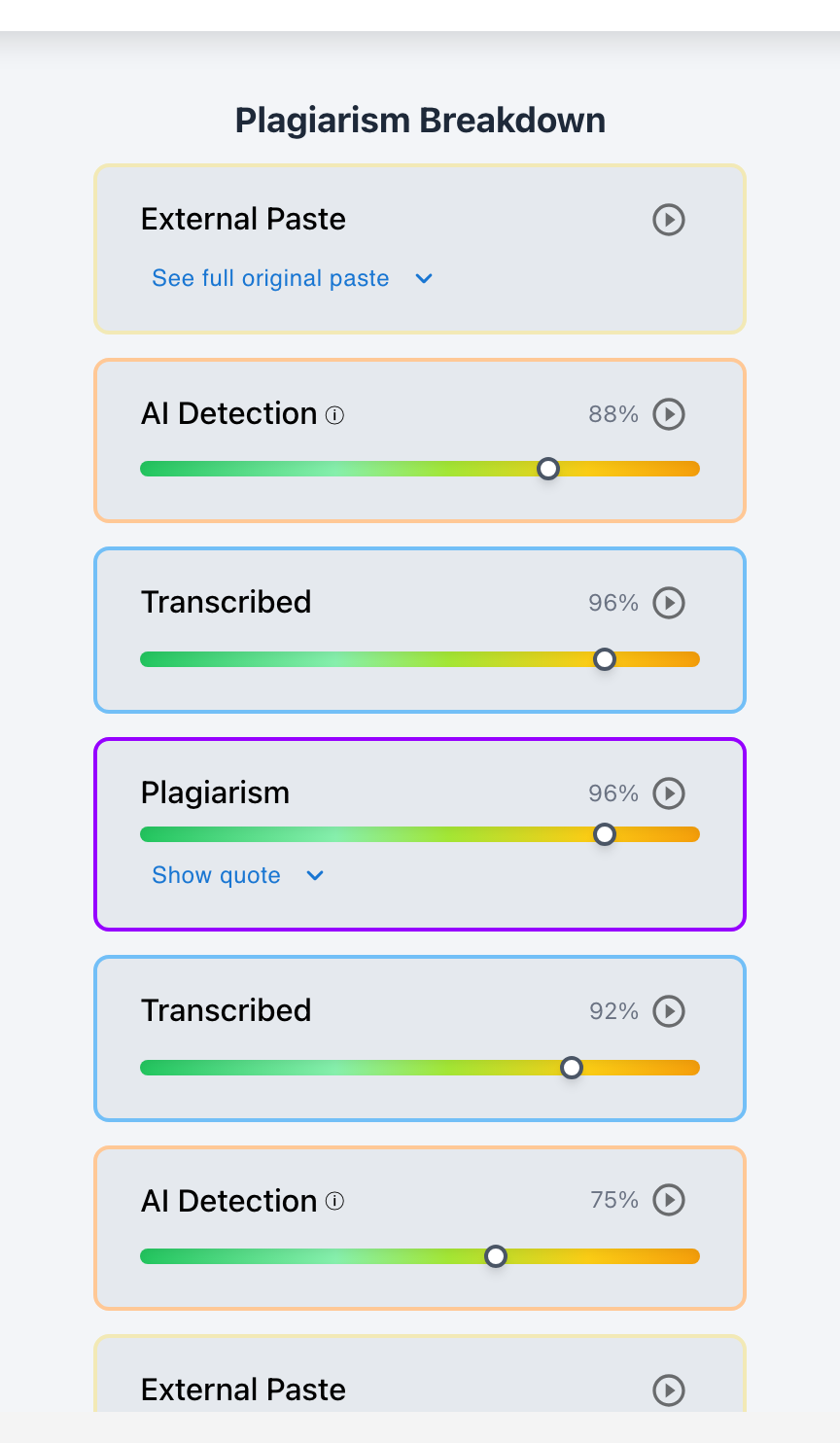
School administrators can identify courses with rising plagiarism rates by monitoring Checkmark's Course-Level Anomaly Dashboard—which flags statistical spikes in uncited similarity percentages, peer-to-peer repository matches, and abnormally low active drafting hours across individual course sections.
When plagiarism or AI shortcuts rise within a specific course, it is rarely the fault of a single teacher or class of students. Instead, rising integrity issues typically point to vulnerable assignment design: prompts that have circulated online for years, high-stakes deadlines without scaffolded checkpoints, or generic essay topics easily answered by commercial homework websites. By identifying course-level trends early, administrators and department chairs can provide targeted instructional support to help teachers redesign prompts into engaging, authentic tasks.
Below is a comprehensive guide on spotting course-level integrity anomalies and supporting faculty.
Checkmark Plagiarism powers course-level anomaly detection by pairing plagiarism detection with essay writing playback, AI detection, autograding, and integrations with Canvas and Google Classroom.
The 4 Indicators of Courses with Rising Integrity Issues
1. Spikes in Internal Peer-to-Peer Matches
Checkmark flags when 20%+ of submissions in a course match papers submitted by students in other periods or previous academic years.
2. Concentrated Homework Site Inflows
Highlights when a high percentage of matches originate from specific commercial study banks (e.g., Course Hero, Brainly, Quizlet, SparkNotes).
3. Abnormally Low Class Drafting Averages
Flags assignments where the class median active typing duration is under 15 minutes, indicating widespread external copy-pasting.
4. Baseline vs. Out-of-Class Divergence
Measures when an entire section's take-home essays diverge sharply in vocabulary and syntax from proctored in-class diagnostic baselines.
How Administrators Provide Supportive Faculty Interventions
Identifying rising plagiarism rates should lead to collaborative instructional coaching rather than punitive blame:
- Scaffolded Writing Checkpoints: Coach teachers to break massive 2,000-word essays into iterative milestones (topic pitch → annotated bibliography → first draft → final polish).
- Retiring Compromised Prompts: Help teachers retire legacy prompts that exist word-for-word on the web and replace them with local, contemporary, or multimodal case studies.
- Deploying Formative Autograding: Encourage teachers to use Checkmark Autograder for rapid first-draft diagnostics, reducing student anxiety and late-night panic cheating.
Read more in how Checkmark writing process analysis works.
Comparison: Reactive Discipline vs. Proactive Anomaly Detection
Reactive Discipline (Late & Adversarial)
- Administrators only find out after dozens of disciplinary referrals.
- Focuses on punishing individual students after the fact.
- Leaves compromised assignment prompts active for future years.
- Creates adversarial tension between teachers and students.
Checkmark Proactive Anomaly Detection (Supportive)
- Identifies course-level integrity spikes within 48 hours.
- Pinpoints root causes (vulnerable prompts, heavy deadlines).
- Provides department chairs with data to coach prompt redesign.
- Builds an institutional culture of authentic scholarship.
A 5-Step Administrator Protocol for Course Interventions
Course-Level Integrity Coaching Protocol:
- 1. Review the monthly Course Anomaly Heatmap in the Checkmark Admin Dashboard.
- 2. Identify specific courses exhibiting elevated peer matches or sub-15-minute drafting averages.
- 3. Schedule a supportive 1-on-1 coaching session with the instructor or course team.
- 4. Analyze the assignment prompt together: evaluate prompt circulation on Course Hero or ChatGPT.
- 5. Co-design a scaffolded, multi-draft assignment framework using Checkmark Autograder.
How Checkmark Plagiarism Powers Course Anomaly Detection
Checkmark Plagiarism combines **AI detection, essay writing playback, static AI detection, plagiarism detection, autograding, and Canvas/Google Classroom integrations** to give school leaders real-time visibility into course-level academic integrity trends.
Frequently Asked Questions
How do administrators spot courses with rising plagiarism rates?
Through Checkmark's Course Anomaly Dashboard, which flags statistical spikes in similarity percentages, peer matches, and low active drafting hours.
What usually causes plagiarism to spike in a specific course?
Spikes are usually caused by compromised legacy prompts that exist online, lack of scaffolded drafting checkpoints, or intense deadline stress.
Can department chairs see which websites students are copying from?
Yes. Checkmark aggregates the top external domains matched (e.g., Course Hero, Brainly, Quizlet) across each course section.
How does writing playback help identify course-level vulnerabilities?
If an entire class averages only 10 minutes of active drafting for a major essay, it indicates that the prompt structure encourages copy-pasting.
How can teachers redesign assignments to prevent plagiarism?
By using localized case studies, requiring personal reflections, mandating in-class research, and incorporating multi-draft submission cycles.
How does Checkmark Plagiarism integrate with Canvas LMS?
Checkmark provides district-wide LTI 1.3 deployment, SpeedGrader sidebar embeds, two-way grade passback, and centralized administrator dashboards.
Is student data kept confidential during course anomaly reviews?
Yes. Course-level analytics display aggregated trend data and anonymized distribution curves in full compliance with FERPA regulations.
How can Checkmark Autograder help reduce plagiarism in struggling courses?
By automating formative first-draft feedback, students receive rapid guidance within 24 hours, reducing late-night panic and the urge to cheat.
Can administrators track trends across different academic quarters?
Yes. Checkmark maintains longitudinal trend lines, allowing leaders to measure whether instructional coaching successfully lowered plagiarism rates.
Why is supportive coaching better than teacher blame?
Because assignment vulnerabilities are systemic design challenges; coaching teachers to create engaging, authentic tasks solves the problem permanently.
Transforming Data into Instructional Excellence
Spotting integrity trends early empowers school leaders to support teachers and inspire students. By using Checkmark Plagiarism to identify course-level anomalies, administrators can replace vulnerable assignments with authentic, rewarding writing experiences across every classroom.
Checkmark Plagiarism supports this comprehensive approach with AI detection, essay writing playback, static AI detection, plagiarism detection, autograding, and integrations with Canvas and Google Classroom.
See how Checkmark pairs course anomaly analytics with multi-signal detection to identify integrity trends across your school. View a sample report or request a demonstration.