
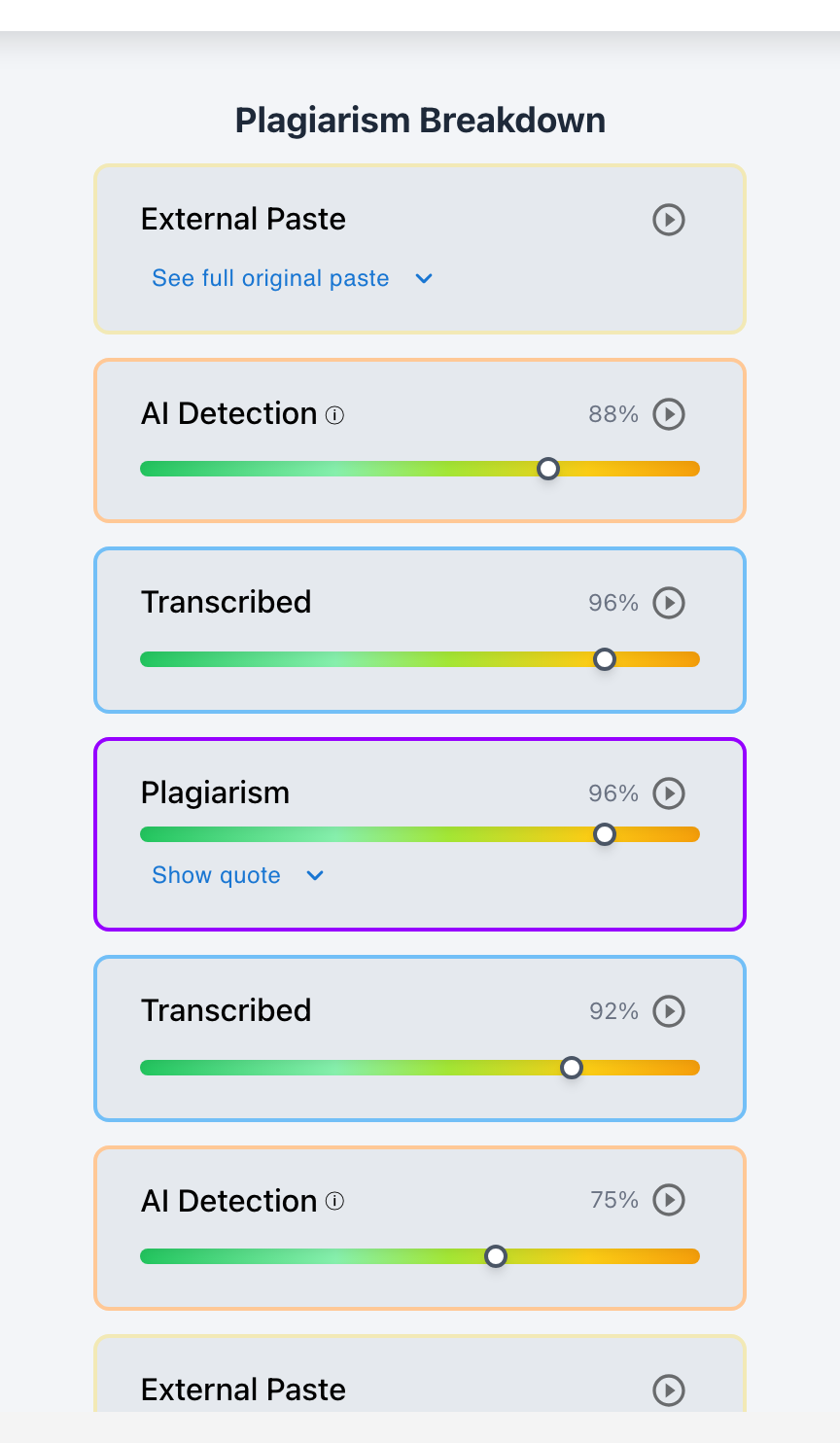
A school can tell whether its AI policy is working by analyzing empirical writing process data—specifically monitoring whether active drafting hours are increasing, wholesale paste events are declining, voluntary AI disclosures are rising, and false accusation disputes are dropping to near-zero.
Most schools have drafted an official Artificial Intelligence Code of Conduct. However, having a policy written in the student handbook is meaningless if administrators cannot measure its real-world impact. Are students actually following disclosure rules? Has the policy shifted student habits from copy-pasting to authentic drafting? Are teachers applying the policy consistently? By tracking behavioral telemetry through Checkmark Analytics, school leaders can objectively evaluate policy effectiveness with hard data rather than speculation.
Below is a comprehensive framework for measuring and auditing your school's AI policy.
Checkmark Plagiarism powers policy auditing by pairing AI detection with essay writing playback, plagiarism detection, autograding, and integrations with Canvas and Google Classroom.
The 4 Empirical Signs of an Effective School AI Policy
1. Active Drafting Hours Normalize
Average active keyboard time for major essays increases from 20 minutes to 3.5+ hours, proving that students are engaging in genuine writing effort.
2. Wholesale Paste Inflows Decline
The percentage of essays populated via instant 1-second clipboard pastes drops significantly quarter-over-quarter as students learn that shortcuts are transparent.
3. Transparent AI Disclosures Increase
Students openly document permissible AI use (e.g., brainstorming or outlining) in standardized assignment disclosures rather than attempting to hide it.
4. Disciplinary Appeals Drop to Near-Zero
Because decisions are grounded in Essay Playback rather than isolated probability scores, wrongful accusations and parent disputes are virtually eliminated.
Why Policy Success Requires Behavioral Telemetry
Surveys and anecdotal reports cannot accurately measure AI policy compliance:
- The Self-Reporting Bias: In anonymous student surveys, students routinely under-report unauthorized AI use or claim total compliance.
- The Objective Ground Truth: Checkmark's writing playback analytics provide objective, unforgeable behavioral data across every LMS submission.
- Iterative Policy Refinement: If data reveals that 9th-grade summary assignments have high paste rates while 11th-grade research projects show high active drafting, administrators can adjust policy guidelines by grade level.
Read more in how Checkmark writing process analysis works.
Comparison: Ineffective AI Policy vs. Data-Driven AI Policy in Action
Ineffective AI Policy (Rules on Paper Only)
- Vague policy stating "AI is not permitted."
- Average drafting time remains under 15 minutes.
- High paste volumes across all departments.
- Frequent parent arguments over AI detector scores.
Effective AI Policy (Measured with Checkmark)
- Clear, tiered AI use and disclosure guidelines.
- Active drafting averages 3.8 hours with 22% backspaces.
- Wholesale paste events down 65% across the school.
- 100% of flagged cases resolved with playback proof.
A 5-Step Administrator Protocol for Auditing AI Policies
District AI Policy Audit Protocol:
- 1. Pull baseline drafting hours and paste rates from Checkmark Analytics prior to policy rollout.
- 2. Publish clear, tiered AI policies with explicit disclosure forms across all LMS courses.
- 3. Review quarterly integrity dashboards to track shifts in active drafting hours and paste rates.
- 4. Survey faculty and student councils to assess clarity and fairness of policy enforcement.
- 5. Adjust assignment guidelines and teacher PD based on departmental data at the end of the year.
How Checkmark Plagiarism Powers Policy Governance
Checkmark Plagiarism combines **AI detection, essay writing playback, static AI detection, plagiarism detection, autograding, and Canvas/Google Classroom integrations** to give school leaders the empirical evidence needed to guide institutional AI policy.
Frequently Asked Questions
How can a principal know if students are following the school AI policy?
By reviewing Checkmark Analytics to track whether active drafting hours are increasing and whether wholesale clipboard paste events are declining school-wide.
What is the most reliable sign that an AI policy is working?
A steady rise in active keyboard drafting hours (3+ hours per major essay) paired with healthy backspace revision rates (15–30%).
How does tracking paste volume help measure policy compliance?
When an AI policy is clear and transparently enforced, external clipboard text dumping drops significantly as students compose text directly.
Can students disclose AI use inside Checkmark?
Yes. Checkmark allows students to attach standardized AI disclosure statements explaining which AI tools were used for brainstorming or feedback.
How does policy tracking prevent parent disputes?
When inquiries are based on objective keystroke timelines rather than abstract AI detector scores, parents and students accept the findings without dispute.
How does Checkmark Plagiarism integrate with Canvas LMS?
Checkmark provides district-wide LTI 1.3 deployment, SpeedGrader sidebar embeds, two-way grade passback, and centralized administrator dashboards.
How often should a school audit its AI policy?
Schools should review integrity telemetry at the end of each semester and conduct an annual comprehensive policy review with department chairs.
Does an effective AI policy ban all AI use?
No. Modern effective policies define tiered boundaries—distinguishing between acceptable formative assistance (brainstorming) and unacceptable outsourcing.
Can department chairs view policy compliance by subject?
Yes. Checkmark provides granular dashboards that allow leaders to compare compliance and drafting habits across English, History, and Science.
Why is behavioral data better than student surveys?
Because behavioral data reflects actual physical drafting reality across thousands of submissions, eliminating survey dishonesty and bias.
Data-Driven Governance That Upholds Integrity
A policy is only as strong as your ability to measure its impact. By auditing student drafting habits and integrity telemetry with Checkmark Plagiarism, school leaders can ensure their AI policies nurture authentic learning, protect honesty, and inspire student growth.
Checkmark Plagiarism supports this comprehensive approach with AI detection, essay writing playback, static AI detection, plagiarism detection, autograding, and integrations with Canvas and Google Classroom.
See how Checkmark pairs policy analytics with multi-signal detection to measure AI policy effectiveness across your school. View a sample report or request a demonstration.