
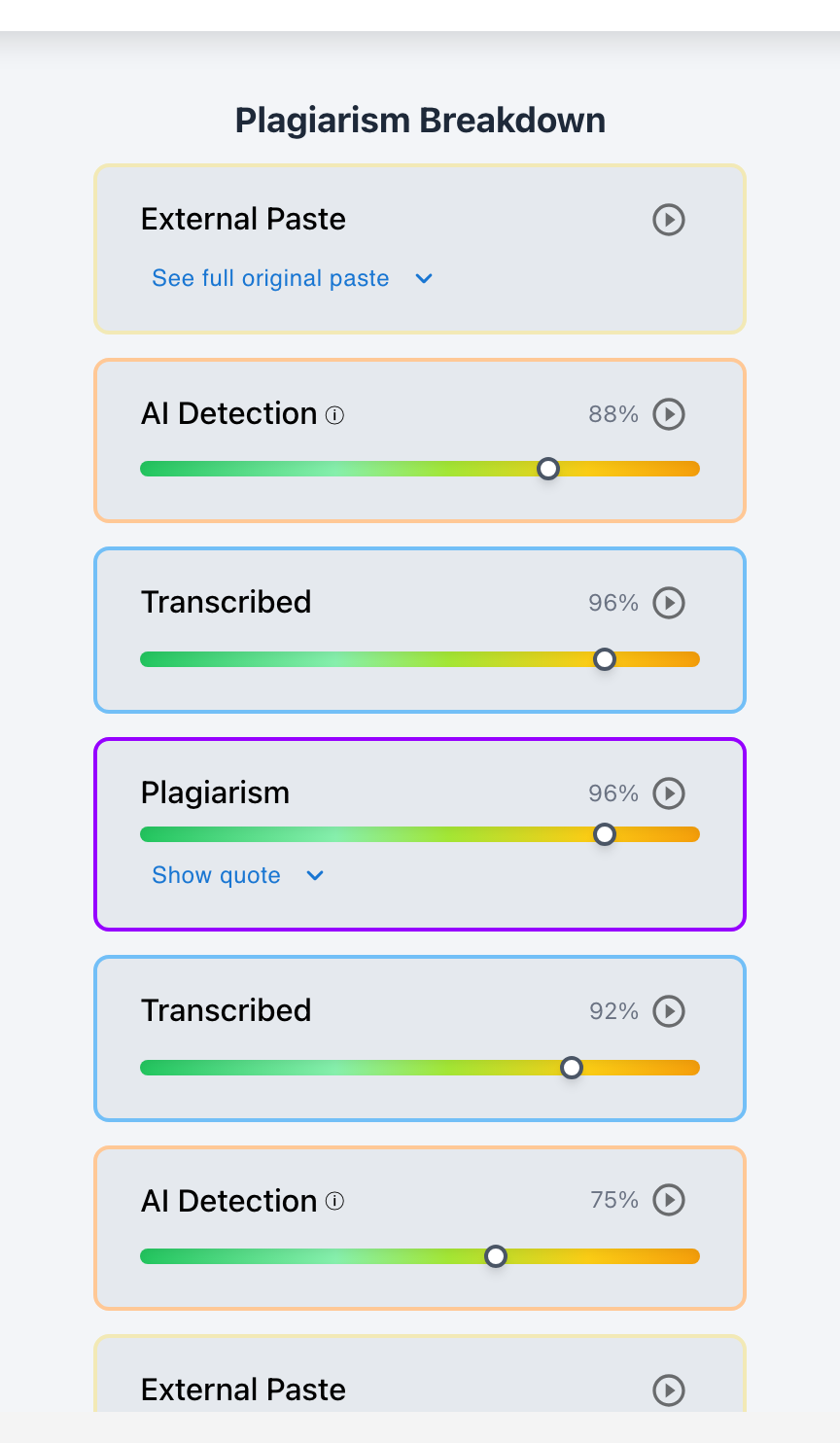
Schools can standardize AI investigations across teachers by establishing an institutional Multi-Signal Due Process Protocol—mandating that no student is penalized based on an AI percentage alone, and requiring that all faculty follow identical evidence-gathering steps, triage thresholds, and supportive conference frameworks using Checkmark Plagiarism.
One of the greatest risks facing modern schools is grading inconsistency: Teacher A sees a 45% AI score and immediately issues a zero without due process, while Teacher B across the hall sees an 85% AI score and ignores it completely. This wild divergence creates deep student cynicism, triggers contentious parent appeals, and exposes school districts to legal and administrative grievances. Establishing a standardized, school-wide investigation protocol ensures that every student is evaluated with equal fairness, transparent evidence, and rigorous due process.
Below is a complete institutional blueprint for standardizing AI writing investigations across your entire faculty.
Checkmark Plagiarism powers standardized investigations by pairing AI detection with essay writing playback, plagiarism detection, autograding, and integrations with Canvas and Google Classroom.
The 4 Pillars of a Standardized AI Investigation Protocol
1. Mandatory Multi-Signal Corroboration
District policy prohibits disciplinary actions based on AI scores alone. Faculty must corroborate alerts with Essay Playback drafting logs or citation audits.
2. Uniform 3-Tier Triage Matrix
Clear institutional thresholds: Low Risk (<20% → Grade normally), Moderate Review (20–50% → Quick playback check), High Inquiry (>50% → Multi-signal audit).
3. Standardized Conference Framework
All teachers use a shared, supportive inquiry script (asking students to define vocabulary and explain thesis evolution) rather than accusatory confrontations.
4. Centralized Evidence Dossier Archiving
All investigation artifacts (playback replays, paste logs, citation checks) are saved directly in Checkmark for seamless administrative and appeal review.
The Institutional 3-Tier Triage Matrix
To eliminate subjective teacher reactions, all faculty must apply the following uniform triage rules:
- Tier 1: Low Risk (0–20% AI Score): Normal grading workflow. No inquiry required unless an obvious external paste event is flagged.
- Tier 2: Moderate Review (20–50% AI Score): Teacher conducts a 30-second SpeedGrader playback review. If active typing exceeds 3 hours and backspaces exceed 15%, the paper is cleared immediately.
- Tier 3: High Inquiry (>50% AI Score + Low Process): If high AI scores coincide with <15 minutes of drafting or large paste events, the teacher initiates a formal supportive student conference.
Read more in how Checkmark writing process analysis works.
Comparison: Subjective Teacher Ad-Hoc Decisions vs. Standardized Protocol
Subjective Ad-Hoc Decisions (High Risk)
- Every teacher enforces different personal rules.
- Penalties issued based on unverified AI detector scores.
- High rate of false accusations and parent disputes.
- Damages student-teacher trust across the school.
Standardized School Protocol (Equitable & Defensible)
- Uniform triage thresholds for all faculty members.
- Mandatory multi-signal proof (playback + citations).
- Supportive, non-adversarial student dialogue scripts.
- Zero overturned appeals; total due process compliance.
A 5-Step Administrator Protocol for Protocol Rollout
Faculty Standardization Checklist:
- 1. Adopt the official District Multi-Signal Academic Integrity Policy.
- 2. Conduct a 45-minute faculty training on reviewing Checkmark Playback in Canvas SpeedGrader.
- 3. Distribute the 3-Tier Triage Matrix and student conference script to all teaching staff.
- 4. Require department chairs to review flagged cases using Checkmark centralized dossiers.
- 5. Review quarterly integrity metrics in the Admin Dashboard to ensure consistent enforcement.
How Checkmark Plagiarism Powers Faculty Standardization
Checkmark Plagiarism combines **AI detection, essay writing playback, static AI detection, plagiarism detection, autograding, and Canvas/Google Classroom integrations** to make standardizing AI investigations effortless, transparent, and completely consistent across all departments.
Frequently Asked Questions
Why is standardizing AI investigations critical for school districts?
Because inconsistent teacher enforcement leads to unfair penalties, student grievances, parent disputes, and potential legal challenges against the school.
What is the most important rule in a standardized AI protocol?
No student may be disciplined based solely on an AI percentage score; all accusations require corroborating process evidence (keystroke playback or citation audits).
How does the 3-tier triage matrix help teachers?
It removes subjective guesswork, telling teachers exactly what steps to take based on objective score ranges and writing process metrics.
What questions should teachers ask in a standardized AI conference?
Teachers should ask: "Can you walk me through how your thesis evolved?", "What do you mean by [specific term]?", and "How did you find this cited source?"
How does writing playback ensure equity across classrooms?
Playback provides the same objective physical creation proof for every student, regardless of whether their teacher is strict or lenient.
How does Checkmark Plagiarism integrate with Canvas LMS?
Checkmark provides district-wide LTI 1.3 deployment, SpeedGrader sidebar embeds, two-way grade passback, and centralized administrator dashboards.
Can students appeal an integrity decision using Checkmark?
Yes. Students and parents have access to their writing playback timelines and document version histories to provide objective proof of original work.
How long does a standardized investigation take?
With Checkmark embedded in SpeedGrader, verifying writing history, checking citations, and concluding an inquiry takes under 3 minutes per case.
Does standardization protect teachers from parent pushback?
Yes. Teachers present concrete physical facts (video playback replays, active typing hours, and paste timestamps) backed by official district policy.
Why is supportive dialogue better than accusatory confrontation?
Because education is about mentorship; supportive conferences turn potential integrity issues into powerful learning moments about academic ethics.
Consistent, Equitable Integrity for Every Student
Every student deserves an academic environment where standards are clear, fair, and uniformly applied. By standardizing AI investigations with Checkmark Plagiarism, school leaders protect student due process, support teachers, and build an unshakeable culture of academic honesty.
Checkmark Plagiarism supports this comprehensive approach with AI detection, essay writing playback, static AI detection, plagiarism detection, autograding, and integrations with Canvas and Google Classroom.
See how Checkmark pairs standardized investigation protocols with multi-signal detection to ensure grading equity across your school. View a sample report or request a demonstration.