
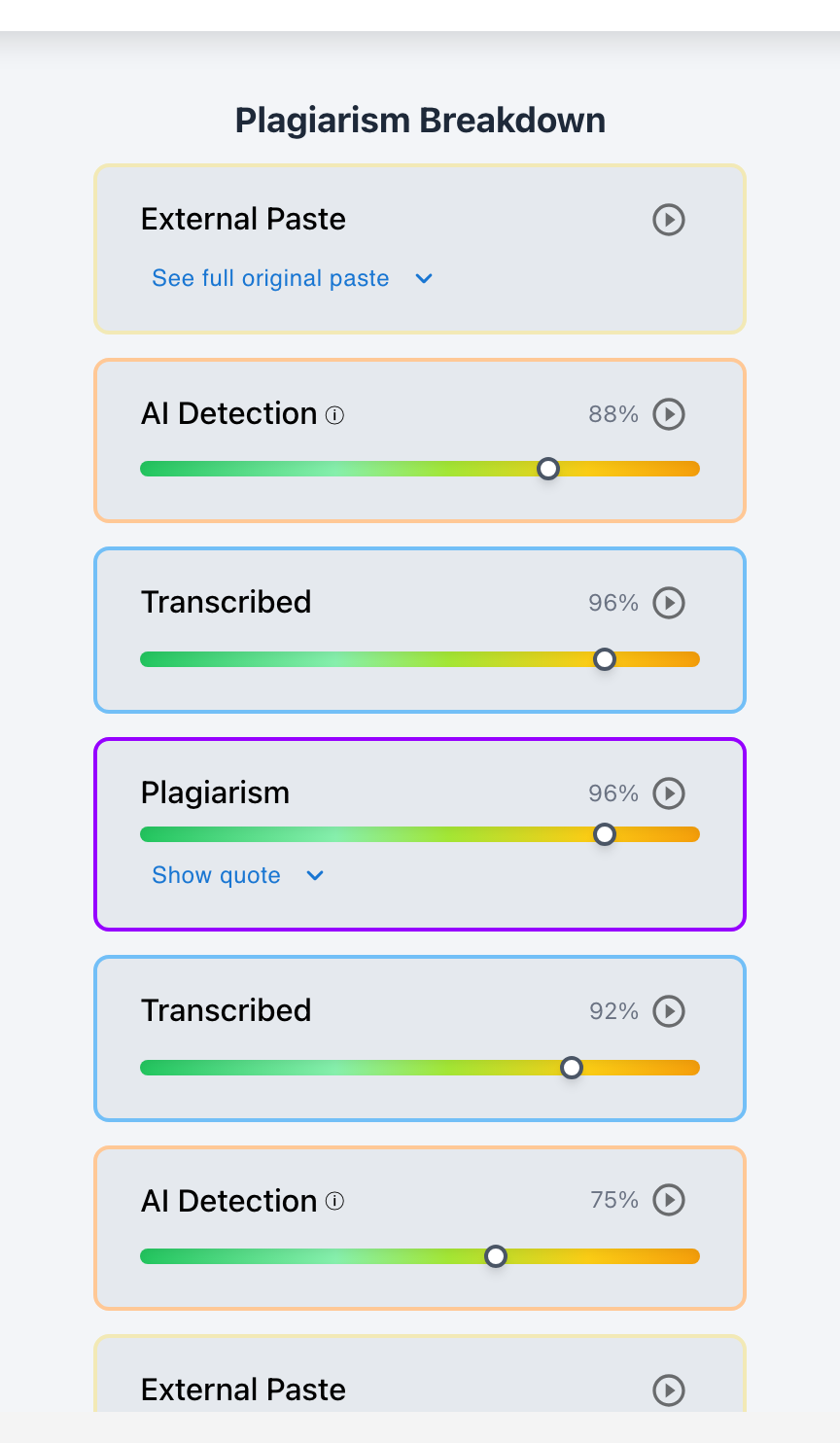
Schools can make AI investigations consistent across teachers by establishing four standardized institutional systems: 1) Deploying a single enterprise platform (Checkmark Plagiarism) natively across all LMS courses; 2) Mandating the Uniform 3-Question Diagnostic Conference Script for all student conversations; 3) Requiring the same multi-signal evidence threshold (writing playback telemetry + citation checks) before issuing penalties; and 4) Routing all escalated cases through a centralized Academic Integrity Committee using standardized Checkmark PDF audit dossiers.
When AI investigations are left to individual teacher discretion, school culture suffers. Students perceive disciplinary actions as unfair or personality-driven: "Mr. Davis failed me because of an 80% score, but Ms. Clark down the hall didn't even check our essays with an AI tool!" Inconsistent investigations lead to bitter parental complaints, administrative reversals, and faculty frustration. Building an objective, repeatable investigation standard guarantees that every student across every grade level and department is evaluated with equal fairness, due process, and evidence rigor.
Below is a comprehensive guide for instructional leaders and administrators on achieving cross-faculty investigation consistency.
Checkmark Plagiarism enforces institutional consistency by pairing AI detection with essay writing playback, plagiarism detection, autograding, and integrations with Canvas and Google Classroom.
The 4 Systems for Cross-Faculty Consistency
1. Unified Enterprise Tool Deployment
Every faculty member uses Checkmark Plagiarism integrated into Canvas SpeedGrader, eliminating contradictory results from random third-party web checkers.
2. Standardized Conference Script
All teachers utilize the same 3 diagnostic questions during 1-on-1 check-ins, eliminating aggressive or subjective confrontations.
3. Objective Evidence Thresholds
School policy mandates that every teacher must verify writing playback duration and cited DOIs before escalating a suspicion.
4. Centralized Dossier Escalations
All formal referrals require exporting the standardized Checkmark PDF audit dossier to the Honor Committee, creating a uniform evidentiary record.
The Uniform 3-Question Diagnostic Conference Script
Standardizing the student dialogue across all classrooms:
- Question 1 (The Core Idea): "Can you summarize the main argument of your third paragraph in your own words?" (Tests conceptual comprehension).
- Question 2 (Source Discovery): "How did you find this specific journal study cited in your second claim?" (Tests research authenticity vs. AI hallucination).
- Question 3 (The Process Walkthrough): "Let's open your writing playback together—can you walk me through the revisions you made here?" (Grounds the conversation in collaborative physical evidence).
Read more in how Checkmark writing process analysis works.
Comparison: Disjointed Teacher Inquiries vs. Checkmark Institutional Consistency
Checkmark Institutional Consistency (Fair & Aligned)
- Identical multi-signal criteria across all departments.
- Standardized, supportive student conference script.
- One-click exportable PDF dossiers for committees.
- Eliminates student perceptions of teacher bias.
Disjointed Teacher Inquiries (Chaotic & Inequitable)
- Each teacher invents their own detection thresholds.
- Hostile, unstructured student interrogations.
- Conflicting penalties for identical infractions.
- High volume of parental appeals and disputes.
A 5-Step Leadership Protocol for Establishing Consistency
Institutional Investigation Consistency Checklist:
- 1. Publish the standardized 4-stage investigation roadmap in faculty handbooks.
- 2. Deploy Checkmark Plagiarism enterprise-wide across Canvas LMS and Google Classroom.
- 3. Conduct a 45-minute faculty calibration workshop on the 3-Question Conference Script and writing playback.
- 4. Require standardized Checkmark PDF dossiers for all formal Honor Council referrals.
- 5. Review quarterly integrity analytics to identify departments requiring additional calibration support.
How Checkmark Plagiarism Powers Institutional Alignment
Checkmark Plagiarism combines **AI detection, essay writing playback, static AI detection, plagiarism detection, autograding, and Canvas/Google Classroom integrations** to provide schools with an automated, equitable, and standardized investigation framework.
Frequently Asked Questions
Why is a standardized conference script so important?
A standardized script ensures that every student is treated with respect, psychological safety, and pedagogical care, eliminating accusatory confrontations.
How does Checkmark prevent teachers from using uncalibrated web detectors?
By providing an enterprise tool natively embedded inside Canvas SpeedGrader, teachers have zero need or incentive to use external websites.
What if a teacher gives a zero without following the standardized process?
The school's academic integrity policy should require the grade to be vacated and reviewed under the standard multi-signal protocol.
How does Checkmark Plagiarism integrate with Canvas LMS?
Checkmark integrates via LTI 1.3, embedding consistent playback telemetry, AI heatmaps, and source cards in every teacher's SpeedGrader view.
Can department heads monitor how often teachers flag AI use?
Yes. Administrative dashboards display investigation rates across departments, helping leaders identify outlier grading patterns.
How does standardized documentation help in parental meetings?
Presenting a standardized PDF dossier containing writing playback videos and paste logs transforms emotional meetings into clear, objective discussions.
What if two teachers disagree on a student's penalty?
The case is reviewed by the Academic Honor Committee using the standardized Checkmark dossier to apply uniform handbook sanctions.
How does Checkmark Autograder support cross-teacher alignment?
Checkmark Autograder evaluates student submissions against department-approved rubrics with mathematical consistency, ensuring uniform grading standards.
Can students see the standardized investigation policy?
Yes. Publishing the investigation protocol in student handbooks demystifies the process, building trust and deterring misconduct.
Why is investigation consistency essential for school culture?
Because students thrive when they know that expectations, evaluations, and due process are applied with complete fairness across every classroom.
Equitable Due Process Across Every Classroom
Fairness is the bedrock of academic trust. By standardizing AI investigations across all faculty with Checkmark Plagiarism, school leaders eliminate arbitrary disparities, protect student due process, and foster an enduring culture of integrity and excellence.
Checkmark Plagiarism supports this comprehensive approach with AI detection, essay writing playback, static AI detection, plagiarism detection, autograding, and integrations with Canvas and Google Classroom.
See how Checkmark powers consistent institutional AI investigations across Canvas courses. View a sample report or request a demonstration.