
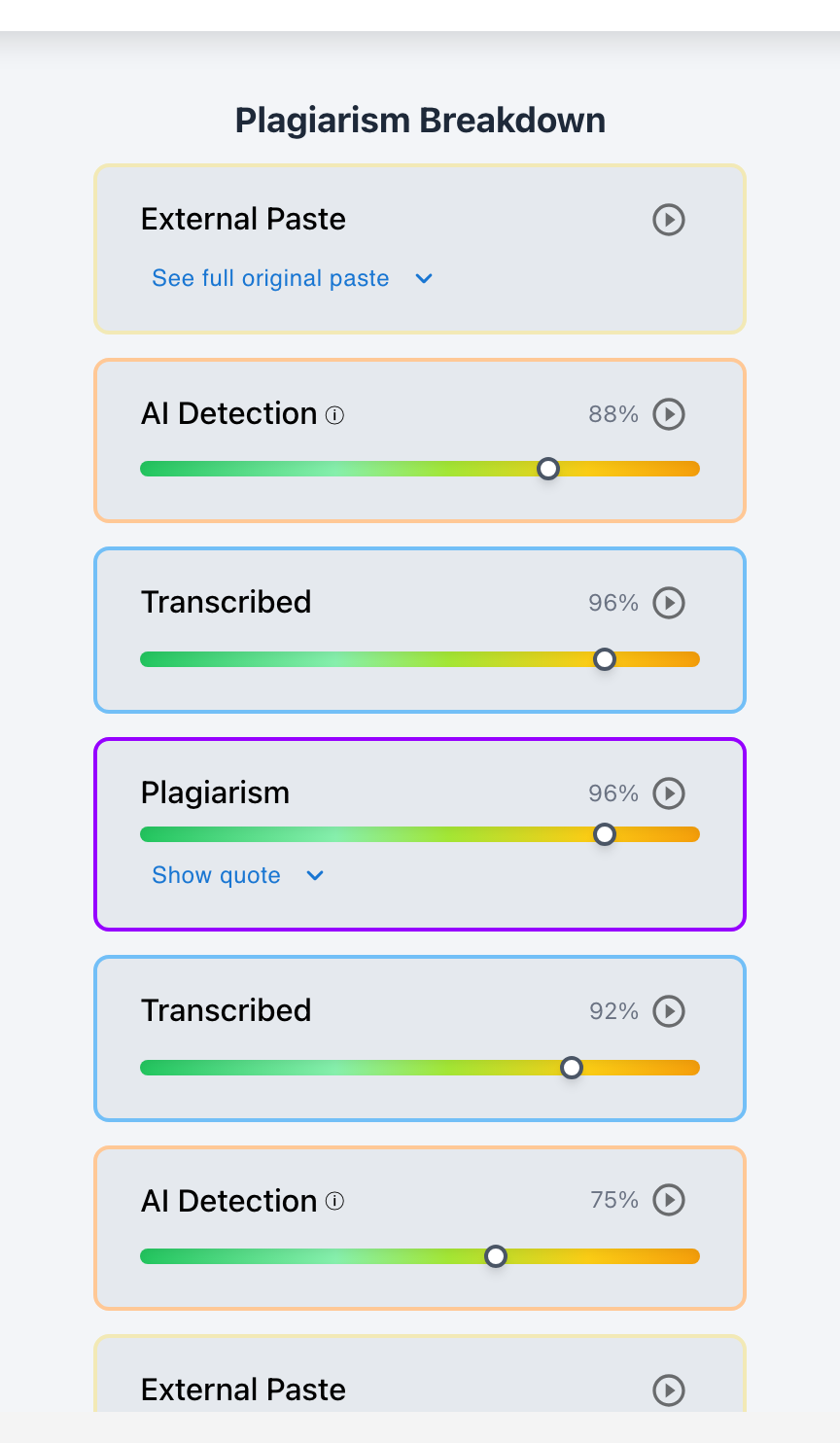
Schools detect reused student papers through four coordinated administrative and technological capabilities: centralized institutional repositories that securely index all historical student submissions across semesters, cross-departmental matching (which flags when a student reuses an AP History paper for an English assignment), writing playback telemetry (showing instant zero-drafting paste payloads), and longitudinal stylometric baseline tracking.
Assignment recycling is one of the most common forms of academic dishonesty in high schools and universities. Students reuse papers written by siblings, purchase old assignments from previous graduates, or commit "self-plagiarism" by submitting the same essay in two different courses without instructor permission. Because these papers never appear on open search engines like Google, basic web scrapers miss them completely. Checkmark Plagiarism provides district-wide institutional repository indexing that automatically cross-checks every submission against millions of historical student files in Canvas and Google Classroom.
Below is a comprehensive guide on how schools deploy systems to detect and prevent recycled student assignments.
Checkmark Plagiarism detects reused papers by pairing plagiarism detection with AI detection, essay writing playback, autograding, and integrations with Canvas and Google Classroom.
The 4 Technological Pillars for Catching Reused Papers
1. District-Wide Institutional Repositories
Every assignment submitted across all high schools or campus departments is indexed in an encrypted, searchable database accessible to all authorized faculty.
2. Cross-Departmental Match Alerts
When a student submits a paper in 12th grade English that matches an essay they wrote in 11th grade Social Studies, Checkmark alerts both instructors.
3. Keystroke Telemetry & Playback
Checkmark Playback records active drafting hours, backspaces, and clipboard events—instantly exposing when a completed external file is pasted into the LMS editor.
4. Semantic Concept & Structural Matching
If a student attempts to disguise an old paper by swapping synonyms or rearranging paragraphs, Checkmark's Semantic Engine still flags the structural match.
Why District-Wide Repositories Outperform Public Web Checkers
Understanding why internal institutional memory is essential for schools:
- The Offline Cheating Loophole: Over 70% of student-to-student paper sharing happens through offline file transfers, AirDrop, USB drives, or shared cloud folders that public search engines cannot crawl.
- Automated Ingestion on Submission: Every time a student turns in an essay in Canvas, Checkmark indexes the document within seconds—instantly protecting it from being reused by other students.
- FERPA-Compliant Architecture: Student data is stored in isolated, encrypted institutional partitions, preventing unauthorized exposure of student personally identifiable information (PII).
Read more in how Checkmark writing process analysis works.
Comparison: Public Web Checker vs. Checkmark Institutional Repository
Checkmark Institutional Repository (Comprehensive)
- Indexes all past student submissions across semesters.
- Flags cross-departmental and cross-school paper reuse.
- Pairs text matches with keystroke writing playback.
- Complete FERPA compliance with encrypted storage.
Public Web Checkers (Incomplete Coverage)
- Only scans public websites, Wikipedia, and blogs.
- Completely blind to offline student file sharing.
- Cannot detect papers passed between siblings or friends.
- Zero visibility into drafting duration or paste history.
A 5-Step Administrative Protocol for Reused Paper Prevention
Reused Paper Prevention Checklist:
- 1. Configure Checkmark Plagiarism at the district LMS level (Canvas or Google Classroom).
- 2. Enable automatic ingestion into the school's Institutional Repository for all written assignments.
- 3. Set cross-departmental matching alerts for high school and university courses.
- 4. Require department chairs to review the Assignment Integrity Analytics dashboard each term.
- 5. Use Writing Playback telemetry during academic appeal hearings to provide unassailable digital evidence.
How Checkmark Plagiarism Powers District-Wide Integrity
Checkmark Plagiarism combines **AI detection, essay writing playback, static AI detection, plagiarism detection, autograding, and Canvas/Google Classroom integrations** to maintain secure, multi-year institutional repositories that protect schools against assignment recycling.
Frequently Asked Questions
What is self-plagiarism in student writing?
Self-plagiarism occurs when a student submits an assignment (or significant portion of an assignment) that they already completed for a previous course without instructor permission.
Can Checkmark detect when a student reuses a paper across two different classes?
Yes. Checkmark cross-matches submissions across all courses and departments in the school, alerting teachers if a paper was submitted elsewhere.
Does the institutional repository store student names publicly?
No. Checkmark protects student privacy under FERPA by encrypting student identifiers and displaying match reports only to authorized instructors.
What if a student changes every third word in an old paper?
Checkmark's Semantic Matching Engine detects matching paragraph structures, evidence arguments, and thesis phrasing even when words are modified.
How does writing playback support institutional repository audits?
Playback proves that the current student did not draft the paper organically, showing a 0.05-second clipboard paste payload with zero editing time.
How does Checkmark Plagiarism integrate with Canvas LMS?
Checkmark provides certified LTI 1.3 integration, SpeedGrader sidebar embeds, two-way grade passback, and single sign-on (SSO).
Can administrators see plagiarism trends across different departments?
Yes. Checkmark's District Analytics Dashboard provides high-level metrics on similarity rates, peer sharing, and AI usage across all schools and subjects.
What should a teacher do when a reused paper is detected?
Review the Checkmark match report, verify the original submission date and author, and follow school policy regarding assignment recycling or collusion.
How long are papers stored in the school repository?
Schools can configure data retention policies according to district guidelines, typically retaining archives for 4 to 7 years to cover student cohorts.
Why is district-wide indexing essential for educational equity?
Because it ensures that all students are held to identical standards of original work and intellectual effort, regardless of who their older siblings or friends are.
Upholding Rigor and Originality Across the Entire District
Academic excellence is built on genuine student effort and discovery. By deploying district-wide institutional repositories and keystroke writing playback with Checkmark Plagiarism, educational leaders ensure that student papers cannot be recycled, fostering an equitable and honest learning community.
Checkmark Plagiarism supports this comprehensive approach with AI detection, essay writing playback, static AI detection, plagiarism detection, autograding, and integrations with Canvas and Google Classroom.
See how Checkmark pairs institutional repositories with multi-signal detection to catch reused student papers. View a sample report or request a demonstration.